Download high-resolution image Look inside
Listen to a clip from the audiobook
audio pause button
0:00
0:00

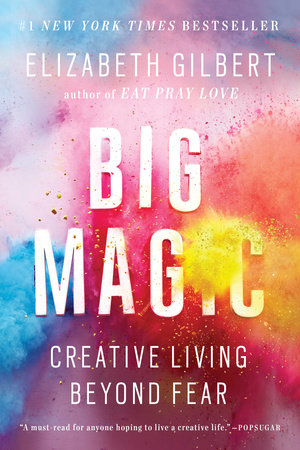
Big Magic

Creative Living Beyond Fear

Look inside
Listen to a clip from the audiobook
audio pause button
0:00
0:00
Best Seller
The instant #1 NEW YORK TIMES Bestseller

"A must read for anyone hoping to live a creative life... I dare you not to be inspired to be brave, to be free, and to be curious.” —PopSugar

From the worldwide bestselling author of Eat Pray Love and City of Girls: the path to the vibrant, fulfilling life you’ve dreamed of
.
 
Readers of all ages and walks of life have drawn inspiration and empowerment from Elizabeth Gilbert’s books for years. Now this beloved author digs deep into her own generative process to share her wisdom and unique perspective about creativity. With profound empathy and radiant generosity, she offers potent insights into the mysterious nature of inspiration. She asks us to embrace our curiosity and let go of needless suffering. She shows us how to tackle what we most love, and how to face down what we most fear. She discusses the attitudes, approaches, and habits we need in order to live our most creative lives. Balancing between soulful spirituality and cheerful pragmatism, Gilbert encourages us to uncover the “strange jewels” that are hidden within each of us. Whether we are looking to write a book, make art, find new ways to address challenges in our work,  embark on a dream long deferred, or simply infuse our everyday lives with more mindfulness and passion, Big Magic cracks open a world of wonder and joy.
Once upon a time, there was a man named Jack Gilbert, who was not related to me—unfortunately for me.

Jack Gilbert was a great poet, but if you’ve never heard of him, don’t worry about it. It’s not your fault. He never much cared about being known. But I knew about him, and I loved him dearly from a respectful distance, so let me tell you about him.

Jack Gilbert was born in Pittsburgh in 1925 and grew up in the midst of that city’s smoke, noise, and industry. He worked in factories and steel mills as a young man, but was called from an early age to write poetry. He answered the call without hesitation. He became a poet the way other men become monks: as a devotional practice, as an act of love, and as a lifelong commitment to the search for grace and transcendence. I think this is probably a very good way to become a poet. Or to become anything, really, that calls to your heart and brings you to life.

Jack could’ve been famous, but he wasn’t into it. He had the talent and the charisma for fame, but he never had the interest. His first collection, published in 1962, won the prestigious Yale Younger Poets prize and was nominated for the Pulitzer. What’s more, he won over audiences as well as critics, which is not an easy feat for a poet in the modern world. There was something about him that drew people in and kept them captivated. He was handsome, passionate, sexy, brilliant on stage. He was a magnet for women and an idol for men. He was photographed for Vogue, looking gorgeous and romantic. People were crazy about him. He could’ve been a rock star.

Instead, he disappeared. He didn’t want to be distractedby too much commotion. Later in life he reported that he had found his fame boring—not because it was immoral or corrupting, but simply because it was exactly the same thing every day. He was looking for something richer, more textured, more varied. So he dropped out. He went to live in Europe and stayed there for twenty years. He lived for a while in Italy, a while in Denmark, but mostly he lived in a shepherd’s hut on a mountaintop in Greece. There, he contemplated the eternal mysteries, watched the light change, and wrote his poems in private. He had his love stories, his obstacles, his victories. He was happy. He got by somehow, making a living here and there. He needed little. He allowed his name to be forgotten.

After two decades, Jack Gilbert resurfaced and publishedanother collection of poems. Again, the literary world fellin love with him. Again, he could have been famous. Again,he disappeared—this time for a decade. This would be hispattern always: isolation, followed by the publication ofsomething sublime, followed by more isolation. He was likea rare orchid, with blooms separated by many years. Henever promoted himself in the least. (In one of the few interviewshe ever gave, Gilbert was asked how he thoughthis detachment from the publishing world had affected hiscareer. He laughed and said, “I suppose it’s been fatal.”)

The only reason I ever heard of Jack Gilbert was that, quite late in his life, he returned to America and—for motives I will never know—took a temporary teaching position in the creative writing department at the University of Tennessee, Knoxville. The following year, 2005, it happened that I took exactly the same job. (Around campus,they started jokingly calling the position “the Gilbert Chair.”) I found Jack Gilbert’s books in my office—the office that had once been his. It was almost like the room was still warm from his presence. I read his poems and was overcome by their grandeur, and by how much his writing reminded me of Whitman. (“We must risk delight,” he wrote. “We must have the stubbornness to accept our gladness in the ruthless furnace of this world.”)

He and I had the same surname, we’d held the same job, we had inhabited the same office, we had taught many ofthe same students, and now I was in love with his words; naturally enough, I became deeply curious about him. I asked around: Who was Jack Gilbert?

Students told me he was the most extraordinary man they’d ever encountered. He had seemed not quite of this world, they said. He seemed to live in a state of uninterrupted marvel, and he encouraged them to do the same. He didn’t so much teach them how to write poetry, they said, but why: because of delight. Because of stubborn gladness. He told them that they must live their most creative lives as a means of fighting back against the ruthless furnace of this world.

Most of all, though, he asked his students to be brave. Without bravery, he instructed, they would never be able to realize the vaulting scope of their own capacities. Without bravery, they would never know the world as richly as it longs to be known. Without bravery, their lives would remain small—far smaller than they probably wanted their lives to be.

I never met Jack Gilbert myself, and now he is gone—he passed away in 2012. I probably could’ve made it a personal mission to seek him out and meet him while he was living, but I never really wanted to. (Experience has taught me to be careful of meeting my heroes in person; it can be terribly disappointing.) Anyway, I quite liked the way he lived inside my imagination as a massive and powerful presence, built out of his poems and the stories I’d heard about him. So I decided to know him only that way—through my imagination. And that’s where he remains for me to this day: still alive inside me, completely internalized, almost as though I dreamed him up.

But I will never forget what the real Jack Gilbert told somebody else—an actual flesh-and-blood person, a shy University of Tennessee student. This young woman recounted to me that one afternoon, after his poetry class, Jack had taken her aside. He complimented her work, then asked what she wanted to do with her life. Hesitantly, she admitted that perhaps she wanted to be a writer.

He smiled at the girl with infinite compassion and asked, “Do you have the courage? Do you have the courage to bring forth this work? The treasures that are hidden inside you are hoping you will say yes.”

So this, I believe, is the central question upon which all creative living hinges: Do you have the courage to bring forth the treasures that are hidden within you?

Look, I don’t know what’s hidden within you. I have no way of knowing such a thing. You yourself may barely know, although I suspect you’ve caught glimpses. I don’t know your capacities, your aspirations, your longings, your secret talents. But surely something wonderful is sheltered inside you. I say this with all confidence, because I happen to believe we are all walking repositories of buried treasure.I believe this is one of the oldest and most generous tricks the universe plays on us human beings, both for its own amusement and for ours: The universe buries strange jewels deep within us all, and then stands back to see if we can find them.

The hunt to uncover those jewels—that’s creative living.

The courage to go on that hunt in the first place—that’s what separates a mundane existence from a more enchanted one.

The often surprising results of that hunt—that’s what I call Big Magic.
Praise for Big Magic

The instant #1 New York Times Bestseller


Big Magic is a celebration of a creative life…Gilbert’s love of creativity is infectious, and there’s a lot of great advice in this sunny book…Gilbert doesn’t just call for aspiring artists to speak their truth, however daffy that may appear to others; she is showing them how.” Washington Post

"In [Gilbert’s] first foray into full-on self-help [she] shares intimate glimpses into the life of a world-famous creative, complete with bouts of paralyzing fear and frustration, in an attempt to coax the rest of us into walking through the world just a little bit braver.” Elle

“Elizabeth Gilbert is my new spirit animal… I have profoundly changed my approach to creating since I read this book." —Huffington Post

“Gilbert leads readers through breaking out of their own creative ruts, finding fulfillment, and facing fear while finding balance between our spiritual and pragmatic beings in her forth coming book. Yes, please.” Bustle

“Will resonate with writers and artists who find the process of producing work to be particularly painful…Through anecdotes about her creative failures and resourcefulness, as well as those other artists, Gilbert encourages readers to pursue a creative life ‘that is driven more strongly by curiosity than by fear.'" Daily Beast

"Gilbert demystifies the creative process, examining the practices of great artists to shed light on finding inspiration in the every day.” Harper’s Bazaar

“Tackles the challenges of living the creative life…Reading it is a little like having a coach by your side, cheering on your efforts – whatever they are – candidly and selflessly.” –Christian Science Monitor

“Gilbert [writes] with sincerity and humility about the joy that creativity has given her... you’ll love Big Magic.” Minneapolis Star-Tribune

Big Magic wants to help its readers live creatively…[Gilbert believes] creativity is inside all of us, it should be expressed, and it is not selfish or crazy or foolish to do so – it is in fact the best way to live a satisfying life...[Big Magic] constitutes good advice…[in a voice that’s] charming, personable, self-aware, jokey, conversational….[and] that Gilbert does so well.” New York Times Book Review

“A lucid and luminous inquiry into the relationship between human beings and the mysteries of the creative experience… What makes her book so immensely helpful is precisely its lived and living nature…wholly electrifying.” —Brainpickings

"Gilbert tackles heavy, sensitive subject matter but keeps it light, making what's essentially a self-help book feel like a good talk with a friend rather than a sermon." —Associated Press

“Transformative.” Flavorwire

“Gilbert’s trademark warmth and enthusiasm abounds...wise...[and] pointed." Boston Globe

“Part pat-on-the-back, part slap-in-the-face, [Big Magic is] a permission slip for readers to stop making excuses and get to work… a fresh and modern surprise that fans of her work will relish." —Wichita Eagle

“Funny. Insightful. Honest. Irreverent...But, of course, most of us have read Gilbert before and these qualities find their way into all of her works. The particular form of magic in Big Magic comes in a very unusual wrapping: hope and love...Big Magic read[s] like a devotional. Like a love letter to the earnest artist inside most of our hearts.” Books and Whatnot

“Distinctly refreshing." —TED Ideas Blog

Big Magic will leave you feeling inspired to be curious, brave, free, and, most of all, creative.” -Lauren Conrad

"Full of chatty advice, pep talks, amusing and inspiring stories...Gilbert’s idea of living creatively may incorporate touches of magic, but she’s practical in the extreme.” —Miami Herald

“In her signature conversational style, both sassy and serious, Gilbert invokes high- and low-brow cultural references and recommends we channel our inner trickster… [Her] manifesto is a book to read through quickly, and then start again to discover any big magic you may have missed.” – KMUW

“Gilbert will completely change the way you think about the creative process.”—Indienext

“The writing here is so friendly and funny that Gilbert’s perspective on creative living goes down like lemonade in summer." BookPage

“Whatever your artistic pursuit, you’ll nod in agreement as Elizabeth Gilbert reflects on the elusive, frustrating and sometimes comically strange process of creativity. Thoughtful and funny, Gilbert makes an excellent case for doing whatever it takes to unlock your inner artist and find more joy in life.” Woman's Day

“What Gilbert’s offering her fans…[is] permission to be creative…[She] is interested in the importance of creativity for the individual’s soul…When you hear the people who want to create, and the gratitude they feel toward [her], you can’t help feeling that she’s healed them—that she has, in fact, become the kind of guru she once sought.” —The New Yorker

"A must read for anyone hoping to live a creative life... I dare you not to be inspired to be brave, to be free, and to be curious.”PopSugar

“Gilbert offers helpful suggestions for outwitting writer’s block and perfectionism...and lets a tart sense of humor emerge." -Columbus Dispatch

"Some might call Elizabeth Gilbert by the name Queen Midas … Everything she touches seems to turn to gold. A rare gift, this book acknowledges difficulty, but empowers its readers to transcend it in the name of the beautiful mysteries of existence.” —WNC Woman Magazine

"Irresistible…If creativity is something you value highly—both in others and as fundamental to your own existence—you should find much to love in Big Magic, whether or not you typically gravitate toward creativity guides.” —Chapter 16

"A non-fiction tour-de force...pragmatic, rational, and wholly convincing." —Reader's Digest UK

“An empathetic and inspiring guide to mustering the courage to live a creative life. … Nearly anyone who picks up this self-help manual should finish it feeling inspired, even if only to dream of a life without limits.”Publisher's Weekly (starred review)

"Gilbert serves as an enthusiastic coach for readers who want more out of life. Highly recommended." —Library Journal (starred review)

“Gilbert’s wise and motivating book of encouragement and advice will induce readers not only to follow specific artistic dreams but also to live life more creatively, fully, and contentedly.” – Booklist

"The sincerity, grace, and flashes of humor that characterize [Gilbert’s] writing and insights should appeal to a wider audience…warmly inspirational.” —Kirkus
© Deborah Lopez
Elizabeth Gilbert is the author of nine previous works of fiction and nonfiction, which collectively have sold more than 25 million copies worldwide, spent more than two hundred weeks on the New York Times bestseller list, and been translated into more than fifty languages. She has been a finalist for the National Book Award, the National Book Critics Circle Award, and the PEN/Hemingway Award. With more than 20 million views of her TED Talk and 2.7 million followers on her social media accounts, she continues to be one of the most beloved and influential writers of our age. View titles by Elizabeth Gilbert

About

The instant #1 NEW YORK TIMES Bestseller

"A must read for anyone hoping to live a creative life... I dare you not to be inspired to be brave, to be free, and to be curious.” —PopSugar

From the worldwide bestselling author of Eat Pray Love and City of Girls: the path to the vibrant, fulfilling life you’ve dreamed of
.
 
Readers of all ages and walks of life have drawn inspiration and empowerment from Elizabeth Gilbert’s books for years. Now this beloved author digs deep into her own generative process to share her wisdom and unique perspective about creativity. With profound empathy and radiant generosity, she offers potent insights into the mysterious nature of inspiration. She asks us to embrace our curiosity and let go of needless suffering. She shows us how to tackle what we most love, and how to face down what we most fear. She discusses the attitudes, approaches, and habits we need in order to live our most creative lives. Balancing between soulful spirituality and cheerful pragmatism, Gilbert encourages us to uncover the “strange jewels” that are hidden within each of us. Whether we are looking to write a book, make art, find new ways to address challenges in our work,  embark on a dream long deferred, or simply infuse our everyday lives with more mindfulness and passion, Big Magic cracks open a world of wonder and joy.

Excerpt

Once upon a time, there was a man named Jack Gilbert, who was not related to me—unfortunately for me.

Jack Gilbert was a great poet, but if you’ve never heard of him, don’t worry about it. It’s not your fault. He never much cared about being known. But I knew about him, and I loved him dearly from a respectful distance, so let me tell you about him.

Jack Gilbert was born in Pittsburgh in 1925 and grew up in the midst of that city’s smoke, noise, and industry. He worked in factories and steel mills as a young man, but was called from an early age to write poetry. He answered the call without hesitation. He became a poet the way other men become monks: as a devotional practice, as an act of love, and as a lifelong commitment to the search for grace and transcendence. I think this is probably a very good way to become a poet. Or to become anything, really, that calls to your heart and brings you to life.

Jack could’ve been famous, but he wasn’t into it. He had the talent and the charisma for fame, but he never had the interest. His first collection, published in 1962, won the prestigious Yale Younger Poets prize and was nominated for the Pulitzer. What’s more, he won over audiences as well as critics, which is not an easy feat for a poet in the modern world. There was something about him that drew people in and kept them captivated. He was handsome, passionate, sexy, brilliant on stage. He was a magnet for women and an idol for men. He was photographed for Vogue, looking gorgeous and romantic. People were crazy about him. He could’ve been a rock star.

Instead, he disappeared. He didn’t want to be distractedby too much commotion. Later in life he reported that he had found his fame boring—not because it was immoral or corrupting, but simply because it was exactly the same thing every day. He was looking for something richer, more textured, more varied. So he dropped out. He went to live in Europe and stayed there for twenty years. He lived for a while in Italy, a while in Denmark, but mostly he lived in a shepherd’s hut on a mountaintop in Greece. There, he contemplated the eternal mysteries, watched the light change, and wrote his poems in private. He had his love stories, his obstacles, his victories. He was happy. He got by somehow, making a living here and there. He needed little. He allowed his name to be forgotten.

After two decades, Jack Gilbert resurfaced and publishedanother collection of poems. Again, the literary world fellin love with him. Again, he could have been famous. Again,he disappeared—this time for a decade. This would be hispattern always: isolation, followed by the publication ofsomething sublime, followed by more isolation. He was likea rare orchid, with blooms separated by many years. Henever promoted himself in the least. (In one of the few interviewshe ever gave, Gilbert was asked how he thoughthis detachment from the publishing world had affected hiscareer. He laughed and said, “I suppose it’s been fatal.”)

The only reason I ever heard of Jack Gilbert was that, quite late in his life, he returned to America and—for motives I will never know—took a temporary teaching position in the creative writing department at the University of Tennessee, Knoxville. The following year, 2005, it happened that I took exactly the same job. (Around campus,they started jokingly calling the position “the Gilbert Chair.”) I found Jack Gilbert’s books in my office—the office that had once been his. It was almost like the room was still warm from his presence. I read his poems and was overcome by their grandeur, and by how much his writing reminded me of Whitman. (“We must risk delight,” he wrote. “We must have the stubbornness to accept our gladness in the ruthless furnace of this world.”)

He and I had the same surname, we’d held the same job, we had inhabited the same office, we had taught many ofthe same students, and now I was in love with his words; naturally enough, I became deeply curious about him. I asked around: Who was Jack Gilbert?

Students told me he was the most extraordinary man they’d ever encountered. He had seemed not quite of this world, they said. He seemed to live in a state of uninterrupted marvel, and he encouraged them to do the same. He didn’t so much teach them how to write poetry, they said, but why: because of delight. Because of stubborn gladness. He told them that they must live their most creative lives as a means of fighting back against the ruthless furnace of this world.

Most of all, though, he asked his students to be brave. Without bravery, he instructed, they would never be able to realize the vaulting scope of their own capacities. Without bravery, they would never know the world as richly as it longs to be known. Without bravery, their lives would remain small—far smaller than they probably wanted their lives to be.

I never met Jack Gilbert myself, and now he is gone—he passed away in 2012. I probably could’ve made it a personal mission to seek him out and meet him while he was living, but I never really wanted to. (Experience has taught me to be careful of meeting my heroes in person; it can be terribly disappointing.) Anyway, I quite liked the way he lived inside my imagination as a massive and powerful presence, built out of his poems and the stories I’d heard about him. So I decided to know him only that way—through my imagination. And that’s where he remains for me to this day: still alive inside me, completely internalized, almost as though I dreamed him up.

But I will never forget what the real Jack Gilbert told somebody else—an actual flesh-and-blood person, a shy University of Tennessee student. This young woman recounted to me that one afternoon, after his poetry class, Jack had taken her aside. He complimented her work, then asked what she wanted to do with her life. Hesitantly, she admitted that perhaps she wanted to be a writer.

He smiled at the girl with infinite compassion and asked, “Do you have the courage? Do you have the courage to bring forth this work? The treasures that are hidden inside you are hoping you will say yes.”

So this, I believe, is the central question upon which all creative living hinges: Do you have the courage to bring forth the treasures that are hidden within you?

Look, I don’t know what’s hidden within you. I have no way of knowing such a thing. You yourself may barely know, although I suspect you’ve caught glimpses. I don’t know your capacities, your aspirations, your longings, your secret talents. But surely something wonderful is sheltered inside you. I say this with all confidence, because I happen to believe we are all walking repositories of buried treasure.I believe this is one of the oldest and most generous tricks the universe plays on us human beings, both for its own amusement and for ours: The universe buries strange jewels deep within us all, and then stands back to see if we can find them.

The hunt to uncover those jewels—that’s creative living.

The courage to go on that hunt in the first place—that’s what separates a mundane existence from a more enchanted one.

The often surprising results of that hunt—that’s what I call Big Magic.

Reviews

Praise for Big Magic

The instant #1 New York Times Bestseller


Big Magic is a celebration of a creative life…Gilbert’s love of creativity is infectious, and there’s a lot of great advice in this sunny book…Gilbert doesn’t just call for aspiring artists to speak their truth, however daffy that may appear to others; she is showing them how.” Washington Post

"In [Gilbert’s] first foray into full-on self-help [she] shares intimate glimpses into the life of a world-famous creative, complete with bouts of paralyzing fear and frustration, in an attempt to coax the rest of us into walking through the world just a little bit braver.” Elle

“Elizabeth Gilbert is my new spirit animal… I have profoundly changed my approach to creating since I read this book." —Huffington Post

“Gilbert leads readers through breaking out of their own creative ruts, finding fulfillment, and facing fear while finding balance between our spiritual and pragmatic beings in her forth coming book. Yes, please.” Bustle

“Will resonate with writers and artists who find the process of producing work to be particularly painful…Through anecdotes about her creative failures and resourcefulness, as well as those other artists, Gilbert encourages readers to pursue a creative life ‘that is driven more strongly by curiosity than by fear.'" Daily Beast

"Gilbert demystifies the creative process, examining the practices of great artists to shed light on finding inspiration in the every day.” Harper’s Bazaar

“Tackles the challenges of living the creative life…Reading it is a little like having a coach by your side, cheering on your efforts – whatever they are – candidly and selflessly.” –Christian Science Monitor

“Gilbert [writes] with sincerity and humility about the joy that creativity has given her... you’ll love Big Magic.” Minneapolis Star-Tribune

Big Magic wants to help its readers live creatively…[Gilbert believes] creativity is inside all of us, it should be expressed, and it is not selfish or crazy or foolish to do so – it is in fact the best way to live a satisfying life...[Big Magic] constitutes good advice…[in a voice that’s] charming, personable, self-aware, jokey, conversational….[and] that Gilbert does so well.” New York Times Book Review

“A lucid and luminous inquiry into the relationship between human beings and the mysteries of the creative experience… What makes her book so immensely helpful is precisely its lived and living nature…wholly electrifying.” —Brainpickings

"Gilbert tackles heavy, sensitive subject matter but keeps it light, making what's essentially a self-help book feel like a good talk with a friend rather than a sermon." —Associated Press

“Transformative.” Flavorwire

“Gilbert’s trademark warmth and enthusiasm abounds...wise...[and] pointed." Boston Globe

“Part pat-on-the-back, part slap-in-the-face, [Big Magic is] a permission slip for readers to stop making excuses and get to work… a fresh and modern surprise that fans of her work will relish." —Wichita Eagle

“Funny. Insightful. Honest. Irreverent...But, of course, most of us have read Gilbert before and these qualities find their way into all of her works. The particular form of magic in Big Magic comes in a very unusual wrapping: hope and love...Big Magic read[s] like a devotional. Like a love letter to the earnest artist inside most of our hearts.” Books and Whatnot

“Distinctly refreshing." —TED Ideas Blog

Big Magic will leave you feeling inspired to be curious, brave, free, and, most of all, creative.” -Lauren Conrad

"Full of chatty advice, pep talks, amusing and inspiring stories...Gilbert’s idea of living creatively may incorporate touches of magic, but she’s practical in the extreme.” —Miami Herald

“In her signature conversational style, both sassy and serious, Gilbert invokes high- and low-brow cultural references and recommends we channel our inner trickster… [Her] manifesto is a book to read through quickly, and then start again to discover any big magic you may have missed.” – KMUW

“Gilbert will completely change the way you think about the creative process.”—Indienext

“The writing here is so friendly and funny that Gilbert’s perspective on creative living goes down like lemonade in summer." BookPage

“Whatever your artistic pursuit, you’ll nod in agreement as Elizabeth Gilbert reflects on the elusive, frustrating and sometimes comically strange process of creativity. Thoughtful and funny, Gilbert makes an excellent case for doing whatever it takes to unlock your inner artist and find more joy in life.” Woman's Day

“What Gilbert’s offering her fans…[is] permission to be creative…[She] is interested in the importance of creativity for the individual’s soul…When you hear the people who want to create, and the gratitude they feel toward [her], you can’t help feeling that she’s healed them—that she has, in fact, become the kind of guru she once sought.” —The New Yorker

"A must read for anyone hoping to live a creative life... I dare you not to be inspired to be brave, to be free, and to be curious.”PopSugar

“Gilbert offers helpful suggestions for outwitting writer’s block and perfectionism...and lets a tart sense of humor emerge." -Columbus Dispatch

"Some might call Elizabeth Gilbert by the name Queen Midas … Everything she touches seems to turn to gold. A rare gift, this book acknowledges difficulty, but empowers its readers to transcend it in the name of the beautiful mysteries of existence.” —WNC Woman Magazine

"Irresistible…If creativity is something you value highly—both in others and as fundamental to your own existence—you should find much to love in Big Magic, whether or not you typically gravitate toward creativity guides.” —Chapter 16

"A non-fiction tour-de force...pragmatic, rational, and wholly convincing." —Reader's Digest UK

“An empathetic and inspiring guide to mustering the courage to live a creative life. … Nearly anyone who picks up this self-help manual should finish it feeling inspired, even if only to dream of a life without limits.”Publisher's Weekly (starred review)

"Gilbert serves as an enthusiastic coach for readers who want more out of life. Highly recommended." —Library Journal (starred review)

“Gilbert’s wise and motivating book of encouragement and advice will induce readers not only to follow specific artistic dreams but also to live life more creatively, fully, and contentedly.” – Booklist

"The sincerity, grace, and flashes of humor that characterize [Gilbert’s] writing and insights should appeal to a wider audience…warmly inspirational.” —Kirkus

Author

© Deborah Lopez
Elizabeth Gilbert is the author of nine previous works of fiction and nonfiction, which collectively have sold more than 25 million copies worldwide, spent more than two hundred weeks on the New York Times bestseller list, and been translated into more than fifty languages. She has been a finalist for the National Book Award, the National Book Critics Circle Award, and the PEN/Hemingway Award. With more than 20 million views of her TED Talk and 2.7 million followers on her social media accounts, she continues to be one of the most beloved and influential writers of our age. View titles by Elizabeth Gilbert
  • More Websites from
    Penguin Random House
  • Common Reads
  • Library Marketing