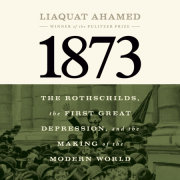
1873

The Rothschilds, the First Great Depression, and the Making of the Modern World

Author Liaquat Ahamed On Tour
Named a Most Anticipated Book of 2026 by Literary Hub

From the author of the Pulitzer Prize–winning Lords of Finance, a magnificent and timely reckoning with the first truly global financial calamity and the famous banking family at the center of the whirlwind


Over the course of the 1850s and 1860s, during the first era of globalization, the world experienced an unprecedented economic boom. Fueling this expansion was an explosion in the global bond market, at the hub of which stood one family—the Rothschilds, arguably the wealthiest banking family in history. While the giant sums of capital provided through the bond market built the railroads, the century’s most transformative investments, the money raised also unleashed a frenzy of speculation, massive overinvestment, and wasteful borrowing by governments.

With excessive euphoria leading to disappointed expectations, in the early 1870s the bubble burst. Stock markets from Vienna to New York crashed, and dozens of railroads and many governments defaulted. Financial officials responded by blundering into a precipitous remaking of the global currency system—exacerbating the ensuing economic collapse and setting the stage for decades of a punitive deflation that sparked waves of anti-globalist populism. As Liaquat Ahamed shows us in this enthralling history, the crisis of 1873 was, among other things, a death blow to Reconstruction in the United States and the proximate cause of the Ottoman Empire’s slow death spiral. Ironically, though the Rothschilds had presciently kept a low profile during the bubble, when the deluge came, they were viciously scapegoated as part of a wider hatred directed at “Jewish finance,” a strain of antisemitism that would come to full evil flower during the twentieth century.

1873 is a bird’s-eye reckoning with the full dimension of the crisis, from its buildup to its long aftermath. The Rothschilds and a cast of other witnesses give us the human perspective. And we have a brilliant financial historian’s grasp of the larger forces at play, resulting in a global narrative with thrilling explanatory power.
“[A]n eye-opening investigation of the ‘first truly significant global financial crisis.’ . . . Granular and deeply researched, it’s an essential new perspective on the link between capitalism’s boom and bust cycles and the emergence of reactionary political movements.” Publishers Weekly (starred review)

“Lively . . . An exemplary work of economic history, with many lessons for the present.” —Kirkus (starred review)

“Liaquat Ahamed has a unique ability to bring financial and monetary history to life. In this superb book, he weaves together the people, forces, and events that led to the global financial crisis of 1873 and then shaped its dire long-term consequences. Not least, he shows how a huge boom-and-bust cycle combined with the decision to make gold the sole monetary anchor, to create a first global ‘great depression.’” —Martin Wolf, author of The Crisis of Democratic Capitalism

“Pendulum shifts in the political economy happen slowly—and then all at once. In this fantastically readable history, Liaquat Ahamed shows us how frothy real estate markets, a burgeoning middle class, failing autocrats, a dodgy bond market, and other seemingly disparate forces eventually came together to produce the first global financial crisis of the modern era. It's a book that has all too much to tell us about our own time period; indeed, it provides both a warning and a roadmap for what might come next.” —Rana Foroohar, author of Homecoming and Don’t Be Evil

“With his readable prose and agile analysis, Liaquat Ahamed has a talent for telescoping huge financial fiascoes into compact and exciting books. 1873 describes how speculative mania and misguided monetary policy produced debt and deflation that shadowed the final decades of the 19th century. With its cast of colorful villains, this saga contains a wealth of sobering insights that ought to sound a warning in our own hyper-speculative era.” —Ron Chernow

“Liaquat Ahamed matches his earlier Lords of Finance with a page-turning saga of the world’s first international financial crisis. By pinpointing the essential characters, from the avaricious Jay Cooke in America to the Turkish sultan blowing his budget on a harem of two hundred women to the mysterious Rothschild banking clan, Ahamed makes 1873 seem as alive as today. And in his hands, it is. By confronting the question of what could topple economies across multiple time zones, this master writer comes again to the question of money, over a quarter-century in which prices spiraled out of control—not up, but down—sowing misery for the common man, especially in America. We read with fascination how Gilded Age bankers and statemen missed the yawning danger of deflation—and wonder if those in our time have yet to learn their lesson. A gripping read, Ahamed makes the crisis of 1873 both compelling and accessible.” —Roger Lowenstein, author of Ways and Means and Buffett

“The latest book from financial historian Ahamed, the author of the Pulitzer Prize–winning Lords of Finance, chronicles the first Great Depression, with special emphasis on the Rothschilds, providing ‘a bird’s-eye reckoning with the full dimension of the crisis, from its buildup to its long aftermath.’ Always relevant, and in 2026, it might just be even more so.” —Emily Temple, LitHub (Most Anticipated Books of 2026)

Liaquat Ahamed graduated with degrees in economics from Cambridge and Harvard, worked at the World Bank in Washington, D.C., and had a twenty-five career as a professional investment manager based in London and New York before turning to writing. His first book, Lords of Finance: The Bankers Who Broke the World, about the lead up to the 1929 Great Depression, won the Pulitzer Prize for History, the Council on Foreign Relations Arthur Ross Gold Medal, and the Financial Times Best Business Book of the Year Award. He is a trustee of the Putnam Funds, an adviser to the Rock Creek Group, and the Chair of the Sun Valley Writers’ Conference. He lives in Los Angeles and Washington, D.C. with his wife Meena. View titles by Liaquat Ahamed

About

Named a Most Anticipated Book of 2026 by Literary Hub

From the author of the Pulitzer Prize–winning Lords of Finance, a magnificent and timely reckoning with the first truly global financial calamity and the famous banking family at the center of the whirlwind


Over the course of the 1850s and 1860s, during the first era of globalization, the world experienced an unprecedented economic boom. Fueling this expansion was an explosion in the global bond market, at the hub of which stood one family—the Rothschilds, arguably the wealthiest banking family in history. While the giant sums of capital provided through the bond market built the railroads, the century’s most transformative investments, the money raised also unleashed a frenzy of speculation, massive overinvestment, and wasteful borrowing by governments.

With excessive euphoria leading to disappointed expectations, in the early 1870s the bubble burst. Stock markets from Vienna to New York crashed, and dozens of railroads and many governments defaulted. Financial officials responded by blundering into a precipitous remaking of the global currency system—exacerbating the ensuing economic collapse and setting the stage for decades of a punitive deflation that sparked waves of anti-globalist populism. As Liaquat Ahamed shows us in this enthralling history, the crisis of 1873 was, among other things, a death blow to Reconstruction in the United States and the proximate cause of the Ottoman Empire’s slow death spiral. Ironically, though the Rothschilds had presciently kept a low profile during the bubble, when the deluge came, they were viciously scapegoated as part of a wider hatred directed at “Jewish finance,” a strain of antisemitism that would come to full evil flower during the twentieth century.

1873 is a bird’s-eye reckoning with the full dimension of the crisis, from its buildup to its long aftermath. The Rothschilds and a cast of other witnesses give us the human perspective. And we have a brilliant financial historian’s grasp of the larger forces at play, resulting in a global narrative with thrilling explanatory power.

Reviews

“[A]n eye-opening investigation of the ‘first truly significant global financial crisis.’ . . . Granular and deeply researched, it’s an essential new perspective on the link between capitalism’s boom and bust cycles and the emergence of reactionary political movements.” Publishers Weekly (starred review)

“Lively . . . An exemplary work of economic history, with many lessons for the present.” —Kirkus (starred review)

“Liaquat Ahamed has a unique ability to bring financial and monetary history to life. In this superb book, he weaves together the people, forces, and events that led to the global financial crisis of 1873 and then shaped its dire long-term consequences. Not least, he shows how a huge boom-and-bust cycle combined with the decision to make gold the sole monetary anchor, to create a first global ‘great depression.’” —Martin Wolf, author of The Crisis of Democratic Capitalism

“Pendulum shifts in the political economy happen slowly—and then all at once. In this fantastically readable history, Liaquat Ahamed shows us how frothy real estate markets, a burgeoning middle class, failing autocrats, a dodgy bond market, and other seemingly disparate forces eventually came together to produce the first global financial crisis of the modern era. It's a book that has all too much to tell us about our own time period; indeed, it provides both a warning and a roadmap for what might come next.” —Rana Foroohar, author of Homecoming and Don’t Be Evil

“With his readable prose and agile analysis, Liaquat Ahamed has a talent for telescoping huge financial fiascoes into compact and exciting books. 1873 describes how speculative mania and misguided monetary policy produced debt and deflation that shadowed the final decades of the 19th century. With its cast of colorful villains, this saga contains a wealth of sobering insights that ought to sound a warning in our own hyper-speculative era.” —Ron Chernow

“Liaquat Ahamed matches his earlier Lords of Finance with a page-turning saga of the world’s first international financial crisis. By pinpointing the essential characters, from the avaricious Jay Cooke in America to the Turkish sultan blowing his budget on a harem of two hundred women to the mysterious Rothschild banking clan, Ahamed makes 1873 seem as alive as today. And in his hands, it is. By confronting the question of what could topple economies across multiple time zones, this master writer comes again to the question of money, over a quarter-century in which prices spiraled out of control—not up, but down—sowing misery for the common man, especially in America. We read with fascination how Gilded Age bankers and statemen missed the yawning danger of deflation—and wonder if those in our time have yet to learn their lesson. A gripping read, Ahamed makes the crisis of 1873 both compelling and accessible.” —Roger Lowenstein, author of Ways and Means and Buffett

“The latest book from financial historian Ahamed, the author of the Pulitzer Prize–winning Lords of Finance, chronicles the first Great Depression, with special emphasis on the Rothschilds, providing ‘a bird’s-eye reckoning with the full dimension of the crisis, from its buildup to its long aftermath.’ Always relevant, and in 2026, it might just be even more so.” —Emily Temple, LitHub (Most Anticipated Books of 2026)

Author

Liaquat Ahamed graduated with degrees in economics from Cambridge and Harvard, worked at the World Bank in Washington, D.C., and had a twenty-five career as a professional investment manager based in London and New York before turning to writing. His first book, Lords of Finance: The Bankers Who Broke the World, about the lead up to the 1929 Great Depression, won the Pulitzer Prize for History, the Council on Foreign Relations Arthur Ross Gold Medal, and the Financial Times Best Business Book of the Year Award. He is a trustee of the Putnam Funds, an adviser to the Rock Creek Group, and the Chair of the Sun Valley Writers’ Conference. He lives in Los Angeles and Washington, D.C. with his wife Meena. View titles by Liaquat Ahamed
  • More Websites from
    Penguin Random House
  • Common Reads
  • Library Marketing