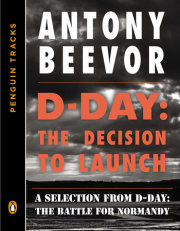
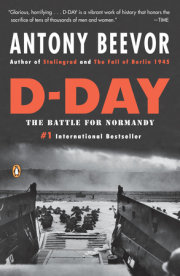
D-DAY: The Battle for Normandy is the first major account in more than twenty years to cover the invasion from June 6, 1944, up to the liberation of Paris on August 25. It is the first book to describe not only the experiences of the American, British, Canadian and German soldiers, but also the terrible suffering of the French caught up in the fighting. The Allied fleet was by far the largest amphibious assault ever attempted, and what followed was a battle as savage as anything seen on the Eastern Front. Even the joys of liberation had their darker side. The war in northern France marked not just a generation but the whole of the postwar world, profoundly influencing relations between America and Europe.
Beevor draws upon his research in more than thirty archives in six countries, going back to original accounts, interviews conducted by combat historians just after the action and many diaries and letters donated to museums and archives in recent years. D-Day: The Battle for Normandy will surely be hailed as the consummate account of the Normandy invasion and the ferocious offensive that led to the liberation of Paris.
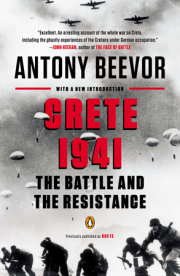
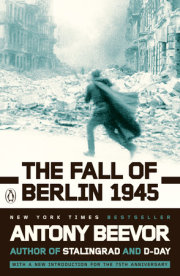
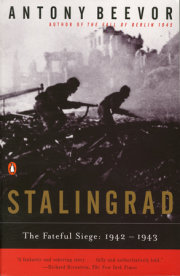
Antony Beevor was educated at Winchester and Sandhurst. A regular officer in the 11th Hussars, he served in Germany and England. He has published several novels, and his works of nonfiction include The Spanish Civil War; Crete: The Battle and the Resistance, which won the 1993 Runciman Award; Stalingrad: The Fateful Siege: 1942—1943; and Berlin: The Downfall, 1945. With his wife, Artemis Cooper, he wrote Paris: After the Liberation: 1944—1949. His book Stalingrad was awarded the Samuel Johnson Prize for Non-Fiction, the Wolfson History Prize, and the Hawthornden Prize in 1999.
View titles by Antony Beevor
D-DAY: The Battle for Normandy is the first major account in more than twenty years to cover the invasion from June 6, 1944, up to the liberation of Paris on August 25. It is the first book to describe not only the experiences of the American, British, Canadian and German soldiers, but also the terrible suffering of the French caught up in the fighting. The Allied fleet was by far the largest amphibious assault ever attempted, and what followed was a battle as savage as anything seen on the Eastern Front. Even the joys of liberation had their darker side. The war in northern France marked not just a generation but the whole of the postwar world, profoundly influencing relations between America and Europe.
Beevor draws upon his research in more than thirty archives in six countries, going back to original accounts, interviews conducted by combat historians just after the action and many diaries and letters donated to museums and archives in recent years. D-Day: The Battle for Normandy will surely be hailed as the consummate account of the Normandy invasion and the ferocious offensive that led to the liberation of Paris.
Antony Beevor was educated at Winchester and Sandhurst. A regular officer in the 11th Hussars, he served in Germany and England. He has published several novels, and his works of nonfiction include The Spanish Civil War; Crete: The Battle and the Resistance, which won the 1993 Runciman Award; Stalingrad: The Fateful Siege: 1942—1943; and Berlin: The Downfall, 1945. With his wife, Artemis Cooper, he wrote Paris: After the Liberation: 1944—1949. His book Stalingrad was awarded the Samuel Johnson Prize for Non-Fiction, the Wolfson History Prize, and the Hawthornden Prize in 1999.
View titles by Antony Beevor