Download high-resolution image Look inside
Listen to a clip from the audiobook
audio pause button
0:00
0:00

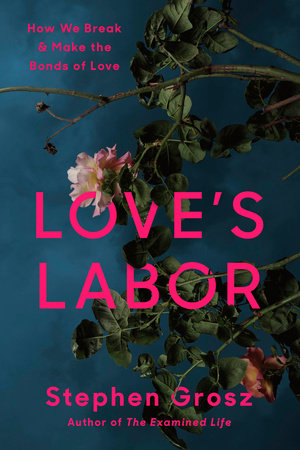
Love's Labor

How We Break and Make the Bonds of Love

Look inside
Listen to a clip from the audiobook
audio pause button
0:00
0:00
Hardcover
$28.00 US
On sale Feb 10, 2026 | 192 Pages | 9780812997552
Grades 9-12 + AP/IB

See Additional Formats
An acclaimed author and psychoanalyst shares moving true stories from his practice to explore the central question of our lives: How do we find and keep love?

“A profound meditation on love and healing. Powerful and important. Essential reading.”—Tara Westover, author of Educated

In these brief, powerful accounts drawn from his more than thirty-five years counseling patients, Stephen Grosz brings us into the lives of people who cannot fully connect to their loved ones. Grosz helps his patients map their internal worlds to uncover the unconscious fears and desires sabotaging their relationships.

Hoping to avoid love’s end, one man obsessively tends to everyone around him. Another retreats from the world, unable to live fully until he’s able to confront the failure of a tragic romance. Adultery and betrayal tear apart two married couples, but in surprising ways, love persists between the spouses.

These true stories of everyday suffering—and profound relief—display Grosz’s deep understanding of the wayward heart and the obstacles to enduring connection.
Marry Me

1

Looking now at my Filofax from 1989, I see that I had planned to spend the last Saturday in November in Cambridge, at Kettle’s Yard. I wanted to see an exhibition of paintings. That plan was scrapped when, late Friday night, I got a call from Sophie A.

Sophie had been given my number by a friend and felt she needed to talk to someone urgently. She and her fiancé, Nicholas—Nick—had spent the previous weekend addressing their wedding invitations. On Monday morning, he’d taken his half of the invitations and mailed them. The sixty invitations that Sophie was responsible for were still at her office, in a carrier bag under her desk. She couldn’t bring herself to post them, or to bring them home, or to tell Nick about any of it. She wasn’t sure what to do. She wasn’t even sure she should be ringing me. I offered her a consultation for the next day.

On Saturday, Sophie didn’t appear for her appointment. After fifteen minutes, I assumed that she had finally sent the invitations, or had talked to her fiancé and was now living through the consequences. I was in the small kitchen next to my consulting room, making a cup of coffee and opening the post, when my doorbell rang.

The woman on my doorstep was tall and stylish. Her straight dark hair was cut in a geometric chin-length bob. She wore wire-rimmed glasses. With the exception of her jeans, everything she had on was black. She stepped with some hesitancy into the consulting room. Without taking off her coat, Sophie sat down on the edge of the chair opposite me and apologized several times for being late. She explained that she’d stopped off at her parents’ house. She had wanted to tell them about the invitations, but, once there, she hadn’t been able to.

“I’m probably frightened of their reaction,” she said. “They really like Nick.” She apologized to me again. She wasn’t herself, she said. She worked as an arts correspondent for a national newspaper. She was a responsible person, not indecisive or impulsive.

“Has anything like this ever happened to you before?” I asked.

“Never,” she said.

She told me about her relationship with Nick. They had met through friends, made it through an early wobble when she thought he might still be interested in an old girlfriend. They had always had good sexual chemistry. Of course, there were things that bothered her. He had just been hired as a history lecturer at a London university, and she thought he worked too much. They had the usual squabbles about the dishes and housework. He was still a bit of an adolescent, but weren’t all men?

“I can’t be easy to live with,” she said. “I expect him to be as well organized as I am. If I send him to the supermarket for ten things and he comes back with eight of them, it’s hard for me to hide my frustration. My ‘should have done it myself’ face.”

But Nick didn’t get upset with her about this sort of thing, she said. Other boyfriends had. She sat forward in her chair. She unbuttoned her coat and pushed it back off her shoulders. “Mr. Grosz, I do love Nick. I don’t want anyone else. I just don’t know what’s happening to me. I feel afraid.”

Sophie had grown up in Notting Hill, near the Portobello Road, where her parents owned an antiques business. They did architectural salvage—chimneypieces, door furniture, floors, garden ornaments, lighting, mirrors, textiles, and carpets. She felt absolutely terrible that she hadn’t been able to tell them about the wedding invitations. She usually told her parents everything. She was an only child, and very close to her parents.

I asked Sophie about her eating and sleeping. She said she’d been waking up early, feeling anxious, and having terrible dreams. The night before had been awful. Fearful that she was going to miss our appointment, she’d woken up again and again to check her alarm clock. At some point, near morning, she fell into a deep sleep and had a dream.

“I dreamed I was in a changing room with my mum and dad. We were all supposed to undress and go through to the showers. Somehow, I realized that we were going to be gassed. There was nothing I could do. We couldn’t stay in the changing room. We had to go forward, through the door. We were all going to die.” She looked at me. “And then I woke up.”

“Why would I dream something like that?” she asked me.

My silence seemed to make Sophie uncomfortable.

She hesitated, then she told me that she wasn’t Jewish; Nick wasn’t either. This subject—the Holocaust—was not something she’d been thinking about. A few months back, just after Primo Levi died, she’d seen a documentary on television about him, and she’d read one of his books, but that was a while ago. Her dream made no sense to her. We sat facing each other in silence.

After a minute or two, I asked her what she’d been thinking.

She twisted her engagement ring, told me she was embarrassed, and hoped that I wouldn’t take it the wrong way, but when her friend had suggested that she come and see me, she’d had the thought that I might be Jewish. Grosz is a Jewish name, isn’t it? She’d thought about Freud. He was Jewish. Sophie stopped. “I sound terrible. I don’t know why I dreamed about the Holocaust.”

My intuition was that Sophie’s dream wasn’t about concentration camps, the Holocaust, or Jewishness—her anxiety suggested some anticipated internal calamity. And yet, although she was offering her associations honestly, freely, and although the dream itself seemed simple, I had to admit, I was struggling to find a way into it. I felt stuck.

I remembered a passage in Freud—if he couldn’t disentangle a patient’s dream, he would ask the patient to repeat it. Ordinarily, the patient would slightly alter the account—according to Freud, those parts of the dream described differently were revealed as the “weak spot” in the dream’s disguise.

When I asked her to repeat it, Sophie reported her dream almost exactly as she had the first time. But when she described the changing room, she added another detail. “It wasn’t very big,” she said, raising her arms. “It was like this, about the size of this room.”

“This room, my consulting room”—I raised my arms too—“is a type of changing room.”

Sophie looked blank, then smiled. “I guess it is, but what does that mean?” she said.

I explained that her dream—her being late to my office, and her sleeplessness—suggested that she was anxious about our meeting.

“Aren’t most people who come here?” She crossed her ankles, tucking them under her chair. “Why would I dream about the gas chambers?”

I told her that her dream could be expressing a fear that going forward—changing—would lead to the destruction of her life with her parents.

“I don’t think of myself as someone who is frightened of change,” she said.

“You want a change—to get married, start a new family. But I think you’re worried that this development threatens your childhood family.”

“You don’t think I want to get married?”

“I don’t hear you saying that,” I said.

I told Sophie I thought she was at an impasse. She wanted to create a new family, but she didn’t want to destroy her old one. While she might feel guilty for not having posted the invitations, her actions were also a way of protecting both Nick and her parents. “If you wanted to end your relationship with him, you would have told him that you couldn’t go through with it.”

“You’re saying I can’t go forward and I can’t go back. I understand that. It’s clever,” she said. But she wanted to know how to make a decision. Should she get married or not? “I was hoping you could help me resolve this.”

Sophie wrapped her arms around herself, then looked at me. “When will I be able to go ahead?”

“I don’t know,” I said. “You just don’t seem to be able to do it now.”

“Is that it?”

I told her that I couldn’t predict the future.

There was something else that struck me. “The force of your anxiety—it feels to me to be about something much more than a wedding—as if, when you send out your invitations, you’ll actually annihilate your parents.”

Sophie considered this. She told me that sometimes after saying goodbye to her parents and walking away from their house, she worried that they didn’t talk to each other when she wasn’t there. Whenever she brought them a problem—a money worry, a medical issue, something wrong with her flat—they seemed to grow close again. And, of course, they were involved with helping her sort out the wedding.

As she spoke, I pictured a woman who over many years had come to relate to her parents through one task or another—involving them in her life’s adventures—as a way of helping their marriage to survive. I told Sophie this. She was struck by my use of the word “survive.”
“This is a beautiful book.”—Nigella Lawson

“A profound meditation on love and healing. P . . . powerful and important. E . . . essential reading.”—Tara Westover, author of Educated

“A compressed, brilliant distillation of forty years of clinical experience and deep thought, written to last. Grosz conveys what he knows, in all its richness, in as pithy and digestible form as possible.”Financial Times

“A fascinating examination of this process [of psychoanalysis] in action . . . Grosz is a captivating writer whose understated vignettes often capture the complexities of the human condition”New Scientist

“Chilling, moving, unforgettable . . . what a privilege it is for the reader to catch a glimpse of this process.”The Guardian

Love’s Labor is a hopeful book and all the more convincingly so because it promises relatively small shifts rather than miraculous recoveries”The Times

“Love really is a labor: that's that’s something they don’t tell you in the fairy stories or the reality shows. But Stephen Grosz knows a lot about the pain and joy of human relationships, and in this book he generously shares his wisdom with the rest of us.”—Zadie Smith, author of The Fraud

“This is a special book, full of little epiphanies. It’s a love story about the relationship between lovers, between a therapist and patient, and between us all, if we are brave enough.”Natasha Lunn, author of Conversations on Love

“Grosz’s transfixing stories will increase your openness to and aptitude for the greatest of all emotions;: you will be better at love after you read this book.”—Andrew Solomon, author of Far from the Tree

“Full of moments of revelation that stay with you forever . . . It would not be humanly possible for me to recommend his work more highly.”―India Knight, author of My Life on a Plate

“Reading Stephen Grosz is a deep sort of pleasure, and this book’s movingly told true stories left me feeling wiser and more open to life.”―Oliver Burkeman, author of Four Thousand Weeks

“Stephen Grosz is a beautiful writer;, a clear, compelling thinker;, an observant, wise, and deeply empathetic human being.”—Nick Hornby, author of Fever Pitch
© Bettina von Zwehl
STEPHEN GROSZ is a psychoanalyst and writer. He is the internationally bestselling author of The Examined Life. Born in America and educated at the University of California, Berkeley and at Oxford University, he now lives and practices in London. View titles by Stephen Grosz

About

An acclaimed author and psychoanalyst shares moving true stories from his practice to explore the central question of our lives: How do we find and keep love?

“A profound meditation on love and healing. Powerful and important. Essential reading.”—Tara Westover, author of Educated

In these brief, powerful accounts drawn from his more than thirty-five years counseling patients, Stephen Grosz brings us into the lives of people who cannot fully connect to their loved ones. Grosz helps his patients map their internal worlds to uncover the unconscious fears and desires sabotaging their relationships.

Hoping to avoid love’s end, one man obsessively tends to everyone around him. Another retreats from the world, unable to live fully until he’s able to confront the failure of a tragic romance. Adultery and betrayal tear apart two married couples, but in surprising ways, love persists between the spouses.

These true stories of everyday suffering—and profound relief—display Grosz’s deep understanding of the wayward heart and the obstacles to enduring connection.

Excerpt

Marry Me

1

Looking now at my Filofax from 1989, I see that I had planned to spend the last Saturday in November in Cambridge, at Kettle’s Yard. I wanted to see an exhibition of paintings. That plan was scrapped when, late Friday night, I got a call from Sophie A.

Sophie had been given my number by a friend and felt she needed to talk to someone urgently. She and her fiancé, Nicholas—Nick—had spent the previous weekend addressing their wedding invitations. On Monday morning, he’d taken his half of the invitations and mailed them. The sixty invitations that Sophie was responsible for were still at her office, in a carrier bag under her desk. She couldn’t bring herself to post them, or to bring them home, or to tell Nick about any of it. She wasn’t sure what to do. She wasn’t even sure she should be ringing me. I offered her a consultation for the next day.

On Saturday, Sophie didn’t appear for her appointment. After fifteen minutes, I assumed that she had finally sent the invitations, or had talked to her fiancé and was now living through the consequences. I was in the small kitchen next to my consulting room, making a cup of coffee and opening the post, when my doorbell rang.

The woman on my doorstep was tall and stylish. Her straight dark hair was cut in a geometric chin-length bob. She wore wire-rimmed glasses. With the exception of her jeans, everything she had on was black. She stepped with some hesitancy into the consulting room. Without taking off her coat, Sophie sat down on the edge of the chair opposite me and apologized several times for being late. She explained that she’d stopped off at her parents’ house. She had wanted to tell them about the invitations, but, once there, she hadn’t been able to.

“I’m probably frightened of their reaction,” she said. “They really like Nick.” She apologized to me again. She wasn’t herself, she said. She worked as an arts correspondent for a national newspaper. She was a responsible person, not indecisive or impulsive.

“Has anything like this ever happened to you before?” I asked.

“Never,” she said.

She told me about her relationship with Nick. They had met through friends, made it through an early wobble when she thought he might still be interested in an old girlfriend. They had always had good sexual chemistry. Of course, there were things that bothered her. He had just been hired as a history lecturer at a London university, and she thought he worked too much. They had the usual squabbles about the dishes and housework. He was still a bit of an adolescent, but weren’t all men?

“I can’t be easy to live with,” she said. “I expect him to be as well organized as I am. If I send him to the supermarket for ten things and he comes back with eight of them, it’s hard for me to hide my frustration. My ‘should have done it myself’ face.”

But Nick didn’t get upset with her about this sort of thing, she said. Other boyfriends had. She sat forward in her chair. She unbuttoned her coat and pushed it back off her shoulders. “Mr. Grosz, I do love Nick. I don’t want anyone else. I just don’t know what’s happening to me. I feel afraid.”

Sophie had grown up in Notting Hill, near the Portobello Road, where her parents owned an antiques business. They did architectural salvage—chimneypieces, door furniture, floors, garden ornaments, lighting, mirrors, textiles, and carpets. She felt absolutely terrible that she hadn’t been able to tell them about the wedding invitations. She usually told her parents everything. She was an only child, and very close to her parents.

I asked Sophie about her eating and sleeping. She said she’d been waking up early, feeling anxious, and having terrible dreams. The night before had been awful. Fearful that she was going to miss our appointment, she’d woken up again and again to check her alarm clock. At some point, near morning, she fell into a deep sleep and had a dream.

“I dreamed I was in a changing room with my mum and dad. We were all supposed to undress and go through to the showers. Somehow, I realized that we were going to be gassed. There was nothing I could do. We couldn’t stay in the changing room. We had to go forward, through the door. We were all going to die.” She looked at me. “And then I woke up.”

“Why would I dream something like that?” she asked me.

My silence seemed to make Sophie uncomfortable.

She hesitated, then she told me that she wasn’t Jewish; Nick wasn’t either. This subject—the Holocaust—was not something she’d been thinking about. A few months back, just after Primo Levi died, she’d seen a documentary on television about him, and she’d read one of his books, but that was a while ago. Her dream made no sense to her. We sat facing each other in silence.

After a minute or two, I asked her what she’d been thinking.

She twisted her engagement ring, told me she was embarrassed, and hoped that I wouldn’t take it the wrong way, but when her friend had suggested that she come and see me, she’d had the thought that I might be Jewish. Grosz is a Jewish name, isn’t it? She’d thought about Freud. He was Jewish. Sophie stopped. “I sound terrible. I don’t know why I dreamed about the Holocaust.”

My intuition was that Sophie’s dream wasn’t about concentration camps, the Holocaust, or Jewishness—her anxiety suggested some anticipated internal calamity. And yet, although she was offering her associations honestly, freely, and although the dream itself seemed simple, I had to admit, I was struggling to find a way into it. I felt stuck.

I remembered a passage in Freud—if he couldn’t disentangle a patient’s dream, he would ask the patient to repeat it. Ordinarily, the patient would slightly alter the account—according to Freud, those parts of the dream described differently were revealed as the “weak spot” in the dream’s disguise.

When I asked her to repeat it, Sophie reported her dream almost exactly as she had the first time. But when she described the changing room, she added another detail. “It wasn’t very big,” she said, raising her arms. “It was like this, about the size of this room.”

“This room, my consulting room”—I raised my arms too—“is a type of changing room.”

Sophie looked blank, then smiled. “I guess it is, but what does that mean?” she said.

I explained that her dream—her being late to my office, and her sleeplessness—suggested that she was anxious about our meeting.

“Aren’t most people who come here?” She crossed her ankles, tucking them under her chair. “Why would I dream about the gas chambers?”

I told her that her dream could be expressing a fear that going forward—changing—would lead to the destruction of her life with her parents.

“I don’t think of myself as someone who is frightened of change,” she said.

“You want a change—to get married, start a new family. But I think you’re worried that this development threatens your childhood family.”

“You don’t think I want to get married?”

“I don’t hear you saying that,” I said.

I told Sophie I thought she was at an impasse. She wanted to create a new family, but she didn’t want to destroy her old one. While she might feel guilty for not having posted the invitations, her actions were also a way of protecting both Nick and her parents. “If you wanted to end your relationship with him, you would have told him that you couldn’t go through with it.”

“You’re saying I can’t go forward and I can’t go back. I understand that. It’s clever,” she said. But she wanted to know how to make a decision. Should she get married or not? “I was hoping you could help me resolve this.”

Sophie wrapped her arms around herself, then looked at me. “When will I be able to go ahead?”

“I don’t know,” I said. “You just don’t seem to be able to do it now.”

“Is that it?”

I told her that I couldn’t predict the future.

There was something else that struck me. “The force of your anxiety—it feels to me to be about something much more than a wedding—as if, when you send out your invitations, you’ll actually annihilate your parents.”

Sophie considered this. She told me that sometimes after saying goodbye to her parents and walking away from their house, she worried that they didn’t talk to each other when she wasn’t there. Whenever she brought them a problem—a money worry, a medical issue, something wrong with her flat—they seemed to grow close again. And, of course, they were involved with helping her sort out the wedding.

As she spoke, I pictured a woman who over many years had come to relate to her parents through one task or another—involving them in her life’s adventures—as a way of helping their marriage to survive. I told Sophie this. She was struck by my use of the word “survive.”

Reviews

“This is a beautiful book.”—Nigella Lawson

“A profound meditation on love and healing. P . . . powerful and important. E . . . essential reading.”—Tara Westover, author of Educated

“A compressed, brilliant distillation of forty years of clinical experience and deep thought, written to last. Grosz conveys what he knows, in all its richness, in as pithy and digestible form as possible.”Financial Times

“A fascinating examination of this process [of psychoanalysis] in action . . . Grosz is a captivating writer whose understated vignettes often capture the complexities of the human condition”New Scientist

“Chilling, moving, unforgettable . . . what a privilege it is for the reader to catch a glimpse of this process.”The Guardian

Love’s Labor is a hopeful book and all the more convincingly so because it promises relatively small shifts rather than miraculous recoveries”The Times

“Love really is a labor: that's that’s something they don’t tell you in the fairy stories or the reality shows. But Stephen Grosz knows a lot about the pain and joy of human relationships, and in this book he generously shares his wisdom with the rest of us.”—Zadie Smith, author of The Fraud

“This is a special book, full of little epiphanies. It’s a love story about the relationship between lovers, between a therapist and patient, and between us all, if we are brave enough.”Natasha Lunn, author of Conversations on Love

“Grosz’s transfixing stories will increase your openness to and aptitude for the greatest of all emotions;: you will be better at love after you read this book.”—Andrew Solomon, author of Far from the Tree

“Full of moments of revelation that stay with you forever . . . It would not be humanly possible for me to recommend his work more highly.”―India Knight, author of My Life on a Plate

“Reading Stephen Grosz is a deep sort of pleasure, and this book’s movingly told true stories left me feeling wiser and more open to life.”―Oliver Burkeman, author of Four Thousand Weeks

“Stephen Grosz is a beautiful writer;, a clear, compelling thinker;, an observant, wise, and deeply empathetic human being.”—Nick Hornby, author of Fever Pitch

Author

© Bettina von Zwehl
STEPHEN GROSZ is a psychoanalyst and writer. He is the internationally bestselling author of The Examined Life. Born in America and educated at the University of California, Berkeley and at Oxford University, he now lives and practices in London. View titles by Stephen Grosz
  • More Websites from
    Penguin Random House
  • Common Reads
  • Library Marketing