Download high-resolution image Look inside
Listen to a clip from the audiobook
audio pause button
0:00
0:00

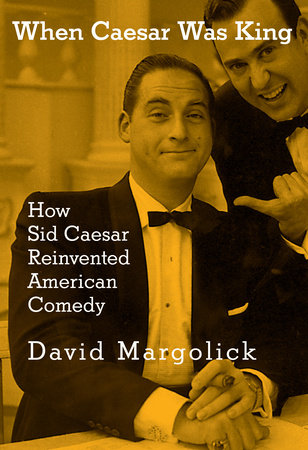
When Caesar Was King

How Sid Caesar Reinvented American Comedy

Look inside
Listen to a clip from the audiobook
audio pause button
0:00
0:00
FINALIST FOR THE PEN/JACQUELINE BOGRAD WELD AWARD FOR BIOGRAPHY • FINALIST FOR THE MARFIELD PRIZE • FEATURED ON CBS SUNDAY MORNING • From longtime New York Times and Vanity Fair writer David Margolick comes the first definitive biography of Sid Caesar: founding father of television comedy and icon to generations of Americans.

“Whip smart. . . . A nuanced appreciation of Caesar’s comedy and the overall atmosphere of TV’s early days.” —Esquire


By the spring of 1954, Sid Caesar was the most influential, highly paid, and enigmatic comedian in America. Every week, twenty million people tuned their TVs to his NBC extravaganza, Your Show of Shows, and witnessed his virtuosity in sketches and film spoofs, pantomime and soliloquy. Onstage, Caesar could play any character and make it funny: a befuddled game-show contestant, a pretentious German professor, a beleaguered husband (opposite his redoubtable co-star Imogene Coca)—even a gumball machine and a bottle of seltzer.

To Caesar’s mostly urban audience, his comedy was an era-defining leap forward from the days of vaudeville, launching a new style of humor that was multilayered and full of character, yet still uproarious. To his rivals, Caesar was the man to beat. To his fellow American Jews, his show’s success meant something more: a post-Holocaust symbol of security and a source of great pride. But behind all that Caesar represented was the real Sid. Introverted and volatile, ill at ease in his own skin, he could terrorize his collaborators but reserved his harshest critiques for himself. After barely a decade, he was essentially off the air, beset by exhaustion, addiction, his own impossibly high standards, and changing viewership as television spread to the American heartland. TV’s first true comic creation was also its first spectacular flameout.

But in his wake came the disciples he personally nurtured—including Mel Brooks, Carl Reiner, Neil Simon, and more. Caesar left an indelible impact on what still makes us laugh. In When Caesar Was King, veteran journalist David Margolick conjures this complexman as never before. Deeply researched, brimming with love for Caesar and the culture from which he sprang, and reanimating a New York City that has all but vanished, this rollicking and poignant book traces the rise and fall of a legend.
Introduction

On the evening of Saturday, April 3, 1954, during a commercial for Griffin Microsheen Boot Polish (“Your ‘Shine of Shines’ on Your Show of Shows”), Sid Caesar quietly made his way down an aisle in New York’s Center Theatre and slipped into the seat set aside for him, the only empty one in sight. It was hard for the bulky, muscular Caesar to be inconspicuous, but in this barn of a place, more cavernous even than the nearby Radio City Music Hall, few in the audience would have noticed him. But they’d always remember what he, and they, were about to pull off: the longest and lustiest laughter, before or since, in the history of television.

That night, Caesar felt cocky, rambunctious, liberated. After more than four years on the air, Your Show of Shows, the program on which he’d made his name, the one that had set the rules, and the standard, and the contours, of television comedy for years to come, was winding down. Soon, he’d launch his own show, bearing his own name, where, with the greatest team of comedy writers ever assembled, he could set his own rules and, presumably, ascend even higher. Now, though, he had to pull off an intricate eleven-minute-long sketch, one centered on him, live on national television. Once the commercial ended, the cameras would roll, and twenty million people would watch a wicked takeoff of another mainstay of early TV, as lachrymose as Caesar’s show was irreverent: This Is Your Life.

On one level, “This Is Your Story,” as the spoof was called, was an orgy of kissing, hugging, and slobbering as Caesar’s hapless character, one Al Duncey from Darling Falls, Montana, is dragged kicking and screaming up to the stage and reunited with various figures from his past, most notably his beloved Uncle Goopy, played by Howard Morris, the third banana on the show. But on another level, Carl Reiner, the second banana, later said what they saw that night was “the greatest sketch ever, ever done in the history of television.” “Such a glorious muddle of bawling humanity does more than gladden the soul,” a critic from The New York Times would write about it. “It leads me to think that on certain Saturday nights Your Show of Shows may have been the laughter of the gods.”

The takeoff was also a clinic in the elements of classic comedy and an inventory of what had made Your Show of Shows unique. “That sketch says it all: the inventiveness, the freedom, the insanity, the brilliance, and yet the control,” said Bill Persky, the Emmy Award–winning comedy writer and producer for The Dick Van Dyke Show, one of many TV shows, movies, and plays that Your Show of Shows and its successor, Caesar’s Hour, had spawned. “The business you want to go into is based on a foundation and this is it,” he’d tell his students at Yale, Columbia, and New York University before playing it for them. “These are the people who set the stage. We didn’t know it at the time, but what they did was impossible.” The screening came with a guarantee: If what he was about to show them wasn’t one of the funniest things they’d ever seen, he’d turn it off after a minute. This he never had to do.

Television was still young when “This Is Your Story” aired, and so was Caesar: only thirty-one years old, though he’d already put five years into the enterprise. In that time, he’d become TV’s initial homegrown star, the first without a long apprenticeship in vaudeville, radio, or the theater. In TV’s original colonies—the big cities, mostly in the Northeast, to which it was limited in its earliest days, shortly after World War II—watching Caesar and his co-stars—Imogene Coca, Reiner, and Morris— on Your Show of Shows had become a grand ritual. Thanks to them, folks could now stay home Saturday nights without feeling like wallflowers. What proved a bane to Broadway theaters, movie palaces, nightclubs, bowling alleys, and babysitters had been a boon to Caesar: By the spring of 1954 he was making an unthinkable $25,000 a week—more, an irate NBC shareholder complained, than David Sarnoff, the man running the network, was collecting. At least publicly, Sarnoff wasn’t perturbed. “I have no doubt there is more public interest in Sid Caesar than in David Sarnoff, so he probably is worth more than I am,” he said.

“You are young and talented and intelligent,” the man who’d brought Caesar to NBC, Sylvester L. “Pat” Weaver Jr., had written to him a few weeks before the sketch was aired, part of a campaign to keep him from straying to another network or going off to Hollywood. “You are gifted in a way which is rarely seen during a lifetime. If you handle yourself right you have a career ahead which will be hard for anyone in our time to top.” And for a while, it was true. Caesar off camera was remote and notoriously hard to read, but entertainment writers and Broadway columnists also recognized his uniqueness and newsworthiness, forever monitoring his latest triumphs, his residences, his waistline, his ratings, his contracts, his diet, his respiratory system, and his mental health.

In some ways Caesar peaked that night. Though Caesar’s Hour, his next show, produced a new body of distinguished work, within a few years Caesar was largely off the air, giving him two additional distinctions in the annals of television: becoming its first great victim and suffering its most precipitous fall. “Much too front-loaded” was how Larry Gelbart, the writer in Caesar’s stable he might have respected most, once described his career. But as invisible as Caesar himself would become, his imprint remained enormous, his disciples ubiquitous.

His influence was felt in every branch of comedy: movies, sitcoms, stand-up, sketches. “No Sid Caesar, no Mel Brooks,” Mel Brooks liked to say, and it was true, for Caesar had discovered, protected, tolerated, and nourished Brooks for a decade. Lenny Bruce’s biographer called Caesar “the only comedian who had a real decisive influence” on Bruce. Woody Allen, who’d worked for Caesar toward the end of his great run, was flabbergasted when, in a conversation with his old boss in the early 1990s, Caesar predicted he’d be a footnote to Allen’s career. “You’re Sid Caesar, and you’re not appreciating what a genius you were and what an influence you are on everybody!” Allen thought to himself. “You’re one of the greatest comedians that we’ve ever had!”

Not just The Dick Van Dyke Show, but The Andy Griffith Show, M*A*S*H, and All in the Family; Bananas and Annie Hall, Blazing Saddles, Fiddler on the Roof, The Odd Couple, Hello, Dolly!—all were written by people who wrote for Caesar first. A generation of leading comics acknowledged their debt to him. The young Johnny Carson knew all of his sketches and ripped off one of the most famous routines for his act at the University of Nebraska. The young Carol Burnett passed up precious tickets to My Fair Lady to watch Caesar rehearse and patterned her own TV show after his. The young Dick Cavett played hooky from Yale to go to New York and watch him perform. Jonathan Winters, Richard Pryor, Conan O’Brien, and Al Franken were all inspired by him. “He was just somebody you couldn’t take your eyes off of, even as a five-or six-year-old,” said Billy Crystal. Larry David watched Caesar as a kid and has called him “easily the best sketch comedian I’ve ever seen, without a close second.” “My dad would watch Sid Caesar, and literally fall off his chair,” the actress and comedienne Louise Lasser remembered. “Literally. He would be on the floor.” In Richard Lewis’s fractured family (and lots of others), a truce was declared when Caesar’s shows came on.

Even when, before VCRs and DVDs and YouTube, Caesar’s work was hard to find, the comic cognoscenti tracked down, pored over, and emulated it. Robin Williams recalled how, after watching a collection of classic Caesar sketches at a movie theater in the 1970s, the old woman seated next to him turned and told him he’d never be that good. “We all lost our grandfather today,” Jon Stewart declared on The Daily Show the night Caesar died. Then, in the program’s “Your Moment of Zen,” there was Caesar once again in one of his most familiar roles: his down-and-out but know-it-all German professor, dressed in his customary crushed top hat and rags, this time playing “Dr. Ludwig von Snowcap,” authority on mountain climbing, who’d fallen 17,780 feet from a Himalayan peak—and lived.

“Were you badly hurt, Professor?” his ever-faithful interlocutor, played by Reiner, asked him.
“See that?” replied Caesar in a thick, ersatz-German accent, pointing to the tip of his pinkie. “That’s the original me. All the rest is new!”

He was the un likeliest of comics: introverted, ill at ease, tongue-tied. “Extremely smart but completely inarticulate,” as another notable Caesar alum, Neil Simon, described him. Buddy Hackett called Caesar “the most quiet man I know and the only quiet comedian I know.” “The first thing I noticed about Sid Caesar was he wasn’t funny,” recalled Tony Webster, a writer whose own alcohol-fueled relationship with Caesar was especially combustible. Reiner said he never heard Caesar tell a joke; another Caesar writer, Joe Stein, said he never heard him laugh. A photograph of the New York comic fraternity (taken in December 1953 at a bachelor party for early television comedy’s other titan, Milton Berle) captured how anomalous Caesar was. While all the others—Red Buttons, Joe E. Lewis, Sam Levenson, Morey Amsterdam, Henny Youngman, Jan Murray, Joey Adams, and Berle himself—mugged, clowned, or wisecracked for the camera, Caesar smiled wanly, looking as if he’d rather be anywhere, or anyone, else. Much of comedy stems from rage, but Caesar was more conspicuously angry than the others. “Comedy comes from animosity and frustration,” he once said. “You want to get back at something but you’re afraid to do it in a big way because you’ll get in trouble.”

But as Simon said, Caesar could be funnier without telling a joke than any man he’d ever seen. “Like seeing a new country” was how he described watching Caesar for the first time, in Tars and Spars, a 1946 film that became, for aspiring funnymen of his generation, part of the comic catechism. “All other comics were basically doing situations with farcical characters,” Simon remembered. “Caesar was doing life.” Caesar demanded more elevated material than the usual stuff—the “my mother-in-law” jokes, the “my wife is so fat” jokes—everyone else did, said Stein. Caesar “had a radar for truth—truth in comedy,” he added. “It could be exaggerated truth, upside-down truth, nutty truth, but there had to be truth. And if Sid didn’t feel it, he wouldn’t give us a lecture about truth, he’d say, ‘Ah, it ain’t funny.’ But we knew he smelled something false.” “He knew intuitively how people behave,” Reiner observed. “He had a perfect pitch about the human condition.” “Sid was a great mimic, but he didn’t do Humphrey Bogart,” as Brooks put it. “He simply mimicked humanity” and had his writers write “mini-plays about mankind.”

Larry Gelbart was once asked to describe Caesar’s personality. “Zero,” he’d replied. “Sid’s personality could be described as ‘non-existent.’ It’s one of the reasons Sid was as good as he was.” With so little of himself to get in the way, Gelbart reasoned, Caesar could become whoever or whatever he wanted, or needed, to be. However opaque, and even baffling, he could appear, inside him were all the tools—insight, imagination, discipline, and what Howard Morris called a “meshugana energy”—that the instantaneous, insatiable new medium of television demanded. His wide-ranging comedic skills—including pantomime and monologues—were tailor-made for small screens in big wooden boxes in living rooms. Though Caesar never got past high school himself, he had a sophistication born of native intelligence and curiosity that resonated with early television’s urbane audiences. But even if you’d never seen On the Waterfront or The Bicycle Thief, or eaten (or tried to eat) at a health food restaurant, or heard Grieg’s Piano Concerto, he could make you laugh about them. And though you might never have seen a silent movie, his meticulous re-creations of them could make you laugh and cry.

For ninety minutes over thirty-odd weeks for more than four years, and an hour a week for three years after that, Caesar presented life live, a feat of endurance and brinkmanship no one else ever attempted, before or since. One of his writers likened it to “walking across Niagara Falls” every Saturday night. An ever-present sense of danger lent the shows an intensity and precariousness in which viewers felt almost complicit. And with the primitive cameras—the size of Volkswagens, Persky recalled—zeroing in on Caesar several times every show, viewers came to know him, or at least to think they did, in a way they’d come to know few stars before him. Comics generally came smaller and more fragile than Caesar; as the architect of Your Show of Shows—its director, Max Liebman—once said, to have succeeded as he did, Caesar had had to overcome his size. And his good looks: Had television had its own Silent Era, Brooks once said, Caesar might have starred in that, too. Most comics looked like comics, one of Caesar’s most faithful students, Nakhman Zalowitz of the Yiddish Forverts once observed; no one could have mistaken Groucho Marx for a steel magnate. But by his appearance, his clothing, his manners and mannerisms, Caesar, Zalowitz wrote, “could be taken for a U.S. Senator, or a successful lawyer, or a Park Avenue doctor.”

Traditional comics generally got away with single characters or routines, tweaked periodically. But aided by his uncanny ear for accents and a knack for mimicry, Caesar could play everyone and everything: imperious German general, Italian cobbler, Stalinist diplomat, American corporate chieftain, British aristocrat, mobster, concert pianist, pasha, gunslinger, silent film star, samurai warrior. He could be a bully or a schlemiel, a boy at his first dance or a paranoid schizophrenic, a duke or a drunk. And should mankind prove too confining, he could become an animal (a trained seal, lion, alley cat, puppy), or a fly crawling on a piece of feta cheese, or various inanimate objects: a punching bag, seltzer bottle, telephone, or gumball machine, to name a few, each with its own sounds and, remarkably, neuroses. His very versatility proved a curse: While viewers cherished comedians whose quirks were limited and predictable, like Jack Benny and Bob Hope, Caesar’s were varied and elusive. The only character he couldn’t play was himself, and for a simple reason: As Reiner put it, “He didn’t know who Sid Caesar was.”

For many viewers Caesar was television, coming with their first DuMonts or Admirals in the way new Maytags came with boxes of Tide. “The pioneer TV set owner was a courageous fellow,” noted a television writer of the time. “He not only had to invite in the entire neighborhood; he had to provide popcorn and beer as well as Sid Caesar.” Eggheads who disdained TV and succumbed to it only reluctantly—like Newton Minow, the chairman-to-be of the Federal Communications Commission who dismissed it as a “vast wasteland” (but only after Caesar had grown scarce)—used Caesar as their excuse. “Satire is what closes on a Saturday night,” the comedy writer George S. Kaufman memorably said, but Caesar’s satires were what Kaufman stayed home Saturday nights to see.
  • FINALIST | 2026
    PEN/Jacqueline Bograd Weld Award for Biography
  • FINALIST | 2025
    Marfield Prize
One of Alta Journal’s Most Anticipated Autumn Book Releases

“Whip smart. . . Sid was one of the first TV comedians to not only conquer the new medium, but pioneer what TV comedy could be. . . . Margolick’s book is a deep dive that moves quickly, giving the reader a nuanced appreciation of Caesar’s comedy and the overall atmosphere of TV’s early days.” Esquire

“Both a portrait of an unstable genius and a cultural history of a medium coming to life. Margolick writes in vibrant detail not only of the Caesar shows but of the early-TV world around them. . . . [Margolick] is an ideal cultural historian . . . . [and] makes the achievements of Caesar and his gang shine through.” —David Denby, The New Yorker

“Margolick brilliantly summarizes Sid Caesar’s fall. . . . At its best [Caesar’s] comedy ranks among the very highest. . . . [And] the world without him is a less amusing place.” —Joseph Epstein, Wall Street Journal

“Margolick is an industrious researcher and skillful writer. One of the first in-depth looks at the comedian. . . . Caesar dominated television in the 1950s, helping to birth and perfect the sketch format.” —Karen Heller, The Washington Post

“Marvelous. . . . Margolick offers both the cognoscenti and the newbies a satisfying examination of [Sid Caesar’s] life and career.” —Bettina Berch, Jewish Book Council

“Lively and thoroughly engrossing. . . . In what is overall a tender and sympathetic portrait, Margolick doesn’t shy away from showing Caesar’s dark side, offering a complex portrait of an enigmatic genius who seemed to be just as much of a mystery to himself as he was to others. Beautifully written and brimming with life, this book establishes Margolick as one of the ultimate mavens of an era of American Jewish history in the mid-to-late 20th century that has all but ceased to exist.” —Ann Levin, Forward

“Well, it's about time! We are finally treated to a nuanced, perceptive biography written with respect and admiration by veteran journalist Margolick. . . . [who] also takes us through the history of American comedy, focusing especially on the changes to the television landscape that made Caesar outmoded. A wonderful tribute to a man whose contributions to comedy cannot be overstated.” —David Pitt, Booklist

“When Caesar Was King is more than the story of Sid Caesar and the writers’ regiment he gathered and commanded that revolutionized American sketch comedy. It is a multilayered examination of how comedy and culture collided in the 1950s. . . . Margolick admires the King and his court, but sees the tragedy clearly: Caesar was the instigator of a cultural revolution he didn’t quite understand and couldn’t survive.” —Thomas Connolly, The Arts Fuse

“A lively biography. . . . David Margolick chronicles the career highs and two-decade lows of Caesar, 'the most original and talented television comic there ever was.' Caesar's humor, Margolick notes, was zany yet sophisticated, blending slapstick, pantomime, his extraordinary gift for double-talk, and parodies of films. . . . Margolick covers all of this, as well as the influence of Caesar's Jewish heritage on his humor, in a lively narrative that explains Caesar's enduring appeal. Comedy fans will love it.” —Michael Magras, Shelf Awareness

“[A] lively biography of the original king of TV comedy. . . . Both a life and a cautionary tale, of great interest to any fan of golden era television.” Kirkus Reviews

“Margolick poignantly assesses the influential comic’s career, noting he was TV’s ‘first great victim and suffer[ed] its most precipitous fall.’ Fans will be riveted.” Publishers Weekly
© Courtesy of author
David Margolick long reported on legal affairs for The New York Times, where he wrote the weekly “At the Bar” column and covered, among other stories, the trial of O. J. Simpson. He was then a contributing editor at Vanity Fair. His many books include Beyond Glory: Joe Louis vs. Max Schmeling, and a World on the Brink; Strange Fruit: The Biography of a Song; Dreadful: The Short Life and Gay Times of John Horne Burns; and Elizabeth and Hazel: Two Women of Little Rock. He lives in New York City. View titles by David Margolick

About

FINALIST FOR THE PEN/JACQUELINE BOGRAD WELD AWARD FOR BIOGRAPHY • FINALIST FOR THE MARFIELD PRIZE • FEATURED ON CBS SUNDAY MORNING • From longtime New York Times and Vanity Fair writer David Margolick comes the first definitive biography of Sid Caesar: founding father of television comedy and icon to generations of Americans.

“Whip smart. . . . A nuanced appreciation of Caesar’s comedy and the overall atmosphere of TV’s early days.” —Esquire


By the spring of 1954, Sid Caesar was the most influential, highly paid, and enigmatic comedian in America. Every week, twenty million people tuned their TVs to his NBC extravaganza, Your Show of Shows, and witnessed his virtuosity in sketches and film spoofs, pantomime and soliloquy. Onstage, Caesar could play any character and make it funny: a befuddled game-show contestant, a pretentious German professor, a beleaguered husband (opposite his redoubtable co-star Imogene Coca)—even a gumball machine and a bottle of seltzer.

To Caesar’s mostly urban audience, his comedy was an era-defining leap forward from the days of vaudeville, launching a new style of humor that was multilayered and full of character, yet still uproarious. To his rivals, Caesar was the man to beat. To his fellow American Jews, his show’s success meant something more: a post-Holocaust symbol of security and a source of great pride. But behind all that Caesar represented was the real Sid. Introverted and volatile, ill at ease in his own skin, he could terrorize his collaborators but reserved his harshest critiques for himself. After barely a decade, he was essentially off the air, beset by exhaustion, addiction, his own impossibly high standards, and changing viewership as television spread to the American heartland. TV’s first true comic creation was also its first spectacular flameout.

But in his wake came the disciples he personally nurtured—including Mel Brooks, Carl Reiner, Neil Simon, and more. Caesar left an indelible impact on what still makes us laugh. In When Caesar Was King, veteran journalist David Margolick conjures this complexman as never before. Deeply researched, brimming with love for Caesar and the culture from which he sprang, and reanimating a New York City that has all but vanished, this rollicking and poignant book traces the rise and fall of a legend.

Excerpt

Introduction

On the evening of Saturday, April 3, 1954, during a commercial for Griffin Microsheen Boot Polish (“Your ‘Shine of Shines’ on Your Show of Shows”), Sid Caesar quietly made his way down an aisle in New York’s Center Theatre and slipped into the seat set aside for him, the only empty one in sight. It was hard for the bulky, muscular Caesar to be inconspicuous, but in this barn of a place, more cavernous even than the nearby Radio City Music Hall, few in the audience would have noticed him. But they’d always remember what he, and they, were about to pull off: the longest and lustiest laughter, before or since, in the history of television.

That night, Caesar felt cocky, rambunctious, liberated. After more than four years on the air, Your Show of Shows, the program on which he’d made his name, the one that had set the rules, and the standard, and the contours, of television comedy for years to come, was winding down. Soon, he’d launch his own show, bearing his own name, where, with the greatest team of comedy writers ever assembled, he could set his own rules and, presumably, ascend even higher. Now, though, he had to pull off an intricate eleven-minute-long sketch, one centered on him, live on national television. Once the commercial ended, the cameras would roll, and twenty million people would watch a wicked takeoff of another mainstay of early TV, as lachrymose as Caesar’s show was irreverent: This Is Your Life.

On one level, “This Is Your Story,” as the spoof was called, was an orgy of kissing, hugging, and slobbering as Caesar’s hapless character, one Al Duncey from Darling Falls, Montana, is dragged kicking and screaming up to the stage and reunited with various figures from his past, most notably his beloved Uncle Goopy, played by Howard Morris, the third banana on the show. But on another level, Carl Reiner, the second banana, later said what they saw that night was “the greatest sketch ever, ever done in the history of television.” “Such a glorious muddle of bawling humanity does more than gladden the soul,” a critic from The New York Times would write about it. “It leads me to think that on certain Saturday nights Your Show of Shows may have been the laughter of the gods.”

The takeoff was also a clinic in the elements of classic comedy and an inventory of what had made Your Show of Shows unique. “That sketch says it all: the inventiveness, the freedom, the insanity, the brilliance, and yet the control,” said Bill Persky, the Emmy Award–winning comedy writer and producer for The Dick Van Dyke Show, one of many TV shows, movies, and plays that Your Show of Shows and its successor, Caesar’s Hour, had spawned. “The business you want to go into is based on a foundation and this is it,” he’d tell his students at Yale, Columbia, and New York University before playing it for them. “These are the people who set the stage. We didn’t know it at the time, but what they did was impossible.” The screening came with a guarantee: If what he was about to show them wasn’t one of the funniest things they’d ever seen, he’d turn it off after a minute. This he never had to do.

Television was still young when “This Is Your Story” aired, and so was Caesar: only thirty-one years old, though he’d already put five years into the enterprise. In that time, he’d become TV’s initial homegrown star, the first without a long apprenticeship in vaudeville, radio, or the theater. In TV’s original colonies—the big cities, mostly in the Northeast, to which it was limited in its earliest days, shortly after World War II—watching Caesar and his co-stars—Imogene Coca, Reiner, and Morris— on Your Show of Shows had become a grand ritual. Thanks to them, folks could now stay home Saturday nights without feeling like wallflowers. What proved a bane to Broadway theaters, movie palaces, nightclubs, bowling alleys, and babysitters had been a boon to Caesar: By the spring of 1954 he was making an unthinkable $25,000 a week—more, an irate NBC shareholder complained, than David Sarnoff, the man running the network, was collecting. At least publicly, Sarnoff wasn’t perturbed. “I have no doubt there is more public interest in Sid Caesar than in David Sarnoff, so he probably is worth more than I am,” he said.

“You are young and talented and intelligent,” the man who’d brought Caesar to NBC, Sylvester L. “Pat” Weaver Jr., had written to him a few weeks before the sketch was aired, part of a campaign to keep him from straying to another network or going off to Hollywood. “You are gifted in a way which is rarely seen during a lifetime. If you handle yourself right you have a career ahead which will be hard for anyone in our time to top.” And for a while, it was true. Caesar off camera was remote and notoriously hard to read, but entertainment writers and Broadway columnists also recognized his uniqueness and newsworthiness, forever monitoring his latest triumphs, his residences, his waistline, his ratings, his contracts, his diet, his respiratory system, and his mental health.

In some ways Caesar peaked that night. Though Caesar’s Hour, his next show, produced a new body of distinguished work, within a few years Caesar was largely off the air, giving him two additional distinctions in the annals of television: becoming its first great victim and suffering its most precipitous fall. “Much too front-loaded” was how Larry Gelbart, the writer in Caesar’s stable he might have respected most, once described his career. But as invisible as Caesar himself would become, his imprint remained enormous, his disciples ubiquitous.

His influence was felt in every branch of comedy: movies, sitcoms, stand-up, sketches. “No Sid Caesar, no Mel Brooks,” Mel Brooks liked to say, and it was true, for Caesar had discovered, protected, tolerated, and nourished Brooks for a decade. Lenny Bruce’s biographer called Caesar “the only comedian who had a real decisive influence” on Bruce. Woody Allen, who’d worked for Caesar toward the end of his great run, was flabbergasted when, in a conversation with his old boss in the early 1990s, Caesar predicted he’d be a footnote to Allen’s career. “You’re Sid Caesar, and you’re not appreciating what a genius you were and what an influence you are on everybody!” Allen thought to himself. “You’re one of the greatest comedians that we’ve ever had!”

Not just The Dick Van Dyke Show, but The Andy Griffith Show, M*A*S*H, and All in the Family; Bananas and Annie Hall, Blazing Saddles, Fiddler on the Roof, The Odd Couple, Hello, Dolly!—all were written by people who wrote for Caesar first. A generation of leading comics acknowledged their debt to him. The young Johnny Carson knew all of his sketches and ripped off one of the most famous routines for his act at the University of Nebraska. The young Carol Burnett passed up precious tickets to My Fair Lady to watch Caesar rehearse and patterned her own TV show after his. The young Dick Cavett played hooky from Yale to go to New York and watch him perform. Jonathan Winters, Richard Pryor, Conan O’Brien, and Al Franken were all inspired by him. “He was just somebody you couldn’t take your eyes off of, even as a five-or six-year-old,” said Billy Crystal. Larry David watched Caesar as a kid and has called him “easily the best sketch comedian I’ve ever seen, without a close second.” “My dad would watch Sid Caesar, and literally fall off his chair,” the actress and comedienne Louise Lasser remembered. “Literally. He would be on the floor.” In Richard Lewis’s fractured family (and lots of others), a truce was declared when Caesar’s shows came on.

Even when, before VCRs and DVDs and YouTube, Caesar’s work was hard to find, the comic cognoscenti tracked down, pored over, and emulated it. Robin Williams recalled how, after watching a collection of classic Caesar sketches at a movie theater in the 1970s, the old woman seated next to him turned and told him he’d never be that good. “We all lost our grandfather today,” Jon Stewart declared on The Daily Show the night Caesar died. Then, in the program’s “Your Moment of Zen,” there was Caesar once again in one of his most familiar roles: his down-and-out but know-it-all German professor, dressed in his customary crushed top hat and rags, this time playing “Dr. Ludwig von Snowcap,” authority on mountain climbing, who’d fallen 17,780 feet from a Himalayan peak—and lived.

“Were you badly hurt, Professor?” his ever-faithful interlocutor, played by Reiner, asked him.
“See that?” replied Caesar in a thick, ersatz-German accent, pointing to the tip of his pinkie. “That’s the original me. All the rest is new!”

He was the un likeliest of comics: introverted, ill at ease, tongue-tied. “Extremely smart but completely inarticulate,” as another notable Caesar alum, Neil Simon, described him. Buddy Hackett called Caesar “the most quiet man I know and the only quiet comedian I know.” “The first thing I noticed about Sid Caesar was he wasn’t funny,” recalled Tony Webster, a writer whose own alcohol-fueled relationship with Caesar was especially combustible. Reiner said he never heard Caesar tell a joke; another Caesar writer, Joe Stein, said he never heard him laugh. A photograph of the New York comic fraternity (taken in December 1953 at a bachelor party for early television comedy’s other titan, Milton Berle) captured how anomalous Caesar was. While all the others—Red Buttons, Joe E. Lewis, Sam Levenson, Morey Amsterdam, Henny Youngman, Jan Murray, Joey Adams, and Berle himself—mugged, clowned, or wisecracked for the camera, Caesar smiled wanly, looking as if he’d rather be anywhere, or anyone, else. Much of comedy stems from rage, but Caesar was more conspicuously angry than the others. “Comedy comes from animosity and frustration,” he once said. “You want to get back at something but you’re afraid to do it in a big way because you’ll get in trouble.”

But as Simon said, Caesar could be funnier without telling a joke than any man he’d ever seen. “Like seeing a new country” was how he described watching Caesar for the first time, in Tars and Spars, a 1946 film that became, for aspiring funnymen of his generation, part of the comic catechism. “All other comics were basically doing situations with farcical characters,” Simon remembered. “Caesar was doing life.” Caesar demanded more elevated material than the usual stuff—the “my mother-in-law” jokes, the “my wife is so fat” jokes—everyone else did, said Stein. Caesar “had a radar for truth—truth in comedy,” he added. “It could be exaggerated truth, upside-down truth, nutty truth, but there had to be truth. And if Sid didn’t feel it, he wouldn’t give us a lecture about truth, he’d say, ‘Ah, it ain’t funny.’ But we knew he smelled something false.” “He knew intuitively how people behave,” Reiner observed. “He had a perfect pitch about the human condition.” “Sid was a great mimic, but he didn’t do Humphrey Bogart,” as Brooks put it. “He simply mimicked humanity” and had his writers write “mini-plays about mankind.”

Larry Gelbart was once asked to describe Caesar’s personality. “Zero,” he’d replied. “Sid’s personality could be described as ‘non-existent.’ It’s one of the reasons Sid was as good as he was.” With so little of himself to get in the way, Gelbart reasoned, Caesar could become whoever or whatever he wanted, or needed, to be. However opaque, and even baffling, he could appear, inside him were all the tools—insight, imagination, discipline, and what Howard Morris called a “meshugana energy”—that the instantaneous, insatiable new medium of television demanded. His wide-ranging comedic skills—including pantomime and monologues—were tailor-made for small screens in big wooden boxes in living rooms. Though Caesar never got past high school himself, he had a sophistication born of native intelligence and curiosity that resonated with early television’s urbane audiences. But even if you’d never seen On the Waterfront or The Bicycle Thief, or eaten (or tried to eat) at a health food restaurant, or heard Grieg’s Piano Concerto, he could make you laugh about them. And though you might never have seen a silent movie, his meticulous re-creations of them could make you laugh and cry.

For ninety minutes over thirty-odd weeks for more than four years, and an hour a week for three years after that, Caesar presented life live, a feat of endurance and brinkmanship no one else ever attempted, before or since. One of his writers likened it to “walking across Niagara Falls” every Saturday night. An ever-present sense of danger lent the shows an intensity and precariousness in which viewers felt almost complicit. And with the primitive cameras—the size of Volkswagens, Persky recalled—zeroing in on Caesar several times every show, viewers came to know him, or at least to think they did, in a way they’d come to know few stars before him. Comics generally came smaller and more fragile than Caesar; as the architect of Your Show of Shows—its director, Max Liebman—once said, to have succeeded as he did, Caesar had had to overcome his size. And his good looks: Had television had its own Silent Era, Brooks once said, Caesar might have starred in that, too. Most comics looked like comics, one of Caesar’s most faithful students, Nakhman Zalowitz of the Yiddish Forverts once observed; no one could have mistaken Groucho Marx for a steel magnate. But by his appearance, his clothing, his manners and mannerisms, Caesar, Zalowitz wrote, “could be taken for a U.S. Senator, or a successful lawyer, or a Park Avenue doctor.”

Traditional comics generally got away with single characters or routines, tweaked periodically. But aided by his uncanny ear for accents and a knack for mimicry, Caesar could play everyone and everything: imperious German general, Italian cobbler, Stalinist diplomat, American corporate chieftain, British aristocrat, mobster, concert pianist, pasha, gunslinger, silent film star, samurai warrior. He could be a bully or a schlemiel, a boy at his first dance or a paranoid schizophrenic, a duke or a drunk. And should mankind prove too confining, he could become an animal (a trained seal, lion, alley cat, puppy), or a fly crawling on a piece of feta cheese, or various inanimate objects: a punching bag, seltzer bottle, telephone, or gumball machine, to name a few, each with its own sounds and, remarkably, neuroses. His very versatility proved a curse: While viewers cherished comedians whose quirks were limited and predictable, like Jack Benny and Bob Hope, Caesar’s were varied and elusive. The only character he couldn’t play was himself, and for a simple reason: As Reiner put it, “He didn’t know who Sid Caesar was.”

For many viewers Caesar was television, coming with their first DuMonts or Admirals in the way new Maytags came with boxes of Tide. “The pioneer TV set owner was a courageous fellow,” noted a television writer of the time. “He not only had to invite in the entire neighborhood; he had to provide popcorn and beer as well as Sid Caesar.” Eggheads who disdained TV and succumbed to it only reluctantly—like Newton Minow, the chairman-to-be of the Federal Communications Commission who dismissed it as a “vast wasteland” (but only after Caesar had grown scarce)—used Caesar as their excuse. “Satire is what closes on a Saturday night,” the comedy writer George S. Kaufman memorably said, but Caesar’s satires were what Kaufman stayed home Saturday nights to see.

Awards

  • FINALIST | 2026
    PEN/Jacqueline Bograd Weld Award for Biography
  • FINALIST | 2025
    Marfield Prize

Reviews

One of Alta Journal’s Most Anticipated Autumn Book Releases

“Whip smart. . . Sid was one of the first TV comedians to not only conquer the new medium, but pioneer what TV comedy could be. . . . Margolick’s book is a deep dive that moves quickly, giving the reader a nuanced appreciation of Caesar’s comedy and the overall atmosphere of TV’s early days.” Esquire

“Both a portrait of an unstable genius and a cultural history of a medium coming to life. Margolick writes in vibrant detail not only of the Caesar shows but of the early-TV world around them. . . . [Margolick] is an ideal cultural historian . . . . [and] makes the achievements of Caesar and his gang shine through.” —David Denby, The New Yorker

“Margolick brilliantly summarizes Sid Caesar’s fall. . . . At its best [Caesar’s] comedy ranks among the very highest. . . . [And] the world without him is a less amusing place.” —Joseph Epstein, Wall Street Journal

“Margolick is an industrious researcher and skillful writer. One of the first in-depth looks at the comedian. . . . Caesar dominated television in the 1950s, helping to birth and perfect the sketch format.” —Karen Heller, The Washington Post

“Marvelous. . . . Margolick offers both the cognoscenti and the newbies a satisfying examination of [Sid Caesar’s] life and career.” —Bettina Berch, Jewish Book Council

“Lively and thoroughly engrossing. . . . In what is overall a tender and sympathetic portrait, Margolick doesn’t shy away from showing Caesar’s dark side, offering a complex portrait of an enigmatic genius who seemed to be just as much of a mystery to himself as he was to others. Beautifully written and brimming with life, this book establishes Margolick as one of the ultimate mavens of an era of American Jewish history in the mid-to-late 20th century that has all but ceased to exist.” —Ann Levin, Forward

“Well, it's about time! We are finally treated to a nuanced, perceptive biography written with respect and admiration by veteran journalist Margolick. . . . [who] also takes us through the history of American comedy, focusing especially on the changes to the television landscape that made Caesar outmoded. A wonderful tribute to a man whose contributions to comedy cannot be overstated.” —David Pitt, Booklist

“When Caesar Was King is more than the story of Sid Caesar and the writers’ regiment he gathered and commanded that revolutionized American sketch comedy. It is a multilayered examination of how comedy and culture collided in the 1950s. . . . Margolick admires the King and his court, but sees the tragedy clearly: Caesar was the instigator of a cultural revolution he didn’t quite understand and couldn’t survive.” —Thomas Connolly, The Arts Fuse

“A lively biography. . . . David Margolick chronicles the career highs and two-decade lows of Caesar, 'the most original and talented television comic there ever was.' Caesar's humor, Margolick notes, was zany yet sophisticated, blending slapstick, pantomime, his extraordinary gift for double-talk, and parodies of films. . . . Margolick covers all of this, as well as the influence of Caesar's Jewish heritage on his humor, in a lively narrative that explains Caesar's enduring appeal. Comedy fans will love it.” —Michael Magras, Shelf Awareness

“[A] lively biography of the original king of TV comedy. . . . Both a life and a cautionary tale, of great interest to any fan of golden era television.” Kirkus Reviews

“Margolick poignantly assesses the influential comic’s career, noting he was TV’s ‘first great victim and suffer[ed] its most precipitous fall.’ Fans will be riveted.” Publishers Weekly

Author

© Courtesy of author
David Margolick long reported on legal affairs for The New York Times, where he wrote the weekly “At the Bar” column and covered, among other stories, the trial of O. J. Simpson. He was then a contributing editor at Vanity Fair. His many books include Beyond Glory: Joe Louis vs. Max Schmeling, and a World on the Brink; Strange Fruit: The Biography of a Song; Dreadful: The Short Life and Gay Times of John Horne Burns; and Elizabeth and Hazel: Two Women of Little Rock. He lives in New York City. View titles by David Margolick
  • More Websites from
    Penguin Random House
  • Common Reads
  • Library Marketing