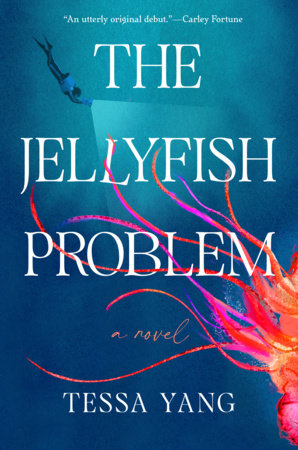
The Jellyfish Problem

Author Tessa Yang On Tour
Look inside
Hardcover
$30.00 US
| $41.99 CAN
On sale Jun 02, 2026 | 384 Pages | 9780593955826
Grades 9-12

See Additional Formats
A marine biologist makes the discovery of a lifetime when called to rescue the inhabitants of a small Maine island being menaced by a giant, glowing jellyfish in this richly imagined, wholly original debut.

Dr. Jo Ness prefers jellyfish to people. Her best friend, Aldo, was the exception, but he died seven months ago. So she spends her days hidden away at an underfunded aquarium with her specimens and a draft of the jellyfish guide she and Aldo had been working on together. His voice is alive in the notes in the margins, and it’s enough. Almost.

Until she receives a call from Nadia, one of the few other humans she’s loved but whom she hasn’t heard from in years, asking for her help. Nadia tells her a grand tale of a giant jellyfish terrorizing her tiny island off the coast of Maine and sends a grainy video of the creature. Frankly, the footage looks fake, but Jo drops everything to fly across the country to see Nadia again, and to find this supposed sea beast. She couldn’t save Aldo, but perhaps she can help Nadia.

But when Jo arrives on Shattering Point, Nadia is nowhere to be found, and the islanders she meets each have something different to say about the creature they’ve dubbed Clementine . . . a jellyfish who changes all who see it.

At turns an ode to classic sea monster stories and a vibrant tale of human connection, The Jellyfish Problem is an unforgettable debut that announces a new talent.
There was something in the water. There was always something in the water in my mother's bedtime stories: a slimy-skinned kappa springing onto land with its life force wobbling in the bowl on its head, a ningyo mermaid heralding storms and disasters, a shape-shifting kawauso luring unsuspecting humans to the water's edge. This menagerie of knowable misfits had felt like the most incredible gift to a misfit girl from a landlocked town. Dad always worried Mom would give me nightmares, but she never did.

In my favorite story, though, the monster was never truly known. It was whispers and glimpses of lights on the water, rumors of drowned sailors traded secondhand. I think that was why I demanded to hear this tale over and over, my fascination born more of frustration than awe. I craved a neat epilogue with a clear moral, where you understood everything that had happened and why. But that was never the kind of story it was going to be.

"Long ago," began Mom, in the hoarse whisper she used when trying to sound spooky, "there lived an aging widow whose son had been lost to the sea . . ."

What was loss to me at that age? A misplaced toy? A pet-store goldfish found floating belly-up in the bowl? I remember feeling baffled by the grief-stricken widow as I lay there tucked under my ladybug comforter, trying to understand why she did what she did. Why get in the water against all warnings and common wisdom? Why take your chances with the beast?

I know the answers now.

This isn't the book we set out to write together, but I still think you would've loved it.

Part One

A Jellyfish Problem

Jellyfish is a misnomer. Fish are cold-blooded vertebrates that respire through gills. Jellyfish are bloodless invertebrates that exchange gases directly through their skin. The spinelessness of jellies-their apparent frailness-has led to the word's slang meaning: a weakling or a doormat. A person devoid of a backbone.

We hope this book will prove jellyfish to be anything but weaklings. As we'll show in the coming chapters, you don't need a backbone to inspire awe, to elicit fear, to change the world.

AA: Too much?

JN: Just enough.

There are certain people from your past whom you never expect to resurface. Nadia was one of mine. We'd had a short-lived, intense friendship near the end of college before graduating and heading down our separate paths. Though I thought of her often in the intervening decade-thought of, in particular, the night we'd spent together on the roof of the science building, stars above, Nadia's head heavy on my chest-I hadn't tried to reach out. Why would I? She'd made it clear that whatever existed between us was over, graduation the perfect excuse to sever a connection that had always meant more to me than to her.

I couldn't think of a single reason for her to be calling me from an unfamiliar number at half past five in the morning on a Tuesday in May after eleven years of silence, but that was what happened.

"Hi! Is this Josie?"

I knew it was her immediately because Nadia was the only person who'd ever called me by that name. I had been Jo and Josephine and Jo-Ness spit to sound like Jonas by a high school softball coach disgusted by my tendency to daydream in the outfield-snap out of it, Jo-Ness!-and in the scuba diving class I took to get certified at sixteen, I was even briefly known as Nessie, as in the lake monster, due to having an air consumption rate so low I was presumed to be partially aquatic.

Josie belonged to Nadia because she claimed it, and I let her.

My shoulders screamed out in pain as I straightened from my desk, where I'd fallen asleep over my laptop. The screen had gone black, sparing me the separate agony of confronting the pages of my book manuscript-The Modern Medusa: A Jellyfish Primer by Josephine Ness and Aldo Antunes-still covered in unresolved comments: mine, and Aldo's.

As I cleared the gravel from my throat and blinked away the last clinging dregs of sleep, the familiar contours of my office at Seaheart swam into focus. The white wall bearing my framed diplomas and Ocean Conservancy calendar, still open to January's image of spawning corals. The broken filing cabinet whose top drawer rolled determinedly open unless sealed with a piece of masking tape. The desk plastered with a quilt of sticky notes, the oldest so old they'd lost their stick and fluttered around each time I patted down the area seeking whatever item I'd lost track of.

It wasn't always like this. Aldo used to scold me for being a neat freak. Then he died and my world tipped into an entropy I couldn't control. Power cords snaked out of nowhere to trip me. Just-washed mugs reappeared in front of me, silty with the cold sediment of coffee I didn't remember drinking. The voice of an old friend slipped through a cracked-open door, beckoning me into the corridor of our shared past.

"Nadia? Nadia Markov?" I said. "Is that really you?"

It was pleasant spending the next several minutes catching up, filling in with broad strokes our lives since undergrad. Nadia had taught English overseas for a few years, gotten her master's in education, bounced around various districts looking for the right fit, and was now teaching in a one-room schoolhouse on a remote island off the coast of Maine. I told her I worked as the research coordinator at a small aquarium, brazenly perched at the waterless edge of Joshua Tree. Small sounded specialized and cozy, which Seaheart was. Small didn't necessarily scream short-staffed and broke, which Seaheart also was.

"Oh my god, you're on the West Coast? What time is it there?" cried Nadia. "I'm so sorry, Josie, I thought you were still in the Northeast . . . I was trying to catch you before work."

I reassured her it was okay without adding that I was already at work, because I hadn't left work, because I'd effectively moved into work, converting my bottom desk drawer into an overnight kit complete with a spare set of clothing, deodorant, toothbrush, and a mini tube of travel toothpaste. What had begun as a contingency plan for those late nights when the hour-plus commute back to my apartment in Riverside didn't seem worth it had fast evolved into the new norm. It was all hands on deck for those of us who'd survived the latest round of layoffs. And I slept better on my office's rock-hard love seat than in my own bed. The guilty dreams didn't follow me here.

By now I was in the staff room, trying to wrest a mug from the dish rack without causing an avalanche. The aquarium's cleaner had quit last year, and Elijah Pinsky, Seaheart's director and general curator, refused to replace her, insisting the staff could learn to clean up after ourselves. I felt newly attuned to my untidy surroundings when I compared them to where I imagined Nadia was calling from. I put her in an airy beach house with sea-green walls, gauzy pastel curtains, and handwoven baskets full of beautiful rocks. Her fridge door displayed magnets from her travels, each one pinning a photograph of an adoring friend.

I successfully rescued a mug, then turned in a helpless circle looking for the coffeepot.

"Are you still into jellyfish?" Nadia asked me.

Was I still into jellyfish?

I had an October deadline for the jellyfish book Aldo and I had been writing for three years, which I was helplessly stalled on now that I had to finish it alone. I saw jellyfish everywhere: in the slow-motion shimmy of a plastic bag being shaken open, in the swirl of water around the bathtub drain, in spiderwebs and raindrops, in the scoop of light floating inside a contact lens. Jellyfish were my first thought on waking and my last thought before falling asleep, and their graceful, translucent bodies undulated through the dreams that fell between. Not one but two women had dumped me on the grounds that I liked jellyfish more than I liked people.

I confirmed for Nadia that I was still into jellyfish.

"That's awesome. Because if I'm being honest, that's why I called you. We're having a bit of a jellyfish problem on the island-actually, we're having a really big jellyfish problem."

"You mean like a bloom?" I hadn't read anything about a high-density jellyfish swarm in New England, though it wasn't impossible that one had turned up there. Across the planet, blooms were on the rise. Theories as to why varied depending upon whom you asked. Aldo was a proponent of the wax-and-wane theory: jellyfish numbers oscillating as part of a natural cycle, with expected peaks and valleys over time. I countered that climate change created ecological vacuums where jellyfish could thrive like never before. We had butted heads on the subject so often, it nearly derailed our book.

"It's probably easiest if I show you," said Nadia. "Hang on, sending it now."

The turn in the conversation led me out of the kitchen and into the lab. The hum of circulating water was instantly soothing. Half the space was given over to quarantine for newly arrived animals or ones recovering from illness. The rest of the room belonged to my polyp parlor. Jellyfish in their polyp phase were twitching stalks half a centimeter high, capped by a swaying bouquet of hairlike tentacles. My heart swelled with affection for these tiny, stubborn weirdos who grew back with weed-like speediness when you tried to scrape them away.

I redirected my attention from the tanks to my phone as the screen lit with an incoming message. It was a video clip-fourteen seconds of shaky footage taken from shore sometime during the night. Out on the water, bright red tendrils of light squiggled through the darkness.

Nadia's voice lifted from my phone speaker, rapt, excited: "What do you think?"

"I think . . ." I watched the clip again. The tendrils were so bright, they smeared together. Even in the dim lighting of the lab, I had to tip my phone at an angle and squint to make out individual lines. "I think this looks really fake, Nadia."

"Assume that it isn't."

"You filmed this?"

"Someone I trust did. A friend."

I watched it for a third time. The Nadia I remembered from college was smart, but burdened with that particular type of naivete that afflicts the people pleasers of the world: She would believe anything before she believed someone had deceived her.

"Even if it is real," I said, "this isn't anything to go off of. Lots of things in the ocean emit light. Algae, bacteria-"

"And jellyfish!"

"Certain species."

"My friend says it's a jellyfish," said Nadia stoutly. "The biggest in the world."

"But you haven't seen it."

"Would it make a difference if I had?"

"Of course," I said, surprised she had to ask. "Footage can be doctored, but you're the most trustworthy person I know."

The embarrassing scale of this compliment echoed back at me. I couldn't actually see my cheeks flushing in the dark glass of the nearest tank, but I felt the heat flooding my face.

Fortunately, Nadia was still preoccupied with my earlier comment. "I haven't seen it," she admitted. "Not in person. My friend says it's not safe."

There were a handful of jellyfish species whose stings could be lethal to humans-their toxins had been Aldo's area of expertise-but I'd yet to meet one that caused harm just by being looked at. I was more convinced than ever that Nadia was being pranked.

"Do you want to?" she asked, after a pause.

"Do I want to what?"

"See it."

It took me a second to grasp her meaning. I was distracted by the sound of a door opening and closing somewhere in the building. That could only be Elijah, whose work hours grew in inverse proportion to the aquarium's funding. The more money we hemorrhaged, the earlier the boss started. I glanced at the time on my phone screen and winced. Not yet 6 a.m.

"You want me to come there?" I asked Nadia. My stomach fizzed with a strange feeling that I identified a moment later as excitement. I hadn't felt truly excited about something in a long time. "Visit you on the island?"

"I know it's a huge ask, you're thousands of miles away, you have your own life-"

I had a mental image of the apartment I hadn't visited in two days, the long-dead snake plant in my foyer, Aldo's ashes in their urn on the mantel, its front emblazoned with a mother-of-pearl sea turtle. No one had fought me for those ashes. His parents were dead, he had no siblings, all his friendships were fleeting. He'd had to die for me to realize how alone he was in this world, except for me.

"-and it's totally weird for me to call you like this out of the blue when we haven't talked in ten years-"

"Eleven," I said.

"Eleven! Even weirder. So, of course, no hard feelings if you say no. But, Josie . . ." A dumb little thrill coursed through me at the second use of my special name. "It's hard to explain. I'm still a newcomer here and the locals can be pretty closed-minded-they're not about to open up to me about their problems, I mean-but from what I can tell, they're scared."

"Of what?"

"It."

I experienced that brain glitch I got sometimes when faced with the nonsense of human emotion. It used to upset me when I was younger, but over the years I'd learned to accept that people didn't make any sense to me, particularly where their fears were concerned. A garter snake slithering past your sneaker wouldn't do you any harm. Thunder was just the expansion of hot air around a lightning bolt. The squeamish terror around insects was especially baffling. Before finding my way to marine biology, I'd thought I would be an entomologist. I used to stalk the playground with a magnifying glass, searching for beetles and centipedes to study.

This hobby didn't endear me to my schoolmates, among whom I was cleverly known as Bug-Eyed Weirdo-an epithet that followed me all the way to graduation, indifferent to the fact I'd shifted my focus to jellyfish in the fifth grade. By the time I fled Indiana for the Pennsylvania college that had dumped a large scholarship in my lap, I'd acclimated to my solitude and even learned to embrace it. Who needed people when I had the dreamy pulsations of the moon jelly, the deep-sea flashes of the atolla jelly, the long swirly oral arms of the black sea nettle-these fragile, gentle beasts incapable of acting cruelly just to make a point?
“Tessa Yang’s The Jellyfish Problem is an utterly original debut. It’s a gripping sea monster mystery, yet beneath the surface lies not only a terrifying jellyfish but a meditation on grief, community, and friendship.”—Carley Fortune, #1 New York Times bestselling author of One Golden Summer

"I thoroughly enjoyed this inventive tale, with an intriguing mystery swimming just below the surface and a cast of quirky, relatable characters forced to confront the unknown."—Nikki Erlick, New York Times bestselling author of The Measure and The Poppy Fields

“A uniquely quirky, fascinating, and heart-warming ode to sea monsters, science, and the frontiers that are still beyond our understanding. This book is marvelous!”—Eve J. Chung, USA Today bestselling author of Daughters of Shandong

“Tessa Yang’s prose is like a friend in your ear: laugh out loud funny one minute and deeply vulnerable the next. Her debut novel, The Jellyfish Problem, deftly combines elements of sea creature horror, romance, and island mystery into a moving story about lost friendship and a love of the ocean. You will drink this right down and want another.”—Yume Kitasei, author of Saltcrop

“Yang’s crystalline prose captures the characters’ fear and yearning. It’s a well-crafted literary monster tale.”—Publishers Weekly

"Using sharp prose and beautifully developed characters, Yang gives readers a novel about new discoveries, love, and loss, with a little bit of mystery mixed in."—Booklist

“With a varied cast of characters, the novel captivates from start to finish and provides a sense of solace as the events unfold. The finale is perfection, sure to leave readers feeling satiated and impassioned, with sticking power that lasts long after the book’s close."—Library Journal (starred review)
© Kristen Renee Photography
Tessa Yang is the author of the short story collection The Runaway Restaurant. Her work has been published in The Magazine of Fantasy and Science Fiction, The Cincinnati Review, Joyland, Foglifter, and elsewhere. She has an MFA from Indiana University and currently lives in Upstate New York. This is her first novel. View titles by Tessa Yang

About

A marine biologist makes the discovery of a lifetime when called to rescue the inhabitants of a small Maine island being menaced by a giant, glowing jellyfish in this richly imagined, wholly original debut.

Dr. Jo Ness prefers jellyfish to people. Her best friend, Aldo, was the exception, but he died seven months ago. So she spends her days hidden away at an underfunded aquarium with her specimens and a draft of the jellyfish guide she and Aldo had been working on together. His voice is alive in the notes in the margins, and it’s enough. Almost.

Until she receives a call from Nadia, one of the few other humans she’s loved but whom she hasn’t heard from in years, asking for her help. Nadia tells her a grand tale of a giant jellyfish terrorizing her tiny island off the coast of Maine and sends a grainy video of the creature. Frankly, the footage looks fake, but Jo drops everything to fly across the country to see Nadia again, and to find this supposed sea beast. She couldn’t save Aldo, but perhaps she can help Nadia.

But when Jo arrives on Shattering Point, Nadia is nowhere to be found, and the islanders she meets each have something different to say about the creature they’ve dubbed Clementine . . . a jellyfish who changes all who see it.

At turns an ode to classic sea monster stories and a vibrant tale of human connection, The Jellyfish Problem is an unforgettable debut that announces a new talent.

Excerpt

There was something in the water. There was always something in the water in my mother's bedtime stories: a slimy-skinned kappa springing onto land with its life force wobbling in the bowl on its head, a ningyo mermaid heralding storms and disasters, a shape-shifting kawauso luring unsuspecting humans to the water's edge. This menagerie of knowable misfits had felt like the most incredible gift to a misfit girl from a landlocked town. Dad always worried Mom would give me nightmares, but she never did.

In my favorite story, though, the monster was never truly known. It was whispers and glimpses of lights on the water, rumors of drowned sailors traded secondhand. I think that was why I demanded to hear this tale over and over, my fascination born more of frustration than awe. I craved a neat epilogue with a clear moral, where you understood everything that had happened and why. But that was never the kind of story it was going to be.

"Long ago," began Mom, in the hoarse whisper she used when trying to sound spooky, "there lived an aging widow whose son had been lost to the sea . . ."

What was loss to me at that age? A misplaced toy? A pet-store goldfish found floating belly-up in the bowl? I remember feeling baffled by the grief-stricken widow as I lay there tucked under my ladybug comforter, trying to understand why she did what she did. Why get in the water against all warnings and common wisdom? Why take your chances with the beast?

I know the answers now.

This isn't the book we set out to write together, but I still think you would've loved it.

Part One

A Jellyfish Problem

Jellyfish is a misnomer. Fish are cold-blooded vertebrates that respire through gills. Jellyfish are bloodless invertebrates that exchange gases directly through their skin. The spinelessness of jellies-their apparent frailness-has led to the word's slang meaning: a weakling or a doormat. A person devoid of a backbone.

We hope this book will prove jellyfish to be anything but weaklings. As we'll show in the coming chapters, you don't need a backbone to inspire awe, to elicit fear, to change the world.

AA: Too much?

JN: Just enough.

There are certain people from your past whom you never expect to resurface. Nadia was one of mine. We'd had a short-lived, intense friendship near the end of college before graduating and heading down our separate paths. Though I thought of her often in the intervening decade-thought of, in particular, the night we'd spent together on the roof of the science building, stars above, Nadia's head heavy on my chest-I hadn't tried to reach out. Why would I? She'd made it clear that whatever existed between us was over, graduation the perfect excuse to sever a connection that had always meant more to me than to her.

I couldn't think of a single reason for her to be calling me from an unfamiliar number at half past five in the morning on a Tuesday in May after eleven years of silence, but that was what happened.

"Hi! Is this Josie?"

I knew it was her immediately because Nadia was the only person who'd ever called me by that name. I had been Jo and Josephine and Jo-Ness spit to sound like Jonas by a high school softball coach disgusted by my tendency to daydream in the outfield-snap out of it, Jo-Ness!-and in the scuba diving class I took to get certified at sixteen, I was even briefly known as Nessie, as in the lake monster, due to having an air consumption rate so low I was presumed to be partially aquatic.

Josie belonged to Nadia because she claimed it, and I let her.

My shoulders screamed out in pain as I straightened from my desk, where I'd fallen asleep over my laptop. The screen had gone black, sparing me the separate agony of confronting the pages of my book manuscript-The Modern Medusa: A Jellyfish Primer by Josephine Ness and Aldo Antunes-still covered in unresolved comments: mine, and Aldo's.

As I cleared the gravel from my throat and blinked away the last clinging dregs of sleep, the familiar contours of my office at Seaheart swam into focus. The white wall bearing my framed diplomas and Ocean Conservancy calendar, still open to January's image of spawning corals. The broken filing cabinet whose top drawer rolled determinedly open unless sealed with a piece of masking tape. The desk plastered with a quilt of sticky notes, the oldest so old they'd lost their stick and fluttered around each time I patted down the area seeking whatever item I'd lost track of.

It wasn't always like this. Aldo used to scold me for being a neat freak. Then he died and my world tipped into an entropy I couldn't control. Power cords snaked out of nowhere to trip me. Just-washed mugs reappeared in front of me, silty with the cold sediment of coffee I didn't remember drinking. The voice of an old friend slipped through a cracked-open door, beckoning me into the corridor of our shared past.

"Nadia? Nadia Markov?" I said. "Is that really you?"

It was pleasant spending the next several minutes catching up, filling in with broad strokes our lives since undergrad. Nadia had taught English overseas for a few years, gotten her master's in education, bounced around various districts looking for the right fit, and was now teaching in a one-room schoolhouse on a remote island off the coast of Maine. I told her I worked as the research coordinator at a small aquarium, brazenly perched at the waterless edge of Joshua Tree. Small sounded specialized and cozy, which Seaheart was. Small didn't necessarily scream short-staffed and broke, which Seaheart also was.

"Oh my god, you're on the West Coast? What time is it there?" cried Nadia. "I'm so sorry, Josie, I thought you were still in the Northeast . . . I was trying to catch you before work."

I reassured her it was okay without adding that I was already at work, because I hadn't left work, because I'd effectively moved into work, converting my bottom desk drawer into an overnight kit complete with a spare set of clothing, deodorant, toothbrush, and a mini tube of travel toothpaste. What had begun as a contingency plan for those late nights when the hour-plus commute back to my apartment in Riverside didn't seem worth it had fast evolved into the new norm. It was all hands on deck for those of us who'd survived the latest round of layoffs. And I slept better on my office's rock-hard love seat than in my own bed. The guilty dreams didn't follow me here.

By now I was in the staff room, trying to wrest a mug from the dish rack without causing an avalanche. The aquarium's cleaner had quit last year, and Elijah Pinsky, Seaheart's director and general curator, refused to replace her, insisting the staff could learn to clean up after ourselves. I felt newly attuned to my untidy surroundings when I compared them to where I imagined Nadia was calling from. I put her in an airy beach house with sea-green walls, gauzy pastel curtains, and handwoven baskets full of beautiful rocks. Her fridge door displayed magnets from her travels, each one pinning a photograph of an adoring friend.

I successfully rescued a mug, then turned in a helpless circle looking for the coffeepot.

"Are you still into jellyfish?" Nadia asked me.

Was I still into jellyfish?

I had an October deadline for the jellyfish book Aldo and I had been writing for three years, which I was helplessly stalled on now that I had to finish it alone. I saw jellyfish everywhere: in the slow-motion shimmy of a plastic bag being shaken open, in the swirl of water around the bathtub drain, in spiderwebs and raindrops, in the scoop of light floating inside a contact lens. Jellyfish were my first thought on waking and my last thought before falling asleep, and their graceful, translucent bodies undulated through the dreams that fell between. Not one but two women had dumped me on the grounds that I liked jellyfish more than I liked people.

I confirmed for Nadia that I was still into jellyfish.

"That's awesome. Because if I'm being honest, that's why I called you. We're having a bit of a jellyfish problem on the island-actually, we're having a really big jellyfish problem."

"You mean like a bloom?" I hadn't read anything about a high-density jellyfish swarm in New England, though it wasn't impossible that one had turned up there. Across the planet, blooms were on the rise. Theories as to why varied depending upon whom you asked. Aldo was a proponent of the wax-and-wane theory: jellyfish numbers oscillating as part of a natural cycle, with expected peaks and valleys over time. I countered that climate change created ecological vacuums where jellyfish could thrive like never before. We had butted heads on the subject so often, it nearly derailed our book.

"It's probably easiest if I show you," said Nadia. "Hang on, sending it now."

The turn in the conversation led me out of the kitchen and into the lab. The hum of circulating water was instantly soothing. Half the space was given over to quarantine for newly arrived animals or ones recovering from illness. The rest of the room belonged to my polyp parlor. Jellyfish in their polyp phase were twitching stalks half a centimeter high, capped by a swaying bouquet of hairlike tentacles. My heart swelled with affection for these tiny, stubborn weirdos who grew back with weed-like speediness when you tried to scrape them away.

I redirected my attention from the tanks to my phone as the screen lit with an incoming message. It was a video clip-fourteen seconds of shaky footage taken from shore sometime during the night. Out on the water, bright red tendrils of light squiggled through the darkness.

Nadia's voice lifted from my phone speaker, rapt, excited: "What do you think?"

"I think . . ." I watched the clip again. The tendrils were so bright, they smeared together. Even in the dim lighting of the lab, I had to tip my phone at an angle and squint to make out individual lines. "I think this looks really fake, Nadia."

"Assume that it isn't."

"You filmed this?"

"Someone I trust did. A friend."

I watched it for a third time. The Nadia I remembered from college was smart, but burdened with that particular type of naivete that afflicts the people pleasers of the world: She would believe anything before she believed someone had deceived her.

"Even if it is real," I said, "this isn't anything to go off of. Lots of things in the ocean emit light. Algae, bacteria-"

"And jellyfish!"

"Certain species."

"My friend says it's a jellyfish," said Nadia stoutly. "The biggest in the world."

"But you haven't seen it."

"Would it make a difference if I had?"

"Of course," I said, surprised she had to ask. "Footage can be doctored, but you're the most trustworthy person I know."

The embarrassing scale of this compliment echoed back at me. I couldn't actually see my cheeks flushing in the dark glass of the nearest tank, but I felt the heat flooding my face.

Fortunately, Nadia was still preoccupied with my earlier comment. "I haven't seen it," she admitted. "Not in person. My friend says it's not safe."

There were a handful of jellyfish species whose stings could be lethal to humans-their toxins had been Aldo's area of expertise-but I'd yet to meet one that caused harm just by being looked at. I was more convinced than ever that Nadia was being pranked.

"Do you want to?" she asked, after a pause.

"Do I want to what?"

"See it."

It took me a second to grasp her meaning. I was distracted by the sound of a door opening and closing somewhere in the building. That could only be Elijah, whose work hours grew in inverse proportion to the aquarium's funding. The more money we hemorrhaged, the earlier the boss started. I glanced at the time on my phone screen and winced. Not yet 6 a.m.

"You want me to come there?" I asked Nadia. My stomach fizzed with a strange feeling that I identified a moment later as excitement. I hadn't felt truly excited about something in a long time. "Visit you on the island?"

"I know it's a huge ask, you're thousands of miles away, you have your own life-"

I had a mental image of the apartment I hadn't visited in two days, the long-dead snake plant in my foyer, Aldo's ashes in their urn on the mantel, its front emblazoned with a mother-of-pearl sea turtle. No one had fought me for those ashes. His parents were dead, he had no siblings, all his friendships were fleeting. He'd had to die for me to realize how alone he was in this world, except for me.

"-and it's totally weird for me to call you like this out of the blue when we haven't talked in ten years-"

"Eleven," I said.

"Eleven! Even weirder. So, of course, no hard feelings if you say no. But, Josie . . ." A dumb little thrill coursed through me at the second use of my special name. "It's hard to explain. I'm still a newcomer here and the locals can be pretty closed-minded-they're not about to open up to me about their problems, I mean-but from what I can tell, they're scared."

"Of what?"

"It."

I experienced that brain glitch I got sometimes when faced with the nonsense of human emotion. It used to upset me when I was younger, but over the years I'd learned to accept that people didn't make any sense to me, particularly where their fears were concerned. A garter snake slithering past your sneaker wouldn't do you any harm. Thunder was just the expansion of hot air around a lightning bolt. The squeamish terror around insects was especially baffling. Before finding my way to marine biology, I'd thought I would be an entomologist. I used to stalk the playground with a magnifying glass, searching for beetles and centipedes to study.

This hobby didn't endear me to my schoolmates, among whom I was cleverly known as Bug-Eyed Weirdo-an epithet that followed me all the way to graduation, indifferent to the fact I'd shifted my focus to jellyfish in the fifth grade. By the time I fled Indiana for the Pennsylvania college that had dumped a large scholarship in my lap, I'd acclimated to my solitude and even learned to embrace it. Who needed people when I had the dreamy pulsations of the moon jelly, the deep-sea flashes of the atolla jelly, the long swirly oral arms of the black sea nettle-these fragile, gentle beasts incapable of acting cruelly just to make a point?

Reviews

“Tessa Yang’s The Jellyfish Problem is an utterly original debut. It’s a gripping sea monster mystery, yet beneath the surface lies not only a terrifying jellyfish but a meditation on grief, community, and friendship.”—Carley Fortune, #1 New York Times bestselling author of One Golden Summer

"I thoroughly enjoyed this inventive tale, with an intriguing mystery swimming just below the surface and a cast of quirky, relatable characters forced to confront the unknown."—Nikki Erlick, New York Times bestselling author of The Measure and The Poppy Fields

“A uniquely quirky, fascinating, and heart-warming ode to sea monsters, science, and the frontiers that are still beyond our understanding. This book is marvelous!”—Eve J. Chung, USA Today bestselling author of Daughters of Shandong

“Tessa Yang’s prose is like a friend in your ear: laugh out loud funny one minute and deeply vulnerable the next. Her debut novel, The Jellyfish Problem, deftly combines elements of sea creature horror, romance, and island mystery into a moving story about lost friendship and a love of the ocean. You will drink this right down and want another.”—Yume Kitasei, author of Saltcrop

“Yang’s crystalline prose captures the characters’ fear and yearning. It’s a well-crafted literary monster tale.”—Publishers Weekly

"Using sharp prose and beautifully developed characters, Yang gives readers a novel about new discoveries, love, and loss, with a little bit of mystery mixed in."—Booklist

“With a varied cast of characters, the novel captivates from start to finish and provides a sense of solace as the events unfold. The finale is perfection, sure to leave readers feeling satiated and impassioned, with sticking power that lasts long after the book’s close."—Library Journal (starred review)

Author

© Kristen Renee Photography
Tessa Yang is the author of the short story collection The Runaway Restaurant. Her work has been published in The Magazine of Fantasy and Science Fiction, The Cincinnati Review, Joyland, Foglifter, and elsewhere. She has an MFA from Indiana University and currently lives in Upstate New York. This is her first novel. View titles by Tessa Yang
  • More Websites from
    Penguin Random House
  • Common Reads
  • Library Marketing