Download high-resolution image Look inside
Listen to a clip from the audiobook
audio pause button
0:00
0:00

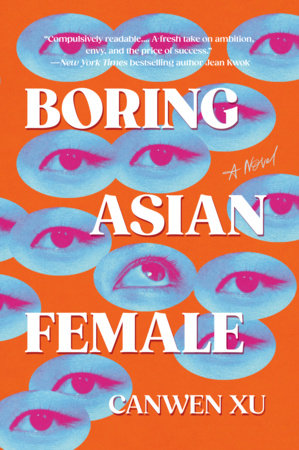
Boring Asian Female

Author Canwen Xu On Tour
Look inside
Listen to a clip from the audiobook
audio pause button
0:00
0:00
“Thank you for your interest in our school, but we regret to inform you that…” you’re not special. You’re too average. You’re too boring.

Well, in that case, she’ll have to show them just how interesting she can be.

Elizabeth Zhang is well aware of her place in the world. She’s in the tenth percentile for likability, the seventieth percentile for attractiveness, and the ninety-ninth percentile for academics. While she’s never been the most beautiful or the most liked, she knows she has the intelligence and ambition to achieve her greatest dream: Harvard Law School. But when Harvard rejects Elizabeth for not standing out enough—which she knows means she's just another boring Asian female—her carefully constructed life falls apart. What shocks her even more is that Laura Kim, a classmate at Columbia, got in. Elizabeth can’t figure out how this could have happened. Why was Laura accepted? What makes her so interesting?

At first, she follows her because she’s just curious. What Laura orders for lunch. Where Laura shops. What Laura’s hobbies are. All of these things must contribute to her overall package, what makes her an acceptable person to Harvard. But still, Elizabeth just can’t see it. The only thing she sees is that Laura has taken her spot.

A spot that she knows she deserves after working so hard. A spot that she’ll simply have to take back.

Layered and subversive, this novel brings to light how, in the face of societal expectations and self-inflicted pressures, a person can unlock the darkest parts of themselves and show how far they’re willing to go to achieve their vision of success.
ONE

He wouldn't stop staring at her legs.

While the rest of the fifty or so potential donors at least pretended to be enamored by Eunjin's violin solo, Arnold Schoenbackler stared straight at Eunjin's exposed thighs.

She had asked me beforehand if the black dress was too short; I told her no. It wasn't the 1930s, for heaven's sake. No one in Manhattan cared about modesty. To eschew traditionalism was to belong right in this crowd of wealthy New Yorkers, among whom sexism and slut-shaming were major faux pas.

But I admit I overlooked this one critical piece: the unwelcome stares of creepy old men. Specifically, Arnold Schoenbackler, the epitome of a creepy old man.

The event that night was hosted at one of his galleries sprawled across the Northeast. It was an alumni fundraising event for Columbia University, of which Arnold was a trustee. The gallery comprised a single floor, with high ceilings in a converted industrial space and entrance doors heavy enough to seem locked even when they weren't. The attendees' clothing, in shades of crimson or chartreuse or electric green, stood in stark contrast to the works hanging on the wall, which were splotches of black ink on yellowed paper. Schoenbackler described the exhibition as "a harmonious symphony of temporal epochs and spiritual contemplation through an alchemical fusion of calligraphic antiquity and the visceral fervor of Abstract Expressionism." I would describe it as a modern take on Chinese calligraphy. The artist was Chinese, but he wasn't there, so I was the only ethnically Chinese person in the room.

Eunjin played her violin in the center while the attendees watched. Many of them grasped plastic cups of wine and squinted to announce to the others that they were concentrating extra hard on the solo. Some even crossed one arm over the other and tilted their heads to the side. I liked to call this "the thinking pose."

From the moment I walked in I had felt like I was missing something that everyone else had; I just couldn't put my finger on what. Every time I spoke to someone I felt they could sense that I lacked this mysterious quality. Their eyes darted away, or they became more animated while talking to someone else. Still, I wondered if I was just overthinking it.

Schoenbackler's assistant had invited Eunjin to perform after emailing the music department at Columbia for a recommendation. The chair knew that her work-study job barely covered her living expenses and referred her for paid gigs whenever possible. As Eunjin's best friend, I tagged along for moral support. It boosted my ego a bit to know that the person I connected with the most happened to be a former child prodigy. If you looked her up on the internet (as I did after the first time we met), you'd find a string of articles describing her as "the ten-year-old virtuoso playing with the Philadelphia Orchestra" and "the daughter of Korean immigrants whose performance sparkled at Carnegie Hall." Technically, only her mom is Korean. Her dad is white.


My name is Elizabeth. I don’t quite know how to describe myself, other than the fact that I’m pretty good at most things I do. I graduated valedictorian from my high school in South Dakota, I have a 3.9 GPA, and I’m decently pretty. I’m pretty enough that it helps me in life, but I’m not pretty enough that it hurts me in life. I’m not so pretty that women find me intimidating, but I’m pretty enough that men want to be friends with me. I think I’m in the 70th percentile of Asian women my age, which is less pretty than a white-passing woman in the 70th percentile of my age. No, I’m not racist. I’m just finely attuned to how our society is racist.

Before I moved to New York for college, I spent all of my life in Brookings, South Dakota. Population 23,000. Whenever I think about my life in South Dakota, I mostly think about how much I wanted to escape South Dakota. You never heard about South Dakota, let alone Brookings, in TV shows, movies, and the national news. Nothing that happened there mattered. The logical conclusion was that if I continued to live there, my life wouldn't matter either.

To make matters worse, I was a nobody in my own high school. This meant I didn't even matter in the place that didn't matter. I was the only person of color in my grade at school, so everybody knew my name, but few wanted anything to do with me. They asked me the exact type of racially charged questions you would expect. Not all of the things that they said were bad. A friend from middle school told me that because I was so smart, they now assumed that all Asians were smart. Still, that didn't make me feel great.

My plan to escape South Dakota and get back at the people who had underappreciated me all my life was to be a somebody in a place that mattered. It was relatively easy to figure out what that place was.

In middle school and high school, everyone, especially the girls, watched The East Siders, a show about wealthy teenagers who all went to the same prep school on the Upper East Side. The show was pretty bad, but that was beside the point. The characters were everything I aspired to be. They weren't just cool because they liked to party; they were cool because they liked to party and cared about school and success.

The show taught us Great Plains teenagers something important about the world: that the least cool Upper East Side private school kid was still eons cooler than the queen bees of a South Dakota public school. Even the popular kids at Brookings High, the ones who looked down upon me all my life, knew that. The week after season three premiered, our prom queen, Georgiana Van Aartsen (she goes by Gigi), started wearing plaid skirts and knee-high socks every day to school. South Dakota was nothing, and New York City was everything. The characters in The East Siders were people who mattered in a place that also mattered.

In season five of the show, the characters all decide to attend Columbia University. In retrospect, I realize that the producers picked the school because it would allow all of the characters to stay in New York, but at the time it felt like my decision was made for me. I, Elizabeth Zhang, would also attend Columbia University. It wasn't feasible for me to go to high school on the Upper East Side, but college on the Upper West Side was something I could accomplish. After all, I wasn't particularly hot, I definitely wasn't popular, but I was pretty smart. And more importantly, I was ambitious.

Senior year of high school, I applied early to Columbia and got in. When the news spread among the eighty or so seniors in our graduating class that I had gotten into an Ivy League, even Georgiana Van Aartsen was impressed. I think it was the only time she ever acknowledged my existence outside of a group project or the conversational portion of Advanced Placement Spanish class. "I heard you're moving to New York," she said. "That's cool." I too thought it was cool. I could already picture the glamour-nights out at clubs with fake IDs, parties in brownstones under swanky chandeliers, and, of course, private fundraising events at art galleries.

I researched everything I could about Columbia University. The classes, the clubs, the alumni. In my head, attending Columbia would be my ticket to the life I always dreamed of, the one that would prove once and for all that I was better than all the people with whom I went to high school.

But then, I stumbled upon some less-than-ideal information. The salaries for Columbia graduates were okay, but not stellar. Sure, I'd have a prestigious degree on my résumé, but it didn't guarantee me a lucrative career. Money was an important aspect of the lifestyle in The East Siders. Without it, I would be back where I started: a nobody. After all, Georgiana Van Aartsen was popular not just because of her button nose and blonde highlights; her dad also owned a regional distribution company, and they lived in a mansion with a swimming pool and tennis court. I started to regret my decision. I realized that it was probably not the best idea to choose a college based on a TV show. I probably should've just done premed at a state school, or applied to Columbia Engineering instead of Columbia College, even though Advanced Placement Physics was my worst class. Also, Columbia wasn't even the best school. Harvard was.

Fortunately, after some more late nights of frantic research, I discovered that I still had a second shot. Law school. It's what you did if you wanted to be rich but hated math. Plus, I could finally get Harvard on my résumé, rather than Columbia, which was at best just a mid-tier Ivy and only had the third-lowest acceptance rate out of universities in the United States. A spot at Harvard Law School would propel me to a high-status and lucrative career in corporate law, the last step it would take for me to reach my full potential. Getting to New York would mean that I was finally in a place that mattered, and now becoming a Harvard-educated lawyer would mean that I would be a person who mattered as well.

So from the moment I stepped foot on Columbia's campus, I knew what I was preparing for. I picked political science as my major (the most respectable of the disciplines for academically challenged people), avoided any weeder classes, maintained a 3.9 GPA, and took the LSAT the spring of my junior year. I scored a 178, two points below perfect. I spent the summer after junior year and the first couple months of senior year writing my application essays and obtaining my letters of recommendation. Unlike the inferior students who were scrambling to decide which professors they would ask, from the start of freshman year I had carefully evaluated each of them based on our personal chemistry and my performance in their class. I continued nurturing an academic relationship with the ones who appeared the most promising through the occasional handwritten note and email update. This would ensure that they would put sufficient thought and personalization into their letters once it came time to write them.

Two weeks ago, I had pressed submit on all my applications. Now it was mid-October, and I was just waiting for the news that my hard work and planning had officially paid off. This thought made me stand a little straighter as Eunjin moved on to the third movement of her sonata. I told myself that I should get used to spending time around these people, even if I found their interest in the arts a bit contrived and annoying. In just a few years, I'd be one of them.


A few minutes later, Eunjin finished her performance, and the audience responded with applause. A couple of them hooted for good measure. Arnold joined her in front of the crowd, slinging an arm over her shoulder. She slouched under his grasp, wearing an embarrassed smile. “Give it up for Eunjin!” he boomed while grinning at the crowd, as though his mouth were trying to take up as much space as possible. This spurred another round of applause and another couple of hoots. Members of the audience approached Eunjin to compliment her.

"You played beautifully!" they said. "You're so talented!"

They mispronounced her name, calling her "Yi-jen" or "Lee-jing" instead of "En-jin." Eunjin didn't correct them. I was a little bit mad that she didn't correct them. But if I were in her position, maybe I wouldn't either.

Eunjin was too preoccupied with her admirers, so I stood on the sidelines, pretending to be preoccupied by the art when really I was watching the people. Earlier in the night, I had discovered that I could judge the importance of each guest by the extent of Schoenbackler's obsequiousness-whether he merely shook your hand or added some personalization, such as asking how your niece was liking their first year at the Lycée. For example, he greeted Eunjin with a handshake and a "Thank you for agreeing to perform," and with me, he barely mustered a wave. I wasn't offended. I knew I was a nobody now, but in a few years, after I had graduated from Harvard Law School and made partner at my law firm, I would be here as a guest, not as a lowly plus-one. I would also be someone whom Arnold would have to woo.

At the end of the night, Schoenbackler's assistant handed Eunjin a two-hundred-dollar check. We walked to the 1 train on 23rd Street to return to campus. The subway car smelled of stale air-conditioning with a hint of pee. It was a slight upgrade from the subway platform, which smelled like trash with a hint of feces. The only people in the car were two construction workers and a homeless man dozing in the corner.

"Didn't he tell you two fifty?" I asked. Eunjin shrugged.

"I thought he did, but for a twenty-minute performance it's still pretty good." The homeless man jolted his head before dozing off once more. The two construction workers sat in silence, slumped against the smooth contours of the subway seats.

"So what did you think?" she asked. "Was it what you expected?"

"It was pretty much what I expected," I replied. "By that I mean I expected I would feel like the poorest person there, and that is indeed how I felt."

"Eh. The bartender is probably poorer than you. I'm poorer than you."

"Semantics, but fine."

We shifted into a comfortable silence, listening to the syncopated rhythm of the train movements. From my tote bag I pulled out one of my assigned readings for class, a printed PDF excerpt of something Hegel wrote. Eunjin flipped through flash cards with names of composers on one side and handwritten biographies on the other. It was hard to focus on the reading with the slowing and speeding of the train, but I felt motivated to continue, even just to comfort myself with the illusion of productivity.

When we arrived at 110th, I looked up from my reading.

"She'll probably receive a nice tip tonight."

"What?"

"The bartender. Judging by how Schoenbackler was looking at her, she'll probably receive a nice tip tonight."

We got off the subway at 116th, passing the turnstile and walking up the steps that led to the main campus gates. I felt a hand on my left shoulder and I turned to the side, expecting it to be Eunjin, but it was actually Gina Lam, wearing a silky dress and strappy heels, standing beside a friend who was also dressed to go out. I knew Gina well because the two of us used to study for Principles of Economics together. Well, by study, I mean I gave her my answers to the problem sets, but this was freshman year and back then I was just grateful that someone as cool as Gina Lam was being nice to me.
"Canwen Xu’s Boring Asian Female is a compulsively readable debut, propelled by sharp writing and pitch-perfect pacing. Smart, engaging, and thought-provoking, it offers a fresh take on ambition, envy, and the price of success."—Jean Kwok, New York Times bestselling author of The Leftover Woman

“Topical and hilarious, Boring Asian Female features a main character who is both relatable and completely unhinged. I literally gasped as Elizabeth makes a series of increasingly outrageous choices in order to try to get into Harvard Law and the twist at the end made me cackle out loud. A perfect book for our contemporary moment.”—Tasha Coryell, bestselling author of Matchmaking for Psychopaths

"In Boring Asian Female, Canwen Xu masterfully examines ambition and self-delusion as her narrator’s obsession with Harvard Law School, and the student who seems to have taken 'her' spot, grows more and more extreme…and dangerous. This sly, propulsive thriller mesmerized me, then moved me with its surprisingly tender final pages. Xu's cautionary tale will resonate with anyone who has found themselves caught in the trap of expectations, whether cultural or self-imposed. A riveting, heartbreaking debut."—Cynthia Weiner, author of A Gorgeous Excitement

"A magnificent and deeply entertaining debut, Boring Asian Female is an incisive and thrilling story that so many will relate to. Canwen Xu pulls no punches in writing a hilariously unhinged protagonist where actions spiral beyond control and stereotypes are subverted in the most refreshing and unapologetic way. A must read!"—Liann Zhang, author of Julie Chan is Dead

“A perfectly calibrated combination of obsession, jealousy, and ambition, Boring Asian Female is a captivating debut. The narrator, Elizabeth Zhang, is ruthless, reckless, and yet somehow impossible not to root for—a truly unforgettable protagonist. Chilling and delightful to the very last page.”—Emma White, author of Venom Lake

“Canwen Xu's sharp-edged debut will have you on the edge of your seat, wondering just how far the protagonist will go. Unputdownable, addictive, and relentlessly clever, it is surely, as the protagonist Elizabeth would say, in the 99th percentile for riveting novels. Xu is a writer to watch.”—Isabel Banta, author of Honey

“If campus thrillers make your heart beat a little faster, this one is about to become your new obsession. Xu delivers a razor-sharp story about a young woman who becomes fixated on her academic rival and spirals into a dark, satirical look at meritocracy and the pressure cooker of elite academia. Perfect for fans of Yellowface and The Other Black Girl, it is subversive, tense, and exactly the kind of book you’ll want to discuss with every friend who went to a competitive school.”—Parade

"Ambition loosens a second-generation Chinese American’s grip on reality in Xu’s gleefully unhinged debut...Xu’s twisted tale nimbly toes the line between noir and satire, with Elizabeth’s neurotic narration growing increasingly claustrophobic as her desperation mounts and her delusions multiply. This darkly funny descent into madness is certain to make a splash."—Publishers Weekly

"Xu’s debut is a thoughtful exploration of a woman consumed with measuring everything by metrics and by an obsession with having the perfect life. Employing a deliberately measured sense of pacing, Xu slowly and effectively builds tension in the novel until everything finally implodes for her protagonist. A great genre crossover for fiction readers looking for a soupçon of suspense or anyone fascinated with the themes of jealousy and envy, as explored in Jesse Q. Sutanto’s I Am Not Done with You Yet."—Library Journal

“For those who love an unraveling woman protagonist (me included, obviously), then get ready for this addictive debut novel.”—Electric Lit
© Austin Ruffer
Canwen Xu is a writer living in New York City, but she grew up in North Dakota, South Dakota, and Idaho, three of the nine American states where cows outnumber people. Her TEDx talk from her senior year of high school, titled “I Am Not Your Asian Stereotype,” has been watched over three million times. She graduated from Columbia College, Columbia University with a Bachelor of Arts degree in political science and computer science. View titles by Canwen Xu

About

“Thank you for your interest in our school, but we regret to inform you that…” you’re not special. You’re too average. You’re too boring.

Well, in that case, she’ll have to show them just how interesting she can be.

Elizabeth Zhang is well aware of her place in the world. She’s in the tenth percentile for likability, the seventieth percentile for attractiveness, and the ninety-ninth percentile for academics. While she’s never been the most beautiful or the most liked, she knows she has the intelligence and ambition to achieve her greatest dream: Harvard Law School. But when Harvard rejects Elizabeth for not standing out enough—which she knows means she's just another boring Asian female—her carefully constructed life falls apart. What shocks her even more is that Laura Kim, a classmate at Columbia, got in. Elizabeth can’t figure out how this could have happened. Why was Laura accepted? What makes her so interesting?

At first, she follows her because she’s just curious. What Laura orders for lunch. Where Laura shops. What Laura’s hobbies are. All of these things must contribute to her overall package, what makes her an acceptable person to Harvard. But still, Elizabeth just can’t see it. The only thing she sees is that Laura has taken her spot.

A spot that she knows she deserves after working so hard. A spot that she’ll simply have to take back.

Layered and subversive, this novel brings to light how, in the face of societal expectations and self-inflicted pressures, a person can unlock the darkest parts of themselves and show how far they’re willing to go to achieve their vision of success.

Excerpt

ONE

He wouldn't stop staring at her legs.

While the rest of the fifty or so potential donors at least pretended to be enamored by Eunjin's violin solo, Arnold Schoenbackler stared straight at Eunjin's exposed thighs.

She had asked me beforehand if the black dress was too short; I told her no. It wasn't the 1930s, for heaven's sake. No one in Manhattan cared about modesty. To eschew traditionalism was to belong right in this crowd of wealthy New Yorkers, among whom sexism and slut-shaming were major faux pas.

But I admit I overlooked this one critical piece: the unwelcome stares of creepy old men. Specifically, Arnold Schoenbackler, the epitome of a creepy old man.

The event that night was hosted at one of his galleries sprawled across the Northeast. It was an alumni fundraising event for Columbia University, of which Arnold was a trustee. The gallery comprised a single floor, with high ceilings in a converted industrial space and entrance doors heavy enough to seem locked even when they weren't. The attendees' clothing, in shades of crimson or chartreuse or electric green, stood in stark contrast to the works hanging on the wall, which were splotches of black ink on yellowed paper. Schoenbackler described the exhibition as "a harmonious symphony of temporal epochs and spiritual contemplation through an alchemical fusion of calligraphic antiquity and the visceral fervor of Abstract Expressionism." I would describe it as a modern take on Chinese calligraphy. The artist was Chinese, but he wasn't there, so I was the only ethnically Chinese person in the room.

Eunjin played her violin in the center while the attendees watched. Many of them grasped plastic cups of wine and squinted to announce to the others that they were concentrating extra hard on the solo. Some even crossed one arm over the other and tilted their heads to the side. I liked to call this "the thinking pose."

From the moment I walked in I had felt like I was missing something that everyone else had; I just couldn't put my finger on what. Every time I spoke to someone I felt they could sense that I lacked this mysterious quality. Their eyes darted away, or they became more animated while talking to someone else. Still, I wondered if I was just overthinking it.

Schoenbackler's assistant had invited Eunjin to perform after emailing the music department at Columbia for a recommendation. The chair knew that her work-study job barely covered her living expenses and referred her for paid gigs whenever possible. As Eunjin's best friend, I tagged along for moral support. It boosted my ego a bit to know that the person I connected with the most happened to be a former child prodigy. If you looked her up on the internet (as I did after the first time we met), you'd find a string of articles describing her as "the ten-year-old virtuoso playing with the Philadelphia Orchestra" and "the daughter of Korean immigrants whose performance sparkled at Carnegie Hall." Technically, only her mom is Korean. Her dad is white.


My name is Elizabeth. I don’t quite know how to describe myself, other than the fact that I’m pretty good at most things I do. I graduated valedictorian from my high school in South Dakota, I have a 3.9 GPA, and I’m decently pretty. I’m pretty enough that it helps me in life, but I’m not pretty enough that it hurts me in life. I’m not so pretty that women find me intimidating, but I’m pretty enough that men want to be friends with me. I think I’m in the 70th percentile of Asian women my age, which is less pretty than a white-passing woman in the 70th percentile of my age. No, I’m not racist. I’m just finely attuned to how our society is racist.

Before I moved to New York for college, I spent all of my life in Brookings, South Dakota. Population 23,000. Whenever I think about my life in South Dakota, I mostly think about how much I wanted to escape South Dakota. You never heard about South Dakota, let alone Brookings, in TV shows, movies, and the national news. Nothing that happened there mattered. The logical conclusion was that if I continued to live there, my life wouldn't matter either.

To make matters worse, I was a nobody in my own high school. This meant I didn't even matter in the place that didn't matter. I was the only person of color in my grade at school, so everybody knew my name, but few wanted anything to do with me. They asked me the exact type of racially charged questions you would expect. Not all of the things that they said were bad. A friend from middle school told me that because I was so smart, they now assumed that all Asians were smart. Still, that didn't make me feel great.

My plan to escape South Dakota and get back at the people who had underappreciated me all my life was to be a somebody in a place that mattered. It was relatively easy to figure out what that place was.

In middle school and high school, everyone, especially the girls, watched The East Siders, a show about wealthy teenagers who all went to the same prep school on the Upper East Side. The show was pretty bad, but that was beside the point. The characters were everything I aspired to be. They weren't just cool because they liked to party; they were cool because they liked to party and cared about school and success.

The show taught us Great Plains teenagers something important about the world: that the least cool Upper East Side private school kid was still eons cooler than the queen bees of a South Dakota public school. Even the popular kids at Brookings High, the ones who looked down upon me all my life, knew that. The week after season three premiered, our prom queen, Georgiana Van Aartsen (she goes by Gigi), started wearing plaid skirts and knee-high socks every day to school. South Dakota was nothing, and New York City was everything. The characters in The East Siders were people who mattered in a place that also mattered.

In season five of the show, the characters all decide to attend Columbia University. In retrospect, I realize that the producers picked the school because it would allow all of the characters to stay in New York, but at the time it felt like my decision was made for me. I, Elizabeth Zhang, would also attend Columbia University. It wasn't feasible for me to go to high school on the Upper East Side, but college on the Upper West Side was something I could accomplish. After all, I wasn't particularly hot, I definitely wasn't popular, but I was pretty smart. And more importantly, I was ambitious.

Senior year of high school, I applied early to Columbia and got in. When the news spread among the eighty or so seniors in our graduating class that I had gotten into an Ivy League, even Georgiana Van Aartsen was impressed. I think it was the only time she ever acknowledged my existence outside of a group project or the conversational portion of Advanced Placement Spanish class. "I heard you're moving to New York," she said. "That's cool." I too thought it was cool. I could already picture the glamour-nights out at clubs with fake IDs, parties in brownstones under swanky chandeliers, and, of course, private fundraising events at art galleries.

I researched everything I could about Columbia University. The classes, the clubs, the alumni. In my head, attending Columbia would be my ticket to the life I always dreamed of, the one that would prove once and for all that I was better than all the people with whom I went to high school.

But then, I stumbled upon some less-than-ideal information. The salaries for Columbia graduates were okay, but not stellar. Sure, I'd have a prestigious degree on my résumé, but it didn't guarantee me a lucrative career. Money was an important aspect of the lifestyle in The East Siders. Without it, I would be back where I started: a nobody. After all, Georgiana Van Aartsen was popular not just because of her button nose and blonde highlights; her dad also owned a regional distribution company, and they lived in a mansion with a swimming pool and tennis court. I started to regret my decision. I realized that it was probably not the best idea to choose a college based on a TV show. I probably should've just done premed at a state school, or applied to Columbia Engineering instead of Columbia College, even though Advanced Placement Physics was my worst class. Also, Columbia wasn't even the best school. Harvard was.

Fortunately, after some more late nights of frantic research, I discovered that I still had a second shot. Law school. It's what you did if you wanted to be rich but hated math. Plus, I could finally get Harvard on my résumé, rather than Columbia, which was at best just a mid-tier Ivy and only had the third-lowest acceptance rate out of universities in the United States. A spot at Harvard Law School would propel me to a high-status and lucrative career in corporate law, the last step it would take for me to reach my full potential. Getting to New York would mean that I was finally in a place that mattered, and now becoming a Harvard-educated lawyer would mean that I would be a person who mattered as well.

So from the moment I stepped foot on Columbia's campus, I knew what I was preparing for. I picked political science as my major (the most respectable of the disciplines for academically challenged people), avoided any weeder classes, maintained a 3.9 GPA, and took the LSAT the spring of my junior year. I scored a 178, two points below perfect. I spent the summer after junior year and the first couple months of senior year writing my application essays and obtaining my letters of recommendation. Unlike the inferior students who were scrambling to decide which professors they would ask, from the start of freshman year I had carefully evaluated each of them based on our personal chemistry and my performance in their class. I continued nurturing an academic relationship with the ones who appeared the most promising through the occasional handwritten note and email update. This would ensure that they would put sufficient thought and personalization into their letters once it came time to write them.

Two weeks ago, I had pressed submit on all my applications. Now it was mid-October, and I was just waiting for the news that my hard work and planning had officially paid off. This thought made me stand a little straighter as Eunjin moved on to the third movement of her sonata. I told myself that I should get used to spending time around these people, even if I found their interest in the arts a bit contrived and annoying. In just a few years, I'd be one of them.


A few minutes later, Eunjin finished her performance, and the audience responded with applause. A couple of them hooted for good measure. Arnold joined her in front of the crowd, slinging an arm over her shoulder. She slouched under his grasp, wearing an embarrassed smile. “Give it up for Eunjin!” he boomed while grinning at the crowd, as though his mouth were trying to take up as much space as possible. This spurred another round of applause and another couple of hoots. Members of the audience approached Eunjin to compliment her.

"You played beautifully!" they said. "You're so talented!"

They mispronounced her name, calling her "Yi-jen" or "Lee-jing" instead of "En-jin." Eunjin didn't correct them. I was a little bit mad that she didn't correct them. But if I were in her position, maybe I wouldn't either.

Eunjin was too preoccupied with her admirers, so I stood on the sidelines, pretending to be preoccupied by the art when really I was watching the people. Earlier in the night, I had discovered that I could judge the importance of each guest by the extent of Schoenbackler's obsequiousness-whether he merely shook your hand or added some personalization, such as asking how your niece was liking their first year at the Lycée. For example, he greeted Eunjin with a handshake and a "Thank you for agreeing to perform," and with me, he barely mustered a wave. I wasn't offended. I knew I was a nobody now, but in a few years, after I had graduated from Harvard Law School and made partner at my law firm, I would be here as a guest, not as a lowly plus-one. I would also be someone whom Arnold would have to woo.

At the end of the night, Schoenbackler's assistant handed Eunjin a two-hundred-dollar check. We walked to the 1 train on 23rd Street to return to campus. The subway car smelled of stale air-conditioning with a hint of pee. It was a slight upgrade from the subway platform, which smelled like trash with a hint of feces. The only people in the car were two construction workers and a homeless man dozing in the corner.

"Didn't he tell you two fifty?" I asked. Eunjin shrugged.

"I thought he did, but for a twenty-minute performance it's still pretty good." The homeless man jolted his head before dozing off once more. The two construction workers sat in silence, slumped against the smooth contours of the subway seats.

"So what did you think?" she asked. "Was it what you expected?"

"It was pretty much what I expected," I replied. "By that I mean I expected I would feel like the poorest person there, and that is indeed how I felt."

"Eh. The bartender is probably poorer than you. I'm poorer than you."

"Semantics, but fine."

We shifted into a comfortable silence, listening to the syncopated rhythm of the train movements. From my tote bag I pulled out one of my assigned readings for class, a printed PDF excerpt of something Hegel wrote. Eunjin flipped through flash cards with names of composers on one side and handwritten biographies on the other. It was hard to focus on the reading with the slowing and speeding of the train, but I felt motivated to continue, even just to comfort myself with the illusion of productivity.

When we arrived at 110th, I looked up from my reading.

"She'll probably receive a nice tip tonight."

"What?"

"The bartender. Judging by how Schoenbackler was looking at her, she'll probably receive a nice tip tonight."

We got off the subway at 116th, passing the turnstile and walking up the steps that led to the main campus gates. I felt a hand on my left shoulder and I turned to the side, expecting it to be Eunjin, but it was actually Gina Lam, wearing a silky dress and strappy heels, standing beside a friend who was also dressed to go out. I knew Gina well because the two of us used to study for Principles of Economics together. Well, by study, I mean I gave her my answers to the problem sets, but this was freshman year and back then I was just grateful that someone as cool as Gina Lam was being nice to me.

Reviews

"Canwen Xu’s Boring Asian Female is a compulsively readable debut, propelled by sharp writing and pitch-perfect pacing. Smart, engaging, and thought-provoking, it offers a fresh take on ambition, envy, and the price of success."—Jean Kwok, New York Times bestselling author of The Leftover Woman

“Topical and hilarious, Boring Asian Female features a main character who is both relatable and completely unhinged. I literally gasped as Elizabeth makes a series of increasingly outrageous choices in order to try to get into Harvard Law and the twist at the end made me cackle out loud. A perfect book for our contemporary moment.”—Tasha Coryell, bestselling author of Matchmaking for Psychopaths

"In Boring Asian Female, Canwen Xu masterfully examines ambition and self-delusion as her narrator’s obsession with Harvard Law School, and the student who seems to have taken 'her' spot, grows more and more extreme…and dangerous. This sly, propulsive thriller mesmerized me, then moved me with its surprisingly tender final pages. Xu's cautionary tale will resonate with anyone who has found themselves caught in the trap of expectations, whether cultural or self-imposed. A riveting, heartbreaking debut."—Cynthia Weiner, author of A Gorgeous Excitement

"A magnificent and deeply entertaining debut, Boring Asian Female is an incisive and thrilling story that so many will relate to. Canwen Xu pulls no punches in writing a hilariously unhinged protagonist where actions spiral beyond control and stereotypes are subverted in the most refreshing and unapologetic way. A must read!"—Liann Zhang, author of Julie Chan is Dead

“A perfectly calibrated combination of obsession, jealousy, and ambition, Boring Asian Female is a captivating debut. The narrator, Elizabeth Zhang, is ruthless, reckless, and yet somehow impossible not to root for—a truly unforgettable protagonist. Chilling and delightful to the very last page.”—Emma White, author of Venom Lake

“Canwen Xu's sharp-edged debut will have you on the edge of your seat, wondering just how far the protagonist will go. Unputdownable, addictive, and relentlessly clever, it is surely, as the protagonist Elizabeth would say, in the 99th percentile for riveting novels. Xu is a writer to watch.”—Isabel Banta, author of Honey

“If campus thrillers make your heart beat a little faster, this one is about to become your new obsession. Xu delivers a razor-sharp story about a young woman who becomes fixated on her academic rival and spirals into a dark, satirical look at meritocracy and the pressure cooker of elite academia. Perfect for fans of Yellowface and The Other Black Girl, it is subversive, tense, and exactly the kind of book you’ll want to discuss with every friend who went to a competitive school.”—Parade

"Ambition loosens a second-generation Chinese American’s grip on reality in Xu’s gleefully unhinged debut...Xu’s twisted tale nimbly toes the line between noir and satire, with Elizabeth’s neurotic narration growing increasingly claustrophobic as her desperation mounts and her delusions multiply. This darkly funny descent into madness is certain to make a splash."—Publishers Weekly

"Xu’s debut is a thoughtful exploration of a woman consumed with measuring everything by metrics and by an obsession with having the perfect life. Employing a deliberately measured sense of pacing, Xu slowly and effectively builds tension in the novel until everything finally implodes for her protagonist. A great genre crossover for fiction readers looking for a soupçon of suspense or anyone fascinated with the themes of jealousy and envy, as explored in Jesse Q. Sutanto’s I Am Not Done with You Yet."—Library Journal

“For those who love an unraveling woman protagonist (me included, obviously), then get ready for this addictive debut novel.”—Electric Lit

Author

© Austin Ruffer
Canwen Xu is a writer living in New York City, but she grew up in North Dakota, South Dakota, and Idaho, three of the nine American states where cows outnumber people. Her TEDx talk from her senior year of high school, titled “I Am Not Your Asian Stereotype,” has been watched over three million times. She graduated from Columbia College, Columbia University with a Bachelor of Arts degree in political science and computer science. View titles by Canwen Xu
  • More Websites from
    Penguin Random House
  • Common Reads
  • Library Marketing