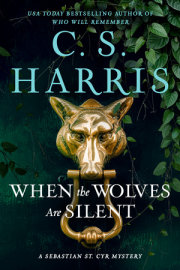
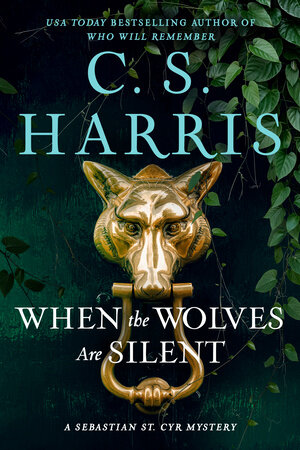
When the Wolves Are Silent

Hardcover
$30.00 US
| $41.99 CAN
On sale Apr 14, 2026 | 400 Pages | 9780593953891

See Additional Formats
A brutal string of ritualistic killings terrorizes a city already shaken by economic and political turmoil in this chilling new historical mystery from C. S. Harris, USA Today bestselling author of Who Will Remember.

London, 1816: When a notorious young aristocrat is burned alive on a windswept hill popular with neo-Druids, former cavalry officer Sebastian St. Cyr, Viscount Devlin, finds himself plunged into a murder investigation shadowed by tales of ancient human sacrifices and long-buried secrets. 

The victim, Marcus Toole, was the only son and heir of a prominent nobleman. His closest friend—Sebastian’s own nephew, Bayard—claims to have passed out drunk before the attack and remembers nothing. But when Sebastian and his brilliant wife, Hero, delve deeper into the sordid activities of Bayard and his friends, they come to realize that Bayard may not be as innocent as he pretends. Following a tangled trail that leads from a disaffected former soldier-turned-highwayman to a beautiful, courageous journalist and a Jamaican-born fencing master with ties to a radical political movement, Sebastian begins to suspect that Bayard and his friends are being targeted in revenge, by victims who believe they have no other recourse.

Then two more of Bayard’s friends are killed, their murders staged to echo the ritual sacrifices of the ancient Celts. With the palace shaken by the fear of riots and one horrifying death following another, Sebastian must race to stop a ruthless plot that threatens the lives of innocents and could rip his troubled nation apart.
Chapter 1

Primrose Hill: Saturday, 23 November 1816

Where the bloody hell am I?

The Right Honorable Bayard Wilcox, Thirteenth Lord Wilcox, blinked up at the storm-churned night sky, its full moon little more than a ghostly aura obscured by roiling clouds. Then his stomach gave a sick lurch and he squeezed his eyes shut again with a groan.

Swiping one gloved fist across his runny nose, Bayard sucked in a deep breath and realized he was lying flat on his back on the bloody ground with the dried stalks of some bloody plant tickling his bloody ear. He was so cold his teeth were chattering, and he smelled of blue ruin, woodsmoke, and piss.

Bloody Marcus Toole and his bloody cork-brained ideas.

Cautiously opening first one eye, then the other, Bayard rolled onto his side and lurched awkwardly to his feet. He stood swaying for a moment, aware that his flap was undone and the front of his pantaloons were soaked with urine. He had a vague memory of leaving the fire to take a piss and Toole laughing at him, telling him to look for some more scraps of wood while he was at it.

Bloody Marcus Toole.

Clumsily buttoning his flap, Bayard staggered back toward the golden, crackling glow of the fire, now blazing up hot and bright. Toole must've found his own bloody firewood, Bayard thought as he caught the scent of roasting meat hanging heavily in the frosty country air. But where the hell was Toole?

"Toole?" Bayard roared. "Are you cooking a bloody rabbit or something? And where the devil did you find that tree trunk?"

The sight of the long black log engulfed by the fire struck Bayard as ridiculously funny, and he doubled over in a gale of laughter that brought tears to his eyes. Except that when he straightened, wiping away his tears, he realized the thick, charred mass feeding those leaping flames was no log, and the pungent scent of roasting meat had nothing to do with a rabbit.

"Marcus?" whispered Bayard, then staggered back with a scream as the spreading flames ignited the smoking soles of his friend's fire-scorched boots.

Chapter 2

Grosvenor Square, London

S
ebastian St. Cyr, Viscount Devlin, repositioned his black knight and said, "Check."

His opponent, Alistair St. Cyr, the Fifth Earl of Hendon and for some years Chancellor of the Exchequer, frowned as he leaned back in his overstuffed leather chair, one hand coming up to cup the smooth wooden bowl of his pipe. The two men faced each other across a well-used chessboard set up between them and illuminated by the soft golden pool of light cast by a nearby brace of candles. A half-empty glass of brandy rested at each man's elbow; the fire dancing on the library hearth nearby filled the book-lined room with a cheerful crackle.

The sprawling Grosvenor Square town house was the Earl's London residence and had been for many years. A big, barrel-chested man in his early seventies, he had a thinning shock of white hair, a heavy-featured face, and the deep, vibrantly blue eyes that had been the hallmark of the St. Cyrs for centuries. Sebastian was younger, in his mid-thirties, tall and lean, with dark hair and strange yellow eyes that most men found disconcerting. He was known to the world as Hendon's only surviving son and heir, although he was not in fact Hendon's biological child. There had been a time when that painful truth-and the manner of its revelation-had driven a seemingly irreparable breach between the two men. But those days were now in the past.

"Not checkmate?" said Hendon, his teeth biting down on his pipe's stem as he studied the board.

"Not yet," said Sebastian, reaching for his brandy and taking a slow swallow. "There is a way."

"For all the good it will do me," grumbled Hendon.

Sebastian smiled. "You used to tell me-" he began, then paused, his head turning at the rattle of a curricle and team drawing up in the street outside. "Expecting someone?"

"No. Why?" said the Earl, just as the sound of a heavy fist beating a frantic tattoo on the front door reverberated through the house.

A man's familiar shrill voice came to them as Hendon's butler opened the door. "He is here, isn't he? My uncle-Devlin, I mean. With Grandfather? Oh, God; please tell me he's here!"

Hendon frowned. "Bayard?"

"Bayard," said Sebastian, his voice flat. Now nearly twenty-seven, Bayard was Hendon's grandson by the Earl's firstborn child and only daughter, Amanda, the Dowager Lady Wilcox. He had come into his title some five years before, on the death of his father, the previous Baron Wilcox. And while Sebastian couldn't help feeling sorry for the younger man in some ways, he'd always suspected Bayard took after his late father too much for comfort.

"My lord," they heard Hendon's butler, Hervey, say, his voice kept deliberately low and soothing. "If you'll just-"

"Where are they?" demanded Bayard, his bootheels clattering as he quickly crossed the entry's marble floor. "The library?"

Hendon pushed to his feet as the door to the library flew open and his disheveled grandson burst into the room. "Bayard? What the devil?"

Bayard's hat was gone, his cravat askew, his brown hair wildly disordered, his soft, plump face pasty white. His greatcoat hung open, and what looked like charcoal and unidentifiable muck smeared his extravagantly tailored navy blue coat, white-and-navy-striped silk waistcoat, and pale yellow pantaloons. He brought with him the pungent odors of woodsmoke, cheap gin, and urine.

"Sir," he said, bowing jerkily to his grandfather. But it was to Sebastian that he turned. "Devlin! Thank God you're here. You must help me! I-" He broke off, his breath coming in shallow pants as he brought up trembling hands to rake his limp straight hair back from his forehead. "Oh, God; I don't know what to do! He's dead, and I don't even understand what happened. I went to take a piss, you see, and I guess I must have stumbled and passed out, because when I came to, the fire was blazing and he was in it!"

"Who? Who the devil are you taking about?" said Hendon.

"Toole! Marcus Toole."

"Sir Samuel Toole's son?"

"Yes, yes!"

"Where?" said Sebastian. "Where did this happen?"

"At the top of Primrose Hill."

"What the hell were you doing there?"

Lying just to the north of London, beyond what was now being called Regent's Park, Primrose Hill was an unusual two-hundred-foot-high hill that rose somewhat like a massive ancient burial mound. Perhaps because of that it had lately become popular with those seeking to resurrect the culture and religion of Britain's legendary pre-Roman inhabitants, the Celts, and the mysterious Druid priesthood for which they were famous.

"It was Toole's idea. We were drinking at Chalk Farm Tavern, and Toole-" Bayard's voice faltered as his grandfather let out a startled oath, for as popular as the tavern's tea gardens were during the day, the place's proximity to the road from Hampstead Heath gave it an unsavory reputation after dark.

Bayard sucked in a deep breath and began again. "Toole, he got this idea in his head that he wanted to climb to the top of Primrose Hill-on account of the Druid ceremonies they're always having up there, you see."

"God help us," said Hendon. "Please tell me you haven't taken to dressing up in white robes to mumble a bunch of heathen nonsense under the full moon."

"What? Good God, no. We were laughing about how batty the lot of them are. It was just a lark."

"So you climbed to the top of the hill," said Sebastian. "And then what happened?"

"We built a fire." Bayard's voice shook, and he had to swallow hard. "There are all sorts of old firepits put there, you know, I suppose on account of whatever it is those Druid fellows do there. Someone'd even left a bundle of unburnt wood, so Toole, he starts this big, roaring fire. And then, like I said, I went to take a piss, and the next thing I know, when I open my eyes, the fire is blazing up like it's Guy Fawkes Day and Toole is in it! Dead!"

Sebastian and Hendon exchanged silent glances.

"What? You don't believe me?" said Bayard, his face taut as he looked from one man to the other. "Don't you understand? Someone must be targeting us! First Gil, and now Toole!"

"Gil?" said Sebastian.

"Gilbert Keebles. You must have heard what happened to him."

"Ah, yes," said Hendon.

"No," said Sebastian, who had only recently returned to London with his family after a several months' stay at his Hampshire estate.

Bayard looked incredulous. "It's only been a couple of weeks since he was killed!"

"How?" said Sebastian.

"Somebody stabbed him and threw him in the Thames. There's six of us who've been friends since we were in short coats, and now two of us are dead-murdered! It can't be a coincidence. It's like someone is deliberately killing us one by one! What if they mean to kill me next?"

Sebastian found that unlikely, but he simply drained his brandy and set the glass aside. "I take it you have your carriage waiting outside?"

Bayard shook his head. "I've got Toole's curricle-that is, if his stupid team haven't wandered off by now. But they're blown-I drove them hard coming back into town."

Hendon stared at his grandson. "Are you telling me you left the man's horses in the street unattended? Where is Toole's groom?"

"That bloody bastard? He was supposed to be waiting for us at the base of the hill, but I had to walk all the way back to Chalk Farm to find him. And then the worthless idiot was dead drunk, so I left him there and took the curricle."

"Good God," said Hendon, starting for the door. "I'll get someone to tend to the horses right away. And if you're planning to go back out there, Devlin, I might as well go ahead and have the stables get my carriage ready while I'm at it. It'll be quicker than sending to Brook Street for yours."

"You are going to help me, aren't you, Uncle?" said Bayard. "I mean, you've dealt with this sort of thing before. You'll know what to do."

"I'll go have a look, yes."

Bayard's features took on a pinched, sickly look. "There's no need for me to go out there with you, is there?"

"Actually, there is," said Sebastian. "Tell me this: How did you know where to find me?"

"I went by Brook Street first, and Lady Devlin said you were here."

"You told her why you wanted me?"

"Sort of."

"I'll send one of the footmen with a note to Hero, explaining where you've gone," said Hendon, coming back into the room. He glanced at his grandson. "And to your new bride as well, Bayard?"

"What? Oh, no need to bother. Fanny knows better than to be expecting me anytime soon."

"Indeed," said Hendon. He waited until Bayard had taken himself off, mumbling something about finding a pisspot, then said to Sebastian, "Will you notify Bow Street?"

"Not until I'm certain this isn't some prank or drunken muddle. Knowing Bayard, I wouldn't be surprised if we find Marcus Toole passed out beside his fire. Unless of course he's managed to make his way back to Chalk Farm Tavern, in which case he is no doubt as we speak shouting down the house because he thinks someone's pinched his curricle."

"It does sound like a farrago of nonsense."

"It does. But . . ." Sebastian paused.

Hendon looked over at him. "But?"

"What if it's not?"

Chapter 3

T
he smell of burnt meat hung like a dirty presence in the cold night air. It was a stench that no man who'd ever smelled charred human flesh could forget.

Sebastian found the odor clinging to his nostrils as he climbed the narrow footpath that wound up Primrose Hill, the frost-tipped, winter-killed grass of the gentle slope glowing silver in the fitful moonlight, the white fog of his exhalations billowing around him in a ghostly nimbus. And he felt himself hurtled back in time, to the days when his life had been filled with the roar of cannons and the reek of gunpowder and the screams of dying horses and wounded, sobbing men.

He pushed the memories away.

The old bullet wound in his right leg was beginning to ache, and he paused for a moment, glancing back at the base of the hill to where he had left Bayard snoring in Hendon's carriage. Still more than half-drunk, the younger man had fallen asleep and been impossible to rouse. And the truth was, Sebastian no longer needed him. The pungent smell carried by the wind told its own story.

He walked on. He was close enough now to the top of the hill to see the faintly glowing embers of the dying fire. He tried to recall whether he'd ever met Marcus Toole, and resurrected a memory of a young man of average height, medium brown hair, and unremarkable features; a man unapologetically proud of his ancient pedigree, of his ringing baritone and firm seat in the saddle, and of the wealth, title, and Norfolk estate that would someday be his.

Except now he was just a charred lump of black, burnt flesh on a cold, windswept hill.

"Bloody hell," whispered Sebastian as he drew up beside the dead man's scorched boots.

What was once a roaring bonfire had been reduced by now to a crumbling pile of blackened, half-incinerated lengths of wood resting on a bed of white ash, with only the faint glow of a few hot coals visible here and there. The hideous remnants of Marcus Toole lay sprawled on top like a late addition or an afterthought. Had he already been dead when his clothes went up in flames and the fire began to lick at his flesh? Sebastian hoped so. The man had fallen-or been thrown-onto the fire on his stomach, with one leg bent at an angle and his arms flung out at his sides.

If a man passed out and fell into a fire, would he wake up? Sebastian wondered. Maybe it depended on how drunk he was. What about an apoplexy or heart seizure? They might be rare in young men still in their twenties, but not unknown. There could be an innocent explanation for what he was looking at.

But he doubted it.

He began to walk in an ever-widening circle around the firepit and its reeking, mutilated horror, studying the ground, looking for something-anything-that might explain what had happened here. But the ground was hard, and the dead vegetation in the area well trampled by many feet, for even without the neo-Druid movement, Primrose Hill was near enough to London to be a popular spot.
© Samantha Lufti-Proctor
C. S. Harris is the USA Today bestselling author of more than thirty novels, including the Sebastian St. Cyr Mysteries; as C. S. Graham, a thriller series coauthored with former intelligence officer Steven Harris; and seven award-winning historical romances written under the name Candice Proctor. A respected scholar with a PhD in nineteenth-century Europe, she is also the author of a nonfiction historical study of the French Revolution. She lives with her husband in New Orleans and has two grown daughters. View titles by C. S. Harris

About

A brutal string of ritualistic killings terrorizes a city already shaken by economic and political turmoil in this chilling new historical mystery from C. S. Harris, USA Today bestselling author of Who Will Remember.

London, 1816: When a notorious young aristocrat is burned alive on a windswept hill popular with neo-Druids, former cavalry officer Sebastian St. Cyr, Viscount Devlin, finds himself plunged into a murder investigation shadowed by tales of ancient human sacrifices and long-buried secrets. 

The victim, Marcus Toole, was the only son and heir of a prominent nobleman. His closest friend—Sebastian’s own nephew, Bayard—claims to have passed out drunk before the attack and remembers nothing. But when Sebastian and his brilliant wife, Hero, delve deeper into the sordid activities of Bayard and his friends, they come to realize that Bayard may not be as innocent as he pretends. Following a tangled trail that leads from a disaffected former soldier-turned-highwayman to a beautiful, courageous journalist and a Jamaican-born fencing master with ties to a radical political movement, Sebastian begins to suspect that Bayard and his friends are being targeted in revenge, by victims who believe they have no other recourse.

Then two more of Bayard’s friends are killed, their murders staged to echo the ritual sacrifices of the ancient Celts. With the palace shaken by the fear of riots and one horrifying death following another, Sebastian must race to stop a ruthless plot that threatens the lives of innocents and could rip his troubled nation apart.

Excerpt

Chapter 1

Primrose Hill: Saturday, 23 November 1816

Where the bloody hell am I?

The Right Honorable Bayard Wilcox, Thirteenth Lord Wilcox, blinked up at the storm-churned night sky, its full moon little more than a ghostly aura obscured by roiling clouds. Then his stomach gave a sick lurch and he squeezed his eyes shut again with a groan.

Swiping one gloved fist across his runny nose, Bayard sucked in a deep breath and realized he was lying flat on his back on the bloody ground with the dried stalks of some bloody plant tickling his bloody ear. He was so cold his teeth were chattering, and he smelled of blue ruin, woodsmoke, and piss.

Bloody Marcus Toole and his bloody cork-brained ideas.

Cautiously opening first one eye, then the other, Bayard rolled onto his side and lurched awkwardly to his feet. He stood swaying for a moment, aware that his flap was undone and the front of his pantaloons were soaked with urine. He had a vague memory of leaving the fire to take a piss and Toole laughing at him, telling him to look for some more scraps of wood while he was at it.

Bloody Marcus Toole.

Clumsily buttoning his flap, Bayard staggered back toward the golden, crackling glow of the fire, now blazing up hot and bright. Toole must've found his own bloody firewood, Bayard thought as he caught the scent of roasting meat hanging heavily in the frosty country air. But where the hell was Toole?

"Toole?" Bayard roared. "Are you cooking a bloody rabbit or something? And where the devil did you find that tree trunk?"

The sight of the long black log engulfed by the fire struck Bayard as ridiculously funny, and he doubled over in a gale of laughter that brought tears to his eyes. Except that when he straightened, wiping away his tears, he realized the thick, charred mass feeding those leaping flames was no log, and the pungent scent of roasting meat had nothing to do with a rabbit.

"Marcus?" whispered Bayard, then staggered back with a scream as the spreading flames ignited the smoking soles of his friend's fire-scorched boots.

Chapter 2

Grosvenor Square, London

S
ebastian St. Cyr, Viscount Devlin, repositioned his black knight and said, "Check."

His opponent, Alistair St. Cyr, the Fifth Earl of Hendon and for some years Chancellor of the Exchequer, frowned as he leaned back in his overstuffed leather chair, one hand coming up to cup the smooth wooden bowl of his pipe. The two men faced each other across a well-used chessboard set up between them and illuminated by the soft golden pool of light cast by a nearby brace of candles. A half-empty glass of brandy rested at each man's elbow; the fire dancing on the library hearth nearby filled the book-lined room with a cheerful crackle.

The sprawling Grosvenor Square town house was the Earl's London residence and had been for many years. A big, barrel-chested man in his early seventies, he had a thinning shock of white hair, a heavy-featured face, and the deep, vibrantly blue eyes that had been the hallmark of the St. Cyrs for centuries. Sebastian was younger, in his mid-thirties, tall and lean, with dark hair and strange yellow eyes that most men found disconcerting. He was known to the world as Hendon's only surviving son and heir, although he was not in fact Hendon's biological child. There had been a time when that painful truth-and the manner of its revelation-had driven a seemingly irreparable breach between the two men. But those days were now in the past.

"Not checkmate?" said Hendon, his teeth biting down on his pipe's stem as he studied the board.

"Not yet," said Sebastian, reaching for his brandy and taking a slow swallow. "There is a way."

"For all the good it will do me," grumbled Hendon.

Sebastian smiled. "You used to tell me-" he began, then paused, his head turning at the rattle of a curricle and team drawing up in the street outside. "Expecting someone?"

"No. Why?" said the Earl, just as the sound of a heavy fist beating a frantic tattoo on the front door reverberated through the house.

A man's familiar shrill voice came to them as Hendon's butler opened the door. "He is here, isn't he? My uncle-Devlin, I mean. With Grandfather? Oh, God; please tell me he's here!"

Hendon frowned. "Bayard?"

"Bayard," said Sebastian, his voice flat. Now nearly twenty-seven, Bayard was Hendon's grandson by the Earl's firstborn child and only daughter, Amanda, the Dowager Lady Wilcox. He had come into his title some five years before, on the death of his father, the previous Baron Wilcox. And while Sebastian couldn't help feeling sorry for the younger man in some ways, he'd always suspected Bayard took after his late father too much for comfort.

"My lord," they heard Hendon's butler, Hervey, say, his voice kept deliberately low and soothing. "If you'll just-"

"Where are they?" demanded Bayard, his bootheels clattering as he quickly crossed the entry's marble floor. "The library?"

Hendon pushed to his feet as the door to the library flew open and his disheveled grandson burst into the room. "Bayard? What the devil?"

Bayard's hat was gone, his cravat askew, his brown hair wildly disordered, his soft, plump face pasty white. His greatcoat hung open, and what looked like charcoal and unidentifiable muck smeared his extravagantly tailored navy blue coat, white-and-navy-striped silk waistcoat, and pale yellow pantaloons. He brought with him the pungent odors of woodsmoke, cheap gin, and urine.

"Sir," he said, bowing jerkily to his grandfather. But it was to Sebastian that he turned. "Devlin! Thank God you're here. You must help me! I-" He broke off, his breath coming in shallow pants as he brought up trembling hands to rake his limp straight hair back from his forehead. "Oh, God; I don't know what to do! He's dead, and I don't even understand what happened. I went to take a piss, you see, and I guess I must have stumbled and passed out, because when I came to, the fire was blazing and he was in it!"

"Who? Who the devil are you taking about?" said Hendon.

"Toole! Marcus Toole."

"Sir Samuel Toole's son?"

"Yes, yes!"

"Where?" said Sebastian. "Where did this happen?"

"At the top of Primrose Hill."

"What the hell were you doing there?"

Lying just to the north of London, beyond what was now being called Regent's Park, Primrose Hill was an unusual two-hundred-foot-high hill that rose somewhat like a massive ancient burial mound. Perhaps because of that it had lately become popular with those seeking to resurrect the culture and religion of Britain's legendary pre-Roman inhabitants, the Celts, and the mysterious Druid priesthood for which they were famous.

"It was Toole's idea. We were drinking at Chalk Farm Tavern, and Toole-" Bayard's voice faltered as his grandfather let out a startled oath, for as popular as the tavern's tea gardens were during the day, the place's proximity to the road from Hampstead Heath gave it an unsavory reputation after dark.

Bayard sucked in a deep breath and began again. "Toole, he got this idea in his head that he wanted to climb to the top of Primrose Hill-on account of the Druid ceremonies they're always having up there, you see."

"God help us," said Hendon. "Please tell me you haven't taken to dressing up in white robes to mumble a bunch of heathen nonsense under the full moon."

"What? Good God, no. We were laughing about how batty the lot of them are. It was just a lark."

"So you climbed to the top of the hill," said Sebastian. "And then what happened?"

"We built a fire." Bayard's voice shook, and he had to swallow hard. "There are all sorts of old firepits put there, you know, I suppose on account of whatever it is those Druid fellows do there. Someone'd even left a bundle of unburnt wood, so Toole, he starts this big, roaring fire. And then, like I said, I went to take a piss, and the next thing I know, when I open my eyes, the fire is blazing up like it's Guy Fawkes Day and Toole is in it! Dead!"

Sebastian and Hendon exchanged silent glances.

"What? You don't believe me?" said Bayard, his face taut as he looked from one man to the other. "Don't you understand? Someone must be targeting us! First Gil, and now Toole!"

"Gil?" said Sebastian.

"Gilbert Keebles. You must have heard what happened to him."

"Ah, yes," said Hendon.

"No," said Sebastian, who had only recently returned to London with his family after a several months' stay at his Hampshire estate.

Bayard looked incredulous. "It's only been a couple of weeks since he was killed!"

"How?" said Sebastian.

"Somebody stabbed him and threw him in the Thames. There's six of us who've been friends since we were in short coats, and now two of us are dead-murdered! It can't be a coincidence. It's like someone is deliberately killing us one by one! What if they mean to kill me next?"

Sebastian found that unlikely, but he simply drained his brandy and set the glass aside. "I take it you have your carriage waiting outside?"

Bayard shook his head. "I've got Toole's curricle-that is, if his stupid team haven't wandered off by now. But they're blown-I drove them hard coming back into town."

Hendon stared at his grandson. "Are you telling me you left the man's horses in the street unattended? Where is Toole's groom?"

"That bloody bastard? He was supposed to be waiting for us at the base of the hill, but I had to walk all the way back to Chalk Farm to find him. And then the worthless idiot was dead drunk, so I left him there and took the curricle."

"Good God," said Hendon, starting for the door. "I'll get someone to tend to the horses right away. And if you're planning to go back out there, Devlin, I might as well go ahead and have the stables get my carriage ready while I'm at it. It'll be quicker than sending to Brook Street for yours."

"You are going to help me, aren't you, Uncle?" said Bayard. "I mean, you've dealt with this sort of thing before. You'll know what to do."

"I'll go have a look, yes."

Bayard's features took on a pinched, sickly look. "There's no need for me to go out there with you, is there?"

"Actually, there is," said Sebastian. "Tell me this: How did you know where to find me?"

"I went by Brook Street first, and Lady Devlin said you were here."

"You told her why you wanted me?"

"Sort of."

"I'll send one of the footmen with a note to Hero, explaining where you've gone," said Hendon, coming back into the room. He glanced at his grandson. "And to your new bride as well, Bayard?"

"What? Oh, no need to bother. Fanny knows better than to be expecting me anytime soon."

"Indeed," said Hendon. He waited until Bayard had taken himself off, mumbling something about finding a pisspot, then said to Sebastian, "Will you notify Bow Street?"

"Not until I'm certain this isn't some prank or drunken muddle. Knowing Bayard, I wouldn't be surprised if we find Marcus Toole passed out beside his fire. Unless of course he's managed to make his way back to Chalk Farm Tavern, in which case he is no doubt as we speak shouting down the house because he thinks someone's pinched his curricle."

"It does sound like a farrago of nonsense."

"It does. But . . ." Sebastian paused.

Hendon looked over at him. "But?"

"What if it's not?"

Chapter 3

T
he smell of burnt meat hung like a dirty presence in the cold night air. It was a stench that no man who'd ever smelled charred human flesh could forget.

Sebastian found the odor clinging to his nostrils as he climbed the narrow footpath that wound up Primrose Hill, the frost-tipped, winter-killed grass of the gentle slope glowing silver in the fitful moonlight, the white fog of his exhalations billowing around him in a ghostly nimbus. And he felt himself hurtled back in time, to the days when his life had been filled with the roar of cannons and the reek of gunpowder and the screams of dying horses and wounded, sobbing men.

He pushed the memories away.

The old bullet wound in his right leg was beginning to ache, and he paused for a moment, glancing back at the base of the hill to where he had left Bayard snoring in Hendon's carriage. Still more than half-drunk, the younger man had fallen asleep and been impossible to rouse. And the truth was, Sebastian no longer needed him. The pungent smell carried by the wind told its own story.

He walked on. He was close enough now to the top of the hill to see the faintly glowing embers of the dying fire. He tried to recall whether he'd ever met Marcus Toole, and resurrected a memory of a young man of average height, medium brown hair, and unremarkable features; a man unapologetically proud of his ancient pedigree, of his ringing baritone and firm seat in the saddle, and of the wealth, title, and Norfolk estate that would someday be his.

Except now he was just a charred lump of black, burnt flesh on a cold, windswept hill.

"Bloody hell," whispered Sebastian as he drew up beside the dead man's scorched boots.

What was once a roaring bonfire had been reduced by now to a crumbling pile of blackened, half-incinerated lengths of wood resting on a bed of white ash, with only the faint glow of a few hot coals visible here and there. The hideous remnants of Marcus Toole lay sprawled on top like a late addition or an afterthought. Had he already been dead when his clothes went up in flames and the fire began to lick at his flesh? Sebastian hoped so. The man had fallen-or been thrown-onto the fire on his stomach, with one leg bent at an angle and his arms flung out at his sides.

If a man passed out and fell into a fire, would he wake up? Sebastian wondered. Maybe it depended on how drunk he was. What about an apoplexy or heart seizure? They might be rare in young men still in their twenties, but not unknown. There could be an innocent explanation for what he was looking at.

But he doubted it.

He began to walk in an ever-widening circle around the firepit and its reeking, mutilated horror, studying the ground, looking for something-anything-that might explain what had happened here. But the ground was hard, and the dead vegetation in the area well trampled by many feet, for even without the neo-Druid movement, Primrose Hill was near enough to London to be a popular spot.

Author

© Samantha Lufti-Proctor
C. S. Harris is the USA Today bestselling author of more than thirty novels, including the Sebastian St. Cyr Mysteries; as C. S. Graham, a thriller series coauthored with former intelligence officer Steven Harris; and seven award-winning historical romances written under the name Candice Proctor. A respected scholar with a PhD in nineteenth-century Europe, she is also the author of a nonfiction historical study of the French Revolution. She lives with her husband in New Orleans and has two grown daughters. View titles by C. S. Harris
  • More Websites from
    Penguin Random House
  • Common Reads
  • Library Marketing