Download high-resolution image Look inside
Listen to a clip from the audiobook
audio pause button
0:00
0:00

The Ghost City

Author Ryan Pote On Tour
Look inside
Listen to a clip from the audiobook
audio pause button
0:00
0:00
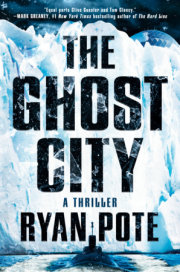
An ancient secret hidden in a forgotten city holds the key to modern riches in this exhilarating sequel to Blood and Treasure.

Once you've made your first ten billion, what's more money? What any billionaire really wants isn't money, it's power, and Shan Zhang has the perfect plan to achieve that. The discovery of a manuscript from the renowned explorer Marco Polo leads to an ancient city buried under the snows of Antarctica. Within that city lies the key to a forgotten technology that will transform modern society, but that transformation may cause the deaths of millions.

Professional treasure hunter and adventurer Ethan Cain is working on the Mekong River in Vietnam when the massive waterway suddenly goes dry. It's a stunning ecological disaster. One that Ethan can't ignore. His quest for answers will lead him to Zhang and ultimately a confrontation from which only one of them will emerge.
1

Ho Chi Minh City, Vietnam

He counted to himself.

Forty-six . . . Two. Three . . .

Ethan Cain burst out of the numbing thirty-five-degree water, gasping for air. His hands found the edges of the freestanding claw-foot tub as ice sloshed over the sides onto the tiled floor. A thick humidity filled his lungs with eighty-seven-degree air, so warm in contrast it almost suffocated him.

A Garmin Fēnix 7 smartwatch buzzed on his wrist.

"Getting better," he said, clicking off the timer to a breath hold of four minutes and twelve seconds.

He stood, a full six feet, stretching his taut, shivering body before stepping out of the tub and toweling himself off. Early-morning sun shone through the window of the French-inspired studio hotel room, illuminating the horrific, crevassed burn scars that enveloped Ethan Cain's entire body. Water dripped from his mid-length brown hair and the droplets flowed down the erratic landscape of his damaged skin like the rivers of a topographic map, twisting along gruesome valleys of poorly healed skin. Reds. Maroons. Purples. Hashed "fishnet" patterns cut across the more sensitive areas-a result of partial-thickness skin grafts. The patchwork of welded skin smoothed out toward the neck, creeping up his left jawline. Ethan's face, however, had been spared the same trauma, leaving him with some semblance of a "normal" appearance. But as much as he tried to forget about the scars, it wasn't their off-putting sight that never let him forget. It was the constant torture of pins and needles plaguing his nervous system.

Burn-scarred skin can't regulate body temperature efficiently, cursed with an inability to release enough sweat and transmit correct temperature signals to the brain. Heat was the worst of it. Though artificial sweat glands helped, they were far from perfect.

Cold, on the other hand, had become his temporary solace.

Ethan wrapped the towel around his waist and made his way to the balcony, where he filled a mug with black coffee from a steel French press. He lifted the steaming liquid to his lips and closed his eyes, savoring the taste, letting the warmth balance out his drop in core temperature. With the first sip, his hazel-green eyes flared open, and he gazed out over a sprawling park.

A loudspeaker echoed a voice in Vietnamese followed by a tone.

Thousands of people stood motionless in a crowd that spanned every available inch of the park. Without another command to guide them, the entire group of thousands began practicing what looked like tai chi, slowly moving in unison with elegant forms like a flock of birds flying through the sky. Turning and swooping as one, they moved like they were all tapped into the same wavelength. The same frequency. The crowd practiced in absolute silence as the sun rose higher. Ethan sipped his coffee and watched.

Then a burst of static interrupted.

It came from his satellite radio next to the French press.

"Morning, sweetheart," a man's upbeat voice said over the radio. "Rise and shine. You ready to go?"

Ethan smirked before picking up the radio and depressing transmit. "I need ten more minutes, but go ahead and get started. I'll meet you at the docks."

"Don't wanna miss the boat," the radio beeped back.

"We can't miss the boat, Rutledge," Ethan said. "It's my boat."

The radio beeped twice in reply, and Ethan placed it back down on the table. It meant understood. Ethan picked up an Iridium satellite phone next to it and read a series of text messages. The first read:

Tag, you're it. Try you again next time.

It was from a contact named Lana Foster. He also had a voicemail from her. He input his password and put it on speakerphone while he poured more coffee.

A refined British accent lifted the words from the tiny speaker. "It's me. One of these days, we'll actually get to speak to each other in the same time zone. Just checking in to see how your survey job is faring. I'm quite looking forward to seeing you when I get back. Before you took Ian away, he was teaching me how to climb, and I've been practicing, so I'll be ready for our little ice-climbing adventure. I'm still planning on staying at your house. Counting the days. Do tell Ian to stay out of trouble. As much as he is able . . . Cheers."

The message ended.

Ethan dialed her number from memory and held the phone to his ear. It went straight to voicemail. Typical.

"Hey, Lana," he said. "Congrats on that interview. I saw bits of it on K5 News last night. The story is gonna be fantastic. My job is going without a hiccup, heading back out on the river here shortly, but we should be finishing up on schedule, then home. I think you might beat me back there, but you know where the key is-fridge might be empty, so you'll need to grab some groceries. And, um, I'll see ya."

Ethan hung up.

He opened his tablet and scanned a finger along a map of the Mekong River. Green shaded half of the map, and red shaded the other half. Ethan zoomed in on the red portions, where bathymetric labels marked the river from bank to bank.

Time to go to work.

Ethan walked down the dock through a mass of merchants and fishermen. On either side, floating boat markets sold fruits and vegetables, fish, or gasoline and cigarettes-both the fuel of the Mekong River and its drivers. The brown water lapped the rickety walkway as he jumped from one dock to the next, meandering toward the deeper slips where his boat was tied up. The Nguyễn Thành. A rusted red-and-blue thirty-foot steel fishing boat with an upper deck. Six black rubber tires acted as bumpers, strapped to its port and starboard sides.

The stench of rot and decay perfumed by cigarette smoke and burning engine oil gave the entire scene a bouquet that was in stark contrast to the picturesque jungle mountains surrounding it.

"Ethan!" a man yelled from the boat's upper deck. He wore thigh-high cream-colored shorts and a bright teal-and-pink flower-print shirt. "What's that little thing you're always saying-'early bird gets the worm'? C'mon, you're late." The man cast off the line as the boat began to chug away from the dock, spewing black diesel smoke.

"Stop screwing around," Ethan said.

But the boat kept going.

He's not stopping! Son of a-

Ethan broke into a jog, then a run. The floating docks bobbed under his feet as he leaped from one platform to the next, dodging groups of people. He gripped his backpack tight and sprinted down the final dock before vaulting himself off the edge. Ethan flew, all arms and legs, barely clearing the starboard gunwale. He hit the deck flat on his side.

"Thanks, Rutledge," Ethan said, groaning. He clutched sore ribs. "Really appreciate that."

Ian Rutledge, a lanky man with a shaved head and bushy beard, saluted from the top deck. "You made it," he said, behind a snorting laugh. "Nothing like getting your blood pumping in the morning . . . I was kinda hoping you'd go for a swim, though."

Ethan lay flat on the deck, catching his breath. "Remind me why I hired you again?"

"Because Pathfinder Survey Systems-aka you-needed good-looking people." Rutledge put on a pair of mirrored aviator sunglasses. "And you don't know shit about computers, E."

Ethan hoisted himself to his feet and climbed the ladder to the upper deck.

"Really . . . It's six forty-five in the morning," Ethan said, referencing the bottle of Coopers Ale in his friend's hand.

Rutledge hid a devilish grin under his beard. "Technically, it's only morning if you went to sleep."

Ethan wagged his head. "That reminds me, Lana told me to tell you to stay out of trouble."

"Now I feel cheap."

"You should."

A small TV screen live-streamed K5 News. From the roof, a Starlink satellite dish provided remote internet. "Hey, your girl is on," Rutledge said, referencing the screen. "You two on again or off again right now?"

"On . . . again. I think?"

Ethan saw a blond woman on TV speaking into a microphone. She was in an undisclosed location. Her symmetrical, freckled features and ocean blue eyes captivated him even through the TV. "Hey, turn that up."

Rutledge pulled a hand away from the wheel and flicked the remote.

"With the global demand for sand increasing over fifty billion metric tons per year, sand remains the most widely consumed commodity in the world, second only to water . . ."

The boat chugged and maneuvered up the Mekong, picking up speed as the river widened. Rutledge's hand hung off the wheel and his other woke up a touchscreen laptop.

". . . the illicit sand trade is said to top seven hundred billion dollars worldwide-that's more than illegal logging, gold mining, and fishing combined. Buyers rarely check the origins of sand, as legal and black market sand look identical . . . dredging destroys rivers and causes flooding . . ."

Ethan lowered the volume, concentrating on his laptop.

"We already all set up?" he said.

"LiDAR drone is good to go. GPR probe is warmed up. Hull-mounted magnetometer is running and calibrated." Rutledge smiled. "The river bottom survey software is five by five. I was up all night-not at a karaoke bar-reworking the source code on the sediment-mapping software. There were a few bugs throwing off the depth of the bedrock from the ground-penetrating radar."

"Probably all the debris," Ethan said. "Fishing nets. Engine parts. It's a junkyard down there, and if the government's gonna lay a gas pipeline along this riverbed, our survey needs to be exact."

"Well, I fixed it. You're welcome. Won't be an issue today."

Ethan patted Rutledge on the shoulder. "All right then, I'll go drop Chickadee in the water."

"You do you, brother. I'll just drive the boat and get paid to look pretty."

Ethan Cain climbed down the ladder and walked toward the bow. Let's get this job done. Get paid. And get home.

2

United Nations World Economic Futures Summit

UN Headquarters, New York City, USA

Excuse me, but is this an inquisition or a discussion?"

A tense silence built in the room, broken only by the Australian ambassador to the UN, Joel Westin, stubbornly stuffed inside a suit so ill-fitted that his neck bulged over the top of his collar. "Mr. Zhang, you didn't answer my question."

Mr. Zhang, not a politician but a Chinese businessman, sat at a long desk where the speaker's lectern was usually set up. A placard read:

Shan Zhang, CEO, Zhang Global Construction, Inc.

In front of him were the arcing terraces of leader countries who debated international policy as if they governed the countries sitting in the cheap seats. Semicircular desks displayed the names of member states, and others welcomed international corporations on small, fixed digital placards. Aside from the desks and chairs, it was standing room only. And plenty of it. Intricate murals of multicultural unity hung over the assembly's trademark emerald carpet and tile. The murals displayed phrases that included words like cooperation, coexistence, and unity.

These were mere words-but words had power.

The UN itself, however, did not.

This summit wasn't part of any formal UN General Assembly. This was, instead, an attempt by the UN to muster international support against those they deemed "violators" of international law-if there was any such thing.

To use teeth it didn't have but so badly wanted.

Zhang removed his glasses and, with painstaking efficiency, scrubbed the lenses clean with a pearl-colored silk napkin. The squeaks of cloth on glass reverberated through his microphone to the entire crowd of 193 representatives from every member nation and other invited nonmembers. He was wiry, and the folds of his face and the white of his hair displayed a grandfatherly age and wisdom. Zhang diligently folded the napkin with origami-like precision and slid it back into the pocket of his chrome-shaded suit before he spoke in a slow, gentle cadence.

"Do you know, Mr. Westin, that at the current rate of growth, the world's demand for urban construction is adding eight cities the size of this very New York City we sit in, every single year?" Zhang looked left and right, slowly. "Zhang Global can build a city the size of Rome in only two weeks." He looked at Joel Westin. "Do you know what is required to build a city?"

"Concrete," Joel said. "Which is exactly my question that you seem so keen on avoiding-"

"A lot of reinforced concrete," Zhang said with a smile that revealed perfectly capped teeth, so white they seemed to be made of plastic. "Two hundred tons of it for a house, thirty thousand for a kilometer of highway, for example. The world demands it. We provide what the world needs."

Joel Westin's nose and cheeks practically glowed red with every word spoken. "That's my point," he said. "Concrete requires sand-river sand, to be exact-and at the rate world demand is going, our report here"-he slapped a thick stack of white paper-"notes that river sand is being stripped from the world at a rate that far exceeds its natural production. Simply put, the world will run out of construction-grade sand by 2050."

"I don't understand your question," Zhang said.

"Your company, Mr. Zhang, is here because you've been accused of illegally mining sand-sand from countries that have outlawed the practice."

Zhang remained calm and unbothered. "Then why aren't they up here, accusing me of any wrongdoing? Why is it you?"

"The Brits claim you stole an entire Jamaican beach in one night." Joel's jaw clenched, and he pointed a stiff finger, jabbing it at Zhang. "Indonesia says you stole two entire islands . . . Should I keep going?"

Zhang said nothing.

Joel stood from his chair now and leaned over the curving terraced desk. "I know you stole them!" he yelled.

Zhang still said nothing. Instead, he brushed a bit of dust from his suit jacket.

"You have amassed," Joel said, sitting back down, referencing his talking points, "exclusive coastal construction contracts in eighty-seven countries-"

"One hundred and seven countries," Zhang said. "We added twenty more as of this week, thanks to this wonderful summit."

The comment seemed to stab Joel Westin in the ribs, but he continued.

"Concrete should last anywhere from ten to fifty years. There have been reports of Zhang Global's concrete failing after as little as four years." Joel pulled out another piece of paper and held it up. "An independent analysis of your concrete shows that the sand used isn't construction-grade . . . rather, it contains rounded sand grains-desert sand-mixed and cut into the cement mixture."
"Ethan Cain and company are back in new adventure. Packed with suspense and intrigue The Ghost City knocks it out of the park. From ancient Mongolia to a modern Antarctica poised on the edge of catastrophe, one mystery begets another in an edge of your seat race against impossible odds. It's the type of thrilling fiction rarely seen these days!"—Beau L'Amour, author of Skyring Water
© Leah's Lens Photography
Ryan Pote is a twelve-year veteran Navy helicopter pilot who was part of a joint interagency special operations task force deployed throughout Central and South America combating drug cartels and transnational criminal organizations. After being medically separated, he investigated prototype aircraft development programs for six years with the Department of Defense. Before the Navy, he lived and worked in Hawaii as a SCUBA diving instructor and a lab assistant conducting microbiological research for Shell Oil. He has a masters degree in History and lives with his wife and kids in Maine. View titles by Ryan Pote

About

An ancient secret hidden in a forgotten city holds the key to modern riches in this exhilarating sequel to Blood and Treasure.

Once you've made your first ten billion, what's more money? What any billionaire really wants isn't money, it's power, and Shan Zhang has the perfect plan to achieve that. The discovery of a manuscript from the renowned explorer Marco Polo leads to an ancient city buried under the snows of Antarctica. Within that city lies the key to a forgotten technology that will transform modern society, but that transformation may cause the deaths of millions.

Professional treasure hunter and adventurer Ethan Cain is working on the Mekong River in Vietnam when the massive waterway suddenly goes dry. It's a stunning ecological disaster. One that Ethan can't ignore. His quest for answers will lead him to Zhang and ultimately a confrontation from which only one of them will emerge.

Excerpt

1

Ho Chi Minh City, Vietnam

He counted to himself.

Forty-six . . . Two. Three . . .

Ethan Cain burst out of the numbing thirty-five-degree water, gasping for air. His hands found the edges of the freestanding claw-foot tub as ice sloshed over the sides onto the tiled floor. A thick humidity filled his lungs with eighty-seven-degree air, so warm in contrast it almost suffocated him.

A Garmin Fēnix 7 smartwatch buzzed on his wrist.

"Getting better," he said, clicking off the timer to a breath hold of four minutes and twelve seconds.

He stood, a full six feet, stretching his taut, shivering body before stepping out of the tub and toweling himself off. Early-morning sun shone through the window of the French-inspired studio hotel room, illuminating the horrific, crevassed burn scars that enveloped Ethan Cain's entire body. Water dripped from his mid-length brown hair and the droplets flowed down the erratic landscape of his damaged skin like the rivers of a topographic map, twisting along gruesome valleys of poorly healed skin. Reds. Maroons. Purples. Hashed "fishnet" patterns cut across the more sensitive areas-a result of partial-thickness skin grafts. The patchwork of welded skin smoothed out toward the neck, creeping up his left jawline. Ethan's face, however, had been spared the same trauma, leaving him with some semblance of a "normal" appearance. But as much as he tried to forget about the scars, it wasn't their off-putting sight that never let him forget. It was the constant torture of pins and needles plaguing his nervous system.

Burn-scarred skin can't regulate body temperature efficiently, cursed with an inability to release enough sweat and transmit correct temperature signals to the brain. Heat was the worst of it. Though artificial sweat glands helped, they were far from perfect.

Cold, on the other hand, had become his temporary solace.

Ethan wrapped the towel around his waist and made his way to the balcony, where he filled a mug with black coffee from a steel French press. He lifted the steaming liquid to his lips and closed his eyes, savoring the taste, letting the warmth balance out his drop in core temperature. With the first sip, his hazel-green eyes flared open, and he gazed out over a sprawling park.

A loudspeaker echoed a voice in Vietnamese followed by a tone.

Thousands of people stood motionless in a crowd that spanned every available inch of the park. Without another command to guide them, the entire group of thousands began practicing what looked like tai chi, slowly moving in unison with elegant forms like a flock of birds flying through the sky. Turning and swooping as one, they moved like they were all tapped into the same wavelength. The same frequency. The crowd practiced in absolute silence as the sun rose higher. Ethan sipped his coffee and watched.

Then a burst of static interrupted.

It came from his satellite radio next to the French press.

"Morning, sweetheart," a man's upbeat voice said over the radio. "Rise and shine. You ready to go?"

Ethan smirked before picking up the radio and depressing transmit. "I need ten more minutes, but go ahead and get started. I'll meet you at the docks."

"Don't wanna miss the boat," the radio beeped back.

"We can't miss the boat, Rutledge," Ethan said. "It's my boat."

The radio beeped twice in reply, and Ethan placed it back down on the table. It meant understood. Ethan picked up an Iridium satellite phone next to it and read a series of text messages. The first read:

Tag, you're it. Try you again next time.

It was from a contact named Lana Foster. He also had a voicemail from her. He input his password and put it on speakerphone while he poured more coffee.

A refined British accent lifted the words from the tiny speaker. "It's me. One of these days, we'll actually get to speak to each other in the same time zone. Just checking in to see how your survey job is faring. I'm quite looking forward to seeing you when I get back. Before you took Ian away, he was teaching me how to climb, and I've been practicing, so I'll be ready for our little ice-climbing adventure. I'm still planning on staying at your house. Counting the days. Do tell Ian to stay out of trouble. As much as he is able . . . Cheers."

The message ended.

Ethan dialed her number from memory and held the phone to his ear. It went straight to voicemail. Typical.

"Hey, Lana," he said. "Congrats on that interview. I saw bits of it on K5 News last night. The story is gonna be fantastic. My job is going without a hiccup, heading back out on the river here shortly, but we should be finishing up on schedule, then home. I think you might beat me back there, but you know where the key is-fridge might be empty, so you'll need to grab some groceries. And, um, I'll see ya."

Ethan hung up.

He opened his tablet and scanned a finger along a map of the Mekong River. Green shaded half of the map, and red shaded the other half. Ethan zoomed in on the red portions, where bathymetric labels marked the river from bank to bank.

Time to go to work.

Ethan walked down the dock through a mass of merchants and fishermen. On either side, floating boat markets sold fruits and vegetables, fish, or gasoline and cigarettes-both the fuel of the Mekong River and its drivers. The brown water lapped the rickety walkway as he jumped from one dock to the next, meandering toward the deeper slips where his boat was tied up. The Nguyễn Thành. A rusted red-and-blue thirty-foot steel fishing boat with an upper deck. Six black rubber tires acted as bumpers, strapped to its port and starboard sides.

The stench of rot and decay perfumed by cigarette smoke and burning engine oil gave the entire scene a bouquet that was in stark contrast to the picturesque jungle mountains surrounding it.

"Ethan!" a man yelled from the boat's upper deck. He wore thigh-high cream-colored shorts and a bright teal-and-pink flower-print shirt. "What's that little thing you're always saying-'early bird gets the worm'? C'mon, you're late." The man cast off the line as the boat began to chug away from the dock, spewing black diesel smoke.

"Stop screwing around," Ethan said.

But the boat kept going.

He's not stopping! Son of a-

Ethan broke into a jog, then a run. The floating docks bobbed under his feet as he leaped from one platform to the next, dodging groups of people. He gripped his backpack tight and sprinted down the final dock before vaulting himself off the edge. Ethan flew, all arms and legs, barely clearing the starboard gunwale. He hit the deck flat on his side.

"Thanks, Rutledge," Ethan said, groaning. He clutched sore ribs. "Really appreciate that."

Ian Rutledge, a lanky man with a shaved head and bushy beard, saluted from the top deck. "You made it," he said, behind a snorting laugh. "Nothing like getting your blood pumping in the morning . . . I was kinda hoping you'd go for a swim, though."

Ethan lay flat on the deck, catching his breath. "Remind me why I hired you again?"

"Because Pathfinder Survey Systems-aka you-needed good-looking people." Rutledge put on a pair of mirrored aviator sunglasses. "And you don't know shit about computers, E."

Ethan hoisted himself to his feet and climbed the ladder to the upper deck.

"Really . . . It's six forty-five in the morning," Ethan said, referencing the bottle of Coopers Ale in his friend's hand.

Rutledge hid a devilish grin under his beard. "Technically, it's only morning if you went to sleep."

Ethan wagged his head. "That reminds me, Lana told me to tell you to stay out of trouble."

"Now I feel cheap."

"You should."

A small TV screen live-streamed K5 News. From the roof, a Starlink satellite dish provided remote internet. "Hey, your girl is on," Rutledge said, referencing the screen. "You two on again or off again right now?"

"On . . . again. I think?"

Ethan saw a blond woman on TV speaking into a microphone. She was in an undisclosed location. Her symmetrical, freckled features and ocean blue eyes captivated him even through the TV. "Hey, turn that up."

Rutledge pulled a hand away from the wheel and flicked the remote.

"With the global demand for sand increasing over fifty billion metric tons per year, sand remains the most widely consumed commodity in the world, second only to water . . ."

The boat chugged and maneuvered up the Mekong, picking up speed as the river widened. Rutledge's hand hung off the wheel and his other woke up a touchscreen laptop.

". . . the illicit sand trade is said to top seven hundred billion dollars worldwide-that's more than illegal logging, gold mining, and fishing combined. Buyers rarely check the origins of sand, as legal and black market sand look identical . . . dredging destroys rivers and causes flooding . . ."

Ethan lowered the volume, concentrating on his laptop.

"We already all set up?" he said.

"LiDAR drone is good to go. GPR probe is warmed up. Hull-mounted magnetometer is running and calibrated." Rutledge smiled. "The river bottom survey software is five by five. I was up all night-not at a karaoke bar-reworking the source code on the sediment-mapping software. There were a few bugs throwing off the depth of the bedrock from the ground-penetrating radar."

"Probably all the debris," Ethan said. "Fishing nets. Engine parts. It's a junkyard down there, and if the government's gonna lay a gas pipeline along this riverbed, our survey needs to be exact."

"Well, I fixed it. You're welcome. Won't be an issue today."

Ethan patted Rutledge on the shoulder. "All right then, I'll go drop Chickadee in the water."

"You do you, brother. I'll just drive the boat and get paid to look pretty."

Ethan Cain climbed down the ladder and walked toward the bow. Let's get this job done. Get paid. And get home.

2

United Nations World Economic Futures Summit

UN Headquarters, New York City, USA

Excuse me, but is this an inquisition or a discussion?"

A tense silence built in the room, broken only by the Australian ambassador to the UN, Joel Westin, stubbornly stuffed inside a suit so ill-fitted that his neck bulged over the top of his collar. "Mr. Zhang, you didn't answer my question."

Mr. Zhang, not a politician but a Chinese businessman, sat at a long desk where the speaker's lectern was usually set up. A placard read:

Shan Zhang, CEO, Zhang Global Construction, Inc.

In front of him were the arcing terraces of leader countries who debated international policy as if they governed the countries sitting in the cheap seats. Semicircular desks displayed the names of member states, and others welcomed international corporations on small, fixed digital placards. Aside from the desks and chairs, it was standing room only. And plenty of it. Intricate murals of multicultural unity hung over the assembly's trademark emerald carpet and tile. The murals displayed phrases that included words like cooperation, coexistence, and unity.

These were mere words-but words had power.

The UN itself, however, did not.

This summit wasn't part of any formal UN General Assembly. This was, instead, an attempt by the UN to muster international support against those they deemed "violators" of international law-if there was any such thing.

To use teeth it didn't have but so badly wanted.

Zhang removed his glasses and, with painstaking efficiency, scrubbed the lenses clean with a pearl-colored silk napkin. The squeaks of cloth on glass reverberated through his microphone to the entire crowd of 193 representatives from every member nation and other invited nonmembers. He was wiry, and the folds of his face and the white of his hair displayed a grandfatherly age and wisdom. Zhang diligently folded the napkin with origami-like precision and slid it back into the pocket of his chrome-shaded suit before he spoke in a slow, gentle cadence.

"Do you know, Mr. Westin, that at the current rate of growth, the world's demand for urban construction is adding eight cities the size of this very New York City we sit in, every single year?" Zhang looked left and right, slowly. "Zhang Global can build a city the size of Rome in only two weeks." He looked at Joel Westin. "Do you know what is required to build a city?"

"Concrete," Joel said. "Which is exactly my question that you seem so keen on avoiding-"

"A lot of reinforced concrete," Zhang said with a smile that revealed perfectly capped teeth, so white they seemed to be made of plastic. "Two hundred tons of it for a house, thirty thousand for a kilometer of highway, for example. The world demands it. We provide what the world needs."

Joel Westin's nose and cheeks practically glowed red with every word spoken. "That's my point," he said. "Concrete requires sand-river sand, to be exact-and at the rate world demand is going, our report here"-he slapped a thick stack of white paper-"notes that river sand is being stripped from the world at a rate that far exceeds its natural production. Simply put, the world will run out of construction-grade sand by 2050."

"I don't understand your question," Zhang said.

"Your company, Mr. Zhang, is here because you've been accused of illegally mining sand-sand from countries that have outlawed the practice."

Zhang remained calm and unbothered. "Then why aren't they up here, accusing me of any wrongdoing? Why is it you?"

"The Brits claim you stole an entire Jamaican beach in one night." Joel's jaw clenched, and he pointed a stiff finger, jabbing it at Zhang. "Indonesia says you stole two entire islands . . . Should I keep going?"

Zhang said nothing.

Joel stood from his chair now and leaned over the curving terraced desk. "I know you stole them!" he yelled.

Zhang still said nothing. Instead, he brushed a bit of dust from his suit jacket.

"You have amassed," Joel said, sitting back down, referencing his talking points, "exclusive coastal construction contracts in eighty-seven countries-"

"One hundred and seven countries," Zhang said. "We added twenty more as of this week, thanks to this wonderful summit."

The comment seemed to stab Joel Westin in the ribs, but he continued.

"Concrete should last anywhere from ten to fifty years. There have been reports of Zhang Global's concrete failing after as little as four years." Joel pulled out another piece of paper and held it up. "An independent analysis of your concrete shows that the sand used isn't construction-grade . . . rather, it contains rounded sand grains-desert sand-mixed and cut into the cement mixture."

Reviews

"Ethan Cain and company are back in new adventure. Packed with suspense and intrigue The Ghost City knocks it out of the park. From ancient Mongolia to a modern Antarctica poised on the edge of catastrophe, one mystery begets another in an edge of your seat race against impossible odds. It's the type of thrilling fiction rarely seen these days!"—Beau L'Amour, author of Skyring Water

Author

© Leah's Lens Photography
Ryan Pote is a twelve-year veteran Navy helicopter pilot who was part of a joint interagency special operations task force deployed throughout Central and South America combating drug cartels and transnational criminal organizations. After being medically separated, he investigated prototype aircraft development programs for six years with the Department of Defense. Before the Navy, he lived and worked in Hawaii as a SCUBA diving instructor and a lab assistant conducting microbiological research for Shell Oil. He has a masters degree in History and lives with his wife and kids in Maine. View titles by Ryan Pote
  • More Websites from
    Penguin Random House
  • Common Reads
  • Library Marketing