Download high-resolution image Look inside
Listen to a clip from the audiobook
audio pause button
0:00
0:00

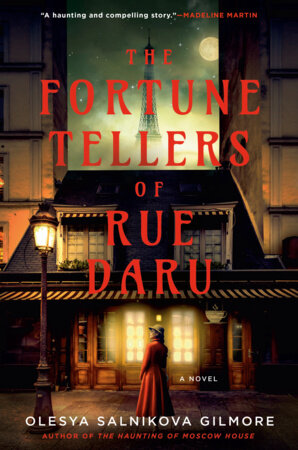
The Fortune Tellers of Rue Daru

Look inside
Listen to a clip from the audiobook
audio pause button
0:00
0:00
A fearless fortune teller in 1920s Paris must use her powers to divine who she can trust when an exiled Romanov princess and her brother come to her seeking answers about a decades-old mystery…


Spirited Zina and her secretive grandmother, Baba Valya, own a tearoom on rue Daru in Paris, where they have lived quietly since Zina’s mother’s untimely death. By day, the women serve tea, mostly to members of the bustling Russian émigré community, but when dusk falls, they divine fortunes and perform séances for their loyal clientele.


Then the charming Princess Olga and her brother arrive, searching for knowledge about the disappearance of their father, the exiled Grand Duke, cousin of the last Tsar of Russia. Zina, eager to learn more about the spirit world and her powers, performs the séance. She is able to summon the Grand Duke, but to her horror, he starts to haunt the shop, and he seems to know something sinister about her mother’s death.


As Zina delves into her family’s hidden past, dark secrets are unearthed, threatening the home and tearoom Zina and her grandmother have worked so hard to build, not to mention their very lives.
1

Zina

February 1924

Almost Twenty-Four Years Later

Friday nights were reserved for séances at Samovar, my grandmother's sometimes tearoom, sometimes fortune-telling business in the 8th arrondissement of Paris. I had called it home ever since I could remember.

Instead of going out to some café or cabaret brimming with life, music, and handsome men, the Friday night before it all started I was trapped in the consulting room, preparing for the famous Valentina Lenormand's weekly séance.

To me, she was just Baba Valya or Babushka-the only family I had left in all the world, and my employer, as I lived and worked in her tearoom.

The consulting room was dim and, as yet, empty. But I felt a velvety midnight-blue vibration to the air as it waited for the night to begin. I sensed the energy, the auras, of people and places as part of my fortune-telling affinity, and this room was no different.

My magnificent cat, Zefir, let out a bored meow. She was as white and fluffy as the marshmallow-like meringue confections we often served with our tea. I knelt and gave her a fond caress, sympathizing with her boredom. My grandmother expected me to assist with her fortune-telling nearly every night, and on séance nights, also with her sitters.

I heard their loud chatter and even louder laughter all the way from the kitchen, where they were commencing the champagne-soaked affair.

Baba Valya's sitters were the quaint yet frightfully old and out-of-touch Russian ladies of the rue Daru community-the tangle of streets by the Alexander Nevsky Cathedral called Little Russia by most everybody in Paris, comprising Russian émigrés and exiles of the 1917 Bolshevik revolution and subsequent civil war.

Baba Valya was an émigré, too, having moved from the Russian Empire in the last year of the last century with my mother, Svetlana. My grandfather had died when Mama was a baby, though I didn't know how. Meanwhile, I was born and have lived in Paris all my life. The closest I came to the old country was Samovar, nestled in the heart of Little Russia on the corner of rue Pierre le Grand and rue Daru.

I went over to the big, round mahogany table, Zefir playfully clawing at my feet, and set out coffee cups for the ladies.

Samovar might have been a tearoom by day, but with dusk, the coffee came out. As there weren't enough tea leaves in Russian-style tea brewing, fortunes were whispered over coffee cups, séances performed instead of evening tea service-though the spirits that Baba Valya summoned were as make-believe as the old country seemed to me.

While our fortunes were real-fortune-telling and divination were passed down from generation to generation of the Lenormand family, from woman to woman, each with her own psychic affinity-our séances were fraudulent, embracing cheap theatrics and phony apparitions. Real séances were complex, requiring the psychic to also be a spirit medium with an affinity for communicating with the dead. Real séances also had a higher risk of tapping into the dark, unnatural power-the nechistaya sila, or "the unclean force"-threatening all divination and spiritualist practices. Selling séances was plain good business, my grandmother said, and harmless. We provided comfort to those poor souls who needed it. What did it matter if our "spirits" were ultimately fake?

I was just fine with being a fraud and with the real work of fortune-telling, even if mostly under Baba Valya. Not so with the menial tasks of séance nights, catering only to her clients, only on her terms, with no say and with little reward. She insisted on doing the séances herself, preferring me to focus on fortune-telling and divination.

I lit the tall taper candles arranged in a circle on the séance table one by one until they danced and glimmered. Baba Valya told our clients that light attracted the spirits with its warmth.

I certainly had never seen any spirit, though I was curious about them.

The candles' waxy, fatty smell drifted over to me, mingling with the cinnamon and lemongrass I'd burned earlier. The tearoom tonight stifled, the candles' smoke catching in my throat. It reminded me that I hadn't had a cigarette all day. I had run out, and Baba Valya abhorred the habit and refused to purchase them.

A whisper came from the doorway, startling me out of my thoughts. "Zina."

I turned to see the always lovely dark-haired, dark-eyed Katya, Baba Valya's assistant and my friend, waving me over-elegantly, as was her way.

As a well-bred lady of the fallen, now penniless aristocratic House of Sherbatsky from imperial Russia, and several years older than me, Katya refused to let her emotions show. But her expressive eyes betrayed her; they glinted like black onyx. Her usually tranquil sunny-yellow energy spurted fiery orange in excitement. Each attempt at escape was a fresh challenge.

I rushed to Katya, Zefir at my heels. "When do you think we can slip away?" I asked eagerly in French. I wished to be done and on our way to the cafés.

"Hopefully earlier than last Friday," Katya said with a sigh. She ran a hand along Zefir's back before leading me into the hallway-to her ugly paisley carpetbag.

The rue Daru ladies' chatter and laughter reached its crescendo in the kitchen.

Katya and I rolled our eyes at each other; the ladies were already, predictably, oiled up for the production to come. I felt the old familiar pang-a desire for my own clients, on my own terms, treating me as a fortune teller in my own right, and paying me what I deserved. My grandmother gave me a mere pittance. And though I'd had clients, they had always been under her watchful eye. Most preferred her skill and experience anyway. It didn't help that she still treated twenty-four-year-old me like the baby she had taken in upon Mama's death. And not just in fortune-telling. The past I was curious about, our family's beginnings in the old country, was rarely spoken of.

My grievances evaporated when Katya pulled out two brightly colored cocktail dresses, both embellished with beads, rhinestones, and fringe. "You raided your mama's closet again, you naughty girl!" I gasped.

"She will not know. She never does. She is too busy slaving away in Mademoiselle Chanel's workrooms to notice much of anything around her." Even me went unsaid.

I patted Katya's hand and touched the dresses in wonder, the satin flowing like water against my fingertips. Zefir reached out a paw. I tugged the dresses out of her grasp just in time, or the fabric would have been in shreds.

"Where do you wish to go?" asked Katya.

I thought about sharing that cigarette with somebody I could have a little fun with-Baba Valya loathed when I came back the morning after an outing with Katya, clear that I had spent the night anywhere but in the tearoom with her. "Montparnasse is never a wrong choice."

"I quite agree."

We smiled at each other conspiratorially just as Baba Valya's Russian cut through to us. "Why don't we proceed to the consulting room, ladies?"

Zefir sniffed at the air and tumbled away-she hated the stale, flowery scents of the old. Katya and I dashed back into the consulting room, to our hiding places behind the mournful black drapery with which Baba Valya covered all the room's windows, doors, and mirrors. This was to prevent the unclean force from flying inside.

Not a moment too soon, Baba Valya appeared in the doorway, small in stature yet with a regal, commanding air, queen of her tearoom, her cloudlike white hair gathered in a pert bun on her head like a makeshift crown. The rue Daru ladies paraded in after her with the click of long-worn heels and the rustle of plain brown skirts.

I caught the sharp smell of alcohol, of the buzzy, restless anticipation that clung to their figures in a fine purple mist. Their eyes were wide as they swiveled their heads and peered about.

It was whispered on rue Daru that Samovar was haunted.

Though Baba Valya never spoke of it, Mama had been murdered in the tearoom, her murderer never found. No matter how many times anyone visited Samovar, they searched for her spirit as if we concealed it for pure shock value and she would leap at them from the shadows. Even if Samovar were haunted, Mama's spirit had never showed itself to me.


It was a small group that night-the tall, rail-thin Inessa Gippa, a philosopher and writer somewhere in her fifties, waiting for her vampire-like husband to die back in Russia; the matronly, domineering Karina Kolyshnaya, wife of a disgraced imperial general who had disappeared in Paris without a trace the year before; and the bent little old lady, Masha Starinina, searching for a son not seen since going off to fight in the Great War on the Russian front. The men were missing and presumed dead, except for Inessa’s husband, who was ill but who Baba Valya secretly told me would live for at least twenty more years. Still, my grandmother cleverly stoked uncertainty, particularly when bills were due. One séance, no answer; the next, the spirits would grace us with their presence.

Each woman placed a photograph of their loved one against the obscenely large vase of white lilies that Baba Valya claimed ushered in the dead, if they were, indeed, dead.

I kept my eyes firmly on the women now taking their seats at the table.

I didn't like looking at the photographs of the dead to be summoned. They reminded me of the furiously warm yet salty and dark-edged feeling that had washed over me when I was sixteen or so-when I tried doing my own séance to summon Mama. The feeling was like Baba Valya's description of the spark of affinity, something I had never experienced with my aura reading. My experiment had not ended well. A cloud of darkness rushed at me, engulfing my mind and body. I fell into a black void and only awoke days later with my grandmother standing over me. I would never forget her lingering stare, the flash of fear in it, her warnings never to let in the darkness.

Hear me, Zinaida, she had said, using my full name to its devastating effect. Unlike psychics with an affinity for spirit mediumship and the dead, for séances and the unclean force, you must not dabble in such arts. The darkness could overwhelm you, and you may fail to wake up. That is what almost happened. Never forget.

Of course, I didn't listen. I wanted to see whether my affinity for living auras also extended to the dead, my psychic abilities to spirit mediumship. I owed it to myself to explore it. And to make contact with Mama on the other side.

When I shared my suspicions with Baba Valya, she answered with a curt Not necessarily, along with that flash of fear. What you experienced was likely but traces of your psychic affinity for living auras. But it is still too close to that darkness. You must not indulge it.

I pressed down my own fear. After all, spirit mediums safely practiced with the darkness, even helped people by holding real séances and truly communing with real spirits. Perhaps Baba Valya simply misunderstood it. I tried holding another séance, and another, and another. But each time yielded no result. Not even that void. Though I sometimes felt something, especially during my grandmother's séances, it was never that furious warmth, that spark of affinity. Maybe it had been a fluke. Maybe reading living auras was all I had, the spark of affinity or spirit mediumship not attainable for me, and I would always be missing something. Maybe I would never know.

"Let us join hands, ladies," came my grandmother's detached voice back in the consulting room. "Close your eyes and think of your dear ones, departed or not." The strictest rule at her séance table was to never, ever open one's eyes; this allowed us to move freely among her sitters to weave the illusion of a séance. "We summon you, beloved spirits. We bring light into your dark world of death. Commune with us, speak to us, show yourselves."

This was our cue-we pulled open the windows behind us with a bang and let the rush of air ripple through the room.

The ladies gasped, one fervently whispering a prayer under her breath.

The candlelight wavered and went out, pitching the room and us into blackness. Excellent. This didn't always happen; in those times, Katya and I stayed hidden, Baba Valya pronouncing the spirits less active than usual.

"Are you with us, summoned spirits? Or has an unsummoned spirit stumbled upon our little gathering? If so, and if you know the fate of the summoned, tell us about it, enlighten us." Baba Valya waited the requisite amount of time. Then she drew in a dramatic breath turned gasp. "Someone is here-I can feel them! Can you?"

I moved from behind the drapery, stepping lightly toward the circle of unsuspecting, too-trusting ladies, who clung to each other with shaking hands and breathed hard through their teeth, as if the air were indeed thick with spirits.

Katya and I wore all-black clothing and trousers so we could move more easily and discreetly.

I brushed a finger along the curve of Karina's long neck-and she released a startled cry. I suppressed a giggle, tugging on Inessa's shock of red hair and tapping her lorgnette-and her whole body quivered. I touched one of Masha's bony shoulders-and the poor woman recoiled so violently that she almost fell from her chair.

"You feel it! You feel it!" Baba Valya cried out triumphantly. "Now, tell us, poor, wandering soul, are you here for one of these women?"

At this point, Katya usually ducked under the consulting table.

Sure enough, a few minutes later, a knock resounded from beneath it. Then a second. Two knocks meant yes.

"Are you a general?"

One knock resounded. No.

"A philosopher or writer?"

One knock. No.

"A soldier?"

Katya paused for effect, then rapped twice. Yes.

"Are you looking for your mother?"

Two knocks. Yes.

"Is she in this room?"

Two knocks. Yes.

"Are you Leonid, and is Masha your mother?"

Two knocks. Yes.

A cry wrenched from Masha. "My dear boy! It has been too long since you appeared. Tell me that you are at peace. Please! Put your poor mama out of her misery."

"Are you at peace, Leonid?" Silence. "What did you wish to tell your mother?"

In answer, the table floated off the floor. Contrary to how heavy it looked, it was rather light when lifted only a few centimeters. The ladies gasped in horror, and the table slammed back down. I glimpsed the shadow of Katya's lithe figure as she crawled out from under the table and made for the door, left ajar for this purpose.
"The Fortune Tellers of Rue Daru is a spine-tingling gothic tale of family, a legacy of secrets, and the dangerous cost of unearthing the past through a forbidden séance. Gilmore conjures 1920s Paris and the Russian émigré community, delivering a haunting and compelling story that is sure to grip readers."—Madeline Martin, New York Times bestselling author of The Secret Book Society

"Gilmore’s latest historical horror will be another crowd-pleaser. For fans of menacing supernatural tales of family secrets, ghosts, possession, and intrigue, such as Alma Katsu’s The Deep or Daphne Fama’s House of Monstrous Women."—Library Journal

"Salnikova Gilmore’s writing soars . . . dazzling readers with unforgettable scenery and achingly beautiful prose. This thrilling story of murder, generational power of love and treachery will be devoured in one sitting.”—Marina Scott, author of The Night Guests

"A haunting, captivating gothic novel that will keep readers tight in its grip until the very last page."—Megan Chance, author of Glamorous Notions

“Salnikova Gilmore expertly balances historical detail, romance, and magic, weaving a tale that will make you truly believe in a world of spirits waiting just beyond the veil.”—Morgan Ryan, author of A Resistance of Witches
© Nicola Levine Photography, LLC
Olesya Salnikova Gilmore is the author of The Witch and the Tsar and The Haunting of Moscow House. Originally from Moscow, she was raised in the US and graduated from Pepperdine University with a BA in English/political science, and from Northwestern School of Law with a JD. She practiced litigation at a large law firm in Chicago for several years before pursuing her dream of becoming an author. She writes speculative gothic suspense and other dark fiction. She also loves exploring Eastern European history and folklore. Her work has appeared in LitHub, Tor.com, CrimeReads, Writer’s Digest, and Washington Independent Review of Books, among others. She lives in a wooded, lakeside suburb of Chicago with her husband and two daughters. View titles by Olesya Salnikova Gilmore

Discussion Guide for The Fortune Tellers of Rue Daru

Provides questions, discussion topics, suggested reading lists, introductions and/or author Q&As, which are intended to enhance reading groups’ experiences.

(Please note: the guide displayed here is the most recently uploaded version; while unlikely, any page citation discrepancies between the guide and book is likely due to pagination differences between a book’s different formats.)

About

A fearless fortune teller in 1920s Paris must use her powers to divine who she can trust when an exiled Romanov princess and her brother come to her seeking answers about a decades-old mystery…


Spirited Zina and her secretive grandmother, Baba Valya, own a tearoom on rue Daru in Paris, where they have lived quietly since Zina’s mother’s untimely death. By day, the women serve tea, mostly to members of the bustling Russian émigré community, but when dusk falls, they divine fortunes and perform séances for their loyal clientele.


Then the charming Princess Olga and her brother arrive, searching for knowledge about the disappearance of their father, the exiled Grand Duke, cousin of the last Tsar of Russia. Zina, eager to learn more about the spirit world and her powers, performs the séance. She is able to summon the Grand Duke, but to her horror, he starts to haunt the shop, and he seems to know something sinister about her mother’s death.


As Zina delves into her family’s hidden past, dark secrets are unearthed, threatening the home and tearoom Zina and her grandmother have worked so hard to build, not to mention their very lives.

Excerpt

1

Zina

February 1924

Almost Twenty-Four Years Later

Friday nights were reserved for séances at Samovar, my grandmother's sometimes tearoom, sometimes fortune-telling business in the 8th arrondissement of Paris. I had called it home ever since I could remember.

Instead of going out to some café or cabaret brimming with life, music, and handsome men, the Friday night before it all started I was trapped in the consulting room, preparing for the famous Valentina Lenormand's weekly séance.

To me, she was just Baba Valya or Babushka-the only family I had left in all the world, and my employer, as I lived and worked in her tearoom.

The consulting room was dim and, as yet, empty. But I felt a velvety midnight-blue vibration to the air as it waited for the night to begin. I sensed the energy, the auras, of people and places as part of my fortune-telling affinity, and this room was no different.

My magnificent cat, Zefir, let out a bored meow. She was as white and fluffy as the marshmallow-like meringue confections we often served with our tea. I knelt and gave her a fond caress, sympathizing with her boredom. My grandmother expected me to assist with her fortune-telling nearly every night, and on séance nights, also with her sitters.

I heard their loud chatter and even louder laughter all the way from the kitchen, where they were commencing the champagne-soaked affair.

Baba Valya's sitters were the quaint yet frightfully old and out-of-touch Russian ladies of the rue Daru community-the tangle of streets by the Alexander Nevsky Cathedral called Little Russia by most everybody in Paris, comprising Russian émigrés and exiles of the 1917 Bolshevik revolution and subsequent civil war.

Baba Valya was an émigré, too, having moved from the Russian Empire in the last year of the last century with my mother, Svetlana. My grandfather had died when Mama was a baby, though I didn't know how. Meanwhile, I was born and have lived in Paris all my life. The closest I came to the old country was Samovar, nestled in the heart of Little Russia on the corner of rue Pierre le Grand and rue Daru.

I went over to the big, round mahogany table, Zefir playfully clawing at my feet, and set out coffee cups for the ladies.

Samovar might have been a tearoom by day, but with dusk, the coffee came out. As there weren't enough tea leaves in Russian-style tea brewing, fortunes were whispered over coffee cups, séances performed instead of evening tea service-though the spirits that Baba Valya summoned were as make-believe as the old country seemed to me.

While our fortunes were real-fortune-telling and divination were passed down from generation to generation of the Lenormand family, from woman to woman, each with her own psychic affinity-our séances were fraudulent, embracing cheap theatrics and phony apparitions. Real séances were complex, requiring the psychic to also be a spirit medium with an affinity for communicating with the dead. Real séances also had a higher risk of tapping into the dark, unnatural power-the nechistaya sila, or "the unclean force"-threatening all divination and spiritualist practices. Selling séances was plain good business, my grandmother said, and harmless. We provided comfort to those poor souls who needed it. What did it matter if our "spirits" were ultimately fake?

I was just fine with being a fraud and with the real work of fortune-telling, even if mostly under Baba Valya. Not so with the menial tasks of séance nights, catering only to her clients, only on her terms, with no say and with little reward. She insisted on doing the séances herself, preferring me to focus on fortune-telling and divination.

I lit the tall taper candles arranged in a circle on the séance table one by one until they danced and glimmered. Baba Valya told our clients that light attracted the spirits with its warmth.

I certainly had never seen any spirit, though I was curious about them.

The candles' waxy, fatty smell drifted over to me, mingling with the cinnamon and lemongrass I'd burned earlier. The tearoom tonight stifled, the candles' smoke catching in my throat. It reminded me that I hadn't had a cigarette all day. I had run out, and Baba Valya abhorred the habit and refused to purchase them.

A whisper came from the doorway, startling me out of my thoughts. "Zina."

I turned to see the always lovely dark-haired, dark-eyed Katya, Baba Valya's assistant and my friend, waving me over-elegantly, as was her way.

As a well-bred lady of the fallen, now penniless aristocratic House of Sherbatsky from imperial Russia, and several years older than me, Katya refused to let her emotions show. But her expressive eyes betrayed her; they glinted like black onyx. Her usually tranquil sunny-yellow energy spurted fiery orange in excitement. Each attempt at escape was a fresh challenge.

I rushed to Katya, Zefir at my heels. "When do you think we can slip away?" I asked eagerly in French. I wished to be done and on our way to the cafés.

"Hopefully earlier than last Friday," Katya said with a sigh. She ran a hand along Zefir's back before leading me into the hallway-to her ugly paisley carpetbag.

The rue Daru ladies' chatter and laughter reached its crescendo in the kitchen.

Katya and I rolled our eyes at each other; the ladies were already, predictably, oiled up for the production to come. I felt the old familiar pang-a desire for my own clients, on my own terms, treating me as a fortune teller in my own right, and paying me what I deserved. My grandmother gave me a mere pittance. And though I'd had clients, they had always been under her watchful eye. Most preferred her skill and experience anyway. It didn't help that she still treated twenty-four-year-old me like the baby she had taken in upon Mama's death. And not just in fortune-telling. The past I was curious about, our family's beginnings in the old country, was rarely spoken of.

My grievances evaporated when Katya pulled out two brightly colored cocktail dresses, both embellished with beads, rhinestones, and fringe. "You raided your mama's closet again, you naughty girl!" I gasped.

"She will not know. She never does. She is too busy slaving away in Mademoiselle Chanel's workrooms to notice much of anything around her." Even me went unsaid.

I patted Katya's hand and touched the dresses in wonder, the satin flowing like water against my fingertips. Zefir reached out a paw. I tugged the dresses out of her grasp just in time, or the fabric would have been in shreds.

"Where do you wish to go?" asked Katya.

I thought about sharing that cigarette with somebody I could have a little fun with-Baba Valya loathed when I came back the morning after an outing with Katya, clear that I had spent the night anywhere but in the tearoom with her. "Montparnasse is never a wrong choice."

"I quite agree."

We smiled at each other conspiratorially just as Baba Valya's Russian cut through to us. "Why don't we proceed to the consulting room, ladies?"

Zefir sniffed at the air and tumbled away-she hated the stale, flowery scents of the old. Katya and I dashed back into the consulting room, to our hiding places behind the mournful black drapery with which Baba Valya covered all the room's windows, doors, and mirrors. This was to prevent the unclean force from flying inside.

Not a moment too soon, Baba Valya appeared in the doorway, small in stature yet with a regal, commanding air, queen of her tearoom, her cloudlike white hair gathered in a pert bun on her head like a makeshift crown. The rue Daru ladies paraded in after her with the click of long-worn heels and the rustle of plain brown skirts.

I caught the sharp smell of alcohol, of the buzzy, restless anticipation that clung to their figures in a fine purple mist. Their eyes were wide as they swiveled their heads and peered about.

It was whispered on rue Daru that Samovar was haunted.

Though Baba Valya never spoke of it, Mama had been murdered in the tearoom, her murderer never found. No matter how many times anyone visited Samovar, they searched for her spirit as if we concealed it for pure shock value and she would leap at them from the shadows. Even if Samovar were haunted, Mama's spirit had never showed itself to me.


It was a small group that night-the tall, rail-thin Inessa Gippa, a philosopher and writer somewhere in her fifties, waiting for her vampire-like husband to die back in Russia; the matronly, domineering Karina Kolyshnaya, wife of a disgraced imperial general who had disappeared in Paris without a trace the year before; and the bent little old lady, Masha Starinina, searching for a son not seen since going off to fight in the Great War on the Russian front. The men were missing and presumed dead, except for Inessa’s husband, who was ill but who Baba Valya secretly told me would live for at least twenty more years. Still, my grandmother cleverly stoked uncertainty, particularly when bills were due. One séance, no answer; the next, the spirits would grace us with their presence.

Each woman placed a photograph of their loved one against the obscenely large vase of white lilies that Baba Valya claimed ushered in the dead, if they were, indeed, dead.

I kept my eyes firmly on the women now taking their seats at the table.

I didn't like looking at the photographs of the dead to be summoned. They reminded me of the furiously warm yet salty and dark-edged feeling that had washed over me when I was sixteen or so-when I tried doing my own séance to summon Mama. The feeling was like Baba Valya's description of the spark of affinity, something I had never experienced with my aura reading. My experiment had not ended well. A cloud of darkness rushed at me, engulfing my mind and body. I fell into a black void and only awoke days later with my grandmother standing over me. I would never forget her lingering stare, the flash of fear in it, her warnings never to let in the darkness.

Hear me, Zinaida, she had said, using my full name to its devastating effect. Unlike psychics with an affinity for spirit mediumship and the dead, for séances and the unclean force, you must not dabble in such arts. The darkness could overwhelm you, and you may fail to wake up. That is what almost happened. Never forget.

Of course, I didn't listen. I wanted to see whether my affinity for living auras also extended to the dead, my psychic abilities to spirit mediumship. I owed it to myself to explore it. And to make contact with Mama on the other side.

When I shared my suspicions with Baba Valya, she answered with a curt Not necessarily, along with that flash of fear. What you experienced was likely but traces of your psychic affinity for living auras. But it is still too close to that darkness. You must not indulge it.

I pressed down my own fear. After all, spirit mediums safely practiced with the darkness, even helped people by holding real séances and truly communing with real spirits. Perhaps Baba Valya simply misunderstood it. I tried holding another séance, and another, and another. But each time yielded no result. Not even that void. Though I sometimes felt something, especially during my grandmother's séances, it was never that furious warmth, that spark of affinity. Maybe it had been a fluke. Maybe reading living auras was all I had, the spark of affinity or spirit mediumship not attainable for me, and I would always be missing something. Maybe I would never know.

"Let us join hands, ladies," came my grandmother's detached voice back in the consulting room. "Close your eyes and think of your dear ones, departed or not." The strictest rule at her séance table was to never, ever open one's eyes; this allowed us to move freely among her sitters to weave the illusion of a séance. "We summon you, beloved spirits. We bring light into your dark world of death. Commune with us, speak to us, show yourselves."

This was our cue-we pulled open the windows behind us with a bang and let the rush of air ripple through the room.

The ladies gasped, one fervently whispering a prayer under her breath.

The candlelight wavered and went out, pitching the room and us into blackness. Excellent. This didn't always happen; in those times, Katya and I stayed hidden, Baba Valya pronouncing the spirits less active than usual.

"Are you with us, summoned spirits? Or has an unsummoned spirit stumbled upon our little gathering? If so, and if you know the fate of the summoned, tell us about it, enlighten us." Baba Valya waited the requisite amount of time. Then she drew in a dramatic breath turned gasp. "Someone is here-I can feel them! Can you?"

I moved from behind the drapery, stepping lightly toward the circle of unsuspecting, too-trusting ladies, who clung to each other with shaking hands and breathed hard through their teeth, as if the air were indeed thick with spirits.

Katya and I wore all-black clothing and trousers so we could move more easily and discreetly.

I brushed a finger along the curve of Karina's long neck-and she released a startled cry. I suppressed a giggle, tugging on Inessa's shock of red hair and tapping her lorgnette-and her whole body quivered. I touched one of Masha's bony shoulders-and the poor woman recoiled so violently that she almost fell from her chair.

"You feel it! You feel it!" Baba Valya cried out triumphantly. "Now, tell us, poor, wandering soul, are you here for one of these women?"

At this point, Katya usually ducked under the consulting table.

Sure enough, a few minutes later, a knock resounded from beneath it. Then a second. Two knocks meant yes.

"Are you a general?"

One knock resounded. No.

"A philosopher or writer?"

One knock. No.

"A soldier?"

Katya paused for effect, then rapped twice. Yes.

"Are you looking for your mother?"

Two knocks. Yes.

"Is she in this room?"

Two knocks. Yes.

"Are you Leonid, and is Masha your mother?"

Two knocks. Yes.

A cry wrenched from Masha. "My dear boy! It has been too long since you appeared. Tell me that you are at peace. Please! Put your poor mama out of her misery."

"Are you at peace, Leonid?" Silence. "What did you wish to tell your mother?"

In answer, the table floated off the floor. Contrary to how heavy it looked, it was rather light when lifted only a few centimeters. The ladies gasped in horror, and the table slammed back down. I glimpsed the shadow of Katya's lithe figure as she crawled out from under the table and made for the door, left ajar for this purpose.

Reviews

"The Fortune Tellers of Rue Daru is a spine-tingling gothic tale of family, a legacy of secrets, and the dangerous cost of unearthing the past through a forbidden séance. Gilmore conjures 1920s Paris and the Russian émigré community, delivering a haunting and compelling story that is sure to grip readers."—Madeline Martin, New York Times bestselling author of The Secret Book Society

"Gilmore’s latest historical horror will be another crowd-pleaser. For fans of menacing supernatural tales of family secrets, ghosts, possession, and intrigue, such as Alma Katsu’s The Deep or Daphne Fama’s House of Monstrous Women."—Library Journal

"Salnikova Gilmore’s writing soars . . . dazzling readers with unforgettable scenery and achingly beautiful prose. This thrilling story of murder, generational power of love and treachery will be devoured in one sitting.”—Marina Scott, author of The Night Guests

"A haunting, captivating gothic novel that will keep readers tight in its grip until the very last page."—Megan Chance, author of Glamorous Notions

“Salnikova Gilmore expertly balances historical detail, romance, and magic, weaving a tale that will make you truly believe in a world of spirits waiting just beyond the veil.”—Morgan Ryan, author of A Resistance of Witches

Author

© Nicola Levine Photography, LLC
Olesya Salnikova Gilmore is the author of The Witch and the Tsar and The Haunting of Moscow House. Originally from Moscow, she was raised in the US and graduated from Pepperdine University with a BA in English/political science, and from Northwestern School of Law with a JD. She practiced litigation at a large law firm in Chicago for several years before pursuing her dream of becoming an author. She writes speculative gothic suspense and other dark fiction. She also loves exploring Eastern European history and folklore. Her work has appeared in LitHub, Tor.com, CrimeReads, Writer’s Digest, and Washington Independent Review of Books, among others. She lives in a wooded, lakeside suburb of Chicago with her husband and two daughters. View titles by Olesya Salnikova Gilmore

Guides

Discussion Guide for The Fortune Tellers of Rue Daru

Provides questions, discussion topics, suggested reading lists, introductions and/or author Q&As, which are intended to enhance reading groups’ experiences.

(Please note: the guide displayed here is the most recently uploaded version; while unlikely, any page citation discrepancies between the guide and book is likely due to pagination differences between a book’s different formats.)

  • More Websites from
    Penguin Random House
  • Common Reads
  • Library Marketing