Close Modal
Download high-resolution image Look inside
Listen to a clip from the audiobook
audio pause button
0:00
0:00

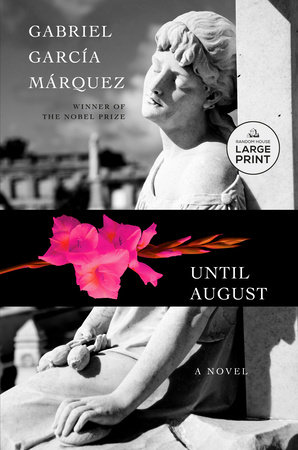
Until August

A novel

Translated by Anne McLean
Look inside
Listen to a clip from the audiobook
audio pause button
0:00
0:00
Large Print (Large Print - Tradepaper)
$24.00 US
| $33.00 CAN
24 per carton
On sale Mar 12, 2024 | 112 Pages | 9780593946602

See Additional Formats
NEW YORK TIMES BEST SELLER • The extraordinary rediscovered novel from the Nobel Prize–winning author of Love in the Time of Cholera and One Hundred Years of Solitude—a moving tale of female desire and abandon
 
Sitting alone beside the languorous blue waters of the lagoon, Ana Magdalena Bach contemplates the men at the hotel bar. She has been happily married for twenty-seven years and has no reason to escape the life she has made with her husband and children. And yet, every August, she travels by ferry here to the island where her mother is buried, and for one night takes a new lover.

Across sultry Caribbean evenings full of salsa and boleros, lotharios and conmen, Ana journeys further each year into the hinterland of her desire and the fear hidden in her heart.

Constantly surprising, joyously sensual, Until August is a profound meditation on freedom, regret, self-transformation, and the mysteries of love—an unexpected gift from one of the greatest writers the world has ever known.
1

She returned to the island on Friday, August 16, on the three o’clock ferry. She was wearing jeans, a plaid shirt, plain flat shoes without socks, carrying a satin parasol and a handbag, and her only luggage was a beach bag. In the row of taxis at the dock she went straight to an old model corroded by the sea air. The driver welcomed her warmly and took her jolting across the destitute village, with its mud-walled shacks, palm-thatch roofs, and streets of burning sand beside a sea in flames. He had to swerve around undaunted pigs and naked children pretending to be toreadors. On the outskirts of the village he drove down an avenue of royal palms where the beaches and the tourist hotels were, between the open sea and a lagoon inhabited by blue herons. At last he stopped outside the oldest, most dilapidated hotel.

The concierge was waiting for her with the registration card ready to sign and the keys to the only room on the second floor that overlooked the lagoon. She climbed the stairs in four strides and entered the shabby room that smelled of recent fumigation and was almost entirely occupied by an enormous double bed. She took a kidskin toiletry case out of her bag and a book with uncut pages that she put on the nightstand with an ivory paper knife marking her place. She took out a pink silk nightgown and tucked it under the pillow. She also took out a silk scarf printed with tropical birds, a short-sleeved white shirt, and a pair of very worn tennis shoes, and took them into the bathroom.

Before getting dressed she took off her wedding ring and the men’s watch she wore on her right wrist, put them on the shelf above the sink, and washed her face quickly to get rid of the dust from the journey, scare away the siesta-time fatigue. After she finished drying off she looked in the mirror and appraised her breasts, still round and high in spite of two pregnancies. She stretched her cheeks back with the heels of her hands to remind herself what she’d looked like when young. She ignored the wrinkles on her neck, as there was nothing she could do about them now, and checked her perfect teeth, which she’d brushed after lunch on board the ferry. She rolled deodorant onto her smooth-shaven underarms and put on the fresh cotton shirt with the initials AMB embroidered on the pocket. She brushed her straight black hair, which fell to her shoulders, and tied it up in a ponytail with the bird-print scarf. To complete her look, she moisturized her lips with vaseline, moistened her fingertips with her tongue and smoothed down her eyebrows, dabbed a drop of Maderas de Oriente behind each ear, and at last confronted her autumnal, motherly face in the mirror. Her skin without a trace of cosmetics had the color and texture of molasses, and her topaz eyes were beautiful with their dark Portuguese lids. She scrutinized herself thoroughly, judged herself without pity, and found that she looked almost as good as she felt. Only when she put her ring and watch back on did she notice how late she was: it was six minutes to four, but she allowed herself a moment of nostalgia to contemplate the herons that glided in stillness over the steamy torpor of the lagoon.

The taxi was waiting for her beneath the banana thatch at the entrance. Without needing instructions, he drove down the palm-lined avenue to a gap between the hotels where the street market was, and pulled up to a flower stall. A large black woman snoozing in a beach chair was startled awake by the horn, recognized the woman in the back seat of the car, and, laughing and chatting, handed her an already prepared bouquet of gladioli. A few blocks ahead the taxi turned up a barely passable track that climbed along a ridge of sharp stones. Through air crystalized by the heat she could see the wide-open Caribbean, the yachts lined up beside the tourists’ dock, the four o’clock ferry on its way back to the city. At the top of the hill was the poorest cemetery. She pushed open the rusty gate without straining and carried the bouquet down the path between burial mounds overgrown with weeds. In the center there was a ceiba tree with huge branches from which she took her bearings to find her mother’s grave. The sharp stones hurt her feet through the hot rubber soles of her shoes, and the harsh sun filtered through the satin of her parasol. An iguana emerged from the underbrush, stopped short in front of her, stared for an instant, then scampered away.

She pulled a gardening glove out of her pocket, put it on, and had to clean three gravestones before she recognized the pale marble with her mother’s name and the date of her death, eight years earlier.

She had repeated this trip every August 16 at the same time, with the same taxi and the same florist, under the fiery sun of that destitute cemetery, to place a bouquet of fresh gladioli on her mother’s grave. After that moment she had nothing to do until nine the next morning, when the first ferry went back to the mainland.

Her name was Ana Magdalena Bach. For twenty-seven of her forty-six years she had been in a well-matched marriage with a man she loved and who loved her and whom she married before finishing her arts-and-letters degree, still a virgin and without any previous relationships. Her mother had been a famous Montessori teacher who, in spite of her talents, never in her entire life wanted to be anything more. Ana Magdalena inherited from her the splendor of her golden eyes, the virtue of being a woman of few words, and the intelligence to manage her temper. They were a family of musicians. Her father had been a piano teacher and the director of the provincial conservatory for forty years. Her husband, an orchestra conductor, also the child of musicians, replaced his teacher when he retired. Ana Magdalena and her husband had an exemplary son who was the first cello of the National Symphony Orchestra by the age of twenty-two, and had been applauded by Mstislav Leopoldovich Rostropovich in a private session. Then there was their eighteen-year-old daughter, who had an almost genius ability to learn any instrument by ear but liked to use it only as a pretext to avoid sleeping at home. She was in the first flush of a fling with an excellent jazz trumpeter but was determined to take her vows with the Discalced Carmelites, against her parents’ will.

Three days before she died Ana Magdalena’s mother had expressed her wish to be buried on the island. Ana Magdalena had wanted to travel to the funeral, but no one thought it prudent, for she herself did not believe she would survive her grief. Her father took her to the island on the first anniversary to place a marble stone on the grave. The crossing, almost four hours in a canoe with an outboard motor, without a single instant of calm water, frightened her. She admired the golden sand beaches bordered by virgin jungle, the clamor of birdsong, and the phantasmal flight of the herons above the stillness of the lagoon. She was depressed by the poverty of the village, where they had to sleep outside in hammocks slung between two coconut palms, despite its being the birthplace of a poet and a grandiloquent senator who had once very nearly been president of the republic. She was struck by the number of black fishermen with mutilated arms from the premature explosions of dynamite sticks. However, she understood her mother’s wish when she saw the splendor of the world from the height of the cemetery. It was the only solitary place where one could not feel alone. That was when Ana Magdalena Bach decided to leave her mother there where she lay and assigned herself the task of bringing a bouquet of gladioli every year to place on her grave.

August was the month of heat waves and crazy downpours, but she understood it as yet another penance she must fulfill unfailingly and always alone. Her only weakness came in the face of her children’s insistence on seeing their grandmother’s grave, and nature made her pay with a terrifying crossing. The motorboat set sail despite the rain so night would not fall on the way and the children arrived petrified and overcome with seasickness. That time, fortunately, they were able to sleep in the first tourist hotel the senator built in his name with state funding.

Ana Magdalena Bach had seen more towering cliffs of glass go up every year while the village grew more and more impoverished. The ferry replaced the motorboats. The crossing still took four hours, but with air-conditioning, a band, and pleasure girls. She alone maintained her routine as the village’s most punctual visitor.

She went back to the hotel, lay down on the bed wearing nothing but her lace panties, opened her book to the page marked by the paper knife, and began to read beneath the blades of a ceiling fan that barely stirred the heat. The book was Dracula, by Bram Stoker. On the ferry she had raced with fervor through the first half of the masterpiece but this time fell asleep with the book on her chest. She woke up two hours later in darkness, drenched in sweat and starving.

The hotel bar was open until ten, and before going back to sleep she went down to eat whatever was on offer. She noticed there were more clients than usual at that hour, and the waiter didn’t seem to be the same one who had been there before. To avoid complications she ordered the same toasted ham and cheese sandwich as in previous years, and a coffee with milk. While they were bringing it she realized she was surrounded by the same older tourists as when this hotel had been the only one. A young woman was singing sad boleros and Agustín Romero himself, now old and blind, accompanied her lovingly on the same decrepit piano from the inaugural fiesta.

She ate her food quickly, trying to overcome the humiliation of eating alone, but she felt good listening to the music, which was soft and tranquil, and the girl could sing. When she finished there were only three couples left at scattered tables and, right in front of her, a man she hadn’t seen come in. He wore a white linen suit and had silver hair. There was a bottle of brandy on his table and a half-empty glass, and he looked as if he was alone in the world.

The piano began a daring bolero arrangement of Debussy’s “Clair de lune,” and the girl sang it with love. Moved, Ana Magdalena Bach ordered a gin with ice and soda, the only alcohol that agreed with her. The world changed with her first sip. She felt mischievous, joyful, capable of anything, and beautified by the sacred mixture of music and gin. She thought the man at the table in front of hers had not seen her, but she caught him watching her when she looked at him a second time. He blushed. She held his gaze while he looked at his pocket watch. He put it away in embarrassment, refilled his glass, one eye on the door, bewildered, because he was now aware that she was staring at him without mercy. Then he looked straight at her. She smiled and he greeted her with a slight nod.

“May I offer you a drink?” he asked.

“That would be a pleasure,” she said.

He moved to her table and very stylishly poured her a shot of brandy. “Cheers,” he said. She perked up, and they both knocked back their drinks in one. He choked, coughed with his whole body shuddering, and was left with tears streaming down his face. They were silent for a long moment while he dried off with a lavender-scented handkerchief and recovered his voice. She dared to ask him if he was expecting anyone.

“No,” he said. “There was something important but it didn’t work out.”

She asked with an expression of calculated incredulity: “Business?” He answered: “I’m no good for anything else anymore.” But he said it in the tone of voice men use when they don’t want to be believed. She obliged him, and added a tasteless comment far from her normal way of being but well judged:

“That may be what they tell you at home.”

And so she carried on shepherding him with her delicate touch, until she had him roped into banal chitchat. She tried to guess his age, and was one year over: forty-six. She tried to guess his country of origin from his accent, and after three tries gave up: he was a Hispanic gringo. She tried to guess his profession, and after her second attempt he hastened to tell her he was a civil engineer, which she suspected was a ruse to prevent her from stumbling onto the truth.

She talked about the audacity of turning a Debussy piece into a bolero, but he hadn’t noticed. No doubt he realized that she knew about music, whereas he hadn’t gone beyond “The Blue Danube.” She told him she was reading Stoker’s Dracula. He had read it in school, and was still struck by the episode of the count disembarking in London transformed into a dog. She agreed, and did not understand why Francis Ford Coppola had changed it in his unforgettable film. After the second drink she felt that the brandy had met up with the gin in some corner of her heart, and she had to concentrate in order not to lose her head. The music ended at eleven and the band was only waiting for them to leave so they could close.

She knew him by then as if she had always lived with him. She knew he was clean, impeccably dressed, with inexpressive hands accentuated by the natural shine of his fingernails, and with a good and cowardly heart. She realized that he was ill at ease under the gaze of her big golden eyes and did not take them off him. Then she felt bold enough to take a step that had never occurred to her in her entire life, not even in dreams, and she took it without any mystique:

“Shall we go up?”

He was at a loss.

“I’m not staying here,” he said.

But she did not even wait for him to finish his sentence. “I am,” she said. She stood up and shook her head a little to get it under control. “Second floor, number 203, to the right of the stairs. Don’t knock, just come right in.”
  • AWARD | 1982
    Nobel Prize in Literature
“Contains enough tenderness and beauty to recommend it to García Márquez’s many fans.” —Wall Street Journal

“Far more than a coda to a magnificent career . . . Anne McLean’s marvelous rendering of García Márquez’s posthumous Until August continues the tradition, immersing us in the dreamy richness of the author’s fictional worlds, amid characters pummeled by the demands of marriage, family and the dead . . . McLean’s nuanced translation harkens back to the maestro’s canonical novels while evoking, in a composition as tight as a Rembrandt portrait, the ache of human need.” —Minneapolis Star Tribune

“García Márquez should be read because he is so influential a writer, one who remodelled his country’s perception of itself and reshaped its literature and that of the wider world . . . Yet more than this, unlike so many other ‘great writers,’ his books are enjoyable. Inventive storytelling comes with indelible characters and arresting images served up with episodes of sharp psychological acuity . . . Love—ecstatic, forbidden, transgressive and especially between older people—is one of his great subjects . . . Until August is inventively enjoyable and working to its surprising, pleasing ending. I read it straight through in one sitting, then got up the next day and did it again.” —The Times (London)
© Caleb Bach
GABRIEL GARCÍA MÁRQUEZ was born in Aracataca, Colombia in 1927. He was awarded the Nobel Prize in Literature in 1982. He is the author of many works of fiction and nonfiction, including One Hundred Years of Solitude, Love in the Time of Cholera, and his memoir, Living to Tell the Tale. He died in 2014. View titles by Gabriel García Márquez

About

NEW YORK TIMES BEST SELLER • The extraordinary rediscovered novel from the Nobel Prize–winning author of Love in the Time of Cholera and One Hundred Years of Solitude—a moving tale of female desire and abandon
 
Sitting alone beside the languorous blue waters of the lagoon, Ana Magdalena Bach contemplates the men at the hotel bar. She has been happily married for twenty-seven years and has no reason to escape the life she has made with her husband and children. And yet, every August, she travels by ferry here to the island where her mother is buried, and for one night takes a new lover.

Across sultry Caribbean evenings full of salsa and boleros, lotharios and conmen, Ana journeys further each year into the hinterland of her desire and the fear hidden in her heart.

Constantly surprising, joyously sensual, Until August is a profound meditation on freedom, regret, self-transformation, and the mysteries of love—an unexpected gift from one of the greatest writers the world has ever known.

Excerpt

1

She returned to the island on Friday, August 16, on the three o’clock ferry. She was wearing jeans, a plaid shirt, plain flat shoes without socks, carrying a satin parasol and a handbag, and her only luggage was a beach bag. In the row of taxis at the dock she went straight to an old model corroded by the sea air. The driver welcomed her warmly and took her jolting across the destitute village, with its mud-walled shacks, palm-thatch roofs, and streets of burning sand beside a sea in flames. He had to swerve around undaunted pigs and naked children pretending to be toreadors. On the outskirts of the village he drove down an avenue of royal palms where the beaches and the tourist hotels were, between the open sea and a lagoon inhabited by blue herons. At last he stopped outside the oldest, most dilapidated hotel.

The concierge was waiting for her with the registration card ready to sign and the keys to the only room on the second floor that overlooked the lagoon. She climbed the stairs in four strides and entered the shabby room that smelled of recent fumigation and was almost entirely occupied by an enormous double bed. She took a kidskin toiletry case out of her bag and a book with uncut pages that she put on the nightstand with an ivory paper knife marking her place. She took out a pink silk nightgown and tucked it under the pillow. She also took out a silk scarf printed with tropical birds, a short-sleeved white shirt, and a pair of very worn tennis shoes, and took them into the bathroom.

Before getting dressed she took off her wedding ring and the men’s watch she wore on her right wrist, put them on the shelf above the sink, and washed her face quickly to get rid of the dust from the journey, scare away the siesta-time fatigue. After she finished drying off she looked in the mirror and appraised her breasts, still round and high in spite of two pregnancies. She stretched her cheeks back with the heels of her hands to remind herself what she’d looked like when young. She ignored the wrinkles on her neck, as there was nothing she could do about them now, and checked her perfect teeth, which she’d brushed after lunch on board the ferry. She rolled deodorant onto her smooth-shaven underarms and put on the fresh cotton shirt with the initials AMB embroidered on the pocket. She brushed her straight black hair, which fell to her shoulders, and tied it up in a ponytail with the bird-print scarf. To complete her look, she moisturized her lips with vaseline, moistened her fingertips with her tongue and smoothed down her eyebrows, dabbed a drop of Maderas de Oriente behind each ear, and at last confronted her autumnal, motherly face in the mirror. Her skin without a trace of cosmetics had the color and texture of molasses, and her topaz eyes were beautiful with their dark Portuguese lids. She scrutinized herself thoroughly, judged herself without pity, and found that she looked almost as good as she felt. Only when she put her ring and watch back on did she notice how late she was: it was six minutes to four, but she allowed herself a moment of nostalgia to contemplate the herons that glided in stillness over the steamy torpor of the lagoon.

The taxi was waiting for her beneath the banana thatch at the entrance. Without needing instructions, he drove down the palm-lined avenue to a gap between the hotels where the street market was, and pulled up to a flower stall. A large black woman snoozing in a beach chair was startled awake by the horn, recognized the woman in the back seat of the car, and, laughing and chatting, handed her an already prepared bouquet of gladioli. A few blocks ahead the taxi turned up a barely passable track that climbed along a ridge of sharp stones. Through air crystalized by the heat she could see the wide-open Caribbean, the yachts lined up beside the tourists’ dock, the four o’clock ferry on its way back to the city. At the top of the hill was the poorest cemetery. She pushed open the rusty gate without straining and carried the bouquet down the path between burial mounds overgrown with weeds. In the center there was a ceiba tree with huge branches from which she took her bearings to find her mother’s grave. The sharp stones hurt her feet through the hot rubber soles of her shoes, and the harsh sun filtered through the satin of her parasol. An iguana emerged from the underbrush, stopped short in front of her, stared for an instant, then scampered away.

She pulled a gardening glove out of her pocket, put it on, and had to clean three gravestones before she recognized the pale marble with her mother’s name and the date of her death, eight years earlier.

She had repeated this trip every August 16 at the same time, with the same taxi and the same florist, under the fiery sun of that destitute cemetery, to place a bouquet of fresh gladioli on her mother’s grave. After that moment she had nothing to do until nine the next morning, when the first ferry went back to the mainland.

Her name was Ana Magdalena Bach. For twenty-seven of her forty-six years she had been in a well-matched marriage with a man she loved and who loved her and whom she married before finishing her arts-and-letters degree, still a virgin and without any previous relationships. Her mother had been a famous Montessori teacher who, in spite of her talents, never in her entire life wanted to be anything more. Ana Magdalena inherited from her the splendor of her golden eyes, the virtue of being a woman of few words, and the intelligence to manage her temper. They were a family of musicians. Her father had been a piano teacher and the director of the provincial conservatory for forty years. Her husband, an orchestra conductor, also the child of musicians, replaced his teacher when he retired. Ana Magdalena and her husband had an exemplary son who was the first cello of the National Symphony Orchestra by the age of twenty-two, and had been applauded by Mstislav Leopoldovich Rostropovich in a private session. Then there was their eighteen-year-old daughter, who had an almost genius ability to learn any instrument by ear but liked to use it only as a pretext to avoid sleeping at home. She was in the first flush of a fling with an excellent jazz trumpeter but was determined to take her vows with the Discalced Carmelites, against her parents’ will.

Three days before she died Ana Magdalena’s mother had expressed her wish to be buried on the island. Ana Magdalena had wanted to travel to the funeral, but no one thought it prudent, for she herself did not believe she would survive her grief. Her father took her to the island on the first anniversary to place a marble stone on the grave. The crossing, almost four hours in a canoe with an outboard motor, without a single instant of calm water, frightened her. She admired the golden sand beaches bordered by virgin jungle, the clamor of birdsong, and the phantasmal flight of the herons above the stillness of the lagoon. She was depressed by the poverty of the village, where they had to sleep outside in hammocks slung between two coconut palms, despite its being the birthplace of a poet and a grandiloquent senator who had once very nearly been president of the republic. She was struck by the number of black fishermen with mutilated arms from the premature explosions of dynamite sticks. However, she understood her mother’s wish when she saw the splendor of the world from the height of the cemetery. It was the only solitary place where one could not feel alone. That was when Ana Magdalena Bach decided to leave her mother there where she lay and assigned herself the task of bringing a bouquet of gladioli every year to place on her grave.

August was the month of heat waves and crazy downpours, but she understood it as yet another penance she must fulfill unfailingly and always alone. Her only weakness came in the face of her children’s insistence on seeing their grandmother’s grave, and nature made her pay with a terrifying crossing. The motorboat set sail despite the rain so night would not fall on the way and the children arrived petrified and overcome with seasickness. That time, fortunately, they were able to sleep in the first tourist hotel the senator built in his name with state funding.

Ana Magdalena Bach had seen more towering cliffs of glass go up every year while the village grew more and more impoverished. The ferry replaced the motorboats. The crossing still took four hours, but with air-conditioning, a band, and pleasure girls. She alone maintained her routine as the village’s most punctual visitor.

She went back to the hotel, lay down on the bed wearing nothing but her lace panties, opened her book to the page marked by the paper knife, and began to read beneath the blades of a ceiling fan that barely stirred the heat. The book was Dracula, by Bram Stoker. On the ferry she had raced with fervor through the first half of the masterpiece but this time fell asleep with the book on her chest. She woke up two hours later in darkness, drenched in sweat and starving.

The hotel bar was open until ten, and before going back to sleep she went down to eat whatever was on offer. She noticed there were more clients than usual at that hour, and the waiter didn’t seem to be the same one who had been there before. To avoid complications she ordered the same toasted ham and cheese sandwich as in previous years, and a coffee with milk. While they were bringing it she realized she was surrounded by the same older tourists as when this hotel had been the only one. A young woman was singing sad boleros and Agustín Romero himself, now old and blind, accompanied her lovingly on the same decrepit piano from the inaugural fiesta.

She ate her food quickly, trying to overcome the humiliation of eating alone, but she felt good listening to the music, which was soft and tranquil, and the girl could sing. When she finished there were only three couples left at scattered tables and, right in front of her, a man she hadn’t seen come in. He wore a white linen suit and had silver hair. There was a bottle of brandy on his table and a half-empty glass, and he looked as if he was alone in the world.

The piano began a daring bolero arrangement of Debussy’s “Clair de lune,” and the girl sang it with love. Moved, Ana Magdalena Bach ordered a gin with ice and soda, the only alcohol that agreed with her. The world changed with her first sip. She felt mischievous, joyful, capable of anything, and beautified by the sacred mixture of music and gin. She thought the man at the table in front of hers had not seen her, but she caught him watching her when she looked at him a second time. He blushed. She held his gaze while he looked at his pocket watch. He put it away in embarrassment, refilled his glass, one eye on the door, bewildered, because he was now aware that she was staring at him without mercy. Then he looked straight at her. She smiled and he greeted her with a slight nod.

“May I offer you a drink?” he asked.

“That would be a pleasure,” she said.

He moved to her table and very stylishly poured her a shot of brandy. “Cheers,” he said. She perked up, and they both knocked back their drinks in one. He choked, coughed with his whole body shuddering, and was left with tears streaming down his face. They were silent for a long moment while he dried off with a lavender-scented handkerchief and recovered his voice. She dared to ask him if he was expecting anyone.

“No,” he said. “There was something important but it didn’t work out.”

She asked with an expression of calculated incredulity: “Business?” He answered: “I’m no good for anything else anymore.” But he said it in the tone of voice men use when they don’t want to be believed. She obliged him, and added a tasteless comment far from her normal way of being but well judged:

“That may be what they tell you at home.”

And so she carried on shepherding him with her delicate touch, until she had him roped into banal chitchat. She tried to guess his age, and was one year over: forty-six. She tried to guess his country of origin from his accent, and after three tries gave up: he was a Hispanic gringo. She tried to guess his profession, and after her second attempt he hastened to tell her he was a civil engineer, which she suspected was a ruse to prevent her from stumbling onto the truth.

She talked about the audacity of turning a Debussy piece into a bolero, but he hadn’t noticed. No doubt he realized that she knew about music, whereas he hadn’t gone beyond “The Blue Danube.” She told him she was reading Stoker’s Dracula. He had read it in school, and was still struck by the episode of the count disembarking in London transformed into a dog. She agreed, and did not understand why Francis Ford Coppola had changed it in his unforgettable film. After the second drink she felt that the brandy had met up with the gin in some corner of her heart, and she had to concentrate in order not to lose her head. The music ended at eleven and the band was only waiting for them to leave so they could close.

She knew him by then as if she had always lived with him. She knew he was clean, impeccably dressed, with inexpressive hands accentuated by the natural shine of his fingernails, and with a good and cowardly heart. She realized that he was ill at ease under the gaze of her big golden eyes and did not take them off him. Then she felt bold enough to take a step that had never occurred to her in her entire life, not even in dreams, and she took it without any mystique:

“Shall we go up?”

He was at a loss.

“I’m not staying here,” he said.

But she did not even wait for him to finish his sentence. “I am,” she said. She stood up and shook her head a little to get it under control. “Second floor, number 203, to the right of the stairs. Don’t knock, just come right in.”

Awards

  • AWARD | 1982
    Nobel Prize in Literature

Reviews

“Contains enough tenderness and beauty to recommend it to García Márquez’s many fans.” —Wall Street Journal

“Far more than a coda to a magnificent career . . . Anne McLean’s marvelous rendering of García Márquez’s posthumous Until August continues the tradition, immersing us in the dreamy richness of the author’s fictional worlds, amid characters pummeled by the demands of marriage, family and the dead . . . McLean’s nuanced translation harkens back to the maestro’s canonical novels while evoking, in a composition as tight as a Rembrandt portrait, the ache of human need.” —Minneapolis Star Tribune

“García Márquez should be read because he is so influential a writer, one who remodelled his country’s perception of itself and reshaped its literature and that of the wider world . . . Yet more than this, unlike so many other ‘great writers,’ his books are enjoyable. Inventive storytelling comes with indelible characters and arresting images served up with episodes of sharp psychological acuity . . . Love—ecstatic, forbidden, transgressive and especially between older people—is one of his great subjects . . . Until August is inventively enjoyable and working to its surprising, pleasing ending. I read it straight through in one sitting, then got up the next day and did it again.” —The Times (London)

Author

© Caleb Bach
GABRIEL GARCÍA MÁRQUEZ was born in Aracataca, Colombia in 1927. He was awarded the Nobel Prize in Literature in 1982. He is the author of many works of fiction and nonfiction, including One Hundred Years of Solitude, Love in the Time of Cholera, and his memoir, Living to Tell the Tale. He died in 2014. View titles by Gabriel García Márquez
  • More Websites from
    Penguin Random House
  • Common Reads
  • Library Marketing