Download high-resolution image Look inside
Listen to a clip from the audiobook
audio pause button
0:00
0:00

Landslide

Look inside
Listen to a clip from the audiobook
audio pause button
0:00
0:00
Hardcover
$17.99 US
| $24.99 CAN
On sale Mar 10, 2026 | 208 Pages | 9780593859933
Age 10 and up | Grades 6-8
Reading Level: Lexile 790L

See Additional Formats
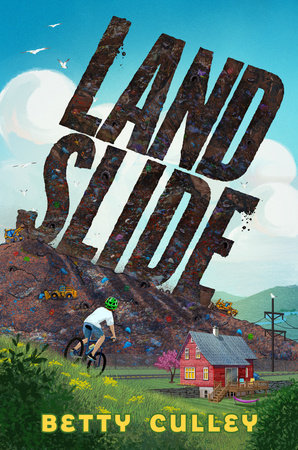
A perceptive boy worries the landfill across the street is on the verge of collapse, forming a brave plan to save his dad who works at the top of the heap.

Nathan Savage has always been fascinated by anything that moves; he sees movement others don’t notice. But what he sees now out his living room window sets off major alarm bells—the massive landfill across the road is shifting, and could be heading toward a catastrophic landslide.
    The landfill is also where Nathan’s dad works, on the top of the heap driving the huge compactor that crushes the garbage with its enormous metal wheels. The more Nathan watches the landfill, the more worried he becomes. What will happen to his father if he’s at work when the garbage hill collapses? A fate that seems closer and closer to happening every day if Nathan doesn’t act soon. But how does a ten-year old boy stop a force of nature? In this fascinating and fast-paced story, author Betty Culley exposes kids to lots of garbage, and the natural and environmental impact country landfills have on local towns.
Chapter 1
The History of Garbage, According to Dad

Our house on Route 4 in Crawley, Maine, is right across the road from the dump. There wasn’t always a dump there. It used to be the other half of my grandparents’ land, and in the summer we’d look out our front windows and see a big field full of tall grass and wildflowers. In the winter we’d watch deer and foxes. Mom doesn’t blame her sister for selling it. Aunt Del had no idea what would happen. But now it’s the place for everyone’s trash.

Last week protestors started gathering at the entrance, under the metal sign that says homefront municipal waste management in big green letters. The sign is higher than the chimney on our roof, and it’s so tall that when we’re driving home from town, we can see it from miles away.

It’s mud season and there’s only melting patches of slushy snow left on the ground, but it’s cold enough that the protestors wear coats and hats, and a few of them have scarves and gloves.
Yesterday, when I was getting off the school bus, a man in a truck rolled down his window and yelled at the protestors, in a not very friendly voice, “You’re all a bunch of NIMBYs!”

“What does NIMBYs mean?” I asked Dad later. “Someone shouted that at the protestors.”

N.I.M.B.Y. stands for Not In My Back Yard,” he answered. “Calling someone a NIMBY is a way of saying they only care about protesting because the dump is near where they live.”

“But the dump isn’t in their backyard, it’s in our front yard,” I pointed out.

I’ve never stood out there with the protestors, but if I did, someone could call me a NIMFY and it would be true.

Not In My Front Yard.


The protestors are singing a new song today.

Which way for Crawley town?

Which way to go?
Are we a dumping ground
For all the other states around?
We say NO NO NO.

That’s because soon the town will vote on whether or not the landfill can expand. Landfill is what they call the dump. The hill of garbage is getting higher and higher, and the dump is running out of room to put trash. Which kind of makes it a landfull. They need permission to build another garbage hill, and if the town says no, they’ll have to close.

As I eat breakfast and listen to the protestors, I wonder about something I never thought of before.

“Why doesn’t the dump make the protestors leave?” I ask Dad.

He’s lacing up his steel-toed boots and zipping up the red wool vest he wears under his jacket. Dad has the woodstove roaring because he gets cold easy. When he worked at Fortier’s Cement he’d come home coughing, his skin covered in gray dust. Even though he doesn’t work there anymore, it’s like some of the dust permanently stuck to his skin, changing the color.

Now Dad works at Homefront Municipal Waste Management, driving the landfill compactor. It’s a huge machine that pushes the garbage with a giant blade and squishes it down with enormous metal spiked wheels.

“Protestors have a right to be there, same as the dump, Nathan. Unless people stop making it, garbage has to go somewhere,” Dad says. “It’s always gonna be in someone’s backyard.”
NIMBY. NIMFY.

Or as Dad says. ISBY.

In Someone’s Back Yard.


Then Dad points his finger in the air, and I know exactly what’s coming.

The history of garbage, according to Dad.

“For three years now, Nathan, we’ve had a commercial landfill here. But long before that, Crawley and all the other Maine towns had open-pit dumps. When I was growing up, the old town dump only operated on Sundays. Cars and trucks would back up and people launched their garbage bags into the air. Once someone left a rusty trampoline in the metal pile, and I jumped on it while my parents threw out our trash and talked to the dump attendant. When the pit got full, they’d set it on fire, and you could see the rats running out. Sometimes the haze from the smoke was so bad, it stopped traffic in town!”

Dad takes a breath and starts in again. It’s like the history of garbage is a bedtime story, and you have to tell it from the very beginning. I spread Mom’s wild grape jelly on my toast, drink half my glass of milk, and keep listening.

“Of course, when your grandparents were growing up, they didn’t even go to the dump. Back then, there wasn’t all the plastic and packaging we have now. They burned what garbage they had in a metal burn barrel—things like paper and old lumber. They laid junk metal on top of the stone walls, and food scraps went to the pigs and chickens.”

Dad stops talking and smiles to himself, like he’s seeing the pigs and chickens eating the food scraps. He puts on his green work jacket and takes his lunch box out of the refrigerator. When he lost weight at Fortier’s Cement, he used Mom’s sharpest awl to make another hole in his leather belt. The end of his belt still hangs down.

I finish my toast and the rest of my milk. I know Dad’s not done with the history of garbage, so I take my glasses off and clean them with a napkin while I wait for him to continue.

“Then the state stopped the towns from burning their trash in open-pit dumps because it sent bad chemicals into the air and groundwater. Pits were bad. Burning was bad. It was all bad.”

“But what about Mom?” I ask. “It’s all bad for Mom now, too, isn’t it?”

Dad doesn’t answer, but we both know it’s true.

Chapter 2

Ice Dam

Three years ago, when I was seven, I went with Dad to the doctor, because Mom still had her job at the shoe repair shop. She said if Dad went by himself, he’d just come back full of stories and jokes, so I was to pay attention to what the doctor said. It was Dad’s first visit to a doctor in twenty-five years. I brought my school binder and a black pen.

The doctor wore purple shoes and her glasses were on top of her head. That made me wonder if she wanted to see things blurry, the way I do when I take my glasses off. Maybe she was tired of looking at all the sick people. There had been a lot of them in the waiting room.

First, she asked Dad why he was there.

“I’m weaker than a rag,” he said.

She waited patiently while he coughed into his cloth handkerchief, then stuffed it back in his pants pocket. I sat in a chair near the window with my binder on my lap.

The doctor took Dad’s temperature, put her stethoscope on his back, then sent him across the street to the hospital for an X-ray. When we got back to the room, she was wearing her glasses. She pointed to a picture on her computer that she said were Dad’s lungs. Her finger touched a place at the bottom.

“You have some scarring in the bases here,” she said.

The only bases I’d ever heard of were in baseball, but I opened my binder and wrote it down.

SCARING BASES

Then she looked at the paper Dad filled out when we first got there.

“How long have you worked at Fortier’s Cement?” she asked.

“Since I was sixteen.”

“What do you do there, Mr. Savage?”

“Whatever I’m told to,” Dad said, so seriously, at first the doctor didn’t realize he was joking.

Then he gave her the history of all the jobs he’d ever done at the cement plant, ending with the one he had now, forklift operator.

The doctor kept nodding to herself as he spoke, and when he was finished talking, she said,
“You have pneumonia.”

I picked up my pen and wrote NEW MOANIA.

“I’m giving you a prescription for antibiotics, but exposure to cement dust, for as long as you’ve had, can be bad for your lungs. It has a cumulative effect.”

I wrote CEMMENT DUST BAD.

“You might want to consider another line of work,” the doctor added.

“If you’re offering me a job, I accept,” Dad answered, and the doctor and Dad both laughed.

I’d been looking out the window at the snowy roof over the office parking lot, where there were dozens of long icicles hanging down. The winter sun was bright, making the icicles shine. I could also see an ice dam, the heavy ridge of ice that had built up along the whole length of the roof just above the icicles. It was shivering under the snow, getting ready to let loose.

As we stepped outside, I grabbed Dad’s hand and pulled us sideways, away from the steep roof. And just as he started the car, the dam broke, icicles smashing onto the pavement in a thousand splintery shards.

When Mom got home, I tore out the page from my binder and gave it to her.

She read what I had written—SCARING BASES, NEW MOANIA, CEMMENT DUST BAD—folded the sheet in half, and put it in her pocket.

And that summer, when the job driving the compactor at Homefront Municipal Waste Management came up, Dad took it.

Chapter 3

I-Sight

When I take my glasses off, like Dad’s doctor did, the world looks blurry. But when I wear my glasses, it’s very clear—sometimes too clear. I can see things moving and what’s going to happen to them—like when the ice dam slid off the roof. I call it my I-sight because sometimes I’m the only one who notices. I think I was born that way, just how owls and cats are born being able to see in the dark.

Mom says when I was a baby, I had a mobile with toy birds hanging over my crib. You wound it up and they moved around and around and music played. Whenever it stopped, I would cry until she started it again. Mom guessed I might grow up to be a musician, because she thought I loved the music so much.

I don’t remember the mobile, but I know it wasn’t the music I wanted. I cried to make the birds keep spinning above me in my crib.

Then, when I was five, my parents took me candlepin bowling for the first time. The bowling alley, with its high ceiling, echoed with the constant sound of balls rolling down the wooden lanes and candlepins falling over.

“Here’s how you play, Nathan,” Dad explained. “See those ten pins at the end of the lane? You get three tries to knock them all over.”

Dad started to recite the history of candlepin bowling, but I was only half listening. There was constant motion all around, in a way I’d never seen before—people winding up to throw, balls spinning, pins toppling over with a crack. It felt like a heaven made especially for me.
I turned out to be a terrible bowler. I knew the point was to knock over the pins, but all I cared about was watching the ball roll, even if it chugged its way slowly into the gutter.
When Mom and Dad took a break to go to the snack bar, I stood on a chair and studied the two men bowling in the next lane. My eyes followed the ball as it left their hand, and I could tell exactly what was going to happen.

“CRASH! Seven down,” I yelled as the first man took his turn.

A few seconds later, seven pins fell over.

“CRASH! Three down,” I yelled again as the next ball careened down the lane.

The ball hit the fallen pins, which moved and knocked over the remaining three candlepins.

The second man got up to make his first throw.

“Headpin and kingpin down,” I predicted, jumping on the chair.

Part of Dad’s history of candlepin bowling included the names of the pin in the front (headpin) and the one right behind it (kingpin).

The headpin and the kingpin fell over.

Then he wound up, swung his arm way back, and released the next ball.

“GUTTER BALL. None down,” I called.

The ball took a sharp curve into the gutter.

“Two down again,” I announced after the man threw his last ball.

Two pins wobbled and tipped onto the wooden lane.

At first the men laughed, especially when my predictions for good throws were right. But when I told them about their bad throws, they began glaring at me.

“Kid, how about keeping your eyes on your own lane? You’re jinxing us here,” the second man hollered.

I got down from the chair and Mom and Dad came back with pizza and a soda for me. I thought everyone could see how many pins their balls would knock over, but that day I learned it wasn’t true. I also learned that sometimes people didn’t want to know what I saw. Especially if it was bad.

The year after that, there were Little League sign-ups. I listened to the history of baseball, according to Dad, and joined a team. My cousin Lizette was on another team. She’s a year younger than I am, and her mother is my aunt Del, Mom’s older sister.

When it was my turn at bat, if I hit the ball, I’d try to see where it was going while I ran to first base. Go, Nathan! Speed it up, my teammates and coach shouted, but it didn’t make any difference.

I was a better fielder than a batter. I loved being out in the grass and watching the ball soar through the air or scuttle along the ground. I especially liked the feel of stopping it in my mitt. But I had the same problem as what happened at candlepin bowling. I couldn’t help saying what I saw.

“GROUNDER UP THE MIDDLE. Base hit.”

“HIGH FLY BALL. Short center field. Easy out.”

I was especially excited when we played Lizette’s team and she got up to bat. The day she had her best hit, I called it.

“DEEP IN LEFT FIELD. DON’T BOTHER CHASING—IT’S A HOME RUN.”

“Yay, Lizette!”

Lizette’s braids flew out behind her batting helmet as she ran the bases.

It wasn’t only Lizette I got excited for. I rooted for the opposing catcher, too.

“FOUL TIP. I bet you can get it.”

One day the coach took me aside. “Nathan, you are very perceptive,” she said, and her mouth twisted a little when she said the word. “But do you think you can tone it down a little?”

I had no idea what she was talking about.

“Nathan,” she sighed. “You’re here to play baseball, right?”

“Yes. I am playing baseball,” I said.

“Good. Then drop the comments. Be a baseball player, not a sports announcer.”

Now that I’m ten, I’ve learned to stop myself from shouting and telling everyone what I see. But lately, when I look across the road at the garbage hill, I don’t know if that’s a good thing or not.
Praise for Landslide:

A JLG Selection

“Culley grounds the story in solid environmental education, explaining rural landfills’ acceptance of out-of-state waste and the cumulative dangers of exposure to environmental waste and landfill gases. The plot builds steadily, and Nathan’s voice remains absorbing throughout, capturing a kid’s determination to protect his family while grappling with complex community politics. The environmental message is clear but never heavy-handed, and Wilder’s feelings about his condition add authentic representation. An author’s note reveals the story is based on an actual Maine landfill collapse in 1989 and states that such disasters occur worldwide. An earnest, well-researched environmental tale that educates as it engages.” —Kirkus

Landslide will appeal to fans of environmental fiction, especially those who liked Carl Hiaasen’s Hoot (2002) and Flush (2005), as well as readers interested in themes of activism.” —Booklist
Betty Culley is the award-winning author of young adult and middle grade novels. As a child, she was in foster care and then adopted and read everything she could get her hands on. Before becoming an author, she worked as an obstetrics nurse and as a pediatric home hospice nurse. She lives in a small town, where she tends a garden and a growing crabapple orchard and floats in her farm pond during Maine’s brief summers. View titles by Betty Culley

About

A perceptive boy worries the landfill across the street is on the verge of collapse, forming a brave plan to save his dad who works at the top of the heap.

Nathan Savage has always been fascinated by anything that moves; he sees movement others don’t notice. But what he sees now out his living room window sets off major alarm bells—the massive landfill across the road is shifting, and could be heading toward a catastrophic landslide.
    The landfill is also where Nathan’s dad works, on the top of the heap driving the huge compactor that crushes the garbage with its enormous metal wheels. The more Nathan watches the landfill, the more worried he becomes. What will happen to his father if he’s at work when the garbage hill collapses? A fate that seems closer and closer to happening every day if Nathan doesn’t act soon. But how does a ten-year old boy stop a force of nature? In this fascinating and fast-paced story, author Betty Culley exposes kids to lots of garbage, and the natural and environmental impact country landfills have on local towns.

Excerpt

Chapter 1
The History of Garbage, According to Dad

Our house on Route 4 in Crawley, Maine, is right across the road from the dump. There wasn’t always a dump there. It used to be the other half of my grandparents’ land, and in the summer we’d look out our front windows and see a big field full of tall grass and wildflowers. In the winter we’d watch deer and foxes. Mom doesn’t blame her sister for selling it. Aunt Del had no idea what would happen. But now it’s the place for everyone’s trash.

Last week protestors started gathering at the entrance, under the metal sign that says homefront municipal waste management in big green letters. The sign is higher than the chimney on our roof, and it’s so tall that when we’re driving home from town, we can see it from miles away.

It’s mud season and there’s only melting patches of slushy snow left on the ground, but it’s cold enough that the protestors wear coats and hats, and a few of them have scarves and gloves.
Yesterday, when I was getting off the school bus, a man in a truck rolled down his window and yelled at the protestors, in a not very friendly voice, “You’re all a bunch of NIMBYs!”

“What does NIMBYs mean?” I asked Dad later. “Someone shouted that at the protestors.”

N.I.M.B.Y. stands for Not In My Back Yard,” he answered. “Calling someone a NIMBY is a way of saying they only care about protesting because the dump is near where they live.”

“But the dump isn’t in their backyard, it’s in our front yard,” I pointed out.

I’ve never stood out there with the protestors, but if I did, someone could call me a NIMFY and it would be true.

Not In My Front Yard.


The protestors are singing a new song today.

Which way for Crawley town?

Which way to go?
Are we a dumping ground
For all the other states around?
We say NO NO NO.

That’s because soon the town will vote on whether or not the landfill can expand. Landfill is what they call the dump. The hill of garbage is getting higher and higher, and the dump is running out of room to put trash. Which kind of makes it a landfull. They need permission to build another garbage hill, and if the town says no, they’ll have to close.

As I eat breakfast and listen to the protestors, I wonder about something I never thought of before.

“Why doesn’t the dump make the protestors leave?” I ask Dad.

He’s lacing up his steel-toed boots and zipping up the red wool vest he wears under his jacket. Dad has the woodstove roaring because he gets cold easy. When he worked at Fortier’s Cement he’d come home coughing, his skin covered in gray dust. Even though he doesn’t work there anymore, it’s like some of the dust permanently stuck to his skin, changing the color.

Now Dad works at Homefront Municipal Waste Management, driving the landfill compactor. It’s a huge machine that pushes the garbage with a giant blade and squishes it down with enormous metal spiked wheels.

“Protestors have a right to be there, same as the dump, Nathan. Unless people stop making it, garbage has to go somewhere,” Dad says. “It’s always gonna be in someone’s backyard.”
NIMBY. NIMFY.

Or as Dad says. ISBY.

In Someone’s Back Yard.


Then Dad points his finger in the air, and I know exactly what’s coming.

The history of garbage, according to Dad.

“For three years now, Nathan, we’ve had a commercial landfill here. But long before that, Crawley and all the other Maine towns had open-pit dumps. When I was growing up, the old town dump only operated on Sundays. Cars and trucks would back up and people launched their garbage bags into the air. Once someone left a rusty trampoline in the metal pile, and I jumped on it while my parents threw out our trash and talked to the dump attendant. When the pit got full, they’d set it on fire, and you could see the rats running out. Sometimes the haze from the smoke was so bad, it stopped traffic in town!”

Dad takes a breath and starts in again. It’s like the history of garbage is a bedtime story, and you have to tell it from the very beginning. I spread Mom’s wild grape jelly on my toast, drink half my glass of milk, and keep listening.

“Of course, when your grandparents were growing up, they didn’t even go to the dump. Back then, there wasn’t all the plastic and packaging we have now. They burned what garbage they had in a metal burn barrel—things like paper and old lumber. They laid junk metal on top of the stone walls, and food scraps went to the pigs and chickens.”

Dad stops talking and smiles to himself, like he’s seeing the pigs and chickens eating the food scraps. He puts on his green work jacket and takes his lunch box out of the refrigerator. When he lost weight at Fortier’s Cement, he used Mom’s sharpest awl to make another hole in his leather belt. The end of his belt still hangs down.

I finish my toast and the rest of my milk. I know Dad’s not done with the history of garbage, so I take my glasses off and clean them with a napkin while I wait for him to continue.

“Then the state stopped the towns from burning their trash in open-pit dumps because it sent bad chemicals into the air and groundwater. Pits were bad. Burning was bad. It was all bad.”

“But what about Mom?” I ask. “It’s all bad for Mom now, too, isn’t it?”

Dad doesn’t answer, but we both know it’s true.

Chapter 2

Ice Dam

Three years ago, when I was seven, I went with Dad to the doctor, because Mom still had her job at the shoe repair shop. She said if Dad went by himself, he’d just come back full of stories and jokes, so I was to pay attention to what the doctor said. It was Dad’s first visit to a doctor in twenty-five years. I brought my school binder and a black pen.

The doctor wore purple shoes and her glasses were on top of her head. That made me wonder if she wanted to see things blurry, the way I do when I take my glasses off. Maybe she was tired of looking at all the sick people. There had been a lot of them in the waiting room.

First, she asked Dad why he was there.

“I’m weaker than a rag,” he said.

She waited patiently while he coughed into his cloth handkerchief, then stuffed it back in his pants pocket. I sat in a chair near the window with my binder on my lap.

The doctor took Dad’s temperature, put her stethoscope on his back, then sent him across the street to the hospital for an X-ray. When we got back to the room, she was wearing her glasses. She pointed to a picture on her computer that she said were Dad’s lungs. Her finger touched a place at the bottom.

“You have some scarring in the bases here,” she said.

The only bases I’d ever heard of were in baseball, but I opened my binder and wrote it down.

SCARING BASES

Then she looked at the paper Dad filled out when we first got there.

“How long have you worked at Fortier’s Cement?” she asked.

“Since I was sixteen.”

“What do you do there, Mr. Savage?”

“Whatever I’m told to,” Dad said, so seriously, at first the doctor didn’t realize he was joking.

Then he gave her the history of all the jobs he’d ever done at the cement plant, ending with the one he had now, forklift operator.

The doctor kept nodding to herself as he spoke, and when he was finished talking, she said,
“You have pneumonia.”

I picked up my pen and wrote NEW MOANIA.

“I’m giving you a prescription for antibiotics, but exposure to cement dust, for as long as you’ve had, can be bad for your lungs. It has a cumulative effect.”

I wrote CEMMENT DUST BAD.

“You might want to consider another line of work,” the doctor added.

“If you’re offering me a job, I accept,” Dad answered, and the doctor and Dad both laughed.

I’d been looking out the window at the snowy roof over the office parking lot, where there were dozens of long icicles hanging down. The winter sun was bright, making the icicles shine. I could also see an ice dam, the heavy ridge of ice that had built up along the whole length of the roof just above the icicles. It was shivering under the snow, getting ready to let loose.

As we stepped outside, I grabbed Dad’s hand and pulled us sideways, away from the steep roof. And just as he started the car, the dam broke, icicles smashing onto the pavement in a thousand splintery shards.

When Mom got home, I tore out the page from my binder and gave it to her.

She read what I had written—SCARING BASES, NEW MOANIA, CEMMENT DUST BAD—folded the sheet in half, and put it in her pocket.

And that summer, when the job driving the compactor at Homefront Municipal Waste Management came up, Dad took it.

Chapter 3

I-Sight

When I take my glasses off, like Dad’s doctor did, the world looks blurry. But when I wear my glasses, it’s very clear—sometimes too clear. I can see things moving and what’s going to happen to them—like when the ice dam slid off the roof. I call it my I-sight because sometimes I’m the only one who notices. I think I was born that way, just how owls and cats are born being able to see in the dark.

Mom says when I was a baby, I had a mobile with toy birds hanging over my crib. You wound it up and they moved around and around and music played. Whenever it stopped, I would cry until she started it again. Mom guessed I might grow up to be a musician, because she thought I loved the music so much.

I don’t remember the mobile, but I know it wasn’t the music I wanted. I cried to make the birds keep spinning above me in my crib.

Then, when I was five, my parents took me candlepin bowling for the first time. The bowling alley, with its high ceiling, echoed with the constant sound of balls rolling down the wooden lanes and candlepins falling over.

“Here’s how you play, Nathan,” Dad explained. “See those ten pins at the end of the lane? You get three tries to knock them all over.”

Dad started to recite the history of candlepin bowling, but I was only half listening. There was constant motion all around, in a way I’d never seen before—people winding up to throw, balls spinning, pins toppling over with a crack. It felt like a heaven made especially for me.
I turned out to be a terrible bowler. I knew the point was to knock over the pins, but all I cared about was watching the ball roll, even if it chugged its way slowly into the gutter.
When Mom and Dad took a break to go to the snack bar, I stood on a chair and studied the two men bowling in the next lane. My eyes followed the ball as it left their hand, and I could tell exactly what was going to happen.

“CRASH! Seven down,” I yelled as the first man took his turn.

A few seconds later, seven pins fell over.

“CRASH! Three down,” I yelled again as the next ball careened down the lane.

The ball hit the fallen pins, which moved and knocked over the remaining three candlepins.

The second man got up to make his first throw.

“Headpin and kingpin down,” I predicted, jumping on the chair.

Part of Dad’s history of candlepin bowling included the names of the pin in the front (headpin) and the one right behind it (kingpin).

The headpin and the kingpin fell over.

Then he wound up, swung his arm way back, and released the next ball.

“GUTTER BALL. None down,” I called.

The ball took a sharp curve into the gutter.

“Two down again,” I announced after the man threw his last ball.

Two pins wobbled and tipped onto the wooden lane.

At first the men laughed, especially when my predictions for good throws were right. But when I told them about their bad throws, they began glaring at me.

“Kid, how about keeping your eyes on your own lane? You’re jinxing us here,” the second man hollered.

I got down from the chair and Mom and Dad came back with pizza and a soda for me. I thought everyone could see how many pins their balls would knock over, but that day I learned it wasn’t true. I also learned that sometimes people didn’t want to know what I saw. Especially if it was bad.

The year after that, there were Little League sign-ups. I listened to the history of baseball, according to Dad, and joined a team. My cousin Lizette was on another team. She’s a year younger than I am, and her mother is my aunt Del, Mom’s older sister.

When it was my turn at bat, if I hit the ball, I’d try to see where it was going while I ran to first base. Go, Nathan! Speed it up, my teammates and coach shouted, but it didn’t make any difference.

I was a better fielder than a batter. I loved being out in the grass and watching the ball soar through the air or scuttle along the ground. I especially liked the feel of stopping it in my mitt. But I had the same problem as what happened at candlepin bowling. I couldn’t help saying what I saw.

“GROUNDER UP THE MIDDLE. Base hit.”

“HIGH FLY BALL. Short center field. Easy out.”

I was especially excited when we played Lizette’s team and she got up to bat. The day she had her best hit, I called it.

“DEEP IN LEFT FIELD. DON’T BOTHER CHASING—IT’S A HOME RUN.”

“Yay, Lizette!”

Lizette’s braids flew out behind her batting helmet as she ran the bases.

It wasn’t only Lizette I got excited for. I rooted for the opposing catcher, too.

“FOUL TIP. I bet you can get it.”

One day the coach took me aside. “Nathan, you are very perceptive,” she said, and her mouth twisted a little when she said the word. “But do you think you can tone it down a little?”

I had no idea what she was talking about.

“Nathan,” she sighed. “You’re here to play baseball, right?”

“Yes. I am playing baseball,” I said.

“Good. Then drop the comments. Be a baseball player, not a sports announcer.”

Now that I’m ten, I’ve learned to stop myself from shouting and telling everyone what I see. But lately, when I look across the road at the garbage hill, I don’t know if that’s a good thing or not.

Reviews

Praise for Landslide:

A JLG Selection

“Culley grounds the story in solid environmental education, explaining rural landfills’ acceptance of out-of-state waste and the cumulative dangers of exposure to environmental waste and landfill gases. The plot builds steadily, and Nathan’s voice remains absorbing throughout, capturing a kid’s determination to protect his family while grappling with complex community politics. The environmental message is clear but never heavy-handed, and Wilder’s feelings about his condition add authentic representation. An author’s note reveals the story is based on an actual Maine landfill collapse in 1989 and states that such disasters occur worldwide. An earnest, well-researched environmental tale that educates as it engages.” —Kirkus

Landslide will appeal to fans of environmental fiction, especially those who liked Carl Hiaasen’s Hoot (2002) and Flush (2005), as well as readers interested in themes of activism.” —Booklist

Author

Betty Culley is the award-winning author of young adult and middle grade novels. As a child, she was in foster care and then adopted and read everything she could get her hands on. Before becoming an author, she worked as an obstetrics nurse and as a pediatric home hospice nurse. She lives in a small town, where she tends a garden and a growing crabapple orchard and floats in her farm pond during Maine’s brief summers. View titles by Betty Culley
  • More Websites from
    Penguin Random House
  • Common Reads
  • Library Marketing