1Hello, French Fry
Pow! I felt my green backpack yanked off my shoulder, my neck whiplashing back with it. From the corner of my eye, I saw it fly across the grassy schoolyard, tan straps fluttering in the air, before landing in a puddle.
I whirled around and found myself face-to-teeth with Lee Beaumont’s snarl. There was a yellow corn chip stuck in between his two front teeth.
“Hey, French Fry!” he sneered.
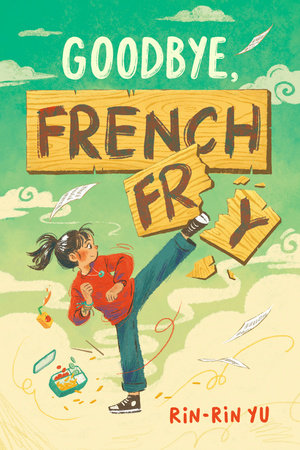
I had been standing by the giant rock in front of the school,waiting for my little brother, Xy, to get out of class while practicing my back kick for taekwondo class—a kick that, even without Lee bothering me, always sent me toppling over. Lee Beaumont and I had both attended Edgewood School since kindergarten. Year after year, he’d sported the same combed-down chestnut hair that ran across his forehead in a straight line. There was something annoying about that line to me, like it was a little too straight for someone who acted so crooked. We’d never been friends, but we hadn’t been enemies either . . . that is, until this year, when he’d decided to start calling me French Fry.
I glared back at him. “What is your problem?” I said loudly.
“
You’re my problem—you’re in my way, French Fry!”
“I’m nowhere near you!” I yelled back. “And quit calling me French Fry!”
“Quit calling me French Fry!” Lee mimicked in a high-pitched voice. “You better go get your bag! You shouldn’t just leave your stuff all over the schoolyard! A second grader might trip over it. Like your little brother. Isn’t that right, X-Y-Z?”
Xy had appeared by my side, a giant book about outer space tucked under his arm. “That’s not my name,” he said patiently, like a teacher correcting a student. Instinctively, I blocked him from Lee with my arm.
“Oooh, you sound
so mad, X-Y-Z,” Lee taunted. Suddenly he spotted Principal Liggett coming out the front door and took off. “See ya tomorrow, French Fry!”
I clenched my fist but did nothing.
“Hello, Ping-Ping,” Principal Liggett said. “How are you?”
For a moment I thought that maybe he had witnessed the whole scene, but his eyes wandered over my head to the activity in the schoolyard as I told him I was fine.
“Hello, Xy,” he added before he continued walking down the path away from our school.
Xy was officially named Xi-An, nicknamed Xy, which was usually mispronounced by Americans as
sigh, rather than the Chinese
she. My nickname, Ping-Ping, was easier to pronounce, but still the double name confused some people. My real name was Ping-An, but it’s common for Chinese parents to take one part of their child’s name and double it into a nickname.
While my parents always insisted that my name was unique and special, I sometimes wished I was named Megan.
Megan sounded like someone cool and confident, who’d let annoyances roll down her back and off it with a toss of her wavy, bouncy hair.
If Megan preferred to be called Meg, no one would do a double take, look down at the attendance sheet, and say, “But it says
Megan here. Is this a misprint?” No one ever asked a Megan if she spoke English, like they did to me, even though I was born in New York City and had lived in Edgewood my whole life. When asked her name, Megan would never have to repeat it for people to understand. Megan also didn’t have to pretend not to care if people made fun of it, because there was nothing unusual about the name
Megan here.
Ping-Ping, on the other hand, dealt with this sort of thing all the time. Plus Ping-Ping’s hair never bounced or waved when she tossed it. It was pin-straight.
I had once asked Mama what she thought of the name
Megan.
“May-gan?” she’d repeated.
“No, it’s pronounced ‘Meg-an,’ ” I had corrected her.
“May-gan,” she’d tried again, enunciating the
gan like the Chinese word for
dry.
“MEG-an.”
“Ai ya, it’s too confusing!” she’d said, exasperated. “Is this someone in your class?”
I let the subject drop.
Lee Beaumont, however, was a pro at not letting things drop. A few weeks ago, after all these years of going to the same school without paying much attention to each other, he had peered over my shoulder in the cafeteria and stared at the strips of tofu over rice that Mama had packed for lunch.
“What’s
that?” he asked, pointing his finger at my dish.
“Uh, rice,” I replied. “Tofu.”
His nose wrinkled. “
Tofu? Yuck. They look like mushy french fries!”
“I don’t know what kind of french fries you must be eating, because these don’t look like any fries I ever had,” I shot back.
“Yes, they do,” he snorted. “The gross kind! And you’re eating them!”
“It’s just food,” I said. I took a bite and glanced back at him. He gripped his stomach and clapped a hand over his mouth, pretending to throw up, before he laughed and sauntered away.
The next day, as I made my way past his table, he decided it would be funny to stick his foot out, causing me to trip and drop my lunch bag. “Hey, careful with those french fries!” he said, laughing.
Luckily, I at least managed to catch myself before my face met the linoleum floor, but the other boys around him had laughed too.
And ever since then, it seemed like Lee Beaumont got his kicks by trying to ruin my day. I guess the worse he made my day, the better his became.
“Jiejie, why is he so mean?” Xy asked. I liked that my brother called me Jiejie—it meant “big sister” in Chinese, and it made me want to protect him even more. Even though his large red backpack made him look small, watching him bravely stand tall while being taunted by Lee Beaumont made me proud of him.
“I don’t know,” I said. “We’re not even in the same classroom this year, so he’s really going out of his way to annoy me.”
I headed across the lawn toward where my backpack lay. My water bottle, which I’d stashed in the side pocket, had been flung in another direction. Xy went to get it while I picked up my backpack and held it at arm’s distance to avoid it dripping on my clothes. The string bracelet I was working on for my cousin Pai, which I’d tied to the water bottle, was now speckled with mud.
“I don’t know,” I repeated as we headed home. “But I hope he gets over it.”
2Mama SenseHome was an easy walk from the school if we took a shortcut through our neighbors’ yard. The Marshalls didn’t mind, so we walked around their house and through the creaky aluminum gate that separated our yards. Our backyard was covered with oak and maple leaves that Baba and I had raked into piles over the weekend. Xy began to jump from one pile to the next, scattering them back across the yard like rustic confetti. I started to say something about undoing all our hours of raking but stopped because he was having such a good time—and he probably wouldn’t listen to me anyway.
I went up the wooden steps and opened the back door to the kitchen, where Mama sat typing on her computer at the round wooden table where we ate breakfast every morning. She usually worked there so she could enjoy the view from the large picture window that overlooked our backyard and the giant maple tree where Baba had hung a swing for us.
“Hi, baobei,” Mama said, glancing up from her latest translation. Mama worked for Chinese-language publishers translating English-language children’s books. She was always studying the books I was reading to see if they would work well in Chinese. Baba would then try to get us to read the Chinese versions, but our Chinese reading skills needed lots of work.
“How was school?” Mama asked.
“Fine,” I answered as evenly as possible, but Mama, ever the detective, could tell from my voice that all was not fine.
She pointed to my backpack. “How did it get so muddy?”
I didn’t want to talk about Lee Beaumont, but Mama knew everything, even if you didn’t tell her. Xy called it “Mama sense.”
“Lee Beaumont threw my bag across the schoolyard,” Iconfessed.
Mama sighed. “Lee, again! Ping-Ping, he’s been bothering you all month.”
“I know!” I said indignantly. “But it’s not
my fault he’s so annoying.”
Baba had once commented that perhaps Lee Beaumont just wanted my attention and wanted me to like him, but Mama had quickly cut him off, saying, “There are plenty of other, nicer ways to do that.”
Now Mama stood over me as I picked up one of the bagels waiting for us on the table. Xy was already sitting there, poking at his.
“What’s this?” he asked.
“Clearly, it’s a bagel,” I said.
“It doesn’t look right.” He put the bagel hole to his eye. “It’s way too skinny.”
“Some visitor from Washington brought a basket of DC’s best bagels to Baba’s office, and he brought the extras home,” Mama said.
“Baba brought bagels from DC to New Yorkers?” Xy complained to us. “This isn’t really a bagel—it’s just bread with a hole.”
New York bagels were usually so fat that the hole closed up.
“It’s fine,” Mama said. “Just eat it.”
Xy pushed the offending imposter aside. “I don’t want to.”
“When did you become such a bagel snob?” Mama said, hands on her hips. “Ai ya, not only am I raising Americans, I’m raising New Yorkers!”
Xy got up from the table, wiped his hands on his shirt, and dashed off. I could see Mama’s mouth form into a scolding shape, but then I guess she decided that battling any more with Xy was pointless, just as I had earlier.
I stayed to eat my bagel, but only because the rule was that when I was done with my snack, I had to start practicing piano, beginning with four rounds of scales, which I enjoyed about as much as Lee Beaumont’s company.
“Why do you think Lee keeps picking on you?” Mama asked.
I made a face. “Because he’s an idiot?”
Mama frowned. “Well, the best thing is to just ignore him.”
I frowned back. “He’s not that easy to ignore, Mama.” I stood up and eased myself away from the table. “I have to go practice now,” I said.
“You must really not want to talk about him anymore,” she said with a smile, “to go practice piano without being asked.”
I grimaced, but we both knew she was right. Mama and her Mama sense.
“I’ll also practice ignoring thoughts of him now,” I said as I sat down at the piano and began to bang out a scale.
“Well, at the very least,” Mama said, “Lee Beaumont will make you into a really good pianist.”
Copyright © 2026 by Rin-rin Yu. All rights reserved. No part of this excerpt may be reproduced or reprinted without permission in writing from the publisher.