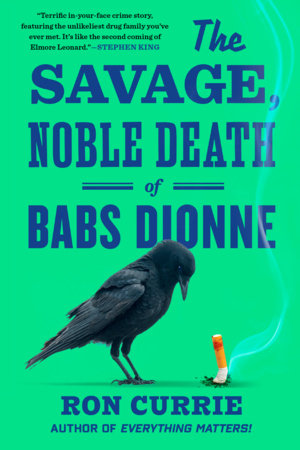
Chapter OneJune 30, 2016When did a person's future become locked in? Consider: on this evening, Sis Dionne was still alive, but in twenty-four hours she would be dead, murdered, in fact. Was it possible for a different choice to be made between now and then that would forestall her departure from this life, and the violent dissolution of a family and a neighborhood that followed? Could her mother, Babs, have done something other than what she did? Her older sister, Lori? Maybe, but impossible to know. The bulk of reality remains just beyond the edges of our ability to perceive, alas. God's still not talking and the physicists haven't figured it all out quite yet, so we're left with the same speculation and superstition as always. Here's what we do know: at this point, in this life, in the story about to unfold, Sis would be killed in little more than a day's time, her body burned with utter lack of ceremony and left in a junkyard. Her end could be viewed, on a long enough time line, as the result of innumerable choices stretching back centuries, the clash of armies and ideas, the appreciative glance and fertilized ovum, every ripple and undulation of history even remotely connected to her life, a change to any one of which might have kept her from such a violent demise. But practically speaking, in our lives, we make our choices and things happen as they happen and that, as they say, is that. As such, Sis would soon be dead.Tonight, however, she was still out there somewhere, drawing breath, and it was, instead, her sister Lori who had just died.Lori lay on the floor of the bathroom in a bar called You Know Who's Pub in Waterville, Maine, where her mother, Babs, she of the mind like a shark's mouth, had raised her and Sis. Beside Lori on the floor sat a hypodermic needle, empty, a crust of Lori's blood drying on the tip. Her legs lay scissored and motionless one over the other, spike arm stretched out and already stiffening on the floor in front of her, the sleeve rolled up to her skinny biceps, which was mottled with gray-green bruises, and because she had only just died and because the heart dies before the brain, she was dreaming:A convoy of military trucks rolls along Highway 1 in Wardak Province, Afghanistan. Humvees, stout MRAPs bristling with machine guns and grenade launchers, massive LVSRs like futuristic tractor trailers painted in desert tan. The landscape they move through is impossibly flat and dusty, ringed by distant mountains. The mountaintops are capped in snow, but on the ground here it's hot as Hades, the sun pounding rock and dirt. Nothing lives or moves other than the trucks, which crawl along the blacktop, diesels growling.Lori sits in the driver's seat of the sixth vehicle in the convoy, a 10x10 LVSR loaded with cargo containers. She's dwarfed by the vehicle's massive steering wheel but at ease behind the controls, her hair pulled into a neat ponytail that peeks out beneath her helmet. On her shoulder she wears a staff sergeant's chevron: three stripes up, one down. Next to her sits Sammy Menendez, and as is usually the case-even when he sleeps-Sammy is talking."'Follow the Highway of Death north,'" Sammy says. "'Stop at every bridge, watering hole, horse hitch, and outhouse along the way, so Colonel Hajji can meet with his soldiers-who may or may not be plotting to blow you up. When you get to the end of the road, turn around. Head back the way you came. Try not to get killed.'""Orders are orders," Lori says."Being as my ass belongs to a supply battalion, I'll admit I'm not well-versed in tactical best practices," Sammy says. "All the same, stopping every half an hour in broad daylight in the most dangerous place on earth to babysit a fake colonel does not seem like, you know, the wisest use of personnel and equipment.""We're not escorting Colonel Ahmadi," Lori says. "We're transporting power equipment and food supplies. That Colonel Ahmadi happens to be along for the ride is incidental to our mission.""Right," Sammy says. "So if I get blown up while he gabs at some checkpoint, will I be incidentally dead?""I suppose so," Lori says."Great," Sammy says. "Make sure they put that on my death certificate. It'll be a huge comfort to my mother."Lori smiles and hits the brakes as the vehicles ahead of her slow, then stop altogether."What now?" Sammy groans. His view of the road is blocked by the LVSR directly in front of them, but Lori's got a line of sight to what's happening up ahead."ANA's guarding a bridge. I imagine the colonel's going to dismount and say hello.""Of course he is," Sammy says.Chatter over the radio reveals the real reason they're stopped: cross talk that an IED has been discovered four kilometers up the road by a bomb dog; EOD is deploying now from Bagram via Blackhawk."Better get comfortable," Lori says."Outstanding," Sammy says. He grabs his rifle and reaches into his ruck on the floor of the cab, pulls out a large plastic package of Twizzlers.They get out. Up and down the convoy line, Marines are dismounting, eyeballing the area, checking the ground for any sign it has been disturbed by men. But that's the thing about the land here: it keeps its secrets. Lori doesn't like the look of a set of hills to the right of the road, three hundred meters distant, at the foot of which sits a cluster of mud-brick buildings, but as she comes around the vehicle she says nothing, not wanting to get Sammy riled up.But Sammy doesn't require prompting. "Again," he says, "I'm more or less a glorified supply clerk, but if I were a real Marine I would consider this a very, very bad place to stop.""Not a lot of cover up there," Lori says."Plenty of cover in that village," Sammy says."That's a Hazara settlement," Lori says. "They hate the Taliban more than you do.""Maybe yesterday," Sammy says. "Today, who knows?""Well, now's your chance to improve relations," Lori says. "Here comes the welcoming committee."A dozen boys, who'd been batting around a volleyball when the convoy rolled up, now make their way toward the trucks. Sammy loves these moments, which is why he's never without Twizzlers.Three Blackhawks thump overhead, pointed north. The racket of their rotors breaks the spell, and everyone seems to remember suddenly that nobody can be trusted, not ten-year-old boys, not friendly Marines bearing gifts. The kids retreat to their makeshift volleyball court, clutching handfuls of licorice. Sammy comes back to the front of the LVSR, where Lori's checking a hose on the tire inflation system. It's been acting up without ready explanation, and she's cranky."Are they really going to make us wait for the next three hours while EOD plays Operation?" Sammy asks."Before you get going on another rant, know that (a) I don't like it any more than you do, and (b) there's nothing to be done so I don't want to hear it.""Wow. Aye, aye, Staff Sergeant.""I'm serious, Sammy. If you're so worried, do your job and keep an eye on that ridgeline until word comes through that it's time to move out. And don't forget to hydrate."Half an hour passes in silence, by far the longest Lori has ever known Sammy to stay quiet. She starts to think maybe she's been too hard on him. She plays back the words she said and how she said them and hears her mother, Babs.Lori's stirred from her thoughts by a low whump, like God stamping His foot just beyond the horizon: the familiar sound of matter being suddenly and violently ripped into its constituent parts. Distant, but never far enough, that noise. The concussion unfurls languidly around the valley, echoing in waves off the hills until finally it fades. And then, less than a minute later, the radio gives word-the IED up ahead now cleared, the convoy can be on its way.They mount up, Sammy still silent."You got any of those Twizzlers left?" she asks Sammy."I thought you didn't like licorice," he says."I don't. It's disgusting."They smile at each other across the cab, and the convoy starts rolling. He hands her a stick.They rumble slowly over the bridge. Lori glances out the window at a pair of ANA sentries, and there's something about them she can't immediately put her finger on. Then she realizes: They're alert, and that's fucking weird, and out here anything weird, no matter how seemingly innocuous, needs a second look. Ninety percent of the time, especially on guard duty, ANA soldiers are listless at best, dicking around and smoking, slumped like sulky teenagers. These two are upright, weapons at the ready. They look edgy, like they're anticipating a fight. But then Lori remembers the colonel, and assumes they're putting on a show for his benefit.In the very next instant, there's a tiny, brief sound in the cab of the truck, like someone has rapped once on the driver's-side window with something hard and sharp-a pebble, maybe. In the same instant, Lori feels something tug at the air in front of her face. All this-the sound and the sensation-happens simultaneously, and though her senses take the information in, it's too fast for her brain to process what it means. So she seeks more information. She turns her head toward where the sound came from and sees the driver's-side window is splintered, spiderweb cracks zigzagging out from a hole near the center of the pane. More confusion. She turns to Sammy to ask if he knows what's going on. His face is turned toward her, and he's smiling-but now there's a hole in his cheek, just below his left eye. This hole is about the diameter of a penny, dry and dark as though punched in plywood rather than flesh. Alarm dogpiles on confusion in Lori's mind. Then Sammy's facial muscles slowly go slack, and gravity pulls the corners of his mouth down. For a moment his face is as blank as any Lori has ever seen-not just expressionless, but untenanted. And then his jaw falls open slightly, and blood pours over his chin as if a tap has been opened, soaking his blouse black.Lori understands none of this-what has happened, what it means. She doesn't understand when the Humvee two vehicles in front of her lifts from the ground on a column of flame and comes back to earth sideways in the road, or when the chatter of small-arms fire starts up in the hills to the left of the convoy, or when the M16s and .50 cals burst to life around her in furious response. She is nothing but amygdala and hypothalamus, blood ionized and mind blank, as she stumbles out of her truck and into a shooting gallery, leaving Sammy behind.For some reason-or no reason-she closes the driver's-side door behind her as she exits, and the moment she does a round pings off the door's armor and ricochets, whining, into the sky. Other bullets hit the road in front of her, sending up little shards of fragmented pavement. If she were thinking straight, or at all, she would scramble for the comparative safety of the opposite side of the convoy, where most of the other Marines-the ones who aren't already dead or unconscious or moaning as they get acquainted with their own blood-have taken cover.Instead, she walks off the road toward the hills.She is unarmed and on autopilot and striding calmly downrange into incoming fire. A bullet whings off the ground near her feet. An RPG sizzles along a horizontal shaft of smoke fifty meters to her left, smashing into the side of her LVSR and setting one of the cargo containers ablaze. Another bullet cuts the air near her, then others, coming faster now as the men in the hills zero in on this target that has inexplicably presented itself like an offering. Behind Lori, voices implore her to come back, scream hoarsely about what in the fuck she thinks she's doing.But Lori just keeps walking toward the hills, and as her mind comes back she realizes why: nothing can hurt her. She's sure of it, that peculiar, ironclad certainty of dreams. And the moment this revelation settles on her, the soles of her boots leave the desert floor. She's levitating-no, flying, leaving the broken world below. The sounds of battle fade, scoured away by the wind in her ears, and she smiles, tentatively at first, then broadly, and then she's laughing, twirling, weightless and free. She drops her helmet, pulls the quick-release on her armor vest, and laughs as it falls.From this height, Afghanistan is something it has never been before: beautiful. The bladelike mountain ridges draped in mist, the rusty red of the desert highlands directly below her, and beyond that, far to the south, a patchwork of farmland, big rough rectangles in every possible shade of green, bisected by the undulating black line of a river. It's heaven. How had she not realized, until now?In the 568 days she's spent in Afghanistan, Lori has often felt as though she might die here. She has never, until now, felt like she could die here and be happy.But then she's braced by an odd hitch directly behind her breastbone. A sudden stillness inside her that she recognizes as wholly incompatible with life, eerie and instantly terrifying-followed by a wallop as her heart starts again, slamming against her ribs. She gasps and plummets like Icarus, end over end, limbs flailing helplessly, earth and sky trading places over and over as she drops, and she can feel but not hear herself scream as the rocky foothills rush up to meet her-Lori shot upright from the floor of the bathroom at You Know Who's, eyes flying open, a scream still in her throat, instantly dope-sick. Where was she? When was she? Clues: A sink. A mirror. Twin toilet stalls with shared middle divider, the grimy bases of the toilets themselves visible from her dog's-eye perspective. Plastic trash bin beside the sink, overflowing with crumpled paper towels. Her hands and ass wet with something from the floor. A second, full-length mirror on the wall opposite her, its edges graffitied crudely with black Sharpie, its center featuring a moving picture of Lori staring at herself, shoulders heaving with each breath, hair chopped short and jagged, a lifetime's worth of baggage under her eyes and the overhead fluorescents not helping one bit with that. She was twenty pounds underweight, her forearms jutting from the rolled-up sleeves of her shirt like bruised bones, and by now she knew exactly when and where she was, not Afghanistan, not Iraq, not Lejeune or COP Sayed Abad but home; she was home in Maine and that explained the state of things, and further she was not the least bit surprised to find two men in the mirror with her, crouched on either side of her legs, both wearing the dark blue uniform of fire department paramedics, and one of whom, the older one with the mustache holding the empty syringe of Narcan with which he'd saved her life, she was pretty sure she recognized from somewhere around town.
Copyright © 2026 by Ron Currie. All rights reserved. No part of this excerpt may be reproduced or reprinted without permission in writing from the publisher.