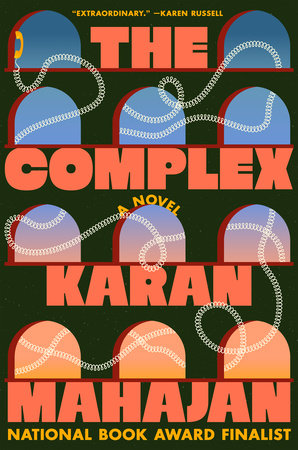
Praise for The Complex
“A sweeping tale of political machinations, family drama, betrayal and social transformation.”
—The New York Times’s “32 Novels We’re Excited About This Spring”
“[A] magisterial performance . . . Mahajan is a confident, ambitious and increasingly important writer.”
—Jonathan Dee, The New York Times Book Review
“This update of Tolstoy and Chekhov is firmly rooted in India, where family obligations and religious divisions set the novel’s course as fatefully as S.P.’s cold paternalism does. Mahajan packs 19th-century pleasures into a very contemporary tale about the rise of ethno-nationalism and the insidious damage of corruption, and includes one enduring truth: A gun introduced in the first act will eventually come in handy.”
—Boris Kachka, The Atlantic’s Summer Reading Guide
“[A] grand social novel constructed with dazzlingly modern ingenuity. . . . Again and again, I was reminded of Jonathan Franzen’s The Corrections — the way wit, psychological shrewdness, and cultural insight can keep a story from gagging on its own bile. Like the complex itself, this capacious novel is constantly evolving and reinventing itself.”
—Ron Charles (Substack)
“If The Complex earns the reputation as one of the first great novels ‘about’ Modi’s India, it will be deserved. . . . This is probably due in part to the fact that, in the vein of Mann or Stendhal, The Complex also strives, in the most rewarding way, to be a book about everything: left and right, love and power, history and time—that is, the pull of future and past on a country demanding something better than what its politicians in—New Delhi have so far delivered. . . . Mahajan’s Great Indian Novel makes room for all of these and more.”
—BookForum
“An anguished, intelligent study of ambition decoupled from principles, and of the complacency and fear that allows it to thrive.”
—The Wall Street Journal
“Gripping. . . . A family this unhappy may remind readers of Leo Tolstoy’s Anna Karenina. . . . The Complex is a sad, transfixing, and, yes, complex novel.”
—The Washington Examiner
“[Written with] tension, tenderness and tenacity. Mahajan remains contagiously courageous and (narratively) humble. Here he deftly untangles how ‘sexual proclivities’ rooted at the familial level can entangle with political upheaval. . . . Mahajan simultaneously shatters and showcases Hindu nationalism. He strips down the real stuff of reverse-immigrant struggles as eidetic text to be read. He pushes cultural boundaries in painfully truthful ways, strangling both stigmas against sexual shame and silence amid sexual violence. . . . This pursuit of this truth makes him not only a liberating literary executor but also a worthy moral educator.”
—Los Angeles Times
“For readers drawn to messy relationships and sharply drawn social dynamics, The Complex delivers.”
—Goop.com
“[A] serious, carefully constructed novel . . . Mahajan’s Delhi is rendered with an accuracy that feels almost archaeological . . . Where the novel is most illuminating is in its portrait of characters that a younger, more globalized generation of Indians would dismiss with a mildly condescending ‘uncle’ or ‘aunty,’ those figures of matrimonial obsession and suburban intrusion who populate wedding shamianas and family drawing rooms. Mahajan takes them seriously as moral and psychological beings. . . . Mahajan does not flinch and does not relent.”
—Asian Review of Books
“[Mahajan] clearly understands the psychology of family, messy as it always is. Mahajan evokes the clashing landscapes of India and Michigan with a sure hand, and displays a keen understanding of Indian society and politics. Though the reader learns in the opening pages that one main character will be murdered by a relative, the novel’s final chapters still manage to be shocking, which is a testament to Mahajan’s genius. This novel is beautiful and unforgettable. A masterly novel, seemingly influenced by Tolstoy and Dostoevsky, by a talented and self-assured writer.”
—Kirkus Reviews (starred review)
“Exquisite. . . . With astonishing economy, clarity and suggestiveness, Mahajan creates a memorable family and depicts a conflicted India lurching into the present. This piercing novel is a book to read and read again.”
—BookPage (starred review)
“Long in the works, long anticipated by his fans. . . . Mahajan has created something savor-worthy: a family epic that takes place in both India and America, as the Chopra family attempts to keep itself together in the face of political unrest and relationship fractures. Mahajan writes with grace and precision, is able to depict both horrors and joys, violence and tenderness in equal measure: the arrival of The Complex is sure to be a literary event.”
—Julia Hass, Lit Hub’s Most Anticipated Books of 2026
“The Complex is an extraordinary gift to its lucky readers: an enormously full and brilliantly structured novel whose characters come to feel as familiar—and as bottomlessly mysterious—as one’s own family. I was spellbound by the ramifying dramas of the Chopras, whose strong roots intertwine below their Delhi complex during decades of sweeping global and national change. I am awestruck by what Karan Mahajan has accomplished in The Complex, and I never wanted this book to end.”
—Karen Russell, author of National Book Award finalist The Antidote
“A delicious page-turner about familial jealousy and revenge that, in the Dostoyevskian tradition, doubles as a masterful investigation of the slipperiness of power in a changing and modernizing world. The Complex is Mahajan’s most exciting, virtuosic novel yet.”
—Vauhini Vara, author of Pulitzer Prize finalist The Immortal King Rao
“In the tradition of Tolstoy, Karan Mahajan has written a family saga and a historical epic that describes humanity with absolute fidelity—no kinder or crueler, wiser or duller, grander or punier than it really is. In The Complex, not only is the personal political, but the political is a duck blind for the personal, demonstrating how family secrets and failed businesses create demagogues, martyrs, and murderers. This is a farsighted and serious novel, and a monument to radicalized times.”
—Tony Tulathimutte, author of Rejection, longlisted for the National Book Award
“Epic in scope, wonderous in its summoning of distinct characters, vital in its weaving of family and politics. This is a miraculous novel.”
—Nana Kwame Adjei-Brenyah, author of National Book Award finalist Chain-Gang All-Stars
“This novel’s rare achievement lies in its masterful portrayal of the intimate relationship between personal lives and political realities. Through the story of a family, it captures the larger movements shaping the nation, revealing how political and social transformations seep into everyday life and quietly shape human choices. . . . Through a powerful mode of storytelling, Mahajan constructs the intricate connections between a society’s moral upheavals and its political and familial aspirations. The strength, intensity, and momentum of his narrative are such that nothing needs to be pointed out deliberately; everything unfolds with organic necessity. There is a constant sense of danger lurking beneath the story, lending the narrative a palpable, high-stakes intensity that holds the reader in its grip.”
—Vivek Shanbhag, author of Ghachar Ghochar
“To watch the wily Chopras jostle for dominion—not just over the crumbling walls of their shared home, but over the very historical and moral record of their age—is pure pleasure. Mahajan is, as always, a political anatomist blessed with a comedian’s eye for the absurd, and The Complex is a singular portrait of a family as riven and fractious—and eternally surprising—as the country that produced it.”
—Madhuri Vijay, author of The Far Field
“Riveting and unputdownable—Shakespearean storytelling. Karan Mahajan’s best work yet.”
—Sonia Faleiro, The Good Girls: An Ordinary Killing