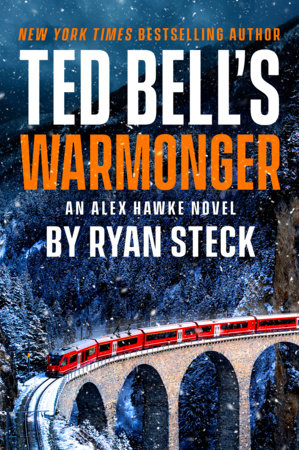
ONE
Istanbul, Turkey
Though it wasn't perhaps what he was best known for, it was certainly no secret that Lord Alexander Hawke knew how to make an entrance.
His Lancia D24-custom-built in 1953 and driven to victory in the 1954 Mille Miglia by Alberto Ascari-roared down the cobbled Bab-ı Ali Caddesi, negotiating a maze of minor streets through Sultanahmet Square before coming to an abrupt and quite dramatic halt at the Imperial Gate, entrance to the historic Topkapı Palace. He idled there, slowly advancing down the queue of attendees, occasionally revving the 3,284-cubic-centimeter, 265-horsepower V6 engine as if to say, "Still here, old chap," until at last it was his turn to hand the reins of his mechanical steed over to a waiting valet.
Hawke stepped out, the midnight blue of his bespoke Tom Ford tuxedo accentuating his athletic frame, looking every inch the aristocrat that he, in fact, was. He stood just north of six feet tall, with a thick mane of unruly black hair that was deliberately at odds with the rest of his immaculate appearance. As he made way for the valet, he allowed himself a wry smile. "Mind you, don't scratch the paint, old boy," he said. "It's older than both of us."
The nervous valet just stared back, goggle-eyed, as Hawke swept past him and joined the line filing through the security checkpoint leading into the complex.
Built in 1459 under Sultan Mehmed II-or Mehmed the Conqueror as he was known to history-the sprawling complex known as Topkapı Palace had, for nearly four centuries, been the stage for crucial state affairs, with viziers and foreign dignitaries gathered beneath its soaring dome. Though now a museum celebrating the fallen grandeur of the Ottoman Empire, the palace nevertheless retained a regal aura, especially tonight, as it played host to some of the most powerful figures in the Western world: ambassadors, military leaders, and, of course, spies.
The NATO strategic alliance summit had been held in Istanbul to address the ongoing conflict in Eastern Europe and growing fears that Russia's adventure in the Ukraine might lead to an all-out conflict with NATO member nations that had once been part of another fallen empire: the Soviet Union. The Republic of Turkey, a NATO member nation since 1952, straddling the line between Europe and the Middle East, had been chosen to host the summit, and this final soiree put on by Turkey's minister of national defense, Amir al-Fulan, celebrated the close of the event. One last chance for the attendees to come together and, theoretically at least, reinforce their mutual commitment to the alliance.
Hawke detested formal events. Found them unimaginably tedious. The only thing that could be said for them was that the champagne usually flowed in copious amounts-though, given a choice, Hawke would have preferred a tot of Goslings Black Seal rum in some grimy outlaw dive bar on a Caribbean waterfront. The company was usually better, and something about it appealed to his pirate blood. He was, in fact, a direct descendant of the notorious buccaneer Richard Hawke, known as "Blackhawke," and had inherited more from his ancestor than just an affinity for grog.
But Hawke wasn't here for the champagne.
He had attended the summit in his role as the CEO of Hawke Industries, an internationally recognized defense contractor whose participation in bolstering NATO's defenses against Russia's growing aggression was a given. The ongoing war in Ukraine had created an unparalleled opportunity for NATO member nations to "sell" many of their aging war machines to Kyiv and replace them with new, state-of-the-art technologies, many of which were produced by Hawke's subsidiary companies, so he had a vested interest in not only knowing how his wares would be used in days to come but also what the next generation of warfare might look like. Yet this too was merely a cover. Alex Hawke wasn't just another billionaire businessman, and he wasn't at the summit to rub elbows with the rich and powerful.
He was here to hunt.
TWO
It would appear that there's a warmonger, Alex," Sir David Trulove had told Hawke less than a fortnight previously. "A bloody fucking nasty man causing all kinds of ruckus around the world."
As the head of the Secret Intelligence Service, the United Kingdom's spy agency-sometimes referred to as MI6-it was Trulove's business to know about all the nasty men causing ruckuses around the world, and as Trulove's most intrepid and audacious secret agent, it was Hawke's business to be told about them.
Despite his successes in the private sector-he was now the fifth wealthiest person in the United Kingdom-Hawke was constitutionally incapable of sitting still. Like his distant pirate ancestor, when adventure called, he answered, first as a Royal Navy aviator, flying Harriers and other fighter-interceptor aircraft into combat, then as an elite commando in the Special Boat Service. He now used his wealth and the access it afforded him to conduct and execute clandestine missions on His Majesty's Secret Service.
"We don't know much about him, to be quite frank," Trulove had continued, "but, you see, he's making demands of the king, and, well, Charles trusts nobody but you to handle this."
Alex, already craving a new adventure, had not needed much convincing. "A warmonger, you say. Well, Trulove, then it sounds like we had better get moving rather quickly, don't you think?"
The next day, in Trulove's private study on the fourth floor of 85 Albert Embankment, Vauxhall Cross-the modern ziggurat-style structure known variously as Babylon on Thames, Legoland, and HQ of the Secret Intelligence Service-Gwendolyn "Pippa" Guinness, a deputy chief of the Service and Trulove's number two, had laid out exactly how little was actually known about the Warmonger.
"He's an enigma," she had told Hawke. "We don't know who he is or where he's from. All we have are rumors hinting at his influence. He's rather like Moriarty in the Sherlock Holmes stories: a mastermind working behind the scenes, manipulating events."
It was a reference Hawke's best friend, former Scotland Yard chief inspector and Holmes aficionado Ambrose Congreve, would have appreciated.
"'The Napoleon of Crime,'" Hawke had murmured, recalling how Conan Doyle described Holmes's archnemesis.
"Only the Warmonger is the Napoleon of war."
"I rather thought Napoleon was the Napoleon of war," Hawke had remarked. "I daresay, Pip, for a bloody intelligence service, you don't seem to have much in the way of bloody intelligence."
"That's why you're here, Alex. You're C's bloodhound, and he wants you to run the Warmonger to ground." C was the official designation used by every chief of the SIS.
"Even a bloodhound needs a sniff."
Pippa's wry smile had told Hawke that she had been waiting for just such a prompt. "We have received credible intelligence indicating that the Warmonger will be putting in a personal appearance at the upcoming NATO strategic alliance summit in Istanbul."
"A personal appearance, you say?"
"It's the opinion of the Eastern European Section that the Warmonger may be a highly placed government official from one of the NATO member nations, possibly one of the former Soviet states, working as a saboteur to undermine the alliance on Putin's behalf. That's just conjecture, but it's a place to start looking."
THREE
Eschewing the offer of a ride in one of the electric trolleys shuttling attendees back and forth across the grounds, Hawke proceeded on foot, strolling through the First Courtyard, the wide, open expanse of manicured gardens and ancient trees that separated the outer and inner walls of the Topkapı Palace. His stroll brought him to the Gate of Salutation, with its two iconic towers standing watch on either side of the entrance. Hawke did not fail to notice the soldiers stationed in the turrets, gazing vigilantly down upon the crowd. Beyond the gate, he entered the more intimate environs of the Second Courtyard, a vast rectangle enclosed by various palace buildings: the Imperial Hall, the Treasury, the Audience Hall, and the kitchens. Elegant lighting illuminated the garden paths, casting soft, amber hues over the old stone buildings of the palace complex.
Inside the magnificently domed Imperial Hall, the atmosphere was thick with decadence and intrigue. Brilliant blue and emerald tiles adorned the walls, shimmering in the glow from the golden lamps that lined the space. Each tile told a story: scenes of paradise, intricate floral patterns, and verses from the Quran, all perfectly preserved from a time when sultans ruled these very halls. A raised dais stood at the far end of the room, where once the sultan would sit, flanked by advisors and warriors, receiving ambassadors and enemies alike. Tonight it served as the stage for a quartet playing Ottoman classical music on ney flutes and tambours, their haunting melodies mixing with the gentle murmur of conversation.
The rich scent of saffron and spices drifted from long banquet tables, where silver trays gleamed with delicacies. Waiters floated amidst the throng, balancing trays loaded with glasses of champagne and, as a concession to the Muslim faith to which many of the host nation's attendees at least nominally adhered, tall glasses of sharbat, a sweet, spiced drink of honey and fruit.
Hawke helped himself to a flute of champagne and ventured out into the midst of the gathering. The crowd-an assortment of diplomats, high-ranking military officers, and plus-ones-parted instinctively as if sensing that someone important was in their midst. Yet it wasn't his aristocratic lineage or prodigious fortune that commanded their attention. It was the way he moved: with the confident, almost predatory gait of a man who was equally at ease on the battlefield or in the boardroom. Alex Hawke resembled nothing so much as a lion sauntering lazily through his pride, seemingly indifferent to the wary gazes of lesser beasts and yet poised and ready to pounce. Counterintuitively, his natural charisma concealed his true purpose, for while he could not help but be noticed, those who observed him often failed to realize that he was also watching them.
Over the course of the four-day-long conference, Hawke had observed dozens of mid-level functionaries as well as members of his own cohort, wealthy defense contractors and arms dealers, warmongers in the literal sense-merchants trafficking in the means to make war-but not necessarily the Warmonger. Now, in the less structured environment of a mixer, he was curious to see who would gravitate toward whom, who came together to whisper, who exchanged discreet nods or glances. In this more relaxed setting, with the barriers down and alliances-both secret and strategic-being made with a casual clink of champagne glasses, perhaps the Warmonger would reveal himself.
Many of the VIPs who had addressed the summit were conspicuously absent. Having so many senior world leaders in one place would have made a very tempting target for terrorists. Consequently, most attendees of the soiree represented lower-tier figures-men and, yes, a few women, whose names and faces were not well-known outside the insular world of international diplomacy but who nonetheless did most of the heavy lifting.
Hawke spotted General Markus Schroeder, the imposing commander of NATO's Eastern European defense forces, in an apparently heated conversation with Ambassador Leena Valge, Estonia's envoy to NATO. General Osman Gul, rumored to be next in line for the post of Turkish national defense minister, hovered near the buffet while the current minister, Amir al-Fulan, was chatting up Alain Devereaux, a notorious French arms dealer.
Then he noticed another familiar face and felt an unexpected flush of excitement. Commander Savannah Stone, Royal Navy-adjutant to the senior British commander in NATO, General Sir Richard West-was someone who had not escaped his notice during the summit, and not merely for professional reasons. Tall, blond, and striking in her navy service dress uniform, she managed a delicate balance between authority and elegance. Now, however, attired in a sleek royal blue evening gown that hugged her spectacular figure, with her hair freed from the strict regulation bun, falling in soft waves to frame her angular face, the balance tipped.
When she caught him looking and flashed a dazzling smile, Hawke inclined his head in an appreciative nod, then looked away. He wasn't a free man, and he wasn't here to play. In any case, Savannah Stone was not someone to trifle with.
All of a sudden, Hawke's senses went to full alert. His instincts, which had more than once awakened him to unexpected danger, were sounding an alarm. He had noticed something-noticed it without really noticing-and now, like the missile warning systems in the jet fighters he had once piloted, his subconscious was pinging like crazy.
He did another slow scan of the hall, searching for the cause of his premonition, and locked in on a figure lingering at the edge of the hall, a man of average height and build, with sharp, angular features and short-cropped dark hair peppered with gray. Hawke did not recognize the man, and while this was not in itself unusual-there were more than five hundred names on the guest list-there was something about this man-the unease in his stance, the sharpness in his gaze as he surreptitiously scanned the room, much as Hawke himself was doing-that seemed to validate Hawke's subconscious alert.
Hawke was not the only one hunting tonight.
There might have been a perfectly reasonable explanation for the man's heightened vigilance. He could have been a plainclothes security agent or even an intelligence operative from one of the other NATO member nations, like Hawke, quietly hunting the elusive Warmonger. But Hawke's instincts said otherwise.
Careful not to look directly at his target, Hawke began moving toward the man, weaving fluidly through the crowd, exchanging pleasantries with military leaders and diplomats, as he closed in on the . . .
Damn it, where the devil did he go?
Hawke surveyed the area where the man had been only moments before, broadening his search in ever-expanding arcs until he spotted someone that he thought might be his quarry, passing through one of the exterior entrances leading back out into the Second Courtyard. The man's face was turned away, but the hair and build looked right, and the conspicuous bulge in the man's dinner jacket, which looked suspiciously like the print of a concealed firearm in a kidney holster, removed any lingering doubt.
Abandoning his pretense of nonchalance, Hawke crossed the hall at a brisk walk, reaching the ornate doorway a mere five seconds after the man's exit. He burst out into the open and spotted the man moving swiftly along the edge of the building, keeping close to the outer walls of the Imperial Council Hall. He was moving fast-too fast for someone who was just taking a leisurely stroll to get some fresh air. No, this man had a purpose, and it wasn't sightseeing.
Copyright © 2026 by Ryan Steck. All rights reserved. No part of this excerpt may be reproduced or reprinted without permission in writing from the publisher.