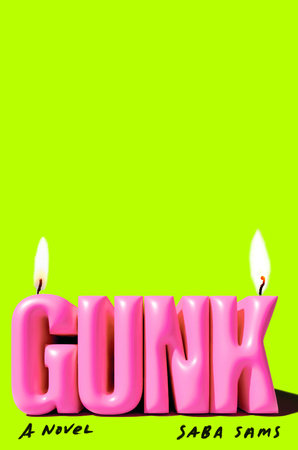
Download high-resolution image
Listen to a clip from the audiobook
audio pause button
0:00
0:00

Gunk

A Novel

Author Saba Sams
Listen to a clip from the audiobook
audio pause button
0:00
0:00
An electrifying first novel from “a fresh new voice in fiction” (Emma Cline, New York Times bestselling author of The Guest), the story of two women circling one another—working side-by-side, sleeping with the same man, inching toward friendship—until an unplanned pregnancy reveals the true nature of their connection.

Jules has been divorced from her ex-husband Leon for five years, but she still works with him at Gunk, the grotty student nightclub he owns in central Brighton. She spends her nights serving shots and watching, from behind the bar, as Leon flirts with students on the dancefloor. In the early hours of the morning, she trudges home to sleep alone. But then Leon hires eighteen-year-old Nim to work the bar with Jules—Nim, with her shaved head and steady pour, her disarming sweetness and sudden distance—and Jules finds herself jolted awake. When Nim discovers she’s pregnant, Jules agrees to help. As the months pass, and the relationship between the two women grows increasingly intimate and perplexing, it emerges that Nim has her own unexpected gifts to give.

Now, alone in her small flat, Jules is holding a baby, just twenty-four-hours old, who still smells of Nim. But no one knows where Nim is, or if she's coming back. What could the future—for Jules, Nim, and this unnamed baby—possibly look like?

Raw, surprising, tender and wise, Gunk is an exhilarating debut novel exploring love and desire, safety and destruction, chaos and control— and family in all its forms.
1

The baby is twenty-four hours and seventeen minutes old. In celebration, I take a syringe of colostrum from the freezer and envelope it beneath my armpit. When the milk has melted to a liquid, I settle onto the sofa with the baby. I cup the back of his head in the palm of my hand, so that we are face to face, the rest of his body propped upright on my forearm. In this position, I can trickle the thick yellow milk from the syringe into his mouth. He swallows most of it, releasing only a small dribble from one corner of his lips. At the far end of the room, the windows have steamed over. The air in here is hot and wet. My skin slides against the baby’s. Through the thin gaps in the shutters, I watch drops of condensation weave clean lines down the glass. It’s July, and yet again the sun is coming up.

After the colostrum is all gone, I place the baby on my chest, his legs folded beneath him like a frog’s, his neck turned so that one of his cheeks is squashed against my breast. He sleeps there for a while, digesting. I stay as still as I can so as not to wake him, listening to his irregular, shuddery breaths. I watch the light move on the ceiling. Sometimes the baby stops breathing, as if after this very short taste of living he has already changed his mind. These occasions last only a matter of seconds, surely, but they drag like hours. I hold my own breath in response, tensing my entire body so that I can focus completely on his. I wait like this, silently fighting my climbing urge to wake him, to remind him to take a breath. Each time that thin wheeze rises, finally, from his lungs, I am so relieved that I cry.

When the baby wakes, he cries too. He shows me real crying, so big and desperate it splits the room. In the middle of the noise, I notice a yellow oval of milk on his pink tongue. Back at the hospital, I found that if I stood, his tiny form pressed securely to mine, and rocked very hard, he’d stop crying. In the flat, I try this same trick. I am attempting to simulate the womb. But there is no fooling the baby. He wails and keeps on wailing. I slow my rocking. I hold him in my arms, hushing him, and watch the yellow oval continue to tremor on his tongue, his eyes screwed tight. I can’t hear myself hushing, which means he can’t either. I fear he will never stop crying. I fear he will never forgive me.

I decide to change his nappy. I lay him down on the floor, a muslin over the mat to protect his bare skin from the cool plastic. He continues to cry. I know why he’s crying, and it’s not because of a wet nappy. He’s crying for something else, something I cannot give him. In my fluster, I pull one of the new nappy’s sticky tabs so hard that it rips. At the sound of the rip, the baby stops crying. He opens his navy eyes, the irises thick as oil, and stares at me, affronted. Then his brow softens, and there is a look of such casual knowing, such tolerance, that a chill passes over me. He’s biding his time, I can see that. He’s decided simply to wait me out.

I’m not the baby’s mother, and this is why he cries. He has no language to tell me that I’m not right for him, and yet he tells me with his body, with his eyes. I was naïve to think that, if I scooped him straight from the womb and held him immediately to my bare chest, so in his first breaths he would inhale only my smell, he would mistake me as his. I was wrong to think that, if I brought him home, all of time would be erased. In reality, the flat was just as we’d left it: the bath full with cool, blue water; Nim’s clothes a twisted loop on the floor; the ice cube tray upside down in the sink.

As soon as I got home with the baby, I’d closed the shutters and turned the lights off again, making it like a womb, so that I might allow him to go backwards, just for a moment. So that we might pretend like she was here. Those hours in the hospital had gone on forever. The best part was the five minutes right after the birth: the ecstasy of the new life. Then Nim was taken away to be stitched up, and I paced the stark corridors with the baby while we waited, thinking of everything I would say to Nim once she and I were alone together, once she had slept a few hours, once things had calmed. It was clear to me, even there in the hospital corridors, that the baby knew who I was, or who I wasn’t. He knew by smell, by taste, that I was not his mother. The baby is an animal, and I couldn’t fool him even if I’d wanted to. I had wanted to, of course, but that was before. The moment I met him, any hope I’d had to deceive him melted away, and suddenly the truth seemed very beautiful. As I watched the birth, I too had felt myself opening.

I don’t know when I realised that Nim wasn’t coming back. It dawned on me slowly. I wasn’t sure how long stitches were meant to take: fifteen minutes, half an hour? An hour passed before I went to speak to someone. The nurses thought Nim was lost in the hospital, that perhaps she’d been sent back to the wrong room. I noticed that the little suitcase I’d packed for her, with a change of clothes and her toothbrush and her phone, was gone. I alerted the nurses to this. A hushed panic bloomed slowly, all around us. The baby slept. Finally the cameras were looked at, and in them Nim was seen leaving, just walking out of the hospital car park. She’d left in a pair of tracksuit bottoms and a ratty grey hoodie, still waddling slightly, a smear of blood on her right eyebrow.

After that, there were many questions for me. The questions came from the nurses, then the doctors, finally the police. Mostly I remember Nim’s phone ringing out, and ringing out again. That regular trilling, over and over, then the answer machine. I left a message where I tried to sound calm, reminding her that she needed rest and support, having so recently given birth. I left another where I told her that I loved her, that I had always loved her but been slow to realise. I left another where I was crying so much that nothing I was saying sounded like words.

I told the police what I knew, which was that, by leaving, Nim was trying to keep her side of a promise. I told them that they could look for her if they wanted, but that there wasn’t much use.

Nim has run away before, I said. And she’s good at hiding.

They asked me about her family, and I lied that I didn’t know. I was composed when I said all this. I didn’t want to give them an excuse to think I wasn’t stable enough to take the baby home. They had no reason not to let me, since it was down in Nim’s pregnancy notes that I was her partner. Still, I could see the judgement on the police’s faces, the way they scanned me for signs I was defective.

As soon as I was alone in the hospital room, I brought the baby’s face to mine. I closed my eyes and breathed him in. He hadn’t been washed, and on his rodent-soft scalp I could smell the inside of Nim’s body. It’s true that I’d expected the baby to come out a stranger to me, pristine as a Cabbage Patch Kid from a box. I’d thought that his birth would erase everything, would make me brand new. But as soon as I saw the baby, I recognised him. His face was so obvious, and no less astounding for that. He smelled plush and earthy, like moss, like someone who’d been alive forever. I felt that he was the only person who understood me, in that cold hospital, after Nim went missing.

I pleaded with the doctor to let me take the baby home, rather than stay another night in hospital. I felt sure that if Nim were to return, it would be to the flat. The doctor, recognising my predicament, and conceding that the baby was a good weight despite having been born early, eventually gave his permission.

Here, the baby has resigned himself to waiting. I cannot blame him, for I am waiting too. I want Nim back desperately. Her phone rings and rings. Into the answer machine, I tell her that I’m sorry, that I was wrong. I tell her that I want whatever she wants, but at the very least I need to know that she’s safe. I tell her that the baby is not only healthy but magic, that I sense in him something supernatural. I laugh a little after that, nervously. Then I lose control, and ask her to come back. I beg her. I hang up and call again, to apologise for the previous message. I tell her she owes me nothing, I’m aware of that. But if she could just call, I say. If we could just talk?
"A funky, surreptitiously fun debut....An exploration of the grottier side of British nightlife, the surrogate families formed after hours, and the allure of mind-altering substances and experiences, whether chemical or biological."
Vogue

“In Sams’s fictional worlds, the edges between female friendship and desire are as smudged as lipstick after a long night partying....Sams writes in the disarming voice of a bored teenager with a gift for one-liners and sudden moments of poetry.”
The Guardian (UK)

“Young motherhood reimagined by an exciting new literary voice....A warm, often funny novel about an unconventional partnership....A joy to read.”
The Times (UK)

“Masterful, very original and moving....Tackles these big, amorphous things with such easy elegance....A very visceral book: the stickiness of the club the raw animality of birth, the milky yearnings of the baby....I love the way [Sams] describes things.”
—Pandora Sykes, author of How Do We Know We’re Doing it Right

“A literary wunderkind....Acutely observed and tight in focus.”
Harpers Bazaar (UK)

“Bold, cheeky and visceral....A very modern novel by a very exciting debut novelist.”
Vogue (UK)


“Sams’s prose is fresh as new paint....Raw, powerful and beautiful in the plain-spokenness of a life cracking open to enfold a new being.”
The Observer (UK)

“A hotly anticipated debut....The perfect depiction of nights out, complete with sours shots and sticky floors.”
The Independent (UK)

“This tender fictional debut....Looks at blended families and nontraditional life choices. Prepare for one of the best birth scenes written on the page along with an original and ageless relationship between two women....This will make you think differently about parenting, friendships and the goals we set in life.”
Elle (UK)

“Saba Sams depicts a love growing between two women that is romantic, at times explosive, and evades a label—an exploration of a chosen family that sits in uncertainty.”
The Times Literary Supplement (UK)

“An elusive, idiosyncratic book that I would not want to have been written any differently.”
—Naoise Dolan, The Irish Times

“Imbued with an affecting authenticity of feeling, this is an involving exploration of life, love and family forged beyond labels by one of Gen Z’s sharpest observers.”
The Daily Mail (UK)

“Sams’ poignant tale parks issues of identity as essentially unknowable and simply glories in the mess of life.”
Financial Times (UK)

“Gunk bristles with confidence….Sams’ other superpower, other than reaching into a treasure trove of fizzy, lyrical metaphors, is her worldbuilding: the reader can all but see and smell the dank walls of Gunk, and taste the sea air of the Brighton seafront….Gunk offers a refreshing revision on conventional romance, family and friendship....Gunk sees Sams more than live up to the considerable hype around her.”
The Irish Independent

“A vivid, reflective exploration of parenthood, personhood, and desire….Sams shines in the details, never shying away from the unsavory, gunky side of life.”
—Kirkus


"This psychologically acute debut novel breezes by in short chapters that carry heft."
Booklist
© Alice Zoo
SABA SAMS has an MA in creative writing from Birkbeck, University of London. Her writing has appeared in Granta, The Stinging Fly, and The White Review. She was selected for Granta’s Best of Young British Novelists in 2023 and The Sunday Times’ Young Power List in 2025. She was raised in Brighton and now lives in London. Gunk is her first novel. View titles by Saba Sams

About

An electrifying first novel from “a fresh new voice in fiction” (Emma Cline, New York Times bestselling author of The Guest), the story of two women circling one another—working side-by-side, sleeping with the same man, inching toward friendship—until an unplanned pregnancy reveals the true nature of their connection.

Jules has been divorced from her ex-husband Leon for five years, but she still works with him at Gunk, the grotty student nightclub he owns in central Brighton. She spends her nights serving shots and watching, from behind the bar, as Leon flirts with students on the dancefloor. In the early hours of the morning, she trudges home to sleep alone. But then Leon hires eighteen-year-old Nim to work the bar with Jules—Nim, with her shaved head and steady pour, her disarming sweetness and sudden distance—and Jules finds herself jolted awake. When Nim discovers she’s pregnant, Jules agrees to help. As the months pass, and the relationship between the two women grows increasingly intimate and perplexing, it emerges that Nim has her own unexpected gifts to give.

Now, alone in her small flat, Jules is holding a baby, just twenty-four-hours old, who still smells of Nim. But no one knows where Nim is, or if she's coming back. What could the future—for Jules, Nim, and this unnamed baby—possibly look like?

Raw, surprising, tender and wise, Gunk is an exhilarating debut novel exploring love and desire, safety and destruction, chaos and control— and family in all its forms.

Excerpt

1

The baby is twenty-four hours and seventeen minutes old. In celebration, I take a syringe of colostrum from the freezer and envelope it beneath my armpit. When the milk has melted to a liquid, I settle onto the sofa with the baby. I cup the back of his head in the palm of my hand, so that we are face to face, the rest of his body propped upright on my forearm. In this position, I can trickle the thick yellow milk from the syringe into his mouth. He swallows most of it, releasing only a small dribble from one corner of his lips. At the far end of the room, the windows have steamed over. The air in here is hot and wet. My skin slides against the baby’s. Through the thin gaps in the shutters, I watch drops of condensation weave clean lines down the glass. It’s July, and yet again the sun is coming up.

After the colostrum is all gone, I place the baby on my chest, his legs folded beneath him like a frog’s, his neck turned so that one of his cheeks is squashed against my breast. He sleeps there for a while, digesting. I stay as still as I can so as not to wake him, listening to his irregular, shuddery breaths. I watch the light move on the ceiling. Sometimes the baby stops breathing, as if after this very short taste of living he has already changed his mind. These occasions last only a matter of seconds, surely, but they drag like hours. I hold my own breath in response, tensing my entire body so that I can focus completely on his. I wait like this, silently fighting my climbing urge to wake him, to remind him to take a breath. Each time that thin wheeze rises, finally, from his lungs, I am so relieved that I cry.

When the baby wakes, he cries too. He shows me real crying, so big and desperate it splits the room. In the middle of the noise, I notice a yellow oval of milk on his pink tongue. Back at the hospital, I found that if I stood, his tiny form pressed securely to mine, and rocked very hard, he’d stop crying. In the flat, I try this same trick. I am attempting to simulate the womb. But there is no fooling the baby. He wails and keeps on wailing. I slow my rocking. I hold him in my arms, hushing him, and watch the yellow oval continue to tremor on his tongue, his eyes screwed tight. I can’t hear myself hushing, which means he can’t either. I fear he will never stop crying. I fear he will never forgive me.

I decide to change his nappy. I lay him down on the floor, a muslin over the mat to protect his bare skin from the cool plastic. He continues to cry. I know why he’s crying, and it’s not because of a wet nappy. He’s crying for something else, something I cannot give him. In my fluster, I pull one of the new nappy’s sticky tabs so hard that it rips. At the sound of the rip, the baby stops crying. He opens his navy eyes, the irises thick as oil, and stares at me, affronted. Then his brow softens, and there is a look of such casual knowing, such tolerance, that a chill passes over me. He’s biding his time, I can see that. He’s decided simply to wait me out.

I’m not the baby’s mother, and this is why he cries. He has no language to tell me that I’m not right for him, and yet he tells me with his body, with his eyes. I was naïve to think that, if I scooped him straight from the womb and held him immediately to my bare chest, so in his first breaths he would inhale only my smell, he would mistake me as his. I was wrong to think that, if I brought him home, all of time would be erased. In reality, the flat was just as we’d left it: the bath full with cool, blue water; Nim’s clothes a twisted loop on the floor; the ice cube tray upside down in the sink.

As soon as I got home with the baby, I’d closed the shutters and turned the lights off again, making it like a womb, so that I might allow him to go backwards, just for a moment. So that we might pretend like she was here. Those hours in the hospital had gone on forever. The best part was the five minutes right after the birth: the ecstasy of the new life. Then Nim was taken away to be stitched up, and I paced the stark corridors with the baby while we waited, thinking of everything I would say to Nim once she and I were alone together, once she had slept a few hours, once things had calmed. It was clear to me, even there in the hospital corridors, that the baby knew who I was, or who I wasn’t. He knew by smell, by taste, that I was not his mother. The baby is an animal, and I couldn’t fool him even if I’d wanted to. I had wanted to, of course, but that was before. The moment I met him, any hope I’d had to deceive him melted away, and suddenly the truth seemed very beautiful. As I watched the birth, I too had felt myself opening.

I don’t know when I realised that Nim wasn’t coming back. It dawned on me slowly. I wasn’t sure how long stitches were meant to take: fifteen minutes, half an hour? An hour passed before I went to speak to someone. The nurses thought Nim was lost in the hospital, that perhaps she’d been sent back to the wrong room. I noticed that the little suitcase I’d packed for her, with a change of clothes and her toothbrush and her phone, was gone. I alerted the nurses to this. A hushed panic bloomed slowly, all around us. The baby slept. Finally the cameras were looked at, and in them Nim was seen leaving, just walking out of the hospital car park. She’d left in a pair of tracksuit bottoms and a ratty grey hoodie, still waddling slightly, a smear of blood on her right eyebrow.

After that, there were many questions for me. The questions came from the nurses, then the doctors, finally the police. Mostly I remember Nim’s phone ringing out, and ringing out again. That regular trilling, over and over, then the answer machine. I left a message where I tried to sound calm, reminding her that she needed rest and support, having so recently given birth. I left another where I told her that I loved her, that I had always loved her but been slow to realise. I left another where I was crying so much that nothing I was saying sounded like words.

I told the police what I knew, which was that, by leaving, Nim was trying to keep her side of a promise. I told them that they could look for her if they wanted, but that there wasn’t much use.

Nim has run away before, I said. And she’s good at hiding.

They asked me about her family, and I lied that I didn’t know. I was composed when I said all this. I didn’t want to give them an excuse to think I wasn’t stable enough to take the baby home. They had no reason not to let me, since it was down in Nim’s pregnancy notes that I was her partner. Still, I could see the judgement on the police’s faces, the way they scanned me for signs I was defective.

As soon as I was alone in the hospital room, I brought the baby’s face to mine. I closed my eyes and breathed him in. He hadn’t been washed, and on his rodent-soft scalp I could smell the inside of Nim’s body. It’s true that I’d expected the baby to come out a stranger to me, pristine as a Cabbage Patch Kid from a box. I’d thought that his birth would erase everything, would make me brand new. But as soon as I saw the baby, I recognised him. His face was so obvious, and no less astounding for that. He smelled plush and earthy, like moss, like someone who’d been alive forever. I felt that he was the only person who understood me, in that cold hospital, after Nim went missing.

I pleaded with the doctor to let me take the baby home, rather than stay another night in hospital. I felt sure that if Nim were to return, it would be to the flat. The doctor, recognising my predicament, and conceding that the baby was a good weight despite having been born early, eventually gave his permission.

Here, the baby has resigned himself to waiting. I cannot blame him, for I am waiting too. I want Nim back desperately. Her phone rings and rings. Into the answer machine, I tell her that I’m sorry, that I was wrong. I tell her that I want whatever she wants, but at the very least I need to know that she’s safe. I tell her that the baby is not only healthy but magic, that I sense in him something supernatural. I laugh a little after that, nervously. Then I lose control, and ask her to come back. I beg her. I hang up and call again, to apologise for the previous message. I tell her she owes me nothing, I’m aware of that. But if she could just call, I say. If we could just talk?

Reviews

"A funky, surreptitiously fun debut....An exploration of the grottier side of British nightlife, the surrogate families formed after hours, and the allure of mind-altering substances and experiences, whether chemical or biological."
Vogue

“In Sams’s fictional worlds, the edges between female friendship and desire are as smudged as lipstick after a long night partying....Sams writes in the disarming voice of a bored teenager with a gift for one-liners and sudden moments of poetry.”
The Guardian (UK)

“Young motherhood reimagined by an exciting new literary voice....A warm, often funny novel about an unconventional partnership....A joy to read.”
The Times (UK)

“Masterful, very original and moving....Tackles these big, amorphous things with such easy elegance....A very visceral book: the stickiness of the club the raw animality of birth, the milky yearnings of the baby....I love the way [Sams] describes things.”
—Pandora Sykes, author of How Do We Know We’re Doing it Right

“A literary wunderkind....Acutely observed and tight in focus.”
Harpers Bazaar (UK)

“Bold, cheeky and visceral....A very modern novel by a very exciting debut novelist.”
Vogue (UK)


“Sams’s prose is fresh as new paint....Raw, powerful and beautiful in the plain-spokenness of a life cracking open to enfold a new being.”
The Observer (UK)

“A hotly anticipated debut....The perfect depiction of nights out, complete with sours shots and sticky floors.”
The Independent (UK)

“This tender fictional debut....Looks at blended families and nontraditional life choices. Prepare for one of the best birth scenes written on the page along with an original and ageless relationship between two women....This will make you think differently about parenting, friendships and the goals we set in life.”
Elle (UK)

“Saba Sams depicts a love growing between two women that is romantic, at times explosive, and evades a label—an exploration of a chosen family that sits in uncertainty.”
The Times Literary Supplement (UK)

“An elusive, idiosyncratic book that I would not want to have been written any differently.”
—Naoise Dolan, The Irish Times

“Imbued with an affecting authenticity of feeling, this is an involving exploration of life, love and family forged beyond labels by one of Gen Z’s sharpest observers.”
The Daily Mail (UK)

“Sams’ poignant tale parks issues of identity as essentially unknowable and simply glories in the mess of life.”
Financial Times (UK)

“Gunk bristles with confidence….Sams’ other superpower, other than reaching into a treasure trove of fizzy, lyrical metaphors, is her worldbuilding: the reader can all but see and smell the dank walls of Gunk, and taste the sea air of the Brighton seafront….Gunk offers a refreshing revision on conventional romance, family and friendship....Gunk sees Sams more than live up to the considerable hype around her.”
The Irish Independent

“A vivid, reflective exploration of parenthood, personhood, and desire….Sams shines in the details, never shying away from the unsavory, gunky side of life.”
—Kirkus


"This psychologically acute debut novel breezes by in short chapters that carry heft."
Booklist

Author

© Alice Zoo
SABA SAMS has an MA in creative writing from Birkbeck, University of London. Her writing has appeared in Granta, The Stinging Fly, and The White Review. She was selected for Granta’s Best of Young British Novelists in 2023 and The Sunday Times’ Young Power List in 2025. She was raised in Brighton and now lives in London. Gunk is her first novel. View titles by Saba Sams
  • More Websites from
    Penguin Random House
  • Common Reads
  • Library Marketing