Download high-resolution image Look inside
Listen to a clip from the audiobook
audio pause button
0:00
0:00

Small Town Girls

a writer's memoir

Look inside
Listen to a clip from the audiobook
audio pause button
0:00
0:00
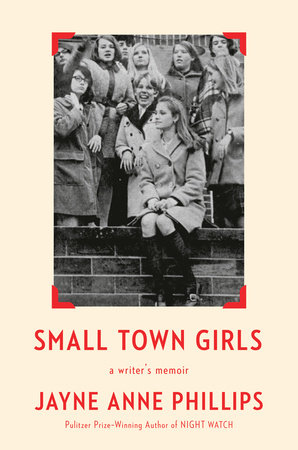
THE NEW YORK TIMES BOOK REVIEW EDITORS' CHOICE • OPRAH'S #1 MOST ANTICIPATED BOOK OF 2026 • A luminous memoir in essays from the Pulitzer Prize–winning writer, who reflects on her origins and the mysteries of memory.

“A brilliant, wide-ranging book, nostalgic and tough-minded at the same time. Like Willa Cather and Stephen Crane, Jayne Anne Phillips writes prose that reads like plainspoken poetry, full of startling and vivid images that bring a vanished world back to life before our eyes.” —Tom Perrotta, author of The Leftovers

“The painful thing about adolescence is that everything seems absolute, and the painful thing about adulthood is that nothing does.”

Jayne Anne Phillips grew up in the small town of Buckhannon, West Virginia. The distinctly American landscape of Appalachia—dense with forests and small churches, rich in history and misunderstandings—has been the great setting for her fiction, even as she and her boundless imagination have traveled to other times and places. In her distinctive first-person voice, Phillips brings us into her childhood and family, most movingly her closeness with her mother. She re-creates the place she calls home, its foundational truths and the densely woven ties among the women of the town. She traces her journeys across the country and her discovery of writing and reading as tools for both survival and revelation, offering insights into the fellow writers and touchstones that moved and influenced her. From the local beauty salon to the legendary Hatfield–McCoy feud, from Jean Shrimpton and Barbara Stanwyck to Stephen Crane and Breece D’J Pancake, Phillips ponders her relationship with inspiration, spirituality, culture, and the troubled annals of the last American centuries.

Tender, inviting, sparkling with wisdom and openheartedness, Small Town Girls is part coming-of-age story, part social history, and Jayne Anne Phillips’s most personal, most accessible book yet—a love letter to the place and the people who have shaped her perceptions and her writing.
Chapter 1

Hometown

For me, “hometown” refers to a small town, nestled in the Allegheny Mountains of north central West Virginia, home to generations of family, a place whose history is interspersed with family stories and myths. I left for college and grad school but went home for years to see my divorced parents, and then to visit their graves in the rolling cemetery that splays its green acreage on either side of the winding narrow road where my father taught me to drive. I know now that I loved my hometown, that its long history and layered stories provided the perfect birthplace for a writer. My mother had grown up there, as had most of her friends, and their mothers before them. People lived there all their lives. Despite the sometimes-doubtful economy, no one wanted to leave, or so it seemed to me as a child.

The town was beautiful then. Main Street was thriving. Local people owned the stores and restaurants. We lived on a rural road in a ranch-style brick house that my father had designed and built. Two local newspapers were delivered every weekday, thrust into the round receptacle next to our mailbox at the end of the driveway. My father went to town early on Sundays, to buy the weekend edition of The Charleston Gazette at the Acme Bookstore on Main Street. The Acme smelled of sawdust, and sold newspapers, magazines, school supplies, and comic books. Comic books were Sunday treats. I think of my father, vital and healthy, perusing the racks, choosing a fifteen-cent “Superman” or “Archie” for my brothers, “Millie the Model” or a Classics Illustrated for me. An addicted reader early on, I first read R. Blackmore’s Lorna Doone and George Eliot’s Silas Marner as comics, before finding the original versions in the library, where I’d replenish armloads of borrowed books under my mother’s watchful eye. She was finishing college, studying at night while her children slept.

I looked out the windows of my grade school and saw, across South Kanawha Street, the big house in which my mother had lived until she married my father. My mother had graduated from the local high school in 1943, and my father, nearly a generation earlier, in 1928, but he wasn’t a true native. Born in neighboring Randolph County, Russell Randolph Phillips had lived in my hometown for a few years as a child and moved back for high school. So masculine in bearing and gesture, my father was not a talker. For years, he owned a concrete company: Russ Concrete. My brothers and I rode school buses past bus shelters emblazoned with our father’s name. We seemed to have lived here forever, even before we were born.

In a sense, we had. Both sides of the family had helped settle western Virginia when the land was still a territory. My mother’s great-aunt Jenny had spoken of the “bad old days” of the Civil War. Her people had fought for the Union—her husband had nearly died in Richmond’s infamous Libby Prison—but the Phillips men, a county south, were Confederates. Local families still told stories of those years. The past and present were endlessly intermingled, and West Virginia history was a sixth-grade tradition. Every kid in town knew that West Virginia had seceded from Virginia to stand for the Union, and that a hundred years before, English brothers John and Samuel Pringle had turned their backs on the English crown during the French and Indian War, deserting their posts at Fort Pitt in 1761. They traveled south on foot, living off the land for three years until they arrived at the mouth of what became a river, following it to find shelter in the vast cavity of a living sycamore tree. The primeval forests were then full of gigantic trees forty or fifty feet in circumference, and the eleven-foot-deep cavity would have provided living space of about a hundred square feet, the equivalent of a ten-by-ten room. The brothers survived the frigid winters on plentiful game, waiting out the war until their gunpowder was gone. John Pringle traveled two hundred miles for supplies, and returned with news that amnesty had been declared. The brothers moved to settlements farther south, but John returned with a wife and other settlers whose names are common in the town today: Cutright, Jackson, Gould.

Hometown adolescents visited a third- or fourth-generation descendant of the original sycamore on school field trips. In 1964, my ninth-grade class rode school buses to the meadow along a road called Turkey Run. The buses bounced and groaned, and we all lined up to walk into the teepee-sized opening of what is still officially designated the Pringle Tree. I remember the loamy smell rising from the soil, damp, fertile, and hidden. Somehow the version of the Pringle brothers’ story that we learned didn’t emphasize that they left a war to found a settlement in a country so virgin and wild they had only to enter it to escape the bonds of military servitude. Wilderness was freedom.

In the 1920s, two thousand farms, averaging eighty-seven acres each, surrounded the town. Such small, nearly self-sufficient farms survived through the Depression and two world wars. Miners and farmers kept Main Street alive, and the town rituals, seasonal and dependable, provided a world. Everyone knew everyone, and everyone’s story was known. There were Protestant churches of every denomination and a Catholic church, but no synagogue. Parades marched down Main Street on Veterans Day, Memorial Day, and the Fourth of July. The third week in May is still devoted to the Strawberry Festival, and the parade attracts high school marching bands from across the state. The populace lines up on the main thoroughfare to watch hours of marching bands, homemade floats, and home-crowned royalty. The year my cousin was queen, I was six and one of the flower girls in her court. We wore white organdy dresses and waved regally from the queen’s frothy float. The parade wound its way through town, slowly, for hours, as though coursing through a collective dream. Though the queen wore her tiara all summer, the town’s everyday royalty were its doctors and dentists, the professors at the Methodist college, and the football coaches who’d taken the high school team to the state AAA championships. Doctors, especially respected and revered, made house calls.

The long dark hallway to our doctor’s office on Main Street led steeply upstairs and the black rubber treads on the steps absorbed all sound. Even the kids called him Jake. He was tall and bald and sardonic, and he could produce dimes from behind the necks and ears of his young patients, unfurling his closed hand to reveal the sparkle of the coin. The waiting room was always full and the office smelled strongly of rubbing alcohol. Framed collages of the hundreds of babies he’d delivered hung on the walls. My mother insisted on flu shots every year, and we kids dreaded them, but Jake was a master of distraction, bantering and performing while the nurse prepared slender hypodermics. After our shots, we picked cellophane-wrapped suckers from the candy jar, sauntered into the dim stairwell, and floated straight down. The rectangular transom above the street door shone below, a dazzling white light. Out there, the three traffic lights on Main Street changed with little clicks. We’d drive the two miles or so home, past the fairgrounds and the fields, in my mother’s two-tone Mercury sedan. The car was aqua and white, big and flat as a boat. My father would be cooking fried potatoes in the black iron skillet, what he called “starting supper.” It was the only domestic chore he ever performed. I knew he’d learned to peel potatoes in the army, cutting their peels in one continuous spiral motion.

My dad had enlisted and joined the Thirty-Eighth Infantry Division, Corps of Engineers. He helped build airstrips in New Guinea throughout World War II, foreman to crews of GIs and Papuan natives. During the war, my mother had trained as a nurse in Washington, D.C. The big city was exciting, she told me, but the food in the dorms was so bad that all the girls took up smoking to cut their appetites. A family illness forced her return; she came home to nurse her mother. My grandmother was still well enough that my mother went out Saturday nights; she wore red lipstick and her dark hair in a chignon. My father was a handsome older man whose family owned a local hospital. They married in 1948 after a three-week courtship and had three children by October of ’53. The winter that the three of us were ages five months to four years, Dr. Jake made a house call—for my mother. She was undernourished, he told her. Though she’d quit during her pregnancies, she was smoking again, and down to a hundred pounds. She told me how Jake sat beside her bed, his black medical bag on the floor. Now, he said, lighting two cigarettes, we’re going to smoke this last one together.

Hometowns are full of stories and memories rinsed with color. The dome of the courthouse glowed gold in those years. The main throughfare ran uphill from Main Street past the largest, most bountiful houses. It was still lined with tall trees whose dense, leafy branches met over the street and lifted as cars passed under them, dazzling voyagers with sunlight, or showering snow. Open fields bordered our house. Tasseled corn filled the fields in summer, and thick stalks of Queen Anne’s lace broke like fuzzy limbs when we tugged them up by the roots. Telephone numbers were three digits; ours was 788. The fields are gone now but the numbers stay in my mind. Towns and cities change; they grow or diminish, but hometowns stay as we left them. Later, they appear, brilliant with sounds and smells, intense, suspended images that slide through time like the slow, saturated frames of a home movie.
OPRAH'S #1 MOST ANTICIPATED BOOK OF 2026

“A bittersweet triumph. . . . Phillips’s new book is rich with evocative descriptions of her hometown. . . . Her love and respect for the people and their pasts, and for the splendor of the landscape, gives the writing at times the feel of a meditation, one that is ideally served by the eloquence and precision of the author’s prose. . . . One of the finest descriptions I have read of how a fiction writer’s mind works.” —Sigrid Nunez, New York Times Book Review

“Jayne Anne Phillips writes like a jeweler, setting each word like a gemstone.” —Here & Now/NPR

“Like a series of old photographs, the color-soaked images she conjures give her dreams a realness and her realism its dreaminess. . . . The effect is powerful indeed. . . . Like the best of Phillips’s fiction, its structure mimics the fracturing of modern American life as she has witnessed it.”Wall Street Journal

“Phillips’s book is suffused with her love for where she came from and the memories of her ancestors.”Boston Globe

“Phillips’s prose is unflagging in its beauty and rhythm, and the memoir-leaning pieces have a special glow. . . . West Virginia has no more eloquent and grateful daughter. Boy, can she write.” Kirkus Reviews (starred)

“Wonderful. . . . Equal parts wistful and pragmatic, Phillips’s autopsy of rural mid-century America doubles as a haunting and insightful self-portrait. Even readers unfamiliar with the author’s fiction will be riveted.” Publishers Weekly (starred)

“A sparkling introduction to the author for those who don’t know her, and a peek behind the scenes of her life for those who do. . . . A mosaic of her voices: humorous, scholarly, pensive, nostalgic.” Booklist

“A lovely, multifaceted memoir. . . . Radiant. . . . Impassioned. . . . At once nostalgic and clear-eyed. . . . Phillips brings to this memoir the kind of resonant details and sharp insights that have enriched her fiction. . . . ‘Writing, we cross the divide between self and others word by word.’ With Small Town Girls, Phillips has once again crossed that divide—beautifully.” Heller McAlpin, Christian Science Monitor

“A powerful example of Phillips’s immense talents. . . . Whether writing fiction or nonfiction, [she] deploys unique depth and eloquence.” —Alice Cary, BookPage

"What the film ‘The Last Picture Show’ began—Small Town Girls brings to fruition. This beautifully written revelation of the essence of The American Dream shines a light on the ways small towns created American girls, and the ways in which American girls created their small towns. And on this shimmers a brilliant Joycean layer of how places create writers and writers create place." —Alice Randall, author of My Black Country

“A poignant and generous memoir. . . . Jayne Anne Phillips [is] the region’s greatest living writer. . . . Skipping around in time, taking in history as well as memory, these essays make a state famous for coal mines and a John Denver song seem like a stage all of us have crossed. . . . Phillips is at her wisdom-literature best.” —Pittsburgh Review of Books

"Small Town Girls is a brilliant, wide-ranging book, nostalgic and tough-minded at the same time. Like Willa Cather and Stephen Crane, Jayne Anne Phillips writes prose that reads like plainspoken poetry, full of startling and vivid images that bring a vanished world back to life before our eyes." Tom Perrotta, author of The Leftovers
© Elena Seibert
JAYNE ANNE PHILLIPS is the author of Black Tickets, Machine Dreams, Fast Lanes, Shelter, MotherKind, Lark and Termite, Quiet Dell, and Night Watch, which was awarded the Pulitzer Prize in 2024. Her work has been a finalist once for the National Book Award and twice for the National Book Critics Circle Award. The recipient of Guggenheim, National Endowment for the Arts, Howard, Bunting, and Rockefeller Foundation Fellowships, she is a member of the American Academy of Arts and Letters. She lives in Boston and New York. View titles by Jayne Anne Phillips

About

THE NEW YORK TIMES BOOK REVIEW EDITORS' CHOICE • OPRAH'S #1 MOST ANTICIPATED BOOK OF 2026 • A luminous memoir in essays from the Pulitzer Prize–winning writer, who reflects on her origins and the mysteries of memory.

“A brilliant, wide-ranging book, nostalgic and tough-minded at the same time. Like Willa Cather and Stephen Crane, Jayne Anne Phillips writes prose that reads like plainspoken poetry, full of startling and vivid images that bring a vanished world back to life before our eyes.” —Tom Perrotta, author of The Leftovers

“The painful thing about adolescence is that everything seems absolute, and the painful thing about adulthood is that nothing does.”

Jayne Anne Phillips grew up in the small town of Buckhannon, West Virginia. The distinctly American landscape of Appalachia—dense with forests and small churches, rich in history and misunderstandings—has been the great setting for her fiction, even as she and her boundless imagination have traveled to other times and places. In her distinctive first-person voice, Phillips brings us into her childhood and family, most movingly her closeness with her mother. She re-creates the place she calls home, its foundational truths and the densely woven ties among the women of the town. She traces her journeys across the country and her discovery of writing and reading as tools for both survival and revelation, offering insights into the fellow writers and touchstones that moved and influenced her. From the local beauty salon to the legendary Hatfield–McCoy feud, from Jean Shrimpton and Barbara Stanwyck to Stephen Crane and Breece D’J Pancake, Phillips ponders her relationship with inspiration, spirituality, culture, and the troubled annals of the last American centuries.

Tender, inviting, sparkling with wisdom and openheartedness, Small Town Girls is part coming-of-age story, part social history, and Jayne Anne Phillips’s most personal, most accessible book yet—a love letter to the place and the people who have shaped her perceptions and her writing.

Excerpt

Chapter 1

Hometown

For me, “hometown” refers to a small town, nestled in the Allegheny Mountains of north central West Virginia, home to generations of family, a place whose history is interspersed with family stories and myths. I left for college and grad school but went home for years to see my divorced parents, and then to visit their graves in the rolling cemetery that splays its green acreage on either side of the winding narrow road where my father taught me to drive. I know now that I loved my hometown, that its long history and layered stories provided the perfect birthplace for a writer. My mother had grown up there, as had most of her friends, and their mothers before them. People lived there all their lives. Despite the sometimes-doubtful economy, no one wanted to leave, or so it seemed to me as a child.

The town was beautiful then. Main Street was thriving. Local people owned the stores and restaurants. We lived on a rural road in a ranch-style brick house that my father had designed and built. Two local newspapers were delivered every weekday, thrust into the round receptacle next to our mailbox at the end of the driveway. My father went to town early on Sundays, to buy the weekend edition of The Charleston Gazette at the Acme Bookstore on Main Street. The Acme smelled of sawdust, and sold newspapers, magazines, school supplies, and comic books. Comic books were Sunday treats. I think of my father, vital and healthy, perusing the racks, choosing a fifteen-cent “Superman” or “Archie” for my brothers, “Millie the Model” or a Classics Illustrated for me. An addicted reader early on, I first read R. Blackmore’s Lorna Doone and George Eliot’s Silas Marner as comics, before finding the original versions in the library, where I’d replenish armloads of borrowed books under my mother’s watchful eye. She was finishing college, studying at night while her children slept.

I looked out the windows of my grade school and saw, across South Kanawha Street, the big house in which my mother had lived until she married my father. My mother had graduated from the local high school in 1943, and my father, nearly a generation earlier, in 1928, but he wasn’t a true native. Born in neighboring Randolph County, Russell Randolph Phillips had lived in my hometown for a few years as a child and moved back for high school. So masculine in bearing and gesture, my father was not a talker. For years, he owned a concrete company: Russ Concrete. My brothers and I rode school buses past bus shelters emblazoned with our father’s name. We seemed to have lived here forever, even before we were born.

In a sense, we had. Both sides of the family had helped settle western Virginia when the land was still a territory. My mother’s great-aunt Jenny had spoken of the “bad old days” of the Civil War. Her people had fought for the Union—her husband had nearly died in Richmond’s infamous Libby Prison—but the Phillips men, a county south, were Confederates. Local families still told stories of those years. The past and present were endlessly intermingled, and West Virginia history was a sixth-grade tradition. Every kid in town knew that West Virginia had seceded from Virginia to stand for the Union, and that a hundred years before, English brothers John and Samuel Pringle had turned their backs on the English crown during the French and Indian War, deserting their posts at Fort Pitt in 1761. They traveled south on foot, living off the land for three years until they arrived at the mouth of what became a river, following it to find shelter in the vast cavity of a living sycamore tree. The primeval forests were then full of gigantic trees forty or fifty feet in circumference, and the eleven-foot-deep cavity would have provided living space of about a hundred square feet, the equivalent of a ten-by-ten room. The brothers survived the frigid winters on plentiful game, waiting out the war until their gunpowder was gone. John Pringle traveled two hundred miles for supplies, and returned with news that amnesty had been declared. The brothers moved to settlements farther south, but John returned with a wife and other settlers whose names are common in the town today: Cutright, Jackson, Gould.

Hometown adolescents visited a third- or fourth-generation descendant of the original sycamore on school field trips. In 1964, my ninth-grade class rode school buses to the meadow along a road called Turkey Run. The buses bounced and groaned, and we all lined up to walk into the teepee-sized opening of what is still officially designated the Pringle Tree. I remember the loamy smell rising from the soil, damp, fertile, and hidden. Somehow the version of the Pringle brothers’ story that we learned didn’t emphasize that they left a war to found a settlement in a country so virgin and wild they had only to enter it to escape the bonds of military servitude. Wilderness was freedom.

In the 1920s, two thousand farms, averaging eighty-seven acres each, surrounded the town. Such small, nearly self-sufficient farms survived through the Depression and two world wars. Miners and farmers kept Main Street alive, and the town rituals, seasonal and dependable, provided a world. Everyone knew everyone, and everyone’s story was known. There were Protestant churches of every denomination and a Catholic church, but no synagogue. Parades marched down Main Street on Veterans Day, Memorial Day, and the Fourth of July. The third week in May is still devoted to the Strawberry Festival, and the parade attracts high school marching bands from across the state. The populace lines up on the main thoroughfare to watch hours of marching bands, homemade floats, and home-crowned royalty. The year my cousin was queen, I was six and one of the flower girls in her court. We wore white organdy dresses and waved regally from the queen’s frothy float. The parade wound its way through town, slowly, for hours, as though coursing through a collective dream. Though the queen wore her tiara all summer, the town’s everyday royalty were its doctors and dentists, the professors at the Methodist college, and the football coaches who’d taken the high school team to the state AAA championships. Doctors, especially respected and revered, made house calls.

The long dark hallway to our doctor’s office on Main Street led steeply upstairs and the black rubber treads on the steps absorbed all sound. Even the kids called him Jake. He was tall and bald and sardonic, and he could produce dimes from behind the necks and ears of his young patients, unfurling his closed hand to reveal the sparkle of the coin. The waiting room was always full and the office smelled strongly of rubbing alcohol. Framed collages of the hundreds of babies he’d delivered hung on the walls. My mother insisted on flu shots every year, and we kids dreaded them, but Jake was a master of distraction, bantering and performing while the nurse prepared slender hypodermics. After our shots, we picked cellophane-wrapped suckers from the candy jar, sauntered into the dim stairwell, and floated straight down. The rectangular transom above the street door shone below, a dazzling white light. Out there, the three traffic lights on Main Street changed with little clicks. We’d drive the two miles or so home, past the fairgrounds and the fields, in my mother’s two-tone Mercury sedan. The car was aqua and white, big and flat as a boat. My father would be cooking fried potatoes in the black iron skillet, what he called “starting supper.” It was the only domestic chore he ever performed. I knew he’d learned to peel potatoes in the army, cutting their peels in one continuous spiral motion.

My dad had enlisted and joined the Thirty-Eighth Infantry Division, Corps of Engineers. He helped build airstrips in New Guinea throughout World War II, foreman to crews of GIs and Papuan natives. During the war, my mother had trained as a nurse in Washington, D.C. The big city was exciting, she told me, but the food in the dorms was so bad that all the girls took up smoking to cut their appetites. A family illness forced her return; she came home to nurse her mother. My grandmother was still well enough that my mother went out Saturday nights; she wore red lipstick and her dark hair in a chignon. My father was a handsome older man whose family owned a local hospital. They married in 1948 after a three-week courtship and had three children by October of ’53. The winter that the three of us were ages five months to four years, Dr. Jake made a house call—for my mother. She was undernourished, he told her. Though she’d quit during her pregnancies, she was smoking again, and down to a hundred pounds. She told me how Jake sat beside her bed, his black medical bag on the floor. Now, he said, lighting two cigarettes, we’re going to smoke this last one together.

Hometowns are full of stories and memories rinsed with color. The dome of the courthouse glowed gold in those years. The main throughfare ran uphill from Main Street past the largest, most bountiful houses. It was still lined with tall trees whose dense, leafy branches met over the street and lifted as cars passed under them, dazzling voyagers with sunlight, or showering snow. Open fields bordered our house. Tasseled corn filled the fields in summer, and thick stalks of Queen Anne’s lace broke like fuzzy limbs when we tugged them up by the roots. Telephone numbers were three digits; ours was 788. The fields are gone now but the numbers stay in my mind. Towns and cities change; they grow or diminish, but hometowns stay as we left them. Later, they appear, brilliant with sounds and smells, intense, suspended images that slide through time like the slow, saturated frames of a home movie.

Reviews

OPRAH'S #1 MOST ANTICIPATED BOOK OF 2026

“A bittersweet triumph. . . . Phillips’s new book is rich with evocative descriptions of her hometown. . . . Her love and respect for the people and their pasts, and for the splendor of the landscape, gives the writing at times the feel of a meditation, one that is ideally served by the eloquence and precision of the author’s prose. . . . One of the finest descriptions I have read of how a fiction writer’s mind works.” —Sigrid Nunez, New York Times Book Review

“Jayne Anne Phillips writes like a jeweler, setting each word like a gemstone.” —Here & Now/NPR

“Like a series of old photographs, the color-soaked images she conjures give her dreams a realness and her realism its dreaminess. . . . The effect is powerful indeed. . . . Like the best of Phillips’s fiction, its structure mimics the fracturing of modern American life as she has witnessed it.”Wall Street Journal

“Phillips’s book is suffused with her love for where she came from and the memories of her ancestors.”Boston Globe

“Phillips’s prose is unflagging in its beauty and rhythm, and the memoir-leaning pieces have a special glow. . . . West Virginia has no more eloquent and grateful daughter. Boy, can she write.” Kirkus Reviews (starred)

“Wonderful. . . . Equal parts wistful and pragmatic, Phillips’s autopsy of rural mid-century America doubles as a haunting and insightful self-portrait. Even readers unfamiliar with the author’s fiction will be riveted.” Publishers Weekly (starred)

“A sparkling introduction to the author for those who don’t know her, and a peek behind the scenes of her life for those who do. . . . A mosaic of her voices: humorous, scholarly, pensive, nostalgic.” Booklist

“A lovely, multifaceted memoir. . . . Radiant. . . . Impassioned. . . . At once nostalgic and clear-eyed. . . . Phillips brings to this memoir the kind of resonant details and sharp insights that have enriched her fiction. . . . ‘Writing, we cross the divide between self and others word by word.’ With Small Town Girls, Phillips has once again crossed that divide—beautifully.” Heller McAlpin, Christian Science Monitor

“A powerful example of Phillips’s immense talents. . . . Whether writing fiction or nonfiction, [she] deploys unique depth and eloquence.” —Alice Cary, BookPage

"What the film ‘The Last Picture Show’ began—Small Town Girls brings to fruition. This beautifully written revelation of the essence of The American Dream shines a light on the ways small towns created American girls, and the ways in which American girls created their small towns. And on this shimmers a brilliant Joycean layer of how places create writers and writers create place." —Alice Randall, author of My Black Country

“A poignant and generous memoir. . . . Jayne Anne Phillips [is] the region’s greatest living writer. . . . Skipping around in time, taking in history as well as memory, these essays make a state famous for coal mines and a John Denver song seem like a stage all of us have crossed. . . . Phillips is at her wisdom-literature best.” —Pittsburgh Review of Books

"Small Town Girls is a brilliant, wide-ranging book, nostalgic and tough-minded at the same time. Like Willa Cather and Stephen Crane, Jayne Anne Phillips writes prose that reads like plainspoken poetry, full of startling and vivid images that bring a vanished world back to life before our eyes." Tom Perrotta, author of The Leftovers

Author

© Elena Seibert
JAYNE ANNE PHILLIPS is the author of Black Tickets, Machine Dreams, Fast Lanes, Shelter, MotherKind, Lark and Termite, Quiet Dell, and Night Watch, which was awarded the Pulitzer Prize in 2024. Her work has been a finalist once for the National Book Award and twice for the National Book Critics Circle Award. The recipient of Guggenheim, National Endowment for the Arts, Howard, Bunting, and Rockefeller Foundation Fellowships, she is a member of the American Academy of Arts and Letters. She lives in Boston and New York. View titles by Jayne Anne Phillips
  • More Websites from
    Penguin Random House
  • Common Reads
  • Library Marketing