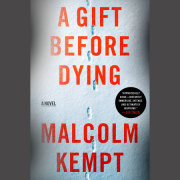
Download high-resolution image
Listen to a clip from the audiobook
audio pause button
0:00
0:00

A Gift Before Dying

A Novel

Author Malcolm Kempt On Tour
Listen to a clip from the audiobook
audio pause button
0:00
0:00
“Hypnotically good—instantly immersive, intense, and ultimately inspiring.”—Lee Child, New York Times bestselling author of the Jack Reacher series

In a hauntingly atmospheric novel set against the unforgiving landscape of the Arctic Circle, a disgraced police investigator discovers that his path to redemption is paved with ice—and blood.

"Kempt, who worked as a criminal lawyer in the Arctic for almost two decades, conjures this forbidding landscape and its residents with artful authority.”—The Wall Street Journal

After a botched high-profile murder investigation, Corporal Elderick Cole is exiled to the remote, rugged landscape of Nunavut, a vast territory in the Arctic Circle known for its untamed beauty, frigid temperatures, and endless winter nights. With his family having severed all ties, Cole waits out the result of a civil lawsuit alone—the wrong verdict could end what’s left of his flailing career.

His bleak existence takes a sinister turn when he discovers the hanging body of Pitseolala, a troubled Inuit girl whom he had sworn to protect. Her death dredges up demons he thought he’d buried along with the scars of a fractured marriage and the aching divide between him and his estranged daughter.

As Cole’s life unravels—and with it, the fragile thread of his investigation, he turns to Pitseolala’s younger brother, Maliktu, a fellow outsider. It’s then that Cole uncovers what binds them—a singular mission to find her killer.

Against fierce backlash, Cole’s overriding desire to redeem just one aspect of his otherwise failed life becomes an obsession—and he’s willing to break every rule in his unyielding pursuit of justice and the smallest shred of redemption.
Chapter 1

Sergeant Elderick Cole pulled back the hood of his parka and switched on his flashlight. Dead. The bulb flickered once and the silhouette of the dead girl lingered on his retinas. He removed one tactical glove using his teeth and fumbled with the battery casing; icy pins and needles pushed deep into his bone-­white fingers. The furnace must have been out for hours. He swore aloud, his warm breath crystallizing in the Arctic air. Cole whacked the frosted device against his palm in frustration. It flashed again, illuminating the crime scene for a heartbeat.

The body of the girl hung in the center of the kitchen, her head bent downward at an unnatural angle, concealing her features in its shadow. It didn’t matter. He didn’t need to see her face. Even from the far end of the hallway in the unlit apartment, he knew exactly who she was. Resignation set in, a feeling of deep sorrow stealing over him. It was the fourth suicide he’d responded to this year in this little Arctic town. December was only hours old.

Standing in the darkness, giving his eyes time to adjust, Cole allowed her image to fade, dreading everything that lay ahead. How did it all come to this? Sliding his bare hand along the cold surface of the wall, he found the light switch for the hallway and flicked it upward. Nothing. Before he could even consider the reason for the outage, a frigid gust ripped through the inner door behind him, so he forced it closed against the howling wind.

As he tightened the cap on his flashlight, it mercifully sparked to life. He brought the beam to bear on her corpse. An electrical cord had been tied around her throat in a crude slipknot. Stiff arms and legs dangled from her tiny frame. She was frozen solid. Her toes were level with Cole’s knees, bringing them face-­to-­face. He stepped closer to her, touching her hair with his gloved hand. Was there anything he should have done differently for her in the past few weeks? He pushed a rigid strand back off her face, but it fell forward again. She looked angelic in the artificial light, crystals of frost on her pale cheeks, her eyes open, lost and vacant. He whispered her name as if to wake her.

“Pitseolala.”

Cole rotated her body with a soft touch, turning her face away from his. He unzipped his parka and reached inside for the handset buckled to his tactical vest.

“This is Sergeant Cole, Dorset detachment. Do you read me?”

A distant voice crackled over the airwaves.

“This is Iqaluit dispatch. I read you.”

“I’m at the location and I’ve found the body. It’s a suicide. Over.”

The operator acknowledged him and he shut down his radio. No need to get his partner out of bed for this. He pulled out his smartphone. No one had told him two years ago, before he flew into Cape Dorset to start his placement, that there was no cell service in the town. No infrastructure, they told him. Too remote, they said. The device had become an overpriced dictation machine. He activated the voice recorder app. As he got older, he’d found himself relying more often on recordings to write incident reports. His memory wasn’t what it used to be. That, and he wrote so many of them now. Crime never seemed to sleep here and as of late, he hadn’t either.

A violent wind shook the house while he spoke into the phone, the wooden frame cracking and shifting in the otherwise silent darkness.

“The deceased is wearing a black T-­shirt with a silver butterfly design on the front, black jeans, green belt. Barefoot. Toenails painted red, fingernails blue. Hair is normally black, recently dyed blond, traces of pink on the ends. No visible injuries except for numerous dated scratches, bruises, and a few hickeys.”

It had been less than a week since Pitseolala slept off a night of heavy drinking in the holding cells. Cole had found her staggering around without a parka or mittens during a night when the temperature had dropped well below −­31 degrees with the windchill. This scenario had become a regular occurrence for her in recent months.

He leaned in and inhaled deeply through his nose. Cheap flowery perfume, no smell of decomposition. He exhaled a cloud of icy frost. No telling how long she’d been hanging there. His hands trembled as he searched her pockets, her frozen body turning slightly at his touch. Nothing but lip gloss and chewing gum. Just a minor, a kid who had nothing. The tension in his neck increased. He realized he was clenching his teeth again, so he closed his eyes and recalled the exercise he had read about on the internet. Open hands, breathe in. Close fists, breathe out.

He slipped past the body to clear his head and survey the room. It looked like every other kitchen in every other prefabricated unit in the area. No signs of a struggle. An overturned chair near the body. A single plastic tumbler and an open bottle of vodka on the table. Nothing notable except the young girl’s blue jacket on the back of a standing kitchen chair.

He pulled a small point-­and-­shoot camera from his pocket and took a dozen pictures of the room from different angles. Then he squatted down to peek through the hole in the glass of the back­door window. Forced entry. No damage except the shattered pane above the knob where she must have gained access to the apartment. A small drift of snow had formed on the tiles among the shards of glass. He stood up, walked to the counter, and picked up the cordless phone. No dial tone. It was tied to the power supply; some fuses must have blown and knocked out the furnace along with them. He reached for his mobile radio unit again and dialed Bert Miller, the local justice of the peace. The regional office had also designated him as a lay coroner.

Ten rings later, a somewhat sober Miller mumbled into the receiver.

“Miller? That you?”

“Yeah, yeah,” he whispered, before breaking into a coughing fit.

“I got a body. House 273. I need you to confirm it so I can cut her down.”

Seven seconds of silence. “I’ll get dressed.”

At the sound of the disconnection, he cursed under his breath and hoped that Miller wouldn’t roll over, fall back asleep, and leave him standing in the cold for the rest of the night.

He braced himself for a long wait and climbed the stairs to investigate the rest of the residence—­a two-­bedroom apartment in one of the five-­unit housing complexes at the edge of the hamlet. Each had an identical layout, so he knew the floor plan. He turned left at the top of the stairs into the bedroom, instinctively reaching for his gun when his own darkened reflection in the mirror startled him. He paused, releasing his grip on his still-­holstered firearm, then swept the flashlight around the room. Empty, as expected. He strode carefully through the unlit room to the lone window and turned off his flashlight, wiping the frost from the pane with the sleeve of his parka.

Outside, through the ice-­covered glass, the tiny community of Cape Dorset, with about eleven hundred Inuit and two hundred Qallunaaq or non-­Inuit, like himself, looked almost peaceful. He knew better. In the early 1900s, the Hudson’s Bay Company established an outpost in this location, offering tobacco, sugar, and ammunition in exchange for animal hides and pelts. It didn’t take long for the nomadic Inuit to become dependent on the goods and services offered by the company and move from their hunting camps on the tundra to settle around the company store.

More than one hundred years later, despite its small size, this isolated town had one of the highest violent crime rates per capita in North America. Harsh weather, rampant substance abuse, lack of treatment resources, and pure isolation created a pressure cooker of social ills. Violence lingered as a potential solution to every problem.

He flicked the flashlight on again. A photo stuck out from the mirror frame above the dresser—­a group of girls on a hiking trip. The teacher who rented the unit stood third from the left. Smiling, happy, elsewhere. She’d been on vacation for the past three weeks. The neighbor who reported the body noticed all of the lights extinguished and used a spare key to check on the place.

He tucked the photo back and stepped out across the hallway. Cosmetics and hair products cluttered the tiny bathroom. The flashlight beam revealed a toilet bowl full of ice; a long crack extended from the flush handle to the base of the tank. He turned the hot water tap on, but nothing came out. The pipes in the house would have frozen when the furnace died, most of them burst. Checking his watch, he wondered if he had accidentally locked the front door on Miller. He descended the stairs and made sure the dead bolt was open before sitting on the couch in the living room. Cold had begun to seep into his joints. When he was a senior in college, a promising career in professional hockey had been derailed by a poorly executed check from a careless defenseman. Two surgeries and three titanium implants later, he would relearn how to walk. He rubbed his bad knee hard with two hands to warm it before taking out a pencil to make notes. Years ago, his instructors had taught him to always use a pen, but up here, the ink kept freezing.
“Hypnotically good—instantly immersive, intense, and ultimately inspiring.”—Lee Child

“Kempt infuses his lived experience into the gripping story, balancing the darkness with a terse writing style that doesn’t get in the way. I await further stories of the area, and of its people.”The New York Times

“Tautly written, this first novel by a former criminal lawyer who spent 17 years in the Arctic is a hard look at the desolate lives of people resigned to life in the bleak far north.”The Denver Post

“Kempt, who worked as a criminal lawyer in the Arctic for almost two decades, conjures this forbidding landscape and its residents with artful authority. A Gift Before Dying merges harsh realism, insomniac perceptions and tribal visions in a story that shocks and engages.”The Wall Street Journal

“This extraordinary, beautifully crafted debut mystery blends together an arresting setting, a background of systemic social net failures in an Indigenous community, and a spiky police procedural . . . If you only read one mystery this year, this should be it.”Booklist, starred review

“One of those crime novels where, once you read the opening scene, you’ve got no choice but to fall through the rest as fast as possible.”—Stephen Graham Jones, New York Times bestselling author of The Buffalo Hunter Hunter

A Gift Before Dying announces Malcolm Kempt as the new guy in town. A gripping thriller—both serious and propulsive, Kempt’s debut is delivered with insight and authority, pacing and style and is sure to win him fans on both sides of the border.”—Ivy Pochoda, winner of the Los Angeles Times Book Prize for Mystery/Thriller and author of Sing Her Down

“Rich in atmosphere and relentlessly suspenseful . . . Kempt conjures his frigid, dark world with graceful prose and haunting imagery that recalls the best of Jo Nesbø and Henning Mankell. If you enjoyed True Detective: Night Country, you’ll be overjoyed by this story.”—Michael Kortya, New York Times bestselling author of An Honest Man

A Gift Before Dying is a haunting, immersive, moving story—told by an expert, with great authority and emotion. Keep an eye on Malcolm Kempt—one of my favorite voices in contemporary dark fiction.”—Richard Thomas, Bram Stoker, Shirley Jackson, and Thriller Award finalist

“It’s a testament to Malcolm Kempt’s talent that I didn’t want his ghostly crime novel to end. A Gift Before Dying is sure to be considered one of the finest debuts of the year.”—Donald Ray Pollock, author of The Devil All the Time

“There’s a river of warmth running under this icy, Arctic thriller, with a big bang of an ending you won’t soon forget. Hold on tight, because A Gift Before Dying will grip you until the last page.”—Rene Denfeld, bestselling author of The Child Finder

“Malcolm Kempt is a brave new author I’d follow anywhere. Set in the Arctic Circle, his illuminating debut, A Gift Before Dying, is ice-cold, yet it still managed to warm my heart by the end.”—Eli Cranor, author of Ozark Dogs

“It’s a knockout.”Publishers Weekly, starred review

“With its gripping opening, exciting climax, powerful sense of place and eerie, nicely unforced mysticism, this is a strong debut. A terrific, permafrosted mystery you may want to read with gloves on.”Kirkus Reviews
© Leanne Pitcher Photography
Malcolm Kempt worked as a criminal lawyer in the remote Arctic for seventeen years before leaving to write full-time. He now lives on the island of Newfoundland. View titles by Malcolm Kempt

Discussion Guide for A Gift Before Dying

Provides questions, discussion topics, suggested reading lists, introductions and/or author Q&As, which are intended to enhance reading groups’ experiences.

(Please note: the guide displayed here is the most recently uploaded version; while unlikely, any page citation discrepancies between the guide and book is likely due to pagination differences between a book’s different formats.)

About

“Hypnotically good—instantly immersive, intense, and ultimately inspiring.”—Lee Child, New York Times bestselling author of the Jack Reacher series

In a hauntingly atmospheric novel set against the unforgiving landscape of the Arctic Circle, a disgraced police investigator discovers that his path to redemption is paved with ice—and blood.

"Kempt, who worked as a criminal lawyer in the Arctic for almost two decades, conjures this forbidding landscape and its residents with artful authority.”—The Wall Street Journal

After a botched high-profile murder investigation, Corporal Elderick Cole is exiled to the remote, rugged landscape of Nunavut, a vast territory in the Arctic Circle known for its untamed beauty, frigid temperatures, and endless winter nights. With his family having severed all ties, Cole waits out the result of a civil lawsuit alone—the wrong verdict could end what’s left of his flailing career.

His bleak existence takes a sinister turn when he discovers the hanging body of Pitseolala, a troubled Inuit girl whom he had sworn to protect. Her death dredges up demons he thought he’d buried along with the scars of a fractured marriage and the aching divide between him and his estranged daughter.

As Cole’s life unravels—and with it, the fragile thread of his investigation, he turns to Pitseolala’s younger brother, Maliktu, a fellow outsider. It’s then that Cole uncovers what binds them—a singular mission to find her killer.

Against fierce backlash, Cole’s overriding desire to redeem just one aspect of his otherwise failed life becomes an obsession—and he’s willing to break every rule in his unyielding pursuit of justice and the smallest shred of redemption.

Excerpt

Chapter 1

Sergeant Elderick Cole pulled back the hood of his parka and switched on his flashlight. Dead. The bulb flickered once and the silhouette of the dead girl lingered on his retinas. He removed one tactical glove using his teeth and fumbled with the battery casing; icy pins and needles pushed deep into his bone-­white fingers. The furnace must have been out for hours. He swore aloud, his warm breath crystallizing in the Arctic air. Cole whacked the frosted device against his palm in frustration. It flashed again, illuminating the crime scene for a heartbeat.

The body of the girl hung in the center of the kitchen, her head bent downward at an unnatural angle, concealing her features in its shadow. It didn’t matter. He didn’t need to see her face. Even from the far end of the hallway in the unlit apartment, he knew exactly who she was. Resignation set in, a feeling of deep sorrow stealing over him. It was the fourth suicide he’d responded to this year in this little Arctic town. December was only hours old.

Standing in the darkness, giving his eyes time to adjust, Cole allowed her image to fade, dreading everything that lay ahead. How did it all come to this? Sliding his bare hand along the cold surface of the wall, he found the light switch for the hallway and flicked it upward. Nothing. Before he could even consider the reason for the outage, a frigid gust ripped through the inner door behind him, so he forced it closed against the howling wind.

As he tightened the cap on his flashlight, it mercifully sparked to life. He brought the beam to bear on her corpse. An electrical cord had been tied around her throat in a crude slipknot. Stiff arms and legs dangled from her tiny frame. She was frozen solid. Her toes were level with Cole’s knees, bringing them face-­to-­face. He stepped closer to her, touching her hair with his gloved hand. Was there anything he should have done differently for her in the past few weeks? He pushed a rigid strand back off her face, but it fell forward again. She looked angelic in the artificial light, crystals of frost on her pale cheeks, her eyes open, lost and vacant. He whispered her name as if to wake her.

“Pitseolala.”

Cole rotated her body with a soft touch, turning her face away from his. He unzipped his parka and reached inside for the handset buckled to his tactical vest.

“This is Sergeant Cole, Dorset detachment. Do you read me?”

A distant voice crackled over the airwaves.

“This is Iqaluit dispatch. I read you.”

“I’m at the location and I’ve found the body. It’s a suicide. Over.”

The operator acknowledged him and he shut down his radio. No need to get his partner out of bed for this. He pulled out his smartphone. No one had told him two years ago, before he flew into Cape Dorset to start his placement, that there was no cell service in the town. No infrastructure, they told him. Too remote, they said. The device had become an overpriced dictation machine. He activated the voice recorder app. As he got older, he’d found himself relying more often on recordings to write incident reports. His memory wasn’t what it used to be. That, and he wrote so many of them now. Crime never seemed to sleep here and as of late, he hadn’t either.

A violent wind shook the house while he spoke into the phone, the wooden frame cracking and shifting in the otherwise silent darkness.

“The deceased is wearing a black T-­shirt with a silver butterfly design on the front, black jeans, green belt. Barefoot. Toenails painted red, fingernails blue. Hair is normally black, recently dyed blond, traces of pink on the ends. No visible injuries except for numerous dated scratches, bruises, and a few hickeys.”

It had been less than a week since Pitseolala slept off a night of heavy drinking in the holding cells. Cole had found her staggering around without a parka or mittens during a night when the temperature had dropped well below −­31 degrees with the windchill. This scenario had become a regular occurrence for her in recent months.

He leaned in and inhaled deeply through his nose. Cheap flowery perfume, no smell of decomposition. He exhaled a cloud of icy frost. No telling how long she’d been hanging there. His hands trembled as he searched her pockets, her frozen body turning slightly at his touch. Nothing but lip gloss and chewing gum. Just a minor, a kid who had nothing. The tension in his neck increased. He realized he was clenching his teeth again, so he closed his eyes and recalled the exercise he had read about on the internet. Open hands, breathe in. Close fists, breathe out.

He slipped past the body to clear his head and survey the room. It looked like every other kitchen in every other prefabricated unit in the area. No signs of a struggle. An overturned chair near the body. A single plastic tumbler and an open bottle of vodka on the table. Nothing notable except the young girl’s blue jacket on the back of a standing kitchen chair.

He pulled a small point-­and-­shoot camera from his pocket and took a dozen pictures of the room from different angles. Then he squatted down to peek through the hole in the glass of the back­door window. Forced entry. No damage except the shattered pane above the knob where she must have gained access to the apartment. A small drift of snow had formed on the tiles among the shards of glass. He stood up, walked to the counter, and picked up the cordless phone. No dial tone. It was tied to the power supply; some fuses must have blown and knocked out the furnace along with them. He reached for his mobile radio unit again and dialed Bert Miller, the local justice of the peace. The regional office had also designated him as a lay coroner.

Ten rings later, a somewhat sober Miller mumbled into the receiver.

“Miller? That you?”

“Yeah, yeah,” he whispered, before breaking into a coughing fit.

“I got a body. House 273. I need you to confirm it so I can cut her down.”

Seven seconds of silence. “I’ll get dressed.”

At the sound of the disconnection, he cursed under his breath and hoped that Miller wouldn’t roll over, fall back asleep, and leave him standing in the cold for the rest of the night.

He braced himself for a long wait and climbed the stairs to investigate the rest of the residence—­a two-­bedroom apartment in one of the five-­unit housing complexes at the edge of the hamlet. Each had an identical layout, so he knew the floor plan. He turned left at the top of the stairs into the bedroom, instinctively reaching for his gun when his own darkened reflection in the mirror startled him. He paused, releasing his grip on his still-­holstered firearm, then swept the flashlight around the room. Empty, as expected. He strode carefully through the unlit room to the lone window and turned off his flashlight, wiping the frost from the pane with the sleeve of his parka.

Outside, through the ice-­covered glass, the tiny community of Cape Dorset, with about eleven hundred Inuit and two hundred Qallunaaq or non-­Inuit, like himself, looked almost peaceful. He knew better. In the early 1900s, the Hudson’s Bay Company established an outpost in this location, offering tobacco, sugar, and ammunition in exchange for animal hides and pelts. It didn’t take long for the nomadic Inuit to become dependent on the goods and services offered by the company and move from their hunting camps on the tundra to settle around the company store.

More than one hundred years later, despite its small size, this isolated town had one of the highest violent crime rates per capita in North America. Harsh weather, rampant substance abuse, lack of treatment resources, and pure isolation created a pressure cooker of social ills. Violence lingered as a potential solution to every problem.

He flicked the flashlight on again. A photo stuck out from the mirror frame above the dresser—­a group of girls on a hiking trip. The teacher who rented the unit stood third from the left. Smiling, happy, elsewhere. She’d been on vacation for the past three weeks. The neighbor who reported the body noticed all of the lights extinguished and used a spare key to check on the place.

He tucked the photo back and stepped out across the hallway. Cosmetics and hair products cluttered the tiny bathroom. The flashlight beam revealed a toilet bowl full of ice; a long crack extended from the flush handle to the base of the tank. He turned the hot water tap on, but nothing came out. The pipes in the house would have frozen when the furnace died, most of them burst. Checking his watch, he wondered if he had accidentally locked the front door on Miller. He descended the stairs and made sure the dead bolt was open before sitting on the couch in the living room. Cold had begun to seep into his joints. When he was a senior in college, a promising career in professional hockey had been derailed by a poorly executed check from a careless defenseman. Two surgeries and three titanium implants later, he would relearn how to walk. He rubbed his bad knee hard with two hands to warm it before taking out a pencil to make notes. Years ago, his instructors had taught him to always use a pen, but up here, the ink kept freezing.

Reviews

“Hypnotically good—instantly immersive, intense, and ultimately inspiring.”—Lee Child

“Kempt infuses his lived experience into the gripping story, balancing the darkness with a terse writing style that doesn’t get in the way. I await further stories of the area, and of its people.”The New York Times

“Tautly written, this first novel by a former criminal lawyer who spent 17 years in the Arctic is a hard look at the desolate lives of people resigned to life in the bleak far north.”The Denver Post

“Kempt, who worked as a criminal lawyer in the Arctic for almost two decades, conjures this forbidding landscape and its residents with artful authority. A Gift Before Dying merges harsh realism, insomniac perceptions and tribal visions in a story that shocks and engages.”The Wall Street Journal

“This extraordinary, beautifully crafted debut mystery blends together an arresting setting, a background of systemic social net failures in an Indigenous community, and a spiky police procedural . . . If you only read one mystery this year, this should be it.”Booklist, starred review

“One of those crime novels where, once you read the opening scene, you’ve got no choice but to fall through the rest as fast as possible.”—Stephen Graham Jones, New York Times bestselling author of The Buffalo Hunter Hunter

A Gift Before Dying announces Malcolm Kempt as the new guy in town. A gripping thriller—both serious and propulsive, Kempt’s debut is delivered with insight and authority, pacing and style and is sure to win him fans on both sides of the border.”—Ivy Pochoda, winner of the Los Angeles Times Book Prize for Mystery/Thriller and author of Sing Her Down

“Rich in atmosphere and relentlessly suspenseful . . . Kempt conjures his frigid, dark world with graceful prose and haunting imagery that recalls the best of Jo Nesbø and Henning Mankell. If you enjoyed True Detective: Night Country, you’ll be overjoyed by this story.”—Michael Kortya, New York Times bestselling author of An Honest Man

A Gift Before Dying is a haunting, immersive, moving story—told by an expert, with great authority and emotion. Keep an eye on Malcolm Kempt—one of my favorite voices in contemporary dark fiction.”—Richard Thomas, Bram Stoker, Shirley Jackson, and Thriller Award finalist

“It’s a testament to Malcolm Kempt’s talent that I didn’t want his ghostly crime novel to end. A Gift Before Dying is sure to be considered one of the finest debuts of the year.”—Donald Ray Pollock, author of The Devil All the Time

“There’s a river of warmth running under this icy, Arctic thriller, with a big bang of an ending you won’t soon forget. Hold on tight, because A Gift Before Dying will grip you until the last page.”—Rene Denfeld, bestselling author of The Child Finder

“Malcolm Kempt is a brave new author I’d follow anywhere. Set in the Arctic Circle, his illuminating debut, A Gift Before Dying, is ice-cold, yet it still managed to warm my heart by the end.”—Eli Cranor, author of Ozark Dogs

“It’s a knockout.”Publishers Weekly, starred review

“With its gripping opening, exciting climax, powerful sense of place and eerie, nicely unforced mysticism, this is a strong debut. A terrific, permafrosted mystery you may want to read with gloves on.”Kirkus Reviews

Author

© Leanne Pitcher Photography
Malcolm Kempt worked as a criminal lawyer in the remote Arctic for seventeen years before leaving to write full-time. He now lives on the island of Newfoundland. View titles by Malcolm Kempt

Guides

Discussion Guide for A Gift Before Dying

Provides questions, discussion topics, suggested reading lists, introductions and/or author Q&As, which are intended to enhance reading groups’ experiences.

(Please note: the guide displayed here is the most recently uploaded version; while unlikely, any page citation discrepancies between the guide and book is likely due to pagination differences between a book’s different formats.)

  • More Websites from
    Penguin Random House
  • Common Reads
  • Library Marketing