Download high-resolution image
Listen to a clip from the audiobook
audio pause button
0:00
0:00

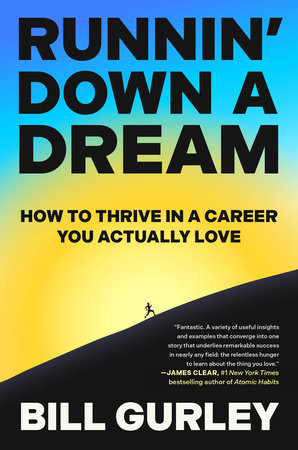
Runnin' Down a Dream

How to Thrive in a Career You Actually Love

Listen to a clip from the audiobook
audio pause button
0:00
0:00
Life is a use-it-or-lose-it proposition. Shouldn’t you spend it doing something you love? This book will teach you how to find your dream job and avoid a career you’ll regret—from a leading venture capitalist, based on his viral college talk.

“Fantastic. A variety of useful insights and examples that converge into one story that underlies remarkable success in nearly any field: The relentless hunger to learn about the thing you love.”—James Clear, #1 New York Times bestselling author of Atomic Habits


For many young people, the path to success feels like a conveyor belt—onto the next test, the next application, the next college—without ever stopping to ask what do I actually want to do with my life? Parents know the pressure can be overwhelming, yet the system pushes everyone forward anyway.

After college Bill Gurley landed a job at a famous tech company. It should have been a dream come true—but he was surprisingly bored. So, Gurley leapt into the unknown, eventually finding his place in the world of venture capital, the beginning of a remarkable investing career.

It turns out, Gurley’s happy ending is rare. Nearly six in ten people would do things differently if they could start over. This is the trap of “career regret.” So how can we avoid it? What can we learn from people at the top of their fields who love what they do? The culmination of Gurley’s decade-long project to unpack the components of success, Runnin’ Down a Dream identifies six principles to flourish in your chosen career: the antidotes to career regret. From developing “obsessive” curiosity to the art of building strong peer groups, these timeless principles add up to a playbook not just for success, but a purpose-filled life.

Written in Gurley’s straight-talk voice and revealing the captivating stories of industry titans like talent agent Lorrie Bartlett, restaurateur Danny Meyer, and sports executive Sam Hinkie, Runnin’ Down a Dream will inspire a new generation to find their place in the world, while offering a much-needed rebuttal to the idea that hustle and happiness are incompatible.
Profile One

The Never-Ending Quest for the Perfect Restaurant

Danny still remembers what he ate for dinner the night he had the most important conversation of his life. He’s not great at memorizing phone numbers or dates, but he has a near-perfect memory for meals he’s eaten and things he’s heard. That night, a Friday in 1983, he was with his aunt Virginia, his uncle Richard, and his grandmother Rosetta Harris at Elio’s, an upscale Italian restaurant on Second Avenue in Manhattan. Danny ordered green and white pasta with a cream sauce and Parmesan along with a serving of pollo al mattone—Italian for “chicken under a brick,” because of the way it’s roasted. His family was enjoying delicious Chianti Classico, something Danny, then about twenty-five years old and built like a long-distance runner, usually loved. But that night he wasn’t drinking. He knew he needed to wake up at 5 a.m. the next morning to take the LSAT, the law school entry exam, and he was dreading it.

Danny had moved to New York in 1980 to work at Checkpoint Systems, a company that made electronic tags to stop shoplifters. In three years, he’d become the firm’s top salesperson. He’d made a lot of money—$125,000 a year, the equivalent of nearly half a million today—and invested most of it in the company’s stock, which quintupled in his time there. Impressed by Danny’s work ethic, his bosses began sending him all over the country to train other salespeople in Chicago, Los Angeles, and Seattle, and when he traveled he dined in some of the best restaurants in America. His bosses asked Danny if he wanted to open an office in London, so he spent two weeks alone there, trying to obtain a feel for the city. This was before the internet, so he used a Gault & Millau guide to learn everything he could about London’s restaurant scene, dining out every single night—including the night he took himself to a Boy George concert.

Danny had a great time on the trip, but at the end of it he did something that shocked his bosses: He gave notice. He liked his job, but he knew that he didn’t want to sell electronic tags for the rest of his life.

As an undergrad at Trinity College in Connecticut Danny had majored in political science, though he spent a lot of his free time going down to New York City, planning his trips around where to eat and drink. Still, the obvious path seemed like a career in journalism or politics. He landed a job right out of college as a production assistant at a public television station in Chicago—a few hours from where he grew up, in St. Louis. Then he worked on the short-lived 1980 presidential campaign of John Anderson, who ran as an independent against both Jimmy Carter and Ronald Reagan. When that long-shot campaign flamed out, Danny headed back to New York.

He looked into a few journalism schools, including UC Berkeley and Northwestern University in Evanston—two of the best programs in the country. He ultimately decided on law school, thinking a law degree would provide more options for a career in politics or public service. At the time, it seemed like an eminently reasonable plan. Looking back now, though, Danny realizes he was lost.

He enrolled in an LSAT prep class—and hated every minute. He knew, deep down, that he didn’t want to be a lawyer. The legal field thrived on conflict. Danny didn’t want to wake up every morning looking for a fight. If anything, he loved bringing people together, making people happy. Now, on the eve of the exam, sitting with his family at Elio’s, he observed his tablemates eating great food and drinking great wine while he stewed about the test he would take in a few hours.

His uncle Richard noticed. Uncle Richard was one-of-a-kind: a prolific artist, a father of five, an early writer for Sesame Street, and an oral historian who knew how to ask the revealing questions. The ensuing conversation went something like this.

“What the hell is eating you?” Danny remembers his uncle saying.

“I can’t believe I’m doing this LSAT thing tomorrow,” Danny told him. “I don’t even want to be a lawyer.”

Danny remembers thinking his uncle looked so mad he might throw his pasta spoon. He didn’t. Instead, he asked a series of questions that changed the shape and direction of Danny’s life.

“Do you have any idea how long you’re going to be dead?” Uncle Richard asked.

“No?”

“I don’t know either, but I’ll tell you one thing,” Uncle Richard said. “You’re going to be dead a hell of a lot longer than you’re going to be alive. So why in the world would you do something that you have no passion around?”

Danny told him he wasn’t sure what else he could do. His uncle was incredulous.

“Why don’t you just do what you’ve been thinking about doing your whole life?”

Danny was confused. “What’s that?” he asked.

“Since you were a child, all you’ve ever talked about or thought about is food and restaurants,” Richard said. “Why don’t you just open a restaurant?”

His uncle was right. Even as a kid, Danny had been fascinated not just by the food in restaurants but by the details: everything from the design of a space to the design of the stemware. As a salesperson at Checkpoint, he had scheduled his sales calls around neighborhood restaurants where he most wanted to stop for lunch. Walking down the streets of Manhattan, he sometimes annoyed his friends by reading nearly every menu he passed on the sidewalk.

Yet the thought of opening his own restaurant had never dawned on him.

“I had never in my mind said, ‘Just because you love something, that could be your career,’ ” Danny told me. “It’s not something people were talking about in college. You’re either going into insurance or banking or medicine or law. Nobody was talking about the restaurant business. It didn’t feel like the kind of thing you want to go tell your parents, ‘Here’s what you just squandered my whole education on.’ ”

His uncle’s words felt like a wake-up call, almost like an intervention.

“Thank God for my uncle,” Danny says. “Thank God someone was there to call me on my shit.”

The next morning, that Saturday, Danny woke up early and took the LSAT. “I had already paid for it, for God’s sake,” he told me. With this new mindset, though, he was totally relaxed. Usually, he hated that kind of fill-in-the-bubble standardized test. But now he wasn’t nervous at all. In the back of his mind, he was planning out his next steps.

In the end, Danny did not apply to a single law school. But the following Monday, he went to the New York Restaurant School and enrolled in Restaurant Management 101.

In his time as a restaurant-frequenting salesman in New York, Danny had assembled an impressive list of regular dining partners, including a food critic at The New York Times and a fraternity brother who was in a bank training program at U.S. Trust. Danny asked his fraternity brother if he wanted to open a restaurant with him.

“You’ll be the money guy,” Danny told him. “I’ll be the food guy.”

Banks didn’t do a lot of business with restaurants at the time, but his friend agreed. They both paid their $150 and started the eight-week class at the New York Restaurant School. It was an initial, intentional step toward their goal. The class was a mix of people ranging from vaguely interested in knowing how a restaurant works to very serious about starting a business that serves food. The school rented classroom space on an upper floor in an otherwise dingy Garment Gistrict loft building.

That same friend agreed to arrange a job interview for Danny with the only restaurant client the bank had at the time: a San Francisco–style seafood place on East Twenty-Second Street named Pesca. The interview consisted of Pesca’s owner sitting halfway down the bar and waving Danny over.

“He looks me up and down,” Danny told me. “From my Wallabees to my Brooks Brothers shirt.”

Eventually the owner concluded: “You’ll do.”

So Danny had his first job in the restaurant business. He was the assistant lunch manager. He took reservations, typed up the daily specials, checked in servers, and hosted lunch—which consisted of greeting and seating the mostly regular lunch crowd. Sometimes he would sit in on menu planning meetings or wine tastings.

The 1980s were a fascinating time to be in New York. It was the center of American culture, but it was gritty, too. It was also more affordable back then, which means Manhattan in particular was a mix of clean-cut bankers, mohawked gutter punks, and people from every country you can imagine.
“Fantastic. A variety of useful insights and examples that converge into one story that underlies remarkable success in nearly any field: The relentless hunger to learn about the thing you love.”—James Clear, #1 New York Times bestselling author of Atomic Habits

Runnin’ Down a Dream is a practical guide to forging a fulfilling career, backed up by a mountain of research. It’s also a page-turner that delves deep into the surprising, often zig-zagging career paths of exceptional performers. There is something inspiring on every page.”—David Epstein, #1 New York Times bestselling author of Range

“Reading this book feels like sitting beside a clear-eyed mentor who’s honest about how work really works. Runnin’ Down a Dream replaces vague advice with vivid human stories and delivers a bracing call to act boldly in every part of our lives.”—Daniel H. Pink, #1 New York Times bestselling author of Drive and The Power of Regret

“Schools never teach a how to find work you love class. Bill Gurley clearly maps the path with sharp insights and real tools. Strongly recommended.”—Tony Fadell, iPod inventor, iPhone co-inventor, Nest founder, New York Times bestselling author of Build

“Many young people now reach their 20s with two strikes already against them: greater anxiety and diminished ability to focus. Gurley offers his readers a way to move forward with increasing energy and confidence. This inspiring book is an invitation to shift into ‘discover mode,’ where curiosity replaces fear and real growth begins.”—Jonathan Haidt, #1 New York Times-bestselling author of The Anxious Generation

“I hadn’t even gotten through the first chapter, and I was already writing down ideas. Wicked smart and original, Bill pulls apart success stories and reverse engineers them for us. Thank you, Bill!”—Jeff Bezos, Amazon founder

“This book might save you from a career you’ll regret. Bill Gurley has spent decades figuring out how to find a dream job, and his stories and advice are poised to take you one step closer to yours.”—Adam Grant, #1 New York Times bestselling author of Hidden Potential and Think Again, and host of the podcast Re:Thinking

“Do the work. Learn from people who have been there. Go deep. Go wide. Be an agent in your own life. This brilliantly useful book is the antidote to entitlement. Everyone should read it.”—Annie Duke, bestselling author of Thinking in Bets, How to Decide, and Quit

“A great book for a young person who won't settle for putting their passion to one side. This book shows how to actually pursue that passion as a career with examples of real-life successes who wouldn’t take no for an answer.”—Greg Lukianoff, New York Times bestselling co-author of The Coddling of the American Mind
© David Paul Morris
Bill Gurley is a general partner at Benchmark, a leading venture capital firm in Silicon Valley. Over his venture career, he has invested in and served on the board of such companies as Nextdoor, OpenTable, Stitch Fix, Uber, and Zillow. Born in 1966 in Dickinson, Texas, Gurley earned a Bachelor of Science degree in computer science from the University of Florida and later received an MBA from the University of Texas at Austin. For more than two decades, Gurley has written about technology and other subjects on his popular blog, Above the Crowd, and on his social media accounts. View titles by Bill Gurley

About

Life is a use-it-or-lose-it proposition. Shouldn’t you spend it doing something you love? This book will teach you how to find your dream job and avoid a career you’ll regret—from a leading venture capitalist, based on his viral college talk.

“Fantastic. A variety of useful insights and examples that converge into one story that underlies remarkable success in nearly any field: The relentless hunger to learn about the thing you love.”—James Clear, #1 New York Times bestselling author of Atomic Habits


For many young people, the path to success feels like a conveyor belt—onto the next test, the next application, the next college—without ever stopping to ask what do I actually want to do with my life? Parents know the pressure can be overwhelming, yet the system pushes everyone forward anyway.

After college Bill Gurley landed a job at a famous tech company. It should have been a dream come true—but he was surprisingly bored. So, Gurley leapt into the unknown, eventually finding his place in the world of venture capital, the beginning of a remarkable investing career.

It turns out, Gurley’s happy ending is rare. Nearly six in ten people would do things differently if they could start over. This is the trap of “career regret.” So how can we avoid it? What can we learn from people at the top of their fields who love what they do? The culmination of Gurley’s decade-long project to unpack the components of success, Runnin’ Down a Dream identifies six principles to flourish in your chosen career: the antidotes to career regret. From developing “obsessive” curiosity to the art of building strong peer groups, these timeless principles add up to a playbook not just for success, but a purpose-filled life.

Written in Gurley’s straight-talk voice and revealing the captivating stories of industry titans like talent agent Lorrie Bartlett, restaurateur Danny Meyer, and sports executive Sam Hinkie, Runnin’ Down a Dream will inspire a new generation to find their place in the world, while offering a much-needed rebuttal to the idea that hustle and happiness are incompatible.

Excerpt

Profile One

The Never-Ending Quest for the Perfect Restaurant

Danny still remembers what he ate for dinner the night he had the most important conversation of his life. He’s not great at memorizing phone numbers or dates, but he has a near-perfect memory for meals he’s eaten and things he’s heard. That night, a Friday in 1983, he was with his aunt Virginia, his uncle Richard, and his grandmother Rosetta Harris at Elio’s, an upscale Italian restaurant on Second Avenue in Manhattan. Danny ordered green and white pasta with a cream sauce and Parmesan along with a serving of pollo al mattone—Italian for “chicken under a brick,” because of the way it’s roasted. His family was enjoying delicious Chianti Classico, something Danny, then about twenty-five years old and built like a long-distance runner, usually loved. But that night he wasn’t drinking. He knew he needed to wake up at 5 a.m. the next morning to take the LSAT, the law school entry exam, and he was dreading it.

Danny had moved to New York in 1980 to work at Checkpoint Systems, a company that made electronic tags to stop shoplifters. In three years, he’d become the firm’s top salesperson. He’d made a lot of money—$125,000 a year, the equivalent of nearly half a million today—and invested most of it in the company’s stock, which quintupled in his time there. Impressed by Danny’s work ethic, his bosses began sending him all over the country to train other salespeople in Chicago, Los Angeles, and Seattle, and when he traveled he dined in some of the best restaurants in America. His bosses asked Danny if he wanted to open an office in London, so he spent two weeks alone there, trying to obtain a feel for the city. This was before the internet, so he used a Gault & Millau guide to learn everything he could about London’s restaurant scene, dining out every single night—including the night he took himself to a Boy George concert.

Danny had a great time on the trip, but at the end of it he did something that shocked his bosses: He gave notice. He liked his job, but he knew that he didn’t want to sell electronic tags for the rest of his life.

As an undergrad at Trinity College in Connecticut Danny had majored in political science, though he spent a lot of his free time going down to New York City, planning his trips around where to eat and drink. Still, the obvious path seemed like a career in journalism or politics. He landed a job right out of college as a production assistant at a public television station in Chicago—a few hours from where he grew up, in St. Louis. Then he worked on the short-lived 1980 presidential campaign of John Anderson, who ran as an independent against both Jimmy Carter and Ronald Reagan. When that long-shot campaign flamed out, Danny headed back to New York.

He looked into a few journalism schools, including UC Berkeley and Northwestern University in Evanston—two of the best programs in the country. He ultimately decided on law school, thinking a law degree would provide more options for a career in politics or public service. At the time, it seemed like an eminently reasonable plan. Looking back now, though, Danny realizes he was lost.

He enrolled in an LSAT prep class—and hated every minute. He knew, deep down, that he didn’t want to be a lawyer. The legal field thrived on conflict. Danny didn’t want to wake up every morning looking for a fight. If anything, he loved bringing people together, making people happy. Now, on the eve of the exam, sitting with his family at Elio’s, he observed his tablemates eating great food and drinking great wine while he stewed about the test he would take in a few hours.

His uncle Richard noticed. Uncle Richard was one-of-a-kind: a prolific artist, a father of five, an early writer for Sesame Street, and an oral historian who knew how to ask the revealing questions. The ensuing conversation went something like this.

“What the hell is eating you?” Danny remembers his uncle saying.

“I can’t believe I’m doing this LSAT thing tomorrow,” Danny told him. “I don’t even want to be a lawyer.”

Danny remembers thinking his uncle looked so mad he might throw his pasta spoon. He didn’t. Instead, he asked a series of questions that changed the shape and direction of Danny’s life.

“Do you have any idea how long you’re going to be dead?” Uncle Richard asked.

“No?”

“I don’t know either, but I’ll tell you one thing,” Uncle Richard said. “You’re going to be dead a hell of a lot longer than you’re going to be alive. So why in the world would you do something that you have no passion around?”

Danny told him he wasn’t sure what else he could do. His uncle was incredulous.

“Why don’t you just do what you’ve been thinking about doing your whole life?”

Danny was confused. “What’s that?” he asked.

“Since you were a child, all you’ve ever talked about or thought about is food and restaurants,” Richard said. “Why don’t you just open a restaurant?”

His uncle was right. Even as a kid, Danny had been fascinated not just by the food in restaurants but by the details: everything from the design of a space to the design of the stemware. As a salesperson at Checkpoint, he had scheduled his sales calls around neighborhood restaurants where he most wanted to stop for lunch. Walking down the streets of Manhattan, he sometimes annoyed his friends by reading nearly every menu he passed on the sidewalk.

Yet the thought of opening his own restaurant had never dawned on him.

“I had never in my mind said, ‘Just because you love something, that could be your career,’ ” Danny told me. “It’s not something people were talking about in college. You’re either going into insurance or banking or medicine or law. Nobody was talking about the restaurant business. It didn’t feel like the kind of thing you want to go tell your parents, ‘Here’s what you just squandered my whole education on.’ ”

His uncle’s words felt like a wake-up call, almost like an intervention.

“Thank God for my uncle,” Danny says. “Thank God someone was there to call me on my shit.”

The next morning, that Saturday, Danny woke up early and took the LSAT. “I had already paid for it, for God’s sake,” he told me. With this new mindset, though, he was totally relaxed. Usually, he hated that kind of fill-in-the-bubble standardized test. But now he wasn’t nervous at all. In the back of his mind, he was planning out his next steps.

In the end, Danny did not apply to a single law school. But the following Monday, he went to the New York Restaurant School and enrolled in Restaurant Management 101.

In his time as a restaurant-frequenting salesman in New York, Danny had assembled an impressive list of regular dining partners, including a food critic at The New York Times and a fraternity brother who was in a bank training program at U.S. Trust. Danny asked his fraternity brother if he wanted to open a restaurant with him.

“You’ll be the money guy,” Danny told him. “I’ll be the food guy.”

Banks didn’t do a lot of business with restaurants at the time, but his friend agreed. They both paid their $150 and started the eight-week class at the New York Restaurant School. It was an initial, intentional step toward their goal. The class was a mix of people ranging from vaguely interested in knowing how a restaurant works to very serious about starting a business that serves food. The school rented classroom space on an upper floor in an otherwise dingy Garment Gistrict loft building.

That same friend agreed to arrange a job interview for Danny with the only restaurant client the bank had at the time: a San Francisco–style seafood place on East Twenty-Second Street named Pesca. The interview consisted of Pesca’s owner sitting halfway down the bar and waving Danny over.

“He looks me up and down,” Danny told me. “From my Wallabees to my Brooks Brothers shirt.”

Eventually the owner concluded: “You’ll do.”

So Danny had his first job in the restaurant business. He was the assistant lunch manager. He took reservations, typed up the daily specials, checked in servers, and hosted lunch—which consisted of greeting and seating the mostly regular lunch crowd. Sometimes he would sit in on menu planning meetings or wine tastings.

The 1980s were a fascinating time to be in New York. It was the center of American culture, but it was gritty, too. It was also more affordable back then, which means Manhattan in particular was a mix of clean-cut bankers, mohawked gutter punks, and people from every country you can imagine.

Reviews

“Fantastic. A variety of useful insights and examples that converge into one story that underlies remarkable success in nearly any field: The relentless hunger to learn about the thing you love.”—James Clear, #1 New York Times bestselling author of Atomic Habits

Runnin’ Down a Dream is a practical guide to forging a fulfilling career, backed up by a mountain of research. It’s also a page-turner that delves deep into the surprising, often zig-zagging career paths of exceptional performers. There is something inspiring on every page.”—David Epstein, #1 New York Times bestselling author of Range

“Reading this book feels like sitting beside a clear-eyed mentor who’s honest about how work really works. Runnin’ Down a Dream replaces vague advice with vivid human stories and delivers a bracing call to act boldly in every part of our lives.”—Daniel H. Pink, #1 New York Times bestselling author of Drive and The Power of Regret

“Schools never teach a how to find work you love class. Bill Gurley clearly maps the path with sharp insights and real tools. Strongly recommended.”—Tony Fadell, iPod inventor, iPhone co-inventor, Nest founder, New York Times bestselling author of Build

“Many young people now reach their 20s with two strikes already against them: greater anxiety and diminished ability to focus. Gurley offers his readers a way to move forward with increasing energy and confidence. This inspiring book is an invitation to shift into ‘discover mode,’ where curiosity replaces fear and real growth begins.”—Jonathan Haidt, #1 New York Times-bestselling author of The Anxious Generation

“I hadn’t even gotten through the first chapter, and I was already writing down ideas. Wicked smart and original, Bill pulls apart success stories and reverse engineers them for us. Thank you, Bill!”—Jeff Bezos, Amazon founder

“This book might save you from a career you’ll regret. Bill Gurley has spent decades figuring out how to find a dream job, and his stories and advice are poised to take you one step closer to yours.”—Adam Grant, #1 New York Times bestselling author of Hidden Potential and Think Again, and host of the podcast Re:Thinking

“Do the work. Learn from people who have been there. Go deep. Go wide. Be an agent in your own life. This brilliantly useful book is the antidote to entitlement. Everyone should read it.”—Annie Duke, bestselling author of Thinking in Bets, How to Decide, and Quit

“A great book for a young person who won't settle for putting their passion to one side. This book shows how to actually pursue that passion as a career with examples of real-life successes who wouldn’t take no for an answer.”—Greg Lukianoff, New York Times bestselling co-author of The Coddling of the American Mind

Author

© David Paul Morris
Bill Gurley is a general partner at Benchmark, a leading venture capital firm in Silicon Valley. Over his venture career, he has invested in and served on the board of such companies as Nextdoor, OpenTable, Stitch Fix, Uber, and Zillow. Born in 1966 in Dickinson, Texas, Gurley earned a Bachelor of Science degree in computer science from the University of Florida and later received an MBA from the University of Texas at Austin. For more than two decades, Gurley has written about technology and other subjects on his popular blog, Above the Crowd, and on his social media accounts. View titles by Bill Gurley
  • More Websites from
    Penguin Random House
  • Common Reads
  • Library Marketing