Download high-resolution image Look inside
Listen to a clip from the audiobook
audio pause button
0:00
0:00

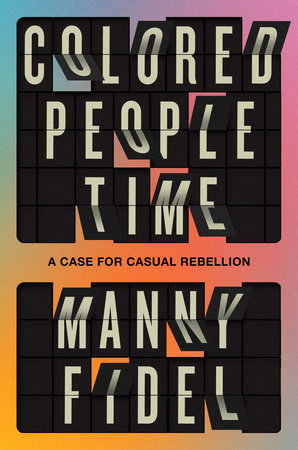
Colored People Time

A Case for (Casual) Rebellion

Look inside
Listen to a clip from the audiobook
audio pause button
0:00
0:00
Hardcover
$28.00 US
| $38.99 CAN
On sale Mar 24, 2026 | 224 Pages | 9780593730669
Grades 9-12 + AP/IB

See Additional Formats
A celebration of tardiness through funny, revealing, and deeply thoughtful essays on the nature of time and collective memory

In Colored People Time, Manny Fidel explores how race, culture, and history shape not only our lives, but our sense of time itself. Through sharp, personal, and often humorous essays, Fidel interrogates the politics of punctuality, the myth of linear progress, and some of the ways people of color are forced to navigate a world that rarely moves at their pace or in their favor.

In this collection of essays, Fidel confronts the systems that structure time around identity and power and invites readers to interrogate the way time folds around them, jovially arguing that until America reaches genuine racial equity, people of color should be encouraged to be late to anything they want. Since our country's inception, the gears that operate it have been oiled to privilege some over others, and the result is that they have fewer barriers to timeliness. For Black and brown people, any number of offenses—grave, minor, or pettily imagined—can gum us up. Fidel argues we deserve the extra time to ourselves. And not for nothing, race relations in the US—by design—are advancing in their own molasses-like pace, ever shifting the ETAs of justice and freedom. Fidel incisively builds this argument in essays like “Summer ‘16,” a nostalgic exploration of a dearly-held season, and “Ocarina of Time,” a meditation on near-death and time travel via video game.

Infused with insights from history, pop culture, and Fidel’s own personal experiences, Colored People Time is not just about lateness. It's about how time works differently depending on who you are and where you stand.
1

From Time

It’s dark. And when I say “it’s dark,” I mean it’s dark everywhere. And anywhere. Perpetually and all-encompassing. Nothing exists yet. But “nothing” exists. “Existing” doesn’t even exist, but the absence of existing does. It is emptiness, if something that doesn’t exist can be empty. The most brutal, or gentlest, of realities, depending on your perspective. But your perspective doesn’t exist yet. And then, in a split second: everything. A giant explosion? A big bang. Galaxies are now zooming through an infantile “universe,” whatever that is. These galaxies float and expand in incomprehensible ways. They seem random but are also the exact shape they need to be. This is infinity.

It’s awesome. Not in the way that the NBA playoffs are awesome, but in the literal sense of the word. Awe-inspiring. Only, there’s no one to inspire just yet. There are no mailmen or teachers or police officers or politicians or pundits. There are no children, no teenagers, and no adults, no elders. There are no feelings, no emotions, no conflicts, no wrongdoings, no good deeds. There are no good times or bad times. There is no justice, and no peace.

Just time. From time.

Stardust is flowing through the clouds on adolescent planets like Mountain Dew through the veins of a Call of Duty enthusiast in 2009 who will try not to call me the N-word after losing in an online match. He will fail, but these planets, in their apparent mission to sustain life, will not. At least one planet will succeed and set forth a derivative series of events that could be described as beautiful or regrettable, depending on your perspective, which, for the record, will exist soon, relatively speaking.

The planet Earth, our home, does not begin in a calm manner. We start off with molten rock. Seas of lava crash into one another like patrons at an overrated bar on the Lower East Side of Manhattan. This is Earth’s least habitable form. As extreme as the start of the universe. A smaller planet lunges into Earth and ejects continent-size pieces of rock into space. These massive boulders come together and form the moon, which sways Earth’s oceans a billion years after the curtains fall on their teenage magma phase. And then, the first sign of life: microbial organisms, or “microbes.” They just sit there and writhe in the dirt. Pulsating and throbbing without a single thought in their minds. Pushing ahead for reasons unknown to them. I’m envious. Eventually, they become mushrooms and plants and vegetables and, at some point, fish.

Narratively speaking, the fish flop out of the water and grow legs. Running around the world, reproducing, they create a web of different hideous creatures born with the mission to keep remaking themselves. Different climates affect these creatures and change them, making them bigger and even uglier. Some of them grow wings and fly away, untethered to the drama on the ground. The dinosaurs arrive and rule the earth for 165 million years. They are wiped out by an asteroid that is approximately six miles long. The rock came from the depths of the universe that, in the meantime, has been endlessly unfurling, stretching, and expanding. As the universe is infinite, there are infinite planets going through these similar growing pains. I wonder if any of the infinite options will end up as tedious as ours.

On Earth, we’re back to chaos. Millions of animals are obliterated in an instant, and millions more starve to death due to the extreme conditions caused by the asteroid. Annihilation for 75 percent of living species. The remaining 25 percent, though, bounce back. They’re not just the stepfathers of life; they’re the fathers who stepped up. The first primates begin to evolve over time. First gorillas, and then chimps. The ancestors of humans diverge from the chimp lineage. One such creature from this new lineage lives in what will become Ethiopia. For some reason, millions of years later, scientists will name her Lucy. (“Luam” or “Lemlem” would have been a more geographically apt option, but I digress.) Lucy’s nieces and nephews migrate across the globe and become Homo sapiens. Depending on where these Homo sapiens settle, their skin color begins to change. The less the sun rules your land, the lighter your skin becomes.

I must pause here for a moment of silence. The earth’s most intellectually advanced creatures are about to become tragically stupid.

Homo sapiens’ brain function isn’t where it is today, but they manage to use tools and make jewelry and create villages. They have families and maintain relationships. After some time, they develop empires and send explorers around the world, partly out of curiosity but mostly to procure resources for their growing populations. When these civilizations interact with one another, we return to chaos. They are different, so they must fight. War, rape, theft, famine. Slavery. For thousands of years. There are winners, and there are losers. Famously, the winners dictate what becomes history, even as I recite it to you now. The Persians stretch their influence from Iran to Egypt. The Han dynasty lasts four hundred years. The Umayyad Caliphate rules over four million square miles of land. The Ottomans conquer three different continents. The British Empire rules over a quarter of the world.

It is this last empire that facilitates much of the slave trade in the Atlantic Ocean. Africans are ripped from their villages to be enslaved for the proliferation of agricultural resources. In the year 1619, a handful of them are the first of their kind to set foot on American soil. They are trafficked to Virginia by a British vessel called the White Lion. Much like the Mayflower, which will land at Plymouth Rock a year later, the White Lion will go down in history as an incredibly consequential ship. The Africans arrive in Hampton, Virginia, and are sold to Governor George Yeardley, who keeps them in Jamestown. Before his arrival there, a harsh winter had recently hit. By the end of it, a fraction of the people survived. The other residents either starved to death or were killed by Native Americans. Things got so bad that Jamestown residents started to eat each other, which was especially harrowing for them as white gentrifiers of sorts; this was a few hundred years before quinoa was popularized as a side dish. Then, help sailed in from England in the form of Yeardley, a man tasked with rehabbing the American locale like in a demented episode of Kitchen Nightmares. He is successful, but as with many of the country’s early triumphs, he had support in the form of the forced labor of enslaved Africans.

That is, albeit simplified, the story of the White Lion, which is, surprisingly, not the name of a shady aphrodisiac behind the counter at your local convenience store. The White Lion is actually one of many overly self-important names for slave ships in that era. Others include Expectation, Deliverance, and Independence—hilariously not the subtitles for Michael Bay’s Transformers films. Almost every terrible thing that has ever happened to Black people in America can be traced back to these ships and their eye roll–inducing names. There is some pain in knowing that the names of the ships that trafficked human beings for profit were likely created by the dorkiest guys imaginable. I can’t help but picture a rosy-cheeked Londoner dipping his feathered quill pen in ink and being proud of himself after writing down a name like “the Brilliant Hog.”

But I’ve digressed again.

The enslaved Africans are forced to toil in America for hundreds of years, operating as the gears that move the country forward into industrialization. Some of the greatest atrocities in the history of mankind are committed against them. In time, the patch of grass the Africans were taken to is titled the United States of America, a name that strikes fear into the hearts of the natives who lived there first. And while the land is modernized with the blood and sweat of natives and Africans, those united states go through an identity crisis. Should America be a racist country that allows slavery or a racist country that doesn’t? This painfully laborious inquiry becomes the foundation for how life is defined for the descendants of the previously mentioned Africans. Those descendants’ pursuit of equity is perilous, and they are threatened at every turn. It is during this moment of national rumination that a notable but historically overlooked human is born on a plantation in South Carolina.

Robert Smalls is born to a Black mother and a white father on the McKee family plantation. His mother, Lydia, is worried that his fair skin will blind him to the full extent of the atrocities of slavery, as lighter-skinned slaves are treated with less aggression on average, and the McKee family does favor him. After Robert grows a bit, Lydia makes him work in the fields with the other enslaved people, so he can witness their abuse at the whipping post. This will radicalize him. Years later, Robert is rented out to work at the Charleston ports, where he learns the waterways like the back of his hand. While on the docks, he meets his wife, Hannah, with whom he has two children. All this in the midst of a Civil War. Confederate boats in Charleston can’t sail too far north; otherwise, they’d run into the Union naval blockade and be fired upon. However, the same ships forming that blockade are also accepting runaway slaves. If a slave can make it to the blockade, they can become free.
© Sammy Deigh
Manny Fidel is a writer and producer based in New York City. His commentary on politics, culture, and sports has been seen in GQ, The Guardian, NPR, MSNBC, Business Insider, and more. He also co-hosts the award-winning NO SUCH THING podcast. View titles by Manny Fidel

About

A celebration of tardiness through funny, revealing, and deeply thoughtful essays on the nature of time and collective memory

In Colored People Time, Manny Fidel explores how race, culture, and history shape not only our lives, but our sense of time itself. Through sharp, personal, and often humorous essays, Fidel interrogates the politics of punctuality, the myth of linear progress, and some of the ways people of color are forced to navigate a world that rarely moves at their pace or in their favor.

In this collection of essays, Fidel confronts the systems that structure time around identity and power and invites readers to interrogate the way time folds around them, jovially arguing that until America reaches genuine racial equity, people of color should be encouraged to be late to anything they want. Since our country's inception, the gears that operate it have been oiled to privilege some over others, and the result is that they have fewer barriers to timeliness. For Black and brown people, any number of offenses—grave, minor, or pettily imagined—can gum us up. Fidel argues we deserve the extra time to ourselves. And not for nothing, race relations in the US—by design—are advancing in their own molasses-like pace, ever shifting the ETAs of justice and freedom. Fidel incisively builds this argument in essays like “Summer ‘16,” a nostalgic exploration of a dearly-held season, and “Ocarina of Time,” a meditation on near-death and time travel via video game.

Infused with insights from history, pop culture, and Fidel’s own personal experiences, Colored People Time is not just about lateness. It's about how time works differently depending on who you are and where you stand.

Excerpt

1

From Time

It’s dark. And when I say “it’s dark,” I mean it’s dark everywhere. And anywhere. Perpetually and all-encompassing. Nothing exists yet. But “nothing” exists. “Existing” doesn’t even exist, but the absence of existing does. It is emptiness, if something that doesn’t exist can be empty. The most brutal, or gentlest, of realities, depending on your perspective. But your perspective doesn’t exist yet. And then, in a split second: everything. A giant explosion? A big bang. Galaxies are now zooming through an infantile “universe,” whatever that is. These galaxies float and expand in incomprehensible ways. They seem random but are also the exact shape they need to be. This is infinity.

It’s awesome. Not in the way that the NBA playoffs are awesome, but in the literal sense of the word. Awe-inspiring. Only, there’s no one to inspire just yet. There are no mailmen or teachers or police officers or politicians or pundits. There are no children, no teenagers, and no adults, no elders. There are no feelings, no emotions, no conflicts, no wrongdoings, no good deeds. There are no good times or bad times. There is no justice, and no peace.

Just time. From time.

Stardust is flowing through the clouds on adolescent planets like Mountain Dew through the veins of a Call of Duty enthusiast in 2009 who will try not to call me the N-word after losing in an online match. He will fail, but these planets, in their apparent mission to sustain life, will not. At least one planet will succeed and set forth a derivative series of events that could be described as beautiful or regrettable, depending on your perspective, which, for the record, will exist soon, relatively speaking.

The planet Earth, our home, does not begin in a calm manner. We start off with molten rock. Seas of lava crash into one another like patrons at an overrated bar on the Lower East Side of Manhattan. This is Earth’s least habitable form. As extreme as the start of the universe. A smaller planet lunges into Earth and ejects continent-size pieces of rock into space. These massive boulders come together and form the moon, which sways Earth’s oceans a billion years after the curtains fall on their teenage magma phase. And then, the first sign of life: microbial organisms, or “microbes.” They just sit there and writhe in the dirt. Pulsating and throbbing without a single thought in their minds. Pushing ahead for reasons unknown to them. I’m envious. Eventually, they become mushrooms and plants and vegetables and, at some point, fish.

Narratively speaking, the fish flop out of the water and grow legs. Running around the world, reproducing, they create a web of different hideous creatures born with the mission to keep remaking themselves. Different climates affect these creatures and change them, making them bigger and even uglier. Some of them grow wings and fly away, untethered to the drama on the ground. The dinosaurs arrive and rule the earth for 165 million years. They are wiped out by an asteroid that is approximately six miles long. The rock came from the depths of the universe that, in the meantime, has been endlessly unfurling, stretching, and expanding. As the universe is infinite, there are infinite planets going through these similar growing pains. I wonder if any of the infinite options will end up as tedious as ours.

On Earth, we’re back to chaos. Millions of animals are obliterated in an instant, and millions more starve to death due to the extreme conditions caused by the asteroid. Annihilation for 75 percent of living species. The remaining 25 percent, though, bounce back. They’re not just the stepfathers of life; they’re the fathers who stepped up. The first primates begin to evolve over time. First gorillas, and then chimps. The ancestors of humans diverge from the chimp lineage. One such creature from this new lineage lives in what will become Ethiopia. For some reason, millions of years later, scientists will name her Lucy. (“Luam” or “Lemlem” would have been a more geographically apt option, but I digress.) Lucy’s nieces and nephews migrate across the globe and become Homo sapiens. Depending on where these Homo sapiens settle, their skin color begins to change. The less the sun rules your land, the lighter your skin becomes.

I must pause here for a moment of silence. The earth’s most intellectually advanced creatures are about to become tragically stupid.

Homo sapiens’ brain function isn’t where it is today, but they manage to use tools and make jewelry and create villages. They have families and maintain relationships. After some time, they develop empires and send explorers around the world, partly out of curiosity but mostly to procure resources for their growing populations. When these civilizations interact with one another, we return to chaos. They are different, so they must fight. War, rape, theft, famine. Slavery. For thousands of years. There are winners, and there are losers. Famously, the winners dictate what becomes history, even as I recite it to you now. The Persians stretch their influence from Iran to Egypt. The Han dynasty lasts four hundred years. The Umayyad Caliphate rules over four million square miles of land. The Ottomans conquer three different continents. The British Empire rules over a quarter of the world.

It is this last empire that facilitates much of the slave trade in the Atlantic Ocean. Africans are ripped from their villages to be enslaved for the proliferation of agricultural resources. In the year 1619, a handful of them are the first of their kind to set foot on American soil. They are trafficked to Virginia by a British vessel called the White Lion. Much like the Mayflower, which will land at Plymouth Rock a year later, the White Lion will go down in history as an incredibly consequential ship. The Africans arrive in Hampton, Virginia, and are sold to Governor George Yeardley, who keeps them in Jamestown. Before his arrival there, a harsh winter had recently hit. By the end of it, a fraction of the people survived. The other residents either starved to death or were killed by Native Americans. Things got so bad that Jamestown residents started to eat each other, which was especially harrowing for them as white gentrifiers of sorts; this was a few hundred years before quinoa was popularized as a side dish. Then, help sailed in from England in the form of Yeardley, a man tasked with rehabbing the American locale like in a demented episode of Kitchen Nightmares. He is successful, but as with many of the country’s early triumphs, he had support in the form of the forced labor of enslaved Africans.

That is, albeit simplified, the story of the White Lion, which is, surprisingly, not the name of a shady aphrodisiac behind the counter at your local convenience store. The White Lion is actually one of many overly self-important names for slave ships in that era. Others include Expectation, Deliverance, and Independence—hilariously not the subtitles for Michael Bay’s Transformers films. Almost every terrible thing that has ever happened to Black people in America can be traced back to these ships and their eye roll–inducing names. There is some pain in knowing that the names of the ships that trafficked human beings for profit were likely created by the dorkiest guys imaginable. I can’t help but picture a rosy-cheeked Londoner dipping his feathered quill pen in ink and being proud of himself after writing down a name like “the Brilliant Hog.”

But I’ve digressed again.

The enslaved Africans are forced to toil in America for hundreds of years, operating as the gears that move the country forward into industrialization. Some of the greatest atrocities in the history of mankind are committed against them. In time, the patch of grass the Africans were taken to is titled the United States of America, a name that strikes fear into the hearts of the natives who lived there first. And while the land is modernized with the blood and sweat of natives and Africans, those united states go through an identity crisis. Should America be a racist country that allows slavery or a racist country that doesn’t? This painfully laborious inquiry becomes the foundation for how life is defined for the descendants of the previously mentioned Africans. Those descendants’ pursuit of equity is perilous, and they are threatened at every turn. It is during this moment of national rumination that a notable but historically overlooked human is born on a plantation in South Carolina.

Robert Smalls is born to a Black mother and a white father on the McKee family plantation. His mother, Lydia, is worried that his fair skin will blind him to the full extent of the atrocities of slavery, as lighter-skinned slaves are treated with less aggression on average, and the McKee family does favor him. After Robert grows a bit, Lydia makes him work in the fields with the other enslaved people, so he can witness their abuse at the whipping post. This will radicalize him. Years later, Robert is rented out to work at the Charleston ports, where he learns the waterways like the back of his hand. While on the docks, he meets his wife, Hannah, with whom he has two children. All this in the midst of a Civil War. Confederate boats in Charleston can’t sail too far north; otherwise, they’d run into the Union naval blockade and be fired upon. However, the same ships forming that blockade are also accepting runaway slaves. If a slave can make it to the blockade, they can become free.

Author

© Sammy Deigh
Manny Fidel is a writer and producer based in New York City. His commentary on politics, culture, and sports has been seen in GQ, The Guardian, NPR, MSNBC, Business Insider, and more. He also co-hosts the award-winning NO SUCH THING podcast. View titles by Manny Fidel
  • More Websites from
    Penguin Random House
  • Common Reads
  • Library Marketing