Download high-resolution image Look inside
Listen to a clip from the audiobook
audio pause button
0:00
0:00

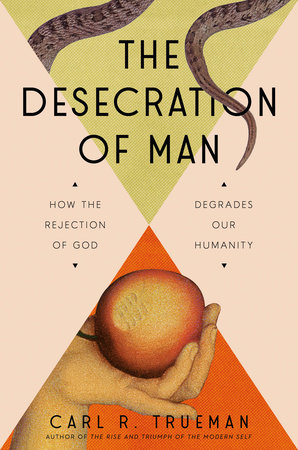
The Desecration of Man

How the Rejection of God Degrades Our Humanity

Look inside
Listen to a clip from the audiobook
audio pause button
0:00
0:00
From the author of The Rise and Triumph of the Modern Self, an account of how the rejection of the imago Dei is unraveling Western culture and how we might recover what it means to be truly human

As church attendance falls, suicide rates climb, and birth rates plummet, Christian pundits have suggested disenchantment and the loss of tradition are to blame for our spiritual malaise. But what if the problem is both much simpler and much more serious?

In The Desecration of Man, Carl Trueman argues that modern man's crisis of meaning stems from a rejection of a simple fact—that he was made in the image of God. Unmoored from the basic moral fact that secures human dignity, we violently disrespect our own minds and bodies through abortion, pornography, casual sex, gender transitions, and more—and in this disrespect we blaspheme against God himself, with devastating practical and spiritual consequences.

With gentle pastoral wisdom, deep insight into church history, and an impressive command of philosophical genealogies, The Desecration of Man speaks to those troubled by the spiritual sickness of our time and points toward consecration to a God who is alive and loving as a solution. The Early Church triumphed over Rome because it offered life in place of death. It is time for modern Christians to offer the same kind of vision.
What Is Man?

A few years ago, I was on an influential British podcast, Triggernometry, hosted by atheists. The hosts were both strong advocates of traditional liberal values-particularly freedom of speech-and disturbed by some of the new progressive ideas that were threatening these. They had an important question: Is it possible to build a moral society without a belief in God?

The question was not rhetorical nor a setup for a "Gotcha" moment. It was genuine. They were wrestling with what they saw as the increasing moral chaos of society and the weakness of those answers that rest upon some form of pragmatism or utilitarianism. I did not understand them to be asking the question in order to find proof for God's existence ("If moral order, then necessarily God?") but out of genuine interest in whether I thought atheism was strong enough to support the humanistic values to which they themselves were committed (many of which I myself share).

It is no wonder that our age is marked by a deep and often disturbing sense of cultural vertigo and by our inability to find anywhere solid to stand to assess the moral and political landscape. Once-unquestioned social goods-for example, freedom of speech, freedom of religion, parental rights-are under huge pressure. Moral norms are in a constant state of flux, outdated as soon as they are established. Yesterday's heroic champion of gay marriage who thinks biological sex is important has become today's transphobic bigot. Who twenty years ago could have predicted the acrimonious split within radical feminist circles over who exactly qualifies as a woman? Even the value of life itself has become questioned, with many Western democracies legalizing assisted suicide. Such a move would have been impossible to imagine fifty years ago. This development has also enjoyed considerable cross-party consensus, highlighting that the big issues of our day often do not fit comfortably into the traditional political taxonomy of right versus left. Indeed, the pressure on what it means to be human does not just come from the trans lobby and the queer theorists favored by the left. The emergence of interest in eugenics and transhumanism on the right is also emblematic of this cultural moment.

In answering the Triggernometry hosts, I commented that I could not imagine every possible world and so maybe there might be one where a moral order could be built without reference to the divine, but that it would certainly be more difficult to do in an atheistic context. While I did not elaborate at the time, I would here add that the problem would be compounded by any such moral code being unstable, having nothing beyond itself to justify its precepts. Morality would degenerate into a function of social taste. If not quite mob rule, it would hardly be more predictable than that.

The reason for this is the question that lies behind the question. When atheists ask, "Can we build a moral society without God?" they are not just inquiring about the values that such a world might reflect. They are responding not to a confluence of unrelated crises, but to a general anthropological conundrum. To ask, "What is moral?" is to ask, "How should man behave?" And to answer that question one needs to know what "man" is. Is human life to have a particular goal or goals? Are these shared by all human beings or are they created or chosen by particular communities or even individuals? Do we define ourselves, or is who and what we are to some extent determined, by the fact that we all share something called "human nature" involving a given set of expectations for our behavior that constitute what we call morality?

The idea that to be human involves a given moral structure has a long pedigree. Philosophers from the ancient world onward have seen human life as having a moral shape. For Aristotle, the ideal was the political man, engaged in the public life of the polis. The opposite, the man concerned only with his own private affairs (literally, "the idiotic man") was inferior and not what a human being should be. For Kant, human beings are persons and must not be treated or treat others as things. They are subjects not objects. The man who treats another, say his wife, as a thing dehumanizes her and thereby dehumanizes himself. Aristotle and Kant may have differed, but both saw the question of man as bound up with the question of morality, of how man chooses to behave.

The question "Can we build a moral society without God?" could therefore be rephrased as "Can we have an understanding of man as a moral being without reference to God?" Or more succinctly, "What is man?" Is he a creature that is supposed to behave in certain ways that are, in a sense, given to him by his nature-for Christians, a God-given nature?

What Is Man?

To ask the question "What is man?" is to reveal the staggering nature of what it means to be human even in advance of any answer. No other creature on the face of the planet can ask such a question of itself. No amoeba pauses to reflect on the nature of amoebic existence. And as close to human beings as they are in many ways, there is no evidence to suggest that chimpanzees and gorillas ever meditate upon the meaning of their existence. Only man has the capacity to pose the question about his own nature and significance. Philosophers may struggle to define what exactly the term "self-consciousness" means, but there is no doubt that human beings experience something that corresponds to that term in a manner unknown to any other type of living being.

The question matters because it shapes everything. Common everyday language indicates this. When we see on the news a report of some horrific act, we might comment that such a thing is "inhuman," indicating that it contravenes what we consider to be moral behavior that should be normative for all human beings. If the report is of an act of altruistic kindness, we may perhaps respond that it "restores our faith in human nature," meaning that it embodies some quality or characteristic that we admire and regard as a normative aspirational moral goal for us all. How we understand human nature, how we answer the question "What is man?"-whether we have deeply reflected upon the issue or simply possess intuitions about it-shapes our moral vision of life and guides us in our attitude to others and to the world around us.

But the question has implications beyond morality. It also speaks to the deepest cry of the human heart. Who am I and do I or my life have any significance? That is the same question posed in a pointedly personal way. Who of us has not at some point asked that? Albert Camus perhaps put the issue most dramatically when he identified suicide as the key question of philosophy upon which everything else depends. One has to first decide to continue living before one can ask any other question. But one does not need to have Camus's philosophical acumen to have faced the same basic issue in one's own life: Is anything I do worthwhile? Why should I get out of bed in the morning? Who am I-indeed, is there an "I" at the core of my being?-when I seem to play so many different roles (e.g., husband, father, employee, neighbor, citizen, consumer) in my life? And does any of it count for anything in the grand scheme of existence? Why bother with anything at all? All are applied personal variations on that single question: What is man?

When the Triggernometry team asked me about the possibility of building a moral society without God, they were rephrasing this deeper query. It is no surprise, then, to find precisely this question posed in the Bible. The Old Testament psalmist asks in Psalm 8: "What is man, that you are mindful of him?" The "you" here is, of course, the God of Israel, and in setting the question up in this way, the psalmist indicates that for him the question of man and his significance cannot be isolated from the question of God. And he answers his own question as follows: "You have made him a little lower than the heavenly beings and crowned him with glory and honor." In short, man is who and what he is because God has made him so. Any significance, any meaning, any value he has is rooted in the divine act of creation that assumes the reality of God as divine creator.

One can reject this God as mythology, as fiction, as pious nonsense. One can reject the very existence of any god. But that then has significance for our answer to "What is man?" because it is always going to be shaped by our views about theology and religion. That is something Christians and atheists can agree upon. Anthropology is inseparable from theology.

Man as Divine Image Bearer

Judaism and Christianity make this connection between God and man explicit in their belief, drawn from Genesis 1, that God created man in his image. All orthodox Christian traditions-that is, all Christian traditions committed to the historic Christian faith-see this claim as central to understanding what it means to be human. And the priority ascribed to God in this teaching makes it important to understand what Christianity means by "God." Article 1 in the Anglican Communion's Thirty-Nine Articles (a summary of the key elements of the Christian faith) describes God as follows:

There is but one living and true God, everlasting, without body, parts, or passions; of infinite power, wisdom, and goodness; the Maker, and Preserver of all things both visible and invisible. And in unity of this Godhead there be three Persons, of one substance, power, and eternity; the Father, the Son, and the Holy Ghost.

The underlying intricacies of the Trinity need not delay us here. The key points are that God is here presented as a self-sufficient, eternal, intelligent being who intentionally creates the world, sustains it in existence, and guides it by his power according to his wisdom and goodness. He is also a personal being, something indicated both by his wisdom and goodness and by his existence as Father, Son, and Holy Spirit who, according to Christian theology, exist in eternal interpersonal communion. To put it in a less technical manner, God is not an impersonal, morally indifferent force analogous to gravity. Orthodox Christian theology maintains that Creation is not an emanation, or something that just necessarily happens because God exists, as the rays of the sun necessarily emanate from it. Creation is a free act and God would still have been God had he chosen not to create. Creation also has a purpose. The structure of the creation narrative in both Genesis 1 and Genesis 2 presents God's action as possessing a logic to it, culminating in God resting, pleased with all that he had done, and then in the marriage and sexual union of the man and the woman that will enable them to fill the earth.

So what does it mean, that human beings are made in God's image? The Catholic Church's Compendium of the Social Doctrine of the Church offers a helpful summary of this doctrine and its implications:

The fundamental message of Sacred Scripture proclaims that the human person is a creature of God (cf. Ps 139:14-18), and sees in his being in the image of God the element that characterizes and distinguishes him: "God created man in his own image, in the image of God he created him; male and female he created them" (Gen 1:27). God places the human creature at the centre and summit of the created order. Man (in Hebrew, "adam") is formed from the earth ("adamah") and God blows into his nostrils the breath of life (cf. Gen 2:7). Therefore, "being in the image of God the human individual possesses the dignity of a person, who is not just something, but someone. He is capable of self-knowledge, of self-possession and of freely giving himself and entering into communion with other persons. Further, he is called by grace to a covenant with his Creator, to offer him a response of faith and love that no other creature can give in his stead."

This statement makes a number of important points. First, human beings are exceptional creatures, placed at the summit of God's creation. The Bible describes no other animal as being made in God's image. We see this human exceptionalism in a variety of ways. We can make things intentionally, not merely instinctively. The builder freely chooses the design and the material for the house he intends to construct, whereas the sparrow simply builds its nest by instinct. In other words, we conceive of the future (and remember lessons from the past) and move ourselves freely into that future. Yes, human beings have instincts: If someone throws a brick at me in the street, I instinctively move to avoid it. But in so much of our lives, our acts are free and intentional, from what we choose from a restaurant menu to whom we decide to marry. We act relative to our futures as free, intentional beings.

Second, human beings are persons, not things; or to return to more philosophical language, we are subjects, not objects. This means that we possess a special dignity, or value, and are marked, as the above catechism's statement indicates, by a self-conscious freedom. Even in our secular age, we talk of human dignity and human rights, language that intuitively reflects this. We are even increasingly inclined as societies to treat other species as subjects rather than objects. And ironically these very acts of anthropomorphism reflect our exceptionalism: No other creature thinks in terms of rights, let alone extends that concept to cover other species.

This personal dimension also shapes our interactions with others. As Christian theology presents the Trinity as an eternal, interpersonal communion of Father, Son, and Holy Spirit, so we as humans enjoy interpersonal communion with each other. We experience love and friendship. All creatures have to reproduce and eat, but human beings have surrounded these basic acts with far greater significance than merely the perpetuation of the species or the replacement of lost calories. We engage in the delicate dance of romancing a potential partner and then, if successful, making love to them. We surround the consumption of food with ritual, and we delight in the company of good friends and conversation as we eat our meals and share bottles of wine. In short, we ascribe personal meaning to these acts that no other animal does. And we do that because we are persons.

Third, human beings have God-given capabilities that connect to responsibilities: We are not isolated individuals but are made to commune with each other and to commune with God. In other words, we have ends that are given to us by virtue of our being creatures made in God's image. We are free, as noted above, to make choices about our futures, but that freedom is qualified by our God-given nature and does not extend to complete self-determination with regard to our ends. Human existence has a given teleology.
“A definitive account of the fruit born of secularism.” —John Stonestreet, president of the Colson Center and coauthor of A Practical Guide to Culture

“Essential reading for everyone who cares about the human future.” —George Weigel, author of Witness to Hope

“[A] powerful book . . . executed with all the grace and erudition, the breadth and depth, that we have come to expect of its author.” —Michael Hanby, associate professor of religion and philosophy of science at the Catholic University of America

“Anyone who wants to better understand key dynamics in our culture will benefit from The Desecration of Man.” —Bishop Robert Barron, Bishop of Winona-Rochester

“Trueman offers the cold plunge we in the West so desperately need.” —Erika Bachiochi, author of The Rights of Women and editor in chief of Fairer Disputations

“We are made in God’s image and likeness. It would be hard to find a more compelling, colorful, cogent exposition of this truth than the one provided by this book.” —Cardinal Timothy Dolan, Archbishop Emeritus of New York

“The book is a cultural lament, but more than that.” —Kevin DeYoung, senior pastor at Christ Covenant Church and associate professor of systematic theology at Reformed Theological Seminary

“Lucidly argued, The Desecration of Man offers rich material to thoughtful secularists and Christian believers alike.” —Mary Harrington, author of Feminism Against Progress

“This book is both sobering and hopeful, for it not only traces the problem but also proposes the best of all solutions.” —Tim Challies, author of Seasons of Sorrow

“One of the sharpest diagnosticians of our many cultural malaises offers us a searing analysis of a question that has long baffled secular humanism: Are we minds or machines?” —James Orr, associate professor of philosophy of religion at the University of Cambridge

The Desecration of Man is yet another Trueman tour de force.” —Christianity Today

“A bold and incisive critique of modern sexual ethics.” —The Wall Street Journal

“Vintage Trueman . . . clear-headed, exquisitely written, and profoundly learned.” First Things

“Like Trueman’s previous efforts, The Desecration of Man combines rigorous research with an easy style. In this sense it follows a classic C. S. Lewis recipe: serious scholarship, delivered in an appealing way, for a broad general audience. And his subject matter—the impact on our humanity of an intensely materialist culture—couldn’t be more pressing.” —Public Discourse

“Classic Trueman . . . yet another important contribution for our time.” — Front Porch Republic
© Ethics and Public Policy Center
Carl Trueman is a professor of biblical and religious studies at Grove City College and a fellow at the Ethics and Public Policy Center. View titles by Carl Trueman

About

From the author of The Rise and Triumph of the Modern Self, an account of how the rejection of the imago Dei is unraveling Western culture and how we might recover what it means to be truly human

As church attendance falls, suicide rates climb, and birth rates plummet, Christian pundits have suggested disenchantment and the loss of tradition are to blame for our spiritual malaise. But what if the problem is both much simpler and much more serious?

In The Desecration of Man, Carl Trueman argues that modern man's crisis of meaning stems from a rejection of a simple fact—that he was made in the image of God. Unmoored from the basic moral fact that secures human dignity, we violently disrespect our own minds and bodies through abortion, pornography, casual sex, gender transitions, and more—and in this disrespect we blaspheme against God himself, with devastating practical and spiritual consequences.

With gentle pastoral wisdom, deep insight into church history, and an impressive command of philosophical genealogies, The Desecration of Man speaks to those troubled by the spiritual sickness of our time and points toward consecration to a God who is alive and loving as a solution. The Early Church triumphed over Rome because it offered life in place of death. It is time for modern Christians to offer the same kind of vision.

Excerpt

What Is Man?

A few years ago, I was on an influential British podcast, Triggernometry, hosted by atheists. The hosts were both strong advocates of traditional liberal values-particularly freedom of speech-and disturbed by some of the new progressive ideas that were threatening these. They had an important question: Is it possible to build a moral society without a belief in God?

The question was not rhetorical nor a setup for a "Gotcha" moment. It was genuine. They were wrestling with what they saw as the increasing moral chaos of society and the weakness of those answers that rest upon some form of pragmatism or utilitarianism. I did not understand them to be asking the question in order to find proof for God's existence ("If moral order, then necessarily God?") but out of genuine interest in whether I thought atheism was strong enough to support the humanistic values to which they themselves were committed (many of which I myself share).

It is no wonder that our age is marked by a deep and often disturbing sense of cultural vertigo and by our inability to find anywhere solid to stand to assess the moral and political landscape. Once-unquestioned social goods-for example, freedom of speech, freedom of religion, parental rights-are under huge pressure. Moral norms are in a constant state of flux, outdated as soon as they are established. Yesterday's heroic champion of gay marriage who thinks biological sex is important has become today's transphobic bigot. Who twenty years ago could have predicted the acrimonious split within radical feminist circles over who exactly qualifies as a woman? Even the value of life itself has become questioned, with many Western democracies legalizing assisted suicide. Such a move would have been impossible to imagine fifty years ago. This development has also enjoyed considerable cross-party consensus, highlighting that the big issues of our day often do not fit comfortably into the traditional political taxonomy of right versus left. Indeed, the pressure on what it means to be human does not just come from the trans lobby and the queer theorists favored by the left. The emergence of interest in eugenics and transhumanism on the right is also emblematic of this cultural moment.

In answering the Triggernometry hosts, I commented that I could not imagine every possible world and so maybe there might be one where a moral order could be built without reference to the divine, but that it would certainly be more difficult to do in an atheistic context. While I did not elaborate at the time, I would here add that the problem would be compounded by any such moral code being unstable, having nothing beyond itself to justify its precepts. Morality would degenerate into a function of social taste. If not quite mob rule, it would hardly be more predictable than that.

The reason for this is the question that lies behind the question. When atheists ask, "Can we build a moral society without God?" they are not just inquiring about the values that such a world might reflect. They are responding not to a confluence of unrelated crises, but to a general anthropological conundrum. To ask, "What is moral?" is to ask, "How should man behave?" And to answer that question one needs to know what "man" is. Is human life to have a particular goal or goals? Are these shared by all human beings or are they created or chosen by particular communities or even individuals? Do we define ourselves, or is who and what we are to some extent determined, by the fact that we all share something called "human nature" involving a given set of expectations for our behavior that constitute what we call morality?

The idea that to be human involves a given moral structure has a long pedigree. Philosophers from the ancient world onward have seen human life as having a moral shape. For Aristotle, the ideal was the political man, engaged in the public life of the polis. The opposite, the man concerned only with his own private affairs (literally, "the idiotic man") was inferior and not what a human being should be. For Kant, human beings are persons and must not be treated or treat others as things. They are subjects not objects. The man who treats another, say his wife, as a thing dehumanizes her and thereby dehumanizes himself. Aristotle and Kant may have differed, but both saw the question of man as bound up with the question of morality, of how man chooses to behave.

The question "Can we build a moral society without God?" could therefore be rephrased as "Can we have an understanding of man as a moral being without reference to God?" Or more succinctly, "What is man?" Is he a creature that is supposed to behave in certain ways that are, in a sense, given to him by his nature-for Christians, a God-given nature?

What Is Man?

To ask the question "What is man?" is to reveal the staggering nature of what it means to be human even in advance of any answer. No other creature on the face of the planet can ask such a question of itself. No amoeba pauses to reflect on the nature of amoebic existence. And as close to human beings as they are in many ways, there is no evidence to suggest that chimpanzees and gorillas ever meditate upon the meaning of their existence. Only man has the capacity to pose the question about his own nature and significance. Philosophers may struggle to define what exactly the term "self-consciousness" means, but there is no doubt that human beings experience something that corresponds to that term in a manner unknown to any other type of living being.

The question matters because it shapes everything. Common everyday language indicates this. When we see on the news a report of some horrific act, we might comment that such a thing is "inhuman," indicating that it contravenes what we consider to be moral behavior that should be normative for all human beings. If the report is of an act of altruistic kindness, we may perhaps respond that it "restores our faith in human nature," meaning that it embodies some quality or characteristic that we admire and regard as a normative aspirational moral goal for us all. How we understand human nature, how we answer the question "What is man?"-whether we have deeply reflected upon the issue or simply possess intuitions about it-shapes our moral vision of life and guides us in our attitude to others and to the world around us.

But the question has implications beyond morality. It also speaks to the deepest cry of the human heart. Who am I and do I or my life have any significance? That is the same question posed in a pointedly personal way. Who of us has not at some point asked that? Albert Camus perhaps put the issue most dramatically when he identified suicide as the key question of philosophy upon which everything else depends. One has to first decide to continue living before one can ask any other question. But one does not need to have Camus's philosophical acumen to have faced the same basic issue in one's own life: Is anything I do worthwhile? Why should I get out of bed in the morning? Who am I-indeed, is there an "I" at the core of my being?-when I seem to play so many different roles (e.g., husband, father, employee, neighbor, citizen, consumer) in my life? And does any of it count for anything in the grand scheme of existence? Why bother with anything at all? All are applied personal variations on that single question: What is man?

When the Triggernometry team asked me about the possibility of building a moral society without God, they were rephrasing this deeper query. It is no surprise, then, to find precisely this question posed in the Bible. The Old Testament psalmist asks in Psalm 8: "What is man, that you are mindful of him?" The "you" here is, of course, the God of Israel, and in setting the question up in this way, the psalmist indicates that for him the question of man and his significance cannot be isolated from the question of God. And he answers his own question as follows: "You have made him a little lower than the heavenly beings and crowned him with glory and honor." In short, man is who and what he is because God has made him so. Any significance, any meaning, any value he has is rooted in the divine act of creation that assumes the reality of God as divine creator.

One can reject this God as mythology, as fiction, as pious nonsense. One can reject the very existence of any god. But that then has significance for our answer to "What is man?" because it is always going to be shaped by our views about theology and religion. That is something Christians and atheists can agree upon. Anthropology is inseparable from theology.

Man as Divine Image Bearer

Judaism and Christianity make this connection between God and man explicit in their belief, drawn from Genesis 1, that God created man in his image. All orthodox Christian traditions-that is, all Christian traditions committed to the historic Christian faith-see this claim as central to understanding what it means to be human. And the priority ascribed to God in this teaching makes it important to understand what Christianity means by "God." Article 1 in the Anglican Communion's Thirty-Nine Articles (a summary of the key elements of the Christian faith) describes God as follows:

There is but one living and true God, everlasting, without body, parts, or passions; of infinite power, wisdom, and goodness; the Maker, and Preserver of all things both visible and invisible. And in unity of this Godhead there be three Persons, of one substance, power, and eternity; the Father, the Son, and the Holy Ghost.

The underlying intricacies of the Trinity need not delay us here. The key points are that God is here presented as a self-sufficient, eternal, intelligent being who intentionally creates the world, sustains it in existence, and guides it by his power according to his wisdom and goodness. He is also a personal being, something indicated both by his wisdom and goodness and by his existence as Father, Son, and Holy Spirit who, according to Christian theology, exist in eternal interpersonal communion. To put it in a less technical manner, God is not an impersonal, morally indifferent force analogous to gravity. Orthodox Christian theology maintains that Creation is not an emanation, or something that just necessarily happens because God exists, as the rays of the sun necessarily emanate from it. Creation is a free act and God would still have been God had he chosen not to create. Creation also has a purpose. The structure of the creation narrative in both Genesis 1 and Genesis 2 presents God's action as possessing a logic to it, culminating in God resting, pleased with all that he had done, and then in the marriage and sexual union of the man and the woman that will enable them to fill the earth.

So what does it mean, that human beings are made in God's image? The Catholic Church's Compendium of the Social Doctrine of the Church offers a helpful summary of this doctrine and its implications:

The fundamental message of Sacred Scripture proclaims that the human person is a creature of God (cf. Ps 139:14-18), and sees in his being in the image of God the element that characterizes and distinguishes him: "God created man in his own image, in the image of God he created him; male and female he created them" (Gen 1:27). God places the human creature at the centre and summit of the created order. Man (in Hebrew, "adam") is formed from the earth ("adamah") and God blows into his nostrils the breath of life (cf. Gen 2:7). Therefore, "being in the image of God the human individual possesses the dignity of a person, who is not just something, but someone. He is capable of self-knowledge, of self-possession and of freely giving himself and entering into communion with other persons. Further, he is called by grace to a covenant with his Creator, to offer him a response of faith and love that no other creature can give in his stead."

This statement makes a number of important points. First, human beings are exceptional creatures, placed at the summit of God's creation. The Bible describes no other animal as being made in God's image. We see this human exceptionalism in a variety of ways. We can make things intentionally, not merely instinctively. The builder freely chooses the design and the material for the house he intends to construct, whereas the sparrow simply builds its nest by instinct. In other words, we conceive of the future (and remember lessons from the past) and move ourselves freely into that future. Yes, human beings have instincts: If someone throws a brick at me in the street, I instinctively move to avoid it. But in so much of our lives, our acts are free and intentional, from what we choose from a restaurant menu to whom we decide to marry. We act relative to our futures as free, intentional beings.

Second, human beings are persons, not things; or to return to more philosophical language, we are subjects, not objects. This means that we possess a special dignity, or value, and are marked, as the above catechism's statement indicates, by a self-conscious freedom. Even in our secular age, we talk of human dignity and human rights, language that intuitively reflects this. We are even increasingly inclined as societies to treat other species as subjects rather than objects. And ironically these very acts of anthropomorphism reflect our exceptionalism: No other creature thinks in terms of rights, let alone extends that concept to cover other species.

This personal dimension also shapes our interactions with others. As Christian theology presents the Trinity as an eternal, interpersonal communion of Father, Son, and Holy Spirit, so we as humans enjoy interpersonal communion with each other. We experience love and friendship. All creatures have to reproduce and eat, but human beings have surrounded these basic acts with far greater significance than merely the perpetuation of the species or the replacement of lost calories. We engage in the delicate dance of romancing a potential partner and then, if successful, making love to them. We surround the consumption of food with ritual, and we delight in the company of good friends and conversation as we eat our meals and share bottles of wine. In short, we ascribe personal meaning to these acts that no other animal does. And we do that because we are persons.

Third, human beings have God-given capabilities that connect to responsibilities: We are not isolated individuals but are made to commune with each other and to commune with God. In other words, we have ends that are given to us by virtue of our being creatures made in God's image. We are free, as noted above, to make choices about our futures, but that freedom is qualified by our God-given nature and does not extend to complete self-determination with regard to our ends. Human existence has a given teleology.

Reviews

“A definitive account of the fruit born of secularism.” —John Stonestreet, president of the Colson Center and coauthor of A Practical Guide to Culture

“Essential reading for everyone who cares about the human future.” —George Weigel, author of Witness to Hope

“[A] powerful book . . . executed with all the grace and erudition, the breadth and depth, that we have come to expect of its author.” —Michael Hanby, associate professor of religion and philosophy of science at the Catholic University of America

“Anyone who wants to better understand key dynamics in our culture will benefit from The Desecration of Man.” —Bishop Robert Barron, Bishop of Winona-Rochester

“Trueman offers the cold plunge we in the West so desperately need.” —Erika Bachiochi, author of The Rights of Women and editor in chief of Fairer Disputations

“We are made in God’s image and likeness. It would be hard to find a more compelling, colorful, cogent exposition of this truth than the one provided by this book.” —Cardinal Timothy Dolan, Archbishop Emeritus of New York

“The book is a cultural lament, but more than that.” —Kevin DeYoung, senior pastor at Christ Covenant Church and associate professor of systematic theology at Reformed Theological Seminary

“Lucidly argued, The Desecration of Man offers rich material to thoughtful secularists and Christian believers alike.” —Mary Harrington, author of Feminism Against Progress

“This book is both sobering and hopeful, for it not only traces the problem but also proposes the best of all solutions.” —Tim Challies, author of Seasons of Sorrow

“One of the sharpest diagnosticians of our many cultural malaises offers us a searing analysis of a question that has long baffled secular humanism: Are we minds or machines?” —James Orr, associate professor of philosophy of religion at the University of Cambridge

The Desecration of Man is yet another Trueman tour de force.” —Christianity Today

“A bold and incisive critique of modern sexual ethics.” —The Wall Street Journal

“Vintage Trueman . . . clear-headed, exquisitely written, and profoundly learned.” First Things

“Like Trueman’s previous efforts, The Desecration of Man combines rigorous research with an easy style. In this sense it follows a classic C. S. Lewis recipe: serious scholarship, delivered in an appealing way, for a broad general audience. And his subject matter—the impact on our humanity of an intensely materialist culture—couldn’t be more pressing.” —Public Discourse

“Classic Trueman . . . yet another important contribution for our time.” — Front Porch Republic

Author

© Ethics and Public Policy Center
Carl Trueman is a professor of biblical and religious studies at Grove City College and a fellow at the Ethics and Public Policy Center. View titles by Carl Trueman
  • More Websites from
    Penguin Random House
  • Common Reads
  • Library Marketing