Download high-resolution image
Listen to a clip from the audiobook
audio pause button
0:00
0:00

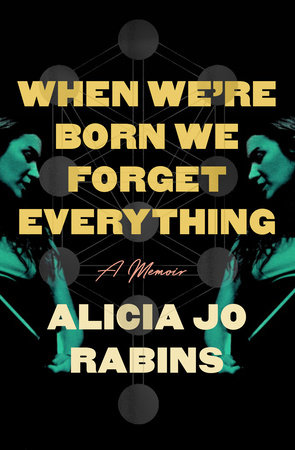
When We're Born We Forget Everything

A Memoir

Author Alicia Jo Rabins On Tour
Listen to a clip from the audiobook
audio pause button
0:00
0:00
From the creator of the internationally acclaimed singer-songwriter project Girls in Trouble, a memoir following her journey from a secular Jewish childhood to becoming a modern queer woman owning ancient teachings and finding her own meanings in them, refracted through feminist interpretations of the lives of Biblical women.

“Alicia Jo Rabins writes as if she’s in conversation with the divine itself. . . .This isn’t merely a book to be read—it’s a scripture for the searching heart, a reminder that the border between the human and the holy is, and always has been, porous.”
—Reza Aslan, author of Zealot: The Life and Times of Jesus of Nazareth


As a self-described ‘90s suburban high school weirdo, Alicia Jo Rabins spent her time practicing violin and smoking cigarettes behind the mall while secretly dreaming of setting out on a spiritual quest no one around her seemed to understand. She often found herself drawn to the more ritualistic and rigorous Judaism that her parents had abandoned to assimilate and “become American.” In college, a chance meeting led her on a pilgrimage to Jerusalem to study rabbinical texts (and play bluegrass fiddle on the street for cash). But that two years of immersing herself in traditional observance was only the start of a journey full of twists and turns.

When We’re Born We Forget Everything follows Alicia’s relentless, often embarrassing, sometimes enlightening search for the sacred in everyday life as she tours America playing with a klezmer-punk band, falls in and out of love, scrapes through the initiations of motherhood, and witnesses the beauty—and danger—of mysticism. Rabins braids this personal narrative with the hidden stories of biblical women, uncovering a path of queer identity, feminist awakening, and spiritual self-invention. This lyrical, searching memoir is a meditation on longing, lineage, and what it takes to find meaning in a fractured world.
The Garden of Earthly Delights

My grandfather shortened his last name to sound less Jewish, but really, I should have been born Alicia Jo Rabino­witz. Rabinowitz: son of the rabbi. Somewhere in my past there was an old bearded man, probably more than one, and likely some wise women too. Culture bearers, teachers of the tradition. But that was a long time ago.

There are two ways to look at my story.

You could say I was a white American girl growing up in late twentieth-­century secular suburbia, sensing a mystery pulsing beneath the sameness of number two pencils, plastic hairbrushes, school buses with their green vinyl seats. In this story, I left everything I knew to search for meaning; I found it in an ancient tradition; and then I had to decide how to come back and live with what I’d learned.

Or you could say I was a Jewish girl born in the Diaspora, in the Hebrew year 5737, whose ancestors improbably passed the traditions on from generation to generation for thousands of years until they reached me, so that I carried within myself the barest forms of ritual (a silver cup, grape juice, the Shema prayer), the faintest Hebrew letters, hints of almost-­forgotten languages. In this story, I returned to the faint flame burning inside me.

Either way: God was nowhere in my childhood, but mystery was everywhere.


It was the 1980s. Our dining room was cozy: a wooden hutch, plates with blue and red flowers, walls painted peach pink. Across from my seat at the table hung a reproduction of Hieronymus Bosch’s ornate painting The Garden of Earthly Delights. I stared at it every night during dinner: a packed dreamscape of bodies and spires, pleasure and torture; a moss-­green and mahogany pano­rama of mortal and Divine.

My father came in the front door from the teaching hospital, where he was a psychiatrist specializing in Alzheimer’s, depression, and dementia. He put down his dark leather briefcase, loosened his bow tie, hung up his jacket, and sat down as my mother called, “Dinnertime!” to me and my two younger sisters.

My mother, her hands in quilted mitts, carried a Pyrex dish of steaming lasagna from the oven. White strands were just beginning to appear in her short black hair. Between bites of buttered peas, we laughed, teased each other, and reported on our days.

My father loved his work, and he would often tell us stories about memory. We knew about Phineas Gage, the railway worker who miraculously survived when a tamping spike blew through his brain and out his head in 1848, but who was left with a greatly changed personality and severe memory loss. (“Gage was no longer Gage,” a friend of his reportedly said.) We knew about H.M., who lost his short-­term memory on an operating table in 1953, when a surgeon removed both of his hippocampi in an attempt to cure his epilepsy. H.M is still alive, my father said, they use his initials to protect his privacy. They study him at MIT. He shook his head. It’s tragic, but it’s also a great service to the medical profession. He doesn’t know whether his parents are alive or dead, but everyone says he’s a very sweet man.

Questions were a currency of love in our house. My sisters and I listened intently to my father’s mini-­lectures; the more insightful our questions, the more delighted he grew. That’s a very good point, he would say. And that’s exactly why every experiment needs a control. His dark eyebrows rose as if pulled by strings, his voice creeping up in volume, louder and louder.

And every time I looked up, The Garden of Earthly Delights pointed me again toward that mystery, that nameless power I sensed just outside the walls of our cozy house. No one had spoken directly of this power, yet I felt it: the cold black river of night; dreamlike bird-­monsters; death, loss, the exquisite terror of knowing everything I loved would end.

I sat back and let the words blur into sounds as my family talked around me. Butter melting on peas, love reverberating in the room, the enigma of the human brain, the way questions could bind us together. We had everything we needed, so why did I feel a hole at the center of it all?

For me, this mystery was a form of loneliness.


Some of my friends’ families said grace before dinner: Jesus, thank you for this food. I found this exotic and uncomfortable, since my family just sat down and ate. But when it came to the holidays, I knew that we were the exotic ones, our family menorah on the mantel a weak substitute for the glowing Christmas tree that filled every other window on the block.

Growing up Jewish in an almost entirely Christian suburb meant that Jesus was palpable, but mysterious—­the ruler of an adjacent, vaguely threatening empire, under whose auspices we lived. God was less foreign, since we heard about Him (always “Him”) the few times a year we went to synagogue. But even God was blurry: a great-­great-­grandfather whose name we couldn’t quite remember, who spoke a language we didn’t understand, probably believed the earth was flat, and wouldn’t approve of the way we lived.

God was indistinct to me, but mystery was clear; it surrounded me on all sides. In the slice removed from H.M.’s brain that cured his seizures but left him unable to form new memories, and in the seventeen-­year cicadas that emerged that spring from their tunnels in the ground, shedding their shrimplike shells across the concrete sidewalks. Mystery lived in our small, sloped backyard, its built-­long-­before-­we-­moved-­here steps of mica and falling-­down stone walls barely visible beneath spreading ivy and pachysandra. The impossible sweetness of coming together in that dining room together night after night, year after year, the peacock-­feather fan hanging from the window frame, the doorbell that rang sympathetically when my dad raised his voice in excitement—­as if there were a ghost in the room.

When I was ten, I made up my own definition for God. God is everything science has not solved yet, I wrote in my notebook. We were not deluded believers in some father figure; we were modern people and we put our faith in science. Yes, I felt mystery acutely, but God and mystery were two different things: so I believed, with the unquestioning faith of a child.

But every childhood ends.

According to tradition, Abraham went forth from the land of his birth to forge a new relationship with the Divine. He smashed the idols of his father, and in the wake of that destruction he began at last to experience God as One. And according to tradition, when Abraham grew up and became a father himself, that same God instructed him to prove his allegiance by binding his own son to be sacrificed on the mountain.

I wonder if Isaac, in that moment, questioned the faith of his father, too. As I hope my children question mine.
ONE OF HEY ALMA’S MOST ANTICIPATED BOOKS OF 2026

“Seeing the world through Alicia Jo Rabins’ eyes is like peering through a diaphanous veil—everything from college hookups to CD jewel cases to fiddle busking in suburbia are rendered with a sacred glow.”
GennaRose Nethercott, author of Thistlefoot

“[Rabins’ memoir] interweaves her narrative of queer, feminist and spiritual self-realization with the stories of powerful biblical women.”
Hey Alma, “27 Jewish Books We’re Looking Forward to in 2026”

“Raucous, entertaining, and always authentic, When We’re Born We Forget Everything filters the pilgrimage narrative through a punk aesthetic, and what emerges on the other side gloriously upends the received strictures and obligations of that which we’ve deemed ‘holy,’ and uncovers along the way a beguiling treatise on love. Throughout, When We’re Born We Forget Everything had me plotzing with joy.”
Matthew Gavin Frank, author of Submersed

“With the lyricism of a poet and the courage of a seeker, [Rabins] transforms the fragments of a modern life—motherhood, music, faith, desire—into a meditation on what it means to awaken to the sacred hidden in the ordinary. I loved this book, it is a wonder.”
Nina McConigley, author of How to Commit a Postcolonial Murder

“Feminist-spelunking in the depths of the patriarchy, Alicia Jo Rabins illuminates the sacred days and nights of the art life.”
—Jolie Holland


“In When We’re Born We Forget Everything, poet and musician Alicia Jo Rabins shares her journey of creating a world of music, love, study, language and care, ultimately finding her makom, her true and fitting place. She remembered everything. We are the enriched beneficiaries.”
Rabbi Ellen Lippmann

“With the propulsive beat of her old-time fiddling, Alicia Jo Rabins’ When We’re Born, We Forget Everything exposes the heart of a great Jewish leader and her development as an educator, rebbe, and musician. These captivating vignettes offer deep insight into Rabins, the Jewish community, and our contemporary world.”
Rabbi Burt Visotzky, Jewish Theological Seminary

“A lyrical, multilayered narrative. . . . The prose is musical, expansive and full of wonder. [It] is a deeply human book that locates the sacred firmly within earthly personhood. . . . [Rabins moves] through life looking into the hearts of the people and places around her, and finding beauty and holiness to a dazzling and psychedelic degree. While this may be a book of special significance to the Jewish community, in all the forms it can take, When We’re Born We Forget Everything can also be held as a balm against all the hurt places of humanity.”
—Anna Christensen, BookPage (starred review)

“Engaging. . . . A thoughtful, tender memoir.”
Kirkus

“Invigorating. . . . Readers drawn to stories of spiritual seeking will cherish this.”
Publishers Weekly
© Dao Strom
ALICIA JO RABINS is an award-winning writer, musician, and Jewish educator. She is the author of Divinity School (winner of the APR/Honickman First Book Prize) and Fruit Geode (finalist for the National Jewish Book Award), and the creator of Girls in Trouble, a feminist indie-folk song cycle about biblical women. Her feature film A Kaddish for Bernie Madoff was called “a blessing” by The Atlantic. Rabins holds an MFA in poetry and an MA in Jewish women’s studies. She tours internationally as a performer and teacher View titles by Alicia Jo Rabins

About

From the creator of the internationally acclaimed singer-songwriter project Girls in Trouble, a memoir following her journey from a secular Jewish childhood to becoming a modern queer woman owning ancient teachings and finding her own meanings in them, refracted through feminist interpretations of the lives of Biblical women.

“Alicia Jo Rabins writes as if she’s in conversation with the divine itself. . . .This isn’t merely a book to be read—it’s a scripture for the searching heart, a reminder that the border between the human and the holy is, and always has been, porous.”
—Reza Aslan, author of Zealot: The Life and Times of Jesus of Nazareth


As a self-described ‘90s suburban high school weirdo, Alicia Jo Rabins spent her time practicing violin and smoking cigarettes behind the mall while secretly dreaming of setting out on a spiritual quest no one around her seemed to understand. She often found herself drawn to the more ritualistic and rigorous Judaism that her parents had abandoned to assimilate and “become American.” In college, a chance meeting led her on a pilgrimage to Jerusalem to study rabbinical texts (and play bluegrass fiddle on the street for cash). But that two years of immersing herself in traditional observance was only the start of a journey full of twists and turns.

When We’re Born We Forget Everything follows Alicia’s relentless, often embarrassing, sometimes enlightening search for the sacred in everyday life as she tours America playing with a klezmer-punk band, falls in and out of love, scrapes through the initiations of motherhood, and witnesses the beauty—and danger—of mysticism. Rabins braids this personal narrative with the hidden stories of biblical women, uncovering a path of queer identity, feminist awakening, and spiritual self-invention. This lyrical, searching memoir is a meditation on longing, lineage, and what it takes to find meaning in a fractured world.

Excerpt

The Garden of Earthly Delights

My grandfather shortened his last name to sound less Jewish, but really, I should have been born Alicia Jo Rabino­witz. Rabinowitz: son of the rabbi. Somewhere in my past there was an old bearded man, probably more than one, and likely some wise women too. Culture bearers, teachers of the tradition. But that was a long time ago.

There are two ways to look at my story.

You could say I was a white American girl growing up in late twentieth-­century secular suburbia, sensing a mystery pulsing beneath the sameness of number two pencils, plastic hairbrushes, school buses with their green vinyl seats. In this story, I left everything I knew to search for meaning; I found it in an ancient tradition; and then I had to decide how to come back and live with what I’d learned.

Or you could say I was a Jewish girl born in the Diaspora, in the Hebrew year 5737, whose ancestors improbably passed the traditions on from generation to generation for thousands of years until they reached me, so that I carried within myself the barest forms of ritual (a silver cup, grape juice, the Shema prayer), the faintest Hebrew letters, hints of almost-­forgotten languages. In this story, I returned to the faint flame burning inside me.

Either way: God was nowhere in my childhood, but mystery was everywhere.


It was the 1980s. Our dining room was cozy: a wooden hutch, plates with blue and red flowers, walls painted peach pink. Across from my seat at the table hung a reproduction of Hieronymus Bosch’s ornate painting The Garden of Earthly Delights. I stared at it every night during dinner: a packed dreamscape of bodies and spires, pleasure and torture; a moss-­green and mahogany pano­rama of mortal and Divine.

My father came in the front door from the teaching hospital, where he was a psychiatrist specializing in Alzheimer’s, depression, and dementia. He put down his dark leather briefcase, loosened his bow tie, hung up his jacket, and sat down as my mother called, “Dinnertime!” to me and my two younger sisters.

My mother, her hands in quilted mitts, carried a Pyrex dish of steaming lasagna from the oven. White strands were just beginning to appear in her short black hair. Between bites of buttered peas, we laughed, teased each other, and reported on our days.

My father loved his work, and he would often tell us stories about memory. We knew about Phineas Gage, the railway worker who miraculously survived when a tamping spike blew through his brain and out his head in 1848, but who was left with a greatly changed personality and severe memory loss. (“Gage was no longer Gage,” a friend of his reportedly said.) We knew about H.M., who lost his short-­term memory on an operating table in 1953, when a surgeon removed both of his hippocampi in an attempt to cure his epilepsy. H.M is still alive, my father said, they use his initials to protect his privacy. They study him at MIT. He shook his head. It’s tragic, but it’s also a great service to the medical profession. He doesn’t know whether his parents are alive or dead, but everyone says he’s a very sweet man.

Questions were a currency of love in our house. My sisters and I listened intently to my father’s mini-­lectures; the more insightful our questions, the more delighted he grew. That’s a very good point, he would say. And that’s exactly why every experiment needs a control. His dark eyebrows rose as if pulled by strings, his voice creeping up in volume, louder and louder.

And every time I looked up, The Garden of Earthly Delights pointed me again toward that mystery, that nameless power I sensed just outside the walls of our cozy house. No one had spoken directly of this power, yet I felt it: the cold black river of night; dreamlike bird-­monsters; death, loss, the exquisite terror of knowing everything I loved would end.

I sat back and let the words blur into sounds as my family talked around me. Butter melting on peas, love reverberating in the room, the enigma of the human brain, the way questions could bind us together. We had everything we needed, so why did I feel a hole at the center of it all?

For me, this mystery was a form of loneliness.


Some of my friends’ families said grace before dinner: Jesus, thank you for this food. I found this exotic and uncomfortable, since my family just sat down and ate. But when it came to the holidays, I knew that we were the exotic ones, our family menorah on the mantel a weak substitute for the glowing Christmas tree that filled every other window on the block.

Growing up Jewish in an almost entirely Christian suburb meant that Jesus was palpable, but mysterious—­the ruler of an adjacent, vaguely threatening empire, under whose auspices we lived. God was less foreign, since we heard about Him (always “Him”) the few times a year we went to synagogue. But even God was blurry: a great-­great-­grandfather whose name we couldn’t quite remember, who spoke a language we didn’t understand, probably believed the earth was flat, and wouldn’t approve of the way we lived.

God was indistinct to me, but mystery was clear; it surrounded me on all sides. In the slice removed from H.M.’s brain that cured his seizures but left him unable to form new memories, and in the seventeen-­year cicadas that emerged that spring from their tunnels in the ground, shedding their shrimplike shells across the concrete sidewalks. Mystery lived in our small, sloped backyard, its built-­long-­before-­we-­moved-­here steps of mica and falling-­down stone walls barely visible beneath spreading ivy and pachysandra. The impossible sweetness of coming together in that dining room together night after night, year after year, the peacock-­feather fan hanging from the window frame, the doorbell that rang sympathetically when my dad raised his voice in excitement—­as if there were a ghost in the room.

When I was ten, I made up my own definition for God. God is everything science has not solved yet, I wrote in my notebook. We were not deluded believers in some father figure; we were modern people and we put our faith in science. Yes, I felt mystery acutely, but God and mystery were two different things: so I believed, with the unquestioning faith of a child.

But every childhood ends.

According to tradition, Abraham went forth from the land of his birth to forge a new relationship with the Divine. He smashed the idols of his father, and in the wake of that destruction he began at last to experience God as One. And according to tradition, when Abraham grew up and became a father himself, that same God instructed him to prove his allegiance by binding his own son to be sacrificed on the mountain.

I wonder if Isaac, in that moment, questioned the faith of his father, too. As I hope my children question mine.

Reviews

ONE OF HEY ALMA’S MOST ANTICIPATED BOOKS OF 2026

“Seeing the world through Alicia Jo Rabins’ eyes is like peering through a diaphanous veil—everything from college hookups to CD jewel cases to fiddle busking in suburbia are rendered with a sacred glow.”
GennaRose Nethercott, author of Thistlefoot

“[Rabins’ memoir] interweaves her narrative of queer, feminist and spiritual self-realization with the stories of powerful biblical women.”
Hey Alma, “27 Jewish Books We’re Looking Forward to in 2026”

“Raucous, entertaining, and always authentic, When We’re Born We Forget Everything filters the pilgrimage narrative through a punk aesthetic, and what emerges on the other side gloriously upends the received strictures and obligations of that which we’ve deemed ‘holy,’ and uncovers along the way a beguiling treatise on love. Throughout, When We’re Born We Forget Everything had me plotzing with joy.”
Matthew Gavin Frank, author of Submersed

“With the lyricism of a poet and the courage of a seeker, [Rabins] transforms the fragments of a modern life—motherhood, music, faith, desire—into a meditation on what it means to awaken to the sacred hidden in the ordinary. I loved this book, it is a wonder.”
Nina McConigley, author of How to Commit a Postcolonial Murder

“Feminist-spelunking in the depths of the patriarchy, Alicia Jo Rabins illuminates the sacred days and nights of the art life.”
—Jolie Holland


“In When We’re Born We Forget Everything, poet and musician Alicia Jo Rabins shares her journey of creating a world of music, love, study, language and care, ultimately finding her makom, her true and fitting place. She remembered everything. We are the enriched beneficiaries.”
Rabbi Ellen Lippmann

“With the propulsive beat of her old-time fiddling, Alicia Jo Rabins’ When We’re Born, We Forget Everything exposes the heart of a great Jewish leader and her development as an educator, rebbe, and musician. These captivating vignettes offer deep insight into Rabins, the Jewish community, and our contemporary world.”
Rabbi Burt Visotzky, Jewish Theological Seminary

“A lyrical, multilayered narrative. . . . The prose is musical, expansive and full of wonder. [It] is a deeply human book that locates the sacred firmly within earthly personhood. . . . [Rabins moves] through life looking into the hearts of the people and places around her, and finding beauty and holiness to a dazzling and psychedelic degree. While this may be a book of special significance to the Jewish community, in all the forms it can take, When We’re Born We Forget Everything can also be held as a balm against all the hurt places of humanity.”
—Anna Christensen, BookPage (starred review)

“Engaging. . . . A thoughtful, tender memoir.”
Kirkus

“Invigorating. . . . Readers drawn to stories of spiritual seeking will cherish this.”
Publishers Weekly

Author

© Dao Strom
ALICIA JO RABINS is an award-winning writer, musician, and Jewish educator. She is the author of Divinity School (winner of the APR/Honickman First Book Prize) and Fruit Geode (finalist for the National Jewish Book Award), and the creator of Girls in Trouble, a feminist indie-folk song cycle about biblical women. Her feature film A Kaddish for Bernie Madoff was called “a blessing” by The Atlantic. Rabins holds an MFA in poetry and an MA in Jewish women’s studies. She tours internationally as a performer and teacher View titles by Alicia Jo Rabins
  • More Websites from
    Penguin Random House
  • Common Reads
  • Library Marketing