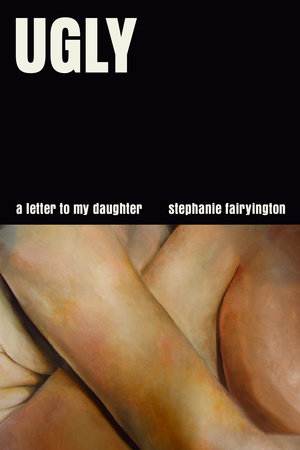
Download high-resolution image
Listen to a clip from the audiobook
audio pause button
0:00
0:00

Ugly

A Letter to My Daughter

Author Stephanie Fairyington On Tour
Listen to a clip from the audiobook
audio pause button
0:00
0:00
A tender, moving, and insightful account of queer motherhood and an interrogation of life on the margins of American culture as a self-described “ugly” woman

“A rigorous ladyballs-out polemic that also tells the most raw, tender, against-all-odds story of parenthood that I've ever read.” —Mary Gaitskill, author of Veronica


Ugly is a word with fangs that can kill a woman’s self-esteem in one bite. Edicts about how women should look, behave, and think are the brutal forge through which they are made — not born — as Simone de Beauvoir famously argued in The Second Sex. And to defy the pretty imperative is to experience a kind of invisibility. It can be a hard thing to admit to yourself, let alone to your child, to say the words “I am ugly” or “I am seen as ugly.” But early on in her motherhood journey, watching her young daughter begin to wrestle with beauty standards, Stephanie Fairyington felt compelled to face her own demons and to unpack her own ugly self-perception, one that she could trace to her own childhood, in order to conquer this seemingly immoveable frontier, far too taboo even among women to broach: the ways in which women’s lives are unfairly contoured by the nature of their looks. 

The multiple iterations of ugliness that Fairyington saw in her young self—her physical appearance, her formative gender dissonance, and obvious lesbianism—are not present in her beautiful and traditionally feminine daughter. But Fairyington’s old feelings of inadequacy take on new meaning as she confronts fresh insecurities around her role as the nonbiological mother in her relationship, exacerbating wounds from a lifetime of being treated differently, from the poverty of her genetic inheritance to questions about her parentage to doubts about the legitimacy of her family.

Interlacing cultural history and analysis with memoir, Ugly is a probing investigation into cultural norms and the formation of our aesthetic sense of self. Fairyington contrasts her so-called ugliness with her daughter’s attractiveness and adherence to beauty ideals, a tender and tenuous condition that her daughter was already walking a tightrope to maintain at age six. By sharing the history of her troubled self-image, Fairyington invites us to go rogue, to invent a new language and logic to overthrow all the ways that women have been cultivated to hate themselves.
Chapter 1

Blood

We were preoccupied with your aesthetics—your material condition—just as you’ve been trained to be, even before you were conceived, when you were just an idea, a hope.

On a trip to Chicago to meet your newly born cousin Mari, I began to long for the impossible: to fuse my bloodline with Sabrina’s—your biological mother whom you call Mama Sabby, the love of my life for the past seventeen years—through you. I wanted to concretize our love, an unquantifiable, abstract thing, in material form.

There was irony—perversity, really—in this longing. At one time, I would have found such a desire unimaginative and lazy, counter to the goals of creating nonbiological forms of kinship and community and new ways of being and relating in the world in accordance with my queer ethos.

Biology, for most of my life, has felt more like a problem—even a punishment—than a solution. I never felt quite right in this body in which I live—like I’m an imposter walking through rooms, sitting on couches, sleeping on beds in a house that doesn’t belong to me. It wasn’t just the creeping sense that my gender and sex were out of sync or the undeniable desire and longing I felt for other girls; it was the poverty of my genetic inheritance visible in my face, a face that wouldn’t have registered as anything spectacularly unattractive if it wasn’t abutting the beauty of my mother and handsome older brother. Where they had full lips, I had thin ones; where they had silky straight hair, mine was thick and wiry; where they had aquiline noses, I had a bulbous red one; where they had perfectly shaped almond eyes—my mother’s blue, my brother’s green—mine were big and buggy and slightly mismatched. I could always see the quiet disbelief—disdain, even—in the faces of strangers when they realized we were related. Their biology visually cohered; mine did not, leaving me outside their pretty dyad and full of dysmorphia.

The unease I felt about my appearance was amplified by the creeping awareness that I was queer, that I was socially disfigured, a biological aberration, ugly on the inside, too, in the eyes of the world. When my politics became more radical—more self-affirming and defiant at Berkeley in the late 1990s—biology troubled me in a whole new way. The mainstream LGBTQ movement has historically sought to secure our civil rights by appealing to a “born this way” politic or a “politic of pity.” This strategy, an effective one in the short term but a limiting one in the long run, goes like this: I’m gay through no fault of my own, through some mysterious congenital defect, as sexologists all the way back to the nineteenth century argued in our defense, so it’s unjust to discriminate against me and deny me equal rights. It’s meant to generate sympathy and rally people to our cause, but subtextually it communicates the self-disparaging message that no right-minded person would willingly submit to such a loathsome and miserable condition.

What kind of acceptance have we truly gained if it’s contingent upon people thinking that we’re genetic mistakes? How does it really help us to take choice out of the equation when we all know that essentialist arguments, those rooted in a fixed and biological understanding of identity, have historically hurt certain populations of people—women, African Americans, and Jews, for example? Isn’t the elasticity of identity more empowering and self-affirming?

While holding these questions in my own mind, I, too, resorted to the expediency of bio logic when I came out to my own mother in a letter at age twenty-eight: “If there were a straight pill, I’d swallow it faster than you can say the word gay,” I wrote idiotically. That was easier to digest because it let both of us off the hook and elicited more compassion than a radical “politic of choice” would—a politic that would lean on the argument that we deserve the freedom to self-determine, to carve out and create a life that brings us meaning and happiness or nihilism and despair, however we see fit as long as we’re not hurting anyone else.

And yet, I get the impulse toward the pragmatism and accessibility of an essentialist understanding of homosexuality: When I was twelve, I witnessed my gentle-hearted dad try to defend gay people using the logic of determinism, which my Argentine grandmother, a passionate Baptist, dismissed in thundering protest. Sitting at the big brown table that occupied half of my grandparents' small kitchen, my grandmother and father were intellectually sparring about whether or not people were born gay. My father, who I believe knew I was a lesbian from an early age, argued that if our condition was congenital, if we “couldn’t help it, like people born with Down syndrome,” he reasoned aloud, then it was unethical and immoral to condemn us. This premise unleashed my grandmother’s fury to such an unusual extent, she slammed her fist on the table hard enough to make the plates clank and their coffees spill. “My God does not make mistakes!” she roared with merciless certainty. “Okay, Mamá, okay,” he said, visibly shrinking himself, as he often did before the overpowering women in his life.

It was the first time I’d heard my dad’s thoughts on the topic of homosexuality, although it didn’t at all surprise me that someone so elegant and compassionate would have a more generous viewpoint than your average American male in the conservative 1980s, even with all his religious training—and he could, indeed, recount every character and story in the Bible with frightening detail and exactitude. But hearing my grandmother’s firm and unforgiving take on the topic, our family’s highest spiritual authority, made me feel like I was awash in the devil’s filth: I was the opposite of God and goodness, the essence of beauty. Even my dad’s more tolerant perspective confirmed to me that I was a malformation, a genetic error. Whatever side of this argument one landed on, my material and immaterial self were troubling affronts—either to nature or to God.

My marriage and wish to materialize my love for Sabrina in you was ironic in other ways, too. As a kid, I vowed that I’d never get married and have babies, a stance reinforced at U.C. Berkeley, where I learned to question and critically disassemble all the beliefs, values, and institutions that organize our society—gender, sexuality, race, marriage, monogamy, capitalism, God—in an effort to see what could be reworked or outright annihilated for the betterment of us all, but especially for those of us on the social peripheries.

All this to say, I never wanted you; I never dreamed I could want you because our dreams are bound by the systems of meaning, institutions, and laws that rule our lives, and in Downey, California, in the mid-1980s, a young person awakening to her same-sex desires could not conceive of getting married and having kids. We were not represented anywhere in popular culture, and whatever one may think of the merits or demerits of the aspiration to marry and have children, neither was an option at the time.

Even acting on our queer lusts was, technically, against the law in all but twenty-one states, although rarely enforced—except in the case of Michael Hardwick, a handsome bartender in Atlanta, Georgia, in the summer of 1982, who was spied by a cop performing oral sex on a married schoolteacher in Hardwick’s very own bedroom. Both were arrested on charges of sodomy and possession of pot. A lower court in the conservative state of Georgia, stunningly, ruled in Hardwick’s favor, but the state appealed to the Supreme Court of the United States.

In June 1986, three months after I turned ten, emerged from puberty, and realized my same-sex attractions, the highest court in the land ruled against Hardwick, arguing that his right-to-privacy argument, inferred in the Fourteenth Amendment’s due process clause, did not cover his right to engage in sodomitical acts, letting anti-sodomy statutes stand throughout the land.

When Hardwick’s lover was arrested, he pleaded for the officer not to tell his wife or publicly disclose his arrest because he could lose his teaching position in North Carolina where he lived—and that was a real concern throughout the ’80s and ’90s, when educators “discovered or perceived to be gay,” says Jennifer C. Pizer, the chief legal officer at Lambda Legal, a civil rights organization fighting for LGBTQ equality, could be dismissed from their posts on moral grounds supported by the Supreme Court’s Hardwick decision. It wasn’t until that law was overturned in 2003 that LGBTQ advocates were able to successfully win us greater civil liberties. As Pizer put it via email: “Lambda Legal’s 2003 victory in Lawrence v. Texas marked a sea change in our ability to secure more robust legal protections for LGBTQ+ people in many more parts of the country,” she explained. “It set the stage for increasing successes in our marriage equality advocacy by removing one of the persistent obstacles to achieving comprehensive family law protections for LGBTQ+ people and their families.” She points out that while we had already made important strides in securing nondiscrimination protections in certain states before the Lawrence decision—including efforts to prevent discrimination in public employment, address bullying of LGBTQ+ students, and combat various forms of police misconduct—Lawrence removed a major barrier. “After that, we were able to make legal progress more quickly and effectively.”

Despite decades of progress since then, we’re heading back, derailingly fast, to a time of restricted freedoms for women (with the end of reproductive choice), for people of color (with the elimination of affirmative action, narrowing voting rights, and Trump’s assault on diversity, equity, and inclusion initiatives), and for LGBTQ communities, especially trans people, whose very existence is under attack: Several states aim to reinstate laws similar to those formulated in the bygone era of my ’80s youth. Alabama, Arkansas, Indiana, Iowa, Kentucky, North Carolina, Mississippi, Texas, and Florida, to name a few states, have ongoing campaigns against us. Florida, for one, passed HB 1557, the Parental Rights in Education bill (popularly known as “Don’t Say Gay”), in 2022, largely outlawing discussions of sexual orientation and gender identity in grades K through 12. Before an agreement between proponents and opponents of the law was reached in the spring of 2024, allowing discussion of the topic as long as it is not a part of academic instruction, it was an open question as to whether queer teachers would be forced back into the closet or risk suspension or expulsion if they displayed welcoming rainbow flags or showcased pictures of their queer families in the classroom. The state’s quest to limit or eliminate references to LGBTQ people extended to its many public school libraries, too, where several purged their collections of books with LGBTQ characters and themes. In northeast Florida, however, a settlement was reached with the School Board of Nassau County, resulting in the restoration of queer titles to the district’s bookshelves. I told you about such wins so you could see intolerance and bigotry successfully thwarted but reminded you that we must remain vigilant and engaged, especially in the age of Trump. Just days ago from this writing, the Supreme Court ruled in favor of religious parents’ request for an “opt-out” provision to excuse their children from school lessons and literature that include LGBTQ people and other curricular content that conflicts with their religious beliefs. We wondered aloud how it might make queer students feel that a schoolmate could skip class just because a book reflecting LGBTQ experiences and feelings was discussed.

If we lived in Florida, you’d asked, would Belle of the Ball, a story about a lesbian love triangle, or The Girl from the Sea, a book about an interspecies romance between a lesbian mermaid and a teenage girl, be available in your school library. You’ve read both graphic novels over and over, reminding us each time, “Moms, these girls are just like you guys.”

“It would depend on where we lived in Florida, but in some school districts, no, those books would not be in the school library,” I said.

I didn’t want to admit to you that we were seen, to some, as a moral affront to the laws of nature and God, an idea too large and complex to unpack and one that might inadvertently taint your perception of us, so I just explained that sometimes people are scared of people who are different from them. “That fear brings out their ugly side,” I said, reflecting on Florida’s fraught LGBTQ history going all the way back to the late 1970s, when singer-turned-activist Anita Bryant fronted a vicious campaign called Save Our Children. Her gay-hating crusade aimed to remove known homosexuals from teaching posts in public schools after Dade County made it illegal to discriminate against gays and lesbians in public accommodations, hiring, and housing. Bryant, using the language in anti-sodomy statutes, told an anchorwoman at the height of the controversy: “According to the Word of God, it’s an abomination to practice homosexuality. . . . Archbishop Carroll . . . took the stand that he would go to jail rather than to hire known homosexuals into their schools, and our pastor said that he would do the same and would even burn the school rather than allow them to be taught by homosexuals. . . . This county ordinance is asking us, in essence, to go against the law of Florida and to go against, even more important, what we believe is above the law of the land: God’s law.” She took her animus and hysteria up an even higher octave in a now-infamous quote: “God made mothers so that we could reproduce; homosexuals cannot reproduce biologically, but they have to reproduce by recruiting our children.”

That kind of vitriol and ignorance lay at the heart of the Bowers v. Hardwick ruling, which swiftly derailed LGBTQ activists’ efforts to challenge anti-sodomy laws in federal courts. These arguments had drawn on emerging Supreme Court precedents recognizing a constitutional right to sexual privacy—cases that affirmed access to abortion (Roe v. Wade) and contraception for married couples (Griswold v. Connecticut) and single people (Eisenstadt v. Baird). When the Lawrence decision finally came down from the highest tribunal in the land, protecting our right to sexual autonomy and self-determination and paving the way for marriage equality across the nation with the Supreme Court’s Obergefell v. Hodges decision in 2015, I was twenty-seven. That’s nearly twenty years after my gay awakening, when it wasn’t conceivable to me to want this, to want you.
“As a bittersweet ode to hope and a consideration of ugliness as a tool of resistance, Ugly has a powerful grace.” —Andi Zeisler, Salon

“[A] bold debut.”­­—The Millions

Ugly is beautiful, a rigorous ladyballs-out polemic that also tells the most raw, tender, against-all-odds story of parenthood that I've ever read. Steph Fairyington and her family are quietly heroic in their will to have what most people are able to take for granted, a warm and loving family unmolested by the blithe incomprehension and cruelty of social norms—particularly the often random norms regarding beauty. Reading it made me sad and outraged anew at the damage that can be done to women, starting in childhood, when they don't conform to what we decree is beauty, no matter how beautiful they actually are.”—Mary Gaitskill, author of Veronica

“An anthropological lesson about our society’s own nefarious history with beauty standards. . . . Fairyington weighs the parenting conundrum of how to encourage your children to be themselves and celebrate their appearance while also acknowledging how doing so feeds the beauty-industrial complex.”The Cut

“Incisive.”—Autostraddle

“A penetrating, courageous, loving, and deeply moving exploration of girlhood, womanhood, motherhood, and selfhood.”—Stephanie Coontz, author of For Better and Worse: The Complicated Past and Challenging Future of Marriage

“A polemic, a memoir, and an important addition to the feminist canon, Ugly is a beautiful book and I am so incredibly glad it exists.”— Molly Jong-Fast, author of How to Lose Your Mother

“Stephanie Fairyington displays a keen intellect and a warm inclusive heart as she takes on the looks-based oppression of women and girls in this endearing letter to her young daughter. Although we are all still plagued by the idea of female imperfection, Ugly brings some hope that there are ways to resist lookism—and is a story and analysis sorely needed.”—Joan Jacobs Brumberg, author of Fasting Girls: The History of Anorexia Nervosa

“What I love about the way Stephanie Fairyington takes ownership of ugliness is the freedom it opens up for uncertainty, unlearning, and reinventing—everything from the family and mother-child knots, to cruelty, femininity, anxiety, and normality. She has a talent for vulnerability and a stunning, startling voice.”—Laura Kipnis, author of Against Love: A Polemic

Ugly is a beautiful book—read it!” —E. Jean Carroll, author of Not My Type: One Woman vs. a President

“Valiant and audacious. . . . Through reflections on parenthood, LGBTQ+ historical context, and biting reprovals of American culture, Fairyington’s concerns for her impressionable offspring are valid, sharp, and urgent, yet eloquently conveyed in this hybrid of maternal love letter and cautionary counsel.”—Kirkus, starred review

“This maternal manifesto makes a major impression.”Publishers Weekly
© Sabrina Weiss
Stephanie Fairyington is a journalist who writes on gender, sexuality, family, and parenting. A former contributing writer for The Advocate and former senior staff writer at Arianna Huffington's Thrive Global, her work has appeared in The New York Times, The Boston Globe, online for The Atlantic, and elsewhere. She lives in Brooklyn with her spouse and daughter. View titles by Stephanie Fairyington
Prologue: Letter to My Daughter 3
1. Blood 7
2. History of Difference 25
3. The Invention of Beauty—and Ugly 43
4. “Lez Alert!” 81
5. Daddy 105
6. Perceptions 118
7. Weird Girls Rule 137
8. Clean 176
9. A Theoretical Life 186
10. Life After Death 197
11. Affirming Our Differences 219
12. Transcendence 234

Acknowledgments 245
Notes 249

About

A tender, moving, and insightful account of queer motherhood and an interrogation of life on the margins of American culture as a self-described “ugly” woman

“A rigorous ladyballs-out polemic that also tells the most raw, tender, against-all-odds story of parenthood that I've ever read.” —Mary Gaitskill, author of Veronica


Ugly is a word with fangs that can kill a woman’s self-esteem in one bite. Edicts about how women should look, behave, and think are the brutal forge through which they are made — not born — as Simone de Beauvoir famously argued in The Second Sex. And to defy the pretty imperative is to experience a kind of invisibility. It can be a hard thing to admit to yourself, let alone to your child, to say the words “I am ugly” or “I am seen as ugly.” But early on in her motherhood journey, watching her young daughter begin to wrestle with beauty standards, Stephanie Fairyington felt compelled to face her own demons and to unpack her own ugly self-perception, one that she could trace to her own childhood, in order to conquer this seemingly immoveable frontier, far too taboo even among women to broach: the ways in which women’s lives are unfairly contoured by the nature of their looks. 

The multiple iterations of ugliness that Fairyington saw in her young self—her physical appearance, her formative gender dissonance, and obvious lesbianism—are not present in her beautiful and traditionally feminine daughter. But Fairyington’s old feelings of inadequacy take on new meaning as she confronts fresh insecurities around her role as the nonbiological mother in her relationship, exacerbating wounds from a lifetime of being treated differently, from the poverty of her genetic inheritance to questions about her parentage to doubts about the legitimacy of her family.

Interlacing cultural history and analysis with memoir, Ugly is a probing investigation into cultural norms and the formation of our aesthetic sense of self. Fairyington contrasts her so-called ugliness with her daughter’s attractiveness and adherence to beauty ideals, a tender and tenuous condition that her daughter was already walking a tightrope to maintain at age six. By sharing the history of her troubled self-image, Fairyington invites us to go rogue, to invent a new language and logic to overthrow all the ways that women have been cultivated to hate themselves.

Excerpt

Chapter 1

Blood

We were preoccupied with your aesthetics—your material condition—just as you’ve been trained to be, even before you were conceived, when you were just an idea, a hope.

On a trip to Chicago to meet your newly born cousin Mari, I began to long for the impossible: to fuse my bloodline with Sabrina’s—your biological mother whom you call Mama Sabby, the love of my life for the past seventeen years—through you. I wanted to concretize our love, an unquantifiable, abstract thing, in material form.

There was irony—perversity, really—in this longing. At one time, I would have found such a desire unimaginative and lazy, counter to the goals of creating nonbiological forms of kinship and community and new ways of being and relating in the world in accordance with my queer ethos.

Biology, for most of my life, has felt more like a problem—even a punishment—than a solution. I never felt quite right in this body in which I live—like I’m an imposter walking through rooms, sitting on couches, sleeping on beds in a house that doesn’t belong to me. It wasn’t just the creeping sense that my gender and sex were out of sync or the undeniable desire and longing I felt for other girls; it was the poverty of my genetic inheritance visible in my face, a face that wouldn’t have registered as anything spectacularly unattractive if it wasn’t abutting the beauty of my mother and handsome older brother. Where they had full lips, I had thin ones; where they had silky straight hair, mine was thick and wiry; where they had aquiline noses, I had a bulbous red one; where they had perfectly shaped almond eyes—my mother’s blue, my brother’s green—mine were big and buggy and slightly mismatched. I could always see the quiet disbelief—disdain, even—in the faces of strangers when they realized we were related. Their biology visually cohered; mine did not, leaving me outside their pretty dyad and full of dysmorphia.

The unease I felt about my appearance was amplified by the creeping awareness that I was queer, that I was socially disfigured, a biological aberration, ugly on the inside, too, in the eyes of the world. When my politics became more radical—more self-affirming and defiant at Berkeley in the late 1990s—biology troubled me in a whole new way. The mainstream LGBTQ movement has historically sought to secure our civil rights by appealing to a “born this way” politic or a “politic of pity.” This strategy, an effective one in the short term but a limiting one in the long run, goes like this: I’m gay through no fault of my own, through some mysterious congenital defect, as sexologists all the way back to the nineteenth century argued in our defense, so it’s unjust to discriminate against me and deny me equal rights. It’s meant to generate sympathy and rally people to our cause, but subtextually it communicates the self-disparaging message that no right-minded person would willingly submit to such a loathsome and miserable condition.

What kind of acceptance have we truly gained if it’s contingent upon people thinking that we’re genetic mistakes? How does it really help us to take choice out of the equation when we all know that essentialist arguments, those rooted in a fixed and biological understanding of identity, have historically hurt certain populations of people—women, African Americans, and Jews, for example? Isn’t the elasticity of identity more empowering and self-affirming?

While holding these questions in my own mind, I, too, resorted to the expediency of bio logic when I came out to my own mother in a letter at age twenty-eight: “If there were a straight pill, I’d swallow it faster than you can say the word gay,” I wrote idiotically. That was easier to digest because it let both of us off the hook and elicited more compassion than a radical “politic of choice” would—a politic that would lean on the argument that we deserve the freedom to self-determine, to carve out and create a life that brings us meaning and happiness or nihilism and despair, however we see fit as long as we’re not hurting anyone else.

And yet, I get the impulse toward the pragmatism and accessibility of an essentialist understanding of homosexuality: When I was twelve, I witnessed my gentle-hearted dad try to defend gay people using the logic of determinism, which my Argentine grandmother, a passionate Baptist, dismissed in thundering protest. Sitting at the big brown table that occupied half of my grandparents' small kitchen, my grandmother and father were intellectually sparring about whether or not people were born gay. My father, who I believe knew I was a lesbian from an early age, argued that if our condition was congenital, if we “couldn’t help it, like people born with Down syndrome,” he reasoned aloud, then it was unethical and immoral to condemn us. This premise unleashed my grandmother’s fury to such an unusual extent, she slammed her fist on the table hard enough to make the plates clank and their coffees spill. “My God does not make mistakes!” she roared with merciless certainty. “Okay, Mamá, okay,” he said, visibly shrinking himself, as he often did before the overpowering women in his life.

It was the first time I’d heard my dad’s thoughts on the topic of homosexuality, although it didn’t at all surprise me that someone so elegant and compassionate would have a more generous viewpoint than your average American male in the conservative 1980s, even with all his religious training—and he could, indeed, recount every character and story in the Bible with frightening detail and exactitude. But hearing my grandmother’s firm and unforgiving take on the topic, our family’s highest spiritual authority, made me feel like I was awash in the devil’s filth: I was the opposite of God and goodness, the essence of beauty. Even my dad’s more tolerant perspective confirmed to me that I was a malformation, a genetic error. Whatever side of this argument one landed on, my material and immaterial self were troubling affronts—either to nature or to God.

My marriage and wish to materialize my love for Sabrina in you was ironic in other ways, too. As a kid, I vowed that I’d never get married and have babies, a stance reinforced at U.C. Berkeley, where I learned to question and critically disassemble all the beliefs, values, and institutions that organize our society—gender, sexuality, race, marriage, monogamy, capitalism, God—in an effort to see what could be reworked or outright annihilated for the betterment of us all, but especially for those of us on the social peripheries.

All this to say, I never wanted you; I never dreamed I could want you because our dreams are bound by the systems of meaning, institutions, and laws that rule our lives, and in Downey, California, in the mid-1980s, a young person awakening to her same-sex desires could not conceive of getting married and having kids. We were not represented anywhere in popular culture, and whatever one may think of the merits or demerits of the aspiration to marry and have children, neither was an option at the time.

Even acting on our queer lusts was, technically, against the law in all but twenty-one states, although rarely enforced—except in the case of Michael Hardwick, a handsome bartender in Atlanta, Georgia, in the summer of 1982, who was spied by a cop performing oral sex on a married schoolteacher in Hardwick’s very own bedroom. Both were arrested on charges of sodomy and possession of pot. A lower court in the conservative state of Georgia, stunningly, ruled in Hardwick’s favor, but the state appealed to the Supreme Court of the United States.

In June 1986, three months after I turned ten, emerged from puberty, and realized my same-sex attractions, the highest court in the land ruled against Hardwick, arguing that his right-to-privacy argument, inferred in the Fourteenth Amendment’s due process clause, did not cover his right to engage in sodomitical acts, letting anti-sodomy statutes stand throughout the land.

When Hardwick’s lover was arrested, he pleaded for the officer not to tell his wife or publicly disclose his arrest because he could lose his teaching position in North Carolina where he lived—and that was a real concern throughout the ’80s and ’90s, when educators “discovered or perceived to be gay,” says Jennifer C. Pizer, the chief legal officer at Lambda Legal, a civil rights organization fighting for LGBTQ equality, could be dismissed from their posts on moral grounds supported by the Supreme Court’s Hardwick decision. It wasn’t until that law was overturned in 2003 that LGBTQ advocates were able to successfully win us greater civil liberties. As Pizer put it via email: “Lambda Legal’s 2003 victory in Lawrence v. Texas marked a sea change in our ability to secure more robust legal protections for LGBTQ+ people in many more parts of the country,” she explained. “It set the stage for increasing successes in our marriage equality advocacy by removing one of the persistent obstacles to achieving comprehensive family law protections for LGBTQ+ people and their families.” She points out that while we had already made important strides in securing nondiscrimination protections in certain states before the Lawrence decision—including efforts to prevent discrimination in public employment, address bullying of LGBTQ+ students, and combat various forms of police misconduct—Lawrence removed a major barrier. “After that, we were able to make legal progress more quickly and effectively.”

Despite decades of progress since then, we’re heading back, derailingly fast, to a time of restricted freedoms for women (with the end of reproductive choice), for people of color (with the elimination of affirmative action, narrowing voting rights, and Trump’s assault on diversity, equity, and inclusion initiatives), and for LGBTQ communities, especially trans people, whose very existence is under attack: Several states aim to reinstate laws similar to those formulated in the bygone era of my ’80s youth. Alabama, Arkansas, Indiana, Iowa, Kentucky, North Carolina, Mississippi, Texas, and Florida, to name a few states, have ongoing campaigns against us. Florida, for one, passed HB 1557, the Parental Rights in Education bill (popularly known as “Don’t Say Gay”), in 2022, largely outlawing discussions of sexual orientation and gender identity in grades K through 12. Before an agreement between proponents and opponents of the law was reached in the spring of 2024, allowing discussion of the topic as long as it is not a part of academic instruction, it was an open question as to whether queer teachers would be forced back into the closet or risk suspension or expulsion if they displayed welcoming rainbow flags or showcased pictures of their queer families in the classroom. The state’s quest to limit or eliminate references to LGBTQ people extended to its many public school libraries, too, where several purged their collections of books with LGBTQ characters and themes. In northeast Florida, however, a settlement was reached with the School Board of Nassau County, resulting in the restoration of queer titles to the district’s bookshelves. I told you about such wins so you could see intolerance and bigotry successfully thwarted but reminded you that we must remain vigilant and engaged, especially in the age of Trump. Just days ago from this writing, the Supreme Court ruled in favor of religious parents’ request for an “opt-out” provision to excuse their children from school lessons and literature that include LGBTQ people and other curricular content that conflicts with their religious beliefs. We wondered aloud how it might make queer students feel that a schoolmate could skip class just because a book reflecting LGBTQ experiences and feelings was discussed.

If we lived in Florida, you’d asked, would Belle of the Ball, a story about a lesbian love triangle, or The Girl from the Sea, a book about an interspecies romance between a lesbian mermaid and a teenage girl, be available in your school library. You’ve read both graphic novels over and over, reminding us each time, “Moms, these girls are just like you guys.”

“It would depend on where we lived in Florida, but in some school districts, no, those books would not be in the school library,” I said.

I didn’t want to admit to you that we were seen, to some, as a moral affront to the laws of nature and God, an idea too large and complex to unpack and one that might inadvertently taint your perception of us, so I just explained that sometimes people are scared of people who are different from them. “That fear brings out their ugly side,” I said, reflecting on Florida’s fraught LGBTQ history going all the way back to the late 1970s, when singer-turned-activist Anita Bryant fronted a vicious campaign called Save Our Children. Her gay-hating crusade aimed to remove known homosexuals from teaching posts in public schools after Dade County made it illegal to discriminate against gays and lesbians in public accommodations, hiring, and housing. Bryant, using the language in anti-sodomy statutes, told an anchorwoman at the height of the controversy: “According to the Word of God, it’s an abomination to practice homosexuality. . . . Archbishop Carroll . . . took the stand that he would go to jail rather than to hire known homosexuals into their schools, and our pastor said that he would do the same and would even burn the school rather than allow them to be taught by homosexuals. . . . This county ordinance is asking us, in essence, to go against the law of Florida and to go against, even more important, what we believe is above the law of the land: God’s law.” She took her animus and hysteria up an even higher octave in a now-infamous quote: “God made mothers so that we could reproduce; homosexuals cannot reproduce biologically, but they have to reproduce by recruiting our children.”

That kind of vitriol and ignorance lay at the heart of the Bowers v. Hardwick ruling, which swiftly derailed LGBTQ activists’ efforts to challenge anti-sodomy laws in federal courts. These arguments had drawn on emerging Supreme Court precedents recognizing a constitutional right to sexual privacy—cases that affirmed access to abortion (Roe v. Wade) and contraception for married couples (Griswold v. Connecticut) and single people (Eisenstadt v. Baird). When the Lawrence decision finally came down from the highest tribunal in the land, protecting our right to sexual autonomy and self-determination and paving the way for marriage equality across the nation with the Supreme Court’s Obergefell v. Hodges decision in 2015, I was twenty-seven. That’s nearly twenty years after my gay awakening, when it wasn’t conceivable to me to want this, to want you.

Reviews

“As a bittersweet ode to hope and a consideration of ugliness as a tool of resistance, Ugly has a powerful grace.” —Andi Zeisler, Salon

“[A] bold debut.”­­—The Millions

Ugly is beautiful, a rigorous ladyballs-out polemic that also tells the most raw, tender, against-all-odds story of parenthood that I've ever read. Steph Fairyington and her family are quietly heroic in their will to have what most people are able to take for granted, a warm and loving family unmolested by the blithe incomprehension and cruelty of social norms—particularly the often random norms regarding beauty. Reading it made me sad and outraged anew at the damage that can be done to women, starting in childhood, when they don't conform to what we decree is beauty, no matter how beautiful they actually are.”—Mary Gaitskill, author of Veronica

“An anthropological lesson about our society’s own nefarious history with beauty standards. . . . Fairyington weighs the parenting conundrum of how to encourage your children to be themselves and celebrate their appearance while also acknowledging how doing so feeds the beauty-industrial complex.”The Cut

“Incisive.”—Autostraddle

“A penetrating, courageous, loving, and deeply moving exploration of girlhood, womanhood, motherhood, and selfhood.”—Stephanie Coontz, author of For Better and Worse: The Complicated Past and Challenging Future of Marriage

“A polemic, a memoir, and an important addition to the feminist canon, Ugly is a beautiful book and I am so incredibly glad it exists.”— Molly Jong-Fast, author of How to Lose Your Mother

“Stephanie Fairyington displays a keen intellect and a warm inclusive heart as she takes on the looks-based oppression of women and girls in this endearing letter to her young daughter. Although we are all still plagued by the idea of female imperfection, Ugly brings some hope that there are ways to resist lookism—and is a story and analysis sorely needed.”—Joan Jacobs Brumberg, author of Fasting Girls: The History of Anorexia Nervosa

“What I love about the way Stephanie Fairyington takes ownership of ugliness is the freedom it opens up for uncertainty, unlearning, and reinventing—everything from the family and mother-child knots, to cruelty, femininity, anxiety, and normality. She has a talent for vulnerability and a stunning, startling voice.”—Laura Kipnis, author of Against Love: A Polemic

Ugly is a beautiful book—read it!” —E. Jean Carroll, author of Not My Type: One Woman vs. a President

“Valiant and audacious. . . . Through reflections on parenthood, LGBTQ+ historical context, and biting reprovals of American culture, Fairyington’s concerns for her impressionable offspring are valid, sharp, and urgent, yet eloquently conveyed in this hybrid of maternal love letter and cautionary counsel.”—Kirkus, starred review

“This maternal manifesto makes a major impression.”Publishers Weekly

Author

© Sabrina Weiss
Stephanie Fairyington is a journalist who writes on gender, sexuality, family, and parenting. A former contributing writer for The Advocate and former senior staff writer at Arianna Huffington's Thrive Global, her work has appeared in The New York Times, The Boston Globe, online for The Atlantic, and elsewhere. She lives in Brooklyn with her spouse and daughter. View titles by Stephanie Fairyington

Table of Contents

Prologue: Letter to My Daughter 3
1. Blood 7
2. History of Difference 25
3. The Invention of Beauty—and Ugly 43
4. “Lez Alert!” 81
5. Daddy 105
6. Perceptions 118
7. Weird Girls Rule 137
8. Clean 176
9. A Theoretical Life 186
10. Life After Death 197
11. Affirming Our Differences 219
12. Transcendence 234

Acknowledgments 245
Notes 249
  • More Websites from
    Penguin Random House
  • Common Reads
  • Library Marketing