Download high-resolution image Look inside
Listen to a clip from the audiobook
audio pause button
0:00
0:00

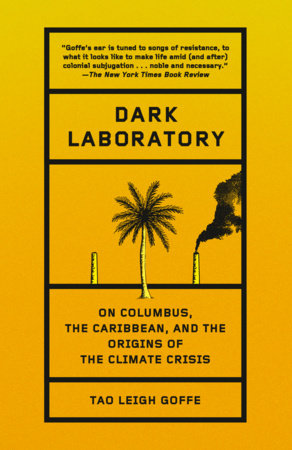
Dark Laboratory

On Columbus, the Caribbean, and the Origins of the Climate Crisis

Look inside
Listen to a clip from the audiobook
audio pause button
0:00
0:00
Paperback
$20.00 US
| $27.99 CAN
On sale Feb 10, 2026 | 384 Pages | 9780593684917
Grades 9-12 + AP/IB

See Additional Formats
A groundbreaking investigation of the Caribbean as both an idyll in the American imagination and a dark laboratory of Western experimentation, revealing secrets to racial and environmental progress that impact how we live today.

Dark Laboratory is a gargantuan, soulful work. It obliterates most of what I thought I knew about the Caribbean’s utility to Western Wealth.”
Kiese Laymon, New York Times bestselling author of Heavy


In 1492, Christopher Columbus arrived on the Caribbean Island of Guanahaní to find an Edenic scene that was soon mythologized. But behind the myth of paradise, the Caribbean and its people would come to pay the price of relentless Western exploitation and abuse. In Dark Laboratory, Dr. Tao Leigh Goffe embarks on a historical journey to chart the forces that have shaped these islands: the legacy of slavery, indentured labor, and the forced toil of Chinese and enslaved Black people who mined the islands’ bounty—including guano, which, at the time, was more valuable than gold—for the benefit of European powers and at the expense of the islands’ sacred ecologies.

Braiding together family history, cultural reportage, and social studies, Goffe radically transforms how we conceive of Blackness, the natural world, colonialism, and the climate crisis; and, in doing so, she deftly dismantles the many layers of entrenched imperialist thinking that shroud our established understanding of the human and environmental conditions to reveal the cause and effect of a global catastrophe. Dark Laboratory forces a reckoning with the received forms of knowledge that have led us astray.

Through the lens of the Caribbean, both guide and warning of the man-made disasters that continue to plague our world, Goffe closely situates the origins of racism and climate catastrophe within a colonial context. And in redressing these twin apocalypses, Dark Laboratory becomes a record of the violence that continues to shape the Caribbean today. But it is also a declaration of hope, offering solutions toward a better future based on knowledge gleaned from island ecosystems, and an impassioned, urgent testament to the human capacity for change and renewal.
BOOK I


Eden Is Not Lost


Lo Ting and Mami Wata

Garden Interlude

What other way is there than the sea? Lo Ting (盧亭) and Mami Wata are two of our guides through this book. From China and from West Africa, they met in the garden of the Caribbean where religious practices came together. Eden is full of such gods who traveled to the Americas with the rituals and beliefs of stolen people and those forcibly brought to those shores. Their saltwater children were born, those between international port cities. He, Lo Ting, is a hybrid, a fish-man native to Hong Kong’s fishing villages. It is said in Chinese folklore, he arose from the water centuries ago. He was resurrected as a political figure by dissident artists, beyond ancient myth, to rally claims for Hong Kong sovereignty in the 1990s. Mami Wata is a West African mermaid deity of the waters, a guardian of those forced to cross the oceans. Or her name is maybe Watramama or River Mumma. Kin to Yemayá, she is amphibious and mermaid-like, a snake charmer. Perhaps a manatee? She became the mother whose children are fish. Born of Lo Ting and Mami Wata, they were called impure, because they were of the saltwater, in Chinese grammar not fully Chinese, born in foreign waters and of diluted bloodlines. My lineage is of salt water.

In 1838, Britain’s colonial labor experiments between harbors connected the Black Pacific and Chinese Atlantic port cities Kingston and Hong Kong. Both are vertical modern cities and today both are flooding. Lo Ting sobs briny tears because he knows that with over sixty surrounding islands, Hong Kong is drowning. Hungry ghosts form a loud chorus asking to be venerated in secret corners and underwater caves. The “Thing with Scales,” Lo Ting’s lore shapes the underwater. The South China Sea islands are in geopolitical and climate crisis. Blank A4 sheets deny the piercing gaze of the surveillance state.

Victoria Harbor was submerged again in 2023, with Super Typhoon Saola’s floods sweeping away infrastructure. Hot and humid days brew as cyclones threaten the city, already channeling the dissent of over seven million residents. What other way is there than the sea? It is said that Lo Ting “fled to the islands and lives wildly there, eats mussels and uses shells to build walls.” For generations, Hong Kong’s Tanka people have built houses called pang uk (棚屋) that are engineered on stilts over the water. These traditional Chinese architectures are the blueprint for the future, for the rising tide of a vertical metropolis. With the rising tide of the climate crisis, will houses across the globe need stilts to walk across the waters?

In the Caribbean, ghosts called jumbies walk on stilts, having crossed the Middle Passage from West Africa. What other way is there than the sea? Caribbean fishermen will not learn how to swim because they believe it is bad luck. They revere the waves as a way of life and livelihood.

Kingston’s Tutty Gran Rosie is another one of our guides through the dark laboratory. She bears witness. Like the late New Orleans YouTuber and Bounce rapper Messy Mya, she is back by popular demand. In Jamaica and beyond she rose to fame because she was inconsolable. A Black woman, a mother of nine, Rosie went viral in 2013 with the exasperated refrain “Everyting flood out.” Cocking her head back, Bridgette Bailey became dubbed Tutty Gran Rosie because she demanded 30,000 Jamaican dollars ($192 USD) in reparations to replace her belongings washed away by flooding. Who will pay the reparations of climate crisis? Echoing the despair of Katrina in New Orleans, Tutty Gran Rosie’s home on Sunlight Street will flood again. She wants back her flat-screen TV, laptop, phone, desk lamp, an inventory of what was swept away. “Everyting flood out.” She demanded a name-brand car and name-brand furniture. She screamed with the ire of all people, Black and poor, swept aside by urban floodwaters by state-sanctioned neglect. The babies would get meningitis from the “shit water” of the overflowing gullies, Rosie warned in the viral video. The world laughed, ignoring her despair and demands for restitution, her ringing of the alarm of the failure of infrastructure of a bridge poorly built to handle climate crisis. Such is the case in many Black impoverished neighborhoods. It was a failure of the Jamaican government to meet the accelerating environmental crises. She is still waiting for her thirty grand. Her exclamation, “We need justice!” echoes.

1


Island Laboratories

My bright yellow Wellington boots were not at all the right shoes. I stared down at the vertical drop of the forested hillside, my hand folded tightly into Colonel’s. We were hiking on his property in Jamaica’s Blue and John Crow Mountains. Chief Wallace Sterling of the Windward Maroons is known by the honorific “Colonel” and is the descendant of a long line of Black warriors who have maintained their people’s independence for over 350 years on the island nation. Sterling is the longest serving chief, having been elected the leader of Moore Town (Windward Maroons) in 1995.

An important climate history about sovereignty is enfolded in Maroon history. Among the African people abducted from the Gold Coast were Akan and Fon generals and prisoners of war taken aboard cargo ships to the Americas. Colonel’s forebears plotted their rebellion at sea and were ready when they landed. They devised ways to fight from the moment they were shackled. They never stopped fighting; no enslaved person did. As much as the Caribbean is made of islands of European experimentation and exploitation, the region is also full of hidden laboratories for Afro-Indigenous sovereignty. In many ways the warfare between West Africa and Europe is ongoing today—despite the abolition of the transatlantic slave trade in 1807—because these Maroon and Amerindian communities still exist off the grid.

Maroon warriors include peoples fragmented across the hemispheres, from Virginia to Suriname to Haiti to French Guiana. These communities have long protected the natural environment as part of their martial philosophy. Cimarrón, a Spanish word derived from the Arawak language, signifies the renegade descendants of the escaped people who had been enslaved from the seventeenth and eighteenth centuries. Maroon autonomy has depended on a philosophy of unity with the wilderness. The Maroons’ identity as Black people who defied the British, the Dutch, the French, the Spanish, and the Danish has also been core to their survival and to the retention of African cultural and spiritual practices. The fate of the Maroons depends on land sovereignty. Where they live tend to be the most biodiverse spaces of wildlife refuge. The European colonial plot to conquer African and Indigenous nations was a twin campaign that also hinged on the depletion of tropical soil, subsoil, and bedrock.

As I looked downward along the mountainside, the sound of the river rushing below us in the wilderness of Moore Town calmed me. I thought of the duality of how the Maroons are perceived: both as traitors to the Jamaican people and as valiant, silent warriors. It’s a troubling contradiction, and one of many in my lineage. Today the Jamaican government is betraying the island while Maroons fight to protect the natural environment from the land grab of European mining. They fight to save the mountain aquifers, from which the island derives 40 percent of its drinking water, from contamination.

For those like me, descended from Africans who were enslaved, escaped, and manumitted, the contradictions of Black sovereignty are disturbing and liberating. Blackness is a lineage more complicated than the binary of free or enslaved. It is not a monolith. There are numerous shades of unfreedom. Maroon genealogies are heterogeneous pedigrees that include collusion and bloodlines with Native peoples. Capture and return of runaways to plantations in Jamaica were the terms of the British 1739 treaty. This clause outlines the requirements of betrayal:

Ninthly, That if any negroes shall hereafter run away from their masters or owners, and shall fall into Captain Cudjoe’s hands, they shall immediately be sent back to the chief magistrate of the next parish where they are taken; and these that bring them are to be satisfied for their trouble, as the legislature shall appoint. [The assembly granted a premium of thirty shillings for each fugitive slave returned to his owner by the Maroons, besides expenses.]

The British army sued for peace, fearing they would lose the whole colony of Jamaica to the Maroons in a protracted war. But only the mountains know the truth of the rival allegiances and what was required for the Maroons to retain Black sovereignty.

We do not yet have the full vocabulary to describe the ethics of these alliances because we rely so much on European languages (which is to say colonial languages such as Spanish and English) to articulate radical coalitions. European lexicons are not only inadequate but are also antithetical to Black, Indigenous, or Asian liberation. At Dark Lab, one of our ongoing initiatives is the composition of a collective Decolonial Glossary. The concept is to demilitarize our language before we can decolonize our imaginations. Some of the terms we will ask contributors to define may be guttural sounds, kissing teeth, common gestures, or specific diasporic registers of humor.

So many other languages and literacies other than Eurocentric ones exist. The language they told us was broken carries the answer to a broken present. In 1739, the price of freedom was forged under and beyond colonial sanctions of the British Crown in the secret headquarters of the limestone mountains. How could this negotiation be adequately translated from the Koramantee language and English? To answer this question, I hear the messages of the abeng, a Maroon heraldic musical instrument made from a cow’s horn and used to communicate across far distances. Such sovereign reverberations of the battle for land rights and sovereignty echo along the spine of the Americas. Across the hemisphere, these communities remain unconquered.

It was rainy season, and I was glad to be wearing my yellow boots, but I teetered on the muddy mountainside. While I have spent the past decade as a researcher traveling across the Caribbean taking part in field research and archival trips, I have never found it easy to acclimate to being so far from New York City.

As a Black person who is also of Chinese descent, I feel the pressure that looms over every climate debate in the Caribbean: the distrust of the Chinese. I believe the contested island geographies—Jamaica and Hong Kong—reveal the key to unlocking strategies that might help to solve this crisis. So here I trace Maroon and Chinese histories in relation to the questions of climate and sovereignty after British Empire. Part of my family history traces back to the borderlands of China and Hong Kong. The Chinese presence in the Antilles spans more than two hundred years, back to at least 1804.

Today, in Jamaica, Chinese-backed loans provide funding for infrastructure to fight climate crisis, but these arrangements also fuel widespread suspicion. What motivates the favorable rates? There is outrage over the extractive practices and the ecological degradation that has occurred. Many Jamaicans fear being indebted to China. There is no shortage of headlines from Western outlets such as the Economist and the New York Times that stoke the anti-Asian rhetoric about China in Latin America, the Caribbean, and Africa. I hear the Yellow Peril sentiments of a century prior echoing throughout these articles. Few denounce the United States, Canada, Russia, and European nations as loudly for their continued role in the Caribbean’s climate degradation.

Where the colonial West has abandoned and neglected the region, China has offered relief in the form of concrete financial investment over the past twenty-five years. The Jamaican prime minister welcomed an investment of $300 million JSD (almost $2 million USD) by Chinese telecommunications corporation Huawei into the capital city of the country in 2022. The presence of a 9,000-square-foot office in the heart of uptown Kingston on Hope Road worries the United States most of all. However, to critique the extractive capitalist policies of China without fully reckoning with the ongoing role of the United States, Europe, and Canada is to remain complicit in false climate innocence and amnesia. Canada is home to 75 percent of global mining companies, which are headquartered there. Toronto is the heart of many colonial extractive prospecting projects and lists 60 percent of these corporations on the Toronto Stock Exchange (TSX).

China’s presence in the Caribbean long predates the twenty-first century; the earliest mass labor migration to Jamaica took place in 1854. Before the voyages of indentured laborers, we must consider the seafaring of Chinese admiral Zheng He, who is said to have arrived in the Americas in 1421. Though often dismissed as counterfactual history, how does Zheng He alter the possible definitions of colonial desire? China’s colonialisms are multiple, and their legacies are evident across Southeast Asia and do not manifest with the same extractivist design of European settler colonialism.

As a small minority community, the Chinese and people of Chinese descent have been a target of frustration across the Caribbean. Loyalties and allegiances are questioned because of their prominence in the merchant and entrepreneurial trades. Many non-Chinese people collapse the difference between centralized Chinese state power and decentralized diaspora formations. Separating these actors, the cycles of migration, the Cultural Revolution, and these spheres of influence is critical to grappling with the Chinese role in Caribbean climate crises. Migrants—chiefly subsistence farmers and small retail shopkeepers who migrated in the nineteenth and twentieth centuries—often subscribe to an uneasy sense of Chinese identity outside of China.

Maroon and Chinese histories flow in my bloodlines, with rival philosophies, territories, and dialects. Many minority groups, including manumitted and free people of color, find themselves at these crossroads in Jamaican history. Have they betrayed the project of Black freedom? Such fractures are the design of the British. How do we envision autonomy after colonialism? The contemporary Jamaican government has been complicit in selling the future of the island to the highest foreign bidder. The exploitation of the islands by British, Canadian, and American absentee colonialism is so normalized that it no longer seems to merit interrogation, while the Chinese are figured as a visible and present target. Canadian banks, such as Scotiabank and Royal Bank of Canada (on which Caribbean nations depend) are guilty of a financial practice called de-risking since 2019. Shuttering banks across the region, they are destabilizing the banking infrastructure of average citizens because it is no longer lucrative. Canada sees more opportunity in Latin America, where there is strong population growth, as opposed to what they consider to be stagnant about the Caribbean. Abandonment is a form of imperial economic control. More financial dependencies are created by the sudden vacuum left in the economy.

Perversely, since racial slavery is the majority history of the region, we lack details about the interior lives of enslaved Africans. What I glean I source from plantation records that document rum and sugar production from those plots of land where generations of my family toiled. Even if they did not escape from plantations to form runaway communities like the Maroons, I know they participated in everyday forms of maroonage or rebellion. Self-determination is an everyday practice of survival through major and minor acts of refusing the colonial reality.
One of Publishers Weekly's Top 10 History Books This Fall • One of Lit Hub's Most Anticipated Books of 2025

“Groundbreaking.” The Guardian

“Goffe’s ear is tuned to songs of resistance, to what it looks like to make life amid (and after) colonial subjugation…noble and necessary.” The New York Times Book Review

Dark Laboratory is stunning, brilliant and transformative. With a vast archive and a mighty pen, Tao Leigh Goffe tells the story of modernity and its discontents through the land, legacy, and people of the Caribbean. Upon reading this book, you will have a new understanding of the world.” —Imani Perry, National Book Award-winning author of South to America: A Journey Below the Mason-Dixon to Understand the Soul of a Nation

“Ambitious….This is an urgent and frequently grim work, but it is also hopeful….And Goffe is relentlessly engaging, leaving the academy’s dusty archives, and traveling from Jamaica to Sardinia, Hong Kong to Hawai‘i, to discover better ways to live.” The Atlantic

Dark Laboratory is a gargantuan, soulful work. It obliterates most of what I thought I knew about the Caribbean’s utility to Western wealth.” Kiese Laymon, New York Times bestselling author of Heavy

“Dark Laboratory takes readers by the hand and guides them from mountain tops to coral reefs, from Jamaica to China, from the story of one family to that of our planet, from the pasts that have made us to a future we can still imagine. At once expansive and intimate, Dark Laboratory is an ambitious, genre-busting book.” —Ada Ferrer, Pulitzer Prize-winning author of Cuba: An American History

Dark Laboratory is an urgent exploration of race, climate, and the devastating colonial experimentation with human lives and the natural world. It explodes conventional thinking about the crushing effects of profit-mongering, then unexpectedly, leads us back to sources of original power and ways of knowing who we are. Tao Leigh Goffe is a courageous, big-picture thinker who leaves no leaf unturned.” Gretel Ehrlich, author of The Solace of Open Spaces

“From past to present and island to island, with wisdom and lyricism, Tao Leigh Goffe shows that we cannot honestly reckon with the global climate crisis without acknowledging its roots in the cultural, social, and ecological upheavals first inflicted on the so-called New World and its peoples in 1492and for centuries thereafter. Yet from this darkness, she offers light.” Jack E. Davis, author of the Pulitzer Prize-winning The Gulf: The Making of an American Sea

“Sweeping and sacred, Dark Laboratory stands as a singular text, leading readers through the dense layers of racial and colonial sedimentation that shape our present while radically reimagining a livable future on our rapidly warming planet.” —Ruha Benjamin, author of Viral Justice: How We Grow the World We Want

“Goffe invites us to see climate action as a decolonial projecto—one that requires transforming not only economies but also systems of knowledge, memory, and belonging.” LSE Review of Books

“In this roving, erudite debut study, Goffe…traces the attitudes and beliefs that undergird today’s climate crisis back to the racist, extractive systems of thought developed by European colonizers in previous centuries…scintillating…bursts with keen insights and connections.” —Publishers Weekly *starred review*

“The best writing in any form leaves the reader with something to ponder, and Goffe’s criticism of, and skepticism about, nearly every aspect of Western academic assumptions concerning the climate crisis, imperialism, and race does just that…A timely and provocative study.” —Kirkus Reviews

“[Goffe] calls readers to rethink their relationships to environments, to rethink the idea of ownership and belonging, and so also rethink the idea of climate justice for everyone…compelling.” –Shelf Awareness
© Elena Seibert
TAO LEIGH GOFFE is a London-born, Black British award-winning writer, theorist, and interdisciplinary artist who grew up between the UK and New York. Her research explores Black diasporic intellectual histories, political, and ecological life. She studied English literature at Princeton University before pursuing a PhD at Yale University. She lives and works in Manhattan where she is currently an Associate Professor at Hunter College, CUNY. Dr. Goffe has held academic positions and fellowships at Leiden University in the Netherlands and Princeton University in New Jersey. View titles by Tao Leigh Goffe

About

A groundbreaking investigation of the Caribbean as both an idyll in the American imagination and a dark laboratory of Western experimentation, revealing secrets to racial and environmental progress that impact how we live today.

Dark Laboratory is a gargantuan, soulful work. It obliterates most of what I thought I knew about the Caribbean’s utility to Western Wealth.”
Kiese Laymon, New York Times bestselling author of Heavy


In 1492, Christopher Columbus arrived on the Caribbean Island of Guanahaní to find an Edenic scene that was soon mythologized. But behind the myth of paradise, the Caribbean and its people would come to pay the price of relentless Western exploitation and abuse. In Dark Laboratory, Dr. Tao Leigh Goffe embarks on a historical journey to chart the forces that have shaped these islands: the legacy of slavery, indentured labor, and the forced toil of Chinese and enslaved Black people who mined the islands’ bounty—including guano, which, at the time, was more valuable than gold—for the benefit of European powers and at the expense of the islands’ sacred ecologies.

Braiding together family history, cultural reportage, and social studies, Goffe radically transforms how we conceive of Blackness, the natural world, colonialism, and the climate crisis; and, in doing so, she deftly dismantles the many layers of entrenched imperialist thinking that shroud our established understanding of the human and environmental conditions to reveal the cause and effect of a global catastrophe. Dark Laboratory forces a reckoning with the received forms of knowledge that have led us astray.

Through the lens of the Caribbean, both guide and warning of the man-made disasters that continue to plague our world, Goffe closely situates the origins of racism and climate catastrophe within a colonial context. And in redressing these twin apocalypses, Dark Laboratory becomes a record of the violence that continues to shape the Caribbean today. But it is also a declaration of hope, offering solutions toward a better future based on knowledge gleaned from island ecosystems, and an impassioned, urgent testament to the human capacity for change and renewal.

Excerpt

BOOK I


Eden Is Not Lost


Lo Ting and Mami Wata

Garden Interlude

What other way is there than the sea? Lo Ting (盧亭) and Mami Wata are two of our guides through this book. From China and from West Africa, they met in the garden of the Caribbean where religious practices came together. Eden is full of such gods who traveled to the Americas with the rituals and beliefs of stolen people and those forcibly brought to those shores. Their saltwater children were born, those between international port cities. He, Lo Ting, is a hybrid, a fish-man native to Hong Kong’s fishing villages. It is said in Chinese folklore, he arose from the water centuries ago. He was resurrected as a political figure by dissident artists, beyond ancient myth, to rally claims for Hong Kong sovereignty in the 1990s. Mami Wata is a West African mermaid deity of the waters, a guardian of those forced to cross the oceans. Or her name is maybe Watramama or River Mumma. Kin to Yemayá, she is amphibious and mermaid-like, a snake charmer. Perhaps a manatee? She became the mother whose children are fish. Born of Lo Ting and Mami Wata, they were called impure, because they were of the saltwater, in Chinese grammar not fully Chinese, born in foreign waters and of diluted bloodlines. My lineage is of salt water.

In 1838, Britain’s colonial labor experiments between harbors connected the Black Pacific and Chinese Atlantic port cities Kingston and Hong Kong. Both are vertical modern cities and today both are flooding. Lo Ting sobs briny tears because he knows that with over sixty surrounding islands, Hong Kong is drowning. Hungry ghosts form a loud chorus asking to be venerated in secret corners and underwater caves. The “Thing with Scales,” Lo Ting’s lore shapes the underwater. The South China Sea islands are in geopolitical and climate crisis. Blank A4 sheets deny the piercing gaze of the surveillance state.

Victoria Harbor was submerged again in 2023, with Super Typhoon Saola’s floods sweeping away infrastructure. Hot and humid days brew as cyclones threaten the city, already channeling the dissent of over seven million residents. What other way is there than the sea? It is said that Lo Ting “fled to the islands and lives wildly there, eats mussels and uses shells to build walls.” For generations, Hong Kong’s Tanka people have built houses called pang uk (棚屋) that are engineered on stilts over the water. These traditional Chinese architectures are the blueprint for the future, for the rising tide of a vertical metropolis. With the rising tide of the climate crisis, will houses across the globe need stilts to walk across the waters?

In the Caribbean, ghosts called jumbies walk on stilts, having crossed the Middle Passage from West Africa. What other way is there than the sea? Caribbean fishermen will not learn how to swim because they believe it is bad luck. They revere the waves as a way of life and livelihood.

Kingston’s Tutty Gran Rosie is another one of our guides through the dark laboratory. She bears witness. Like the late New Orleans YouTuber and Bounce rapper Messy Mya, she is back by popular demand. In Jamaica and beyond she rose to fame because she was inconsolable. A Black woman, a mother of nine, Rosie went viral in 2013 with the exasperated refrain “Everyting flood out.” Cocking her head back, Bridgette Bailey became dubbed Tutty Gran Rosie because she demanded 30,000 Jamaican dollars ($192 USD) in reparations to replace her belongings washed away by flooding. Who will pay the reparations of climate crisis? Echoing the despair of Katrina in New Orleans, Tutty Gran Rosie’s home on Sunlight Street will flood again. She wants back her flat-screen TV, laptop, phone, desk lamp, an inventory of what was swept away. “Everyting flood out.” She demanded a name-brand car and name-brand furniture. She screamed with the ire of all people, Black and poor, swept aside by urban floodwaters by state-sanctioned neglect. The babies would get meningitis from the “shit water” of the overflowing gullies, Rosie warned in the viral video. The world laughed, ignoring her despair and demands for restitution, her ringing of the alarm of the failure of infrastructure of a bridge poorly built to handle climate crisis. Such is the case in many Black impoverished neighborhoods. It was a failure of the Jamaican government to meet the accelerating environmental crises. She is still waiting for her thirty grand. Her exclamation, “We need justice!” echoes.

1


Island Laboratories

My bright yellow Wellington boots were not at all the right shoes. I stared down at the vertical drop of the forested hillside, my hand folded tightly into Colonel’s. We were hiking on his property in Jamaica’s Blue and John Crow Mountains. Chief Wallace Sterling of the Windward Maroons is known by the honorific “Colonel” and is the descendant of a long line of Black warriors who have maintained their people’s independence for over 350 years on the island nation. Sterling is the longest serving chief, having been elected the leader of Moore Town (Windward Maroons) in 1995.

An important climate history about sovereignty is enfolded in Maroon history. Among the African people abducted from the Gold Coast were Akan and Fon generals and prisoners of war taken aboard cargo ships to the Americas. Colonel’s forebears plotted their rebellion at sea and were ready when they landed. They devised ways to fight from the moment they were shackled. They never stopped fighting; no enslaved person did. As much as the Caribbean is made of islands of European experimentation and exploitation, the region is also full of hidden laboratories for Afro-Indigenous sovereignty. In many ways the warfare between West Africa and Europe is ongoing today—despite the abolition of the transatlantic slave trade in 1807—because these Maroon and Amerindian communities still exist off the grid.

Maroon warriors include peoples fragmented across the hemispheres, from Virginia to Suriname to Haiti to French Guiana. These communities have long protected the natural environment as part of their martial philosophy. Cimarrón, a Spanish word derived from the Arawak language, signifies the renegade descendants of the escaped people who had been enslaved from the seventeenth and eighteenth centuries. Maroon autonomy has depended on a philosophy of unity with the wilderness. The Maroons’ identity as Black people who defied the British, the Dutch, the French, the Spanish, and the Danish has also been core to their survival and to the retention of African cultural and spiritual practices. The fate of the Maroons depends on land sovereignty. Where they live tend to be the most biodiverse spaces of wildlife refuge. The European colonial plot to conquer African and Indigenous nations was a twin campaign that also hinged on the depletion of tropical soil, subsoil, and bedrock.

As I looked downward along the mountainside, the sound of the river rushing below us in the wilderness of Moore Town calmed me. I thought of the duality of how the Maroons are perceived: both as traitors to the Jamaican people and as valiant, silent warriors. It’s a troubling contradiction, and one of many in my lineage. Today the Jamaican government is betraying the island while Maroons fight to protect the natural environment from the land grab of European mining. They fight to save the mountain aquifers, from which the island derives 40 percent of its drinking water, from contamination.

For those like me, descended from Africans who were enslaved, escaped, and manumitted, the contradictions of Black sovereignty are disturbing and liberating. Blackness is a lineage more complicated than the binary of free or enslaved. It is not a monolith. There are numerous shades of unfreedom. Maroon genealogies are heterogeneous pedigrees that include collusion and bloodlines with Native peoples. Capture and return of runaways to plantations in Jamaica were the terms of the British 1739 treaty. This clause outlines the requirements of betrayal:

Ninthly, That if any negroes shall hereafter run away from their masters or owners, and shall fall into Captain Cudjoe’s hands, they shall immediately be sent back to the chief magistrate of the next parish where they are taken; and these that bring them are to be satisfied for their trouble, as the legislature shall appoint. [The assembly granted a premium of thirty shillings for each fugitive slave returned to his owner by the Maroons, besides expenses.]

The British army sued for peace, fearing they would lose the whole colony of Jamaica to the Maroons in a protracted war. But only the mountains know the truth of the rival allegiances and what was required for the Maroons to retain Black sovereignty.

We do not yet have the full vocabulary to describe the ethics of these alliances because we rely so much on European languages (which is to say colonial languages such as Spanish and English) to articulate radical coalitions. European lexicons are not only inadequate but are also antithetical to Black, Indigenous, or Asian liberation. At Dark Lab, one of our ongoing initiatives is the composition of a collective Decolonial Glossary. The concept is to demilitarize our language before we can decolonize our imaginations. Some of the terms we will ask contributors to define may be guttural sounds, kissing teeth, common gestures, or specific diasporic registers of humor.

So many other languages and literacies other than Eurocentric ones exist. The language they told us was broken carries the answer to a broken present. In 1739, the price of freedom was forged under and beyond colonial sanctions of the British Crown in the secret headquarters of the limestone mountains. How could this negotiation be adequately translated from the Koramantee language and English? To answer this question, I hear the messages of the abeng, a Maroon heraldic musical instrument made from a cow’s horn and used to communicate across far distances. Such sovereign reverberations of the battle for land rights and sovereignty echo along the spine of the Americas. Across the hemisphere, these communities remain unconquered.

It was rainy season, and I was glad to be wearing my yellow boots, but I teetered on the muddy mountainside. While I have spent the past decade as a researcher traveling across the Caribbean taking part in field research and archival trips, I have never found it easy to acclimate to being so far from New York City.

As a Black person who is also of Chinese descent, I feel the pressure that looms over every climate debate in the Caribbean: the distrust of the Chinese. I believe the contested island geographies—Jamaica and Hong Kong—reveal the key to unlocking strategies that might help to solve this crisis. So here I trace Maroon and Chinese histories in relation to the questions of climate and sovereignty after British Empire. Part of my family history traces back to the borderlands of China and Hong Kong. The Chinese presence in the Antilles spans more than two hundred years, back to at least 1804.

Today, in Jamaica, Chinese-backed loans provide funding for infrastructure to fight climate crisis, but these arrangements also fuel widespread suspicion. What motivates the favorable rates? There is outrage over the extractive practices and the ecological degradation that has occurred. Many Jamaicans fear being indebted to China. There is no shortage of headlines from Western outlets such as the Economist and the New York Times that stoke the anti-Asian rhetoric about China in Latin America, the Caribbean, and Africa. I hear the Yellow Peril sentiments of a century prior echoing throughout these articles. Few denounce the United States, Canada, Russia, and European nations as loudly for their continued role in the Caribbean’s climate degradation.

Where the colonial West has abandoned and neglected the region, China has offered relief in the form of concrete financial investment over the past twenty-five years. The Jamaican prime minister welcomed an investment of $300 million JSD (almost $2 million USD) by Chinese telecommunications corporation Huawei into the capital city of the country in 2022. The presence of a 9,000-square-foot office in the heart of uptown Kingston on Hope Road worries the United States most of all. However, to critique the extractive capitalist policies of China without fully reckoning with the ongoing role of the United States, Europe, and Canada is to remain complicit in false climate innocence and amnesia. Canada is home to 75 percent of global mining companies, which are headquartered there. Toronto is the heart of many colonial extractive prospecting projects and lists 60 percent of these corporations on the Toronto Stock Exchange (TSX).

China’s presence in the Caribbean long predates the twenty-first century; the earliest mass labor migration to Jamaica took place in 1854. Before the voyages of indentured laborers, we must consider the seafaring of Chinese admiral Zheng He, who is said to have arrived in the Americas in 1421. Though often dismissed as counterfactual history, how does Zheng He alter the possible definitions of colonial desire? China’s colonialisms are multiple, and their legacies are evident across Southeast Asia and do not manifest with the same extractivist design of European settler colonialism.

As a small minority community, the Chinese and people of Chinese descent have been a target of frustration across the Caribbean. Loyalties and allegiances are questioned because of their prominence in the merchant and entrepreneurial trades. Many non-Chinese people collapse the difference between centralized Chinese state power and decentralized diaspora formations. Separating these actors, the cycles of migration, the Cultural Revolution, and these spheres of influence is critical to grappling with the Chinese role in Caribbean climate crises. Migrants—chiefly subsistence farmers and small retail shopkeepers who migrated in the nineteenth and twentieth centuries—often subscribe to an uneasy sense of Chinese identity outside of China.

Maroon and Chinese histories flow in my bloodlines, with rival philosophies, territories, and dialects. Many minority groups, including manumitted and free people of color, find themselves at these crossroads in Jamaican history. Have they betrayed the project of Black freedom? Such fractures are the design of the British. How do we envision autonomy after colonialism? The contemporary Jamaican government has been complicit in selling the future of the island to the highest foreign bidder. The exploitation of the islands by British, Canadian, and American absentee colonialism is so normalized that it no longer seems to merit interrogation, while the Chinese are figured as a visible and present target. Canadian banks, such as Scotiabank and Royal Bank of Canada (on which Caribbean nations depend) are guilty of a financial practice called de-risking since 2019. Shuttering banks across the region, they are destabilizing the banking infrastructure of average citizens because it is no longer lucrative. Canada sees more opportunity in Latin America, where there is strong population growth, as opposed to what they consider to be stagnant about the Caribbean. Abandonment is a form of imperial economic control. More financial dependencies are created by the sudden vacuum left in the economy.

Perversely, since racial slavery is the majority history of the region, we lack details about the interior lives of enslaved Africans. What I glean I source from plantation records that document rum and sugar production from those plots of land where generations of my family toiled. Even if they did not escape from plantations to form runaway communities like the Maroons, I know they participated in everyday forms of maroonage or rebellion. Self-determination is an everyday practice of survival through major and minor acts of refusing the colonial reality.

Reviews

One of Publishers Weekly's Top 10 History Books This Fall • One of Lit Hub's Most Anticipated Books of 2025

“Groundbreaking.” The Guardian

“Goffe’s ear is tuned to songs of resistance, to what it looks like to make life amid (and after) colonial subjugation…noble and necessary.” The New York Times Book Review

Dark Laboratory is stunning, brilliant and transformative. With a vast archive and a mighty pen, Tao Leigh Goffe tells the story of modernity and its discontents through the land, legacy, and people of the Caribbean. Upon reading this book, you will have a new understanding of the world.” —Imani Perry, National Book Award-winning author of South to America: A Journey Below the Mason-Dixon to Understand the Soul of a Nation

“Ambitious….This is an urgent and frequently grim work, but it is also hopeful….And Goffe is relentlessly engaging, leaving the academy’s dusty archives, and traveling from Jamaica to Sardinia, Hong Kong to Hawai‘i, to discover better ways to live.” The Atlantic

Dark Laboratory is a gargantuan, soulful work. It obliterates most of what I thought I knew about the Caribbean’s utility to Western wealth.” Kiese Laymon, New York Times bestselling author of Heavy

“Dark Laboratory takes readers by the hand and guides them from mountain tops to coral reefs, from Jamaica to China, from the story of one family to that of our planet, from the pasts that have made us to a future we can still imagine. At once expansive and intimate, Dark Laboratory is an ambitious, genre-busting book.” —Ada Ferrer, Pulitzer Prize-winning author of Cuba: An American History

Dark Laboratory is an urgent exploration of race, climate, and the devastating colonial experimentation with human lives and the natural world. It explodes conventional thinking about the crushing effects of profit-mongering, then unexpectedly, leads us back to sources of original power and ways of knowing who we are. Tao Leigh Goffe is a courageous, big-picture thinker who leaves no leaf unturned.” Gretel Ehrlich, author of The Solace of Open Spaces

“From past to present and island to island, with wisdom and lyricism, Tao Leigh Goffe shows that we cannot honestly reckon with the global climate crisis without acknowledging its roots in the cultural, social, and ecological upheavals first inflicted on the so-called New World and its peoples in 1492and for centuries thereafter. Yet from this darkness, she offers light.” Jack E. Davis, author of the Pulitzer Prize-winning The Gulf: The Making of an American Sea

“Sweeping and sacred, Dark Laboratory stands as a singular text, leading readers through the dense layers of racial and colonial sedimentation that shape our present while radically reimagining a livable future on our rapidly warming planet.” —Ruha Benjamin, author of Viral Justice: How We Grow the World We Want

“Goffe invites us to see climate action as a decolonial projecto—one that requires transforming not only economies but also systems of knowledge, memory, and belonging.” LSE Review of Books

“In this roving, erudite debut study, Goffe…traces the attitudes and beliefs that undergird today’s climate crisis back to the racist, extractive systems of thought developed by European colonizers in previous centuries…scintillating…bursts with keen insights and connections.” —Publishers Weekly *starred review*

“The best writing in any form leaves the reader with something to ponder, and Goffe’s criticism of, and skepticism about, nearly every aspect of Western academic assumptions concerning the climate crisis, imperialism, and race does just that…A timely and provocative study.” —Kirkus Reviews

“[Goffe] calls readers to rethink their relationships to environments, to rethink the idea of ownership and belonging, and so also rethink the idea of climate justice for everyone…compelling.” –Shelf Awareness

Author

© Elena Seibert
TAO LEIGH GOFFE is a London-born, Black British award-winning writer, theorist, and interdisciplinary artist who grew up between the UK and New York. Her research explores Black diasporic intellectual histories, political, and ecological life. She studied English literature at Princeton University before pursuing a PhD at Yale University. She lives and works in Manhattan where she is currently an Associate Professor at Hunter College, CUNY. Dr. Goffe has held academic positions and fellowships at Leiden University in the Netherlands and Princeton University in New Jersey. View titles by Tao Leigh Goffe
  • More Websites from
    Penguin Random House
  • Common Reads
  • Library Marketing