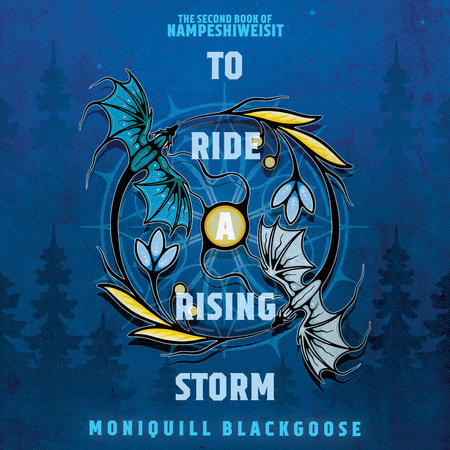
To Ride a Rising Storm

The Second Book of Nampeshiweisit

Audiobook Download
On sale Jan 27, 2026 | 17 Hours and 0 Minutes | 9780593677278
Grades 9-12

See Additional Formats
A young indigenous woman and her dragon fight for the independence of their homeland in this epic sequel to the bestselling and multi-award-winning To Shape a Dragon’s Breath, “a remarkable novel that is bound to be a staple of fantasy shelves for years to come” (BuzzFeed).

Anequs has not only survived her first year at Kuiper’s Academy but exceeded her professors’ admittedly low expectations—and passed all her courses with honors. Now she and her dragon, Kasaqua, are headed home for the summer, along with Theod, the only other native student at the Academy.

But what should have been a relaxing break takes a darker turn. Thanks to Anequs’s notoriety, there is an Anglish presence on Masquapaug for the first time ever: a presence that Anequs hates. Anequs will always fight for what she believes in, however, and what she believes in is her people’s right to self-govern and live as they have for generations, without the restrictive yoke of Anglish rules and social customs. And fight she will—even if it means lighting a spark that may flare into civil war.
First, Anequs came home

The first thing I saw, as Masquapaug became visible on the horizon, was the new Anglish encampment. The sight of it made my eyes sting and my breath catch. The Anglish were not supposed to be on Masquapaug—­home was supposed to be safe from them.

I wanted to scream. I wanted to ask Kasaqua to loose her breath at it, shapeless and wild, reducing everything to ash and wind. I didn’t just want the camp and its people gone; I wanted it to never have been.

The jarl and his people had hidden all of this from me until this morning.

On the ninth of May, a representative of the Ravens of Joden had made an attempt on the jarl’s life, and had shot at Kasaqua and me in the process. Kasaqua had dispatched the would-­be assassin. She wasn’t yet one year of age and still could not fly, but she’d already killed a man in my defense—­and in defense of the jarl, which made the act heroic rather than monstrous. At least to the jarl and his supporters.

It was the twenty-­sixth of May today, and Theod and I had been informed just this morning that, in the wake of these events, the Ministry of Dragon Affairs had decided that Masquapaug—­as a district of Lindmarden—­ought to have an outpost of thanegards. Every other district had one, after all—­even Naquipaug. Especially Naquipaug.

Whatever I might have expected them to do in seventeen days, it hadn’t been this.

What had been the point of my going to the academy, in following all the rules that had been dictated to me, if the Anglish were going to be here anyway?

A neat row of white canvas tents stood along the road that led from the docks back to the village, and the skeletal timber frame of a building under construction loomed behind them. It was twice the size of the post and telegraph office, built in the Anglish style—­a square base with a sharply sloping roof. It was not at all the kind of building that belonged on Masquapaug. I wondered, as we approached, if they’d sourced the timber locally—­if trees that had grown on the island had been felled to make that monstrosity. And if they’d thought to plant new ones to replace the ones they’d killed.

“It’s bigger than I thought it would be,” I said, swallowing hard, gripping the rail so tightly that my fingers ached. I glanced at Theod. We were both leaning over the railing near the bow of a boat, gazing toward the island. He was staring at the tents, his face devoid of emotion. It couldn’t be the same for him; he’d been raised among the Anglish. He wasn’t from Masquapaug.

“Isn’t it a provision of the treaty of 1757 that the Anglish can’t even visit Masquapaug without special invitation?” he asked uncertainly, not looking away from the camp.

“It is,” I said. “I wonder if Sachem Tanaquish signed an amendment, or if this is just a breach of the treaty. I wish someone had told us about this before.”

Another thing they hadn’t told us until after breakfast was that our travel plans from the academy had changed. We wouldn’t be taking the train and the ferry as usual, but would instead be delivered by automotor to a private sailboat chartered by the office of the jarl. We’d be accompanied by a pair of handpicked guards armed with pistols. No one had been precisely clear on what we were being protected from. Or what was being protected from us.

Apart from “seeing to the safety of our journey from the academy to the island,” the men in our company were here to ensure the seamless installation of the thanegards at their new outpost. They’d be staying on the island all summer and would be escorting us back to the security of the academy’s grounds in September.

We had very little choice in the matter.

The worst of it was that the Anglish force was on Masquapaug because of me—­because I was Nampeshiweisit.

I’d become Nampeshiweisit on the eighth of July last year, when a dragon of the kind native to this land—­a Nampeshiwe—­had been hatched in our meetinghouse on Masquapaug. Upon her hatching, Kasaqua had chosen me to be her lifelong companion.

The Anglish did not approve.

I had learned very soon after Kasaqua’s hatching that the Anglish had innumerable laws concerning the keeping of dragons, particularly relating to who was and who wasn’t allowed to pair with them. The indisputable fact that nothing, save death, could sever the bond shared by a dragon and its human companion meant that any dragon who chose a companion deemed unfit by Anglish authorities was at significant risk of being put to death. I had been expressly threatened with such a fate for Kasaqua, in the event that I did not prove myself fit—­by Anglish standards—­for the command of a dragon.

Because the Anglish did very much view it as command—­not as a partnership or a way of relating.

By the Anglish way of thinking, dragons were weapons before anything else.

There were people in authority who believed that neither Theod nor I should be allowed the command of dragons, because of our race. Theod’s dragon, Copper, had only avoided being killed because he was held under the auspices of Frau Karina Kuiper, headmistress of Kuiper’s Academy of Natural Philosophy and Skiltakraft. So long as Copper was housed in the school’s dragonhall, his attachment to Theod had been . . . tolerated. That concession had made Theod something of a prisoner—­a state of affairs that he had been willing to accept. The same fate had been intended for Kasaqua and me, but unlike Theod, I was not of a mind to endure separation from my family and my home.

So I’d become accomplished in the art of skiltakraft, and I’d dragged Theod along with me.

Having passed our examinations, we had the provisional permission given to all passing students of the academy: to travel home—­with our dragons—­for the duration of the summer recess.

Kasaqua thrust her nose into my armpit from behind in a demand for attention, pushing me with enough force that I had to steady myself against the handrail to keep on my feet. I could feel my connection with her in the cores of my bones; I was broadly aware of her wants and worries, and she of mine. At times of high emotion, it could seem that we were one creature.

She knew that I was angry and fraught, just now, and she didn’t understand why.

Kasaqua made a chirping sound, and I turned to tousle the feathers at the crown of her head, right between her antlers. She’d gotten tall enough in these last weeks that she could comfortably rest her muzzle on my shoulder. She was still so slight in build that I hadn’t tried her as a mount, but she was filling out quickly. Riding classes would certainly be on my schedule when I returned to the academy in September.

Theod’s Copper was a year older than Kasaqua and nearing his adult size—­six and half feet tall at the shoulder, twenty feet from nose to tail, thirty from wingtip to wingtip at full spread. He was an Akhari, of an excellent pedigree, bred across generations to be a long-­distance flyer. He’d had his first flight in December, and while Theod could ride him over land, he couldn’t bear Theod’s weight in the air for more than fifteen or twenty minutes. Yet. He was sleeping on the sunniest part of the deck and seemed blissfully unaware of anything upsetting happening on the island.

Before I’d become Nampeshiweisit, the only person living on Masquapaug who wasn’t a native of the islands had been Mister Aroztegui, the fastidious Vaskosman who ran the post and telegraph office. Naquipaug had had thanegards since the tragic events of 1825, but Masquapaug had been a place below Anglish notice of any kind.

Now, because I was Nampeshiweisit, we were subjects of great interest.

I stepped off the ferry and directly into my mother’s arms. My siblings, Sigoskwe and Sakewa and especially Niquiat, had been able to visit me at school. I hadn’t seen Mother or Grandma since Nikkomo—­almost half a year. I’d been shot at, in the meantime.

“I’ve missed you so much,” I said against her shoulder, hugging her as tightly as my tender ribs would allow. “I have so much to tell you about, and things I want to talk about, and—­”

“Let’s get you home,” Mother said, the warmth of her voice making my eyes sting.

There were introductions to be made, of course, and polite welcome made to our guards. They, thankfully, bid us goodbye and moved toward the encampment and building site. There was a whole carton of letters and telegrams waiting at the post office, some addressed to me and some addressed to Theod. We thanked Mister Aroztegui for them, and he welcomed us home.

My younger siblings were very keen to play with the dragons, marveling at how they’d both grown. That was just as well, because both Kasaqua and Copper were restless from general confinement, and having Kasaqua stretch her legs and wings was a point of pure relief among many different points of tension.

Nothing had ever tasted as good as the bowl of sobaheg that Mother put into my hands. It was a very green batch, as befitted springtime—­made with ramps and sea rocket and cherrystone clams. It tasted like home.
© Angelina Rose Photography
Moniquill Blackgoose is the bestselling author of To Shape a Dragon’s Breath, which has won both the Nebula and Lodestar Awards. She began writing science fiction and fantasy when she was twelve and hasn’t stopped writing since. She is an enrolled member of the Seaconke Wampanoag Tribe and a lineal descendant of Ousamequin Massasoit. She is an avid costumer and an active member of the steampunk community. She has blogged, essayed, and discussed extensively across many platforms the depictions of Indigenous and Indigenous-coded characters in sci-fi and fantasy. View titles by Moniquill Blackgoose

About

A young indigenous woman and her dragon fight for the independence of their homeland in this epic sequel to the bestselling and multi-award-winning To Shape a Dragon’s Breath, “a remarkable novel that is bound to be a staple of fantasy shelves for years to come” (BuzzFeed).

Anequs has not only survived her first year at Kuiper’s Academy but exceeded her professors’ admittedly low expectations—and passed all her courses with honors. Now she and her dragon, Kasaqua, are headed home for the summer, along with Theod, the only other native student at the Academy.

But what should have been a relaxing break takes a darker turn. Thanks to Anequs’s notoriety, there is an Anglish presence on Masquapaug for the first time ever: a presence that Anequs hates. Anequs will always fight for what she believes in, however, and what she believes in is her people’s right to self-govern and live as they have for generations, without the restrictive yoke of Anglish rules and social customs. And fight she will—even if it means lighting a spark that may flare into civil war.

Excerpt

First, Anequs came home

The first thing I saw, as Masquapaug became visible on the horizon, was the new Anglish encampment. The sight of it made my eyes sting and my breath catch. The Anglish were not supposed to be on Masquapaug—­home was supposed to be safe from them.

I wanted to scream. I wanted to ask Kasaqua to loose her breath at it, shapeless and wild, reducing everything to ash and wind. I didn’t just want the camp and its people gone; I wanted it to never have been.

The jarl and his people had hidden all of this from me until this morning.

On the ninth of May, a representative of the Ravens of Joden had made an attempt on the jarl’s life, and had shot at Kasaqua and me in the process. Kasaqua had dispatched the would-­be assassin. She wasn’t yet one year of age and still could not fly, but she’d already killed a man in my defense—­and in defense of the jarl, which made the act heroic rather than monstrous. At least to the jarl and his supporters.

It was the twenty-­sixth of May today, and Theod and I had been informed just this morning that, in the wake of these events, the Ministry of Dragon Affairs had decided that Masquapaug—­as a district of Lindmarden—­ought to have an outpost of thanegards. Every other district had one, after all—­even Naquipaug. Especially Naquipaug.

Whatever I might have expected them to do in seventeen days, it hadn’t been this.

What had been the point of my going to the academy, in following all the rules that had been dictated to me, if the Anglish were going to be here anyway?

A neat row of white canvas tents stood along the road that led from the docks back to the village, and the skeletal timber frame of a building under construction loomed behind them. It was twice the size of the post and telegraph office, built in the Anglish style—­a square base with a sharply sloping roof. It was not at all the kind of building that belonged on Masquapaug. I wondered, as we approached, if they’d sourced the timber locally—­if trees that had grown on the island had been felled to make that monstrosity. And if they’d thought to plant new ones to replace the ones they’d killed.

“It’s bigger than I thought it would be,” I said, swallowing hard, gripping the rail so tightly that my fingers ached. I glanced at Theod. We were both leaning over the railing near the bow of a boat, gazing toward the island. He was staring at the tents, his face devoid of emotion. It couldn’t be the same for him; he’d been raised among the Anglish. He wasn’t from Masquapaug.

“Isn’t it a provision of the treaty of 1757 that the Anglish can’t even visit Masquapaug without special invitation?” he asked uncertainly, not looking away from the camp.

“It is,” I said. “I wonder if Sachem Tanaquish signed an amendment, or if this is just a breach of the treaty. I wish someone had told us about this before.”

Another thing they hadn’t told us until after breakfast was that our travel plans from the academy had changed. We wouldn’t be taking the train and the ferry as usual, but would instead be delivered by automotor to a private sailboat chartered by the office of the jarl. We’d be accompanied by a pair of handpicked guards armed with pistols. No one had been precisely clear on what we were being protected from. Or what was being protected from us.

Apart from “seeing to the safety of our journey from the academy to the island,” the men in our company were here to ensure the seamless installation of the thanegards at their new outpost. They’d be staying on the island all summer and would be escorting us back to the security of the academy’s grounds in September.

We had very little choice in the matter.

The worst of it was that the Anglish force was on Masquapaug because of me—­because I was Nampeshiweisit.

I’d become Nampeshiweisit on the eighth of July last year, when a dragon of the kind native to this land—­a Nampeshiwe—­had been hatched in our meetinghouse on Masquapaug. Upon her hatching, Kasaqua had chosen me to be her lifelong companion.

The Anglish did not approve.

I had learned very soon after Kasaqua’s hatching that the Anglish had innumerable laws concerning the keeping of dragons, particularly relating to who was and who wasn’t allowed to pair with them. The indisputable fact that nothing, save death, could sever the bond shared by a dragon and its human companion meant that any dragon who chose a companion deemed unfit by Anglish authorities was at significant risk of being put to death. I had been expressly threatened with such a fate for Kasaqua, in the event that I did not prove myself fit—­by Anglish standards—­for the command of a dragon.

Because the Anglish did very much view it as command—­not as a partnership or a way of relating.

By the Anglish way of thinking, dragons were weapons before anything else.

There were people in authority who believed that neither Theod nor I should be allowed the command of dragons, because of our race. Theod’s dragon, Copper, had only avoided being killed because he was held under the auspices of Frau Karina Kuiper, headmistress of Kuiper’s Academy of Natural Philosophy and Skiltakraft. So long as Copper was housed in the school’s dragonhall, his attachment to Theod had been . . . tolerated. That concession had made Theod something of a prisoner—­a state of affairs that he had been willing to accept. The same fate had been intended for Kasaqua and me, but unlike Theod, I was not of a mind to endure separation from my family and my home.

So I’d become accomplished in the art of skiltakraft, and I’d dragged Theod along with me.

Having passed our examinations, we had the provisional permission given to all passing students of the academy: to travel home—­with our dragons—­for the duration of the summer recess.

Kasaqua thrust her nose into my armpit from behind in a demand for attention, pushing me with enough force that I had to steady myself against the handrail to keep on my feet. I could feel my connection with her in the cores of my bones; I was broadly aware of her wants and worries, and she of mine. At times of high emotion, it could seem that we were one creature.

She knew that I was angry and fraught, just now, and she didn’t understand why.

Kasaqua made a chirping sound, and I turned to tousle the feathers at the crown of her head, right between her antlers. She’d gotten tall enough in these last weeks that she could comfortably rest her muzzle on my shoulder. She was still so slight in build that I hadn’t tried her as a mount, but she was filling out quickly. Riding classes would certainly be on my schedule when I returned to the academy in September.

Theod’s Copper was a year older than Kasaqua and nearing his adult size—­six and half feet tall at the shoulder, twenty feet from nose to tail, thirty from wingtip to wingtip at full spread. He was an Akhari, of an excellent pedigree, bred across generations to be a long-­distance flyer. He’d had his first flight in December, and while Theod could ride him over land, he couldn’t bear Theod’s weight in the air for more than fifteen or twenty minutes. Yet. He was sleeping on the sunniest part of the deck and seemed blissfully unaware of anything upsetting happening on the island.

Before I’d become Nampeshiweisit, the only person living on Masquapaug who wasn’t a native of the islands had been Mister Aroztegui, the fastidious Vaskosman who ran the post and telegraph office. Naquipaug had had thanegards since the tragic events of 1825, but Masquapaug had been a place below Anglish notice of any kind.

Now, because I was Nampeshiweisit, we were subjects of great interest.

I stepped off the ferry and directly into my mother’s arms. My siblings, Sigoskwe and Sakewa and especially Niquiat, had been able to visit me at school. I hadn’t seen Mother or Grandma since Nikkomo—­almost half a year. I’d been shot at, in the meantime.

“I’ve missed you so much,” I said against her shoulder, hugging her as tightly as my tender ribs would allow. “I have so much to tell you about, and things I want to talk about, and—­”

“Let’s get you home,” Mother said, the warmth of her voice making my eyes sting.

There were introductions to be made, of course, and polite welcome made to our guards. They, thankfully, bid us goodbye and moved toward the encampment and building site. There was a whole carton of letters and telegrams waiting at the post office, some addressed to me and some addressed to Theod. We thanked Mister Aroztegui for them, and he welcomed us home.

My younger siblings were very keen to play with the dragons, marveling at how they’d both grown. That was just as well, because both Kasaqua and Copper were restless from general confinement, and having Kasaqua stretch her legs and wings was a point of pure relief among many different points of tension.

Nothing had ever tasted as good as the bowl of sobaheg that Mother put into my hands. It was a very green batch, as befitted springtime—­made with ramps and sea rocket and cherrystone clams. It tasted like home.

Author

© Angelina Rose Photography
Moniquill Blackgoose is the bestselling author of To Shape a Dragon’s Breath, which has won both the Nebula and Lodestar Awards. She began writing science fiction and fantasy when she was twelve and hasn’t stopped writing since. She is an enrolled member of the Seaconke Wampanoag Tribe and a lineal descendant of Ousamequin Massasoit. She is an avid costumer and an active member of the steampunk community. She has blogged, essayed, and discussed extensively across many platforms the depictions of Indigenous and Indigenous-coded characters in sci-fi and fantasy. View titles by Moniquill Blackgoose
  • More Websites from
    Penguin Random House
  • Common Reads
  • Library Marketing