Download high-resolution image
Listen to a clip from the audiobook
audio pause button
0:00
0:00

Defying China

A Memoir

Listen to a clip from the audiobook
audio pause button
0:00
0:00
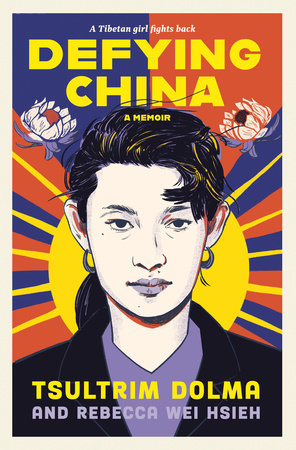
The incredible true story of a teen who became an activist for the Tibetan independence movement, for readers of Red Scarf Girl and Farewell to Manzanar.

Tsultrim Dolma, born in a tiny village in the stunning mountains of eastern Tibet, always knew there had to be more than the life expected of her: More than no education, because her family was poor. More than being married off at a young age, because she was a girl. More than barely getting by under oppressive Chinese occupation, because she was Tibetan. When she was sixteen, Tsultrim found more, joining protests for the Tibetan independence movement, the call for her beloved country’s liberation from the People’s Republic of China. Shortly after, she was arrested and sent to Gutsa Detention Center, notorious for its brutal torture of political prisoners like Tsultrim.

This young adult memoir follows Tsultrim’s courageous coming of age through her time at Gutsa, being heavily surveilled by the government after her release, and, ultimately, her escape to the U.S. It also underscores the bravery it takes to speak up, and the power to be found in sharing one’s story.
Chapter One

The place I call home has tall mountains and long rivers. Even the small stream in my hometown flows past the village boundaries, disappearing into the grassy plains of the Kham region of Tibet. Some days, I imagined it pouring into a lake as a waterfall. Others, I dreamed that it unfurled into a river and carved the steep valleys of the Tibetan Plateau, finally snaking its way back to the ocean. Or maybe it simply went on forever. All I knew was that it flowed beyond the borders of a little village called Pelbar Dzong, and that, more than anything, I wanted to follow that stream and see its end for myself.

Very rarely, airplanes would soar across the sky like birds, and I wondered if they could see me going about my day. Every morning, for as long as I could remember, I stepped down the squeaky stairs of our squat house, wooden bucket in hand. My breath appeared in puffs of cool air against the pink sliver crawling over the horizon as I let out our livestock.

We had a variety of animals under our care: a single horse, cattle, sheep, yaks, and female yaks, called dri. Yaks and cattle belong to the same family of animals, but to my eyes, they couldn’t be more different. Yaks have long horns that reach high toward the sky and a pronounced hump on their back, covered by long, warm wool. On the other hand, cattle tend to have shorter horns and hair. Sometimes they’re crossbred to create a hybrid called a dzo for males and dzomo for females.

We had one such dzomo, and she was my favorite among them all. She had a sleek black coat and a pair of curved horns. Maybe I adored her because she reminded me of myself: just a shy little thing that nonetheless stood out like a sore thumb. She snickered anxiously as I smoothed a hand over her head. I was still a child at around eleven years old, but I’d grown up caring for two younger siblings, so the sweet murmurs came naturally to me.

“Hey, it’s okay,” I cooed. “You’re such a cute little baby, such a good girl.”

One by one, I milked the livestock, the rhythm of milk hitting the bucket a soothing thump thump thump as they grazed lazily outside our home. Normally, I’d move on to other tasks afterward: churning dri butter, making tsampa bread out of barley flour, gathering firewood and dried yak dung for fuel.

Today, however, I was to forgo those chores, leaving them to my siblings Bhuti and Yeshe instead. It was the day my father and I would depart for a pilgrimage to Lhasa, the capital city of Tibet, west of our humble little village. In the Tibetan language, Lhasa literally translates to “land of the gods”—the city was more than a governmental hub. It was also the spiritual center of our faith, Tibetan Buddhism.

I’d tossed and turned all night. And yet, I’d never felt so awake in my life as I sat by the front door. From our house, I could see villagers slowly emerging from their own homes. They were like tiny ants, milling about in preparation and streaming steadily to the main path, where we’d agreed to meet for the journey. Father was well respected in the community, so it came as no surprise that at least a dozen people had leapt at the chance to travel with him.

“Punjun,” he called from the house, “give Bhuti the bucket and get your pack. It’s time to leave.”
My brother Bhuti was around four years younger than me, and our sister Yeshe was a little younger than that. We didn’t keep track of the years with a calendar, so I was never quite sure of our exact ages. He trudged down the stairs and took my spot by the dri.

“I got it,” he mumbled, before giving her a fond little pat and continuing to milk her.

It seemed like only yesterday when he and Yeshe were still infants, babbling nonsense and blowing raspberries.

After invading Tibet in the fifties, the Chinese government had seized control of land from Tibetans, including my own family. For as long as I could recall, like many other Tibetans, my parents left each morning to work on other people’s fields until nightfall. These fields were farther from home, so I’d spent the first few years of my very young life taking care of my two baby siblings. On days when my parents worked especially late, I’d strap the babies to my chest with a blanket, banging on pots and pans to lull them to sleep.

But now, around four or five years later, things were different. Better. We had our land back, our parents were home more often, and we were about to embark on a major spiritual journey.
My friend Pema was already waiting by the time Father and I arrived, wearing a determined look on her round face. Her hair was tied up neatly for the arduous trip, and a large pack, filled with barley flour, dried meats, and water, towered over her. It was covered in a large cloth that would be her sleeping roll as we made our way to Lhasa. Her parents had allowed her to join us, entrusting her to Father’s care. At around fourteen, Pema was already of marrying age, and this would be her only chance to see Lhasa. It would most likely be my only chance to travel as well. Though Father never said so, I had an inkling that he’d meant the trip as a final gift before I married. I shook off the thoughts before they could spiral out of control. Parting gift or not, I didn’t want to waste time focusing on the negative.

I adjusted my own pack and took a deep breath until my lungs felt close to bursting. I stuck by my father’s side as the adults chatted amicably: the weather, the route we would take, the towns we could stop at for supplies. The excitement in the air was almost palpable, shot through with apprehension.

There were four mountains we had to cross, each tipped in a thick layer of snow. Even with the mild spring weather, it would take us at least a month to reach Lhasa on foot. Some pilgrims even died on the way there. The journey was not for the faint of heart. I was the youngest, but I knew from past experience that I had what it took to complete the journey.

-

My friends and I were collecting firewood one day, chatting and squealing as we always had. It had been a day like any other: We sang as we picked splinters out of our gloves. We played silly games, making up the rules as we went. We spotted the occasional berry bush and plucked off the ripe berries as a treat. We were in our own merry bubble, cracking jokes as we hacked at tree stumps with our little axes.

Nyima huffed as she tossed away another piece of wood. “Too damp,” she declared bitterly. I picked it up, examining it before adding it to my own bundle of kindling. I tied the kindling together with a leather rope and placed it into the large basket on my back.

The bubble burst when I made eye contact with my older brother, Gelek. I closed my mouth mid-song, teeth clacking together, suddenly hyperaware of what I was doing. I’d forgotten that he’d tagged along that day.

Gelek was almost a stranger to me. My brother was a bit older, although I never learned by exactly how many years. He’d lived with our grandparents on the other side of the village for as long as I could remember. Every spring, the villagers would take their livestock to higher ground to prevent them from grazing in the newly planted barley fields. It was a massive undertaking that spanned months until the harvest was over in the early autumn. Our grandparents owned a particularly large herd of animals, and as they grew older, they needed the extra help to maintain their flock. As a result, Gelek had grown up with them, and he felt more like a distant cousin, one who was kind and cordial, but always at an arm’s length.

We meandered up the mountain in awkward silence, me taking care to stay closer to my friends. But I couldn’t avoid him forever. For some reason, we’d decided to venture farther than usual, following a beaten path that eventually led to a terrifying drop. I can’t quite remember how large the gap was, only that alarms sounded in my brain the moment I laid eyes on it. We had to jump across, onto the opposite ledge that was higher than the one we were standing on. Loose rocks and dirt slid under my feet as I shuffled behind my friends in single file.
Gelek crossed without hesitation. Just one clean jump, and he was on the other side, helping the other kids onto the ledge. I tried not to think too much about the stones that scattered off the edge and into the river below.

Wiping my clammy hands, I approached the ledge and looked down.

These were not the placid waters of the village stream. The river below us, frothing mad and white, crashed down themountain at a dizzying speed. Even if I were to survive thefall, I was sure to be swept away by the river.

I stared. This close and with a basket weighing me down, the gap felt twice as big. I swayed, from the gusts of wind or from dizziness, I wasn’t entirely sure. My shirt was beginning to soak through with sweat, and suddenly three layers of clothing felt stifling even on a chilly day.
One by one, my friends jumped across the gap, sending small rocks flying as they landed on the other side. Nyima had been quick to follow Gelek across the gap; Dawa had made the leap with an excited squeal. Sangye had let out a whoop and was chatting animatedly as I stood frozen in fear.

“Punjun!” Gelek called my name and opened his arms. He gestured to our surroundings, so casually as if I was missing something obvious. “You can do it.”

“No, I can’t,” I said.

“You’ll be fine.”

My jaw ached from how hard I clenched my mouth shut, and I stared at him with eyes round as saucers because clearly, he was the one who missed the obvious.

Gelek reached out a hand, ready to grab me once I got close enough. If I got close enough. I still had to take the leap, hang in the air for a split second with nothing under my feet.

Heart hammering, I stepped back a few paces for a running start. Twigs crunched beneath my feet, the roar in my ears growing louder as I tensed my muscles, and then—
No no no no absolutely not.

I skidded to a halt, my leather shoes slipping on the ground, which only spiked my pulse with a fresh wave of fear. It hadn’t rained today, but the air was humid enough to make everything just a little more slippery than I’d have liked. Shoulders raised to my ears in embarrassment, I looked up to see Gelek gesticulating at me.

“Come on,” he said, firm but not unkind. “It’s not that bad.”

My eyes must’ve been bulging by then. But I didn’t want to wait here as everyone else went ahead without me, and I had no intention of heading back home, not when the sun was still glaring down overhead.

I stepped back, took a deep breath, and threw myself at the ledge. My eyes squeezed shut the moment my feet left the ground, and I held my breath, biting back a scream in my throat.
For a single, breathless moment, I was flying. And in the next, I was falling. Then I felt the sharp bite of gravel on my knees and a strong grip crushing my fingers, pulling me away from the ledge. I stumbled, lurching forward on shaky legs as Gelek led me away. Mind buzzing, I looked back at where the last few kids were crossing the gap. My brother was right; it wasn’t that bad, now that I’d made it to the other side. A bundle of wood slid out of someone’s basket, disappearing in the river with a dull splash, and I shuddered. No, it was definitely that bad.
“Told you you could do it,” my brother said, a proud smile on his face. And as much as I hated to admit it, he was right.

The wind tugged at my clothes as we climbed higher. The sun dipped toward the horizon, the towering mountains casting long dark shadows onto a slope of gold.

The view was yet another reminder that there was life outside of Pelbar Dzong. There were taller mountains in the distance, so tall that they reached the clouds. There were sights hiding beyond the horizon, lush forests and billowing waters and towns full of people I’d never get to meet.

But at the same time, everything looked so small from up here: the houses, the people, the squabbles and inconveniences of daily life. From this vantage point, anything seemed possible. As we made our way home, I carried a piece of that scenery with me, nestled in my chest like a little seed of hope.

-

Now that seed had begun to sprout.

Each step I took brought me farther from my hometown than I’d ever dreamed of. By midday, Pelbar Dzong had already vanished beyond the horizon. Turning back to see my tiny village—my whole world—out of sight should’ve been terrifying. But all I could do was marvel at the scenery around us.

Trees I never learned the names of dotted the landscape, sometimes growing into the kind of thick, lush forest my great-aunt Jampa had once described to me. Thin leaves dangled from squiggly branches. I jumped up, trying to grab hold of one. I could hear the gurgle of a stream nearby and wondered if it merged with the one in the village or a different river entirely. Excitement quickly overruled any initial nervousness I’d felt; I didn’t have time to be scared when there were so many new things to take in. It didn’t matter to me then that I didn’t know the names of a plant. It didn’t matter that I didn’t know how the terrain looked, or the exact flow of a river close by. What mattered was putting one foot in front of the other, and a voice in my head saying, Punjun, you can do it.
★ "This work shows the power of prayer and the kindness of strangers when facing horrifying circumstances. This powerfully and accessibly written story puts a human face on complex, ongoing issues. Chilling and memorable; a must-read." —Kirkus, starred review

"In this unflinching memoir . . . vivid language transports readers to the Kham region." —Publishers Weekly

"[A] vivid memoir . . . Visceral descriptions of Dolma’s emotional, spiritual, and physical journey create an immersive story." —Booklist
Tsultrim Dolma is a Tibetan American activist who first garnered attention for her testimony before Congress, and has since been profiled by multiple outlets (including The Independent, USA Today, and The Washington Times) in advocating for Tibetan liberation.

Rebecca Wei Hsieh is a writer from Taipei, Taiwan, where she grew up under political and military pressure from the People’s Republic of China; her work has been featured in outlets like We Need Diverse Books, Observer, and Book Riot.

About

The incredible true story of a teen who became an activist for the Tibetan independence movement, for readers of Red Scarf Girl and Farewell to Manzanar.

Tsultrim Dolma, born in a tiny village in the stunning mountains of eastern Tibet, always knew there had to be more than the life expected of her: More than no education, because her family was poor. More than being married off at a young age, because she was a girl. More than barely getting by under oppressive Chinese occupation, because she was Tibetan. When she was sixteen, Tsultrim found more, joining protests for the Tibetan independence movement, the call for her beloved country’s liberation from the People’s Republic of China. Shortly after, she was arrested and sent to Gutsa Detention Center, notorious for its brutal torture of political prisoners like Tsultrim.

This young adult memoir follows Tsultrim’s courageous coming of age through her time at Gutsa, being heavily surveilled by the government after her release, and, ultimately, her escape to the U.S. It also underscores the bravery it takes to speak up, and the power to be found in sharing one’s story.

Excerpt

Chapter One

The place I call home has tall mountains and long rivers. Even the small stream in my hometown flows past the village boundaries, disappearing into the grassy plains of the Kham region of Tibet. Some days, I imagined it pouring into a lake as a waterfall. Others, I dreamed that it unfurled into a river and carved the steep valleys of the Tibetan Plateau, finally snaking its way back to the ocean. Or maybe it simply went on forever. All I knew was that it flowed beyond the borders of a little village called Pelbar Dzong, and that, more than anything, I wanted to follow that stream and see its end for myself.

Very rarely, airplanes would soar across the sky like birds, and I wondered if they could see me going about my day. Every morning, for as long as I could remember, I stepped down the squeaky stairs of our squat house, wooden bucket in hand. My breath appeared in puffs of cool air against the pink sliver crawling over the horizon as I let out our livestock.

We had a variety of animals under our care: a single horse, cattle, sheep, yaks, and female yaks, called dri. Yaks and cattle belong to the same family of animals, but to my eyes, they couldn’t be more different. Yaks have long horns that reach high toward the sky and a pronounced hump on their back, covered by long, warm wool. On the other hand, cattle tend to have shorter horns and hair. Sometimes they’re crossbred to create a hybrid called a dzo for males and dzomo for females.

We had one such dzomo, and she was my favorite among them all. She had a sleek black coat and a pair of curved horns. Maybe I adored her because she reminded me of myself: just a shy little thing that nonetheless stood out like a sore thumb. She snickered anxiously as I smoothed a hand over her head. I was still a child at around eleven years old, but I’d grown up caring for two younger siblings, so the sweet murmurs came naturally to me.

“Hey, it’s okay,” I cooed. “You’re such a cute little baby, such a good girl.”

One by one, I milked the livestock, the rhythm of milk hitting the bucket a soothing thump thump thump as they grazed lazily outside our home. Normally, I’d move on to other tasks afterward: churning dri butter, making tsampa bread out of barley flour, gathering firewood and dried yak dung for fuel.

Today, however, I was to forgo those chores, leaving them to my siblings Bhuti and Yeshe instead. It was the day my father and I would depart for a pilgrimage to Lhasa, the capital city of Tibet, west of our humble little village. In the Tibetan language, Lhasa literally translates to “land of the gods”—the city was more than a governmental hub. It was also the spiritual center of our faith, Tibetan Buddhism.

I’d tossed and turned all night. And yet, I’d never felt so awake in my life as I sat by the front door. From our house, I could see villagers slowly emerging from their own homes. They were like tiny ants, milling about in preparation and streaming steadily to the main path, where we’d agreed to meet for the journey. Father was well respected in the community, so it came as no surprise that at least a dozen people had leapt at the chance to travel with him.

“Punjun,” he called from the house, “give Bhuti the bucket and get your pack. It’s time to leave.”
My brother Bhuti was around four years younger than me, and our sister Yeshe was a little younger than that. We didn’t keep track of the years with a calendar, so I was never quite sure of our exact ages. He trudged down the stairs and took my spot by the dri.

“I got it,” he mumbled, before giving her a fond little pat and continuing to milk her.

It seemed like only yesterday when he and Yeshe were still infants, babbling nonsense and blowing raspberries.

After invading Tibet in the fifties, the Chinese government had seized control of land from Tibetans, including my own family. For as long as I could recall, like many other Tibetans, my parents left each morning to work on other people’s fields until nightfall. These fields were farther from home, so I’d spent the first few years of my very young life taking care of my two baby siblings. On days when my parents worked especially late, I’d strap the babies to my chest with a blanket, banging on pots and pans to lull them to sleep.

But now, around four or five years later, things were different. Better. We had our land back, our parents were home more often, and we were about to embark on a major spiritual journey.
My friend Pema was already waiting by the time Father and I arrived, wearing a determined look on her round face. Her hair was tied up neatly for the arduous trip, and a large pack, filled with barley flour, dried meats, and water, towered over her. It was covered in a large cloth that would be her sleeping roll as we made our way to Lhasa. Her parents had allowed her to join us, entrusting her to Father’s care. At around fourteen, Pema was already of marrying age, and this would be her only chance to see Lhasa. It would most likely be my only chance to travel as well. Though Father never said so, I had an inkling that he’d meant the trip as a final gift before I married. I shook off the thoughts before they could spiral out of control. Parting gift or not, I didn’t want to waste time focusing on the negative.

I adjusted my own pack and took a deep breath until my lungs felt close to bursting. I stuck by my father’s side as the adults chatted amicably: the weather, the route we would take, the towns we could stop at for supplies. The excitement in the air was almost palpable, shot through with apprehension.

There were four mountains we had to cross, each tipped in a thick layer of snow. Even with the mild spring weather, it would take us at least a month to reach Lhasa on foot. Some pilgrims even died on the way there. The journey was not for the faint of heart. I was the youngest, but I knew from past experience that I had what it took to complete the journey.

-

My friends and I were collecting firewood one day, chatting and squealing as we always had. It had been a day like any other: We sang as we picked splinters out of our gloves. We played silly games, making up the rules as we went. We spotted the occasional berry bush and plucked off the ripe berries as a treat. We were in our own merry bubble, cracking jokes as we hacked at tree stumps with our little axes.

Nyima huffed as she tossed away another piece of wood. “Too damp,” she declared bitterly. I picked it up, examining it before adding it to my own bundle of kindling. I tied the kindling together with a leather rope and placed it into the large basket on my back.

The bubble burst when I made eye contact with my older brother, Gelek. I closed my mouth mid-song, teeth clacking together, suddenly hyperaware of what I was doing. I’d forgotten that he’d tagged along that day.

Gelek was almost a stranger to me. My brother was a bit older, although I never learned by exactly how many years. He’d lived with our grandparents on the other side of the village for as long as I could remember. Every spring, the villagers would take their livestock to higher ground to prevent them from grazing in the newly planted barley fields. It was a massive undertaking that spanned months until the harvest was over in the early autumn. Our grandparents owned a particularly large herd of animals, and as they grew older, they needed the extra help to maintain their flock. As a result, Gelek had grown up with them, and he felt more like a distant cousin, one who was kind and cordial, but always at an arm’s length.

We meandered up the mountain in awkward silence, me taking care to stay closer to my friends. But I couldn’t avoid him forever. For some reason, we’d decided to venture farther than usual, following a beaten path that eventually led to a terrifying drop. I can’t quite remember how large the gap was, only that alarms sounded in my brain the moment I laid eyes on it. We had to jump across, onto the opposite ledge that was higher than the one we were standing on. Loose rocks and dirt slid under my feet as I shuffled behind my friends in single file.
Gelek crossed without hesitation. Just one clean jump, and he was on the other side, helping the other kids onto the ledge. I tried not to think too much about the stones that scattered off the edge and into the river below.

Wiping my clammy hands, I approached the ledge and looked down.

These were not the placid waters of the village stream. The river below us, frothing mad and white, crashed down themountain at a dizzying speed. Even if I were to survive thefall, I was sure to be swept away by the river.

I stared. This close and with a basket weighing me down, the gap felt twice as big. I swayed, from the gusts of wind or from dizziness, I wasn’t entirely sure. My shirt was beginning to soak through with sweat, and suddenly three layers of clothing felt stifling even on a chilly day.
One by one, my friends jumped across the gap, sending small rocks flying as they landed on the other side. Nyima had been quick to follow Gelek across the gap; Dawa had made the leap with an excited squeal. Sangye had let out a whoop and was chatting animatedly as I stood frozen in fear.

“Punjun!” Gelek called my name and opened his arms. He gestured to our surroundings, so casually as if I was missing something obvious. “You can do it.”

“No, I can’t,” I said.

“You’ll be fine.”

My jaw ached from how hard I clenched my mouth shut, and I stared at him with eyes round as saucers because clearly, he was the one who missed the obvious.

Gelek reached out a hand, ready to grab me once I got close enough. If I got close enough. I still had to take the leap, hang in the air for a split second with nothing under my feet.

Heart hammering, I stepped back a few paces for a running start. Twigs crunched beneath my feet, the roar in my ears growing louder as I tensed my muscles, and then—
No no no no absolutely not.

I skidded to a halt, my leather shoes slipping on the ground, which only spiked my pulse with a fresh wave of fear. It hadn’t rained today, but the air was humid enough to make everything just a little more slippery than I’d have liked. Shoulders raised to my ears in embarrassment, I looked up to see Gelek gesticulating at me.

“Come on,” he said, firm but not unkind. “It’s not that bad.”

My eyes must’ve been bulging by then. But I didn’t want to wait here as everyone else went ahead without me, and I had no intention of heading back home, not when the sun was still glaring down overhead.

I stepped back, took a deep breath, and threw myself at the ledge. My eyes squeezed shut the moment my feet left the ground, and I held my breath, biting back a scream in my throat.
For a single, breathless moment, I was flying. And in the next, I was falling. Then I felt the sharp bite of gravel on my knees and a strong grip crushing my fingers, pulling me away from the ledge. I stumbled, lurching forward on shaky legs as Gelek led me away. Mind buzzing, I looked back at where the last few kids were crossing the gap. My brother was right; it wasn’t that bad, now that I’d made it to the other side. A bundle of wood slid out of someone’s basket, disappearing in the river with a dull splash, and I shuddered. No, it was definitely that bad.
“Told you you could do it,” my brother said, a proud smile on his face. And as much as I hated to admit it, he was right.

The wind tugged at my clothes as we climbed higher. The sun dipped toward the horizon, the towering mountains casting long dark shadows onto a slope of gold.

The view was yet another reminder that there was life outside of Pelbar Dzong. There were taller mountains in the distance, so tall that they reached the clouds. There were sights hiding beyond the horizon, lush forests and billowing waters and towns full of people I’d never get to meet.

But at the same time, everything looked so small from up here: the houses, the people, the squabbles and inconveniences of daily life. From this vantage point, anything seemed possible. As we made our way home, I carried a piece of that scenery with me, nestled in my chest like a little seed of hope.

-

Now that seed had begun to sprout.

Each step I took brought me farther from my hometown than I’d ever dreamed of. By midday, Pelbar Dzong had already vanished beyond the horizon. Turning back to see my tiny village—my whole world—out of sight should’ve been terrifying. But all I could do was marvel at the scenery around us.

Trees I never learned the names of dotted the landscape, sometimes growing into the kind of thick, lush forest my great-aunt Jampa had once described to me. Thin leaves dangled from squiggly branches. I jumped up, trying to grab hold of one. I could hear the gurgle of a stream nearby and wondered if it merged with the one in the village or a different river entirely. Excitement quickly overruled any initial nervousness I’d felt; I didn’t have time to be scared when there were so many new things to take in. It didn’t matter to me then that I didn’t know the names of a plant. It didn’t matter that I didn’t know how the terrain looked, or the exact flow of a river close by. What mattered was putting one foot in front of the other, and a voice in my head saying, Punjun, you can do it.

Reviews

★ "This work shows the power of prayer and the kindness of strangers when facing horrifying circumstances. This powerfully and accessibly written story puts a human face on complex, ongoing issues. Chilling and memorable; a must-read." —Kirkus, starred review

"In this unflinching memoir . . . vivid language transports readers to the Kham region." —Publishers Weekly

"[A] vivid memoir . . . Visceral descriptions of Dolma’s emotional, spiritual, and physical journey create an immersive story." —Booklist

Author

Tsultrim Dolma is a Tibetan American activist who first garnered attention for her testimony before Congress, and has since been profiled by multiple outlets (including The Independent, USA Today, and The Washington Times) in advocating for Tibetan liberation.

Rebecca Wei Hsieh is a writer from Taipei, Taiwan, where she grew up under political and military pressure from the People’s Republic of China; her work has been featured in outlets like We Need Diverse Books, Observer, and Book Riot.
  • More Websites from
    Penguin Random House
  • Common Reads
  • Library Marketing