Download high-resolution image
Listen to a clip from the audiobook
audio pause button
0:00
0:00

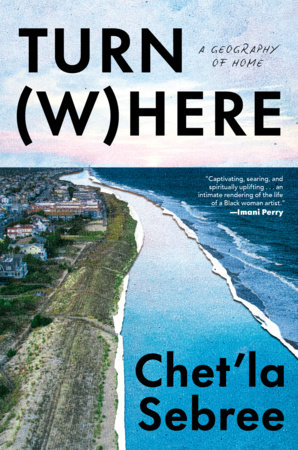
Turn Where

A Geography of Home

Author Chet'la Sebree On Tour
Listen to a clip from the audiobook
audio pause button
0:00
0:00
A probing essay collection that chronicles one woman’s complicated quest to find home in a fractured America, from the award-winning author of Field Study

“In Chet’la Sebree’s sensitive and tender hands, this book’s quest (and question) of home is captivating. An intimate rendering of the life of a Black woman artist.”—Imani Perry, National Book Award winner and author of Black in Blues

At eighteen, Chet’la Sebree began, as she writes, “perfecting the art of leaving.” After moving out of her parents’ house in Delaware for college, the lauded poet, essayist, and academic rarely kept the same address for more than two years—bouncing from city to city, country to country, perpetually in search of her next adventure.

For Sebree, traveling has been a life-long passion, forged during family road trips and vacations with friends; college study abroad programs in Europe; and far-flung writing residencies and job opportunities. She dreamed of one day taking her own Great American Road Trip, Jack Kerouac–style—except refashioned as a millennial Black woman who had also begun considering her next chapter: settling down and starting a solo fertility journey.

During the pandemic, Sebree thought she might finally get her chance to hit the road. But then, George Floyd was murdered, following the killings of Breonna Taylor, Ahmaud Aubrey, and so many others. As America continued to reveal its most violent self, Sebree started to wrestle with the very idea of home: Where do I belong in a country not meant for people like me to survive? What does this mean for a child I might bring into it?

In Turn (W)here, Sebree turns to the page for answers, seamlessly weaving memoir with history and cultural criticism in a collection of inventive essays bound by themes of movement, home, inheritance, and belonging. Spanning continents, geographies, and states of mind, Sebree lights a pathway for the wanderer, the seeker—anyone propelled into the unknown by the desire for a place to truly belong.
Prologue

Turn Where?

Point of Origin: Variable
Destination: Unknown


(1) Buckle up; check your mirrors.

Travel has always sung a song I’ve loved, especially when its tongue is slick with the euphony of smooth transit. Rubber on road reminds me of the ocean—a hush of white noise I can count on to be both constant and variable. Concrete laps louder than asphalt, and the crash of rumble strips ensures I slow for tolls or wake fast from an accidental doze. The hum of it lulling my innards.


(2) Select a route.

You might ask yourself how I plan to start if I don’t know where to go. But who among us is ever certain? Even with multifold road maps and GPS, detours and road closures force routes we wouldn’t have chosen, ones we’ve never seen before.


(3) Pull off.

People travel for various reasons: experience, escape, education; pleasure, status, food; to seek aloneness, connection. In it, I seek a groundedness.


(4) Read the reflective signs.

Travel can be good for us because otherness is good. —Emily Thomas


(5) Merge.

Life is a blur of forest from train windows, all of it passing faster than I can process. No matter how quickly I turn my head, the trees vanish from my vision. But travel helps me move at life’s speed—the relative motion making the pace of my brain and my existence more congruous. Spending time in new locales slows the world: a walk through a park touching tree bark, the stickiness of its sap between my fingers. I’m less likely to take time to touch grass when I’m at home, sorting through which bills are due. But out in the vast impermanence of an unfamiliar place, an unfamiliar experience, I am steadied by a fresh landscape inching into focus.


(6) Turn on cruise control.

But even when the world won’t slow in transit, I can make room for disorientation, as I soar through postal codes like a time traveler. Because when I am somewhere new, I am supposed to be bewildered. I expect to wander, hand tight-fisted around directions, chin toward sky looking at street signs; that a shopkeeper in Quebec might hear the inflection of my “bonjour” and switch to English, ask if she can be of assistance. As someone who has rarely felt like I fit in—Black girl in a white school, poet among a family in finance and law enforcement, aspiring single mom surrounded by partnered-parent households—I am drawn to travel’s acceptable otherness, to be somewhere I don’t, and don’t expect to, belong.

I will admit I am too romantic about this.


(7) Adjust speed.

When you’re a tourist, people might treat you the way they would someone with Wisconsin plates driving the stop-and-start streets of downtown DC: with kid gloves or contempt— letting you cross three lanes to make a right turn or laying on their horn. That’s if you have the luxury of being a visitor they deem acceptable.


(8) Read the reflective signs.

How you travel, never mind what for, depends on who you are, the resources you have access to, what you look like, and how the world perceives your very presence in it. —Padma Lakshmi


(9) Check your blind spot; change lanes.

Feeling like an outsider doesn’t land the same when you’re lost on roads you know, ones with which you should be familiar.


(10) Slow for incident.

In 1998, three white supremacists—Shawn Berry, Lawrence Brewer, and John King—offered a Black man, James Byrd, Jr., a ride home in Jasper, Texas. Byrd knew Berry, so he accepted the lift. Instead of taking Byrd home, the white men drove him to a remote location, where they beat him, chained him to their truck by his ankles, and dragged him for miles. Evidence suggests Byrd lived for half the time they pulled him down a rural, tree-lined road. He died from decapitation when his body hit the edge of a culvert.


(11) Be mindful of your intersections.

Five years later, in 2003, my mom told me of James Byrd, Jr., as I prepped for a school trip to Dallas. I, at fifteen, dismissed her concerns. Ten years after, fresh from grad school, I told her that I wanted to take a great American road trip; she suggested I go ahead and get a job instead. It would be ten more before she would tell me how she worried she’d never be able to protect me, her forever little girl—who was born four weeks early, in a body that has continued to be surly. I was, and still am, her audacious, strong-willed little Taurus.


(12) Swerve around obstructions.

But there did come a time when my mother’s anxieties became mine.


(13) Turn on your hazards.

After a drive from Pennsylvania to Vermont in summer 2016, carefully plotted with bathroom breaks in college towns, I arrived at an artist enclave. The small town bourgeoned with creatives attending a residency. We gave readings in the laundromat. Dominated the mic during the bar’s karaoke night. Popped into the bookshop before returning to our studios to work. But even in this adult summer camp for creatives, the world found its way in with the ease of the wind in crevices.

During a reception, details of Philando Castile’s murder crept into our phones, and a white painter asked me how I felt about racism in America, as if it were its dawn.


(14) Read the reflective signs.

Considering new and unfamiliar things forces us to expand and rethink what we know . . . It forces us to question what we take to be obvious. —Emily Thomas


(15) Pull over.

Alone in my home for a full pandemic year, I asked myself: Why is travel’s song such an earworm? What is it about its simultaneous time-lapse and slow-motion state that I keep continuing to replay? Why, despite its ability to produce anxiety, do I reject stasis, clamber toward movement?

As I pull my body through space, displace myself with intention, I can quell the disquiet about my place alongside people whose lives plotted a clearer trajectory: college, job, partner, house, child; maybe a dog in there somewhere. I have avoided orienting myself toward those destinations—mistrustful of the “safety” presented by those nuclear iterations.

But is my itinerancy its own trajectory? Will my route, like this book, rove until novelty becomes familiar?


(16) Read the reflective signs.

How do we decide where we belong? —Toni Morrison


(17) Find your way back onto the road.

I’ve come closest to myself far from addresses I’ve listed on legal documents: under the full moon over Useless Bay; on a walk through the Chattahoochee woods; below the sun’s glow on the Gateway Arch. In rented homes across America, I’ve learned to manage chronic pain; admitted to myself I wanted to be a mom, that I was queer; decided it was time to let go of people I’ve loved so I could, instead, love myself.

But where do I—single, Black, itinerant, aspiring parent—belong?


(18) Select next route. Start over.
“In Chet’la Sebree’s sensitive and tender hands, this book’s quest (and question) of home is captivating. An intimate rendering of the life of a Black woman artist, in these pages genealogy is a journey, the heart is a map, and family is essential even when uncertain. . . . Insightful, vulnerable, layered, and full of love.”—Imani Perry, National Book Award winner and author of Black in Blues

“An exquisitely observed and multifaceted collection of essays . . . This is the sort of book that invites the reader to share with loved ones, compare notes, and read again.”—Maurice Carlos Ruffin, author of The American Daughters

“With a poet’s precision and care, Sebree has crafted an intricate map of one woman’s search for home. . . . A breathtaking essay collection that remains deeply rooted in history while forging ahead into the uncertain future.”—Lilly Dancyger, author of First Love

“Chet’la Sebree continues in the lineage of Dionne Brand, Katherine McKittrick, and Saidiya Hartman to trace and retrace home through language. . . . Turn (W)here charts new territory.”—Vanessa Angélica Villarreal, author of Magical/Realism

“A hearty feast for those of us at midlife starved for direction.”—Minda Honey, author of The Heartbreak Years

“An expansive topography of home through history, cultural criticism, and lived experience . . . Sebree writes beautifully about belonging and becoming, and how wanderlust is a crucial part of the equation.”—Michele Filgate, editor of What My Father and I Don’t Talk About

“Always trust a poet to deliver a beautiful memoir. . . . Chet’la Sebree’s essays about, broadly, searching for home as a Black woman in America, blend memoir, cultural criticism, and history and deliver a formally inventive, emotionally rich personal history that stretches beyond the bounds of the self.”—Literary Hub


© Shannon Woodloe
Chet'la Sebree is the author of Blue Opening, Field Study, winner of the James Laughlin Award from the Academy of American Poets, and Mistress, selected by Cathy Park Hong as the winner of the New Issues Poetry Prize and nominated for an NAACP Image Award for Outstanding Literary Work-Poetry. Her essays and poems have been anthologized in Ibram X. Kendi and Keisha N. Blain’s Four Hundred Souls: A Community History of African America, 1619-2019, Kwame Alexander’s This Is the Honey: An Anthology of Contemporary Black Poets, and others. Sebree is an assistant professor of English at George Washington University. View titles by Chet'la Sebree

About

A probing essay collection that chronicles one woman’s complicated quest to find home in a fractured America, from the award-winning author of Field Study

“In Chet’la Sebree’s sensitive and tender hands, this book’s quest (and question) of home is captivating. An intimate rendering of the life of a Black woman artist.”—Imani Perry, National Book Award winner and author of Black in Blues

At eighteen, Chet’la Sebree began, as she writes, “perfecting the art of leaving.” After moving out of her parents’ house in Delaware for college, the lauded poet, essayist, and academic rarely kept the same address for more than two years—bouncing from city to city, country to country, perpetually in search of her next adventure.

For Sebree, traveling has been a life-long passion, forged during family road trips and vacations with friends; college study abroad programs in Europe; and far-flung writing residencies and job opportunities. She dreamed of one day taking her own Great American Road Trip, Jack Kerouac–style—except refashioned as a millennial Black woman who had also begun considering her next chapter: settling down and starting a solo fertility journey.

During the pandemic, Sebree thought she might finally get her chance to hit the road. But then, George Floyd was murdered, following the killings of Breonna Taylor, Ahmaud Aubrey, and so many others. As America continued to reveal its most violent self, Sebree started to wrestle with the very idea of home: Where do I belong in a country not meant for people like me to survive? What does this mean for a child I might bring into it?

In Turn (W)here, Sebree turns to the page for answers, seamlessly weaving memoir with history and cultural criticism in a collection of inventive essays bound by themes of movement, home, inheritance, and belonging. Spanning continents, geographies, and states of mind, Sebree lights a pathway for the wanderer, the seeker—anyone propelled into the unknown by the desire for a place to truly belong.

Excerpt

Prologue

Turn Where?

Point of Origin: Variable
Destination: Unknown


(1) Buckle up; check your mirrors.

Travel has always sung a song I’ve loved, especially when its tongue is slick with the euphony of smooth transit. Rubber on road reminds me of the ocean—a hush of white noise I can count on to be both constant and variable. Concrete laps louder than asphalt, and the crash of rumble strips ensures I slow for tolls or wake fast from an accidental doze. The hum of it lulling my innards.


(2) Select a route.

You might ask yourself how I plan to start if I don’t know where to go. But who among us is ever certain? Even with multifold road maps and GPS, detours and road closures force routes we wouldn’t have chosen, ones we’ve never seen before.


(3) Pull off.

People travel for various reasons: experience, escape, education; pleasure, status, food; to seek aloneness, connection. In it, I seek a groundedness.


(4) Read the reflective signs.

Travel can be good for us because otherness is good. —Emily Thomas


(5) Merge.

Life is a blur of forest from train windows, all of it passing faster than I can process. No matter how quickly I turn my head, the trees vanish from my vision. But travel helps me move at life’s speed—the relative motion making the pace of my brain and my existence more congruous. Spending time in new locales slows the world: a walk through a park touching tree bark, the stickiness of its sap between my fingers. I’m less likely to take time to touch grass when I’m at home, sorting through which bills are due. But out in the vast impermanence of an unfamiliar place, an unfamiliar experience, I am steadied by a fresh landscape inching into focus.


(6) Turn on cruise control.

But even when the world won’t slow in transit, I can make room for disorientation, as I soar through postal codes like a time traveler. Because when I am somewhere new, I am supposed to be bewildered. I expect to wander, hand tight-fisted around directions, chin toward sky looking at street signs; that a shopkeeper in Quebec might hear the inflection of my “bonjour” and switch to English, ask if she can be of assistance. As someone who has rarely felt like I fit in—Black girl in a white school, poet among a family in finance and law enforcement, aspiring single mom surrounded by partnered-parent households—I am drawn to travel’s acceptable otherness, to be somewhere I don’t, and don’t expect to, belong.

I will admit I am too romantic about this.


(7) Adjust speed.

When you’re a tourist, people might treat you the way they would someone with Wisconsin plates driving the stop-and-start streets of downtown DC: with kid gloves or contempt— letting you cross three lanes to make a right turn or laying on their horn. That’s if you have the luxury of being a visitor they deem acceptable.


(8) Read the reflective signs.

How you travel, never mind what for, depends on who you are, the resources you have access to, what you look like, and how the world perceives your very presence in it. —Padma Lakshmi


(9) Check your blind spot; change lanes.

Feeling like an outsider doesn’t land the same when you’re lost on roads you know, ones with which you should be familiar.


(10) Slow for incident.

In 1998, three white supremacists—Shawn Berry, Lawrence Brewer, and John King—offered a Black man, James Byrd, Jr., a ride home in Jasper, Texas. Byrd knew Berry, so he accepted the lift. Instead of taking Byrd home, the white men drove him to a remote location, where they beat him, chained him to their truck by his ankles, and dragged him for miles. Evidence suggests Byrd lived for half the time they pulled him down a rural, tree-lined road. He died from decapitation when his body hit the edge of a culvert.


(11) Be mindful of your intersections.

Five years later, in 2003, my mom told me of James Byrd, Jr., as I prepped for a school trip to Dallas. I, at fifteen, dismissed her concerns. Ten years after, fresh from grad school, I told her that I wanted to take a great American road trip; she suggested I go ahead and get a job instead. It would be ten more before she would tell me how she worried she’d never be able to protect me, her forever little girl—who was born four weeks early, in a body that has continued to be surly. I was, and still am, her audacious, strong-willed little Taurus.


(12) Swerve around obstructions.

But there did come a time when my mother’s anxieties became mine.


(13) Turn on your hazards.

After a drive from Pennsylvania to Vermont in summer 2016, carefully plotted with bathroom breaks in college towns, I arrived at an artist enclave. The small town bourgeoned with creatives attending a residency. We gave readings in the laundromat. Dominated the mic during the bar’s karaoke night. Popped into the bookshop before returning to our studios to work. But even in this adult summer camp for creatives, the world found its way in with the ease of the wind in crevices.

During a reception, details of Philando Castile’s murder crept into our phones, and a white painter asked me how I felt about racism in America, as if it were its dawn.


(14) Read the reflective signs.

Considering new and unfamiliar things forces us to expand and rethink what we know . . . It forces us to question what we take to be obvious. —Emily Thomas


(15) Pull over.

Alone in my home for a full pandemic year, I asked myself: Why is travel’s song such an earworm? What is it about its simultaneous time-lapse and slow-motion state that I keep continuing to replay? Why, despite its ability to produce anxiety, do I reject stasis, clamber toward movement?

As I pull my body through space, displace myself with intention, I can quell the disquiet about my place alongside people whose lives plotted a clearer trajectory: college, job, partner, house, child; maybe a dog in there somewhere. I have avoided orienting myself toward those destinations—mistrustful of the “safety” presented by those nuclear iterations.

But is my itinerancy its own trajectory? Will my route, like this book, rove until novelty becomes familiar?


(16) Read the reflective signs.

How do we decide where we belong? —Toni Morrison


(17) Find your way back onto the road.

I’ve come closest to myself far from addresses I’ve listed on legal documents: under the full moon over Useless Bay; on a walk through the Chattahoochee woods; below the sun’s glow on the Gateway Arch. In rented homes across America, I’ve learned to manage chronic pain; admitted to myself I wanted to be a mom, that I was queer; decided it was time to let go of people I’ve loved so I could, instead, love myself.

But where do I—single, Black, itinerant, aspiring parent—belong?


(18) Select next route. Start over.

Reviews

“In Chet’la Sebree’s sensitive and tender hands, this book’s quest (and question) of home is captivating. An intimate rendering of the life of a Black woman artist, in these pages genealogy is a journey, the heart is a map, and family is essential even when uncertain. . . . Insightful, vulnerable, layered, and full of love.”—Imani Perry, National Book Award winner and author of Black in Blues

“An exquisitely observed and multifaceted collection of essays . . . This is the sort of book that invites the reader to share with loved ones, compare notes, and read again.”—Maurice Carlos Ruffin, author of The American Daughters

“With a poet’s precision and care, Sebree has crafted an intricate map of one woman’s search for home. . . . A breathtaking essay collection that remains deeply rooted in history while forging ahead into the uncertain future.”—Lilly Dancyger, author of First Love

“Chet’la Sebree continues in the lineage of Dionne Brand, Katherine McKittrick, and Saidiya Hartman to trace and retrace home through language. . . . Turn (W)here charts new territory.”—Vanessa Angélica Villarreal, author of Magical/Realism

“A hearty feast for those of us at midlife starved for direction.”—Minda Honey, author of The Heartbreak Years

“An expansive topography of home through history, cultural criticism, and lived experience . . . Sebree writes beautifully about belonging and becoming, and how wanderlust is a crucial part of the equation.”—Michele Filgate, editor of What My Father and I Don’t Talk About

“Always trust a poet to deliver a beautiful memoir. . . . Chet’la Sebree’s essays about, broadly, searching for home as a Black woman in America, blend memoir, cultural criticism, and history and deliver a formally inventive, emotionally rich personal history that stretches beyond the bounds of the self.”—Literary Hub


Author

© Shannon Woodloe
Chet'la Sebree is the author of Blue Opening, Field Study, winner of the James Laughlin Award from the Academy of American Poets, and Mistress, selected by Cathy Park Hong as the winner of the New Issues Poetry Prize and nominated for an NAACP Image Award for Outstanding Literary Work-Poetry. Her essays and poems have been anthologized in Ibram X. Kendi and Keisha N. Blain’s Four Hundred Souls: A Community History of African America, 1619-2019, Kwame Alexander’s This Is the Honey: An Anthology of Contemporary Black Poets, and others. Sebree is an assistant professor of English at George Washington University. View titles by Chet'la Sebree
  • More Websites from
    Penguin Random House
  • Common Reads
  • Library Marketing