Download high-resolution image Look inside
Listen to a clip from the audiobook
audio pause button
0:00
0:00

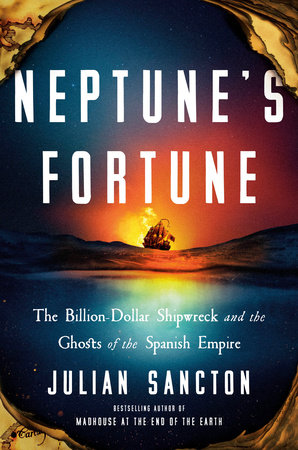
Neptune's Fortune

The Billion-Dollar Shipwreck and the Ghosts of the Spanish Empire

Look inside
Listen to a clip from the audiobook
audio pause button
0:00
0:00
Hardcover
$33.00 US
| $44.00 CAN
On sale Jan 27, 2026 | 384 Pages | 9780593594179
Grades 9-12 + AP/IB

See Additional Formats
The riveting true story of a legendary Spanish galleon that sunk off the coast of Colombia with over $1 billion in gold and silver—and one man’s obsessive quest to find it—from the New York Times bestselling author of Madhouse at the End of the Earth

“Splendid . . . Sancton is an expert guide through eighteenth-century European geopolitics [and] modern marine archaeology.”—The Wall Street Journal

Roger Dooley wasn’t looking for the San José. But an accidental discovery in the dusty stacks of a Spanish archive led him to the story of a lifetime, the tale of a great eighteenth-century treasure ship loaded with riches from the New World and destined for Spain. But that ship, the galleon San José, met a darker fate. It was drawn into a pitched battle with British ships of war off the coast of Cartagena, and when the smoke cleared, the San José and its bounty had disappeared into the ocean, its coordinates lost to time.

Though a diver at heart, Dooley was an unlikely candidate to find the San José. He had little in the way of serious credentials, yet his tenacity and single-minded devotion to finding and excavating the ship powered him across four decades, even as he became a man in exile from the country of his birth. As Dooley jousted with famous treasure hunters and well-funded competitors, he slowly homed in on a patch of sea that might contain a three-hundred-year-old shipwreck—or nothing at all.

Neptune's Fortune is a thrilling adventure, taking readers from great naval battles on the high seas to the sun-soaked shores that nurtured history’s most notorious treasure hunters, to the archives that held the secret keys to lost fortune on the ocean floor.
Chapter 1

The Graveyard of the Spanish

In surviving accounts, he is known only as the Frenchman. He was a prisoner aboard an English warship lurking off the coast of New Granada—the imperial Spanish territory corresponding largely to today’s Colombia—in search of vessels to plunder. For weeks the three-masted ship, part of a squadron of four, had been prowling the area, sailing far from shore to avoid detection. But in early May of 1708, the ship strayed close enough to land for the Frenchman to attempt an escape. When he sensed the opportunity, he climbed atop the bulwarks and threw himself overboard into the turbid, brackish waters where the Magdalena River spilled into the Caribbean Sea. It is unknown whether he jumped by daylight or under the cover of night. But had the English seen him, they would surely have done all they could to prevent him from reaching the shore alive.

Allowing his clothes little time to dry after the exhausting swim, he journeyed along the coast until he arrived at the port city of Cartagena de Indias and beheld its massive fortifications. Cartagena’s defenses were among the most imposing in the Caribbean, designed to protect the formidable wealth within. Most of the riches taken from South America passed through Cartagena on their way back to Spain, and most of the African men and women forcibly shipped in to extract those riches passed through the city’s slave market—one of the largest in the world.

The Frenchman walked beyond the ramparts into the city’s bustling streets. Not long before, a French traveler wandering through Cartagena would have drawn sidelong looks, or worse. Decades of war between France and Spain had nurtured a profound mutual loathing. Just a decade earlier, the city had been ruthlessly sacked and set aflame by marauders under the orders of the French corsair Jean-Baptiste Ducasse. But in 1700, upon the death of Spain’s heirless King Carlos II, France’s Louis XIV installed his own grandson, Philippe, on the throne in Madrid, citing a circuitous line of succession. In the time it took for the news to spread across the oceans, the French and the Spanish had become allies in what would later be called the War of the Spanish Succession, perhaps the first truly global conflict. Bad blood was washed away. Once the butcher of Cartagena, Ducasse was suddenly recast as a heroic naval commander, entrusted to defend Spain’s cities and ships against the English and the Dutch. The latter two countries were supporters of the Habsburg claimant to the throne, Charles of Austria. Having until then been allied with Spain, they were now the nation’s enemies.

The English threat was precisely what the Frenchman was anxious to warn the Spanish authorities about. (One witness described him as a “deserter,” which suggests he might have expected leniency in exchange for his information.) He was brought before Cartagena’s governor-general, José de Zúñiga, who heard his declaration. “There are along these coasts four English ships,” the Frenchman was reported to have said. “Two of seventy cannon, one of fifty, and one . . . which they call a fireship.”

The escaped prisoner’s report had a chilling effect on Governor Zúñiga. He had heard whispers of an English presence in the area, but none so specific. The danger could no longer be attributed to hearsay. The enemy ships’ objective was all too obvious: to intercept the Spanish treasure fleet on its return from the fair in Portobelo, a harbor on the Isthmus of Darién (in what is now Panama), where galleons were currently filling their hulls with gold and silver.

For nearly a century and a half, the Tierra Firme fleet had sailed between Spain and the Caribbean every two years on average. The Spanish Crown relied on the regular influx of precious metals stripped from the New World to pay its troops and its many creditors, to sustain its empire, and to gild its palaces, churches, and wealthy men and women. Yet by 1708 it had been more than a decade since the last treasure fleet had come and gone. The convoy system had begun to collapse at the end of the seventeenth century as Spain’s debts piled up, inflation spiraled, and the economy devolved into perpetual crisis. The war of succession delayed the dispatching of the galleons and merchant ships from Spain until 1706, and the constant threat of ambush in the Caribbean further prolonged their homeward voyage. Back in Madrid, Philippe, now King Felipe V, had grown desperate for the return of the galleons, which he expected would carry twelve years’ worth of accumulated treasure. The English raiders, of course, would have had the same expectation.

It was clear to Zúñiga that the outcome of the war—the very survival of the Crown—could depend on the safe passage of the fleet. He ordered a scribe to make a copy of the Frenchman’s declaration and entrusted it, along with corroborating accounts, to his thirty-year-old adjutant, Pedro de Fuentes, with instructions that he board a French sloop bound for Portobelo and hand the documents without delay to the captain general of the galleons, the Count of Casa Alegre.

Fuentes’s westward journey took several days. While the bureaucrat did his best to avoid paying tribute to Neptune, sailors kept watch from the crow’s nest, scanning the horizon for the English squadron. Only near the end of their voyage, in the Gulf of Darién, did they report anything unusual.

“Land!” bellowed a lookout, pointing off the port bow.

The sloop’s captain, who knew the coast so well he could draw a map of it by memory, was taken aback. He was aware of no landmass at that latitude, at that bearing.

“Have a better look,” he shouted, but the sailor could not make out the indistinct shapes in the distance. The captain sent another man to the top of the mast, yet the nature of the objects was no clearer to him—perhaps they were uncharted islands, perhaps they were foreign sails. The captain eyed the horizon. There was no time to investigate. Zúñiga’s orders had been clear: The message he carried could not wait. They sailed on.

As the sloop approached Portobelo, Fuentes gazed at the crenellated bastions that guarded the town and still bore the scars of multiple raids over the previous century. The English buccaneer Bartholomew Sharp had attacked the town in 1680, when it was still recovering from the vicious assault led by his infamous compatriot the pirate Henry Morgan twelve years earlier. Somewhere in these waters, the body of Francis Drake lay in a lead-lined coffin, dressed in a full suit of armor.

For pirates and privateers, there was no more tempting target in all of Spanish America than Portobelo during the fair: It was here that galleons and merchant ships discharged goods from Europe (olive oil, wine, iron, textiles, clothing, books, armaments, etc.) and filled their emptied hulls with riches from all across the Viceroyalty of Peru, which covered most of South America.

Christopher Columbus had given this place its idyllic name: Porto Bello, beautiful harbor. This appellation would turn out to be grimly ironic. The picturesque setting that had so charmed the explorer from a distance—a placid haven nestled at the foot of misty emerald hills—turned out to be a pestilential swamp, known among colonists as “the graveyard of the Spanish,” an inherently cursed place. “It destroys the vigour of nature, and often untimely cuts the thread of life,” wrote one eighteenth-century traveler, the scientist Antonio de Ulloa. In his description, the town’s infestations of jungle creatures rivaled the biblical plagues: “Serpents are here . . . numerous and deadly and toads innumerable, swarming not only in the damp and marshy places, as in other countries, but even in the streets, courts of great houses, and all open places in general.”

The sloop weaved among the galleons and merchant ships that cluttered the bay and sidled up to the Tierra Firme fleet’s magnificent flagship, the galleon San José. Fuentes was helped aboard the San José and led to the Count of Casa Alegre, Don José Fernández de Santillán. He delivered Zúñiga’s message along with a report of the possible ships the sailors on his sloop had seen in the Gulf of Darién.

Casa Alegre’s ornately appointed quarters occupied the stern of the vessel, their size and gilded splendor reflecting his rank. As captain general of galleons, the count was at the top of the viceroyalty’s hierarchy, superseding the viceroy of Peru himself. He was here not only as the commander of the fleet but as a proxy for the king.
“Sancton is a masterful storyteller, and he has struck gold—pun intended—with Neptune’s Fortune. Through extraordinary research across three continents and with a journalist’s eye for the telling detail, he has penned a rollicking tale of buccaneers, shady treasure hunters, and sea battles both past and present. Readers are in for a rare treat.”—Scott Anderson, New York Times bestselling author of Lawrence in Arabia

Neptune’s Fortune is a wonderful book, full of heroism, greed, piracy, sunken treasure, and adventure on the high seas. A wild, incredible story from beginning to end, with a central character straight out of Hemingway, it’s even more remarkable because it’s true.”—Eric Schlosser, New York Times bestselling author of Chew on This and Fast Food Nation

Neptune’s Fortune is about treasure and the subculture of treasure seekers, but more importantly it reminds us of the deeper and more satisfying riches that come embedded within a splendid historical tale that’s been researched meticulously and told exceptionally well.”—Hampton Sides, New York Times bestselling author of The Wide Wide Sea

Neptune’s Fortune is a real-life drama, a maritime riddle, a swashbuckling adventure, and, above all, a riveting tale.”—Susan Casey, New York Times bestselling author of The Underworld

“Roaring with excitement, Neptune’s Fortune is a deeply reported adventure, a study in obsession, and a thoroughly engrossing read. Sancton writes in the fine tradition of great narrative nonfiction that transports the reader into private worlds and into marvelous larger-than-life characters.”—Susan Orlean, bestselling author of The Orchid Thief and The Library Book

“[A] thrilling maritime saga . . . technically complex [and] nail-biting . . . [Neptune’s Fortune] is a rollicking historical mystery and a beguiling human drama rolled into one.”Publishers Weekly, starred review

“[G]ripping. . . . Sancton navigates the fraught tensions among archaeologists, governments, private salvors, and Indigenous groups with nuance and clarity. This is more than a treasure-hunt tale; it’s also a compelling examination of history, ethics, and obsession beneath the waves.”Library Journal, starred review

“A rousing historical treasure hunt.”—Kirkus Reviews

“[A] riveting, nonfiction tale of sunken treasure worth unimaginable sums that reads like fiction.”Booklist
© Jess Levine
Julian Sancton is the New York Times bestselling author of Madhouse at the End of the Earth and a senior features editor at The Hollywood Reporter. His work has appeared in Vanity Fair, National Geographic, Esquire, The New Yorker, and GQ, among other publications. He has reported from every continent, including Antarctica, and lives in Larchmont, New York. View titles by Julian Sancton

Discussion Guide for Neptune's Fortune

Provides questions, discussion topics, suggested reading lists, introductions and/or author Q&As, which are intended to enhance reading groups’ experiences.

(Please note: the guide displayed here is the most recently uploaded version; while unlikely, any page citation discrepancies between the guide and book is likely due to pagination differences between a book’s different formats.)

About

The riveting true story of a legendary Spanish galleon that sunk off the coast of Colombia with over $1 billion in gold and silver—and one man’s obsessive quest to find it—from the New York Times bestselling author of Madhouse at the End of the Earth

“Splendid . . . Sancton is an expert guide through eighteenth-century European geopolitics [and] modern marine archaeology.”—The Wall Street Journal

Roger Dooley wasn’t looking for the San José. But an accidental discovery in the dusty stacks of a Spanish archive led him to the story of a lifetime, the tale of a great eighteenth-century treasure ship loaded with riches from the New World and destined for Spain. But that ship, the galleon San José, met a darker fate. It was drawn into a pitched battle with British ships of war off the coast of Cartagena, and when the smoke cleared, the San José and its bounty had disappeared into the ocean, its coordinates lost to time.

Though a diver at heart, Dooley was an unlikely candidate to find the San José. He had little in the way of serious credentials, yet his tenacity and single-minded devotion to finding and excavating the ship powered him across four decades, even as he became a man in exile from the country of his birth. As Dooley jousted with famous treasure hunters and well-funded competitors, he slowly homed in on a patch of sea that might contain a three-hundred-year-old shipwreck—or nothing at all.

Neptune's Fortune is a thrilling adventure, taking readers from great naval battles on the high seas to the sun-soaked shores that nurtured history’s most notorious treasure hunters, to the archives that held the secret keys to lost fortune on the ocean floor.

Excerpt

Chapter 1

The Graveyard of the Spanish

In surviving accounts, he is known only as the Frenchman. He was a prisoner aboard an English warship lurking off the coast of New Granada—the imperial Spanish territory corresponding largely to today’s Colombia—in search of vessels to plunder. For weeks the three-masted ship, part of a squadron of four, had been prowling the area, sailing far from shore to avoid detection. But in early May of 1708, the ship strayed close enough to land for the Frenchman to attempt an escape. When he sensed the opportunity, he climbed atop the bulwarks and threw himself overboard into the turbid, brackish waters where the Magdalena River spilled into the Caribbean Sea. It is unknown whether he jumped by daylight or under the cover of night. But had the English seen him, they would surely have done all they could to prevent him from reaching the shore alive.

Allowing his clothes little time to dry after the exhausting swim, he journeyed along the coast until he arrived at the port city of Cartagena de Indias and beheld its massive fortifications. Cartagena’s defenses were among the most imposing in the Caribbean, designed to protect the formidable wealth within. Most of the riches taken from South America passed through Cartagena on their way back to Spain, and most of the African men and women forcibly shipped in to extract those riches passed through the city’s slave market—one of the largest in the world.

The Frenchman walked beyond the ramparts into the city’s bustling streets. Not long before, a French traveler wandering through Cartagena would have drawn sidelong looks, or worse. Decades of war between France and Spain had nurtured a profound mutual loathing. Just a decade earlier, the city had been ruthlessly sacked and set aflame by marauders under the orders of the French corsair Jean-Baptiste Ducasse. But in 1700, upon the death of Spain’s heirless King Carlos II, France’s Louis XIV installed his own grandson, Philippe, on the throne in Madrid, citing a circuitous line of succession. In the time it took for the news to spread across the oceans, the French and the Spanish had become allies in what would later be called the War of the Spanish Succession, perhaps the first truly global conflict. Bad blood was washed away. Once the butcher of Cartagena, Ducasse was suddenly recast as a heroic naval commander, entrusted to defend Spain’s cities and ships against the English and the Dutch. The latter two countries were supporters of the Habsburg claimant to the throne, Charles of Austria. Having until then been allied with Spain, they were now the nation’s enemies.

The English threat was precisely what the Frenchman was anxious to warn the Spanish authorities about. (One witness described him as a “deserter,” which suggests he might have expected leniency in exchange for his information.) He was brought before Cartagena’s governor-general, José de Zúñiga, who heard his declaration. “There are along these coasts four English ships,” the Frenchman was reported to have said. “Two of seventy cannon, one of fifty, and one . . . which they call a fireship.”

The escaped prisoner’s report had a chilling effect on Governor Zúñiga. He had heard whispers of an English presence in the area, but none so specific. The danger could no longer be attributed to hearsay. The enemy ships’ objective was all too obvious: to intercept the Spanish treasure fleet on its return from the fair in Portobelo, a harbor on the Isthmus of Darién (in what is now Panama), where galleons were currently filling their hulls with gold and silver.

For nearly a century and a half, the Tierra Firme fleet had sailed between Spain and the Caribbean every two years on average. The Spanish Crown relied on the regular influx of precious metals stripped from the New World to pay its troops and its many creditors, to sustain its empire, and to gild its palaces, churches, and wealthy men and women. Yet by 1708 it had been more than a decade since the last treasure fleet had come and gone. The convoy system had begun to collapse at the end of the seventeenth century as Spain’s debts piled up, inflation spiraled, and the economy devolved into perpetual crisis. The war of succession delayed the dispatching of the galleons and merchant ships from Spain until 1706, and the constant threat of ambush in the Caribbean further prolonged their homeward voyage. Back in Madrid, Philippe, now King Felipe V, had grown desperate for the return of the galleons, which he expected would carry twelve years’ worth of accumulated treasure. The English raiders, of course, would have had the same expectation.

It was clear to Zúñiga that the outcome of the war—the very survival of the Crown—could depend on the safe passage of the fleet. He ordered a scribe to make a copy of the Frenchman’s declaration and entrusted it, along with corroborating accounts, to his thirty-year-old adjutant, Pedro de Fuentes, with instructions that he board a French sloop bound for Portobelo and hand the documents without delay to the captain general of the galleons, the Count of Casa Alegre.

Fuentes’s westward journey took several days. While the bureaucrat did his best to avoid paying tribute to Neptune, sailors kept watch from the crow’s nest, scanning the horizon for the English squadron. Only near the end of their voyage, in the Gulf of Darién, did they report anything unusual.

“Land!” bellowed a lookout, pointing off the port bow.

The sloop’s captain, who knew the coast so well he could draw a map of it by memory, was taken aback. He was aware of no landmass at that latitude, at that bearing.

“Have a better look,” he shouted, but the sailor could not make out the indistinct shapes in the distance. The captain sent another man to the top of the mast, yet the nature of the objects was no clearer to him—perhaps they were uncharted islands, perhaps they were foreign sails. The captain eyed the horizon. There was no time to investigate. Zúñiga’s orders had been clear: The message he carried could not wait. They sailed on.

As the sloop approached Portobelo, Fuentes gazed at the crenellated bastions that guarded the town and still bore the scars of multiple raids over the previous century. The English buccaneer Bartholomew Sharp had attacked the town in 1680, when it was still recovering from the vicious assault led by his infamous compatriot the pirate Henry Morgan twelve years earlier. Somewhere in these waters, the body of Francis Drake lay in a lead-lined coffin, dressed in a full suit of armor.

For pirates and privateers, there was no more tempting target in all of Spanish America than Portobelo during the fair: It was here that galleons and merchant ships discharged goods from Europe (olive oil, wine, iron, textiles, clothing, books, armaments, etc.) and filled their emptied hulls with riches from all across the Viceroyalty of Peru, which covered most of South America.

Christopher Columbus had given this place its idyllic name: Porto Bello, beautiful harbor. This appellation would turn out to be grimly ironic. The picturesque setting that had so charmed the explorer from a distance—a placid haven nestled at the foot of misty emerald hills—turned out to be a pestilential swamp, known among colonists as “the graveyard of the Spanish,” an inherently cursed place. “It destroys the vigour of nature, and often untimely cuts the thread of life,” wrote one eighteenth-century traveler, the scientist Antonio de Ulloa. In his description, the town’s infestations of jungle creatures rivaled the biblical plagues: “Serpents are here . . . numerous and deadly and toads innumerable, swarming not only in the damp and marshy places, as in other countries, but even in the streets, courts of great houses, and all open places in general.”

The sloop weaved among the galleons and merchant ships that cluttered the bay and sidled up to the Tierra Firme fleet’s magnificent flagship, the galleon San José. Fuentes was helped aboard the San José and led to the Count of Casa Alegre, Don José Fernández de Santillán. He delivered Zúñiga’s message along with a report of the possible ships the sailors on his sloop had seen in the Gulf of Darién.

Casa Alegre’s ornately appointed quarters occupied the stern of the vessel, their size and gilded splendor reflecting his rank. As captain general of galleons, the count was at the top of the viceroyalty’s hierarchy, superseding the viceroy of Peru himself. He was here not only as the commander of the fleet but as a proxy for the king.

Reviews

“Sancton is a masterful storyteller, and he has struck gold—pun intended—with Neptune’s Fortune. Through extraordinary research across three continents and with a journalist’s eye for the telling detail, he has penned a rollicking tale of buccaneers, shady treasure hunters, and sea battles both past and present. Readers are in for a rare treat.”—Scott Anderson, New York Times bestselling author of Lawrence in Arabia

Neptune’s Fortune is a wonderful book, full of heroism, greed, piracy, sunken treasure, and adventure on the high seas. A wild, incredible story from beginning to end, with a central character straight out of Hemingway, it’s even more remarkable because it’s true.”—Eric Schlosser, New York Times bestselling author of Chew on This and Fast Food Nation

Neptune’s Fortune is about treasure and the subculture of treasure seekers, but more importantly it reminds us of the deeper and more satisfying riches that come embedded within a splendid historical tale that’s been researched meticulously and told exceptionally well.”—Hampton Sides, New York Times bestselling author of The Wide Wide Sea

Neptune’s Fortune is a real-life drama, a maritime riddle, a swashbuckling adventure, and, above all, a riveting tale.”—Susan Casey, New York Times bestselling author of The Underworld

“Roaring with excitement, Neptune’s Fortune is a deeply reported adventure, a study in obsession, and a thoroughly engrossing read. Sancton writes in the fine tradition of great narrative nonfiction that transports the reader into private worlds and into marvelous larger-than-life characters.”—Susan Orlean, bestselling author of The Orchid Thief and The Library Book

“[A] thrilling maritime saga . . . technically complex [and] nail-biting . . . [Neptune’s Fortune] is a rollicking historical mystery and a beguiling human drama rolled into one.”Publishers Weekly, starred review

“[G]ripping. . . . Sancton navigates the fraught tensions among archaeologists, governments, private salvors, and Indigenous groups with nuance and clarity. This is more than a treasure-hunt tale; it’s also a compelling examination of history, ethics, and obsession beneath the waves.”Library Journal, starred review

“A rousing historical treasure hunt.”—Kirkus Reviews

“[A] riveting, nonfiction tale of sunken treasure worth unimaginable sums that reads like fiction.”Booklist

Author

© Jess Levine
Julian Sancton is the New York Times bestselling author of Madhouse at the End of the Earth and a senior features editor at The Hollywood Reporter. His work has appeared in Vanity Fair, National Geographic, Esquire, The New Yorker, and GQ, among other publications. He has reported from every continent, including Antarctica, and lives in Larchmont, New York. View titles by Julian Sancton

Guides

Discussion Guide for Neptune's Fortune

Provides questions, discussion topics, suggested reading lists, introductions and/or author Q&As, which are intended to enhance reading groups’ experiences.

(Please note: the guide displayed here is the most recently uploaded version; while unlikely, any page citation discrepancies between the guide and book is likely due to pagination differences between a book’s different formats.)

  • More Websites from
    Penguin Random House
  • Common Reads
  • Library Marketing