Download high-resolution image
Listen to a clip from the audiobook
audio pause button
0:00
0:00

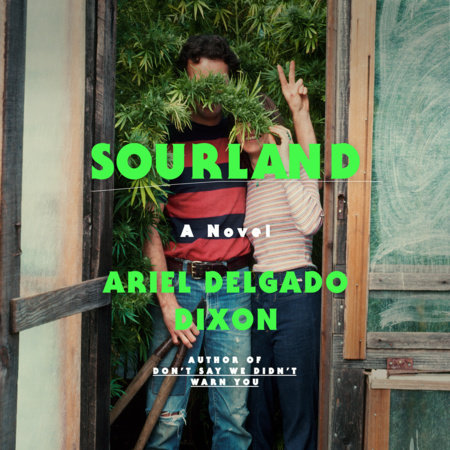
Sourland

A Novel

Listen to a clip from the audiobook
audio pause button
0:00
0:00
A gripping, propulsive novel about succession, sex, and revenge on a California marijuana farm

“Deliciously written and compulsively readable . . . As the ex-lovers of a missing weed farmer grapple for control of her land and harvest, they contend with the force of her presence and the complexities of their own pasts.”—Carmen Maria Machado, author of In the Dream House and Her Body and Other Parties

A Most Anticipated Book: Electric Lit, Harper’s Bazaar, The Seattle Times, and Autostraddle

Sapphire and her farm, Sourland, are fixtures of Northern California’s rugged wilderness, offering refuge to rejects, rebels, and outcasts—anyone willing to work and learn. But the haven Sapphire has built is fractured when she suddenly goes missing, her scorched truck abandoned on a mountain road.

Frankie, a disgraced ballerina and Sapphire’s former girlfriend and right-hand woman, returns to Sourland, claiming ownership of the farm. When she arrives, Frankie finds that Fizz—Sapphire’s most recent lover, an ex–baseball player with a preternatural green thumb—has already begun prepping Sourland for its biggest harvest yet.

As the two grapple for power, the farm’s fate hangs in the balance, and with it, the future Fizz and Frankie each covet for themselves. Past demons and scorned admirers remain hauntingly close, while the specter of Sapphire looms over the farm: in cryptic notes, in bud-tender gossip, in every blade of grass and whorl of smoke.

A brilliantly constructed novel of desire and betrayal, Sourland sparkles with the beauty and grime of the California woods. Dixon’s novel warns that our true nature catches up to us all—no matter how far we run.
Frankie

In the beginning, I saw cows everywhere they were not.

A capsized stump, blonded by open sun, was a heifer lounging in the tall grass.

In Garberville, I thought I saw a young bull strutting down an alley, but it was just a broad-bellied man in a suede jacket, walking away.

A loose cow can happen anywhere, anytime, spell trouble. How do you halt a willed thing when it wants to run away, or run you through?

I'm here to say it's possible, but your eyes have to be open.


We grew ourselves a garden. Our patch of cannabis was modest by most standards on the mountain, but it was easily hidden inside the treeline on the farm's back acres. We chose the spot for its look at the sun, then we started cutting.

With spurs and bull ropes, I climbed into the canopy while Sapphire coached me from the ground. There is an art to paring back the overstory. Trim enough so that sunlight pierces through to the plants below, but not so much that the patch looks unnatural from above. Wherever a tan oak or a madrone or a fir limb was buzzed short, we spray-painted its fresh edge a shade of green or ochre to dupe the low-flying spotter planes we called shitbirds, buzzing the hillside on surveillance.

My first summer on Sourland, I thought every rustle of leaves was the sound of livestock on the lam, escaped through some gate I'd left open. I used to dream of those gates, their chains dangling. If I was careless, the cows could escape into the hay barn to chow down, or else wander down to the road like hitchhikers, bewildered by their freedom. And when you're alone in the patch for too long, you begin to see or hear trouble even when there is none. Your ears detect a chopper that isn't coming. You discern a rival silhouette through the scrub, but it's only shadow, she evaporates as soon as the sun ticks west. Movement in the patch could mean nothing at all, but once, it was a mountain lion.

She froze when I froze, or the other way around. Under her yellow eyes, it was no longer clear to whom the patch belonged.

I told myself: She isn't real.

I told myself: Do not run.

I had caught her snoozing near an irrigation hose that had sprung a leak. She was cooling off, and while the mountain lion considered me, I ran inventory on my person, my pockets. I remember what I was wearing because it was what I always wore during the high season. Tank top, cargo cutoffs, a bandana on one wrist for mopping sweat. If it came to blows, what could I put in my hands? I was holding a pair of trimmers, that was all. Plus I was stoned, I always was then.

Have you heard about the mountain lions down in Los Angeles? Some of them are collared and they bleat their data out to a government computer. The lions can't cross the freeways, they keep inbreeding, they keep eating rat poison. A trimmer I once knew, Gentle Travis, saw one up close. He was working for an indoor grow on some dead-end drag in the Valley. Around dawn, after another rager, in another house he did not own, he went out to the pool for a smoke. A stranger was passed out on a pool floatie, circulating mutely between the jets. That's when Gentle Travis clocked the red dot. A mountain lion was hunched poolside, lapping greedily from the chlorinated water. Wildfires had driven her into the suburbs and she was thirsty, but she kept her eyes trained on him. If you're lucky, Gentle Travis told me, sometimes danger will glide right over you and leave you to your business. For him, it was true.

In the patch, my mountain lion put her nose to a gangly cannabis leaf and snuffed. She had one milky eye and it drifted in my direction. She was curious about me, and about the patch, I could tell. Her scent was mud, gerbil cage, wood rot, and the musk of something major, something that can kill a few different ways. Now I wished she was only a cow on the loose. A cow can kick you, trample you, but that's the worst they'll do.

"Hey, lion," I said, raising my arms to get big. "Go on. Get!"

I tried to push a plan through the wool in my head. My pulse throbbed in little bleats, like the red dot on a lion's collar, but my bleats went nowhere, messages to no one. The lion's milky eye fixed upon me and she began to move.

As she stepped through the patch, the fragrance of the buds broke open and she carried with her the sugar off the blooms, skunky resin, psychoactive sap. The stalks shuddered as she muscled through them. I don't know what came over me then. Sometimes I can't explain myself.

I reached out my hand.

There she was, just beyond my fingertips. Her fur, the harp of her whiskers. She gave a rolling growl but sauntered on. She was in no hurry. I was nothing to her, and she knew it, even as I let my hand hang.


After that, I hiked out quick as I could. We rarely took the John Deere buggy out to the patch for the trail it left, and it was sunset by the time I reached the cottage in its shallow clearing. The sky was the same slick shade of coral that always made me wonder how far the aerosols of the Central Valley traveled. Sweat was coursing down my legs, into my socks and boots. I shucked everything off, left my clothes in a heap behind me. I found Sapphire in her den.

She was sat at the steel tanker desk someone had hauled up the mountain and onto Sourland some unknown years ago. I was stark naked, still clutching the pair of Fiskars trimmers we used to pare back the plants.

Sapphire looked me up and down. "What happened to you?"

I let the trimmers drop. I pulled her up by the wrists, backed her toward the leather armchair in the corner, and climbed into her lap. Somewhere between the patch and the cottage, my adrenaline had liquefied and I felt it rushing up against my edges until I took Sapphire's hand, led her hand to my cunt. She moaned, I moaned. I wasn't stoned anymore.

Behind us, the bay window was open onto the Pit where the others slept, and to the barns and the drying shed, the menagerie, the greenhouse, the lower pasture where Sapphire's cows were grazing, their tails swishing darker than dusk. I had been on the farm three months. I thought I had found the edge of the world, or at least the edge of mine. When I came, Sapphire told me she loved me. Three months became five years, five years went to dust. I never saw the mountain lion again.


You probably have the wrong idea about outlaws.

It's true that a single harvest might net you enough to disappear and live large, for a while. Jet to Bali. Eat surf and turf for every meal. A lot of people buy boats.

It's truer that a single night will cost you. Rippers will slither onto your property, or roar in, guns blazing, when the plants are high, or curing or stashed in body bags or buried. In one sweep, they'll strip you of a season. And if a shitbird fingers you, or the Feds come sniffing, say goodbye to all that toil and trouble, to every penny you haven't buried in the ground. It doesn't even have to be robbers or the law. Mold kills a crop faster than you can isolate and burn it, and then you're just another sad sack on the hill, your springs running dry, your patch and greenhouses infested, all those pricey soil amendments and that premium cow shit leeched into the ground.

If you can't stay in the money, if rippers or the odd spore lay you low, you may decide to cut your losses. Split north or south, where you know people. You could leave it all behind and really be gone, just like that. Or else, someone can decide that for you. People don't stay here by accident, but they fall off the map every day.


By the time I fell off the map, I had good reasons to be gone. I was not the same person who had arrived those years ago, desperate to change my life. I was not the same person who reached for the mountain lion or f***ed with abandon because the hazards of my world gave me purpose, and purpose turned me on. It had been five years of smeared time. Time told by the weather. Five high seasons, five harvests, five winters spent kicking rocks. I wasn't leaving Sourland as some touristing farmhand who'd had their fill of the lifestyle. Even if Sapphire and I fell out of love, I still knew how to drive the skid-steer. Even if we'd come to resent each other in the worst ways, I could still milk the cows and jerry-rig the manure spreader and treat the hens if one got bumblefoot. I sexed the plants and mastered the post-hole digger like a rancher. I fertilized and tended and tied and trimmed and no one packed a pound faster than I could, not Gentle Travis, or even Sapphire. My scissors were a third appendage, snipping through heaps of flower, their resin frosting the hairs on my arms until I learned to wear long sleeves, even when the heat hit 110, barreling up from the San Joaquin Valley like hellfire on the run. The animals knew me. When I scanned the land, I knew what did not belong.

You don't throw away know-how like that unless you cannot trust someone, full stop. Even then, sometimes you do what you have to do.
“Full of sinewy desire, deception, shootouts and chases, and characters you might meet in a DeLillo novel. Atmospheric, with an eye for people, it reads like no other crime novel.”Electric Lit

“If you wish Succession was a little more Gen Z.”Harper’s Bazaar

“The kind of literary thriller that gets dirt under its nails—moody, combustible and charged with the sense that everyone is hiding something dangerous. An instant add to any summer to-be-read list.”The Seattle Times

“As the ex-lovers of a missing weed farmer grapple for control of her land and harvest, they contend with the force of her presence and the complexities of their own pasts against the sensuous Northern California wilderness. Deliciously written and compulsively readable, Sourland captures the dying days of a band of outlaws ensnared in a web of pleasure, labor, and loss.”—Carmen Maria Machado, author of In the Dream House and Her Body and Other Parties

“I am in love with this story, the way one hillside can be a world unto itself, imperiled and lasting. . . . From the smallest noticing in exquisite detail to the carnal twist of plot and fortune, what a shockingly delightful book.”—Jackie Polzin, author of Brood

Sourland is an absorbing, sensuous novel about sex and ambition, and what happens when a marijuana farmer disappears and two of her former lovers vie for control of the crop. Dixon’s characters love and fight with primal urgency, even as they save the best of themselves for their beloved plants. In prose that is as lush as the dankest harvest, Sourland is a bittersweet symphony of sweat, smoke, and dirt.”—Elizabeth Gonzalez James, author of The Bullet Swallower

“A mind-blowing, page-turning, utterly original literary thriller, Sourland is a novel of passion, shifting allegiances, and dangerous power struggles set on an illegal weed farm. Ariel Delgado Dixon packs this gritty underworld with sex, brutal violence, and virtuosic sentences. I stayed up way too late to find out who makes it out of Sourland alive. . . . A high-octane masterpiece.”—Mary Pauline Lowry, author of The Roxy Letters

“Atmospheric . . . Expertly paced and with equal amounts of suspense and melodrama, Dixon’s story captures the pulse of criminal life and the thrum of desire. This sizzles.”Publishers Weekly

“[A] gritty neo-Western, complete with double crosses, shootouts, rattletrap pickup trucks, a herd of cattle, and a dog named Pistol . . . Dixon’s wealth of knowledge about both legal and illegal farming practices and her feel for the texture of rural queer living infuse this sweaty, smoky thriller with vibrant realism . . . Skunky, in the best possible way.”Kirkus Reviews

“A lush tale of revenge, crime, love, and weed . . . Well told from all three main characters’ points of view, with turns of suspense, humor, and sensuality, this is engrossing.”Booklist
© epli
Ariel Delgado Dixon was born and raised in Trenton, New Jersey. She is the author of the novels Sourland and Don’t Say We Didn’t Warn You. She lives in Western Massachusetts where she works in farming and teaches writing. View titles by Ariel Delgado Dixon

About

A gripping, propulsive novel about succession, sex, and revenge on a California marijuana farm

“Deliciously written and compulsively readable . . . As the ex-lovers of a missing weed farmer grapple for control of her land and harvest, they contend with the force of her presence and the complexities of their own pasts.”—Carmen Maria Machado, author of In the Dream House and Her Body and Other Parties

A Most Anticipated Book: Electric Lit, Harper’s Bazaar, The Seattle Times, and Autostraddle

Sapphire and her farm, Sourland, are fixtures of Northern California’s rugged wilderness, offering refuge to rejects, rebels, and outcasts—anyone willing to work and learn. But the haven Sapphire has built is fractured when she suddenly goes missing, her scorched truck abandoned on a mountain road.

Frankie, a disgraced ballerina and Sapphire’s former girlfriend and right-hand woman, returns to Sourland, claiming ownership of the farm. When she arrives, Frankie finds that Fizz—Sapphire’s most recent lover, an ex–baseball player with a preternatural green thumb—has already begun prepping Sourland for its biggest harvest yet.

As the two grapple for power, the farm’s fate hangs in the balance, and with it, the future Fizz and Frankie each covet for themselves. Past demons and scorned admirers remain hauntingly close, while the specter of Sapphire looms over the farm: in cryptic notes, in bud-tender gossip, in every blade of grass and whorl of smoke.

A brilliantly constructed novel of desire and betrayal, Sourland sparkles with the beauty and grime of the California woods. Dixon’s novel warns that our true nature catches up to us all—no matter how far we run.

Excerpt

Frankie

In the beginning, I saw cows everywhere they were not.

A capsized stump, blonded by open sun, was a heifer lounging in the tall grass.

In Garberville, I thought I saw a young bull strutting down an alley, but it was just a broad-bellied man in a suede jacket, walking away.

A loose cow can happen anywhere, anytime, spell trouble. How do you halt a willed thing when it wants to run away, or run you through?

I'm here to say it's possible, but your eyes have to be open.


We grew ourselves a garden. Our patch of cannabis was modest by most standards on the mountain, but it was easily hidden inside the treeline on the farm's back acres. We chose the spot for its look at the sun, then we started cutting.

With spurs and bull ropes, I climbed into the canopy while Sapphire coached me from the ground. There is an art to paring back the overstory. Trim enough so that sunlight pierces through to the plants below, but not so much that the patch looks unnatural from above. Wherever a tan oak or a madrone or a fir limb was buzzed short, we spray-painted its fresh edge a shade of green or ochre to dupe the low-flying spotter planes we called shitbirds, buzzing the hillside on surveillance.

My first summer on Sourland, I thought every rustle of leaves was the sound of livestock on the lam, escaped through some gate I'd left open. I used to dream of those gates, their chains dangling. If I was careless, the cows could escape into the hay barn to chow down, or else wander down to the road like hitchhikers, bewildered by their freedom. And when you're alone in the patch for too long, you begin to see or hear trouble even when there is none. Your ears detect a chopper that isn't coming. You discern a rival silhouette through the scrub, but it's only shadow, she evaporates as soon as the sun ticks west. Movement in the patch could mean nothing at all, but once, it was a mountain lion.

She froze when I froze, or the other way around. Under her yellow eyes, it was no longer clear to whom the patch belonged.

I told myself: She isn't real.

I told myself: Do not run.

I had caught her snoozing near an irrigation hose that had sprung a leak. She was cooling off, and while the mountain lion considered me, I ran inventory on my person, my pockets. I remember what I was wearing because it was what I always wore during the high season. Tank top, cargo cutoffs, a bandana on one wrist for mopping sweat. If it came to blows, what could I put in my hands? I was holding a pair of trimmers, that was all. Plus I was stoned, I always was then.

Have you heard about the mountain lions down in Los Angeles? Some of them are collared and they bleat their data out to a government computer. The lions can't cross the freeways, they keep inbreeding, they keep eating rat poison. A trimmer I once knew, Gentle Travis, saw one up close. He was working for an indoor grow on some dead-end drag in the Valley. Around dawn, after another rager, in another house he did not own, he went out to the pool for a smoke. A stranger was passed out on a pool floatie, circulating mutely between the jets. That's when Gentle Travis clocked the red dot. A mountain lion was hunched poolside, lapping greedily from the chlorinated water. Wildfires had driven her into the suburbs and she was thirsty, but she kept her eyes trained on him. If you're lucky, Gentle Travis told me, sometimes danger will glide right over you and leave you to your business. For him, it was true.

In the patch, my mountain lion put her nose to a gangly cannabis leaf and snuffed. She had one milky eye and it drifted in my direction. She was curious about me, and about the patch, I could tell. Her scent was mud, gerbil cage, wood rot, and the musk of something major, something that can kill a few different ways. Now I wished she was only a cow on the loose. A cow can kick you, trample you, but that's the worst they'll do.

"Hey, lion," I said, raising my arms to get big. "Go on. Get!"

I tried to push a plan through the wool in my head. My pulse throbbed in little bleats, like the red dot on a lion's collar, but my bleats went nowhere, messages to no one. The lion's milky eye fixed upon me and she began to move.

As she stepped through the patch, the fragrance of the buds broke open and she carried with her the sugar off the blooms, skunky resin, psychoactive sap. The stalks shuddered as she muscled through them. I don't know what came over me then. Sometimes I can't explain myself.

I reached out my hand.

There she was, just beyond my fingertips. Her fur, the harp of her whiskers. She gave a rolling growl but sauntered on. She was in no hurry. I was nothing to her, and she knew it, even as I let my hand hang.


After that, I hiked out quick as I could. We rarely took the John Deere buggy out to the patch for the trail it left, and it was sunset by the time I reached the cottage in its shallow clearing. The sky was the same slick shade of coral that always made me wonder how far the aerosols of the Central Valley traveled. Sweat was coursing down my legs, into my socks and boots. I shucked everything off, left my clothes in a heap behind me. I found Sapphire in her den.

She was sat at the steel tanker desk someone had hauled up the mountain and onto Sourland some unknown years ago. I was stark naked, still clutching the pair of Fiskars trimmers we used to pare back the plants.

Sapphire looked me up and down. "What happened to you?"

I let the trimmers drop. I pulled her up by the wrists, backed her toward the leather armchair in the corner, and climbed into her lap. Somewhere between the patch and the cottage, my adrenaline had liquefied and I felt it rushing up against my edges until I took Sapphire's hand, led her hand to my cunt. She moaned, I moaned. I wasn't stoned anymore.

Behind us, the bay window was open onto the Pit where the others slept, and to the barns and the drying shed, the menagerie, the greenhouse, the lower pasture where Sapphire's cows were grazing, their tails swishing darker than dusk. I had been on the farm three months. I thought I had found the edge of the world, or at least the edge of mine. When I came, Sapphire told me she loved me. Three months became five years, five years went to dust. I never saw the mountain lion again.


You probably have the wrong idea about outlaws.

It's true that a single harvest might net you enough to disappear and live large, for a while. Jet to Bali. Eat surf and turf for every meal. A lot of people buy boats.

It's truer that a single night will cost you. Rippers will slither onto your property, or roar in, guns blazing, when the plants are high, or curing or stashed in body bags or buried. In one sweep, they'll strip you of a season. And if a shitbird fingers you, or the Feds come sniffing, say goodbye to all that toil and trouble, to every penny you haven't buried in the ground. It doesn't even have to be robbers or the law. Mold kills a crop faster than you can isolate and burn it, and then you're just another sad sack on the hill, your springs running dry, your patch and greenhouses infested, all those pricey soil amendments and that premium cow shit leeched into the ground.

If you can't stay in the money, if rippers or the odd spore lay you low, you may decide to cut your losses. Split north or south, where you know people. You could leave it all behind and really be gone, just like that. Or else, someone can decide that for you. People don't stay here by accident, but they fall off the map every day.


By the time I fell off the map, I had good reasons to be gone. I was not the same person who had arrived those years ago, desperate to change my life. I was not the same person who reached for the mountain lion or f***ed with abandon because the hazards of my world gave me purpose, and purpose turned me on. It had been five years of smeared time. Time told by the weather. Five high seasons, five harvests, five winters spent kicking rocks. I wasn't leaving Sourland as some touristing farmhand who'd had their fill of the lifestyle. Even if Sapphire and I fell out of love, I still knew how to drive the skid-steer. Even if we'd come to resent each other in the worst ways, I could still milk the cows and jerry-rig the manure spreader and treat the hens if one got bumblefoot. I sexed the plants and mastered the post-hole digger like a rancher. I fertilized and tended and tied and trimmed and no one packed a pound faster than I could, not Gentle Travis, or even Sapphire. My scissors were a third appendage, snipping through heaps of flower, their resin frosting the hairs on my arms until I learned to wear long sleeves, even when the heat hit 110, barreling up from the San Joaquin Valley like hellfire on the run. The animals knew me. When I scanned the land, I knew what did not belong.

You don't throw away know-how like that unless you cannot trust someone, full stop. Even then, sometimes you do what you have to do.

Reviews

“Full of sinewy desire, deception, shootouts and chases, and characters you might meet in a DeLillo novel. Atmospheric, with an eye for people, it reads like no other crime novel.”Electric Lit

“If you wish Succession was a little more Gen Z.”Harper’s Bazaar

“The kind of literary thriller that gets dirt under its nails—moody, combustible and charged with the sense that everyone is hiding something dangerous. An instant add to any summer to-be-read list.”The Seattle Times

“As the ex-lovers of a missing weed farmer grapple for control of her land and harvest, they contend with the force of her presence and the complexities of their own pasts against the sensuous Northern California wilderness. Deliciously written and compulsively readable, Sourland captures the dying days of a band of outlaws ensnared in a web of pleasure, labor, and loss.”—Carmen Maria Machado, author of In the Dream House and Her Body and Other Parties

“I am in love with this story, the way one hillside can be a world unto itself, imperiled and lasting. . . . From the smallest noticing in exquisite detail to the carnal twist of plot and fortune, what a shockingly delightful book.”—Jackie Polzin, author of Brood

Sourland is an absorbing, sensuous novel about sex and ambition, and what happens when a marijuana farmer disappears and two of her former lovers vie for control of the crop. Dixon’s characters love and fight with primal urgency, even as they save the best of themselves for their beloved plants. In prose that is as lush as the dankest harvest, Sourland is a bittersweet symphony of sweat, smoke, and dirt.”—Elizabeth Gonzalez James, author of The Bullet Swallower

“A mind-blowing, page-turning, utterly original literary thriller, Sourland is a novel of passion, shifting allegiances, and dangerous power struggles set on an illegal weed farm. Ariel Delgado Dixon packs this gritty underworld with sex, brutal violence, and virtuosic sentences. I stayed up way too late to find out who makes it out of Sourland alive. . . . A high-octane masterpiece.”—Mary Pauline Lowry, author of The Roxy Letters

“Atmospheric . . . Expertly paced and with equal amounts of suspense and melodrama, Dixon’s story captures the pulse of criminal life and the thrum of desire. This sizzles.”Publishers Weekly

“[A] gritty neo-Western, complete with double crosses, shootouts, rattletrap pickup trucks, a herd of cattle, and a dog named Pistol . . . Dixon’s wealth of knowledge about both legal and illegal farming practices and her feel for the texture of rural queer living infuse this sweaty, smoky thriller with vibrant realism . . . Skunky, in the best possible way.”Kirkus Reviews

“A lush tale of revenge, crime, love, and weed . . . Well told from all three main characters’ points of view, with turns of suspense, humor, and sensuality, this is engrossing.”Booklist

Author

© epli
Ariel Delgado Dixon was born and raised in Trenton, New Jersey. She is the author of the novels Sourland and Don’t Say We Didn’t Warn You. She lives in Western Massachusetts where she works in farming and teaches writing. View titles by Ariel Delgado Dixon
  • More Websites from
    Penguin Random House
  • Common Reads
  • Library Marketing