Download high-resolution image Look inside
Listen to a clip from the audiobook
audio pause button
0:00
0:00

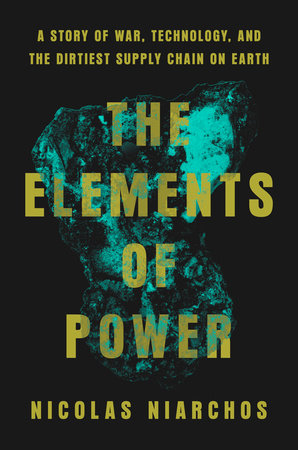
The Elements of Power

A Story of War, Technology, and the Dirtiest Supply Chain on Earth

Look inside
Listen to a clip from the audiobook
audio pause button
0:00
0:00
“A tale of rapacious colonialism, Cold War spy games, dazzling technical innovation, big business rivalry, big power geopolitics . . . Niarchos has produced an unflinching, landmark work on the nature of extractive capitalism.” —Patrick Radden Keefe, New York Times best-selling author of Empire of Pain and Say Nothing

Epic, shocking, and deeply reported, The Elements of Power tells the story of the war for the global supply of battery metals—essential for the decarbonization of our economies—and the terrible, bloody human cost of this badly misunderstood industry


Congo is rich. Swaths of the war-torn African country lack basic infrastructure, and, after many decades of colonial occupation, its people are officially among the poorest in the world. But hidden beneath the soil are vast quantities of cobalt, lithium, copper, tin, tantalum, tungsten, and other treasures. Recently, this veritable periodic table of resources has become extremely valuable because these metals are essential for the global “energy transition”—the plan for wealthy nations to wean themselves off fossil fuels by shifting to sustainable forms of energy, such as solar and wind. The race to electrify the world’s economy has begun, and China has a considerable head start. From Indonesia to South America to Central Africa, Beijing has invested in mines and infrastructure for decades. But the U.S. has begun fighting back with massive investments of its own, as well as sanctions and disruptive tariffs.

In this rush for green energy, the world has become utterly reliant on resources unearthed far away and willfully blind to the terrible political, environmental, and social consequences of their extraction. If the Democratic Republic of the Congo possesses such riches, why are its children routinely descending deep into treacherous mines to dig with the most rudimentary of tools, or in some cases their bare hands? Why are Indonesia’s seas and skies being polluted in a rush for battery metals? Why is the Western Sahara, a source for phosphates, still being treated like a colony? Who must pay the price for progress?

With unparalleled, original reporting, Nicolas Niarchos reveals how the scramble to control these metals and their production is overturning the world order, just as the global race to drill for oil shaped the twentieth century. Exploring the advent of the lithium-ion battery and tracing the supply chain for its production, Niarchos tells the story both of the people driving these tectonic changes and those whose lives are being upended. He reveals the true, devastating consequences of our best intentions and helps us prepare for an uncertain future. If you have ever used a smartphone or driven an electric vehicle, you are implicated.
CHAPTER 2

THE GREAT ROCK THAT SPREADS ALL OVER THE LANDS


By the time I met him, in September 2019, Odilon Kajumba Kilanga was thirty‑two. He had lost his right front tooth in a brawl four years before. (“I was in a group of people who clashed with another group of people,” he said. “We didn’t get along.”) His eyes were sunken and hollowed, and his level gaze suggested he had experienced much more than a man should in several lifetimes. Kajumba knew that some people had made it big in Kolwezi, but their number was vanishingly small, and once they’d made their money, they had often gotten as far from the pits as possible, moving on to brighter, airier places in South Africa or even as far away as Malta. The name of the island in the middle of the Mediterranean didn’t mean much to someone like Kajumba, though—it was just an impossible distance. Rather, he dreamed of making enough money to buy a restaurant, a small place where he could serve food and build a stable life, one in which he could afford to send his four children to school. He said that although many people he knew in Kolwezi wasted all their earnings on partying, alcohol, and even narcotics, he tried to avoid such temptations. Whenever I met up with him, he made a point of drinking cola.

For the moment, though, Kajumba was stuck in that suffocating little room, where the smells of manioc root mingled with human sweat and rushed the nostrils. The room was in a small stand‑alone cinder‑block structure on the edge of one of Kolwezi’s teeming cités populaires—slums where wastewater would run in rivulets down dirt hills into patches of garbage. Two walls of the room had been painted green in an effort to lighten the mood, but the color had become caked with grime. The windows were fitted with sheets of metal rather than glass panes. On one of the other walls, which were painted a liverish red, there was a picture of his brother. In the image, Amos, bathed in light, was depicted as an acolyte of the church that Kajumba and the two Mputus—Trésor and Yannick—attended. The church was the “thirtieth Pentecostal community in Congo,” a fading sign painted on the building’s facade proclaimed. It was better to have faith if you were poor and lived in Katanga.


It was not always so. the people of katanga knew their undulating country was rich long before the Europeans conducted their soundings and their surveys. Katanga’s wealth wasn’t just in red metal; it lay in its land, hills, and high‑altitude savanna, scattered with lakes and trees. If you had stood atop one of the region’s many hills in AD 1600, say, you would have seen swaths of woodland pocked with termite mounds. Perhaps, in a dembo or a dilungu—an area of low‑lying ground where the drainage was poor—there might have been areas of high grass where antelope grazed. “The plains pullulate with strange animals whose equals don’t exist anywhere else,” an early European traveler to the region wrote, “and it’s an endless pleasure to contemplate the myriads of antelope moving from place to place.” By the great lakes of the Upemba Depression, which drained into the Congo River, there were strips of marshland where hippos bathed. Fishermen had lived in villages around the lakes for at least a thousand years.

The people living in Katanga’s millions of acres of clear forest had learned to live among the trees. In the miombo, as the forest was known, there were trees for heat and cooking (musamba, which makes a good charcoal), trees for building (the sturdy‑branched muputu, or zebrawood), trees for healing (kafissi, whose roots had medicinal powers), and trees for harming (the bushman’s poison, whose sap was used to coat deadly arrows). There were, too, trees for eating, trees of myriad shapes, sizes, and colors that bore nourishment: the orange fruit of the mubambangoma, the single green thorn, the pulp of the yellow‑flowered kabalala, and the wild golden custard apples from the tree known as mulolo. The land was lush and verdant after the rains, but during the dry season, it became cold and parched. The soil turned to dust and stained the trees ocher.

You also would have noticed villages—perhaps sending smoke into the sky, perhaps vibrating with drums and dances to please ancestors whose spirits were all‑important. And mines had always been an important part of Katanga’s lived landscape. The most profitable of them were ruled over by powerful rulers. As the historian Eugenia W. Herbert has noted, the ability to work metal may have conferred regality or magical powers upon kings. In Katanga, the secrets of master smiths were passed from generation to generation, and sorcerers invoked ancestral spirits before mines were dug into the ground, chanting, “You who have preceded us, it is you who have opened for your children the entrails of the mountain. Grant that we may find treasure.” By the fifteenth century, cross‑shaped copper ingots smelted in Katanga had become currency in regions across Central Africa, and the people of Katanga began to band together.

The kingdoms grew and the peoples of Katanga created armies and fought one another for control of resources, human and otherwise. Slaves were captured and traded between rulers and chiefs, sometimes over long distances.

Looking about the region sometime around 1600, you might have also seen a conflict between two kings, one known as Red, the other as Black. The date is only approximate because the peoples of Katanga did not use writing, although some used lukasa—“memory boards” studded with beads— to help them remember their history, which was passed down orally.

According to the most common version of the story, Nkongolo Mwamba, the Red King, was the descendant of peoples from east of the upper Congo River. As a boy, he had watched a colony of driver ants destroy a more numerous colony of termites, and he had resolved to dominate other men. Kalala Ilunga, the Black King, was a hunter who grew up in Nkongolo’s capital and helped him subdue some of the copper‑rich lands to the south. One day, the Black King beat the Red King at a ceremonial game played with a rubber ball, causing the latter’s mother to burst into a fit of laughter. The Red King was so upset that he buried his mother alive and planned to kill the Black King. The younger man escaped, however, and fled across the upper Congo River. He ultimately returned with an army to defeat the Red King.

The dynasty that the Red King founded, that of the Luba people, would last until Belgian colonists arrived in the region. Praise phrases— short mnemonic poems that are still passed down in Katangese villages— composed for Kalala Ilunga reflect the expansive understanding of his kingship: Ami ne dibwe dya kyalantanda; kekudipo ntanda ya shile (“I am the great rock that spreads all over the lands; there is no land that it does not reach”) and Ami nkidopo mukalo na muntu (“I have no boundaries with any man”). The Luba king might well have been talking about Katanga today, or at least its minerals, which have spread, through technology, to every part of the globe.

Over the next two hundred years or so, the Luba Empire grew and split into other kingdoms. By the time the first written records of Katanga began to appear, the country was divided, broadly, into three kingdoms, or empires—the Luba, Lunda, and Yeke. (Other groups of people, includ‑ ing the Sanga, existed at the peripheries of these realms.) The alliances formed, and the wars waged, in the days before the colonialization of Katanga would continue to profoundly affect Congo into the twenty‑first century. In his work on mining in Katanga, the social scientist Claude Iguma Wakenge points out how “politico‑ethnic relationships,” many of which can be traced to the separation of the early Katangese kingdoms, continue to create informal governance structures and corruption in the Congolese mining industry. As one local administrator put it when speaking to Iguma in 2018, “The governance of the Katangese extractive sector is shaped with politics and ethnicity.”


In 1806, two enterprising mixed‑race portuguese traders, or pombeiros, arrived in the area and described for the first time to the outside world a hilly country governed by powerful master smiths. One, Pedro João Batista, wrote in his diary that “green stones (malachite) are found in the ground, called ‘catanga.’” This was probably the first written instance of the name Katanga. Batista’s words were later translated into English as an exploration mania gripped the colonial European powers; to a certain type of Victorian Brit, Frenchman, or Belgian, the mere mention of the journey of the pombeiros would have conjured some magic. The same green stones that Batista wrote about are the ore from which cobalt and copper are extracted today.
“Journalist Niarchos debuts with an impressive investigation into the global race to acquire the raw materials needed to power electric vehicles, cellphones, laptops, and other devices . . . Readers won’t look at their smartphones the same way again.” —Publishers Weekly (starred review)

“Journalist Nick Niarchos digs into the global minerals trade at the heart of the Democratic Republic of the Congo, a hub in the vast supply chains that have brought misery to many and immense profits to a few . . . Told with journalistic flair . . . His book will have readers rethink the ethics of extraction—you’ll never look at your phone or your EV in quite the same way again. An eye-opening and sobering investigation that challenges us to consider the suffering embedded in our everyday devices.” —Kirkus (starred review)

“A striking and vigorous investigation into the ongoing devastation of the Democratic Republic of the Congo at the hands of foreign and domestic powers intent on exploiting its natural wealth. . . . the country now supplies 70 percent of the world’s cobalt . . . critical to lithium batteries, which run smartphones, among many other things, and as Niarchos documents with lethal precision, mining it destroys the lives of millions. . . . Having traveled to Congo, China, and other countries in pursuit of this story, Niarchos immerses readers in the history of this land burdened with coveted resources. . . . Niarchos tracks a legacy of injustice. Like Siddharth Kara’s Cobalt Red (2023), this urgent exposé shines a light on extreme corporate malfeasance and the bleakest inhumanity.” —Booklist (starred review)

“In another era, when oil was the undisputed lubricant of global capitalism, the economic historian Daniel Yergin charted the intersection of business and geopolitics in his 1992 Pulitzer-winning classic The Prize: The Epic Quest for Oil, Money, and Power. In 2026, Nicolas Niarchos, a journalist specializing in energy and mining, attempts something similar for the age of batteries. Mostly he succeeds. The Elements of Power cuts like a fast-paced action film from battery labs in California, Tokyo, and the backstreets of Shenzhen . . . to mines in Africa and elsewhere where a combination of powerful companies, hucksters and mostly downtrodden miners scrabble for the minerals needed to power the energy transition.” —David Pilling, Financial Times

“Nicolas Niarchos exposes how the metal cobalt gets from the mines of the Democratic Republic of Congo to the battery factories of China and into the electric vehicles that purr along our streets—and who profits . . . The book is a serious exposé . . . Niarchos traces the webs of multibillion-dollar international deals that enmesh Congo’s cobalt mines and juxtaposes this material, painfully, with boots-on-the-ground descriptions of Congolese lives.” —The Times (UK)

“This is a bold and original book, a deep exploration of the way in which the batteries powering our most antiseptic seeming technologies—smartphones and electric cars—are connected to a world of conflict and predation. Drawing on his own dauntless reporting in over a dozen countries, Nicolas Niarchos distills this complex subject, finding its dramatic essence—a tale of rapacious colonialism, Cold War spy games, dazzling technical innovation, big business rivalry, big power geopolitics, and incalculable (and ongoing) human cost. By connecting Congo's present to its past and future, and tracing the links in the supply chain to demonstrate the way in which this story morally implicates us all, Niarchos has produced an unflinching, landmark work on the nature of extractive capitalism.” —Patrick Radden Keefe, New York Times best-selling author of Empire of Pain and Say Nothing

“With forensic research and vivid reporting, Niarchos unpacks the dirty paradox of clean energy: a technology celebrated as the key to a sustainable future, yet one that exacts a devastating human and environmental cost in Congo. Expansive and eye-opening, it is essential reading for our age.” —Clarissa Ward, author of On All Fronts

The Elements of Power is a terrific book—punchy, intelligent, and critically attuned to its subject’s moral and technical complexities. Niarchos’s lively storytelling and wonderfully diverse characters make his history of batteries at once sobering and fun to read. There isn’t a dull moment in it.” —Atossa Araxia Abrahamian, author of The Hidden Globe: How Wealth Hacks the World

“In this fascinating book, The Elements of Power, Nicolas Niarchos tells how the convulsed history of the Congo and its strategic minerals have played a vital role in fueling today’s Big Tech revolution. In a cruel paradox, Congo’s role as a key provider of the minerals that are helping drive the world’s energy transition—the lithium-ion battery—has also condemned it to inequality, social instability and seemingly endless cycles of armed conflict. This disturbing reality is one of the epic stories of our time, and Niarchos tells it skillfully, with narrative verve, keen insights, and an admirable attention to factual detail. That he has done so after years of firsthand research that included dangerous field forays in the Congo is an accomplishment that deserves high praise. The Elements of Power is, quite simply, a firecracker of a book, a must-read for anyone seeking clarity in the murk of today’s world.” —Jon Lee Anderson, author of To Lose a War: The Fall and Rise of the Taliban

“Niarchos's The Elements of Power is one of the most illuminating reads of and for our times. Hard-hitting stories of corporate invention and greed, government corruption, and human exploitation will make you question the devices we use almost constantly. Niarchos brilliantly investigates and dissects the brazen profiteering of some of the world's most sought-after commodities and the lives it affects. An unmissable book in this day and age.” —David de Jong, author of Nazi Billionaires: The Dark History of Germany Wealthiest Dynasties

“Intrepid reporter Niarchos exposes how the green transition is a dirty and violent tale – with the lithium-ion battery at the heart of the geo-politics and history -- in which the rich world’s luxury beliefs about climate crisis ignore the poverty and environmental despoliation unfolding in Africa.” —Aidan Hartley, author of The Zanzibar Chest

“What begins as a book about batteries becomes a riveting journey through lithium-ion technology and its global consequences. From colonial Congo to Cold War rivalries to China’s rise, it reveals how genius, ambition, and exploitation built the supply chains powering our devices, cars, and life-saving medical tools. Fair, compelling, and meticulously researched, it captures both the promise and the human cost of the battery revolution. Essential reading for anyone interested in technology, politics, and the forces shaping our future.“ —Mohamedsalem Werad, editor and cofounder, Sahrawi Voice
© Malù dalla Piccola
Nicolas Niarchos is a journalist whose work focuses on energy, war, and migration. His work has been published in The New YorkerThe Nation, and The New York Times. He has testified on the effects of Congolese battery metal mining on Capitol Hill. His work on mining in Indonesia was shortlisted for a 2024 Livingston Award. In 2023, he won an Edward R. Murrow Award for a radio report from Ukraine for The New Yorker and WNYC. View titles by Nicolas Niarchos

About

“A tale of rapacious colonialism, Cold War spy games, dazzling technical innovation, big business rivalry, big power geopolitics . . . Niarchos has produced an unflinching, landmark work on the nature of extractive capitalism.” —Patrick Radden Keefe, New York Times best-selling author of Empire of Pain and Say Nothing

Epic, shocking, and deeply reported, The Elements of Power tells the story of the war for the global supply of battery metals—essential for the decarbonization of our economies—and the terrible, bloody human cost of this badly misunderstood industry


Congo is rich. Swaths of the war-torn African country lack basic infrastructure, and, after many decades of colonial occupation, its people are officially among the poorest in the world. But hidden beneath the soil are vast quantities of cobalt, lithium, copper, tin, tantalum, tungsten, and other treasures. Recently, this veritable periodic table of resources has become extremely valuable because these metals are essential for the global “energy transition”—the plan for wealthy nations to wean themselves off fossil fuels by shifting to sustainable forms of energy, such as solar and wind. The race to electrify the world’s economy has begun, and China has a considerable head start. From Indonesia to South America to Central Africa, Beijing has invested in mines and infrastructure for decades. But the U.S. has begun fighting back with massive investments of its own, as well as sanctions and disruptive tariffs.

In this rush for green energy, the world has become utterly reliant on resources unearthed far away and willfully blind to the terrible political, environmental, and social consequences of their extraction. If the Democratic Republic of the Congo possesses such riches, why are its children routinely descending deep into treacherous mines to dig with the most rudimentary of tools, or in some cases their bare hands? Why are Indonesia’s seas and skies being polluted in a rush for battery metals? Why is the Western Sahara, a source for phosphates, still being treated like a colony? Who must pay the price for progress?

With unparalleled, original reporting, Nicolas Niarchos reveals how the scramble to control these metals and their production is overturning the world order, just as the global race to drill for oil shaped the twentieth century. Exploring the advent of the lithium-ion battery and tracing the supply chain for its production, Niarchos tells the story both of the people driving these tectonic changes and those whose lives are being upended. He reveals the true, devastating consequences of our best intentions and helps us prepare for an uncertain future. If you have ever used a smartphone or driven an electric vehicle, you are implicated.

Excerpt

CHAPTER 2

THE GREAT ROCK THAT SPREADS ALL OVER THE LANDS


By the time I met him, in September 2019, Odilon Kajumba Kilanga was thirty‑two. He had lost his right front tooth in a brawl four years before. (“I was in a group of people who clashed with another group of people,” he said. “We didn’t get along.”) His eyes were sunken and hollowed, and his level gaze suggested he had experienced much more than a man should in several lifetimes. Kajumba knew that some people had made it big in Kolwezi, but their number was vanishingly small, and once they’d made their money, they had often gotten as far from the pits as possible, moving on to brighter, airier places in South Africa or even as far away as Malta. The name of the island in the middle of the Mediterranean didn’t mean much to someone like Kajumba, though—it was just an impossible distance. Rather, he dreamed of making enough money to buy a restaurant, a small place where he could serve food and build a stable life, one in which he could afford to send his four children to school. He said that although many people he knew in Kolwezi wasted all their earnings on partying, alcohol, and even narcotics, he tried to avoid such temptations. Whenever I met up with him, he made a point of drinking cola.

For the moment, though, Kajumba was stuck in that suffocating little room, where the smells of manioc root mingled with human sweat and rushed the nostrils. The room was in a small stand‑alone cinder‑block structure on the edge of one of Kolwezi’s teeming cités populaires—slums where wastewater would run in rivulets down dirt hills into patches of garbage. Two walls of the room had been painted green in an effort to lighten the mood, but the color had become caked with grime. The windows were fitted with sheets of metal rather than glass panes. On one of the other walls, which were painted a liverish red, there was a picture of his brother. In the image, Amos, bathed in light, was depicted as an acolyte of the church that Kajumba and the two Mputus—Trésor and Yannick—attended. The church was the “thirtieth Pentecostal community in Congo,” a fading sign painted on the building’s facade proclaimed. It was better to have faith if you were poor and lived in Katanga.


It was not always so. the people of katanga knew their undulating country was rich long before the Europeans conducted their soundings and their surveys. Katanga’s wealth wasn’t just in red metal; it lay in its land, hills, and high‑altitude savanna, scattered with lakes and trees. If you had stood atop one of the region’s many hills in AD 1600, say, you would have seen swaths of woodland pocked with termite mounds. Perhaps, in a dembo or a dilungu—an area of low‑lying ground where the drainage was poor—there might have been areas of high grass where antelope grazed. “The plains pullulate with strange animals whose equals don’t exist anywhere else,” an early European traveler to the region wrote, “and it’s an endless pleasure to contemplate the myriads of antelope moving from place to place.” By the great lakes of the Upemba Depression, which drained into the Congo River, there were strips of marshland where hippos bathed. Fishermen had lived in villages around the lakes for at least a thousand years.

The people living in Katanga’s millions of acres of clear forest had learned to live among the trees. In the miombo, as the forest was known, there were trees for heat and cooking (musamba, which makes a good charcoal), trees for building (the sturdy‑branched muputu, or zebrawood), trees for healing (kafissi, whose roots had medicinal powers), and trees for harming (the bushman’s poison, whose sap was used to coat deadly arrows). There were, too, trees for eating, trees of myriad shapes, sizes, and colors that bore nourishment: the orange fruit of the mubambangoma, the single green thorn, the pulp of the yellow‑flowered kabalala, and the wild golden custard apples from the tree known as mulolo. The land was lush and verdant after the rains, but during the dry season, it became cold and parched. The soil turned to dust and stained the trees ocher.

You also would have noticed villages—perhaps sending smoke into the sky, perhaps vibrating with drums and dances to please ancestors whose spirits were all‑important. And mines had always been an important part of Katanga’s lived landscape. The most profitable of them were ruled over by powerful rulers. As the historian Eugenia W. Herbert has noted, the ability to work metal may have conferred regality or magical powers upon kings. In Katanga, the secrets of master smiths were passed from generation to generation, and sorcerers invoked ancestral spirits before mines were dug into the ground, chanting, “You who have preceded us, it is you who have opened for your children the entrails of the mountain. Grant that we may find treasure.” By the fifteenth century, cross‑shaped copper ingots smelted in Katanga had become currency in regions across Central Africa, and the people of Katanga began to band together.

The kingdoms grew and the peoples of Katanga created armies and fought one another for control of resources, human and otherwise. Slaves were captured and traded between rulers and chiefs, sometimes over long distances.

Looking about the region sometime around 1600, you might have also seen a conflict between two kings, one known as Red, the other as Black. The date is only approximate because the peoples of Katanga did not use writing, although some used lukasa—“memory boards” studded with beads— to help them remember their history, which was passed down orally.

According to the most common version of the story, Nkongolo Mwamba, the Red King, was the descendant of peoples from east of the upper Congo River. As a boy, he had watched a colony of driver ants destroy a more numerous colony of termites, and he had resolved to dominate other men. Kalala Ilunga, the Black King, was a hunter who grew up in Nkongolo’s capital and helped him subdue some of the copper‑rich lands to the south. One day, the Black King beat the Red King at a ceremonial game played with a rubber ball, causing the latter’s mother to burst into a fit of laughter. The Red King was so upset that he buried his mother alive and planned to kill the Black King. The younger man escaped, however, and fled across the upper Congo River. He ultimately returned with an army to defeat the Red King.

The dynasty that the Red King founded, that of the Luba people, would last until Belgian colonists arrived in the region. Praise phrases— short mnemonic poems that are still passed down in Katangese villages— composed for Kalala Ilunga reflect the expansive understanding of his kingship: Ami ne dibwe dya kyalantanda; kekudipo ntanda ya shile (“I am the great rock that spreads all over the lands; there is no land that it does not reach”) and Ami nkidopo mukalo na muntu (“I have no boundaries with any man”). The Luba king might well have been talking about Katanga today, or at least its minerals, which have spread, through technology, to every part of the globe.

Over the next two hundred years or so, the Luba Empire grew and split into other kingdoms. By the time the first written records of Katanga began to appear, the country was divided, broadly, into three kingdoms, or empires—the Luba, Lunda, and Yeke. (Other groups of people, includ‑ ing the Sanga, existed at the peripheries of these realms.) The alliances formed, and the wars waged, in the days before the colonialization of Katanga would continue to profoundly affect Congo into the twenty‑first century. In his work on mining in Katanga, the social scientist Claude Iguma Wakenge points out how “politico‑ethnic relationships,” many of which can be traced to the separation of the early Katangese kingdoms, continue to create informal governance structures and corruption in the Congolese mining industry. As one local administrator put it when speaking to Iguma in 2018, “The governance of the Katangese extractive sector is shaped with politics and ethnicity.”


In 1806, two enterprising mixed‑race portuguese traders, or pombeiros, arrived in the area and described for the first time to the outside world a hilly country governed by powerful master smiths. One, Pedro João Batista, wrote in his diary that “green stones (malachite) are found in the ground, called ‘catanga.’” This was probably the first written instance of the name Katanga. Batista’s words were later translated into English as an exploration mania gripped the colonial European powers; to a certain type of Victorian Brit, Frenchman, or Belgian, the mere mention of the journey of the pombeiros would have conjured some magic. The same green stones that Batista wrote about are the ore from which cobalt and copper are extracted today.

Reviews

“Journalist Niarchos debuts with an impressive investigation into the global race to acquire the raw materials needed to power electric vehicles, cellphones, laptops, and other devices . . . Readers won’t look at their smartphones the same way again.” —Publishers Weekly (starred review)

“Journalist Nick Niarchos digs into the global minerals trade at the heart of the Democratic Republic of the Congo, a hub in the vast supply chains that have brought misery to many and immense profits to a few . . . Told with journalistic flair . . . His book will have readers rethink the ethics of extraction—you’ll never look at your phone or your EV in quite the same way again. An eye-opening and sobering investigation that challenges us to consider the suffering embedded in our everyday devices.” —Kirkus (starred review)

“A striking and vigorous investigation into the ongoing devastation of the Democratic Republic of the Congo at the hands of foreign and domestic powers intent on exploiting its natural wealth. . . . the country now supplies 70 percent of the world’s cobalt . . . critical to lithium batteries, which run smartphones, among many other things, and as Niarchos documents with lethal precision, mining it destroys the lives of millions. . . . Having traveled to Congo, China, and other countries in pursuit of this story, Niarchos immerses readers in the history of this land burdened with coveted resources. . . . Niarchos tracks a legacy of injustice. Like Siddharth Kara’s Cobalt Red (2023), this urgent exposé shines a light on extreme corporate malfeasance and the bleakest inhumanity.” —Booklist (starred review)

“In another era, when oil was the undisputed lubricant of global capitalism, the economic historian Daniel Yergin charted the intersection of business and geopolitics in his 1992 Pulitzer-winning classic The Prize: The Epic Quest for Oil, Money, and Power. In 2026, Nicolas Niarchos, a journalist specializing in energy and mining, attempts something similar for the age of batteries. Mostly he succeeds. The Elements of Power cuts like a fast-paced action film from battery labs in California, Tokyo, and the backstreets of Shenzhen . . . to mines in Africa and elsewhere where a combination of powerful companies, hucksters and mostly downtrodden miners scrabble for the minerals needed to power the energy transition.” —David Pilling, Financial Times

“Nicolas Niarchos exposes how the metal cobalt gets from the mines of the Democratic Republic of Congo to the battery factories of China and into the electric vehicles that purr along our streets—and who profits . . . The book is a serious exposé . . . Niarchos traces the webs of multibillion-dollar international deals that enmesh Congo’s cobalt mines and juxtaposes this material, painfully, with boots-on-the-ground descriptions of Congolese lives.” —The Times (UK)

“This is a bold and original book, a deep exploration of the way in which the batteries powering our most antiseptic seeming technologies—smartphones and electric cars—are connected to a world of conflict and predation. Drawing on his own dauntless reporting in over a dozen countries, Nicolas Niarchos distills this complex subject, finding its dramatic essence—a tale of rapacious colonialism, Cold War spy games, dazzling technical innovation, big business rivalry, big power geopolitics, and incalculable (and ongoing) human cost. By connecting Congo's present to its past and future, and tracing the links in the supply chain to demonstrate the way in which this story morally implicates us all, Niarchos has produced an unflinching, landmark work on the nature of extractive capitalism.” —Patrick Radden Keefe, New York Times best-selling author of Empire of Pain and Say Nothing

“With forensic research and vivid reporting, Niarchos unpacks the dirty paradox of clean energy: a technology celebrated as the key to a sustainable future, yet one that exacts a devastating human and environmental cost in Congo. Expansive and eye-opening, it is essential reading for our age.” —Clarissa Ward, author of On All Fronts

The Elements of Power is a terrific book—punchy, intelligent, and critically attuned to its subject’s moral and technical complexities. Niarchos’s lively storytelling and wonderfully diverse characters make his history of batteries at once sobering and fun to read. There isn’t a dull moment in it.” —Atossa Araxia Abrahamian, author of The Hidden Globe: How Wealth Hacks the World

“In this fascinating book, The Elements of Power, Nicolas Niarchos tells how the convulsed history of the Congo and its strategic minerals have played a vital role in fueling today’s Big Tech revolution. In a cruel paradox, Congo’s role as a key provider of the minerals that are helping drive the world’s energy transition—the lithium-ion battery—has also condemned it to inequality, social instability and seemingly endless cycles of armed conflict. This disturbing reality is one of the epic stories of our time, and Niarchos tells it skillfully, with narrative verve, keen insights, and an admirable attention to factual detail. That he has done so after years of firsthand research that included dangerous field forays in the Congo is an accomplishment that deserves high praise. The Elements of Power is, quite simply, a firecracker of a book, a must-read for anyone seeking clarity in the murk of today’s world.” —Jon Lee Anderson, author of To Lose a War: The Fall and Rise of the Taliban

“Niarchos's The Elements of Power is one of the most illuminating reads of and for our times. Hard-hitting stories of corporate invention and greed, government corruption, and human exploitation will make you question the devices we use almost constantly. Niarchos brilliantly investigates and dissects the brazen profiteering of some of the world's most sought-after commodities and the lives it affects. An unmissable book in this day and age.” —David de Jong, author of Nazi Billionaires: The Dark History of Germany Wealthiest Dynasties

“Intrepid reporter Niarchos exposes how the green transition is a dirty and violent tale – with the lithium-ion battery at the heart of the geo-politics and history -- in which the rich world’s luxury beliefs about climate crisis ignore the poverty and environmental despoliation unfolding in Africa.” —Aidan Hartley, author of The Zanzibar Chest

“What begins as a book about batteries becomes a riveting journey through lithium-ion technology and its global consequences. From colonial Congo to Cold War rivalries to China’s rise, it reveals how genius, ambition, and exploitation built the supply chains powering our devices, cars, and life-saving medical tools. Fair, compelling, and meticulously researched, it captures both the promise and the human cost of the battery revolution. Essential reading for anyone interested in technology, politics, and the forces shaping our future.“ —Mohamedsalem Werad, editor and cofounder, Sahrawi Voice

Author

© Malù dalla Piccola
Nicolas Niarchos is a journalist whose work focuses on energy, war, and migration. His work has been published in The New YorkerThe Nation, and The New York Times. He has testified on the effects of Congolese battery metal mining on Capitol Hill. His work on mining in Indonesia was shortlisted for a 2024 Livingston Award. In 2023, he won an Edward R. Murrow Award for a radio report from Ukraine for The New Yorker and WNYC. View titles by Nicolas Niarchos
  • More Websites from
    Penguin Random House
  • Common Reads
  • Library Marketing