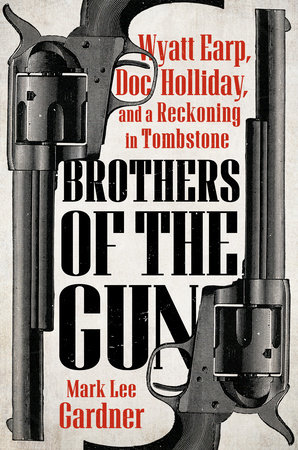
Download high-resolution image
Listen to a clip from the audiobook
audio pause button
0:00
0:00

Brothers of the Gun

Wyatt Earp, Doc Holliday, and a Reckoning in Tombstone

Author Mark Lee Gardner On Tour
Listen to a clip from the audiobook
audio pause button
0:00
0:00
A colorful and groundbreaking account of the most storied friendship of the American West: the bond between Wyatt Earp and Doc Holliday

Wyatt Earp and Doc Holliday: Legendary gunfighters and friends who gained immortality because of a thirty-second shootout near a livery stable called the O.K. Corral. Their friendship actually began three years before that iconic 1881 gunfight, in the rollicking cattle town of Dodge City. Wyatt, an assistant city marshal, was surrounded by armed, belligerent cowboys. Doc saw Wyatt’s predicament from a monte table in the Long Branch saloon and burst out the door with two leveled revolvers shouting, “Throw up your hands!” The startled cowboys did, and Wyatt and Doc led them off to jail. Wyatt credited Doc with saving his life, and thus began their lasting—and curious—friendship.

In this illuminating dual biography, the first about Earp and Holliday, the lives of these two men, one a sometime lawman and the other a sometime dentist, are chronicled in a swirling tableau of saloons, brothels, gambling dens, stage holdups, arrests, manhunts, and revenge killings. And while there’s plenty of gunsmoke in this saga, hero-worshipping won’t be found. Wyatt and Doc, just like anyone else then and now, had their flaws and failings, and the unsavory parts of their lives are here, too.

In Brothers of the Gun, Old West authority Mark Lee Gardner reveals fresh information about Wyatt’s and Doc’s early lives, their famous friendship, the O.K. Corral gunfight, and Wyatt’s controversial “vendetta ride” following the assassination of his brother Morgan. Drawing upon new research into diaries, letters, court records, and contemporary newspaper reports, as well as firsthand observation at several historic sites, this is the definitive book on Wyatt Earp, Doc Holliday, and their enduring bond. Brothers of the Gun is edge-of-your-saddle nonfiction storytelling at its best.
ONE

THE WAY WEST

And the world began when I was born

And the world is mine to win.

Charles Badger Clark

Vidal, California

March 1927

Feeling his years at the age of seventy-eight, Wyatt Earp was tired, exasperated, and broke. His big mustache had been white for a long time now, and he was practically bald, but his six- foot frame remained slim and straight as a board. Wyatt lived with his common-law wife, Josephine, in a tiny cottage that sat just 216 feet from the tracks of the Atchison, Topeka & Santa Fe Railway. From their front door, unbroken desert peppered with clumps of greasewood stretched for eight miles to the foot of the Whipple Mountains, where Wyatt would spend most days digging and scratching the earth for gold and copper ore at his Happy Day Mine.

But even in this two- bit town in the Sonoran Desert, Wyatt was having to deal with his distant— and controversial— past. On March 15, the old lawman reached back into his memory as he composed a long letter to bestselling author Walter Noble Burns. Burns had requested information from Wyatt on Doc Holliday for a planned biography. The author was originally keen on writing Earp’s story, but he’d settled on Doc, or so he claimed, after Wyatt told him that a friend had already completed a manuscript of his life, and they were currently looking for a publisher.

Wyatt wrote Burns that he was happy to tell him what he wanted to know, but he asked the author not to mention his name too freely in the book. “I am getting tired of it all,” Wyatt explained, “as there have been so many lies written about me in so many magazines in the last few years that it makes a man feel like fighting.” Referring to a research trip Burns had made to Tombstone, Wyatt commented that, “No doubt you were filled up with lots of things which never happened about me.” Wyatt had indeed had more than enough of the stories from blowhards and journalists who weren’t even there. “I can’t understand why they don’t let me alone,” he wrote, “and I think it time to put a stop to it all.”

That wasn’t necessarily an idle threat. In 1922, he’d been enraged by a “nasty and ugly article” in the Los Angeles Times that described Wyatt, his brothers, and Doc Holliday as part of a gang of stage robbers. They’d made Tombstone their headquarters, the story went, after being driven
out of Dodge City by “Chief of Police” Bat Masterson. Not only that, but the writer, a John M. Scanland, had Wyatt being killed in Colton, California, some years later.

The silent-​film star William S. Hart, an unabashed Earp admirer, came to the old lawman’s defense in a subsequent issue of the newspaper, but Wyatt wasn’t satisfied. He was determined to find the offending writer and set the man straight himself. It took two years, but Scanland, then age seventy-​nine, was finally located, boarding with a couple in Los Angeles and about as broke as Wyatt. Wyatt showed up at the front door along with John Flood Jr., the man who was writing Earp’s autobiography, and Wyatt was in no mood for introductory pleasantries.
Just how startled Scanland was to see the famed Wyatt Earp towering over him can only be imagined, but Earp later wrote Hart that the journalist expressed real regret and readily apologized for his two-​year-​old story. Scanland even typed up a retraction and signed it—
anything to get Earp on his way.

“It does beat the band how the truth will be warped and misstated over a period of years,” Earp wrote Hart, which was a big reason why Wyatt was dictating his life story to John Flood. Another reason was that authors were making money off those faulty newspaper and magazine articles, and Wyatt felt that if anyone should be making money off his exploits, real or imagined, it should be him.

The old lawman had high hopes for the manuscript John Flood was preparing, which they would tout as the “first and only authentic story” of Wyatt Earp. He was eager that that story be told right not only for himself, but for the sake of those no longer living and unable to defend their reputations: brothers Virgil, Morgan, and Warren— and Doc Holliday. They’d all backed Wyatt when he needed backing. It was a debt that could never be fully repaid, but Wyatt would try. His story, then, Wyatt instructed Flood, was to be about truth, correctness, and vindication.

Especially vindication.

The truth of Wyatt Earp begins in Illinois in the spring of 1848. He came into the world on March 19 of that year in the rural village of Monmouth, the third son of Nicholas and Virginia Ann Earp. Six months earlier, thirty-​four-​year-​old Nicholas had ridden off to Mexico with one hundred recruits from the town and surrounding area, eager to win laurels fighting the soldiers of Antonio López de Santa Anna. They called themselves the Monmouth Dragoons, and their commander was a well-​liked attorney and merchant named Wyatt Berry Stapp. However, a
mule kick to the groin abruptly ended Nicholas’s soldiering south of the Rio Grande. He was discharged in Vera Cruz in December 1847 and arrived home four weeks before the birth of his son, whom he named for his former captain: Wyatt Berry Stapp Earp.

Young Wyatt joined three brothers, Newton (a half brother), James (Jim), and Virgil, and a sister, Martha, in the Earp family’s small two-​story home. But it wouldn’t be their home for long. Just one year after Wyatt’s birth, Nicholas sold the house for $300 and moved his family one
hundred and twenty-​three miles northwest to the new settlement of Pella, in Marion County, Iowa. Like Monmouth, Pella was surrounded by lush prairie land with rich, black soil just beneath the surface. The settlement had been founded by emigrants from Holland seeking religious freedom in the United States. Their colony numbered some nine hundred individuals with more on the way.

Nicholas wasn’t Dutch, nor was he fleeing religious persecution, but he was a cooper (barrel maker) by trade, and there was surely money to be made serving these newcomers. In fact, one newspaper article about the Hollanders observed that they had “considerable pecuniary means.” Nothing is known of Nicholas’s initial dealings with the Hollanders, but it’s apparent that the bearded five-​foot-​eleven Mexican War vet quickly took to his new surroundings and neighbors. When the federal census taker visited Marion County’s Lake Prairie Township in September 1850, he recorded Nicholas as engaging in both coopering and farming, with land holdings valued at $500. The following year, Nicholas added flatboat captain to his résumé of skills, floating a load of corn down the Des Moines and Mississippi rivers to St. Louis.

Wyatt remembered his father as having a “love for the soil and for making things grow,” but that didn’t mean he wouldn’t give up that passion if something more lucrative came along. Intoxicating stories of easy riches coming from the California gold fields spread like a contagion
among Iowa’s farmers and tradesmen. “Even the most thoughtful and sober-​minded,” stated an early Marion County history, “found it difficult to resist the infection.” Nicholas was one of the many who succumbed. He’d earned 160 acres of bounty land for his wartime service and sold it in June 1852, possibly to raise funds for his overland journey. The exact date of his trip is uncertain, but the fabled bonanzas were as elusive to Nicholas as they were to thousands of other Argonauts. He returned to his family after a few months, with nothing to show for his weary adventure but the experience of crossing the Great Plains and Rocky Mountains and some fireside tales to delight Wyatt and his siblings.


Wyatt gained two brothers while the family lived in Marion County: Morgan in 1851 and Warren in 1855. In March 1856, however, Nicholas sold his Iowa land at a good profit and moved Virginia Ann and the kids back to back to Monmouth, the Warren County seat, which had grown to a population of about three thousand. Nicholas purchased three lots in town and opened a grocery store. He also ran for the office of constable, one of three in Monmouth, and won. In July of 1857, the Mercantile Agency, a credit-reporting firm based in New York City, observed that although Nicholas was doing a “small business,” he was industrious, sober, and was good for his debts. He was also a member in good standing of the Warren chapter of Masons.

From all accounts, then, Nicholas was one of the community’s leaders, but less than a year later, things suddenly took a turn for the worse: Earp was charged with selling liquor out of his store. At that time, only druggists could legally sell alcohol in Monmouth, although that restriction hardly stopped the flow of ardent spirits. “The roudyism, and drunkenness and revellings which are carried on in our streets at night are [becoming] next to intolerable,” complained the town’s newspaper editor, “and the sooner it is suppressed the better it will be for the morals and good name of Monmouth.” Earp, though a town constable, enjoyed the occasional drink himself, but helping to supply the townsfolk with booze, regardless of the fact that numerous Monmouth citizens were clearly opposed to prohibition, was an egregious violation of the public trust.

Thus began several months of court appearances, fines that he avoided paying, and because Constable Earp continued to believe he was above the law, two additional charges of selling alcohol. Nicholas sold out to his brother Walter, who had his own indictment and conviction for peddling liquor. The Mercantile Agency wasn’t nearly as confident about Walter and reported that he was “not worth anything.” Worthless brother Walter skipped town without paying his fines.

Nicholas also concluded that it was time to leave his Monmouth woes behind. The Earp family, young Wyatt now eleven, returned to Pella, Iowa, in November 1859. They’d suffered the loss of a daughter while in Monmouth: young Martha, who died at the age of ten. But another daughter had been born to Nicholas and Virginia Ann in 1858 and named for her mother, bringing the Earp tally to six boys and a girl. Clearly, that mule kick to the groin did Nicholas no lasting harm.

There are hardly any stories of Wyatt Earp as a boy, no reminiscences from doting parents and, other than yarns of a schoolyard fight or two, no revealing tales from childhood friends or classmates. This seems odd. What neighbors, either in Illinois or Iowa, wouldn’t recall the
time they lived next to the family that had three sons in the legendary Tombstone gunfight? And yet the record is largely silent. The only detailed stories we have of Wyatt’s youth take place when he was in his teens— and they come from Wyatt himself.

Following the outbreak of the Civil War in 1861, three of Wyatt’s brothers marched off to fight to preserve the Union. Wyatt’s father, then forty-seven, didn’t enlist, but he did his part— for a time. Nicholas helped to recruit and drill troops in the county and was later appointed a deputy provost marshal. As a deputy provost marshal, Nicholas’s primary charge was chasing down and arresting deserters. On top of that, he also served as Pella’s town marshal from 1862 to 1864.

With his father so busy, Wyatt was left to tend the corn crop in an acre field just outside Pella. It was then, Wyatt recalled, “I gained my lifelong sympathy for the man with a hoe. . . . I was barely thirteen, but I was warned that if I didn’t bring that corn crop through, my brothers in the army might go hungry.” Wyatt’s younger brothers, Morgan and Warren, helped in the field as much as small boys could, but that didn’t make the task any more pleasant. Nevertheless, Wyatt got the 1861 crop harvested, but when springtime came the next year, he couldn’t stand the idea of more days in the Iowa sun and humidity. If his brothers in the army went hungry, so be it, but he’d be hungry with them. He was going to fight the Rebs, too.

On a day when he believed his father would be away from home for a good length of time, the fourteen-​year-​old Wyatt started for Ottumwa, forty-​five miles southwest of Pella, where he hoped to enlist. It wasn’t an easy journey, for rail lines had yet to reach Pella. Wyatt either caught a stagecoach or hoofed it to Eddyville, twenty-​seven miles away, where a train left at 11:30 each morning for Ottumwa. By the time Wyatt reached his destination, he would have spent most of two days looking over his shoulder for his father. But as he stepped off the train at this bustling town on the banks of the Des Moines River, he could finally relax. All that remained was to find a recruiting officer and convince him he was of age for the service. That is, until Wyatt entered a hotel lobby and recognized his father across the room.

Nicholas Earp, who’d not been away from home as long as expected, had immediately started after his son and actually beaten the boy to Ottumwa. But while Wyatt couldn’t help but make out the figure of the man he most feared seeing, he wasn’t certain his father had spotted his son. Wyatt made a quick about-​face, dashed into the street, and started back for Pella, this time outpacing his father. But Wyatt was wrong about his father not observing him in the hotel, and, as Wyatt told the story years later, he narrowly escaped a whipping when his father arrived home. The matter was settled after Wyatt made a solemn vow that he wouldn’t run
away again, nor attempt to enlist without his mother’s permission.

And he would tend to that dreaded cornfield.

Except for a dalliance as a supporter of RepublicanJohn C. Fremont in the 1856 presidential election, Nicholas Earp was a strong Democrat. And for Nicholas and many of his fellow Democrats in the North, the nature of the war with the South had changed into something alarming. “It was begun with the declaration that it was simply and only a war for the Constitution and the Union of our fathers,” spouted a Democrat orator early in 1864. But now, he continued, the war was “declared unblushingly ‘an abolition war.’ ”

Nicholas was said to have at one time been a slave owner himself. Whether this was true or not, he held an ingrained racist bias that led him to question why his sons and other young men were fighting and dying in an endless war to free a people he believed were unsuited for anything but servitude. It wasn’t just the possible wholesale emancipation of the South’s slave population that Nicholas and others of his party were opposed to, however. There was the controversial suspension of habeas corpus by President Abraham Lincoln in 1862, and the passage of the Conscription Act by Congress the following year. Liberties taken for granted were no longer certain, and a government “of the people” appeared, to many Democrats, more like a people governed by tyrants. These Democrats pushed for an immediate end to the war. They were known as Copperheads, and Nicholas readily cast his lot with them.
Praise for Brothers of the Gun:

"Brothers of the Gun
illustrates this fascinating aspect of the old west: friction between law and lawlessness, authorities trying to exert control over newly forming societies, or those societies attempting to rule themselves. The amount of bureaucracy that follows a gunfight – hearings, affidavits, orders for compensation – might be surprising, at least to a reader raised on Clint Eastwood movies, men with no names brooding in vast and terrible lands.” The Guardian

"Gardner brings his charismatic, fact-filled prose to the forefront in Brothers of the Gun, providing the reader with a deeper understanding of these complicated characters and the significance of their lives to American Western history.” True West

"The author has done extensive research, painting a picture of Tombstone in its heyday, with its saloons, prostitution and gunfights." —Denver Post

"The book shows us an Earp and Holliday we haven’t seen before: not bigger-than-life legends, but real men who lived in a real, vividly realized time period.... Their story in the years leading up to the brief shoot-out that catapulted them into legend is a Wild West saga as exciting as anything you’ll read in the pages of a novel or see on-screen. A must-read for fans of the history of the American West." —Booklist

"Gardner’s retelling of this famous incident paints a colorful, atmospheric panorama of the Wild West as an archipelago of saloons, gambling dens, and whorehouses where brutal violence was status quo. Gardner conveys it all in two-fisted prose that smacks of a Hollywood western; while he brings some nuance to the tale...he still finds a lot to admire about the duo. The result is a raucous and entertaining slice of Americana." —Publishers Weekly

"A revealing account that adds shades of gray to black-and-white legends of the Wild West." Kirkus

“The gunfight at the OK Corral stands as one of the most iconic moments in the annals of the West, and participants Wyatt Earp and Doc Holliday have become legendary figures. In Brothers of the Gun, renowned Western historian Mark Gardner has produced not only a riveting and nuanced portrayal of the enigmatic friendship between Earp and Holliday but also the clearest and most compelling account of the OK Corral yet written. Thanks to Gardner’s wonderful narrative skills and superb research, fact replaces legend in this essential Western work.” —Peter Cozzens, author of Deadwood: Gold, Guns, and Greed in the American West

"Mark Lee Gardner has emerged as one of our leading western historians, and this crisply written, well-researched book only adds to his sterling reputation. Here is the story of the Damon and Pythias of the Old West—Wyatt Earp and Doc Holliday—told from an entirely fresh perspective. Gardner brings history alive in a way few authors can—you can almost smell the gun smoke as he corrects long-held myths about the events surrounding these two frontier legends, Tombstone and the O.K. Corral —a must read that makes it clear why the West was Wild!" —Paul Andrew Hutton, New York Times bestselling author of The Undiscovered Country

"These are familiar stories made fascinating and new with fresh insights, deft storytelling, and diligent, curated research. I loved it. Simply put: as a historian of the Old West, Mark Lee Gardner is without parallel." —Ron Hansen, author of The Assassination of Jesse James by the Coward Robert Ford
© Vance Lee Gardner
Mark Lee Gardner is a recipient of the Frank Waters Award for Literary Excellence. His bestselling books, many of them award winners, include The Earth Is All That Lasts, Rough Riders, Shot All To Hell, and To Hell on a Fast Horse. An authority on the American West, Mark has appeared on numerous television programs and other media, including the hit Netflix docuseries Wyatt Earp and the Cowboy War. His YouTube video for WIRED’s Tech Support, where Mark answers questions from the Internet about the Wild West, has received several million views. A native of Missouri, he holds an MA in American studies from the University of Wyoming and lives with his family at the foot of Pikes Peak. View titles by Mark Lee Gardner

About

A colorful and groundbreaking account of the most storied friendship of the American West: the bond between Wyatt Earp and Doc Holliday

Wyatt Earp and Doc Holliday: Legendary gunfighters and friends who gained immortality because of a thirty-second shootout near a livery stable called the O.K. Corral. Their friendship actually began three years before that iconic 1881 gunfight, in the rollicking cattle town of Dodge City. Wyatt, an assistant city marshal, was surrounded by armed, belligerent cowboys. Doc saw Wyatt’s predicament from a monte table in the Long Branch saloon and burst out the door with two leveled revolvers shouting, “Throw up your hands!” The startled cowboys did, and Wyatt and Doc led them off to jail. Wyatt credited Doc with saving his life, and thus began their lasting—and curious—friendship.

In this illuminating dual biography, the first about Earp and Holliday, the lives of these two men, one a sometime lawman and the other a sometime dentist, are chronicled in a swirling tableau of saloons, brothels, gambling dens, stage holdups, arrests, manhunts, and revenge killings. And while there’s plenty of gunsmoke in this saga, hero-worshipping won’t be found. Wyatt and Doc, just like anyone else then and now, had their flaws and failings, and the unsavory parts of their lives are here, too.

In Brothers of the Gun, Old West authority Mark Lee Gardner reveals fresh information about Wyatt’s and Doc’s early lives, their famous friendship, the O.K. Corral gunfight, and Wyatt’s controversial “vendetta ride” following the assassination of his brother Morgan. Drawing upon new research into diaries, letters, court records, and contemporary newspaper reports, as well as firsthand observation at several historic sites, this is the definitive book on Wyatt Earp, Doc Holliday, and their enduring bond. Brothers of the Gun is edge-of-your-saddle nonfiction storytelling at its best.

Excerpt

ONE

THE WAY WEST

And the world began when I was born

And the world is mine to win.

Charles Badger Clark

Vidal, California

March 1927

Feeling his years at the age of seventy-eight, Wyatt Earp was tired, exasperated, and broke. His big mustache had been white for a long time now, and he was practically bald, but his six- foot frame remained slim and straight as a board. Wyatt lived with his common-law wife, Josephine, in a tiny cottage that sat just 216 feet from the tracks of the Atchison, Topeka & Santa Fe Railway. From their front door, unbroken desert peppered with clumps of greasewood stretched for eight miles to the foot of the Whipple Mountains, where Wyatt would spend most days digging and scratching the earth for gold and copper ore at his Happy Day Mine.

But even in this two- bit town in the Sonoran Desert, Wyatt was having to deal with his distant— and controversial— past. On March 15, the old lawman reached back into his memory as he composed a long letter to bestselling author Walter Noble Burns. Burns had requested information from Wyatt on Doc Holliday for a planned biography. The author was originally keen on writing Earp’s story, but he’d settled on Doc, or so he claimed, after Wyatt told him that a friend had already completed a manuscript of his life, and they were currently looking for a publisher.

Wyatt wrote Burns that he was happy to tell him what he wanted to know, but he asked the author not to mention his name too freely in the book. “I am getting tired of it all,” Wyatt explained, “as there have been so many lies written about me in so many magazines in the last few years that it makes a man feel like fighting.” Referring to a research trip Burns had made to Tombstone, Wyatt commented that, “No doubt you were filled up with lots of things which never happened about me.” Wyatt had indeed had more than enough of the stories from blowhards and journalists who weren’t even there. “I can’t understand why they don’t let me alone,” he wrote, “and I think it time to put a stop to it all.”

That wasn’t necessarily an idle threat. In 1922, he’d been enraged by a “nasty and ugly article” in the Los Angeles Times that described Wyatt, his brothers, and Doc Holliday as part of a gang of stage robbers. They’d made Tombstone their headquarters, the story went, after being driven
out of Dodge City by “Chief of Police” Bat Masterson. Not only that, but the writer, a John M. Scanland, had Wyatt being killed in Colton, California, some years later.

The silent-​film star William S. Hart, an unabashed Earp admirer, came to the old lawman’s defense in a subsequent issue of the newspaper, but Wyatt wasn’t satisfied. He was determined to find the offending writer and set the man straight himself. It took two years, but Scanland, then age seventy-​nine, was finally located, boarding with a couple in Los Angeles and about as broke as Wyatt. Wyatt showed up at the front door along with John Flood Jr., the man who was writing Earp’s autobiography, and Wyatt was in no mood for introductory pleasantries.
Just how startled Scanland was to see the famed Wyatt Earp towering over him can only be imagined, but Earp later wrote Hart that the journalist expressed real regret and readily apologized for his two-​year-​old story. Scanland even typed up a retraction and signed it—
anything to get Earp on his way.

“It does beat the band how the truth will be warped and misstated over a period of years,” Earp wrote Hart, which was a big reason why Wyatt was dictating his life story to John Flood. Another reason was that authors were making money off those faulty newspaper and magazine articles, and Wyatt felt that if anyone should be making money off his exploits, real or imagined, it should be him.

The old lawman had high hopes for the manuscript John Flood was preparing, which they would tout as the “first and only authentic story” of Wyatt Earp. He was eager that that story be told right not only for himself, but for the sake of those no longer living and unable to defend their reputations: brothers Virgil, Morgan, and Warren— and Doc Holliday. They’d all backed Wyatt when he needed backing. It was a debt that could never be fully repaid, but Wyatt would try. His story, then, Wyatt instructed Flood, was to be about truth, correctness, and vindication.

Especially vindication.

The truth of Wyatt Earp begins in Illinois in the spring of 1848. He came into the world on March 19 of that year in the rural village of Monmouth, the third son of Nicholas and Virginia Ann Earp. Six months earlier, thirty-​four-​year-​old Nicholas had ridden off to Mexico with one hundred recruits from the town and surrounding area, eager to win laurels fighting the soldiers of Antonio López de Santa Anna. They called themselves the Monmouth Dragoons, and their commander was a well-​liked attorney and merchant named Wyatt Berry Stapp. However, a
mule kick to the groin abruptly ended Nicholas’s soldiering south of the Rio Grande. He was discharged in Vera Cruz in December 1847 and arrived home four weeks before the birth of his son, whom he named for his former captain: Wyatt Berry Stapp Earp.

Young Wyatt joined three brothers, Newton (a half brother), James (Jim), and Virgil, and a sister, Martha, in the Earp family’s small two-​story home. But it wouldn’t be their home for long. Just one year after Wyatt’s birth, Nicholas sold the house for $300 and moved his family one
hundred and twenty-​three miles northwest to the new settlement of Pella, in Marion County, Iowa. Like Monmouth, Pella was surrounded by lush prairie land with rich, black soil just beneath the surface. The settlement had been founded by emigrants from Holland seeking religious freedom in the United States. Their colony numbered some nine hundred individuals with more on the way.

Nicholas wasn’t Dutch, nor was he fleeing religious persecution, but he was a cooper (barrel maker) by trade, and there was surely money to be made serving these newcomers. In fact, one newspaper article about the Hollanders observed that they had “considerable pecuniary means.” Nothing is known of Nicholas’s initial dealings with the Hollanders, but it’s apparent that the bearded five-​foot-​eleven Mexican War vet quickly took to his new surroundings and neighbors. When the federal census taker visited Marion County’s Lake Prairie Township in September 1850, he recorded Nicholas as engaging in both coopering and farming, with land holdings valued at $500. The following year, Nicholas added flatboat captain to his résumé of skills, floating a load of corn down the Des Moines and Mississippi rivers to St. Louis.

Wyatt remembered his father as having a “love for the soil and for making things grow,” but that didn’t mean he wouldn’t give up that passion if something more lucrative came along. Intoxicating stories of easy riches coming from the California gold fields spread like a contagion
among Iowa’s farmers and tradesmen. “Even the most thoughtful and sober-​minded,” stated an early Marion County history, “found it difficult to resist the infection.” Nicholas was one of the many who succumbed. He’d earned 160 acres of bounty land for his wartime service and sold it in June 1852, possibly to raise funds for his overland journey. The exact date of his trip is uncertain, but the fabled bonanzas were as elusive to Nicholas as they were to thousands of other Argonauts. He returned to his family after a few months, with nothing to show for his weary adventure but the experience of crossing the Great Plains and Rocky Mountains and some fireside tales to delight Wyatt and his siblings.


Wyatt gained two brothers while the family lived in Marion County: Morgan in 1851 and Warren in 1855. In March 1856, however, Nicholas sold his Iowa land at a good profit and moved Virginia Ann and the kids back to back to Monmouth, the Warren County seat, which had grown to a population of about three thousand. Nicholas purchased three lots in town and opened a grocery store. He also ran for the office of constable, one of three in Monmouth, and won. In July of 1857, the Mercantile Agency, a credit-reporting firm based in New York City, observed that although Nicholas was doing a “small business,” he was industrious, sober, and was good for his debts. He was also a member in good standing of the Warren chapter of Masons.

From all accounts, then, Nicholas was one of the community’s leaders, but less than a year later, things suddenly took a turn for the worse: Earp was charged with selling liquor out of his store. At that time, only druggists could legally sell alcohol in Monmouth, although that restriction hardly stopped the flow of ardent spirits. “The roudyism, and drunkenness and revellings which are carried on in our streets at night are [becoming] next to intolerable,” complained the town’s newspaper editor, “and the sooner it is suppressed the better it will be for the morals and good name of Monmouth.” Earp, though a town constable, enjoyed the occasional drink himself, but helping to supply the townsfolk with booze, regardless of the fact that numerous Monmouth citizens were clearly opposed to prohibition, was an egregious violation of the public trust.

Thus began several months of court appearances, fines that he avoided paying, and because Constable Earp continued to believe he was above the law, two additional charges of selling alcohol. Nicholas sold out to his brother Walter, who had his own indictment and conviction for peddling liquor. The Mercantile Agency wasn’t nearly as confident about Walter and reported that he was “not worth anything.” Worthless brother Walter skipped town without paying his fines.

Nicholas also concluded that it was time to leave his Monmouth woes behind. The Earp family, young Wyatt now eleven, returned to Pella, Iowa, in November 1859. They’d suffered the loss of a daughter while in Monmouth: young Martha, who died at the age of ten. But another daughter had been born to Nicholas and Virginia Ann in 1858 and named for her mother, bringing the Earp tally to six boys and a girl. Clearly, that mule kick to the groin did Nicholas no lasting harm.

There are hardly any stories of Wyatt Earp as a boy, no reminiscences from doting parents and, other than yarns of a schoolyard fight or two, no revealing tales from childhood friends or classmates. This seems odd. What neighbors, either in Illinois or Iowa, wouldn’t recall the
time they lived next to the family that had three sons in the legendary Tombstone gunfight? And yet the record is largely silent. The only detailed stories we have of Wyatt’s youth take place when he was in his teens— and they come from Wyatt himself.

Following the outbreak of the Civil War in 1861, three of Wyatt’s brothers marched off to fight to preserve the Union. Wyatt’s father, then forty-seven, didn’t enlist, but he did his part— for a time. Nicholas helped to recruit and drill troops in the county and was later appointed a deputy provost marshal. As a deputy provost marshal, Nicholas’s primary charge was chasing down and arresting deserters. On top of that, he also served as Pella’s town marshal from 1862 to 1864.

With his father so busy, Wyatt was left to tend the corn crop in an acre field just outside Pella. It was then, Wyatt recalled, “I gained my lifelong sympathy for the man with a hoe. . . . I was barely thirteen, but I was warned that if I didn’t bring that corn crop through, my brothers in the army might go hungry.” Wyatt’s younger brothers, Morgan and Warren, helped in the field as much as small boys could, but that didn’t make the task any more pleasant. Nevertheless, Wyatt got the 1861 crop harvested, but when springtime came the next year, he couldn’t stand the idea of more days in the Iowa sun and humidity. If his brothers in the army went hungry, so be it, but he’d be hungry with them. He was going to fight the Rebs, too.

On a day when he believed his father would be away from home for a good length of time, the fourteen-​year-​old Wyatt started for Ottumwa, forty-​five miles southwest of Pella, where he hoped to enlist. It wasn’t an easy journey, for rail lines had yet to reach Pella. Wyatt either caught a stagecoach or hoofed it to Eddyville, twenty-​seven miles away, where a train left at 11:30 each morning for Ottumwa. By the time Wyatt reached his destination, he would have spent most of two days looking over his shoulder for his father. But as he stepped off the train at this bustling town on the banks of the Des Moines River, he could finally relax. All that remained was to find a recruiting officer and convince him he was of age for the service. That is, until Wyatt entered a hotel lobby and recognized his father across the room.

Nicholas Earp, who’d not been away from home as long as expected, had immediately started after his son and actually beaten the boy to Ottumwa. But while Wyatt couldn’t help but make out the figure of the man he most feared seeing, he wasn’t certain his father had spotted his son. Wyatt made a quick about-​face, dashed into the street, and started back for Pella, this time outpacing his father. But Wyatt was wrong about his father not observing him in the hotel, and, as Wyatt told the story years later, he narrowly escaped a whipping when his father arrived home. The matter was settled after Wyatt made a solemn vow that he wouldn’t run
away again, nor attempt to enlist without his mother’s permission.

And he would tend to that dreaded cornfield.

Except for a dalliance as a supporter of RepublicanJohn C. Fremont in the 1856 presidential election, Nicholas Earp was a strong Democrat. And for Nicholas and many of his fellow Democrats in the North, the nature of the war with the South had changed into something alarming. “It was begun with the declaration that it was simply and only a war for the Constitution and the Union of our fathers,” spouted a Democrat orator early in 1864. But now, he continued, the war was “declared unblushingly ‘an abolition war.’ ”

Nicholas was said to have at one time been a slave owner himself. Whether this was true or not, he held an ingrained racist bias that led him to question why his sons and other young men were fighting and dying in an endless war to free a people he believed were unsuited for anything but servitude. It wasn’t just the possible wholesale emancipation of the South’s slave population that Nicholas and others of his party were opposed to, however. There was the controversial suspension of habeas corpus by President Abraham Lincoln in 1862, and the passage of the Conscription Act by Congress the following year. Liberties taken for granted were no longer certain, and a government “of the people” appeared, to many Democrats, more like a people governed by tyrants. These Democrats pushed for an immediate end to the war. They were known as Copperheads, and Nicholas readily cast his lot with them.

Reviews

Praise for Brothers of the Gun:

"Brothers of the Gun
illustrates this fascinating aspect of the old west: friction between law and lawlessness, authorities trying to exert control over newly forming societies, or those societies attempting to rule themselves. The amount of bureaucracy that follows a gunfight – hearings, affidavits, orders for compensation – might be surprising, at least to a reader raised on Clint Eastwood movies, men with no names brooding in vast and terrible lands.” The Guardian

"Gardner brings his charismatic, fact-filled prose to the forefront in Brothers of the Gun, providing the reader with a deeper understanding of these complicated characters and the significance of their lives to American Western history.” True West

"The author has done extensive research, painting a picture of Tombstone in its heyday, with its saloons, prostitution and gunfights." —Denver Post

"The book shows us an Earp and Holliday we haven’t seen before: not bigger-than-life legends, but real men who lived in a real, vividly realized time period.... Their story in the years leading up to the brief shoot-out that catapulted them into legend is a Wild West saga as exciting as anything you’ll read in the pages of a novel or see on-screen. A must-read for fans of the history of the American West." —Booklist

"Gardner’s retelling of this famous incident paints a colorful, atmospheric panorama of the Wild West as an archipelago of saloons, gambling dens, and whorehouses where brutal violence was status quo. Gardner conveys it all in two-fisted prose that smacks of a Hollywood western; while he brings some nuance to the tale...he still finds a lot to admire about the duo. The result is a raucous and entertaining slice of Americana." —Publishers Weekly

"A revealing account that adds shades of gray to black-and-white legends of the Wild West." Kirkus

“The gunfight at the OK Corral stands as one of the most iconic moments in the annals of the West, and participants Wyatt Earp and Doc Holliday have become legendary figures. In Brothers of the Gun, renowned Western historian Mark Gardner has produced not only a riveting and nuanced portrayal of the enigmatic friendship between Earp and Holliday but also the clearest and most compelling account of the OK Corral yet written. Thanks to Gardner’s wonderful narrative skills and superb research, fact replaces legend in this essential Western work.” —Peter Cozzens, author of Deadwood: Gold, Guns, and Greed in the American West

"Mark Lee Gardner has emerged as one of our leading western historians, and this crisply written, well-researched book only adds to his sterling reputation. Here is the story of the Damon and Pythias of the Old West—Wyatt Earp and Doc Holliday—told from an entirely fresh perspective. Gardner brings history alive in a way few authors can—you can almost smell the gun smoke as he corrects long-held myths about the events surrounding these two frontier legends, Tombstone and the O.K. Corral —a must read that makes it clear why the West was Wild!" —Paul Andrew Hutton, New York Times bestselling author of The Undiscovered Country

"These are familiar stories made fascinating and new with fresh insights, deft storytelling, and diligent, curated research. I loved it. Simply put: as a historian of the Old West, Mark Lee Gardner is without parallel." —Ron Hansen, author of The Assassination of Jesse James by the Coward Robert Ford

Author

© Vance Lee Gardner
Mark Lee Gardner is a recipient of the Frank Waters Award for Literary Excellence. His bestselling books, many of them award winners, include The Earth Is All That Lasts, Rough Riders, Shot All To Hell, and To Hell on a Fast Horse. An authority on the American West, Mark has appeared on numerous television programs and other media, including the hit Netflix docuseries Wyatt Earp and the Cowboy War. His YouTube video for WIRED’s Tech Support, where Mark answers questions from the Internet about the Wild West, has received several million views. A native of Missouri, he holds an MA in American studies from the University of Wyoming and lives with his family at the foot of Pikes Peak. View titles by Mark Lee Gardner
  • More Websites from
    Penguin Random House
  • Common Reads
  • Library Marketing