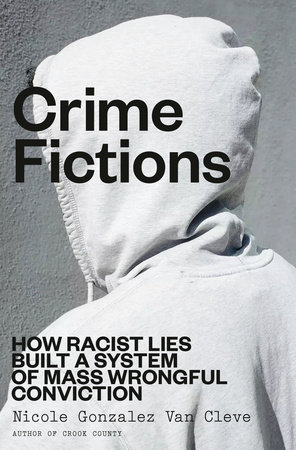
Crime Fictions

How Racist Lies Built a System of Mass Wrongful Conviction

Hardcover
$32.00 US
| $44.00 CAN
On sale May 19, 2026 | 336 Pages | 9780593447086
Grades 9-12 + AP/IB

See Additional Formats
From award-winning sociologist Nicole Gonzalez Van Cleve comes the first account of mass wrongful conviction in America, indicting a system purposefully designed to ensnare Black youth in order to close cases

“A must-read reckoning with past and present alike.”—Heather Ann Thompson, Pulitzer Prize–winning author of Fear and Fury and Blood in the Water

Wrongful convictions have long been dismissed as rare exceptions to an otherwise well-oiled criminal justice machine. But, after years spent investigating the largest criminal courthouse in the nation, Chicago’s Cook County, Dr. Nicole Gonzalez Van Cleve began to uncover a far more chilling truth. Wrongful convictions are not accidental, nor anomalous: There are at least hundreds of cases indicting innocent Black youth of crimes they didn’t commit. Arresting and incarcerating kids is the point—the “evidence” is tailored to fit.

In a suspenseful narrative account based on years of interviews, archival research, and the excavation of hidden documents, Gonzalez Van Cleve presents an ironclad “howdunit,” illustrating the steps that our supposed system of justice takes to “find” criminals, coerce confessions, and bury evidence.

A clear pattern emerges as Lee Hester, a disabled fourteen-year-old boy, is branded a “super predator” and convicted of killing his teacher. At just seven years old, Romarr Gipson is charged with a murder that is physically impossible for him to commit. Groups of boys like the Roscetti Four and Dixmoor Five are characterized as “wolf packs” in a pattern that connects them to the Central Park Five. These “crime fictions” are actively produced, perfected by police, enshrined in our legal records by the courts, and reinforced by the media.

Placing the exonerated boys at the center of their own story, Crime Fictions is a devastating, systemic account that leaves us to wonder just how many innocent souls have been claimed by the racist lies police tell.
1

The Question We Must Ask

Therefore, justice must satisfy the appearance of justice. —Supreme Court decision, Offutt v. United States, 348 U.S. 11 (1954)

If summer in Englewood in the 1990s had a sound, it would be the slow build of Al Green’s “Love and Happiness,” a wistful memory sung like a regret and a joy. Soulful, slow, pensive, but laced with small layers of happiness and rhythm that come with Chicago in the summer and the Englewood neighbors on their stoops.

Groups of boys and girls rode their bikes back and forth, skipped rope, talked smack, made plans, taunted, laughed, and looked around for small change to buy penny candy at the store across from the elementary school. Getting that money took work: planning with friends, asking adults, offering to do chores, and promising to be good.

There was a lot happening on Normal Avenue. It was near Paul Robeson High School, where the local kids could parade their bikes, show off new reflectors and streamers and the like. They rode back and forth and sometimes in circles, legs straight, back flat, and coasted with the momentum. Adults sat on the stoops, watching and supervising the circus of love and happiness on Normal Avenue, two worlds, together but apart.

Eleven-­year-­old Ryan Harris was part of this crowd, balancing on a blue Road Warrior bike that had some splendor to it. Ryan was the new girl on the block, visiting her godmother and heading to camp along with many of the kids riding around. Ryan had a tall and slender frame, her hair often in those rubber bands bound with plastic balls that looked like little candy jawbreakers. Ryan was summer, dressed in a white shirt, popsicle green shorts, and white Nikes.

Seeing Ryan bike toward Marquette Road was expected. Almost every child would eventually go down that road. The momentum of Normal Avenue pulled toward Marquette Road. The convenience store was the ever-­coveted destination for all the kids, because that place offered the promise of not just candy but also BBQ chips and cheese-­flavored popcorn.

But to see her turn left and not right—­toward the railroad tracks—­that was something only a few folks saw, and that was strange for her because Ryan had always been told to stay in sight of her godmother. She was a particle jumping its orbit.

Some would say they last saw Ryan place her bike in the trunk of a car and get in. Others insisted they saw her with a man, walking calmly. Others didn’t notice her missing at all, only remembered her riding the bike, a new face in the neighborhood, an older kid with confidence and beauty. A crush—­that was the way Romarr Gipson remembered Ryan.

Romarr was only seven. He had a crown of braids like his dad, tight to his head. Romarr had energy and charisma as well as a big grin. He had severe language delays—­when he tried to say “Batman,” it would sound like “Bam Bam”; his mom was a constant translator. Romarr often went to the Wash Factory laundromat right near the convenience store. There, he would sweep and earn extra change. He was so tiny that the broom would stretch above his head, and his “work” was like Snow White, pushing the dirt back and forth on the floor, whimsical but ineffectual. Shirley Blanton, who ran the Wash Factory, was inclined to say “yes” to such a boy. He was to be protected and cared for, and that was exactly what neighbors did.

Romarr’s friend was eight-­year-­old Elijah, who lived near his grandmother’s house. They played dump trucks in mud and then got inventive and built themselves a basketball hoop out of a plastic crate. And in the yard, they would live in that imaginary space for hours on end, close to their families. But they also rode bikes, navigating their way through the crowd of older kids.

For a boy Romarr’s age, there was one draw that could pull him away from the backyard, the candy store, and the Wash Factory. It was the lure of the train that roared high over Marquette Street on an overpass.

For a child, it was a fantastic spectacle. Like watching construction workers or dump trucks or garbage trucks. Not the toys that ignited their backyard world but real ones, with real men doing big things. For little guys like Romarr and Elijah, a train overhead was one of the perks of living so close to Normal Avenue and Marquette Road. There was safety, happiness, and joy in Englewood. When Romarr grew up, he could tell you the exact moment when all of this, the Englewood they knew, their childhoods, and their dear friend, was lost. It was July 27, 1998.

Gone Missing and Found

It was about 3 p.m. when Ryan’s godmother, Diane Arrington, felt that feeling, that small panic that comes from the silence of a child who has been away for too long.

At eleven years old, children are like boomerangs. They soar away but you wait, with a small tension, for their inevitable return. When they go away and do not come back with the same rhythm, a portion of your breathing stops. It is like a defiance of gravity, a misfire of nature and the rhythms that give reassurance. For Ryan’s godmother, she began asking the kids of the community if they had seen her goddaughter. One little girl told her about the convenience store, and so that was the first stop. Diane went to the store, likely readying some speech to scold her about “going out of sight.” But when Ryan wasn’t in the shop, it was clear that there was no speech to give; there was now only panic and a sense of dread.

Streetlights were the curfew call, the bat signal to the kids of Englewood that it was time to head home. They didn’t have to go to bed, but they had to circle and coast their bikes toward where their moms, grandmas, and aunties could see them and where they could hear their names being called. And so, one kid after another started coming, until eventually it was only Ryan’s godmother who was still alone, her child unaccounted for. That was when she decided to call the police. The police’s response sent her further into terror. The family needed to wait twenty-­four hours to file a missing person’s report. Like so many times before, with one of its own missing, Englewood was on its own, and the police were abdicating responsibility.

Ryan’s godmother assembled a search party of friends and neighbors. That’s when groups of people started searching in vacant buildings and back alleys, with concerned Romarr and Elijah tagging along in the growing darkness. All the adults started asking the kids the same questions: Who was the last to see the baby girl? Who was with her? Where did she go?

Englewood did the so-­called detective work to find Ryan. By morning, 250 flyers were made, a grainy picture of Ryan with a big smile and a ballerina-­style bun in her hair. The media would descend upon the neighborhood, and Romarr was part of the growing crowd of concerned neighbors who were searching for Ryan.

What happened next was confusing. It was said that a teenage boy found Ryan’s body in the high weeds and shrubs on South Parnell Avenue, adjacent to the railroad tracks. Some people said that a man nicknamed “Car Wash” was one of the first to see the body and then told others in the neighborhood. Later, some would wonder if it was Romarr and Elijah who were among the earliest to find their friend behind the two-­story building. Maybe the boys even saw the attack unfold. But Ryan was dead and lying on the ground, and that made people run with momentum toward the unfolding tragedy.

Romarr saw Ryan’s body, but it was not Ryan, not the Ryan he knew. Her clothes were pulled down and torn, part of her small frame exposed and left in the worst indignity. This was an image you could not unsee, one that doesn’t go away when you close your eyes. Romarr would say that he went to his dad to tell him that he found Ryan but that no one would believe him. His words were heard but not believed because even to adults, the tragedy was too much to bear.

Now that it was time to recover Ryan’s body rather than help find her alive, it took police nearly fifteen minutes to descend on Englewood. In the time it took police to arrive at the scene, neighbors estimated that more than fifty people tramped through the crime scene in disbelief and horror. After one young man fainted, the people of Englewood took a green shirt and covered their lost daughter to protect her dignity, an act that should have been undertaken by police.

And for Romarr, he was a boy with few words, with language delays, so to say what he saw, to put words to those images of Ryan was impossible. It was stored in his body, his wide eyes, and the erratic movements that made him run away and hide back home. The sound of his dad fixing cars in the background broke the dead silence as fear squelched any language he had. Elijah was already a quiet and hesitant boy. Unlike Romarr, he was able to talk, but what words can do justice to such unthinkable tragedy?
“At once a beautiful rescuing of so many Black lives that have been irreparably scarred by wrongful accusation and conviction and an unflinching reminder that it is on all of us to insist that this broken system is dismantled, this is a must-read reckoning with past and present alike.”—Heather Ann Thompson, Pulitzer Prize–winning author of Fear and Fury and Blood in the Water

“Nicole Gonzalez Van Cleve is a masterful storyteller and a rigorous scholar. Yet again, she has written a book that is deeply moving, brilliant, and righteous. You will never look at the institutions of criminal law the same way again after reading this book.”—Imani Perry, National Book Award–winning author of South to America

Crime Fictions exposes a racist shadow system run by police and enabled by unethical prosecutors, anti-Black stereotypes, and junk science that brands Black children as ‘monsters’ and deliberately convicts them of crimes they did not commit. The stories she tells are searing—almost too painful to read—yet far too urgent to ignore. . . . A compelling call for radical change.”—Dorothy Roberts, author of Killing the Black Body and Torn Apart

“Beautifully written and powerfully argued, Crime Fictions is a devastating indictment of criminal injustice.”—James Forman Jr., Pultizer Prize–winning author of Locking Up Our Own

Crime Fictions is a gripping exposé that reads like a thriller—except every devastating detail is real. Dr. Nicole Gonzalez Van Cleve spent years uncovering a chilling system designed not to find justice, but to lock up children. A landmark work of investigative storytelling, Crime Fictions forces a reckoning with a criminal legal system embedded with racism, corruption, and lies.”—Paul Butler, author of Chokehold
© Timothy Archibald
Nicole Gonzalez Van Cleve is Associate Professor of Sociology at Brown University and an affiliated scholar with the American Bar Foundation in Chicago, Illinois. She is the award-winning author of Crook County and has contributed articles to The New York Times, The Atlantic, NBC News, Crain’s Chicago Business, and CNN.  Her legal commentary has been featured on NPR, NBC News, CNN, and MSNBC’s The Rachel Maddow Show. View titles by Nicole Gonzalez Van Cleve

About

From award-winning sociologist Nicole Gonzalez Van Cleve comes the first account of mass wrongful conviction in America, indicting a system purposefully designed to ensnare Black youth in order to close cases

“A must-read reckoning with past and present alike.”—Heather Ann Thompson, Pulitzer Prize–winning author of Fear and Fury and Blood in the Water

Wrongful convictions have long been dismissed as rare exceptions to an otherwise well-oiled criminal justice machine. But, after years spent investigating the largest criminal courthouse in the nation, Chicago’s Cook County, Dr. Nicole Gonzalez Van Cleve began to uncover a far more chilling truth. Wrongful convictions are not accidental, nor anomalous: There are at least hundreds of cases indicting innocent Black youth of crimes they didn’t commit. Arresting and incarcerating kids is the point—the “evidence” is tailored to fit.

In a suspenseful narrative account based on years of interviews, archival research, and the excavation of hidden documents, Gonzalez Van Cleve presents an ironclad “howdunit,” illustrating the steps that our supposed system of justice takes to “find” criminals, coerce confessions, and bury evidence.

A clear pattern emerges as Lee Hester, a disabled fourteen-year-old boy, is branded a “super predator” and convicted of killing his teacher. At just seven years old, Romarr Gipson is charged with a murder that is physically impossible for him to commit. Groups of boys like the Roscetti Four and Dixmoor Five are characterized as “wolf packs” in a pattern that connects them to the Central Park Five. These “crime fictions” are actively produced, perfected by police, enshrined in our legal records by the courts, and reinforced by the media.

Placing the exonerated boys at the center of their own story, Crime Fictions is a devastating, systemic account that leaves us to wonder just how many innocent souls have been claimed by the racist lies police tell.

Excerpt

1

The Question We Must Ask

Therefore, justice must satisfy the appearance of justice. —Supreme Court decision, Offutt v. United States, 348 U.S. 11 (1954)

If summer in Englewood in the 1990s had a sound, it would be the slow build of Al Green’s “Love and Happiness,” a wistful memory sung like a regret and a joy. Soulful, slow, pensive, but laced with small layers of happiness and rhythm that come with Chicago in the summer and the Englewood neighbors on their stoops.

Groups of boys and girls rode their bikes back and forth, skipped rope, talked smack, made plans, taunted, laughed, and looked around for small change to buy penny candy at the store across from the elementary school. Getting that money took work: planning with friends, asking adults, offering to do chores, and promising to be good.

There was a lot happening on Normal Avenue. It was near Paul Robeson High School, where the local kids could parade their bikes, show off new reflectors and streamers and the like. They rode back and forth and sometimes in circles, legs straight, back flat, and coasted with the momentum. Adults sat on the stoops, watching and supervising the circus of love and happiness on Normal Avenue, two worlds, together but apart.

Eleven-­year-­old Ryan Harris was part of this crowd, balancing on a blue Road Warrior bike that had some splendor to it. Ryan was the new girl on the block, visiting her godmother and heading to camp along with many of the kids riding around. Ryan had a tall and slender frame, her hair often in those rubber bands bound with plastic balls that looked like little candy jawbreakers. Ryan was summer, dressed in a white shirt, popsicle green shorts, and white Nikes.

Seeing Ryan bike toward Marquette Road was expected. Almost every child would eventually go down that road. The momentum of Normal Avenue pulled toward Marquette Road. The convenience store was the ever-­coveted destination for all the kids, because that place offered the promise of not just candy but also BBQ chips and cheese-­flavored popcorn.

But to see her turn left and not right—­toward the railroad tracks—­that was something only a few folks saw, and that was strange for her because Ryan had always been told to stay in sight of her godmother. She was a particle jumping its orbit.

Some would say they last saw Ryan place her bike in the trunk of a car and get in. Others insisted they saw her with a man, walking calmly. Others didn’t notice her missing at all, only remembered her riding the bike, a new face in the neighborhood, an older kid with confidence and beauty. A crush—­that was the way Romarr Gipson remembered Ryan.

Romarr was only seven. He had a crown of braids like his dad, tight to his head. Romarr had energy and charisma as well as a big grin. He had severe language delays—­when he tried to say “Batman,” it would sound like “Bam Bam”; his mom was a constant translator. Romarr often went to the Wash Factory laundromat right near the convenience store. There, he would sweep and earn extra change. He was so tiny that the broom would stretch above his head, and his “work” was like Snow White, pushing the dirt back and forth on the floor, whimsical but ineffectual. Shirley Blanton, who ran the Wash Factory, was inclined to say “yes” to such a boy. He was to be protected and cared for, and that was exactly what neighbors did.

Romarr’s friend was eight-­year-­old Elijah, who lived near his grandmother’s house. They played dump trucks in mud and then got inventive and built themselves a basketball hoop out of a plastic crate. And in the yard, they would live in that imaginary space for hours on end, close to their families. But they also rode bikes, navigating their way through the crowd of older kids.

For a boy Romarr’s age, there was one draw that could pull him away from the backyard, the candy store, and the Wash Factory. It was the lure of the train that roared high over Marquette Street on an overpass.

For a child, it was a fantastic spectacle. Like watching construction workers or dump trucks or garbage trucks. Not the toys that ignited their backyard world but real ones, with real men doing big things. For little guys like Romarr and Elijah, a train overhead was one of the perks of living so close to Normal Avenue and Marquette Road. There was safety, happiness, and joy in Englewood. When Romarr grew up, he could tell you the exact moment when all of this, the Englewood they knew, their childhoods, and their dear friend, was lost. It was July 27, 1998.

Gone Missing and Found

It was about 3 p.m. when Ryan’s godmother, Diane Arrington, felt that feeling, that small panic that comes from the silence of a child who has been away for too long.

At eleven years old, children are like boomerangs. They soar away but you wait, with a small tension, for their inevitable return. When they go away and do not come back with the same rhythm, a portion of your breathing stops. It is like a defiance of gravity, a misfire of nature and the rhythms that give reassurance. For Ryan’s godmother, she began asking the kids of the community if they had seen her goddaughter. One little girl told her about the convenience store, and so that was the first stop. Diane went to the store, likely readying some speech to scold her about “going out of sight.” But when Ryan wasn’t in the shop, it was clear that there was no speech to give; there was now only panic and a sense of dread.

Streetlights were the curfew call, the bat signal to the kids of Englewood that it was time to head home. They didn’t have to go to bed, but they had to circle and coast their bikes toward where their moms, grandmas, and aunties could see them and where they could hear their names being called. And so, one kid after another started coming, until eventually it was only Ryan’s godmother who was still alone, her child unaccounted for. That was when she decided to call the police. The police’s response sent her further into terror. The family needed to wait twenty-­four hours to file a missing person’s report. Like so many times before, with one of its own missing, Englewood was on its own, and the police were abdicating responsibility.

Ryan’s godmother assembled a search party of friends and neighbors. That’s when groups of people started searching in vacant buildings and back alleys, with concerned Romarr and Elijah tagging along in the growing darkness. All the adults started asking the kids the same questions: Who was the last to see the baby girl? Who was with her? Where did she go?

Englewood did the so-­called detective work to find Ryan. By morning, 250 flyers were made, a grainy picture of Ryan with a big smile and a ballerina-­style bun in her hair. The media would descend upon the neighborhood, and Romarr was part of the growing crowd of concerned neighbors who were searching for Ryan.

What happened next was confusing. It was said that a teenage boy found Ryan’s body in the high weeds and shrubs on South Parnell Avenue, adjacent to the railroad tracks. Some people said that a man nicknamed “Car Wash” was one of the first to see the body and then told others in the neighborhood. Later, some would wonder if it was Romarr and Elijah who were among the earliest to find their friend behind the two-­story building. Maybe the boys even saw the attack unfold. But Ryan was dead and lying on the ground, and that made people run with momentum toward the unfolding tragedy.

Romarr saw Ryan’s body, but it was not Ryan, not the Ryan he knew. Her clothes were pulled down and torn, part of her small frame exposed and left in the worst indignity. This was an image you could not unsee, one that doesn’t go away when you close your eyes. Romarr would say that he went to his dad to tell him that he found Ryan but that no one would believe him. His words were heard but not believed because even to adults, the tragedy was too much to bear.

Now that it was time to recover Ryan’s body rather than help find her alive, it took police nearly fifteen minutes to descend on Englewood. In the time it took police to arrive at the scene, neighbors estimated that more than fifty people tramped through the crime scene in disbelief and horror. After one young man fainted, the people of Englewood took a green shirt and covered their lost daughter to protect her dignity, an act that should have been undertaken by police.

And for Romarr, he was a boy with few words, with language delays, so to say what he saw, to put words to those images of Ryan was impossible. It was stored in his body, his wide eyes, and the erratic movements that made him run away and hide back home. The sound of his dad fixing cars in the background broke the dead silence as fear squelched any language he had. Elijah was already a quiet and hesitant boy. Unlike Romarr, he was able to talk, but what words can do justice to such unthinkable tragedy?

Reviews

“At once a beautiful rescuing of so many Black lives that have been irreparably scarred by wrongful accusation and conviction and an unflinching reminder that it is on all of us to insist that this broken system is dismantled, this is a must-read reckoning with past and present alike.”—Heather Ann Thompson, Pulitzer Prize–winning author of Fear and Fury and Blood in the Water

“Nicole Gonzalez Van Cleve is a masterful storyteller and a rigorous scholar. Yet again, she has written a book that is deeply moving, brilliant, and righteous. You will never look at the institutions of criminal law the same way again after reading this book.”—Imani Perry, National Book Award–winning author of South to America

Crime Fictions exposes a racist shadow system run by police and enabled by unethical prosecutors, anti-Black stereotypes, and junk science that brands Black children as ‘monsters’ and deliberately convicts them of crimes they did not commit. The stories she tells are searing—almost too painful to read—yet far too urgent to ignore. . . . A compelling call for radical change.”—Dorothy Roberts, author of Killing the Black Body and Torn Apart

“Beautifully written and powerfully argued, Crime Fictions is a devastating indictment of criminal injustice.”—James Forman Jr., Pultizer Prize–winning author of Locking Up Our Own

Crime Fictions is a gripping exposé that reads like a thriller—except every devastating detail is real. Dr. Nicole Gonzalez Van Cleve spent years uncovering a chilling system designed not to find justice, but to lock up children. A landmark work of investigative storytelling, Crime Fictions forces a reckoning with a criminal legal system embedded with racism, corruption, and lies.”—Paul Butler, author of Chokehold

Author

© Timothy Archibald
Nicole Gonzalez Van Cleve is Associate Professor of Sociology at Brown University and an affiliated scholar with the American Bar Foundation in Chicago, Illinois. She is the award-winning author of Crook County and has contributed articles to The New York Times, The Atlantic, NBC News, Crain’s Chicago Business, and CNN.  Her legal commentary has been featured on NPR, NBC News, CNN, and MSNBC’s The Rachel Maddow Show. View titles by Nicole Gonzalez Van Cleve
  • More Websites from
    Penguin Random House
  • Common Reads
  • Library Marketing