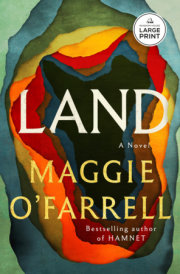
Land

A Novel

Author Maggie O'Farrell On Tour
The award-winning, bestselling author of Hamnet and The Marriage Portrait returns with a soaring historical novel set in Ireland in the years before and after the Great Hunger.

“A breathtaking hymn to the sanctity of natural spaces, operating on timescales both intimate and geological. I finished Land moved not only by the vivid lives of its human characters, but the thrumming, gorgeous presence of its mosses, waters, winds, and skies.” —Daniel Mason, author of North Woods


On a windswept peninsula stretching out into the Atlantic, Tomás and his reluctant son, Liam, are working for the great Ordnance Survey project to map the whole of Ireland. The year is 1865, and in a country not long since ravaged and emptied by the Great Hunger, the task is not an easy one. Tomás, however, is determined that his maps will be a record of the disaster.

The British soldiers in charge are due to arrive any day, expecting the work to be completed, but Tomás is unexpectedly sent off course by an unsettling encounter in a copse. His life, and the lives of those of his family, will never be the same again. Liam is terrified by the sudden change in his taciturn father. What was it that caused such cracks to open in Tomás, and how is Liam, aged only ten, going to finish the mapping and get them both home?

Land is a novel about separation and reunion, tragedy and recovery, colonization and rebellion. It is a story of buried treasure, overlapping lives, ancient woodland, persistent ghosts, a particularly loyal dog, and how, when it comes to both land and history, nothing ever goes away. As spellbinding and varied as the landscape that inspired it, Land is, above all, a story of survival, for our times and for all time.
His father was ever a man of few words. Even when Liam is on the other side of the world, with a new name and unfa­miliar clothes, facing a committee of robed men who have come to sit in judgement of him, he will be able to recall the astonishing day that turned his father garrulous.
__

The morning had been a long one, Liam and his father out since dawn. A north-westerly breeze has been at them for hours, scrupu­lous in its self-appointed work of lifting the caps from their heads, in hurling a scree of water over them. Liam stands on what he would call a hillock and his father a drumlin or tulach, holding the end of the chain and the surveying pole in hands that are scarlet with cold. He is scrawny, in short trousers and a handed-down jacket that has been mended and re-mended by his mother. Her patches, with their fret­ted edges, have to Liam the fascinating appearance of postage stamps. He likes to rub at the stitches, those marks of maternal patience and devotion, with the side of his thumb. He imagines, at night, when he catches sight of the jacket hanging on a peg, that it might take off through the darkness on a journey across oceans and mountains, borne along by his mother’s faceless, stateless stamps. Not that he would tell anyone this: at ten years old, he has lately attained the awareness that such flights of fancy should not be divulged.

The year is 1865, the place a narrow promontory of land lapped on either side by cold blue inlets: a peninsula, stretching out into the Atlantic, like an imploring hand, the westernmost scrap of Eu­rope before it surrenders to icy cross-currents of a vast ocean. As Liam waits there, on his hillock, buffeted nearly off his feet by saline gusts, he brings up a hand to worry at the corner of his elbow patch—a minuscule snarl resides there, a place where his mother has been obliged to knot and retie her darning thread, something he knows she is loath to do.

He is startled by a sudden noise. His father, at the other end of the measuring chain, perhaps twenty or thirty yards away, reduced by distance to nothing more than a little peg man, like the ones his sisters make with fabric scraps, is yelling something at him—what Liam’s schoolmaster would term an imperative—but the greedy breeze snatches away the words. Liam stands more upright, wishing to signal that he is paying attention. His father is gesturing, brandish­ing his arm. Could he be instructing him to straighten the chain or to move the pole? It is what he most often shouts at Liam.

The boy adjusts the stick with one hand, tugs at the heavy links with the other. His father is still yelling from his matching hilltop, still motioning, waving his tripod. Liam waits, anxiety trickling through his chest. He sees his father throw down his instruments and stride towards him. He licks the salt from his lips and tries not to shiver. His father doesn’t like to see him affected by weather: a sign of weakness in a man, he calls it.
__

What does Tomás see as he walks from the pinnacle of one drumlin to the next (counting his strides, as is his habit)? The bedraggled figure of his only son, faithfully holding the surveying pole, a child dear to his heart, whom he will perhaps take back to their lodgings soon because this is no weather to stay out in, a person too young for the job he has been given.

If only it were so.

Tomás, as he feels the slope of the first drumlin level out under his boots and then the incline of the second start to lift him up, sees only this: a gradient of perhaps 1:3, topological landforms caused by glacial activity, a valley scraped and forced to submit to a U-shape by the slow force of ice, to his left the rearing structure of a high rocky outcrop of likely volcanic origin, a smoothness of moraine. And in the middle of this abundance of cartographic detail is an irregular greyish mark that does not belong there—a human, a small one, with bare knees, a cap, under which is some hair the colour of copper coins, and a surveying pole tilted at an inefficacious angle.

Without warning, his gaze, passing over the landscape, is arrested by a curious fissure in the southernmost slope. Filled with a dense copse, from which flows a reasonable-sized stream, it is a geographi­cal feature not shown on the existing map sheet, making it Tomás’s responsibility to measure and survey it for the necessary revision.

Tomás sighs. He removes his own cap and uses it to wipe the moisture from his forehead. He doesn’t feel the cold, doesn’t mind the rain. I am waterproof, he likes to say to the scarlet-jacketed sol­diers who employ him for their great mapping project. The redcoats, who come from over the water, bare their teeth in a smile and roll up the charts and sketches he creates. Tomás is useful to them, he knows, not so much for his surveying and draughtsman skills—there are plenty to be found over the water who can do such things—but harder to find someone who has these abilities and can also speak to the locals in their own language. Tomás may be classified in their accounts and ledgers as a “labourer” but the soldier-men cannot do without him. He is the only one of their division who can measure and calculate, draw detailed draft maps in ink for the engravers to copy, and also converse with the people about where the boundar­ies lie, who owns which field, what this valley or that bluff is called and why, where might the ruins of this building be. He alone is able to parse a polysyllabic string comprehensible only to those who have lived here for generations: he makes the-crossroads-under-the-bluff-where-once-a-hailstorm-killed-a-cockerel read “Bluff’s Cross” and renders the-strand-where-the-yellow-periwinkles-gather-in-spring into “Yellowcove.” In a tent set up in a field or a town square, the redcoat sappers and surveyors will mill around behind Tomás, half listening, while he negotiates with a crowd of people a toponymic compromise over a mountain known by one name to those who live on its eastern slopes and quite another to those on its north. Or he untangles from several shouted accounts who the landowner was before this one, and the one before that. Then the redcoats step forward; they take these revisions away to their barracks and their camps; they collate them; they sign their names to Tomás’s work; they print their maps and put them in a cabinet somewhere in their city.

So lost is he in his reverie that when he gains the higher ground and someone taps him on the elbow, he is startled to find a person of short stature, looking up at him, mouthing something.

“What?” Tomás yelps.

His son, Liam, quivering like a wet hound, speaks again but his words are whirled away into the fog. Tomás permits the child to cling to his damp jacket hem as he looks around them: a good vantage point, this. The land slopes away from the drumlin in all directions, as if he and his son are standing on a bolt of cloth tweaked aloft by immense and invisible fingertips. They are ninety feet or so above the unmapped copse to the south, a comparable distance to an old field boundary with a gatepost to the west, the volcanic outcrop behind them, the clutter of the village—or what remains of it—to be seen below. On an elevated piece of ground, a quarter of a mile away, stands the ruin of an isolated dwelling place, also absent from the map—roofless, walls bared to the sky, like crumbling teeth, a sapling sprouting from what would have been the chimney breast.

Anyone observing Tomás at this moment would see the muscles in his jaw tighten. It is a necessary but unenviable part of his cur­rent task to distil into inked symbols and ordered lines what has taken place here since the first maps were drawn. These new revisions must contain a cartographic record of the Great Hunger, the disaster that struck this land more than a decade ago now. Tomás must amend the hundreds of households in a barony to the handful that now remain; he must erase row after row of tenant cottages on landowner estates, which have been emptied and dismantled. The redcoats turn their eyes from this task; they prefer never to acknowledge the crisis that befell the country, the losses and deprivations it has suffered. They do not wish to make such marks upon their maps, which might lead to certain admittances. Tomás has determined, however, that his maps will bear an account of what happened, what was lost, if it kills him.

He twists away from the ruined cabin before it presses itself too firmly to his eye, inadvertently pulling his jacket from his son’s grasp.

“What’s that you’re saying?” he snaps, aware that the boy persists in squeaking out some words.

“I said,” his son falters, and it makes Tomás bristle because he can’t abide timidity in his children, “will we be finished soon, Da? Because—”

“Finished?” Tomás thunders. “Finished? You want to know if we’ll have finished this task soon? The revisions to the great map of the—”

“No, no, I meant only for today, Da, not—”

“—whole country? Will we have it finished today? Is it that you’re asking me?”

Liam bites his lip. He worries away at the patch on his elbow. Tomás sees that the wet has spread over the boy’s cap and jacket, turning the cloth dark. He sees that his bright hair is dulled by the rain to the dun of old envelopes. Water drips from the boy’s eyelashes, his chin. A brief pang passes through Tomás but then he pushes back his shoulders: the soldiers are coming out to this place in a week; they will expect the new map sheet of this parish to be near completion. There is no opportunity for sentiment; no time must be lost.

“Away over there,” he says, pointing, without looking at the boy, “to that copse.”

The child lifts the surveying pole, which becomes tangled with his ankles, making him stumble, but he rights himself, and makes his halting way down the slope, towards the gathering of trees. Aspen, elder, Tomás is noting in his book, birch, oak—both ancient and new—and how odd it is that the place is absent from the last map.

“It’s not on the map we have, so we’ll need to locate the source of that stream before we do our surveying. Go on inside,” he calls to his son’s retreating back, “and tell me what you find.”

Was it a mistake, he wonders, to bring the child along? But the boy must have a trade, must learn to work a job: Tomás will not have him cast out into the world without any prospects, so why not train him as his apprentice? The boy excels at mathematics and draughtsmanship, but Tomás senses resistance in the child, a part of him that yearns for something other. It is pure ingratitude, he has said to the boy’s mother. He doesn’t care for the work, doesn’t put his back into it.

Ah, now, Tomás, she replied, he’s young.

Ten isn’t young, Tomás retorted, sure when I was ten—

Tomás had fallen silent, the words choked to a halt. He does not like to go down that vertiginous path, into those particular dark woods. It is Tomás’s belief that it is always better to say too little than too much: many things are best left unsaid.

He slides his pencil back into his pocket. If his wife were here with him, on this drumlin (which is formed from eroded soil and loose shale gathered during the long journey of a once-mighty glacier, its power waning as it reached this exact spot, causing it to drop its gritty treasures, what a miracle, what a revelation), if she were stand­ing here at his side, her shawl pulled over her hair to keep off the rain, he knows exactly what she would say. Be kinder to him, speak more gently, and he will listen to you. And she would be right, of course.

Tomás scuffs with a curled hand at his bristling chin. The problem is there is so much work to be done, so many field notes to take, so many mistakes to correct, so much history to preserve. He sees him­self as that cursed man in the story—read to them once by a visitor—who was forced to push a boulder up a hill every day, only for it to roll back down each night. He can still recall the tale, the book with a red-leather binding, held in gloved fingers, as they all sat huddled together on their benches; he has been both intrigued and repelled by it ever since. He can imagine the grain of the boulder against his palms—it would be granite, he thinks, and he can feel the glistening flecks of mica pricking his palms as he struggles to find a shoulder-hold on the rock. He can imagine the exact tilt of the gradient, how much pressure he would have to exert against his back foot, pushing down with his calf muscles, straining, straining—

His thoughts are snipped short by the recollection that his son should have reached the copse by now. Tomás gives himself an almost visible shake: why has he allowed his thoughts to run along such fanciful pathways? He shades his eyes with his hand and peers into the mist.
__

Liam trudges the distance towards the cluster of trees tucked into a hollow between two hills. He glances back to find out if his father is watching him, but sees only a gaunt outline etched against a shift­ing, liquid sky. In an unaccustomed act of rebellion, Liam tosses the surveying pole to the ground. He’s sick of carrying it, sick to his back teeth.

He moves towards the copse, talking in his mind to his sister, Enda, who is not quite a year older than him: Sick to my back teeth, he tells her. You should see the way he orders me about, like I’m a donkey or a dog, and you wouldn’t believe the weather he has me out in.

Enda had been acutely disappointed that she hadn’t been taken on this mapping expedition, but their father had said it was no work for a girl. Liam will tell her, when they get back, that she was the lucky one, getting to stay at home. He is exploring his own emerging back teeth, as he steps between the first tree trunks, feeling the hard, pearly nubs erupting from his tender pink gums.

Then he pauses. Later that night, he will wonder why. Was it that he stopped or did something stop him? Which way round was it?

The quality of light in the copse is immediately different, ver­dant and lustrous, glimmering with the trembling of the leaf canopy. The wind vanishes, as does the relentless rain. He is enclosed and enfolded, as if he has stepped inside the secret green house of a giant. Liam looks up: the tops of the trees separate and collide in the breeze, revealing and concealing the opaline sky. He sees the arrowhead leaves of an aspen entangling with the ripple-edge foliage of an oak, bending together like conspirators. Underfoot, the ground is spongy with damp. It oozes from the soil, the leaf-rot; it sucks and grips at his boot soles. He glances down and sees that there is thick, luxuri­ant moss, glistening and emerald-bright, blanketing everything: the humps of stones, the long cylinders of fallen branches, the ridged splay of roots, unidentifiable mounds that suggest loaves of bread or animal lairs. Or tiny graves.
“A breathtaking hymn to the sanctity of natural spaces, operating on timescales both intimate and geological. I finished Land moved not only by the vivid lives of its human characters but the thrumming, gorgeous presence of its mosses, waters, winds, and skies.” —Daniel Mason, author of North Woods

Land is a vast, darkly magical novel from a masterful writer. Maggie O’Farrell's historical fiction illuminates not only the past, but our own moment in time. A brilliant and powerful novel.” —Alice Winn, author of In Memoriam

“This deep, dense, heartrending novel is the best of Maggie O’Farrell, who is the best of writers, modern and alive, with the detailed brilliance of great nineteenth-century storytellers. All I need as a reader is in Land.” —Amy Bloom, author of In Love

Land is as visceral as a novel can get. It feels deeply and it tells deeply, both of nature and of the small tragedy of man. It's rare to find a story so grand told with such a fine brush. Land read to me as ancient and brand-new all at once, and something best experienced by diving into it headfirst.” —Yael van der Wouden, author of The Safekeep

“Expansive and intimate, this beautiful book swallowed me whole. I loved it and will miss its characters terribly.” —Charlotte McConaghy, author of Wild Dark Shore

“Wondrous and magisterial.” —Kamila Shamsie, author of Home Fire

“A deep-mapping of a place and its people, a heart-bursting story of resilience and love. Land is simply the best novel I’ve read in years.” —Louise Kennedy, author of Trespasses

“Haunting and elemental in its evocation, Land is a novel of startling imagination and power. Upon finishing it, I did not feel so much that I had read a book as lived inside it.” —Ferdia Lennon, author of Glorious Exploits

“A stunning achievement. Maggie O’Farrell’s most ambitious novel yet, and maybe her most moving. I adored it.” —Bobby Palmer, author of Main Characters

“A stunning and gorgeous epic. . . . O’Farrell paints a devasting yet tender portrait of Irish history.” Publishers Weekly (starred review)

“Evocative and impassioned. . . . Steeped in Irish history and folklore, alive with a sense of wonder.” Kirkus (starred review)

“A transfixing epic . . . [Land] adds to O’Farrell’s reputation as a superb literary stylist. . . . This wonderfully expansive yet intimate saga, which illustrates how individuals survive the devastating legacies of imperialism and religious control, offers a sense of empathetic harmony between author and subject.” Booklist (starred review)
© Dasha Tenditna
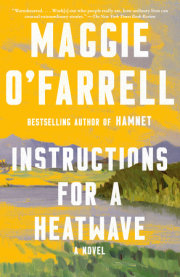
MAGGIE O'FARRELL was born in Northern Ireland in 1972. Her novels include Hamnet (winner of the National Book Critics Circle Award), After You’d Gone, The Vanishing Act of Esme Lennox, The Hand That First Held Mine (winner of the Costa Novel Award), and Instructions for a Heatwave. She has also written a memoir, I Am, I Am, I Am: Seventeen Brushes with Death. She lives in Edinburgh. View titles by Maggie O'Farrell

About

The award-winning, bestselling author of Hamnet and The Marriage Portrait returns with a soaring historical novel set in Ireland in the years before and after the Great Hunger.

“A breathtaking hymn to the sanctity of natural spaces, operating on timescales both intimate and geological. I finished Land moved not only by the vivid lives of its human characters, but the thrumming, gorgeous presence of its mosses, waters, winds, and skies.” —Daniel Mason, author of North Woods


On a windswept peninsula stretching out into the Atlantic, Tomás and his reluctant son, Liam, are working for the great Ordnance Survey project to map the whole of Ireland. The year is 1865, and in a country not long since ravaged and emptied by the Great Hunger, the task is not an easy one. Tomás, however, is determined that his maps will be a record of the disaster.

The British soldiers in charge are due to arrive any day, expecting the work to be completed, but Tomás is unexpectedly sent off course by an unsettling encounter in a copse. His life, and the lives of those of his family, will never be the same again. Liam is terrified by the sudden change in his taciturn father. What was it that caused such cracks to open in Tomás, and how is Liam, aged only ten, going to finish the mapping and get them both home?

Land is a novel about separation and reunion, tragedy and recovery, colonization and rebellion. It is a story of buried treasure, overlapping lives, ancient woodland, persistent ghosts, a particularly loyal dog, and how, when it comes to both land and history, nothing ever goes away. As spellbinding and varied as the landscape that inspired it, Land is, above all, a story of survival, for our times and for all time.

Excerpt

His father was ever a man of few words. Even when Liam is on the other side of the world, with a new name and unfa­miliar clothes, facing a committee of robed men who have come to sit in judgement of him, he will be able to recall the astonishing day that turned his father garrulous.
__

The morning had been a long one, Liam and his father out since dawn. A north-westerly breeze has been at them for hours, scrupu­lous in its self-appointed work of lifting the caps from their heads, in hurling a scree of water over them. Liam stands on what he would call a hillock and his father a drumlin or tulach, holding the end of the chain and the surveying pole in hands that are scarlet with cold. He is scrawny, in short trousers and a handed-down jacket that has been mended and re-mended by his mother. Her patches, with their fret­ted edges, have to Liam the fascinating appearance of postage stamps. He likes to rub at the stitches, those marks of maternal patience and devotion, with the side of his thumb. He imagines, at night, when he catches sight of the jacket hanging on a peg, that it might take off through the darkness on a journey across oceans and mountains, borne along by his mother’s faceless, stateless stamps. Not that he would tell anyone this: at ten years old, he has lately attained the awareness that such flights of fancy should not be divulged.

The year is 1865, the place a narrow promontory of land lapped on either side by cold blue inlets: a peninsula, stretching out into the Atlantic, like an imploring hand, the westernmost scrap of Eu­rope before it surrenders to icy cross-currents of a vast ocean. As Liam waits there, on his hillock, buffeted nearly off his feet by saline gusts, he brings up a hand to worry at the corner of his elbow patch—a minuscule snarl resides there, a place where his mother has been obliged to knot and retie her darning thread, something he knows she is loath to do.

He is startled by a sudden noise. His father, at the other end of the measuring chain, perhaps twenty or thirty yards away, reduced by distance to nothing more than a little peg man, like the ones his sisters make with fabric scraps, is yelling something at him—what Liam’s schoolmaster would term an imperative—but the greedy breeze snatches away the words. Liam stands more upright, wishing to signal that he is paying attention. His father is gesturing, brandish­ing his arm. Could he be instructing him to straighten the chain or to move the pole? It is what he most often shouts at Liam.

The boy adjusts the stick with one hand, tugs at the heavy links with the other. His father is still yelling from his matching hilltop, still motioning, waving his tripod. Liam waits, anxiety trickling through his chest. He sees his father throw down his instruments and stride towards him. He licks the salt from his lips and tries not to shiver. His father doesn’t like to see him affected by weather: a sign of weakness in a man, he calls it.
__

What does Tomás see as he walks from the pinnacle of one drumlin to the next (counting his strides, as is his habit)? The bedraggled figure of his only son, faithfully holding the surveying pole, a child dear to his heart, whom he will perhaps take back to their lodgings soon because this is no weather to stay out in, a person too young for the job he has been given.

If only it were so.

Tomás, as he feels the slope of the first drumlin level out under his boots and then the incline of the second start to lift him up, sees only this: a gradient of perhaps 1:3, topological landforms caused by glacial activity, a valley scraped and forced to submit to a U-shape by the slow force of ice, to his left the rearing structure of a high rocky outcrop of likely volcanic origin, a smoothness of moraine. And in the middle of this abundance of cartographic detail is an irregular greyish mark that does not belong there—a human, a small one, with bare knees, a cap, under which is some hair the colour of copper coins, and a surveying pole tilted at an inefficacious angle.

Without warning, his gaze, passing over the landscape, is arrested by a curious fissure in the southernmost slope. Filled with a dense copse, from which flows a reasonable-sized stream, it is a geographi­cal feature not shown on the existing map sheet, making it Tomás’s responsibility to measure and survey it for the necessary revision.

Tomás sighs. He removes his own cap and uses it to wipe the moisture from his forehead. He doesn’t feel the cold, doesn’t mind the rain. I am waterproof, he likes to say to the scarlet-jacketed sol­diers who employ him for their great mapping project. The redcoats, who come from over the water, bare their teeth in a smile and roll up the charts and sketches he creates. Tomás is useful to them, he knows, not so much for his surveying and draughtsman skills—there are plenty to be found over the water who can do such things—but harder to find someone who has these abilities and can also speak to the locals in their own language. Tomás may be classified in their accounts and ledgers as a “labourer” but the soldier-men cannot do without him. He is the only one of their division who can measure and calculate, draw detailed draft maps in ink for the engravers to copy, and also converse with the people about where the boundar­ies lie, who owns which field, what this valley or that bluff is called and why, where might the ruins of this building be. He alone is able to parse a polysyllabic string comprehensible only to those who have lived here for generations: he makes the-crossroads-under-the-bluff-where-once-a-hailstorm-killed-a-cockerel read “Bluff’s Cross” and renders the-strand-where-the-yellow-periwinkles-gather-in-spring into “Yellowcove.” In a tent set up in a field or a town square, the redcoat sappers and surveyors will mill around behind Tomás, half listening, while he negotiates with a crowd of people a toponymic compromise over a mountain known by one name to those who live on its eastern slopes and quite another to those on its north. Or he untangles from several shouted accounts who the landowner was before this one, and the one before that. Then the redcoats step forward; they take these revisions away to their barracks and their camps; they collate them; they sign their names to Tomás’s work; they print their maps and put them in a cabinet somewhere in their city.

So lost is he in his reverie that when he gains the higher ground and someone taps him on the elbow, he is startled to find a person of short stature, looking up at him, mouthing something.

“What?” Tomás yelps.

His son, Liam, quivering like a wet hound, speaks again but his words are whirled away into the fog. Tomás permits the child to cling to his damp jacket hem as he looks around them: a good vantage point, this. The land slopes away from the drumlin in all directions, as if he and his son are standing on a bolt of cloth tweaked aloft by immense and invisible fingertips. They are ninety feet or so above the unmapped copse to the south, a comparable distance to an old field boundary with a gatepost to the west, the volcanic outcrop behind them, the clutter of the village—or what remains of it—to be seen below. On an elevated piece of ground, a quarter of a mile away, stands the ruin of an isolated dwelling place, also absent from the map—roofless, walls bared to the sky, like crumbling teeth, a sapling sprouting from what would have been the chimney breast.

Anyone observing Tomás at this moment would see the muscles in his jaw tighten. It is a necessary but unenviable part of his cur­rent task to distil into inked symbols and ordered lines what has taken place here since the first maps were drawn. These new revisions must contain a cartographic record of the Great Hunger, the disaster that struck this land more than a decade ago now. Tomás must amend the hundreds of households in a barony to the handful that now remain; he must erase row after row of tenant cottages on landowner estates, which have been emptied and dismantled. The redcoats turn their eyes from this task; they prefer never to acknowledge the crisis that befell the country, the losses and deprivations it has suffered. They do not wish to make such marks upon their maps, which might lead to certain admittances. Tomás has determined, however, that his maps will bear an account of what happened, what was lost, if it kills him.

He twists away from the ruined cabin before it presses itself too firmly to his eye, inadvertently pulling his jacket from his son’s grasp.

“What’s that you’re saying?” he snaps, aware that the boy persists in squeaking out some words.

“I said,” his son falters, and it makes Tomás bristle because he can’t abide timidity in his children, “will we be finished soon, Da? Because—”

“Finished?” Tomás thunders. “Finished? You want to know if we’ll have finished this task soon? The revisions to the great map of the—”

“No, no, I meant only for today, Da, not—”

“—whole country? Will we have it finished today? Is it that you’re asking me?”

Liam bites his lip. He worries away at the patch on his elbow. Tomás sees that the wet has spread over the boy’s cap and jacket, turning the cloth dark. He sees that his bright hair is dulled by the rain to the dun of old envelopes. Water drips from the boy’s eyelashes, his chin. A brief pang passes through Tomás but then he pushes back his shoulders: the soldiers are coming out to this place in a week; they will expect the new map sheet of this parish to be near completion. There is no opportunity for sentiment; no time must be lost.

“Away over there,” he says, pointing, without looking at the boy, “to that copse.”

The child lifts the surveying pole, which becomes tangled with his ankles, making him stumble, but he rights himself, and makes his halting way down the slope, towards the gathering of trees. Aspen, elder, Tomás is noting in his book, birch, oak—both ancient and new—and how odd it is that the place is absent from the last map.

“It’s not on the map we have, so we’ll need to locate the source of that stream before we do our surveying. Go on inside,” he calls to his son’s retreating back, “and tell me what you find.”

Was it a mistake, he wonders, to bring the child along? But the boy must have a trade, must learn to work a job: Tomás will not have him cast out into the world without any prospects, so why not train him as his apprentice? The boy excels at mathematics and draughtsmanship, but Tomás senses resistance in the child, a part of him that yearns for something other. It is pure ingratitude, he has said to the boy’s mother. He doesn’t care for the work, doesn’t put his back into it.

Ah, now, Tomás, she replied, he’s young.

Ten isn’t young, Tomás retorted, sure when I was ten—

Tomás had fallen silent, the words choked to a halt. He does not like to go down that vertiginous path, into those particular dark woods. It is Tomás’s belief that it is always better to say too little than too much: many things are best left unsaid.

He slides his pencil back into his pocket. If his wife were here with him, on this drumlin (which is formed from eroded soil and loose shale gathered during the long journey of a once-mighty glacier, its power waning as it reached this exact spot, causing it to drop its gritty treasures, what a miracle, what a revelation), if she were stand­ing here at his side, her shawl pulled over her hair to keep off the rain, he knows exactly what she would say. Be kinder to him, speak more gently, and he will listen to you. And she would be right, of course.

Tomás scuffs with a curled hand at his bristling chin. The problem is there is so much work to be done, so many field notes to take, so many mistakes to correct, so much history to preserve. He sees him­self as that cursed man in the story—read to them once by a visitor—who was forced to push a boulder up a hill every day, only for it to roll back down each night. He can still recall the tale, the book with a red-leather binding, held in gloved fingers, as they all sat huddled together on their benches; he has been both intrigued and repelled by it ever since. He can imagine the grain of the boulder against his palms—it would be granite, he thinks, and he can feel the glistening flecks of mica pricking his palms as he struggles to find a shoulder-hold on the rock. He can imagine the exact tilt of the gradient, how much pressure he would have to exert against his back foot, pushing down with his calf muscles, straining, straining—

His thoughts are snipped short by the recollection that his son should have reached the copse by now. Tomás gives himself an almost visible shake: why has he allowed his thoughts to run along such fanciful pathways? He shades his eyes with his hand and peers into the mist.
__

Liam trudges the distance towards the cluster of trees tucked into a hollow between two hills. He glances back to find out if his father is watching him, but sees only a gaunt outline etched against a shift­ing, liquid sky. In an unaccustomed act of rebellion, Liam tosses the surveying pole to the ground. He’s sick of carrying it, sick to his back teeth.

He moves towards the copse, talking in his mind to his sister, Enda, who is not quite a year older than him: Sick to my back teeth, he tells her. You should see the way he orders me about, like I’m a donkey or a dog, and you wouldn’t believe the weather he has me out in.

Enda had been acutely disappointed that she hadn’t been taken on this mapping expedition, but their father had said it was no work for a girl. Liam will tell her, when they get back, that she was the lucky one, getting to stay at home. He is exploring his own emerging back teeth, as he steps between the first tree trunks, feeling the hard, pearly nubs erupting from his tender pink gums.

Then he pauses. Later that night, he will wonder why. Was it that he stopped or did something stop him? Which way round was it?

The quality of light in the copse is immediately different, ver­dant and lustrous, glimmering with the trembling of the leaf canopy. The wind vanishes, as does the relentless rain. He is enclosed and enfolded, as if he has stepped inside the secret green house of a giant. Liam looks up: the tops of the trees separate and collide in the breeze, revealing and concealing the opaline sky. He sees the arrowhead leaves of an aspen entangling with the ripple-edge foliage of an oak, bending together like conspirators. Underfoot, the ground is spongy with damp. It oozes from the soil, the leaf-rot; it sucks and grips at his boot soles. He glances down and sees that there is thick, luxuri­ant moss, glistening and emerald-bright, blanketing everything: the humps of stones, the long cylinders of fallen branches, the ridged splay of roots, unidentifiable mounds that suggest loaves of bread or animal lairs. Or tiny graves.

Reviews

“A breathtaking hymn to the sanctity of natural spaces, operating on timescales both intimate and geological. I finished Land moved not only by the vivid lives of its human characters but the thrumming, gorgeous presence of its mosses, waters, winds, and skies.” —Daniel Mason, author of North Woods

Land is a vast, darkly magical novel from a masterful writer. Maggie O’Farrell's historical fiction illuminates not only the past, but our own moment in time. A brilliant and powerful novel.” —Alice Winn, author of In Memoriam

“This deep, dense, heartrending novel is the best of Maggie O’Farrell, who is the best of writers, modern and alive, with the detailed brilliance of great nineteenth-century storytellers. All I need as a reader is in Land.” —Amy Bloom, author of In Love

Land is as visceral as a novel can get. It feels deeply and it tells deeply, both of nature and of the small tragedy of man. It's rare to find a story so grand told with such a fine brush. Land read to me as ancient and brand-new all at once, and something best experienced by diving into it headfirst.” —Yael van der Wouden, author of The Safekeep

“Expansive and intimate, this beautiful book swallowed me whole. I loved it and will miss its characters terribly.” —Charlotte McConaghy, author of Wild Dark Shore

“Wondrous and magisterial.” —Kamila Shamsie, author of Home Fire

“A deep-mapping of a place and its people, a heart-bursting story of resilience and love. Land is simply the best novel I’ve read in years.” —Louise Kennedy, author of Trespasses

“Haunting and elemental in its evocation, Land is a novel of startling imagination and power. Upon finishing it, I did not feel so much that I had read a book as lived inside it.” —Ferdia Lennon, author of Glorious Exploits

“A stunning achievement. Maggie O’Farrell’s most ambitious novel yet, and maybe her most moving. I adored it.” —Bobby Palmer, author of Main Characters

“A stunning and gorgeous epic. . . . O’Farrell paints a devasting yet tender portrait of Irish history.” Publishers Weekly (starred review)

“Evocative and impassioned. . . . Steeped in Irish history and folklore, alive with a sense of wonder.” Kirkus (starred review)

“A transfixing epic . . . [Land] adds to O’Farrell’s reputation as a superb literary stylist. . . . This wonderfully expansive yet intimate saga, which illustrates how individuals survive the devastating legacies of imperialism and religious control, offers a sense of empathetic harmony between author and subject.” Booklist (starred review)

Author

© Dasha Tenditna
MAGGIE O'FARRELL was born in Northern Ireland in 1972. Her novels include Hamnet (winner of the National Book Critics Circle Award), After You’d Gone, The Vanishing Act of Esme Lennox, The Hand That First Held Mine (winner of the Costa Novel Award), and Instructions for a Heatwave. She has also written a memoir, I Am, I Am, I Am: Seventeen Brushes with Death. She lives in Edinburgh. View titles by Maggie O'Farrell
  • More Websites from
    Penguin Random House
  • Common Reads
  • Library Marketing