Download high-resolution image
Listen to a clip from the audiobook
audio pause button
0:00
0:00

Insomnia

Listen to a clip from the audiobook
audio pause button
0:00
0:00
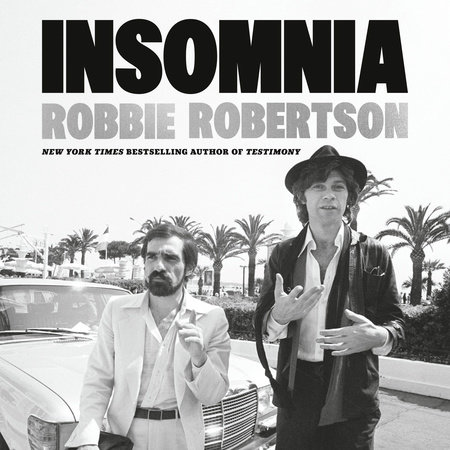
The rock legend tells the story of his wild ride with Martin Scorsese—as friends, adventure-seekers, and boundary-pushing collaborators—with all the heart of his New York Times bestselling memoir Testimony.

For four decades, Robbie Robertson produced music for Martin Scorsese's films, a relationship that began when Robertson convinced Scorsese to direct The Last Waltz, the iconic film of the Band's farewell performance at the Winterland Ballroom on Thanksgiving 1976.

The closing of the Band's story with that landmark concert thrust Robertson into a new and uncertain world. With his relationship with his bandmates deteriorating and his marriage collapsing, Robertson arrived on Scorsese’s Beverly Hills doorstep only to find his friend in similar straits. Before the night was out, Scorsese had invited him to move in. Both men, already culture-transforming stars before the age of thirty-five, stood at a creative precipice, searching for the beginning of a new phase of life and work. As their friendship deepened into a career-altering collaboration, their shared journey would take them around the world and down the rabbit hole of American culture in the long hangover of the seventies. Buffeted on either side by temptation and paranoia, veering closer to self-destruction than either wanted to admit, together they had devoted themselves to a partnership defined by equal parts admiration and ambition.

With a cast of characters featuring Robert De Niro, Harvey Keitel, Federico Fellini, Sophia Loren, Sam Fuller, Liza Minelli, Tuesday Weld, and many more, Insomnia is an intimate portrait of a remarkable creative friendship between two titans of American arts, one that would explore the outer limits of excess and experience before returning to tell the tale.
Chapter 1

September 1978

I rolled up to my hotel, right in the heart of the French Quarter. As I stepped out of the car, beneath the iron railings of the hotel balconies, the Crescent City sent out its “bon temps rouler” welcome: the rumble of a funky brass band from over in Jackson Square, mixed with a crying guitar drifting up from Bourbon Street. The scent of spicy gumbo, fresh beignets, and chicory coffee wafted through the thick, humid air like a voodoo tonic pulling you under its spell.

New Orleans. I had been infatuated with the city since I was thirteen years old, growing up in Canada with my ears tuned to the radio airwaves blasting out from the American South. I soaked up the rhythm and blues of Fats Domino and Smiley Lewis; then Professor Longhair, Huey “Piano” Smith and the Clowns, and Shirley and Lee. I got completely hooked. On top of that, this was the actual birthplace of jazz, with the amazing Louis Armstrong leading the march.

What was in the water down there?!

Over the years, I had come to New Orleans many times, as both a musician and a pilgrim. The deeper I dug in, the better it got. Eventually, I got to know all these amazing players personally: Allen Toussaint, the Meters, Big Chief Monk Boudreaux, Dr. John, the Neville Brothers. These guys had a unique take on rock and roll: They were singing a different language, making feel-good music, music that celebrated itself. I rejoiced in that.

The invite for this trip came from Robert De Niro, whom I had met a couple of years back through my housemate and close friend Martin Scorsese. By now, I had been living with Marty for almost two years. Over that time, Bob and I had gotten to enjoy each other’s company. I admired Marty and Bob’s director-actor relationship, which had begun with the groundbreaking Mean Streets and continued with Taxi Driver and New York, New York.

For a while now, Bob had been trying to convince Marty to make a movie based on the life of boxing legend Jake LaMotta, in which Bob would play Jake. Marty hadn’t committed yet, but Bob was all in: He had already been working with Jake on mastering his ways, his boxing technique, the sound and rhythm of his voice, even his walk. It was dedication, a quiet study. Bob had his eye on it all. It was the first time I had ever seen an actor taking a role in like that.

As a show of his appreciation, Bob was bringing Jake down to New Orleans to see the much-awaited rematch between Muhammad Ali and Leon Spinks at the Superdome. Knowing I was a longtime fight fan and had a special connection to the city, he had asked me to join them. Harvey Keitel, another extraordinary talent from the Scorsese circle, would be coming, too. Bob thought Harvey and I would make the whole trip more fun. Because Jake was there, it would be work for Bob, but he didn’t want it to be all work.

He made it sound so inviting: We’re gonna let the good times roll. I’d just spent a week of sleepless nights at the Telluride Film Festival, and I was feeling tired in my bones. But between the fight and the chance to be back in New Orleans, it was an offer I couldn’t refuse.

Bob and Harvey met me at my hotel later that afternoon. I didn’t know Harvey as well, but he seemed like a terrific guy. If Marty and Bob loved Harvey, I wanted to love him, too. I figured Bob would have to tend to Jake and his wife, which meant Harvey and I could get a chance to hang. Harvey had a real street quality to him, and something about him was a little bit standoffish. But that was fine. We were all a little standoffish at times. But with one another we could sometimes let our guards down.

Jake and his wife were arriving the following day, so the three of us had the night to ourselves. I told Bob and Harvey, “I just got word the Staple Singers are playing in town tonight; they’re incredible performers, and friends of mine. I’m gonna go, if you want to join me.”

They were in.

As we arrived at the venue, I saw a familiar face coming up the street toward me: Big Chief Bo Dollis from the Wild Magnolias tribe of the Mardi Gras Indians. The tribes were an old New Orleans tradition, formed by and made up of local African Americans, who had historically been shut out of the fancy, racist Mardi Gras krewes. Years ago, the tribes used to meet up and battle, settling their scores in the streets, but over time, those battles had become musical. Instead of fighting, tribe members dressed in elaborate costumes and sang and danced—and whoever did it best would win the battle.

As chief of the Wild Magnolias, Bo possessed a deeper power. The locals treated chiefs like superheroes, like people who could conjure up a spell. They stood aside when a big chief of the Indians went by, whether he was wearing his ceremonial feathered outfit or not. My New Orleans musician friends the Neville Brothers told me about their uncle George Landry, better known as Big Chief Jolly, of the Wild Tchoupitoulas Indians. On the morning of Mardi Gras, after they had finished sewing his uniform and working on the beads, he would come out of his house to find hundreds of people waiting to catch a glimpse of him. Women would faint upon seeing him. And when he started to move and sing, it would be all over.

Bo Dollis had a wonderful smile and sparkling eyes. You could feel the tradition in the way he looked and carried himself. He was also a wicked singer. I greeted Bo with open arms and introduced him to Bob and Harvey. He bowed his head, but clearly had no idea who they were, and they had no idea what a Black big chief Indian was all about, either.

Walking into the club, I found the Staples killing it on “I’ll Take You There”—Roebuck “Pops” Staples on his tremolo guitar, with his daughter Mavis and her sisters, Yvonne and Cleotha, belting it out. I sang along to Bob and Harvey like we were entering the cool zone. We were ushered to a table amid a packed crowd, mostly Black. In New Orleans, when it came to good live music, I always felt a welcoming vibe. A few moments later, a very pretty waitress came over to take our drink orders. Bob and Harvey were slow to decide while staring at her lovely face. We all broke out laughing, including the waitress, because the gazing was so obvious.

Every tune the Staples sang was more glorious than the next. They did my song “The Weight” like a gospel revival. What a thrill! I winked at the guys and said, “I haven’t seen the Staples since we did this tune with Marty filming The Last Waltz.” I gave Harvey a little backstory, explaining that they had started out as a strictly gospel group, then spread their wings into popular music, much as Sam Cooke and Aretha Franklin had done. But they never really left the church, in their sound, and I loved that. Pops’s soft, soothing, sliding-to-the-note voice could weave a spell. And Mavis was one of the great gospel singers of all time. When she put that voice and feel into popular music, it didn’t get much better.

They finished their show with “Respect Yourself,” and the whole audience stood, chanting along with hands clapping time. The Staples’ harmonies not only soared to the heavens, but they brought the church way downtown.

“Let’s go backstage and say hello.” I motioned to the guys. When I walked into the dressing room, Mavis shrieked and nearly knocked me over with a huge hug. Yvonne and Cleotha threw kisses as I raved about how great the show had been. I introduced Bob and Harvey around the room, but I think Mavis might have been the only one who knew they were movie actors. I told Pops that his singing was better than ever, but I was still trying to figure out how he had gotten that beautiful guitar sound. He smiled with a shining light. “I’ve asked you before, and I’m gonna ask you again. That song, ‘The Weight,’ ” he said under his breath, “what’s it really about?”

I put my arm around his shoulders and confessed, “Pops, I’ll tell you, I’m still trying to get to the bottom of that myself, but when I do, you’ll be the first one I’m gonna call.”
“A rollicking account of the pedal-to-the-metal years that followed the [Band’s] dissolution. . . . Robertson’s speedy narrative eschews the maudlin self-analysis common in books of this stripe, delivering a magpie assemblage of impressions and anecdotes—late-night sound mixing sessions with Scorsese, cocaine-fueled gallivanting, and hobnobbing with famous faces. . . . At the same time, Robertson’s sensitive portrait of his friendship with Scorsese—particularly during his addiction-induced hospitalization—provides a potent emotional ballast to the otherwise careening narrative. For rock fans, this is a must.”Publisher’s Weekly, starred review

“A pensive, clear-eyed vision of a collapsing world as seen through grimy, rain-streaked windows . . . a pleasure for golden-age rock fans.”Kirkus Reviews
© Silvia Grav
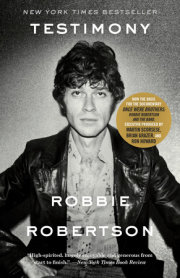
ROBBIE ROBERTSON was the guitarist and principal songwriter in the Band and had a long career as a solo artist. He produced many movie soundtracks for Martin Scorsese and others. His first memoir, Testimony, was a New York Times bestseller. Robbie Robertson died in 2023. View titles by Robbie Robertson

About

The rock legend tells the story of his wild ride with Martin Scorsese—as friends, adventure-seekers, and boundary-pushing collaborators—with all the heart of his New York Times bestselling memoir Testimony.

For four decades, Robbie Robertson produced music for Martin Scorsese's films, a relationship that began when Robertson convinced Scorsese to direct The Last Waltz, the iconic film of the Band's farewell performance at the Winterland Ballroom on Thanksgiving 1976.

The closing of the Band's story with that landmark concert thrust Robertson into a new and uncertain world. With his relationship with his bandmates deteriorating and his marriage collapsing, Robertson arrived on Scorsese’s Beverly Hills doorstep only to find his friend in similar straits. Before the night was out, Scorsese had invited him to move in. Both men, already culture-transforming stars before the age of thirty-five, stood at a creative precipice, searching for the beginning of a new phase of life and work. As their friendship deepened into a career-altering collaboration, their shared journey would take them around the world and down the rabbit hole of American culture in the long hangover of the seventies. Buffeted on either side by temptation and paranoia, veering closer to self-destruction than either wanted to admit, together they had devoted themselves to a partnership defined by equal parts admiration and ambition.

With a cast of characters featuring Robert De Niro, Harvey Keitel, Federico Fellini, Sophia Loren, Sam Fuller, Liza Minelli, Tuesday Weld, and many more, Insomnia is an intimate portrait of a remarkable creative friendship between two titans of American arts, one that would explore the outer limits of excess and experience before returning to tell the tale.

Excerpt

Chapter 1

September 1978

I rolled up to my hotel, right in the heart of the French Quarter. As I stepped out of the car, beneath the iron railings of the hotel balconies, the Crescent City sent out its “bon temps rouler” welcome: the rumble of a funky brass band from over in Jackson Square, mixed with a crying guitar drifting up from Bourbon Street. The scent of spicy gumbo, fresh beignets, and chicory coffee wafted through the thick, humid air like a voodoo tonic pulling you under its spell.

New Orleans. I had been infatuated with the city since I was thirteen years old, growing up in Canada with my ears tuned to the radio airwaves blasting out from the American South. I soaked up the rhythm and blues of Fats Domino and Smiley Lewis; then Professor Longhair, Huey “Piano” Smith and the Clowns, and Shirley and Lee. I got completely hooked. On top of that, this was the actual birthplace of jazz, with the amazing Louis Armstrong leading the march.

What was in the water down there?!

Over the years, I had come to New Orleans many times, as both a musician and a pilgrim. The deeper I dug in, the better it got. Eventually, I got to know all these amazing players personally: Allen Toussaint, the Meters, Big Chief Monk Boudreaux, Dr. John, the Neville Brothers. These guys had a unique take on rock and roll: They were singing a different language, making feel-good music, music that celebrated itself. I rejoiced in that.

The invite for this trip came from Robert De Niro, whom I had met a couple of years back through my housemate and close friend Martin Scorsese. By now, I had been living with Marty for almost two years. Over that time, Bob and I had gotten to enjoy each other’s company. I admired Marty and Bob’s director-actor relationship, which had begun with the groundbreaking Mean Streets and continued with Taxi Driver and New York, New York.

For a while now, Bob had been trying to convince Marty to make a movie based on the life of boxing legend Jake LaMotta, in which Bob would play Jake. Marty hadn’t committed yet, but Bob was all in: He had already been working with Jake on mastering his ways, his boxing technique, the sound and rhythm of his voice, even his walk. It was dedication, a quiet study. Bob had his eye on it all. It was the first time I had ever seen an actor taking a role in like that.

As a show of his appreciation, Bob was bringing Jake down to New Orleans to see the much-awaited rematch between Muhammad Ali and Leon Spinks at the Superdome. Knowing I was a longtime fight fan and had a special connection to the city, he had asked me to join them. Harvey Keitel, another extraordinary talent from the Scorsese circle, would be coming, too. Bob thought Harvey and I would make the whole trip more fun. Because Jake was there, it would be work for Bob, but he didn’t want it to be all work.

He made it sound so inviting: We’re gonna let the good times roll. I’d just spent a week of sleepless nights at the Telluride Film Festival, and I was feeling tired in my bones. But between the fight and the chance to be back in New Orleans, it was an offer I couldn’t refuse.

Bob and Harvey met me at my hotel later that afternoon. I didn’t know Harvey as well, but he seemed like a terrific guy. If Marty and Bob loved Harvey, I wanted to love him, too. I figured Bob would have to tend to Jake and his wife, which meant Harvey and I could get a chance to hang. Harvey had a real street quality to him, and something about him was a little bit standoffish. But that was fine. We were all a little standoffish at times. But with one another we could sometimes let our guards down.

Jake and his wife were arriving the following day, so the three of us had the night to ourselves. I told Bob and Harvey, “I just got word the Staple Singers are playing in town tonight; they’re incredible performers, and friends of mine. I’m gonna go, if you want to join me.”

They were in.

As we arrived at the venue, I saw a familiar face coming up the street toward me: Big Chief Bo Dollis from the Wild Magnolias tribe of the Mardi Gras Indians. The tribes were an old New Orleans tradition, formed by and made up of local African Americans, who had historically been shut out of the fancy, racist Mardi Gras krewes. Years ago, the tribes used to meet up and battle, settling their scores in the streets, but over time, those battles had become musical. Instead of fighting, tribe members dressed in elaborate costumes and sang and danced—and whoever did it best would win the battle.

As chief of the Wild Magnolias, Bo possessed a deeper power. The locals treated chiefs like superheroes, like people who could conjure up a spell. They stood aside when a big chief of the Indians went by, whether he was wearing his ceremonial feathered outfit or not. My New Orleans musician friends the Neville Brothers told me about their uncle George Landry, better known as Big Chief Jolly, of the Wild Tchoupitoulas Indians. On the morning of Mardi Gras, after they had finished sewing his uniform and working on the beads, he would come out of his house to find hundreds of people waiting to catch a glimpse of him. Women would faint upon seeing him. And when he started to move and sing, it would be all over.

Bo Dollis had a wonderful smile and sparkling eyes. You could feel the tradition in the way he looked and carried himself. He was also a wicked singer. I greeted Bo with open arms and introduced him to Bob and Harvey. He bowed his head, but clearly had no idea who they were, and they had no idea what a Black big chief Indian was all about, either.

Walking into the club, I found the Staples killing it on “I’ll Take You There”—Roebuck “Pops” Staples on his tremolo guitar, with his daughter Mavis and her sisters, Yvonne and Cleotha, belting it out. I sang along to Bob and Harvey like we were entering the cool zone. We were ushered to a table amid a packed crowd, mostly Black. In New Orleans, when it came to good live music, I always felt a welcoming vibe. A few moments later, a very pretty waitress came over to take our drink orders. Bob and Harvey were slow to decide while staring at her lovely face. We all broke out laughing, including the waitress, because the gazing was so obvious.

Every tune the Staples sang was more glorious than the next. They did my song “The Weight” like a gospel revival. What a thrill! I winked at the guys and said, “I haven’t seen the Staples since we did this tune with Marty filming The Last Waltz.” I gave Harvey a little backstory, explaining that they had started out as a strictly gospel group, then spread their wings into popular music, much as Sam Cooke and Aretha Franklin had done. But they never really left the church, in their sound, and I loved that. Pops’s soft, soothing, sliding-to-the-note voice could weave a spell. And Mavis was one of the great gospel singers of all time. When she put that voice and feel into popular music, it didn’t get much better.

They finished their show with “Respect Yourself,” and the whole audience stood, chanting along with hands clapping time. The Staples’ harmonies not only soared to the heavens, but they brought the church way downtown.

“Let’s go backstage and say hello.” I motioned to the guys. When I walked into the dressing room, Mavis shrieked and nearly knocked me over with a huge hug. Yvonne and Cleotha threw kisses as I raved about how great the show had been. I introduced Bob and Harvey around the room, but I think Mavis might have been the only one who knew they were movie actors. I told Pops that his singing was better than ever, but I was still trying to figure out how he had gotten that beautiful guitar sound. He smiled with a shining light. “I’ve asked you before, and I’m gonna ask you again. That song, ‘The Weight,’ ” he said under his breath, “what’s it really about?”

I put my arm around his shoulders and confessed, “Pops, I’ll tell you, I’m still trying to get to the bottom of that myself, but when I do, you’ll be the first one I’m gonna call.”

Reviews

“A rollicking account of the pedal-to-the-metal years that followed the [Band’s] dissolution. . . . Robertson’s speedy narrative eschews the maudlin self-analysis common in books of this stripe, delivering a magpie assemblage of impressions and anecdotes—late-night sound mixing sessions with Scorsese, cocaine-fueled gallivanting, and hobnobbing with famous faces. . . . At the same time, Robertson’s sensitive portrait of his friendship with Scorsese—particularly during his addiction-induced hospitalization—provides a potent emotional ballast to the otherwise careening narrative. For rock fans, this is a must.”Publisher’s Weekly, starred review

“A pensive, clear-eyed vision of a collapsing world as seen through grimy, rain-streaked windows . . . a pleasure for golden-age rock fans.”Kirkus Reviews

Author

© Silvia Grav
ROBBIE ROBERTSON was the guitarist and principal songwriter in the Band and had a long career as a solo artist. He produced many movie soundtracks for Martin Scorsese and others. His first memoir, Testimony, was a New York Times bestseller. Robbie Robertson died in 2023. View titles by Robbie Robertson
  • More Websites from
    Penguin Random House
  • Common Reads
  • Library Marketing