Download high-resolution image Look inside
Listen to a clip from the audiobook
audio pause button
0:00
0:00

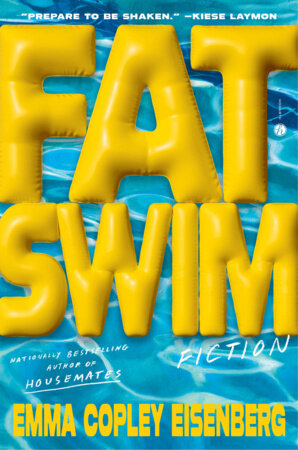
Fat Swim

Fiction

Look inside
Listen to a clip from the audiobook
audio pause button
0:00
0:00
Hardcover
$28.00 US
| $38.99 CAN
On sale Apr 28, 2026 | 240 Pages | 9780593242261
Grades 9-12 + AP/IB

See Additional Formats
An electrifying collection of linked stories following a cast of characters navigating bodies, queerness, power, and sex—with radical results—from the bestselling author of Housemates.

“These interconnected stories blitzed my brain and gut. Prepare to be shaken.”—Kiese Laymon, author of Long Division and Heavy

A MOST ANTICIPATED BOOK OF 2026: Playboy, Literary Hub, Debutiful, LGBTQ Reads, Electric Lit, SheReads/The Stacks, Publishers Lunch

With a brash and stylish voice that implicates and confronts the reader, Emma Copley Eisenberg wades into the contradictions, joys, and violence of a modern world shaped by looking and watching, examining how our hungers can both hijack and crack open our lives.

In the title story, a young girl looks to a group of fat women at her local pool to teach her about her changing body. In “Swiffer Girl,” a woman agrees to try for a baby with her partner, only to suddenly find herself haunted by the viral sex video that made the rounds during high school—a video indelibly tied to her own sense of self. In other stories, an obscure fat makeup vlogger’s strange friendship with a middle schooler forces her to reflect on her past life at a toxic beauty startup, a boomer retiree tries to understand her nonbinary child’s gender and polyamory, and a trans librarian takes a job as assistant to a famous science fiction writer only to find himself screening hookups on his octogenarian employer’s behalf.

For better or for worse, these stories counsel, none of us can leave our bodies behind: they remind us what it is to be alive. As the characters in Fat Swim dance into and out of each other’s lives—and through and around Philadelphia—they seek connections and experiences that remind them of that fact, culminating in a reality-bending, tour de force finale, “Camp Sensation.” Eisenberg, whose fiction “should be studied by every contemporary author as the finest departure from the fatphobic hellscape of fiction that exists” (Electric Literature), has a singular vision, and Fat Swim is her most incisive and provocative work yet.
Fat Swim

Alice spots the fat women through the second-story kitchen window. It’s the colors that catch her eye, the parade of bright bodies turning the corner of Forty-Ninth Street onto the avenue, then veering into the rec area that holds the pool.

It’s Wednesday, early evening, so Dad is out at his feelings meeting. Alice has just turned eight and has been dragging her drumsticks over different household surfaces to see what sounds they make. The sink has been working well—a satisfying ting, ting, ting. Also the panes of window glass—higher, more muffled. The kitten meows on the ledge. Shush, Alice tells him, then bops him lightly on the head with a stick.

Back soon, back soon, back soon, Alice tells the kitten. The drumsticks roll off the counter and hit the parquet floor.

The public pool is on Alice’s avenue in West Philadelphia, which has many trees and a lot of garbage. The sidewalks are cracked but the parking is permit-only—the old woman who lives in the purple house is the captain and she is efficient.

From the top of Alice’s stoop she can clearly see the women across the street and through the chain-link fence. The women are fat and they are swimming. Well, they are about to swim. They are taking off their jean shorts and belly shirts and fringe vests and heart-shaped sunglasses and putting their hair up into ponytails or, if they have short hair, pressing both of their hands onto their heads like a hat—a dance move. A song is playing from a radio that is attached to the motorbike of the boy who lives in the purple house. The song is a hip-hop song that has been playing all summer and even before that, in the weeks when the kids at school believed it should have been summer vacation but it was not, and the air conditioners were working at home but not at school. The fat women are Black and they are white, a thing that almost never happens in this neighborhood. They snap their fingers. They lean forward and stick out their butts, then lean back and lift their breasts to the sun, their bellies hanging over their bikini bottoms.

This is interesting to Alice because they are fat like her. As they move to the song, sometimes a swath of fat goes one way while the woman goes another. These are moves Alice, too, has sometimes done, but only alone and only in front of the mirror. Slight rolls of flesh puff out just below the elastic of their bras and gather on their backs like wings. Alice would like to run a finger through the creases this flesh makes. This is what she thinks about later, at night, in her bed with the lights out. With both hands, she holds the flap of fat where the low part of her stomach touches her thighs. She jiggles it in both hands—first together, then each hand separately—then lets it go. She pats the skin above her vagina, the part that her mother calls her FUPA, with her whole hand—once, twice. The thing that most people do not know about fat is that it is stronger than you think. It is not all softness. It bounces. It bounces back.

The following Wednesday, Alice is ready for the women. She sits a little closer, on the bottom step of her stoop, waiting for them. In addition to sexy touching, she has also been dreaming of the fat women in their bathing suits, which is how she knows the feeling she has for them is romantic. She has imagined a birthday party. It is her birthday, a pool party, and the women are her guests. There is cake and ice cream. Everyone eats as much as they want and no one asks if Alice is sure she really wants to eat that second piece. They eat the ice cream from pint cartons because it is assumed that everyone will finish their own pint. No one has to share, no one has to put the ice cream back with one bite left to avoid their mother noticing the carton is missing. Then there is dancing. The fat women compliment Alice on her moves. They say they have never seen moves like that and ask Alice to teach them. Then two women come up on either side of Alice, grab her hands, and swing her body back and forth. Then they toss her into the water and she swims and swims.

In real life, they are not dancing today. It is too hot, the women say, entirely too hot. They take their clothes off and get right in the water, either by jumping or easing themselves down the flimsy metal ladders. If they ease themselves in, their breasts are the first to float. Recently, Alice has learned that breasts are actually just sacks of fat. Her own breasts, which she has had for a year already, are also made of fat. Strange, she thinks, the way people love breasts but hate fat. If the women jump in, they surface slowly, gasping and laughing, then move across the water slow as manatees. They circulate a beach ball, tapping it with the tips of their fingers until they get bored. It falls to the surface of the water with a light slap.

Alice sits with Dad when he gets home, munching on a crispy grilled cheese and carrots that he has grown in their garden. She knows now that carrots come from seeds and that just because the ones that come from their garden look like crooked knuckles and not like the smooth pinkie fingers from the grocery store does not mean they are bad.

How big will I get? Alice asks Dad, holding up another knobby carrot. Will I keep growing?

Dad looks up from the pile of stapled papers he is writing on. Whenever he is writing to his students, he uses the cheapest possible pen, Alice has noticed, usually the free ones from the bank near their house where the trolley stops. Dad is fat, too, but Alice’s mom, Tara, who used to be Dad’s wife, is not. Alice has noticed that this happens often—a fat man with a thin woman. Rarely does it go the other way around.

I don’t know, Dad says. You will very likely keep growing up, vertically. I don’t know if you will also keep growing out, horizontally. Do you want to?

Yes, says Alice.

Okay, says Dad.

. . .

After dinner, Alice and Dad take a walk to Fred’s Water Ice across from the funeral parlor. Everything at Fred’s is red metal—red metal poles to hold up awnings, red metal horses that you can ride for fifty cents. Alice gets a jumbo opaque plastic cup of black cherry water ice mixed with vanilla soft serve—a gelati! She holds it in one hand and the red metal hair of the horse in the other. Next to her, on Santa’s red metal sleigh, is a little girl with her hair up in two poufs secured with bright colored balls that Alice thinks are cool. She thinks the girl is five, maybe six.

How old are you? Alice asks the girl.

Eight and a half, the girl says. But inside, I’m much older.

Me too, Alice says.

Her thighs are much bigger than the girl’s, white tree trunks compared to the girl’s Black branches. Does this matter? Can people be the same age but different sizes? Alice squeezes her thighs together, hard, to see if she can suffocate the metal horse. But he keeps right on bucking.

You’re fat, the girl says.

I know, Alice says.

Oh, the girl says. What’s your name?

Alice. But sometimes people call me Alley Cat or Topsy.

Because of your hair?

Yes.

Can I touch it?

Okay, Alice says. She is used to this from school. Curly hair like hers, so curly it sticks straight out from her head in a circle like a Truffula Tree, is interesting to people, she knows. It is interesting to Black kids, who make up most of her classmates, because it is like their hair but not like it too, and it is interesting to white kids who have straight hair for the same reason. Alice leans her head down and into the space between her horse and the girl’s sleigh. The girl puts her hand into Alice’s hair and moves it side to side.

Cool, the girl says.

Dad has his right leg up on the sitting part of the red metal picnic table and is leaning over it, stretching. His jumbo cup of mango water ice is empty, and the smallest bit of orange liquid puddles at the bottom. His feet are exposed in sandals that have a toe and a back but barely any sides. Alice worries about him. At night, after she has put on her pajamas, they meet in her red chair and he does the silly voices and smooths her hair away from her ears.

The girl gets off the ride and goes to take the hand of a tall man leaning against the red metal fence—her dad. Alice sees how this dad holds himself, chest a little puffed out. He moves a toothpick around in his mouth and his boots are laced up tight and right. Dad carries a canvas tote with two straps, and usually the tops of vegetables—kale, rhubarb, collards—poke up out of the bag. Alice worries that Dad is too gentle for this world. That he will not last. That one day she will wake up and wait for Dad to pour her cereal with blueberries and he will not be there.
“Emma Copley Eisenberg is attuned to every beautiful, terrible human thing: desire, shame, sensation, connection. Fat Swim is a lush, radical meditation on the body’s pleasure and potential.”—Carmen Maria Machado, author of In the Dream House

“These are some of the best short stories I’ve read in a long time—vivid, surprising, and pin-sharp. Emma Copley Eisenberg is a phenomenal talent. Buy this collection and thank me later.”—Kelly Link, author of The Book of Love

“Absolutely everything I ever imagined for the future of American fiction . . . These interconnected stories blitzed my brain and gut.”—Kiese Laymon, author of Long Division

“Spiky, acerbic, and utterly addictive . . . a book as provocative as it is lush, traversing everything from toxic beauty startups to viral sex tapes.”Playboy

“The collection resists the erasure of fat bodies in American letters, mostly by giving us all too rare portraits of pleasure and desire. Grace Paley is in these pages, as is summer, and ice cream, and Ray’s Birthday Bar, and refusing to be defined in binary terms.”—Electric Literature

“I can’t stop thinking about these stories. Emma Copley Eisenberg is one of the most interesting and observant young fiction writers on the scene.”—Andrea Lawlor, author of Paul Takes the Form of a Mortal Girl

“Eisenberg has a spooky talent for inhabiting the minds of completely disparate people. All the narrators are funny, wise, and heartbreaking, and know how to tell a quick, gripping story.”—Torrey Peters, author of Stag Dance

“Funny, mordant, and tender all at once—this is the rare book that exuberantly inhabits the human body, in all its grossness and glory.”—Rachel Khong, author of My Dear You

“I loved these stories—funny and sad and deeply resonant.”—Marcy Dermansky, author of Hot Air

“Glittering . . . There’s plenty to admire in these offbeat tales.”Publishers Weekly

“Dynamic . . . [Eisenberg’s] bold, vivid stories will capture the reader’s attention.”Booklist
© Kenzi Crash
Emma Copley Eisenberg is the bestselling author of the novel Housemates, nominated for a Lambda Literary Award and the VCU Cabell First Novelist Prize, as well as the nonfiction book The Third Rainbow Girl, a New York Times Notable Book and Editor’s Choice and a finalist for an Edgar Award and an Anthony Award. Her fiction, essays, and criticism have appeared in such publications as Granta, Esquire, VQR, The New Republic, and The Cut, and she writes the popular Substack Frump Feelings. She lives in Philadelphia, where she co-founded Blue Stoop, a community hub for the literary arts. View titles by Emma Copley Eisenberg

About

An electrifying collection of linked stories following a cast of characters navigating bodies, queerness, power, and sex—with radical results—from the bestselling author of Housemates.

“These interconnected stories blitzed my brain and gut. Prepare to be shaken.”—Kiese Laymon, author of Long Division and Heavy

A MOST ANTICIPATED BOOK OF 2026: Playboy, Literary Hub, Debutiful, LGBTQ Reads, Electric Lit, SheReads/The Stacks, Publishers Lunch

With a brash and stylish voice that implicates and confronts the reader, Emma Copley Eisenberg wades into the contradictions, joys, and violence of a modern world shaped by looking and watching, examining how our hungers can both hijack and crack open our lives.

In the title story, a young girl looks to a group of fat women at her local pool to teach her about her changing body. In “Swiffer Girl,” a woman agrees to try for a baby with her partner, only to suddenly find herself haunted by the viral sex video that made the rounds during high school—a video indelibly tied to her own sense of self. In other stories, an obscure fat makeup vlogger’s strange friendship with a middle schooler forces her to reflect on her past life at a toxic beauty startup, a boomer retiree tries to understand her nonbinary child’s gender and polyamory, and a trans librarian takes a job as assistant to a famous science fiction writer only to find himself screening hookups on his octogenarian employer’s behalf.

For better or for worse, these stories counsel, none of us can leave our bodies behind: they remind us what it is to be alive. As the characters in Fat Swim dance into and out of each other’s lives—and through and around Philadelphia—they seek connections and experiences that remind them of that fact, culminating in a reality-bending, tour de force finale, “Camp Sensation.” Eisenberg, whose fiction “should be studied by every contemporary author as the finest departure from the fatphobic hellscape of fiction that exists” (Electric Literature), has a singular vision, and Fat Swim is her most incisive and provocative work yet.

Excerpt

Fat Swim

Alice spots the fat women through the second-story kitchen window. It’s the colors that catch her eye, the parade of bright bodies turning the corner of Forty-Ninth Street onto the avenue, then veering into the rec area that holds the pool.

It’s Wednesday, early evening, so Dad is out at his feelings meeting. Alice has just turned eight and has been dragging her drumsticks over different household surfaces to see what sounds they make. The sink has been working well—a satisfying ting, ting, ting. Also the panes of window glass—higher, more muffled. The kitten meows on the ledge. Shush, Alice tells him, then bops him lightly on the head with a stick.

Back soon, back soon, back soon, Alice tells the kitten. The drumsticks roll off the counter and hit the parquet floor.

The public pool is on Alice’s avenue in West Philadelphia, which has many trees and a lot of garbage. The sidewalks are cracked but the parking is permit-only—the old woman who lives in the purple house is the captain and she is efficient.

From the top of Alice’s stoop she can clearly see the women across the street and through the chain-link fence. The women are fat and they are swimming. Well, they are about to swim. They are taking off their jean shorts and belly shirts and fringe vests and heart-shaped sunglasses and putting their hair up into ponytails or, if they have short hair, pressing both of their hands onto their heads like a hat—a dance move. A song is playing from a radio that is attached to the motorbike of the boy who lives in the purple house. The song is a hip-hop song that has been playing all summer and even before that, in the weeks when the kids at school believed it should have been summer vacation but it was not, and the air conditioners were working at home but not at school. The fat women are Black and they are white, a thing that almost never happens in this neighborhood. They snap their fingers. They lean forward and stick out their butts, then lean back and lift their breasts to the sun, their bellies hanging over their bikini bottoms.

This is interesting to Alice because they are fat like her. As they move to the song, sometimes a swath of fat goes one way while the woman goes another. These are moves Alice, too, has sometimes done, but only alone and only in front of the mirror. Slight rolls of flesh puff out just below the elastic of their bras and gather on their backs like wings. Alice would like to run a finger through the creases this flesh makes. This is what she thinks about later, at night, in her bed with the lights out. With both hands, she holds the flap of fat where the low part of her stomach touches her thighs. She jiggles it in both hands—first together, then each hand separately—then lets it go. She pats the skin above her vagina, the part that her mother calls her FUPA, with her whole hand—once, twice. The thing that most people do not know about fat is that it is stronger than you think. It is not all softness. It bounces. It bounces back.

The following Wednesday, Alice is ready for the women. She sits a little closer, on the bottom step of her stoop, waiting for them. In addition to sexy touching, she has also been dreaming of the fat women in their bathing suits, which is how she knows the feeling she has for them is romantic. She has imagined a birthday party. It is her birthday, a pool party, and the women are her guests. There is cake and ice cream. Everyone eats as much as they want and no one asks if Alice is sure she really wants to eat that second piece. They eat the ice cream from pint cartons because it is assumed that everyone will finish their own pint. No one has to share, no one has to put the ice cream back with one bite left to avoid their mother noticing the carton is missing. Then there is dancing. The fat women compliment Alice on her moves. They say they have never seen moves like that and ask Alice to teach them. Then two women come up on either side of Alice, grab her hands, and swing her body back and forth. Then they toss her into the water and she swims and swims.

In real life, they are not dancing today. It is too hot, the women say, entirely too hot. They take their clothes off and get right in the water, either by jumping or easing themselves down the flimsy metal ladders. If they ease themselves in, their breasts are the first to float. Recently, Alice has learned that breasts are actually just sacks of fat. Her own breasts, which she has had for a year already, are also made of fat. Strange, she thinks, the way people love breasts but hate fat. If the women jump in, they surface slowly, gasping and laughing, then move across the water slow as manatees. They circulate a beach ball, tapping it with the tips of their fingers until they get bored. It falls to the surface of the water with a light slap.

Alice sits with Dad when he gets home, munching on a crispy grilled cheese and carrots that he has grown in their garden. She knows now that carrots come from seeds and that just because the ones that come from their garden look like crooked knuckles and not like the smooth pinkie fingers from the grocery store does not mean they are bad.

How big will I get? Alice asks Dad, holding up another knobby carrot. Will I keep growing?

Dad looks up from the pile of stapled papers he is writing on. Whenever he is writing to his students, he uses the cheapest possible pen, Alice has noticed, usually the free ones from the bank near their house where the trolley stops. Dad is fat, too, but Alice’s mom, Tara, who used to be Dad’s wife, is not. Alice has noticed that this happens often—a fat man with a thin woman. Rarely does it go the other way around.

I don’t know, Dad says. You will very likely keep growing up, vertically. I don’t know if you will also keep growing out, horizontally. Do you want to?

Yes, says Alice.

Okay, says Dad.

. . .

After dinner, Alice and Dad take a walk to Fred’s Water Ice across from the funeral parlor. Everything at Fred’s is red metal—red metal poles to hold up awnings, red metal horses that you can ride for fifty cents. Alice gets a jumbo opaque plastic cup of black cherry water ice mixed with vanilla soft serve—a gelati! She holds it in one hand and the red metal hair of the horse in the other. Next to her, on Santa’s red metal sleigh, is a little girl with her hair up in two poufs secured with bright colored balls that Alice thinks are cool. She thinks the girl is five, maybe six.

How old are you? Alice asks the girl.

Eight and a half, the girl says. But inside, I’m much older.

Me too, Alice says.

Her thighs are much bigger than the girl’s, white tree trunks compared to the girl’s Black branches. Does this matter? Can people be the same age but different sizes? Alice squeezes her thighs together, hard, to see if she can suffocate the metal horse. But he keeps right on bucking.

You’re fat, the girl says.

I know, Alice says.

Oh, the girl says. What’s your name?

Alice. But sometimes people call me Alley Cat or Topsy.

Because of your hair?

Yes.

Can I touch it?

Okay, Alice says. She is used to this from school. Curly hair like hers, so curly it sticks straight out from her head in a circle like a Truffula Tree, is interesting to people, she knows. It is interesting to Black kids, who make up most of her classmates, because it is like their hair but not like it too, and it is interesting to white kids who have straight hair for the same reason. Alice leans her head down and into the space between her horse and the girl’s sleigh. The girl puts her hand into Alice’s hair and moves it side to side.

Cool, the girl says.

Dad has his right leg up on the sitting part of the red metal picnic table and is leaning over it, stretching. His jumbo cup of mango water ice is empty, and the smallest bit of orange liquid puddles at the bottom. His feet are exposed in sandals that have a toe and a back but barely any sides. Alice worries about him. At night, after she has put on her pajamas, they meet in her red chair and he does the silly voices and smooths her hair away from her ears.

The girl gets off the ride and goes to take the hand of a tall man leaning against the red metal fence—her dad. Alice sees how this dad holds himself, chest a little puffed out. He moves a toothpick around in his mouth and his boots are laced up tight and right. Dad carries a canvas tote with two straps, and usually the tops of vegetables—kale, rhubarb, collards—poke up out of the bag. Alice worries that Dad is too gentle for this world. That he will not last. That one day she will wake up and wait for Dad to pour her cereal with blueberries and he will not be there.

Reviews

“Emma Copley Eisenberg is attuned to every beautiful, terrible human thing: desire, shame, sensation, connection. Fat Swim is a lush, radical meditation on the body’s pleasure and potential.”—Carmen Maria Machado, author of In the Dream House

“These are some of the best short stories I’ve read in a long time—vivid, surprising, and pin-sharp. Emma Copley Eisenberg is a phenomenal talent. Buy this collection and thank me later.”—Kelly Link, author of The Book of Love

“Absolutely everything I ever imagined for the future of American fiction . . . These interconnected stories blitzed my brain and gut.”—Kiese Laymon, author of Long Division

“Spiky, acerbic, and utterly addictive . . . a book as provocative as it is lush, traversing everything from toxic beauty startups to viral sex tapes.”Playboy

“The collection resists the erasure of fat bodies in American letters, mostly by giving us all too rare portraits of pleasure and desire. Grace Paley is in these pages, as is summer, and ice cream, and Ray’s Birthday Bar, and refusing to be defined in binary terms.”—Electric Literature

“I can’t stop thinking about these stories. Emma Copley Eisenberg is one of the most interesting and observant young fiction writers on the scene.”—Andrea Lawlor, author of Paul Takes the Form of a Mortal Girl

“Eisenberg has a spooky talent for inhabiting the minds of completely disparate people. All the narrators are funny, wise, and heartbreaking, and know how to tell a quick, gripping story.”—Torrey Peters, author of Stag Dance

“Funny, mordant, and tender all at once—this is the rare book that exuberantly inhabits the human body, in all its grossness and glory.”—Rachel Khong, author of My Dear You

“I loved these stories—funny and sad and deeply resonant.”—Marcy Dermansky, author of Hot Air

“Glittering . . . There’s plenty to admire in these offbeat tales.”Publishers Weekly

“Dynamic . . . [Eisenberg’s] bold, vivid stories will capture the reader’s attention.”Booklist

Author

© Kenzi Crash
Emma Copley Eisenberg is the bestselling author of the novel Housemates, nominated for a Lambda Literary Award and the VCU Cabell First Novelist Prize, as well as the nonfiction book The Third Rainbow Girl, a New York Times Notable Book and Editor’s Choice and a finalist for an Edgar Award and an Anthony Award. Her fiction, essays, and criticism have appeared in such publications as Granta, Esquire, VQR, The New Republic, and The Cut, and she writes the popular Substack Frump Feelings. She lives in Philadelphia, where she co-founded Blue Stoop, a community hub for the literary arts. View titles by Emma Copley Eisenberg
  • More Websites from
    Penguin Random House
  • Common Reads
  • Library Marketing