Close Modal
Download high-resolution image Look inside
Listen to a clip from the audiobook
audio pause button
0:00
0:00

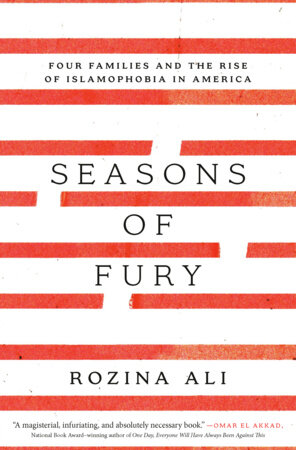
Seasons of Fury

Four Families and the Rise of Islamophobia in America

Author Rozina Ali
Look inside
Listen to a clip from the audiobook
audio pause button
0:00
0:00
LONGLISTED FOR THE NATIONAL BOOK AWARD • An “unforgettable”* history of the U.S. government’s broken compact with its Muslim citizens, culminating in the post-9/11 era of mass surveillance and increased violence—from an award-winning New York Times Magazine journalist.

“A deeply reported tale of hysteria, bigotry, surveillance, and persecution.”—Patrick Radden Keefe, bestselling author of London Is Falling


“By bringing the ordeal of American Muslims out from the margins, Seasons of Fury indicts the society that sacrificed them on the altar of 9/11.”—The New York Times Book Review*

In this closely reported and elegantly written book, Rozina Ali shows how the War on Terror, conceived in the wake of the September 11 attacks, only accelerated long-standing conflicts between American law enforcement and Muslim communities around the country. From the surveillance of Arab activists that began in the 1960s and laws in the 90s that broadened the definition of terrorism, to the mass detention of entire Muslim communities in the 2000s and the rise of think tanks and nonprofits that sowed panic about the threat of Islam itself, Seasons of Fury shows that the history of policies that have warped the American perception of Muslim communities reaches deep into our past.

Through the powerful stories of four families across eight decades, Ali narrates a range of Muslim experiences shaped by relentless suspicion and prejudice. Introducing readers to Abdeen Jabara, Mohammad Ali Chaudry, Shahina and Matin Siraj, and the pseudonymous Omar family, she shows how fears about American Muslims have always been inextricable from the Israel–Palestine conflict, stoking the idea of a religious war between Muslims and the West.

Ultimately, the U.S. government’s Islamophobic policies disillusioned generations of Muslims who sought the promise of the American dream only to find their communities torn apart, their relatives imprisoned, and their religion villainized by politicians and media. Ali’s story of how we got to our terrifying present is a magisterial accomplishment and a damning indictment of the United States’ abandonment of its core principles in the face of fear.
1

Jabara: Memories

Abdeen Jabara stretched out his crimson-stained fingers. Balancing on his toes, the eight-year-old met the tree branch that his elder brother, Khalid, lowered for him. Quickly, he pulled off a few plump mulberries and dropped them into the basket below.

The two trees that the Jabara family was circling sat on a patch of land in northern Michigan owned by an elderly couple who didn’t quite know what to do with these berries. But their wide, leafy trees were a boon to Abdeen’s mother, Mymonie. The fondness for their sweet tartness was a family inheritance, passed down from her Syrian mother. Mymonie would bake the mulberries into a cobbler when the Jabaras returned home to Mancelona.

Abdeen sneaked a couple into his mouth, with one eye on his sister, who stood nearby. Mymonie had been so busy raising six other children that when Abdeen was born, Essie, the eldest, became a second mother to him. Brother and sister had fifteen years between them, and it was Essie who rocked Abdeen to sleep, read him his favorite book about a lion in the jungle, turned her gaze away from his mischiefs.

In front of the Jabara family, the turquoise waters of Torch Lake gleamed alluringly in the July heat. While their father Sam took the kids for a swim, Mymonie would saunter by the road and search for wild grape leaves. Maybe next week the boys would wade into the river near town for her and collect bushels of the watercress that carpeted the water. Abdeen was sure his mother was the only one in town with two ovens: an electric stove for cooking, just like everyone else, and a wood-burning one that she used to make flatbread. Their table was always lined with fatayer of spinach and meat and warm plain pitas that would be dipped in dense yogurt.

Soon the days would cool, and the boys would start hunting. Khalid had handed Abdeen a toy rifle a short while ago. Donning a white cap over his golden curls, Abdeen studied Khalid as he crouched down to the dirt and aimed at a rabbit. In a few months, his brothers, cousins, and uncles and Sam would go off on their annual Christmastime hunts.

But not yet. For now, there was still summer to be had. The Jabara family loaded their treasure of berries and themselves onto Sam’s black Dodge truck and headed back toward Mancelona.

•

S.A. Jabara Grocery store stood on the corner of State and Maple streets, just west of the post office. On windy days, whiffs of smelting iron reached town from the factory, just beyond the tracks, that produced ingots and carbon iron for the rest of the United States. Technically, the area around the factory was unincorporated land, but workers and their families settled there in bare-bones housing—Abdeen was shocked to learn they lacked indoor plumbing—and came into Mancelona to attend school or buy groceries. Jabara may have been an unusual name to the visitors, but perhaps not more so than Moeke or Rahilly or Ludwig, whose businesses also lined the streets.

The first time Sam and Mymonie met was on their wedding day, in 1924. Sam had been twenty when he traveled from Greater Syria to the United States. He had left an entire life behind, one in which he was born Mohammed Ali Jabara. His parents mortgaged a bit of land to pay for his ship passage from the Beirut harbor to Marseilles to New York, where he became Sam. He peddled, worked at a tannery, got injured and spent his recovery learning English, joined the army just like fourteen thousand other Arabs, then was medically discharged for severe asthma. Now a merchant, it was time to settle down. Sam phoned relatives in Flint, Michigan. Did they know of a nice Arab girl? They did, in fact, know a family in Ross, North Dakota, who had emigrated from a village in Syria not far from Sam’s own. The Mellems had a lovely daughter.

Mymonie rode a train to Duluth, Minnesota, wearing a simple and delicate dress. Her only embellishments were a pearl necklace and a rose pinned below her right collar. Sam towered above her in a crisp three-piece suit decorated with a gold pocket watch. Mymonie could see that behind his thick mustache, he was handsome. They visited the World’s Fair in Chicago as a new couple, where Mymonie posed atop a replica of a camel. She hated photos, believing that a click of the camera took a bite out of one’s soul. But she dutifully looked toward the lens, a knee-length polka-dot dress arranged over her legs.

Sam gave Mymonie the option of settling in Mancelona, a small town in northern Michigan where he owned a general store, or Detroit, where he had some relatives and where a few hundred Arab families had built a budding community. Mymonie had grown up in the isolated farmlands of North Dakota—a city was foreign to her.

When they moved to Mancelona, the village was not much more than a few paved roads and wooden boardwalks. There was a dime store, a haberdashery, and one newspaper. It would be a couple of years before the first snowplow would pass through, and for a while Sam delivered fresh produce and cured meats by horse and buggy. The family grew with the town itself. When Abdeen was born, in 1940, one of the original pioneers was still living.

At the store, when a customer asked, Sam drew a map to show where the Jabaras hailed from. He traced the coastline of the Levant and marked a dot. He and Mymonie were from that tiny corner, just by the Mediterranean, Sam explained. They were Syrian.

You mean Assyrian? the reply usually came.

Khalid and Essie, who often helped at the store, were embarrassed. They hated when their father traced the family tree, or when he spoke to them in Arabic in front of the townspeople. Or worse still, their friends. Baee, they pleaded, don’t speak in Arabic. This annoyed Sam. He didn’t care who heard, he snapped back.

•

There was a big discussion in the house one day, and tensions were high. One of Abdeen’s older sisters, Frieda, was participating in a school cherry pie–baking contest. Everyone knew that the crust tasted better if you used lard instead of Crisco, but lard was made of pig fat, and no one in the Jabara household consumed pork. After much arguing, Sam and Mymonie agreed that Frieda could make the crust with lard—as long as she didn’t eat her own pie. She won.

The drama was past when a delivery arrived all the way from Rashid Sales, a record store in Brooklyn. The large box was carried to the living room, which was packed with rugs and brass lamps and inlaid wooden tables that Sam had managed to import from Damascus. The family crowded around the box to inspect the treasure inside.

Abdeen insisted on opening the lid and snatched away the paper inside to reveal a shiny record album cover. More lay underneath. The kids took them out cautiously and handed them to Sam. Mymonie had grown up hearing Arabic at home, but only Sam could read the writings on the covers. The children, even Abdeen, caught on to a few words and phrases. Haram, for instance. Or when Sam was upset, his bottom teeth would cover his top lip and he would say Shoo deenu?—What’s his religion? It was shorthand for asking, What kind of person is he? But that was the extent of it. Their father spoke a language they could not quite access.

Sam laid the record into the player, and music cascaded through the house.

•

One evening in 1948, when Abdeen was not yet nine, he found his father sitting in a chair in the family room. The china cabinet behind him held an English translation of the Qur’an, gathering dust. It was strange to find his father alone. Sam was always at the store, or in the garden with Mymonie. She tended to her violets, chickpeas, and peppery leaves as if they were her children. A neighbor once remarked that she could “plant a broomstick and make it grow.” Even Sam had come to love gardening, and every year the couple competed with Bill Schroeder, across the street, to see who could produce the first ripe tomato of the season.

But tonight Sam was inside, all alone. Abdeen wasn’t sure if his father had noticed him enter. Sam’s head was bent low, his ear leaning toward the mesh of their brown Stromberg Carlson radio. Usually Sam cut a strong figure in any room. He rarely left the house without a tie, and he commanded every conversation, charmed any gathering. Abdeen had never seen his face contorted as it was now.

The voice on the radio was crackling, urgent. All Abdeen could recognize was that it was speaking in Arabic. Later, this memory would come with great clarity, after he recognized that this was the first time he heard of the Nakba, in which tens of thousands of Palestinians were driven out of their homes by Israeli forces. That night, however, watching Sam, all Abdeen could gather was that something very bad was happening, somewhere very far away.
“Seasons of Fury is a magisterial, infuriating, and absolutely necessary book. With a sense of care and thoroughness developed over years of journalistic expertise in the subject matter, Rozina Ali interrogates one of the most acceptable and least-punished forms of prejudice in America today. A vital work, as illuminating as any I’ve read in many years on how and why hatred becomes normalized.”—Omar El Akkad, National Book Award–winning author of One Day, Everyone Will Have Always Been Against This

“This book is an essential and eloquent record of our times, and of one of the most troubling realities of America. Tracing the rise of Islamophobia and its alarming resurgence, this prescient accounting is a must-read.”—Eliza Griswold, Pulitzer Prize-winning author of Circle of Hope

“This a deeply reported tale of hysteria, bigotry, surveillance and persecution, one that is suffused with quiet outrage but observed with a clear eye. At the same time, Ali has captured, with great compassion, the resilience, dignity, and patriotism of American Muslims.”—Patrick Radden Keefe, #1 New York Times bestselling author of London Falling

“Rozina Ali’s unforgettable new book, Seasons of Fury, takes an overdue hammer to [September 11] myths. A thorough, subtle reporter, [Ali] presents a disparate record of American Muslim life. . . . [She] details what it is to survive state persecution draped in the legitimacy of counterterrorism [and] insightfully shows how even before 9/11 American Muslims were already dehumanized. . . . By bringing the ordeal of American Muslims out from the margins, Seasons of Fury indicts the society that sacrificed them on the altar of 9/11.”—The New York Times Book Review

“With intimate and beautifully crafted portraiture, Rozina Ali explores the history of Islamophobia in America, and how the war on terror deepened the ugliness at its heart. Nested prejudices and cruelties combine with think tanks that push moral panics about the threat of Islam.”—Eddie S. Glaude, Jr., author of America, U.S.A.: How Race Shadows the Nation’s Anniversaries

“Rozina Ali has written a vital and page-turning account of some of our country’s darkest recent chapters. This is a book about immigration, race, and persecution, told in stellar reportorial detail. But it’s also a mirror that Ali skillfully holds up to force a reckoning about the kind of country we really are. Seasons of Fury should be required reading.”—Jonathan Blitzer, bestselling author of Everyone Who Is Gone Is Here

“Seasons of Fury is an excellent autopsy of America’s last few decades and the Islamophobia that has riddled its politics and policies. [Ali’s] writing is evocative without becoming ornate, and she makes even the most well-known stories from the era compelling page-turners.”—Moira Lavelle, Inkstick

“With its wide scope, this riveting account exposes how the ‘war on terror’ was always a war at home.”—Publishers Weekly, starred review
© Zahin Ali
Rozina Ali is a journalist and contributing writer at New York Times Magazine, a fellow at Type Media Center, a fellow at New America, and was previously a senior editor at The Cairo Review of Global Affairs. Ali writes primarily about the War on Terror, Islamophobia, the Middle East, and South Asia, and her work has been featured in The New Yorker, Harper’s, Foreign Affairs, The Nation, The American Prospect, and more. Ali is a recipient of the National Magazine Award in Reporting. View titles by Rozina Ali

Discussion Guide for Seasons of Fury

Provides questions, discussion topics, suggested reading lists, introductions and/or author Q&As, which are intended to enhance reading groups’ experiences.

(Please note: the guide displayed here is the most recently uploaded version; while unlikely, any page citation discrepancies between the guide and book is likely due to pagination differences between a book’s different formats.)

About

LONGLISTED FOR THE NATIONAL BOOK AWARD • An “unforgettable”* history of the U.S. government’s broken compact with its Muslim citizens, culminating in the post-9/11 era of mass surveillance and increased violence—from an award-winning New York Times Magazine journalist.

“A deeply reported tale of hysteria, bigotry, surveillance, and persecution.”—Patrick Radden Keefe, bestselling author of London Is Falling


“By bringing the ordeal of American Muslims out from the margins, Seasons of Fury indicts the society that sacrificed them on the altar of 9/11.”—The New York Times Book Review*

In this closely reported and elegantly written book, Rozina Ali shows how the War on Terror, conceived in the wake of the September 11 attacks, only accelerated long-standing conflicts between American law enforcement and Muslim communities around the country. From the surveillance of Arab activists that began in the 1960s and laws in the 90s that broadened the definition of terrorism, to the mass detention of entire Muslim communities in the 2000s and the rise of think tanks and nonprofits that sowed panic about the threat of Islam itself, Seasons of Fury shows that the history of policies that have warped the American perception of Muslim communities reaches deep into our past.

Through the powerful stories of four families across eight decades, Ali narrates a range of Muslim experiences shaped by relentless suspicion and prejudice. Introducing readers to Abdeen Jabara, Mohammad Ali Chaudry, Shahina and Matin Siraj, and the pseudonymous Omar family, she shows how fears about American Muslims have always been inextricable from the Israel–Palestine conflict, stoking the idea of a religious war between Muslims and the West.

Ultimately, the U.S. government’s Islamophobic policies disillusioned generations of Muslims who sought the promise of the American dream only to find their communities torn apart, their relatives imprisoned, and their religion villainized by politicians and media. Ali’s story of how we got to our terrifying present is a magisterial accomplishment and a damning indictment of the United States’ abandonment of its core principles in the face of fear.

Excerpt

1

Jabara: Memories

Abdeen Jabara stretched out his crimson-stained fingers. Balancing on his toes, the eight-year-old met the tree branch that his elder brother, Khalid, lowered for him. Quickly, he pulled off a few plump mulberries and dropped them into the basket below.

The two trees that the Jabara family was circling sat on a patch of land in northern Michigan owned by an elderly couple who didn’t quite know what to do with these berries. But their wide, leafy trees were a boon to Abdeen’s mother, Mymonie. The fondness for their sweet tartness was a family inheritance, passed down from her Syrian mother. Mymonie would bake the mulberries into a cobbler when the Jabaras returned home to Mancelona.

Abdeen sneaked a couple into his mouth, with one eye on his sister, who stood nearby. Mymonie had been so busy raising six other children that when Abdeen was born, Essie, the eldest, became a second mother to him. Brother and sister had fifteen years between them, and it was Essie who rocked Abdeen to sleep, read him his favorite book about a lion in the jungle, turned her gaze away from his mischiefs.

In front of the Jabara family, the turquoise waters of Torch Lake gleamed alluringly in the July heat. While their father Sam took the kids for a swim, Mymonie would saunter by the road and search for wild grape leaves. Maybe next week the boys would wade into the river near town for her and collect bushels of the watercress that carpeted the water. Abdeen was sure his mother was the only one in town with two ovens: an electric stove for cooking, just like everyone else, and a wood-burning one that she used to make flatbread. Their table was always lined with fatayer of spinach and meat and warm plain pitas that would be dipped in dense yogurt.

Soon the days would cool, and the boys would start hunting. Khalid had handed Abdeen a toy rifle a short while ago. Donning a white cap over his golden curls, Abdeen studied Khalid as he crouched down to the dirt and aimed at a rabbit. In a few months, his brothers, cousins, and uncles and Sam would go off on their annual Christmastime hunts.

But not yet. For now, there was still summer to be had. The Jabara family loaded their treasure of berries and themselves onto Sam’s black Dodge truck and headed back toward Mancelona.

•

S.A. Jabara Grocery store stood on the corner of State and Maple streets, just west of the post office. On windy days, whiffs of smelting iron reached town from the factory, just beyond the tracks, that produced ingots and carbon iron for the rest of the United States. Technically, the area around the factory was unincorporated land, but workers and their families settled there in bare-bones housing—Abdeen was shocked to learn they lacked indoor plumbing—and came into Mancelona to attend school or buy groceries. Jabara may have been an unusual name to the visitors, but perhaps not more so than Moeke or Rahilly or Ludwig, whose businesses also lined the streets.

The first time Sam and Mymonie met was on their wedding day, in 1924. Sam had been twenty when he traveled from Greater Syria to the United States. He had left an entire life behind, one in which he was born Mohammed Ali Jabara. His parents mortgaged a bit of land to pay for his ship passage from the Beirut harbor to Marseilles to New York, where he became Sam. He peddled, worked at a tannery, got injured and spent his recovery learning English, joined the army just like fourteen thousand other Arabs, then was medically discharged for severe asthma. Now a merchant, it was time to settle down. Sam phoned relatives in Flint, Michigan. Did they know of a nice Arab girl? They did, in fact, know a family in Ross, North Dakota, who had emigrated from a village in Syria not far from Sam’s own. The Mellems had a lovely daughter.

Mymonie rode a train to Duluth, Minnesota, wearing a simple and delicate dress. Her only embellishments were a pearl necklace and a rose pinned below her right collar. Sam towered above her in a crisp three-piece suit decorated with a gold pocket watch. Mymonie could see that behind his thick mustache, he was handsome. They visited the World’s Fair in Chicago as a new couple, where Mymonie posed atop a replica of a camel. She hated photos, believing that a click of the camera took a bite out of one’s soul. But she dutifully looked toward the lens, a knee-length polka-dot dress arranged over her legs.

Sam gave Mymonie the option of settling in Mancelona, a small town in northern Michigan where he owned a general store, or Detroit, where he had some relatives and where a few hundred Arab families had built a budding community. Mymonie had grown up in the isolated farmlands of North Dakota—a city was foreign to her.

When they moved to Mancelona, the village was not much more than a few paved roads and wooden boardwalks. There was a dime store, a haberdashery, and one newspaper. It would be a couple of years before the first snowplow would pass through, and for a while Sam delivered fresh produce and cured meats by horse and buggy. The family grew with the town itself. When Abdeen was born, in 1940, one of the original pioneers was still living.

At the store, when a customer asked, Sam drew a map to show where the Jabaras hailed from. He traced the coastline of the Levant and marked a dot. He and Mymonie were from that tiny corner, just by the Mediterranean, Sam explained. They were Syrian.

You mean Assyrian? the reply usually came.

Khalid and Essie, who often helped at the store, were embarrassed. They hated when their father traced the family tree, or when he spoke to them in Arabic in front of the townspeople. Or worse still, their friends. Baee, they pleaded, don’t speak in Arabic. This annoyed Sam. He didn’t care who heard, he snapped back.

•

There was a big discussion in the house one day, and tensions were high. One of Abdeen’s older sisters, Frieda, was participating in a school cherry pie–baking contest. Everyone knew that the crust tasted better if you used lard instead of Crisco, but lard was made of pig fat, and no one in the Jabara household consumed pork. After much arguing, Sam and Mymonie agreed that Frieda could make the crust with lard—as long as she didn’t eat her own pie. She won.

The drama was past when a delivery arrived all the way from Rashid Sales, a record store in Brooklyn. The large box was carried to the living room, which was packed with rugs and brass lamps and inlaid wooden tables that Sam had managed to import from Damascus. The family crowded around the box to inspect the treasure inside.

Abdeen insisted on opening the lid and snatched away the paper inside to reveal a shiny record album cover. More lay underneath. The kids took them out cautiously and handed them to Sam. Mymonie had grown up hearing Arabic at home, but only Sam could read the writings on the covers. The children, even Abdeen, caught on to a few words and phrases. Haram, for instance. Or when Sam was upset, his bottom teeth would cover his top lip and he would say Shoo deenu?—What’s his religion? It was shorthand for asking, What kind of person is he? But that was the extent of it. Their father spoke a language they could not quite access.

Sam laid the record into the player, and music cascaded through the house.

•

One evening in 1948, when Abdeen was not yet nine, he found his father sitting in a chair in the family room. The china cabinet behind him held an English translation of the Qur’an, gathering dust. It was strange to find his father alone. Sam was always at the store, or in the garden with Mymonie. She tended to her violets, chickpeas, and peppery leaves as if they were her children. A neighbor once remarked that she could “plant a broomstick and make it grow.” Even Sam had come to love gardening, and every year the couple competed with Bill Schroeder, across the street, to see who could produce the first ripe tomato of the season.

But tonight Sam was inside, all alone. Abdeen wasn’t sure if his father had noticed him enter. Sam’s head was bent low, his ear leaning toward the mesh of their brown Stromberg Carlson radio. Usually Sam cut a strong figure in any room. He rarely left the house without a tie, and he commanded every conversation, charmed any gathering. Abdeen had never seen his face contorted as it was now.

The voice on the radio was crackling, urgent. All Abdeen could recognize was that it was speaking in Arabic. Later, this memory would come with great clarity, after he recognized that this was the first time he heard of the Nakba, in which tens of thousands of Palestinians were driven out of their homes by Israeli forces. That night, however, watching Sam, all Abdeen could gather was that something very bad was happening, somewhere very far away.

Reviews

“Seasons of Fury is a magisterial, infuriating, and absolutely necessary book. With a sense of care and thoroughness developed over years of journalistic expertise in the subject matter, Rozina Ali interrogates one of the most acceptable and least-punished forms of prejudice in America today. A vital work, as illuminating as any I’ve read in many years on how and why hatred becomes normalized.”—Omar El Akkad, National Book Award–winning author of One Day, Everyone Will Have Always Been Against This

“This book is an essential and eloquent record of our times, and of one of the most troubling realities of America. Tracing the rise of Islamophobia and its alarming resurgence, this prescient accounting is a must-read.”—Eliza Griswold, Pulitzer Prize-winning author of Circle of Hope

“This a deeply reported tale of hysteria, bigotry, surveillance and persecution, one that is suffused with quiet outrage but observed with a clear eye. At the same time, Ali has captured, with great compassion, the resilience, dignity, and patriotism of American Muslims.”—Patrick Radden Keefe, #1 New York Times bestselling author of London Falling

“Rozina Ali’s unforgettable new book, Seasons of Fury, takes an overdue hammer to [September 11] myths. A thorough, subtle reporter, [Ali] presents a disparate record of American Muslim life. . . . [She] details what it is to survive state persecution draped in the legitimacy of counterterrorism [and] insightfully shows how even before 9/11 American Muslims were already dehumanized. . . . By bringing the ordeal of American Muslims out from the margins, Seasons of Fury indicts the society that sacrificed them on the altar of 9/11.”—The New York Times Book Review

“With intimate and beautifully crafted portraiture, Rozina Ali explores the history of Islamophobia in America, and how the war on terror deepened the ugliness at its heart. Nested prejudices and cruelties combine with think tanks that push moral panics about the threat of Islam.”—Eddie S. Glaude, Jr., author of America, U.S.A.: How Race Shadows the Nation’s Anniversaries

“Rozina Ali has written a vital and page-turning account of some of our country’s darkest recent chapters. This is a book about immigration, race, and persecution, told in stellar reportorial detail. But it’s also a mirror that Ali skillfully holds up to force a reckoning about the kind of country we really are. Seasons of Fury should be required reading.”—Jonathan Blitzer, bestselling author of Everyone Who Is Gone Is Here

“Seasons of Fury is an excellent autopsy of America’s last few decades and the Islamophobia that has riddled its politics and policies. [Ali’s] writing is evocative without becoming ornate, and she makes even the most well-known stories from the era compelling page-turners.”—Moira Lavelle, Inkstick

“With its wide scope, this riveting account exposes how the ‘war on terror’ was always a war at home.”—Publishers Weekly, starred review

Author

© Zahin Ali
Rozina Ali is a journalist and contributing writer at New York Times Magazine, a fellow at Type Media Center, a fellow at New America, and was previously a senior editor at The Cairo Review of Global Affairs. Ali writes primarily about the War on Terror, Islamophobia, the Middle East, and South Asia, and her work has been featured in The New Yorker, Harper’s, Foreign Affairs, The Nation, The American Prospect, and more. Ali is a recipient of the National Magazine Award in Reporting. View titles by Rozina Ali

Guides

Discussion Guide for Seasons of Fury

Provides questions, discussion topics, suggested reading lists, introductions and/or author Q&As, which are intended to enhance reading groups’ experiences.

(Please note: the guide displayed here is the most recently uploaded version; while unlikely, any page citation discrepancies between the guide and book is likely due to pagination differences between a book’s different formats.)

  • More Websites from
    Penguin Random House
  • Common Reads
  • Library Marketing