Download high-resolution image
Listen to a clip from the audiobook
audio pause button
0:00
0:00

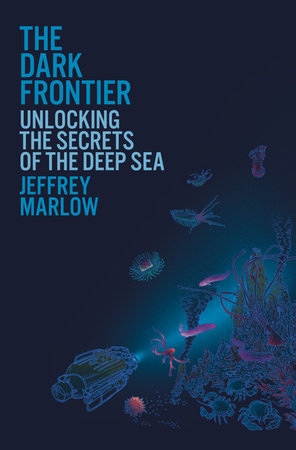
The Dark Frontier

Unlocking the Secrets of the Deep Sea

Listen to a clip from the audiobook
audio pause button
0:00
0:00
An awe-inspiring investigation into the hidden world of the deep sea—the most mysterious, unforgiving environment on Earth—whose secrets can radically revise our understanding of life itself and chart our planetary future.

“A brilliant scientist and storyteller, Jeffrey Marlow takes us on a page-turning descent into the deepest mysteries on the planet.”—Jack E. Davis, Pulitzer Prize–winning author of The Gulf: The Making of an American Sea


The deep sea is our planet’s last frontier. For most of human history, it was a vast, unknown realm that invoked awe and terror. And despite how much we’ve learned, it remains largely unexplored.

In The Dark Frontier, marine microbiologist and explorer Jeffrey Marlow offers a new perspective on the power and beauty of the deep sea, beginning with the nineteenth-century discovery that the ocean’s depths were teeming with life and shifting to more recent investigations of the kaleidoscopic ecology of hydrothermal vents, methane seeps, and whale falls. Marlow illuminates the ocean’s scientific marvels, including microbes that breathe metal and fish that withstand crushing pressures, as well as theories about how underwater habitats may have been the cradle of life on Earth. He reveals the deep sea’s microbial universes, worlds within worlds that have opened new possibilities of survival in extreme environments.

The Dark Frontier is an engaging narrative journey grounded in Marlow’s research and wide-ranging knowledge, together with insights from hundreds of experts, from deep-sea scientists to conservationists and UN diplomats. The book considers the twinned forces of exploration and exploitation, shining a light on deep-sea drilling and mining as well as the complexity of governing the high seas and their precious resources.

In this authoritative and accessible account of ocean exploration, Marlow captures the wonder and potential of the deep sea, teaching us lessons that help navigate the future—not just for the remarkable creatures that live there but for those of us on the surface as well.
1. Discovery

Sardinia: October 1860

In the autumn sunlight, the jagged coastline was a lavish display. Copper-tinged cliffs cascaded toward the sea, cross-stitched with fractures and painted with splotches of orange and yellow lichens. Over a dusty ridge, flamingos filled a brackish lagoon, deer cantered through the valley, and swarms of mosquitos clouded the sunset view. It was a stunning scene: the full splendor of the Mediterranean coast exposed, flaunting its beauty and raw vivacity. But just beyond the island’s gentle curves, stretching to the horizon, the dappled surface of the ocean grew harder to read—a world redacted, seemingly unknowable.

The British engineer Fleeming Jenkin was visiting Sardinia to explore those distant waters. Not to “explore,” perhaps—nothing quite so grandiose—but to study, understand, and ultimately tame. Somewhere out there, between this craggy island outpost and North Africa, a broken telegraph cable was resting on the seafloor. In order to restore communication between Europe and the French colony in Algeria, the cable needed to be raised from the seabed and, if possible, repaired.

As he boarded SS Elba to tackle the task, Jenkin strode with the purpose of a young man eager to make his mark on the world. He felt as if his twenty-seven years—an eventful run that included a childhood sketching ancient Scottish castles with his father, an adolescence dodging musket fire in revolutionary Paris, and an apprenticeship building engines in Manchester—had been a prelude to his next few weeks at sea. It was his second journey along the Sardinia–to–French Algeria route in the last three years—the telegraph cable was proving to be stubbornly problematic—but his first in command, a position he cottoned to quickly as he dispatched aides to fetch marmalade and make handwritten copies of his journal.

Elba’s mission was part of the telegraph cable bonanza of the mid-nineteenth century. The newly developed technology could send messages quickly over long distances by transmitting pulses of electricity through copper wires. Engineers, entrepreneurs, and politicians sought to scale the approach by encircling the globe with cables; for the first time, it was possible to communicate across long distances without physically transporting written messages between people.

The most prominent cable-laying effort was the ambitious plan to connect Europe and North America with a 3,200-kilometer-long cable that crossed the Atlantic Ocean. It was the moonshot of its day, a logistical and technological endeavor whose boldness so wildly surpassed previous projects as to seem impossible. Initial attempts in 1857 and early 1858 failed when the line repeatedly snapped and couldn’t be repaired. When a reliable version of the cable was finally completed in 1866, it was transformational: communication time between Europe and North America collapsed from the ten days required for a ship to cross the Atlantic to the several minutes needed for electrons to speed through copper wires beneath the sea. Cyrus West Field, the driving force behind the effort who co-founded the Atlantic Telegraph Company to fund the cable, held the lofty ambition that the project would “disarm all prejudice” and usher in a new era of world peace.

Why, then, was a mere two-hundred-kilometer-long cable in the Mediterranean proving so challenging? It was initially installed in 1857; by the next year, it needed servicing, and Jenkin was called in to do the job. Fifty kilometers of cable was replaced, and operation was restored. Now, in 1860, it had ceased transmission again, and Jenkin was growing frustrated. “Confound the cable, though! I shall never be able to repair it,” he wrote before setting off from Sardinia. The plan was to start from the African side, close to shore, and toss a grappling hook over the side of the ship. By scraping the hook along the seafloor—back and forth, until it seized—the team would be able to find the cable, but to test its electrical integrity, they needed to bring it on board. It was a delicate operation: if the cable had been cut nearby, it could quickly slide away, like a slippery strand of spaghetti on a fork.

Despite a range of logistical delays, the grappling hook worked, and the cable was secured on Elba’s deck. Jenkin and his team traced it northward, only to find a clean break a few kilometers offshore, which they attributed to overzealous fishermen whose trawl had snapped the cable. It was a harsh reminder of the challenges that come with deep-sea work, where unpredictable hazards like fishing, anchoring, or the long-term effects of the seafloor environment could, in an instant, bring an expensive multiyear effort to a grinding halt.

From the Italian side, the crew followed the same procedure, hooking the cable near shore and following it to deeper water. Jenkin watched as the line dragged along the deck. He was carefully attuned to the kink of the wire and the nature of the goopy sediment that coated the cable; he hoped to learn about the seafloor environment—and any obstacles it could present to telegraph operations—based on subtle contextual clues. He noticed corals, sponges, and other unknown creatures encrusting the cable’s outer steel wire; ever the scientist, he pried the animals loose and placed them in collection jars, recording exactly where on the cable each sample originated.

The presence of these organisms wasn’t so surprising—Jenkin had seen similar fauna several days earlier on the African side of the cable, and it didn’t seem to affect the transmission of an electrical signal. But he grew increasingly alarmed as they reached fifty and then sixty kilometers from shore, as the seafloor dropped sharply from a few hundred meters’ depth to more than 2,000 meters, and still, there were creatures firmly attached to the cable. Sixty-four kilometers from shore, floating 2,200 meters above the silty bottom, the line came to an abrupt, frayed end. Jenkin was no doubt dismayed by what this rupture meant for his team’s repair efforts, but such thoughts faded from his mind as he stared, transfixed, at the cable. There, undeniably bound to the wire, was a small coral whose sharp skeletal bristles projected outward from a central ring, surrounded by a gelatinous orange sheen.

The animal he was looking at wasn’t supposed to exist. It was well established that there was no life in the deep sea. The darkness was too absolute, the pressure too crushing, the food too scarce. Jenkin removed the final coral; fearing no one would believe his improbable story without evidence, he sent the full collection to a zoologist at the University of Edinburgh, sensing, perhaps, the rippling repercussions his discovery would have.

To understand the significance of Jenkin’s finding, we must appreciate the prevailing sense, at the time, that the deep sea was a barren, largely irrelevant wasteland. For centuries, open water was a barrier to be crossed, a threat to be minimized, and in many cultures, a boisterous spirit to be quelled with rituals and prayers. Reports from sailors and fishermen—no doubt rooted in some degree of truth—metastasized into tales of terrifying beasts and relentless storms that dominated the public’s perception of the sea. The prevailing belief that water got denser with depth implied that sinking objects would stop falling when their density matched that of a given water layer. One logical extension of this mistaken idea was the horrifying specter of a layer of corpses—victims of naval battles, mutinies, and shipwrecks past—suspended in salt water. Another was that flesh-and-blood organisms would be restricted to the shallow, low-density zones, and that life on the deep seabed was impossible.

Well into the nineteenth century, it wasn’t even entirely clear that the ocean had a bottom. “Navigators didn’t carry sounding lines longer than two hundred fathoms [~365 meters],” Helen Rozwadowski, a professor of history at the University of Connecticut, told me, “because if you weren’t on a continental shelf worried about running aground, then it didn’t matter how deep it was. Nobody thought of articulating that question.”

This particular stance was prescribed, of course, by the geography and culture of land-centered European societies. By contrast, the Tahitian navigator Tupaia displayed a more holistic relationship with the sea when he was seconded by Captain James Cook to guide HMS Endeavor through Polynesia in 1769. Having grown up among small islands scattered across the South Pacific, Tupaia knew “land” was the exception rather than the rule. He understood the archipelago as the uppermost fringe of a series of peaks and valleys whose full extent remained underwater, obscured but ever present.

Along the shores of West Africa, historian Kevin Dawson writes, precontact societies “wove terrestrial and aquatic experiences into amphibious lives, interlacing spiritual and secular beliefs, economies, social structures, and political institutions—their very way of life—around relationships with water.” Among the pearl divers of the Persian Gulf, as well as the female divers known in Japanese as ama and in Korean as haenyeo, traditions of free diving built an immersive familiarity with the sea’s third dimension in a way that net-casting fishing practices could not.
“A brilliant scientist and storyteller, Jeffrey Marlow takes us on a page-turning descent into the deepest mysteries on the planet, revealing a world as strange, beautiful, and edifying as it is essential to our uncertain future. Though witness to the farthest reach of our destructive ways, Marlow leaves us with words of hope.”—Jack E. Davis, Pulitzer Prize-winning author of The Gulf: The Making of an American Sea

“A fascinating, even moving, deep dive into the deepest of subjects. As Jeffery Marlow shows us, the ocean floor isn’t a bleak wasteland—it’s the largest part of our planet, teeming with life and with possibilities for a radically reimagined future. Marlow’s book shines a brilliant light on Earth’s crucial frontier.”—Jason Roberts, Pulitzer Prize-winning author of Every Living Thing and A Sense of the World

“Dr. Jeffrey Marlow gives readers a front-row seat and a backstage pass to the vanguard of deep-sea science, at a time when this research has never been more exciting or vital. The Dark Frontier is a meticulous, wide-ranging, and riveting book, and an essential addition to the ocean canon.”—Susan Casey, New York Times bestselling author of The Underworld: Journeys to the Depths of the Ocean

“This gripping trip to the bottom of the ocean doesn’t just explore many of the otherworldly mysteries lurking in a lightless universe;, it is an illuminating peek into something deeper yet - —the nature of life itself.”—Dan Egan, New York Times bestselling author of The Death and Life of the Great Lakes

“Jeffrey Marlow goes deep—really deep—beneath the sea to explore a world we can’t see and can barely imagine. The Dark Frontier is at once an adventure story, a tale of scientific discovery, and a plea for preserving one of the world’s most fascinating and fragile environments.”—Elizabeth Kolbert, Pulitzer Prize–winning author of The Sixth Extinction

“[A] moving debut exploration . . . Marlow’s fascination with underwater environments is palpable throughout, as he studies microbes that can exist by metabolizing methane, and discovers hidden ecosystems of strange fish, crustaceans, and worms . . . This is science writing at its finest.”Publishers Weekly, starred review

“An eloquent scientist’s rare view into deep-ocean expeditions . . . Few people have plumbed the mysteries of the deep sea like Marlow, a Boston University biologist. A gifted writer whose prose leaps off the page, he takes the reader along on varied expeditions to research, mine, and map biodiversity throughout his career . . . In his telling, even the most staid, diplomatic meetings are riveting. His tales lend context and continuity to a fragmented picture of the unseeable seas. . . . Marlow’s tales of seafloor mountain ranges and the characters he encounters are delightful and emotive . . . His science is injected with feeling and perspective . . . A romantic, illuminating dive into the deep sea and the controversies of exploiting it.”Kirkus Reviews, starred review
Dr. Jeffrey Marlow is a professor of biology at Boston University. He received his B.S. from Washington University in St. Louis, M.Phil. from Imperial College London, and Ph.D. from the California Institute of Technology. He has been named a National Geographic Emerging Explorer and is a Fellow of the Explorers Club and the Royal Geographical Society. His journalistic work has appeared in publications including The New York Times, The New Yorker, and Scientific American. He enjoys traveling, trail running, and nurturing his extensive collection of house plants. View titles by Jeffrey Marlow

About

An awe-inspiring investigation into the hidden world of the deep sea—the most mysterious, unforgiving environment on Earth—whose secrets can radically revise our understanding of life itself and chart our planetary future.

“A brilliant scientist and storyteller, Jeffrey Marlow takes us on a page-turning descent into the deepest mysteries on the planet.”—Jack E. Davis, Pulitzer Prize–winning author of The Gulf: The Making of an American Sea


The deep sea is our planet’s last frontier. For most of human history, it was a vast, unknown realm that invoked awe and terror. And despite how much we’ve learned, it remains largely unexplored.

In The Dark Frontier, marine microbiologist and explorer Jeffrey Marlow offers a new perspective on the power and beauty of the deep sea, beginning with the nineteenth-century discovery that the ocean’s depths were teeming with life and shifting to more recent investigations of the kaleidoscopic ecology of hydrothermal vents, methane seeps, and whale falls. Marlow illuminates the ocean’s scientific marvels, including microbes that breathe metal and fish that withstand crushing pressures, as well as theories about how underwater habitats may have been the cradle of life on Earth. He reveals the deep sea’s microbial universes, worlds within worlds that have opened new possibilities of survival in extreme environments.

The Dark Frontier is an engaging narrative journey grounded in Marlow’s research and wide-ranging knowledge, together with insights from hundreds of experts, from deep-sea scientists to conservationists and UN diplomats. The book considers the twinned forces of exploration and exploitation, shining a light on deep-sea drilling and mining as well as the complexity of governing the high seas and their precious resources.

In this authoritative and accessible account of ocean exploration, Marlow captures the wonder and potential of the deep sea, teaching us lessons that help navigate the future—not just for the remarkable creatures that live there but for those of us on the surface as well.

Excerpt

1. Discovery

Sardinia: October 1860

In the autumn sunlight, the jagged coastline was a lavish display. Copper-tinged cliffs cascaded toward the sea, cross-stitched with fractures and painted with splotches of orange and yellow lichens. Over a dusty ridge, flamingos filled a brackish lagoon, deer cantered through the valley, and swarms of mosquitos clouded the sunset view. It was a stunning scene: the full splendor of the Mediterranean coast exposed, flaunting its beauty and raw vivacity. But just beyond the island’s gentle curves, stretching to the horizon, the dappled surface of the ocean grew harder to read—a world redacted, seemingly unknowable.

The British engineer Fleeming Jenkin was visiting Sardinia to explore those distant waters. Not to “explore,” perhaps—nothing quite so grandiose—but to study, understand, and ultimately tame. Somewhere out there, between this craggy island outpost and North Africa, a broken telegraph cable was resting on the seafloor. In order to restore communication between Europe and the French colony in Algeria, the cable needed to be raised from the seabed and, if possible, repaired.

As he boarded SS Elba to tackle the task, Jenkin strode with the purpose of a young man eager to make his mark on the world. He felt as if his twenty-seven years—an eventful run that included a childhood sketching ancient Scottish castles with his father, an adolescence dodging musket fire in revolutionary Paris, and an apprenticeship building engines in Manchester—had been a prelude to his next few weeks at sea. It was his second journey along the Sardinia–to–French Algeria route in the last three years—the telegraph cable was proving to be stubbornly problematic—but his first in command, a position he cottoned to quickly as he dispatched aides to fetch marmalade and make handwritten copies of his journal.

Elba’s mission was part of the telegraph cable bonanza of the mid-nineteenth century. The newly developed technology could send messages quickly over long distances by transmitting pulses of electricity through copper wires. Engineers, entrepreneurs, and politicians sought to scale the approach by encircling the globe with cables; for the first time, it was possible to communicate across long distances without physically transporting written messages between people.

The most prominent cable-laying effort was the ambitious plan to connect Europe and North America with a 3,200-kilometer-long cable that crossed the Atlantic Ocean. It was the moonshot of its day, a logistical and technological endeavor whose boldness so wildly surpassed previous projects as to seem impossible. Initial attempts in 1857 and early 1858 failed when the line repeatedly snapped and couldn’t be repaired. When a reliable version of the cable was finally completed in 1866, it was transformational: communication time between Europe and North America collapsed from the ten days required for a ship to cross the Atlantic to the several minutes needed for electrons to speed through copper wires beneath the sea. Cyrus West Field, the driving force behind the effort who co-founded the Atlantic Telegraph Company to fund the cable, held the lofty ambition that the project would “disarm all prejudice” and usher in a new era of world peace.

Why, then, was a mere two-hundred-kilometer-long cable in the Mediterranean proving so challenging? It was initially installed in 1857; by the next year, it needed servicing, and Jenkin was called in to do the job. Fifty kilometers of cable was replaced, and operation was restored. Now, in 1860, it had ceased transmission again, and Jenkin was growing frustrated. “Confound the cable, though! I shall never be able to repair it,” he wrote before setting off from Sardinia. The plan was to start from the African side, close to shore, and toss a grappling hook over the side of the ship. By scraping the hook along the seafloor—back and forth, until it seized—the team would be able to find the cable, but to test its electrical integrity, they needed to bring it on board. It was a delicate operation: if the cable had been cut nearby, it could quickly slide away, like a slippery strand of spaghetti on a fork.

Despite a range of logistical delays, the grappling hook worked, and the cable was secured on Elba’s deck. Jenkin and his team traced it northward, only to find a clean break a few kilometers offshore, which they attributed to overzealous fishermen whose trawl had snapped the cable. It was a harsh reminder of the challenges that come with deep-sea work, where unpredictable hazards like fishing, anchoring, or the long-term effects of the seafloor environment could, in an instant, bring an expensive multiyear effort to a grinding halt.

From the Italian side, the crew followed the same procedure, hooking the cable near shore and following it to deeper water. Jenkin watched as the line dragged along the deck. He was carefully attuned to the kink of the wire and the nature of the goopy sediment that coated the cable; he hoped to learn about the seafloor environment—and any obstacles it could present to telegraph operations—based on subtle contextual clues. He noticed corals, sponges, and other unknown creatures encrusting the cable’s outer steel wire; ever the scientist, he pried the animals loose and placed them in collection jars, recording exactly where on the cable each sample originated.

The presence of these organisms wasn’t so surprising—Jenkin had seen similar fauna several days earlier on the African side of the cable, and it didn’t seem to affect the transmission of an electrical signal. But he grew increasingly alarmed as they reached fifty and then sixty kilometers from shore, as the seafloor dropped sharply from a few hundred meters’ depth to more than 2,000 meters, and still, there were creatures firmly attached to the cable. Sixty-four kilometers from shore, floating 2,200 meters above the silty bottom, the line came to an abrupt, frayed end. Jenkin was no doubt dismayed by what this rupture meant for his team’s repair efforts, but such thoughts faded from his mind as he stared, transfixed, at the cable. There, undeniably bound to the wire, was a small coral whose sharp skeletal bristles projected outward from a central ring, surrounded by a gelatinous orange sheen.

The animal he was looking at wasn’t supposed to exist. It was well established that there was no life in the deep sea. The darkness was too absolute, the pressure too crushing, the food too scarce. Jenkin removed the final coral; fearing no one would believe his improbable story without evidence, he sent the full collection to a zoologist at the University of Edinburgh, sensing, perhaps, the rippling repercussions his discovery would have.

To understand the significance of Jenkin’s finding, we must appreciate the prevailing sense, at the time, that the deep sea was a barren, largely irrelevant wasteland. For centuries, open water was a barrier to be crossed, a threat to be minimized, and in many cultures, a boisterous spirit to be quelled with rituals and prayers. Reports from sailors and fishermen—no doubt rooted in some degree of truth—metastasized into tales of terrifying beasts and relentless storms that dominated the public’s perception of the sea. The prevailing belief that water got denser with depth implied that sinking objects would stop falling when their density matched that of a given water layer. One logical extension of this mistaken idea was the horrifying specter of a layer of corpses—victims of naval battles, mutinies, and shipwrecks past—suspended in salt water. Another was that flesh-and-blood organisms would be restricted to the shallow, low-density zones, and that life on the deep seabed was impossible.

Well into the nineteenth century, it wasn’t even entirely clear that the ocean had a bottom. “Navigators didn’t carry sounding lines longer than two hundred fathoms [~365 meters],” Helen Rozwadowski, a professor of history at the University of Connecticut, told me, “because if you weren’t on a continental shelf worried about running aground, then it didn’t matter how deep it was. Nobody thought of articulating that question.”

This particular stance was prescribed, of course, by the geography and culture of land-centered European societies. By contrast, the Tahitian navigator Tupaia displayed a more holistic relationship with the sea when he was seconded by Captain James Cook to guide HMS Endeavor through Polynesia in 1769. Having grown up among small islands scattered across the South Pacific, Tupaia knew “land” was the exception rather than the rule. He understood the archipelago as the uppermost fringe of a series of peaks and valleys whose full extent remained underwater, obscured but ever present.

Along the shores of West Africa, historian Kevin Dawson writes, precontact societies “wove terrestrial and aquatic experiences into amphibious lives, interlacing spiritual and secular beliefs, economies, social structures, and political institutions—their very way of life—around relationships with water.” Among the pearl divers of the Persian Gulf, as well as the female divers known in Japanese as ama and in Korean as haenyeo, traditions of free diving built an immersive familiarity with the sea’s third dimension in a way that net-casting fishing practices could not.

Reviews

“A brilliant scientist and storyteller, Jeffrey Marlow takes us on a page-turning descent into the deepest mysteries on the planet, revealing a world as strange, beautiful, and edifying as it is essential to our uncertain future. Though witness to the farthest reach of our destructive ways, Marlow leaves us with words of hope.”—Jack E. Davis, Pulitzer Prize-winning author of The Gulf: The Making of an American Sea

“A fascinating, even moving, deep dive into the deepest of subjects. As Jeffery Marlow shows us, the ocean floor isn’t a bleak wasteland—it’s the largest part of our planet, teeming with life and with possibilities for a radically reimagined future. Marlow’s book shines a brilliant light on Earth’s crucial frontier.”—Jason Roberts, Pulitzer Prize-winning author of Every Living Thing and A Sense of the World

“Dr. Jeffrey Marlow gives readers a front-row seat and a backstage pass to the vanguard of deep-sea science, at a time when this research has never been more exciting or vital. The Dark Frontier is a meticulous, wide-ranging, and riveting book, and an essential addition to the ocean canon.”—Susan Casey, New York Times bestselling author of The Underworld: Journeys to the Depths of the Ocean

“This gripping trip to the bottom of the ocean doesn’t just explore many of the otherworldly mysteries lurking in a lightless universe;, it is an illuminating peek into something deeper yet - —the nature of life itself.”—Dan Egan, New York Times bestselling author of The Death and Life of the Great Lakes

“Jeffrey Marlow goes deep—really deep—beneath the sea to explore a world we can’t see and can barely imagine. The Dark Frontier is at once an adventure story, a tale of scientific discovery, and a plea for preserving one of the world’s most fascinating and fragile environments.”—Elizabeth Kolbert, Pulitzer Prize–winning author of The Sixth Extinction

“[A] moving debut exploration . . . Marlow’s fascination with underwater environments is palpable throughout, as he studies microbes that can exist by metabolizing methane, and discovers hidden ecosystems of strange fish, crustaceans, and worms . . . This is science writing at its finest.”Publishers Weekly, starred review

“An eloquent scientist’s rare view into deep-ocean expeditions . . . Few people have plumbed the mysteries of the deep sea like Marlow, a Boston University biologist. A gifted writer whose prose leaps off the page, he takes the reader along on varied expeditions to research, mine, and map biodiversity throughout his career . . . In his telling, even the most staid, diplomatic meetings are riveting. His tales lend context and continuity to a fragmented picture of the unseeable seas. . . . Marlow’s tales of seafloor mountain ranges and the characters he encounters are delightful and emotive . . . His science is injected with feeling and perspective . . . A romantic, illuminating dive into the deep sea and the controversies of exploiting it.”Kirkus Reviews, starred review

Author

Dr. Jeffrey Marlow is a professor of biology at Boston University. He received his B.S. from Washington University in St. Louis, M.Phil. from Imperial College London, and Ph.D. from the California Institute of Technology. He has been named a National Geographic Emerging Explorer and is a Fellow of the Explorers Club and the Royal Geographical Society. His journalistic work has appeared in publications including The New York Times, The New Yorker, and Scientific American. He enjoys traveling, trail running, and nurturing his extensive collection of house plants. View titles by Jeffrey Marlow
  • More Websites from
    Penguin Random House
  • Common Reads
  • Library Marketing