Download high-resolution image
Listen to a clip from the audiobook
audio pause button
0:00
0:00

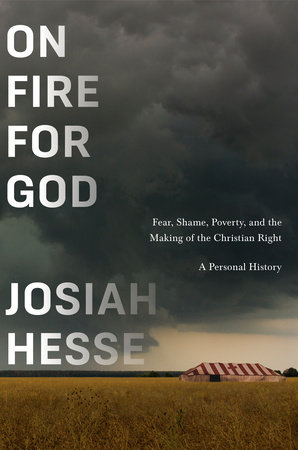
On Fire for God

Fear, Shame, Poverty, and the Making of the Christian Right - a Personal History

Author Josiah Hesse On Tour
Listen to a clip from the audiobook
audio pause button
0:00
0:00
One part Educated, one part rebuttal to Hillbilly Elegy, On Fire for God explores the ways evangelical Christianity has preyed upon its followers while galvanizing them into the political force known today as the Christian right.

“Of all the books I've read about young people devastated by the fundamentalist religion they've grown up with, this one stands out.”­— Frances FitzGerald, Pulitzer Prize-winning author of The Evangelicals


Exvangelical journalist Josiah Hesse grew up in the stifling working-class town of Mason City, Iowa, raised in the institutions of fundamentalist Christianity: a toxic mixture of schools, ministries, and religious camps that taught creationism, instilled sexual shame, and foretold horrific tales of the rapture. In the churches where he worshipped, pastors siphoned their flocks’ wealth while preaching a doctrine of prosperity. Meanwhile, as economic struggles grew in the community, Hesse's fellow believers lambasted organized labor and shunned the social safety net, becoming an army for God against the evils of progressivism. Only upon escaping Iowa in search of something more would he consider the possibility that the world wasn’t about to end and that he was woefully unprepared for a future he’d never believed would arrive.

Written in vivid prose, On Fire for God is both an unflinching memoir of religious trauma and survival and a stirring examination of the emotional, political, and sociological effects of the Christian right. Returning to his hometown in search of answers about his upbringing and the political forces at work in the region, Hesse calls into question prevailing theories about the disappearing working class that point to opioids, automation, or globalism as the culprits. His story of awakening and escape exposes how conservative Christian con men have, over generations, trapped working-class believers in an isolated bubble of racism, xenophobia, and self-imposed martyrdom, while stripping communities like his of their wealth and self-esteem. In On Fire for God, Hesse plumbs the depths of his own experience to illuminate, with deep feeling and piercing immediacy, what he describes as the socioeconomic tragedy of the American working class.
Chapter One

Turn and Face the Strange

2023

The right-­wing icon William F. Buckley once said, “A conservative is someone who stands athwart history, yelling Stop.”

Speaking as a liberal, I couldn’t agree more.

I’ve been in Iowa for about a week now, spending most of my time in the windowless archives-room at the Mason City Public Library, sporting a jeweler’s magnifying headband to read stacks of yellowing newspaper clippings. After the years I’ve spent reporting on the machinations of the Christian right today, it’s easy to see the old adage “There is nothing new under the sun” come to life in the history of North Iowa.

Again and again, with every new advancement in society—­be it technology, culture, science, geopolitics, or the empowerment of a repressed minority—­there has always been some conservative organization yelling “Stop!”

It’s a gorgeous summer afternoon, and I’ve taken a break from the library archives to ride my bike through downtown Mason City, which has retained its early-­twentieth-­century, Music Man-­era charm, with antique lampposts, footbridges, and several homes and a hotel designed by Frank Lloyd Wright. After riding past a bank once robbed by John Dillinger, I turn onto Federal Avenue, a street that in 1925 hosted a parade of six hundred robed members of the Ku Klux Klan—­led by the city commissioner—­who were headed toward the “immigrant ghettos” on the north end of town.

The Klan visited Mason City regularly throughout the 1920s, hosting Fourth of July carnivals at the local fairgrounds, with clowns, contortionists, fireworks, a high-­wire act, and a “Klan baby contest.”

Of all the changes conservatives have been fighting against throughout American history, threats to the exclusive power of rich white Protestant men has been the most consistent. The Klan members of the 1920s were much more media-­savvy than their nineteenth-­century forebears, attacking jazz music, drug dealers, and women in makeup as threats to “Christian, family values” and “Americanism.” Like the Klan before and after, they fought for white supremacy, though they packaged their message a bit more tactfully, recruiting not just racists but anyone concerned with the moral direction of the country when it came to booze, dancing, sexuality, and the secularizing of public schools.

Mason City was experiencing an economic boom at this time. Cement plants on the north end of town were outperforming any in the world, and the demand for labor was drawing thousands of Black Americans from the South, as well as immigrants from Mexico, Ireland, Greece, and as far away as India and Iceland, all of whom had set up their own little communities on the north end of town.

Just as Donald Trump would a century later, the Klan recruiters—­dispatched to the Midwest to sniff out problems and offer themselves as a solution—­convinced white laborers that these immigrants were a threat to their livelihood (and their women).

River City ain’t in any trouble.
Then we’ll have to create some.

Like Trump, they would tap into a nostalgia for the wholesomeness of the past, using the song “Old Time Religion” as their rallying cry. And, like Trump, they tapped into the ubiquitous fear of humiliation among working-­class white men, who are so easily manipulated by the phrase “They’re laughing at us.”

In 1925, the biggest threat to the pride of white Christian nationalism was evolution.

The state of Tennessee had just enacted a ban against both the teaching of Darwin’s theory and the disparagement of creationism in public schools, leading to one of America’s most heavily publicized trials when the high-­school science teacher John Scopes found himself jailed for his lesson plan. Journalists swarmed the city of Dayton, mocking the prosecution for claiming that the book of Genesis was a literal, scientific account of the Earth’s creation. The newspapers branded it “The Scopes Monkey Trial”: Time magazine called it “a cross between a circus and a holy war.” Radio broadcasters cracked jokes, cartoonists mocked fundamentalists, and a trained monkey was set on the courthouse lawn to dance. The journalist H. L. Mencken was perhaps the most overtly cruel, calling defenders of the law “morons,” “yokels,” “primates,” and “hillbillies.”

These widely publicized attacks against rural Christians by liberal, atheist intellectuals from the big city were a neatly wrapped gift to Klansmen seeking recruits in the Midwest. They joined forces with prominent evangelists like Billy Sunday and Bob Jones, Sr., in decrying evolution as an existential threat to American morality.

A backlash ensued against the media, intellectuals, and the ACLU for providing Scopes’s attorney, Clarence Darrow. They all became iconic villains in the eyes of evangelicals, and the backlash led to greater church attendance for the evangelists and more recruits for the KKK. As with Harold Hill’s band uniforms, the Klan charged each new member sixteen dollars for a robe and a hood, giving the organization millions in revenue.

According to newspaper reports of the Klan’s Mason City rallies, recruits were called to be “living sacrifices to God” in their efforts to protect white Christian power; to sing “Onward, Christian Soldiers” as they marched into the streets; set up burning crosses on lawns; harass Black-owned businesses; set off bombs; and kidnap the socialist speaker Ida Crouch-­Hazlett, who was in town attempting to unionize workers on the north end.

As I’m riding my bike through Mason City in 2023, my heart breaks for the immigrants terrorized by the Klan in the name of Jesus. At the same time, I am filled with rage when I think of all the young men manipulated by the KKK into believing it was their Christian duty to don those white robes. Just as my heart breaks for the young men today whose low wages, mental­health issues, and bleak prospects have been exploited by Trump’s MAGA movement to push them into harassing trans people or Black Lives Matter protesters.

And as I ride my bike up to a small, abandoned TV station in downtown Mason City, my mind takes me to the 2000 presidential election, back when I was one of these reactionary young men.

The logo for KIMT News 3 still hangs above the doors of this single-­story building, even though the TV station moved to Rochester several years ago. I was a camera operator for the KIMT studio in the fall of 2000 (one of forty-­five low-­wage jobs I held in my teens and twenties), and just before showing up for work, I’d voted in my first presidential election—­for George W. Bush. Standing on the sidewalk today, I can easily recall my feeling of righteous arrogance when I stood in the KIMT studio that election night, viewing my ballot for Bush as an exercise of my Christian faith, protecting America from the threat of sex-­crazed liberals like Bill Clinton (whose vice-­president, Al Gore, was actually the Democratic candidate, but our ire was for Slick Willy).

During his presidency, Bush would put a halt on stem-­cell research, attempt to get creationism taught in public schools, inadvertently launch a holy war against Muslims, and convince America that gay marriage was an existential threat to Christianity.

There is nothing new under the sun.

As I will many times during the course of researching this book, I mourn the loss of my youth, spent as a political soldier awaiting the coming wars of the Apocalypse, manipulated by those who taught me to fear science, art, my own body, and anyone who didn’t fit the mold of the white Protestant American, never realizing I was a disposable pawn in someone else’s game.

I’ve ridden my bike to this former TV studio not to indulge in self-­pity, however, but because, in the course of my research today, I discovered a fascinating story behind the construction of this building eighty-­five years ago, a tale of Music Man grifts tapping into the existential anxieties of small-­town puritans to pick their meager pockets.

It was built as a church.

Not a Catholic or mainline Protestant church, but a precursor to the evangelical megachurch, a nondenominational tourist attraction with breathtaking showmanship, state-­of-­the-­art technology, and modern interior design. Though it may seem contradictory, conservative hucksters are just as likely to manipulate their flocks with the fear of falling behind in the modern world—­to be dismissed as hillbillies or rednecks—­as they are to prey on their fears of change.

Either way, they utilize the dread of humiliation.

The hypervigilance to combat change, or stay ahead of it.

And, just like the Klan or Professor Harold Hill, the traveling preacher behind this church rolled into Mason City with a message of fear and the promise of salvation, then parasitically drained this boom town of its economic momentum, stuffed his pockets with all he could carry, and headed off into the sunset.

1937

“The signs are everywhere, the day of the Lord is upon us!” Doctor of Divinity Burroughs Waltrip shouted to a packed crowd of Iowans at his tent revival, sweat dripping from his forehead as he brandished a worn Bible high in the air. “And how will you, good people of Mason City, greet the Lord on the day of his return? Will you be a sheep in his flock, or a goat from Hell?!”

“Amen!” replied one farmer.

“Preach it!” exclaimed another.

It was a sweltering August night under this white canvas tent. Crickets and cicadas harmonized in the dewy fields surrounding them, as fireflies lazily breathed their fluorescent glow in and out. The people crowded together on wooden benches under a string of lights, fanning themselves with the End Is Near! pamphlets they’d been handed when they walked in. The recently paved streets of Mason City had been getting busier every year, as the town began its journey from a quiet outpost for farmers to an urban destination. As the Great Depression gutted agriculture, downtown Mason City diversified its economy, drawing influence from the nearby metropolises of Chicago and Minneapolis, with jazz concerts, movie houses, bootleggers, theaters, and motels that rented by the hour. The Mason City resident Orville K. Snav was a pioneer of conceptual art, selling novelty products with no purpose beyond the satirical humor of their marketing (a precursor to postmodern consumerism like the “Pet Rock”). In 1935, the drag queen Miss Tillie Yensen was a downtown celebrity, getting paid to show up at parties and take pictures with local politicians (seventy years before Paris Hilton made a career of it).

Plenty of newcomers loved the hedonism that came with their new jobs at the quarries, while just as many farmers (a lot of them descendants of pioneers) resented the indecency and intellectualism that came with this economic boon.

The typically raucous downtown was conspicuously quiet that night, as all the energy of the city was drawn toward the tent revival that had been gaining steam all summer. Two good-­looking young preachers had been shaking hands on the street corners all afternoon, promising faith healings and the light heart of a child to all who attended their services that night.

A flop of hair swung back and forth across Waltrip’s sweaty brow like the pendulum of a clock as he proclaimed, “The agents of Satan are among us! One of the Devil’s most effective ways of dealing with Christians is to use the shadow of doubt like a cloak to hide the wondrous jewels of God’s mercy! That’s the aim of the intellectuals, to hide God’s miracles behind a shadow of science!”

Behind Waltrip sat a captivating woman in a long white dress. Her hands rested primly across her lap, and her posture was tall, her down-­home smile nurturing, yet Kathryn Kuhlman nonetheless radiated a primal magnetism that was slowly driving the crowd into a frenzy before she even said a word.

When Burroughs Waltrip suddenly broke into song—­“Onward, Christian soldiers, marching as to war!”—­this tent-­full of typically stoic Midwesterners marched in place with comic abandon, swaying from side to side as they sang along loudly enough to be heard in the cornfields. With each stomp of Waltrip’s foot, each seductive pronunciation of the words “Sanctified!” “Purified!” and “Come into me, Jesus!,” they raised their hands, closed their eyes, and shouted, “Yes Lord!” “I am yours!” “Forgive my disobedience!”

Shooting an index finger at the crowd, the preacher warned, “Theology won’t save you! Science won’t save you! Only the redeeming blood of Jesus can cleanse the filth of sin!”

Though I can’t be sure that my great-­grandparents attended Waltrip’s services, I do know that all branches of my family tree in the 1930s attended such tent revivals when they came through town. And I also know—­thanks to their writings and conversations I’ve had with those who knew them—­that my maternal great-­grandparents, Nora and Oskar, and my paternal great-grandparents, Giles and Rose, would have held opposing views of Burroughs Waltrip and Kathryn Kuhlman.

Nora and Oskar were quiet, hardworking Methodists who supported FDR’s New Deal and pushed their children to work as hard at school as they did on the family farm. They were as prudent with their faith as with their finances, and wouldn’t be easily seduced by the histrionics of Burroughs Waltrip—­particularly his attacks on education.

Universities were a common whipping boy for preachers like Waltrip.
“Hesse is a wonderful writer, who narrates his own life with wit, intelligence, and sophistication, making what could have been an almost unbearable story something exceptional. Of all the books I've read about young people devastated by the fundamentalist religion they've grown up with, this one stands out.”­— Frances FitzGerald, Pulitzer Prize-winning author of The Evangelicals: The Struggle to Shape America

On Fire for God is both a survival story and a cultural history, charting how the rise of Christian fundamentalism ignited a culture war that bound church to state. With vivid storytelling, Hesse shows how leaders exploited parents’ deepest desires, ensnared a generation, and reshaped America’s political landscape.”—Stephanie Warren, The Strong-Willed Child and host of Focus on Your Own Family

“Hesse brings a sharp cultural eye and serious journalistic chops to the telling of his heart-breaking personal story. He logs decades of political, corporate, and religious exploitation of rural communities like his own, and reveals the poverty, isolation, trauma, and aggression it breeds. Brutal, punishing, and profound.”­—Linda Kay Klein, author of Pure

“There is no book in print that I know of with the exception of Atwood's The Handmaid's Tale that so completely captures the utter depravity of the Charismatic and Pentecostal movements’ impact on ordinary Americans. But the Republic of Gilead that Atwood invented is nothing compared to the brutal reality Hesse exposes. We are living in a world shaped by voters who are themselves shaped by the apocalyptic theology and culture he lived through and documents, chapter and verse.”— Frank Schaeffer, author of Crazy for God

“Eye-opening. . . . Evocative. . . . Readers who’ve wrestled with their faith or finding home will find this inspiring.”Publishers Weekly

“Might be thought of as the antidote to J.D. Vance’s Hillbilly Elegy. . . . Worthy of attention for its personal view of an ‘American theocracy’ in the making.”—Kirkus

“An introspective memoir of a religious life. Recommended for readers interested in the impact of the religious right.”Library Journal
© Glenn Ross
JOSIAH HESSE, author of Runner’s High and the Carnality series, is a freelance journalist out of Denver, Colorado, covering everything from politics, science, and crime, to art, pop culture, and evangelical culture and theology. A regular contributor to The Guardian and Vice, his work has appeared in Esquire, Newsweek, Men's Health, and Politico, among other publications. View titles by Josiah Hesse

About

One part Educated, one part rebuttal to Hillbilly Elegy, On Fire for God explores the ways evangelical Christianity has preyed upon its followers while galvanizing them into the political force known today as the Christian right.

“Of all the books I've read about young people devastated by the fundamentalist religion they've grown up with, this one stands out.”­— Frances FitzGerald, Pulitzer Prize-winning author of The Evangelicals


Exvangelical journalist Josiah Hesse grew up in the stifling working-class town of Mason City, Iowa, raised in the institutions of fundamentalist Christianity: a toxic mixture of schools, ministries, and religious camps that taught creationism, instilled sexual shame, and foretold horrific tales of the rapture. In the churches where he worshipped, pastors siphoned their flocks’ wealth while preaching a doctrine of prosperity. Meanwhile, as economic struggles grew in the community, Hesse's fellow believers lambasted organized labor and shunned the social safety net, becoming an army for God against the evils of progressivism. Only upon escaping Iowa in search of something more would he consider the possibility that the world wasn’t about to end and that he was woefully unprepared for a future he’d never believed would arrive.

Written in vivid prose, On Fire for God is both an unflinching memoir of religious trauma and survival and a stirring examination of the emotional, political, and sociological effects of the Christian right. Returning to his hometown in search of answers about his upbringing and the political forces at work in the region, Hesse calls into question prevailing theories about the disappearing working class that point to opioids, automation, or globalism as the culprits. His story of awakening and escape exposes how conservative Christian con men have, over generations, trapped working-class believers in an isolated bubble of racism, xenophobia, and self-imposed martyrdom, while stripping communities like his of their wealth and self-esteem. In On Fire for God, Hesse plumbs the depths of his own experience to illuminate, with deep feeling and piercing immediacy, what he describes as the socioeconomic tragedy of the American working class.

Excerpt

Chapter One

Turn and Face the Strange

2023

The right-­wing icon William F. Buckley once said, “A conservative is someone who stands athwart history, yelling Stop.”

Speaking as a liberal, I couldn’t agree more.

I’ve been in Iowa for about a week now, spending most of my time in the windowless archives-room at the Mason City Public Library, sporting a jeweler’s magnifying headband to read stacks of yellowing newspaper clippings. After the years I’ve spent reporting on the machinations of the Christian right today, it’s easy to see the old adage “There is nothing new under the sun” come to life in the history of North Iowa.

Again and again, with every new advancement in society—­be it technology, culture, science, geopolitics, or the empowerment of a repressed minority—­there has always been some conservative organization yelling “Stop!”

It’s a gorgeous summer afternoon, and I’ve taken a break from the library archives to ride my bike through downtown Mason City, which has retained its early-­twentieth-­century, Music Man-­era charm, with antique lampposts, footbridges, and several homes and a hotel designed by Frank Lloyd Wright. After riding past a bank once robbed by John Dillinger, I turn onto Federal Avenue, a street that in 1925 hosted a parade of six hundred robed members of the Ku Klux Klan—­led by the city commissioner—­who were headed toward the “immigrant ghettos” on the north end of town.

The Klan visited Mason City regularly throughout the 1920s, hosting Fourth of July carnivals at the local fairgrounds, with clowns, contortionists, fireworks, a high-­wire act, and a “Klan baby contest.”

Of all the changes conservatives have been fighting against throughout American history, threats to the exclusive power of rich white Protestant men has been the most consistent. The Klan members of the 1920s were much more media-­savvy than their nineteenth-­century forebears, attacking jazz music, drug dealers, and women in makeup as threats to “Christian, family values” and “Americanism.” Like the Klan before and after, they fought for white supremacy, though they packaged their message a bit more tactfully, recruiting not just racists but anyone concerned with the moral direction of the country when it came to booze, dancing, sexuality, and the secularizing of public schools.

Mason City was experiencing an economic boom at this time. Cement plants on the north end of town were outperforming any in the world, and the demand for labor was drawing thousands of Black Americans from the South, as well as immigrants from Mexico, Ireland, Greece, and as far away as India and Iceland, all of whom had set up their own little communities on the north end of town.

Just as Donald Trump would a century later, the Klan recruiters—­dispatched to the Midwest to sniff out problems and offer themselves as a solution—­convinced white laborers that these immigrants were a threat to their livelihood (and their women).

River City ain’t in any trouble.
Then we’ll have to create some.

Like Trump, they would tap into a nostalgia for the wholesomeness of the past, using the song “Old Time Religion” as their rallying cry. And, like Trump, they tapped into the ubiquitous fear of humiliation among working-­class white men, who are so easily manipulated by the phrase “They’re laughing at us.”

In 1925, the biggest threat to the pride of white Christian nationalism was evolution.

The state of Tennessee had just enacted a ban against both the teaching of Darwin’s theory and the disparagement of creationism in public schools, leading to one of America’s most heavily publicized trials when the high-­school science teacher John Scopes found himself jailed for his lesson plan. Journalists swarmed the city of Dayton, mocking the prosecution for claiming that the book of Genesis was a literal, scientific account of the Earth’s creation. The newspapers branded it “The Scopes Monkey Trial”: Time magazine called it “a cross between a circus and a holy war.” Radio broadcasters cracked jokes, cartoonists mocked fundamentalists, and a trained monkey was set on the courthouse lawn to dance. The journalist H. L. Mencken was perhaps the most overtly cruel, calling defenders of the law “morons,” “yokels,” “primates,” and “hillbillies.”

These widely publicized attacks against rural Christians by liberal, atheist intellectuals from the big city were a neatly wrapped gift to Klansmen seeking recruits in the Midwest. They joined forces with prominent evangelists like Billy Sunday and Bob Jones, Sr., in decrying evolution as an existential threat to American morality.

A backlash ensued against the media, intellectuals, and the ACLU for providing Scopes’s attorney, Clarence Darrow. They all became iconic villains in the eyes of evangelicals, and the backlash led to greater church attendance for the evangelists and more recruits for the KKK. As with Harold Hill’s band uniforms, the Klan charged each new member sixteen dollars for a robe and a hood, giving the organization millions in revenue.

According to newspaper reports of the Klan’s Mason City rallies, recruits were called to be “living sacrifices to God” in their efforts to protect white Christian power; to sing “Onward, Christian Soldiers” as they marched into the streets; set up burning crosses on lawns; harass Black-owned businesses; set off bombs; and kidnap the socialist speaker Ida Crouch-­Hazlett, who was in town attempting to unionize workers on the north end.

As I’m riding my bike through Mason City in 2023, my heart breaks for the immigrants terrorized by the Klan in the name of Jesus. At the same time, I am filled with rage when I think of all the young men manipulated by the KKK into believing it was their Christian duty to don those white robes. Just as my heart breaks for the young men today whose low wages, mental­health issues, and bleak prospects have been exploited by Trump’s MAGA movement to push them into harassing trans people or Black Lives Matter protesters.

And as I ride my bike up to a small, abandoned TV station in downtown Mason City, my mind takes me to the 2000 presidential election, back when I was one of these reactionary young men.

The logo for KIMT News 3 still hangs above the doors of this single-­story building, even though the TV station moved to Rochester several years ago. I was a camera operator for the KIMT studio in the fall of 2000 (one of forty-­five low-­wage jobs I held in my teens and twenties), and just before showing up for work, I’d voted in my first presidential election—­for George W. Bush. Standing on the sidewalk today, I can easily recall my feeling of righteous arrogance when I stood in the KIMT studio that election night, viewing my ballot for Bush as an exercise of my Christian faith, protecting America from the threat of sex-­crazed liberals like Bill Clinton (whose vice-­president, Al Gore, was actually the Democratic candidate, but our ire was for Slick Willy).

During his presidency, Bush would put a halt on stem-­cell research, attempt to get creationism taught in public schools, inadvertently launch a holy war against Muslims, and convince America that gay marriage was an existential threat to Christianity.

There is nothing new under the sun.

As I will many times during the course of researching this book, I mourn the loss of my youth, spent as a political soldier awaiting the coming wars of the Apocalypse, manipulated by those who taught me to fear science, art, my own body, and anyone who didn’t fit the mold of the white Protestant American, never realizing I was a disposable pawn in someone else’s game.

I’ve ridden my bike to this former TV studio not to indulge in self-­pity, however, but because, in the course of my research today, I discovered a fascinating story behind the construction of this building eighty-­five years ago, a tale of Music Man grifts tapping into the existential anxieties of small-­town puritans to pick their meager pockets.

It was built as a church.

Not a Catholic or mainline Protestant church, but a precursor to the evangelical megachurch, a nondenominational tourist attraction with breathtaking showmanship, state-­of-­the-­art technology, and modern interior design. Though it may seem contradictory, conservative hucksters are just as likely to manipulate their flocks with the fear of falling behind in the modern world—­to be dismissed as hillbillies or rednecks—­as they are to prey on their fears of change.

Either way, they utilize the dread of humiliation.

The hypervigilance to combat change, or stay ahead of it.

And, just like the Klan or Professor Harold Hill, the traveling preacher behind this church rolled into Mason City with a message of fear and the promise of salvation, then parasitically drained this boom town of its economic momentum, stuffed his pockets with all he could carry, and headed off into the sunset.

1937

“The signs are everywhere, the day of the Lord is upon us!” Doctor of Divinity Burroughs Waltrip shouted to a packed crowd of Iowans at his tent revival, sweat dripping from his forehead as he brandished a worn Bible high in the air. “And how will you, good people of Mason City, greet the Lord on the day of his return? Will you be a sheep in his flock, or a goat from Hell?!”

“Amen!” replied one farmer.

“Preach it!” exclaimed another.

It was a sweltering August night under this white canvas tent. Crickets and cicadas harmonized in the dewy fields surrounding them, as fireflies lazily breathed their fluorescent glow in and out. The people crowded together on wooden benches under a string of lights, fanning themselves with the End Is Near! pamphlets they’d been handed when they walked in. The recently paved streets of Mason City had been getting busier every year, as the town began its journey from a quiet outpost for farmers to an urban destination. As the Great Depression gutted agriculture, downtown Mason City diversified its economy, drawing influence from the nearby metropolises of Chicago and Minneapolis, with jazz concerts, movie houses, bootleggers, theaters, and motels that rented by the hour. The Mason City resident Orville K. Snav was a pioneer of conceptual art, selling novelty products with no purpose beyond the satirical humor of their marketing (a precursor to postmodern consumerism like the “Pet Rock”). In 1935, the drag queen Miss Tillie Yensen was a downtown celebrity, getting paid to show up at parties and take pictures with local politicians (seventy years before Paris Hilton made a career of it).

Plenty of newcomers loved the hedonism that came with their new jobs at the quarries, while just as many farmers (a lot of them descendants of pioneers) resented the indecency and intellectualism that came with this economic boon.

The typically raucous downtown was conspicuously quiet that night, as all the energy of the city was drawn toward the tent revival that had been gaining steam all summer. Two good-­looking young preachers had been shaking hands on the street corners all afternoon, promising faith healings and the light heart of a child to all who attended their services that night.

A flop of hair swung back and forth across Waltrip’s sweaty brow like the pendulum of a clock as he proclaimed, “The agents of Satan are among us! One of the Devil’s most effective ways of dealing with Christians is to use the shadow of doubt like a cloak to hide the wondrous jewels of God’s mercy! That’s the aim of the intellectuals, to hide God’s miracles behind a shadow of science!”

Behind Waltrip sat a captivating woman in a long white dress. Her hands rested primly across her lap, and her posture was tall, her down-­home smile nurturing, yet Kathryn Kuhlman nonetheless radiated a primal magnetism that was slowly driving the crowd into a frenzy before she even said a word.

When Burroughs Waltrip suddenly broke into song—­“Onward, Christian soldiers, marching as to war!”—­this tent-­full of typically stoic Midwesterners marched in place with comic abandon, swaying from side to side as they sang along loudly enough to be heard in the cornfields. With each stomp of Waltrip’s foot, each seductive pronunciation of the words “Sanctified!” “Purified!” and “Come into me, Jesus!,” they raised their hands, closed their eyes, and shouted, “Yes Lord!” “I am yours!” “Forgive my disobedience!”

Shooting an index finger at the crowd, the preacher warned, “Theology won’t save you! Science won’t save you! Only the redeeming blood of Jesus can cleanse the filth of sin!”

Though I can’t be sure that my great-­grandparents attended Waltrip’s services, I do know that all branches of my family tree in the 1930s attended such tent revivals when they came through town. And I also know—­thanks to their writings and conversations I’ve had with those who knew them—­that my maternal great-­grandparents, Nora and Oskar, and my paternal great-grandparents, Giles and Rose, would have held opposing views of Burroughs Waltrip and Kathryn Kuhlman.

Nora and Oskar were quiet, hardworking Methodists who supported FDR’s New Deal and pushed their children to work as hard at school as they did on the family farm. They were as prudent with their faith as with their finances, and wouldn’t be easily seduced by the histrionics of Burroughs Waltrip—­particularly his attacks on education.

Universities were a common whipping boy for preachers like Waltrip.

Reviews

“Hesse is a wonderful writer, who narrates his own life with wit, intelligence, and sophistication, making what could have been an almost unbearable story something exceptional. Of all the books I've read about young people devastated by the fundamentalist religion they've grown up with, this one stands out.”­— Frances FitzGerald, Pulitzer Prize-winning author of The Evangelicals: The Struggle to Shape America

On Fire for God is both a survival story and a cultural history, charting how the rise of Christian fundamentalism ignited a culture war that bound church to state. With vivid storytelling, Hesse shows how leaders exploited parents’ deepest desires, ensnared a generation, and reshaped America’s political landscape.”—Stephanie Warren, The Strong-Willed Child and host of Focus on Your Own Family

“Hesse brings a sharp cultural eye and serious journalistic chops to the telling of his heart-breaking personal story. He logs decades of political, corporate, and religious exploitation of rural communities like his own, and reveals the poverty, isolation, trauma, and aggression it breeds. Brutal, punishing, and profound.”­—Linda Kay Klein, author of Pure

“There is no book in print that I know of with the exception of Atwood's The Handmaid's Tale that so completely captures the utter depravity of the Charismatic and Pentecostal movements’ impact on ordinary Americans. But the Republic of Gilead that Atwood invented is nothing compared to the brutal reality Hesse exposes. We are living in a world shaped by voters who are themselves shaped by the apocalyptic theology and culture he lived through and documents, chapter and verse.”— Frank Schaeffer, author of Crazy for God

“Eye-opening. . . . Evocative. . . . Readers who’ve wrestled with their faith or finding home will find this inspiring.”Publishers Weekly

“Might be thought of as the antidote to J.D. Vance’s Hillbilly Elegy. . . . Worthy of attention for its personal view of an ‘American theocracy’ in the making.”—Kirkus

“An introspective memoir of a religious life. Recommended for readers interested in the impact of the religious right.”Library Journal

Author

© Glenn Ross
JOSIAH HESSE, author of Runner’s High and the Carnality series, is a freelance journalist out of Denver, Colorado, covering everything from politics, science, and crime, to art, pop culture, and evangelical culture and theology. A regular contributor to The Guardian and Vice, his work has appeared in Esquire, Newsweek, Men's Health, and Politico, among other publications. View titles by Josiah Hesse
  • More Websites from
    Penguin Random House
  • Common Reads
  • Library Marketing