Download high-resolution image Look inside
Listen to a clip from the audiobook
audio pause button
0:00
0:00

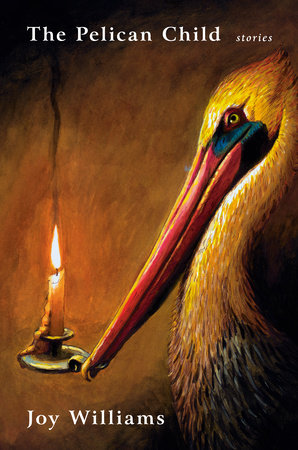
The Pelican Child

Stories

Look inside
Listen to a clip from the audiobook
audio pause button
0:00
0:00
Hardcover
$27.00 US
| $37.00 CAN
On sale Nov 18, 2025 | 176 Pages | 9780525657583

See Additional Formats
LONGLISTED FOR THE NATIONAL BOOK AWARD • FINALIST FOR THE PEN/JEAN STEIN BOOK AWARD • LONGLISTED FOR THE STORY PRIZE • NAMED A NOTABLE BOOK OF THE YEAR BY THE WASHINGTON POST • A razor-sharp new collection of stories of visionary childhood misfits and struggling adult dreamers from this legendary writer of “perfectly indescribable fiction . . . To read Williams is to look into the abyss” (The Atlantic).

“An American master is back with crystalline stories that map the personal and political minefields of her unmoored characters. Williams blends everyday dramas with surreal imagery, her voice and range inspiring awe.” —Boston Globe


“Night was best, for, as everyone knows but does not tell, the sobbing of the earth is most audible at night.” “Men are but unconscious machines and they perform their cruelties so effortlessly.” “Caring was a power she’d once possessed but had given up freely.” The sentences of Joy Williams are like no others—the coiled wit, the sense of a confused and ruined landscape, even the slight whisper of hope that lurks between the words—for the scrupulous effort of telling, in these stories, has a ravishing beauty that belies their subjects. We meet lost souls such as the twin sister heiresses of a dirty industrial fortune in “After the Haiku Period,” who must commit a violent act in recompense for their family’s deeds; in “Nettle,” we encounter a newly grown man who still revolves in a dreamscape of his childhood boarding-school innocence; and in the final story, we learn of the “pelican child” who lives with the “bony, ill-tempered” Baba Iaga “in a little hut on chicken legs.”

All of these characters insist on exploring an indifferent and caustic world. They struggle against our degradation of the climate and of each other, possibly in vain. But each brief, haunted triumph of understanding is celebrated by Williams, a writer for our time and all time.
Flour

The driver and I got a late start. I usually decide on these excursions the night before, but it was late in the morning when I informed the friend who was coming to visit me for the weekend that I had to cancel, it was absolutely necessary for me to cancel. I had got it in my head that in her presence some calamity or another would arise and she would have to assist me in some way, rush me to a physician or something. She would be grateful she was there for me perhaps, but I would find it a terrific annoyance and embarrassment. I gave some other excuse for the disinvitation of course. Pipes. I think it was broken pipes. I should have written it down so I don’t use it again.

I cleaned the house, which was very much in need of cleaning, for I had been putting it off. Still, my commitment was not great and I neglected the windows as usual. The dogs had pressed against them day and night for years. Their breaths are etched in the glass now, very lightly etched.

By departing so late, we could not make our customary first stop. The driver and I usually spend two nights in lodgings on our route. This time three nights would be necessary. We take separate rooms, of course. If by chance we should come across one another in the restaurant or the hallways, we offer no acknowledgment.

The car is a big one, encompassing three rows, three tiers behind the driver. It amuses me to think of them as the celestial, the terrestrial, and the chthonic. In fact, I quite believe that all things—every moment, every vision, every departure and arrival—possess the celestial, the terrestrial, and the chthonic.

The dogs had pretty much stayed in the terrestrial section where their beds were, as well as a few empty plastic bottles. They liked to play with them, make them crackle and clatter. Sometimes I ride in the chthonic with the luggage, the boots and coats, the boxes of fruit and gin and books. It smells strangely good back there, coolly hopeful and warmly worn at once. But usually I stretch out in the seat behind the driver and watch the landscape change as we rise from the desert floor.

Shockingly, it is almost two o’clock in the afternoon. We will not get far today!

When the driver and I first met—when I was interviewing him, you might say—he told me that he was studying Coptic.

Naturally, I did not believe this for one moment.

Without any encouragement from me he said, “The verb forms and tenses of Coptic are interesting. For example, some tenses that we English speakers do not have are the circumstantial, the habitual, the third future, the fourth future, the optative, and tenses of unfulfilled action signifying until and not yet. I am working now on translating and interpreting the story about the woman carrying flour to her home in a jar that is broken.”

“The flour all pours out?” I said.

“Why yes.” He seemed pleased.

Everyone knows the story of the woman and the flour. Who did he think he was kidding? Still, you’re never drawn to a person for the reasons you think. Besides, he was the only one who applied for the position I sought, which I had kept purposefully vague, and parsing every nuance of the woman and the jar would keep him occupied at least.

We are at a crossroads light behind a new, bright yellow truck. When the light changes the truck accelerates, a dense cloud of black smoke erupts from the tailpipe. People spend more than a thousand dollars to customize their vehicles for this effect, which honors freedom and individuality. It takes a moment for the simple clarity of the air and sky to reassert itself.

When a little baby dies you think, If they can do it with such wonderment, so can I.

The bright yellow truck, the yolk-colored truck, dances away. He is not going in our direction, though perhaps he quite is, and our driver is graciously finding a detour for my sake. Rather than discussing the wisdom of this—will we find a decent place to stay when dusk descends—I leave my perch and crawl over the backs of seats to the very rear, the cozy chthonic. There is scarcely room for me to curl, to burrow, and surprisingly I do not even feel comfortable here.

Dusk is not nearly as considerate as is generally assumed. One thinks it offers a reasonable amount of time to adjust to night descendants, but the reality is it does not. With only moments to spare, we sweep under the portico of a large hotel that has seen better days.

The driver goes in to address the desk while I pick about among the rubble in the back. Sometimes I like to bring my own lamp into these places, but I feel too tired to locate the cord, then follow the cord. I am remarkably tired. I look instead at the gardens that rim the crescent of the drive. Though they are not extensive, someone cares for them, really cares. I feel better watching them, as though I have just enjoyed a cocktail, though that is still ahead of me, thank God.

(In the morning the gardens would not seem nearly as responsibly cared for, but I was paying less attention to them then.)

The driver has arranged for everything. He escorts me to an adequate room, smiles as guilelessly as the boy he so seems to be, and says good night. Later I go down for my cocktails in the cavernous dining room made tragic with the heads of animals and loud with the happy screams of tourists. There are commendable ruins nearby, apparently. We would never have stopped here had I been more decisive earlier.

We leave at daybreak, the reasoning being that we would make up some time. Preposterous of course. One cannot make up time. One can make up a story or a face or a bed. Ugh. I find it all repellent. My bed, by the way, was so uncomfortable. I would not have been surprised if, on tearing the mattress open, I’d found it to be stuffed with rocks. The driver says apologetically that he had spent a restful night, though he had slept little, as he was working on his translation.

“The art of translation is very forgiving, isn’t it,” I say.

“Forgiving?” he repeats.

For a while I ride up front with him but find I can gain no perspective. We are climbing, climbing, there are switchbacks and signs of warning in the bright falsity of daylight, and nature pressing in around us, fierce yet helpless, regarding us with distaste.

I think of my friend. She might not have received the message and could be knocking at the door of my house this very moment. She might have even already left once and returned. But I cannot think about her for long. We both have betrayed one another more than once.


After a few hours, though we had not made up one minute of lost time, the driver asks if I would like to stop for a moment. He pulls off the road and spreads the blanket—which we have used often for this purpose—upon the ground and puts out bread and water. I had once tried to make the bread myself, but it was dreadful. I don’t know where it’s acquired now. We seldom eat much of it. We never finish it. Sometimes we don’t even begin, though I don’t wish to think we waste it. The sun is warm, the air feels fresh and good, but I feel that the small pleasure I am taking in this instant is significant only to be dissatisfied.

The car looms beside us, handsome, without agency. The driver had once confessed to me that he loved it as he had loved nothing in his life before that if I ever found it necessary to separate him from its care he would probably kill himself.

He is such a child, I thought at the time, but I did not reassure him. I might even have smiled, possibly laughed, his question was so naïve. Of course, the both of them could crush me like an insect at any time. It is a serious business, a most serious business.

He packs up the bread and water and folds up the blanket, the raveling border of which I pretend not to notice. What he should be doing in the evening is repairing our picnic blanket, or at the very least determining how it can be displayed without calling attention to its degradation. Instead, he spends the nights searching for the missing word in some Coptic riddle. Or so he claims.

Hours pass rather senselessly, as they often do. I do some thinking once again in the rear, in my cannily constructed chthonic, but nothing of any really import. When we stop again, dusk is just beginning to assemble her portentous armies. The lodging is once again unfamiliar. It might have been plucked out of a hat, as they say. Again it is a hotel from an earlier time, restored to partial grandeur. There seems to be a niche of Texas billionaires who specialize in these labors of love. What is their fantasy really, I wonder. With very little inquiry I learn that one of the new owners is an artist. Her paintings are everywhere, her specialty scenes of dinner parties where the well-known dead are guests. Frida Kahlo and her parrots are there, for example. I think they are parrots.

In my room is a fruit basket, which contains a single orange. Quite naturally, I am afraid to eat it. The room is pleasant enough, but there is a certain beyondness to it. I cannot explain this at all but I very much want to discuss it with the driver. Yet when I come upon him later, drinking a glass of wine on one of the verandas, I ignore him as usual.
Trains rumble past the hotel all night but there are no passengers on them. They carry freight, interminable freight.

The next morning is bitterly cold. I approach breakfast wearing everything I own and even a robe I do not, a fat white that is one of the amenities of the hotel. A small fire is burning in the vast fieldstone fireplace. It looks absurd—a few sticks when it could have been mighty logs. There is certainly enough timber surrounding the place.

The driver is seated some distance from the inadequate fire. He is not one for pretending that things offer what they cannot. He, too, is wearing the provided robes, and the sight of it over his dark suit—for it looks as foolish as the fire—prompts me to acknowledge him with a shy wave. I approach him, even sit down opposite him. His notebook is open and he is pressing a pencil against the page. This I have witnessed before.

“Not still the woman with the jar,” I tease. “Surely you must be on to another narrative by now.”

“I’ve rendered the road as a distant road,” he says.

“But that is nowhere near the end,” I protested. “Practically nothing can be known at that point.”

“What is important is the quality of the emptiness she eventually discovers,” he agrees. “And that is what is so difficult to suggest.”

We do not return to our respective rooms but place the robes in a barrel that we believe to be for that purpose.

In the car, the driver says, “I think with a little effort it’s very possible we can recover the schedule.”

“Excellent,” I say.

And we do arrive, though it struck me then as being utterly foreign. But the driver, breaking our comfortable silence at last, says that to him it appeared much the same as always.
  • FINALIST | 2026
    PEN/Jean Stein Book Award
  • LONGLIST | 2025
    National Book Award
  • LONGLIST | 2025
    The Story Prize
A Publishers Weekly Editors' Pick
One of Kirkus’s Best Fiction Books of the Year
One of People’s Best New Books
One of the Boston Globe’s Best New Books for Fall and Best Books of the Year

One of Lit Hub’s Most Anticipated Books of 2025

“Painterly and provocative, slipping beyond the frame of reality, as if Magritte or Dalí had propped their easels amid the Sonoran desert. . . . Williams’s serious business is to plumb the volatile interior lives of her characters. . . . The prose is beautifully lean. . . . She flavors her pieces with piercing observations, a pinch of irony, and her signature moxie. She’s still got it, still mulling the riddles we pose to each other, and to ourselves.” —Hamilton Cain, Boston Globe

“Peculiar and tantalizingly ambiguous. . . . Williams’s stories seem to have passed beyond the dramatic arcs and emotional payoffs customary to short fiction. They are beyond pretending that the world makes sense. They are even beyond caring about the familiar concerns of the living—yet they are about life, anyhow, as it persists in this beyondness.” —Sam Sacks, Wall Street Journal

“[A] knockout new collection. . . . Her best book since The Quick and the Dead.” —Jake Cline, The Washington Post

“Haunting, inventive tales. . . . Rife with dry wit, dark humor and a touch of the sinister.” —Louisa Ermelino, People

“Williams is one of our most accomplished adepts in the art of estrangement—in literally making the mundane strange. The short stories in her latest collection are spiny little nuggets of jamais vu. . . . In Williams's hands, reality is a changeling with an occasionally wicked sense of humor.” —Colin Dwyer, NPR

“The singular, disconcerting uneasiness that is so characteristic of Joy Williams’s fiction, yet so hard to pin down, is once again dazzlingly on display in her latest collection. . . . A detail from her prose can stop you in your tracks. . . . And sometimes you have to pause simply to ponder the insightful beauty of what is being observed.” —Cory Oldweiler, Minnesota Star Tribune

“Grande dame of ‘writers’ writers,’ among the greatest living practitioners of the short story. . . . Williams is a witty writer, dry and precise in her language. . . . The stories in The Pelican Child have the clean, clear surfaces that have led some critics to identify Williams as a minimalist, but the density and explosive weirdness that make her something else. . . . Strange and striking and wonderful.” —Mariah Kreutter, Kismet

“In a dozen intricate, unnerving, caustically funny, and haunting tales, [Williams’s] lonely, displaced, and bewildered characters struggle with painful quandaries in a desiccated world. . . . These grim tales are so ravishingly well-made, so astutely imagined, they evoke as much awe as despair.” —Donna Seaman, Booklist

“Welcome to the Cult of Joy and Williams’s new collection, The Pelican Child. . . . These are some of the finest short stories in the last century of American literature, all heartbreaking and beautiful and elusive and true.” —Mike Jeffrey, On the Seawall

“An American master is back with crystalline stories that map the personal and political minefields of her unmoored characters. Williams blends everyday dramas with surreal imagery, her voice and range inspiring awe.” —Boston Globe, “Best New Books for Fall”

“Another intelligent and fascinating literary collection from this Pulitzer-nominated author. . . . The uncompromising and often surreal tales have been crafted with a distinctive style, offering a mix of fables and fantasy connected by themes including death, grief, cruelty and greed. Despite the bleak and pessimistic outlook in many of the tales, there is much symbolism at play.” —Rhianon Holley, Buzz

“[Williams] is a writer of arrestingly beautiful sentences and imagery.” —Alex Clark, Times Literary Supplement

“This is nothing short of revolutionary. . . . Williams writes in the unredemptive, existential mode, with a keen eye for the hilarious-cum-absurdist in the face of death or nothingness, as well as for sudden swerves, gear-shifts, jump-cuts and leaps that destabilise our expectations from the narrative. . . . Ineffable, indescribable, darkness, unknowing – it’s easy to see how her work shares genes with Samuel Beckett’s. She lifts the skin of reality to peer unflinchingly into something that lies beyond the territory of language and meaning, and uses a form made of language to bring us there.” —Neel Mukherjee, The New Stateman

“My platonic ideal of a writer. . . . Williams blends the real and fantastical.” —Chris Powers, The Observer

“Williams [is] one of the form’s living masters. . . . A vast, ecologically motivated collection, Williams’s newest effort is far reaching, and while these stories are full of everyday happenings, The Pelican Child always keeps one eye on what the future has in store.” —Colm McKenna, The Irish Times

“Pithy, spiky and defiantly strange. . . . Williams hopes to reignite our sense of wonder in the world, so that we might be rallied to protect it. Here, at the height of her powers, she may just triumph.” —Miriam Balanescu, Financial Times

“[Williams] extrapolates the effect of environmental devastation on not only humanity but also, and most fundamentally, society.” —David Ulin, Alta

“Enigmatic, elegant stories by a writer at the pinnacle of her art. Williams has long worked magic with stories that, on the surface, seem quite quotidian, save that something unspoken—and occasionally sinister—lies beneath. . . . Superb, and yet more evidence that Williams should be next in line for the Nobel Prize in Literature.” Kirkus Reviews (starred review)

“The protagonists of these gorgeous stories from Williams grapple with mortality and their hold on reality. . . . Throughout, Williams grabs the reader’s attention with striking dialogue and arresting conceits. This collection is a gift from a master of the form.”Publishers Weekly (starred review)
© Jonno Rattman
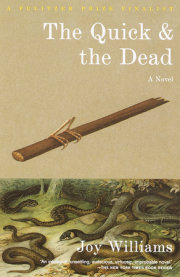
JOY WILLIAMS is the author of four previous novels--including The Quick and the Dead, a runner-up for the Pulitzer Prize--and four collections of stories, as well as Ill Nature, a book of essays that was a finalist for the National Book Critics Circle Award. Among her many honors are the Rea Award for the Short Story and the Strauss Living Award from the American Academy of Arts and Letters. She was elected to the Academy in 2008. She lives in Tucson, Arizona, and Laramie, Wyoming. View titles by Joy Williams

About

LONGLISTED FOR THE NATIONAL BOOK AWARD • FINALIST FOR THE PEN/JEAN STEIN BOOK AWARD • LONGLISTED FOR THE STORY PRIZE • NAMED A NOTABLE BOOK OF THE YEAR BY THE WASHINGTON POST • A razor-sharp new collection of stories of visionary childhood misfits and struggling adult dreamers from this legendary writer of “perfectly indescribable fiction . . . To read Williams is to look into the abyss” (The Atlantic).

“An American master is back with crystalline stories that map the personal and political minefields of her unmoored characters. Williams blends everyday dramas with surreal imagery, her voice and range inspiring awe.” —Boston Globe


“Night was best, for, as everyone knows but does not tell, the sobbing of the earth is most audible at night.” “Men are but unconscious machines and they perform their cruelties so effortlessly.” “Caring was a power she’d once possessed but had given up freely.” The sentences of Joy Williams are like no others—the coiled wit, the sense of a confused and ruined landscape, even the slight whisper of hope that lurks between the words—for the scrupulous effort of telling, in these stories, has a ravishing beauty that belies their subjects. We meet lost souls such as the twin sister heiresses of a dirty industrial fortune in “After the Haiku Period,” who must commit a violent act in recompense for their family’s deeds; in “Nettle,” we encounter a newly grown man who still revolves in a dreamscape of his childhood boarding-school innocence; and in the final story, we learn of the “pelican child” who lives with the “bony, ill-tempered” Baba Iaga “in a little hut on chicken legs.”

All of these characters insist on exploring an indifferent and caustic world. They struggle against our degradation of the climate and of each other, possibly in vain. But each brief, haunted triumph of understanding is celebrated by Williams, a writer for our time and all time.

Excerpt

Flour

The driver and I got a late start. I usually decide on these excursions the night before, but it was late in the morning when I informed the friend who was coming to visit me for the weekend that I had to cancel, it was absolutely necessary for me to cancel. I had got it in my head that in her presence some calamity or another would arise and she would have to assist me in some way, rush me to a physician or something. She would be grateful she was there for me perhaps, but I would find it a terrific annoyance and embarrassment. I gave some other excuse for the disinvitation of course. Pipes. I think it was broken pipes. I should have written it down so I don’t use it again.

I cleaned the house, which was very much in need of cleaning, for I had been putting it off. Still, my commitment was not great and I neglected the windows as usual. The dogs had pressed against them day and night for years. Their breaths are etched in the glass now, very lightly etched.

By departing so late, we could not make our customary first stop. The driver and I usually spend two nights in lodgings on our route. This time three nights would be necessary. We take separate rooms, of course. If by chance we should come across one another in the restaurant or the hallways, we offer no acknowledgment.

The car is a big one, encompassing three rows, three tiers behind the driver. It amuses me to think of them as the celestial, the terrestrial, and the chthonic. In fact, I quite believe that all things—every moment, every vision, every departure and arrival—possess the celestial, the terrestrial, and the chthonic.

The dogs had pretty much stayed in the terrestrial section where their beds were, as well as a few empty plastic bottles. They liked to play with them, make them crackle and clatter. Sometimes I ride in the chthonic with the luggage, the boots and coats, the boxes of fruit and gin and books. It smells strangely good back there, coolly hopeful and warmly worn at once. But usually I stretch out in the seat behind the driver and watch the landscape change as we rise from the desert floor.

Shockingly, it is almost two o’clock in the afternoon. We will not get far today!

When the driver and I first met—when I was interviewing him, you might say—he told me that he was studying Coptic.

Naturally, I did not believe this for one moment.

Without any encouragement from me he said, “The verb forms and tenses of Coptic are interesting. For example, some tenses that we English speakers do not have are the circumstantial, the habitual, the third future, the fourth future, the optative, and tenses of unfulfilled action signifying until and not yet. I am working now on translating and interpreting the story about the woman carrying flour to her home in a jar that is broken.”

“The flour all pours out?” I said.

“Why yes.” He seemed pleased.

Everyone knows the story of the woman and the flour. Who did he think he was kidding? Still, you’re never drawn to a person for the reasons you think. Besides, he was the only one who applied for the position I sought, which I had kept purposefully vague, and parsing every nuance of the woman and the jar would keep him occupied at least.

We are at a crossroads light behind a new, bright yellow truck. When the light changes the truck accelerates, a dense cloud of black smoke erupts from the tailpipe. People spend more than a thousand dollars to customize their vehicles for this effect, which honors freedom and individuality. It takes a moment for the simple clarity of the air and sky to reassert itself.

When a little baby dies you think, If they can do it with such wonderment, so can I.

The bright yellow truck, the yolk-colored truck, dances away. He is not going in our direction, though perhaps he quite is, and our driver is graciously finding a detour for my sake. Rather than discussing the wisdom of this—will we find a decent place to stay when dusk descends—I leave my perch and crawl over the backs of seats to the very rear, the cozy chthonic. There is scarcely room for me to curl, to burrow, and surprisingly I do not even feel comfortable here.

Dusk is not nearly as considerate as is generally assumed. One thinks it offers a reasonable amount of time to adjust to night descendants, but the reality is it does not. With only moments to spare, we sweep under the portico of a large hotel that has seen better days.

The driver goes in to address the desk while I pick about among the rubble in the back. Sometimes I like to bring my own lamp into these places, but I feel too tired to locate the cord, then follow the cord. I am remarkably tired. I look instead at the gardens that rim the crescent of the drive. Though they are not extensive, someone cares for them, really cares. I feel better watching them, as though I have just enjoyed a cocktail, though that is still ahead of me, thank God.

(In the morning the gardens would not seem nearly as responsibly cared for, but I was paying less attention to them then.)

The driver has arranged for everything. He escorts me to an adequate room, smiles as guilelessly as the boy he so seems to be, and says good night. Later I go down for my cocktails in the cavernous dining room made tragic with the heads of animals and loud with the happy screams of tourists. There are commendable ruins nearby, apparently. We would never have stopped here had I been more decisive earlier.

We leave at daybreak, the reasoning being that we would make up some time. Preposterous of course. One cannot make up time. One can make up a story or a face or a bed. Ugh. I find it all repellent. My bed, by the way, was so uncomfortable. I would not have been surprised if, on tearing the mattress open, I’d found it to be stuffed with rocks. The driver says apologetically that he had spent a restful night, though he had slept little, as he was working on his translation.

“The art of translation is very forgiving, isn’t it,” I say.

“Forgiving?” he repeats.

For a while I ride up front with him but find I can gain no perspective. We are climbing, climbing, there are switchbacks and signs of warning in the bright falsity of daylight, and nature pressing in around us, fierce yet helpless, regarding us with distaste.

I think of my friend. She might not have received the message and could be knocking at the door of my house this very moment. She might have even already left once and returned. But I cannot think about her for long. We both have betrayed one another more than once.


After a few hours, though we had not made up one minute of lost time, the driver asks if I would like to stop for a moment. He pulls off the road and spreads the blanket—which we have used often for this purpose—upon the ground and puts out bread and water. I had once tried to make the bread myself, but it was dreadful. I don’t know where it’s acquired now. We seldom eat much of it. We never finish it. Sometimes we don’t even begin, though I don’t wish to think we waste it. The sun is warm, the air feels fresh and good, but I feel that the small pleasure I am taking in this instant is significant only to be dissatisfied.

The car looms beside us, handsome, without agency. The driver had once confessed to me that he loved it as he had loved nothing in his life before that if I ever found it necessary to separate him from its care he would probably kill himself.

He is such a child, I thought at the time, but I did not reassure him. I might even have smiled, possibly laughed, his question was so naïve. Of course, the both of them could crush me like an insect at any time. It is a serious business, a most serious business.

He packs up the bread and water and folds up the blanket, the raveling border of which I pretend not to notice. What he should be doing in the evening is repairing our picnic blanket, or at the very least determining how it can be displayed without calling attention to its degradation. Instead, he spends the nights searching for the missing word in some Coptic riddle. Or so he claims.

Hours pass rather senselessly, as they often do. I do some thinking once again in the rear, in my cannily constructed chthonic, but nothing of any really import. When we stop again, dusk is just beginning to assemble her portentous armies. The lodging is once again unfamiliar. It might have been plucked out of a hat, as they say. Again it is a hotel from an earlier time, restored to partial grandeur. There seems to be a niche of Texas billionaires who specialize in these labors of love. What is their fantasy really, I wonder. With very little inquiry I learn that one of the new owners is an artist. Her paintings are everywhere, her specialty scenes of dinner parties where the well-known dead are guests. Frida Kahlo and her parrots are there, for example. I think they are parrots.

In my room is a fruit basket, which contains a single orange. Quite naturally, I am afraid to eat it. The room is pleasant enough, but there is a certain beyondness to it. I cannot explain this at all but I very much want to discuss it with the driver. Yet when I come upon him later, drinking a glass of wine on one of the verandas, I ignore him as usual.
Trains rumble past the hotel all night but there are no passengers on them. They carry freight, interminable freight.

The next morning is bitterly cold. I approach breakfast wearing everything I own and even a robe I do not, a fat white that is one of the amenities of the hotel. A small fire is burning in the vast fieldstone fireplace. It looks absurd—a few sticks when it could have been mighty logs. There is certainly enough timber surrounding the place.

The driver is seated some distance from the inadequate fire. He is not one for pretending that things offer what they cannot. He, too, is wearing the provided robes, and the sight of it over his dark suit—for it looks as foolish as the fire—prompts me to acknowledge him with a shy wave. I approach him, even sit down opposite him. His notebook is open and he is pressing a pencil against the page. This I have witnessed before.

“Not still the woman with the jar,” I tease. “Surely you must be on to another narrative by now.”

“I’ve rendered the road as a distant road,” he says.

“But that is nowhere near the end,” I protested. “Practically nothing can be known at that point.”

“What is important is the quality of the emptiness she eventually discovers,” he agrees. “And that is what is so difficult to suggest.”

We do not return to our respective rooms but place the robes in a barrel that we believe to be for that purpose.

In the car, the driver says, “I think with a little effort it’s very possible we can recover the schedule.”

“Excellent,” I say.

And we do arrive, though it struck me then as being utterly foreign. But the driver, breaking our comfortable silence at last, says that to him it appeared much the same as always.

Awards

  • FINALIST | 2026
    PEN/Jean Stein Book Award
  • LONGLIST | 2025
    National Book Award
  • LONGLIST | 2025
    The Story Prize

Reviews

A Publishers Weekly Editors' Pick
One of Kirkus’s Best Fiction Books of the Year
One of People’s Best New Books
One of the Boston Globe’s Best New Books for Fall and Best Books of the Year

One of Lit Hub’s Most Anticipated Books of 2025

“Painterly and provocative, slipping beyond the frame of reality, as if Magritte or Dalí had propped their easels amid the Sonoran desert. . . . Williams’s serious business is to plumb the volatile interior lives of her characters. . . . The prose is beautifully lean. . . . She flavors her pieces with piercing observations, a pinch of irony, and her signature moxie. She’s still got it, still mulling the riddles we pose to each other, and to ourselves.” —Hamilton Cain, Boston Globe

“Peculiar and tantalizingly ambiguous. . . . Williams’s stories seem to have passed beyond the dramatic arcs and emotional payoffs customary to short fiction. They are beyond pretending that the world makes sense. They are even beyond caring about the familiar concerns of the living—yet they are about life, anyhow, as it persists in this beyondness.” —Sam Sacks, Wall Street Journal

“[A] knockout new collection. . . . Her best book since The Quick and the Dead.” —Jake Cline, The Washington Post

“Haunting, inventive tales. . . . Rife with dry wit, dark humor and a touch of the sinister.” —Louisa Ermelino, People

“Williams is one of our most accomplished adepts in the art of estrangement—in literally making the mundane strange. The short stories in her latest collection are spiny little nuggets of jamais vu. . . . In Williams's hands, reality is a changeling with an occasionally wicked sense of humor.” —Colin Dwyer, NPR

“The singular, disconcerting uneasiness that is so characteristic of Joy Williams’s fiction, yet so hard to pin down, is once again dazzlingly on display in her latest collection. . . . A detail from her prose can stop you in your tracks. . . . And sometimes you have to pause simply to ponder the insightful beauty of what is being observed.” —Cory Oldweiler, Minnesota Star Tribune

“Grande dame of ‘writers’ writers,’ among the greatest living practitioners of the short story. . . . Williams is a witty writer, dry and precise in her language. . . . The stories in The Pelican Child have the clean, clear surfaces that have led some critics to identify Williams as a minimalist, but the density and explosive weirdness that make her something else. . . . Strange and striking and wonderful.” —Mariah Kreutter, Kismet

“In a dozen intricate, unnerving, caustically funny, and haunting tales, [Williams’s] lonely, displaced, and bewildered characters struggle with painful quandaries in a desiccated world. . . . These grim tales are so ravishingly well-made, so astutely imagined, they evoke as much awe as despair.” —Donna Seaman, Booklist

“Welcome to the Cult of Joy and Williams’s new collection, The Pelican Child. . . . These are some of the finest short stories in the last century of American literature, all heartbreaking and beautiful and elusive and true.” —Mike Jeffrey, On the Seawall

“An American master is back with crystalline stories that map the personal and political minefields of her unmoored characters. Williams blends everyday dramas with surreal imagery, her voice and range inspiring awe.” —Boston Globe, “Best New Books for Fall”

“Another intelligent and fascinating literary collection from this Pulitzer-nominated author. . . . The uncompromising and often surreal tales have been crafted with a distinctive style, offering a mix of fables and fantasy connected by themes including death, grief, cruelty and greed. Despite the bleak and pessimistic outlook in many of the tales, there is much symbolism at play.” —Rhianon Holley, Buzz

“[Williams] is a writer of arrestingly beautiful sentences and imagery.” —Alex Clark, Times Literary Supplement

“This is nothing short of revolutionary. . . . Williams writes in the unredemptive, existential mode, with a keen eye for the hilarious-cum-absurdist in the face of death or nothingness, as well as for sudden swerves, gear-shifts, jump-cuts and leaps that destabilise our expectations from the narrative. . . . Ineffable, indescribable, darkness, unknowing – it’s easy to see how her work shares genes with Samuel Beckett’s. She lifts the skin of reality to peer unflinchingly into something that lies beyond the territory of language and meaning, and uses a form made of language to bring us there.” —Neel Mukherjee, The New Stateman

“My platonic ideal of a writer. . . . Williams blends the real and fantastical.” —Chris Powers, The Observer

“Williams [is] one of the form’s living masters. . . . A vast, ecologically motivated collection, Williams’s newest effort is far reaching, and while these stories are full of everyday happenings, The Pelican Child always keeps one eye on what the future has in store.” —Colm McKenna, The Irish Times

“Pithy, spiky and defiantly strange. . . . Williams hopes to reignite our sense of wonder in the world, so that we might be rallied to protect it. Here, at the height of her powers, she may just triumph.” —Miriam Balanescu, Financial Times

“[Williams] extrapolates the effect of environmental devastation on not only humanity but also, and most fundamentally, society.” —David Ulin, Alta

“Enigmatic, elegant stories by a writer at the pinnacle of her art. Williams has long worked magic with stories that, on the surface, seem quite quotidian, save that something unspoken—and occasionally sinister—lies beneath. . . . Superb, and yet more evidence that Williams should be next in line for the Nobel Prize in Literature.” Kirkus Reviews (starred review)

“The protagonists of these gorgeous stories from Williams grapple with mortality and their hold on reality. . . . Throughout, Williams grabs the reader’s attention with striking dialogue and arresting conceits. This collection is a gift from a master of the form.”Publishers Weekly (starred review)

Author

© Jonno Rattman
JOY WILLIAMS is the author of four previous novels--including The Quick and the Dead, a runner-up for the Pulitzer Prize--and four collections of stories, as well as Ill Nature, a book of essays that was a finalist for the National Book Critics Circle Award. Among her many honors are the Rea Award for the Short Story and the Strauss Living Award from the American Academy of Arts and Letters. She was elected to the Academy in 2008. She lives in Tucson, Arizona, and Laramie, Wyoming. View titles by Joy Williams
  • More Websites from
    Penguin Random House
  • Common Reads
  • Library Marketing