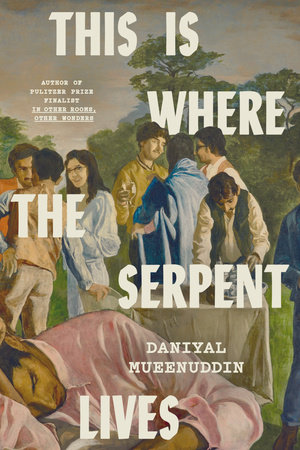
Download high-resolution image
Listen to a clip from the audiobook
audio pause button
0:00
0:00

This Is Where the Serpent Lives

Listen to a clip from the audiobook
audio pause button
0:00
0:00
A stunning new work from universally acclaimed Daniyal Mueenuddin, whose debut short story collection won the Story Prize and was a finalist for the Los Angeles Book Prize, the National Book Award, and the Pulitzer Prize.

THE NEW YORK TIMES BOOK REVIEW EDITORS' CHOICE. NAMED A MOST ANTICIPATED BOOK OF 2026: Town & Country, Bustle, AARP, Kirkus


Moving from Pakistan’s dazzling chaotic cities to its lawless feudal countryside, This Is Where the Serpent Lives powerfully evokes contemporary feudal Pakistan, following the destinies of a dozen unforgettable characters whose lives are linked through violence and tragedy, triumph, and love. Orphaned as a little boy and fending for himself in the city streets, Yazid rises to a place of responsibility and respect in the Lahore household of Colonel Atar, a powerful industrialist and politician, only to find that position threatened by conflicting loyalties and misplaced trust. Born on Colonel Atar’s country estate to a poor gardener, Saqib is entrusted with the management of a pioneering business, but he overreaches and finds himself an outlaw, confronting the violence of the corrupt Punjab Police. The colonel’s son competes with his cherished brother for the love of a woman and discovers that her choice colors his life with unexpected darkness as well as light.

In matters of power and money and the heart, Mueenuddin’s characters struggle to choose between paths that are moral and just and more worldly choices that allow them to survive in the systems of caste, capital, and social power that so tightly grip their culture. Intimate and epic, elegiac and profoundly moving, This Is Where the Serpent Lives is a tour de force destined to become a classic of contemporary literature.
Bayazid never knew how he came to be a little boy alone in the streets of Rawalpindi. He had a memory more of forces than of people, a crowd, a hand, a hand no more. Yet the bazaars in those early 1950s were not so crowded as that, and Rawalpindi a town small enough that a lost little boy should be found. That was a bitter day when he accepted years later that there might have been no hand, no desperate parent seeking him in the crowd. He might have been abandoned, not lost. Karim Khan, the owner of the tea and curry stall where his known history began, could tell him only that he had been sitting in front of the stall on a fine winter day, three or four years old, wearing just a shalvar kameez, barefoot and clean, holding a new pair of cheap plastic shoes tightly in his arms as if afraid they would be taken away, and scanning the crowds passing by. The shoes had caught Karim Khan’s eye, not only because they were brand-­new, but because the children of the streets, those sparrows, ran barefoot always. In those early years following the great Indian Partition, families drifted about, mothers dead, fathers dead, murdered for religion’s sake, for politics, unwelcome children without parents thrown on some relative’s mercy. Karim Khan thought this must be one of those stories, Hindus stuck on the wrong side of the border and on the run, an unwanted child—­though that didn’t explain the shoes.

Karim Khan kept an eye on the boy all through the afternoon and evening, serving customers by the light of a hissing pressure-­gas lantern, dishing up dal or a meat curry that grew more delicious each year, for he never washed out the fire-­blackened pots that sat over the coals, but replenished them with a double handful of lentils or meat, beef or mutton, whichever was cheaper, the mix of meat juices adding to its savor. The boy had a remarkable power of concentration, immobile all day and seeming quite unperturbed, but for the fierceness with which he held the shoes. He stood out even then as a person not to be treated lightly, as a being with resources of spirit if not of fortune. When Karim Khan finally approached him, the boy brushed him off, politely but firmly. He was waiting for his mother, who would soon be back, and must not move from this spot. Rebuffed, Karim Khan retreated back to his cook fire, the evening crowd getting a quick bite before taking a bus from the nearby station up to the mountains or out to the plains, for the shop served mostly travelers. Finally, when the crowds had died, when pye-­dogs began sniffing around under the charpoys in front of the food stall for a last chicken bone or scrap of dry bread, when the lights in the shops along the road faltered out, and the cold came down from the Margalla Hills so that breath showed in a little cloud, Karim Khan went to the boy, and took his hand, and drew him away from the road and over by the fire.

“Come on, have a dish of my curry,” he told the boy. “You’re shivering, you’ll get sick. Sit here and eat, you can still keep watch.” The boy came along easily enough then, his will weakened by hunger, heavy-­headed over food and then burrowing under a blanket that Karim Khan pulled over him, lying on a charpoy in the open-­fronted veranda where the cook fire had just gone out, asleep so quick. At dawn he was back by the road, and for that whole day too he watched, not crying but just resolute, knowing that of course they would come back, his mother and father. Admiring the boy’s remarkable tenacity, pitying him, Karim Khan fed him morning, midday, and evening with unsold chapattis and the leavings from customers’ half-­eaten plates—­which otherwise would be poured back into the general pot. That evening Karim Khan said to him firmly, “Come on, little man. I’m not rich enough to feed you on charity. From now on you clean up and carry out the plates and then we’ll see. Until your people come.” Earlier he had been to the nearby police station but, as he expected, found the duty officer there quite uninterested in a street boy’s troubles. In any case, the boy had struck his fancy, though no one would have accused that Mardani Pathan of being fanciful, with his wife back home awaiting money and three daughters there to feed, and this food stall his enterprise, and his pride too—­he’d built it up from a little cart that he hawked around the train station.

Karim Khan, who was a good man, took the boy in and named him Bayazid after a Sufi mystic who was known to Karim Khan rather as a magician, jhadoo ghar—­more fancy, indulging himself in poetry!—­and treated him not like a son, perhaps, but like a cherished apprentice, miniature serving boy, dishwasher, runner, paid in food and treated unsentimentally but fairly, hardly any use at first, then gradually indispensable. Yazid grew up exceptionally large for a Pakistani, six feet tall by the time he first began shaving, and strong: big hands, big feet, a large head. He tended to be slovenly rather than unclean, ate enormously but without much discrimination, worked day and night slowly but implacably, and was a neighborhood pet as a little boy, and a person of accepted station by the time he was thirteen. He didn’t banter or fling himself around, as teahouse boys often do—­but had a humor that called forth smiles in return, and accepted all who accepted him, and damn the rest, and even them he forgave easily.

Most remarkably, Yazid had a long view of bettering himself, told to no one, an ambling bear moving to his own North. He taught himself to read, first learning the alphabet, buying government school grammars with his own money, encouraged and corrected by one of the regular customers, a schoolteacher who came in the afternoons for a cup of tea, and whom he treated with ceremony and respect that kept the tuition flowing. To the extent that Karim Khan thought of such things, he accepted this as one of the boy’s caprices, a distraction in any station that he might achieve, but better than going to the cinema or flying kites. At ten Yazid would read aloud the Urdu newspaper to illiterate Karim Khan, a morning ritual after the shop was opened and before the customers came, choosing the stories that he knew his boss would like. At fourteen and fifteen he could be found whenever he wasn’t working reading gruesome stories of murder, or stories of thwarted love or lovers dying requited, bought secondhand from stalls and bound like magazines, with lurid pictures on the covers of fat-­bummed girls and mustachioed men, lovers or enemies, kidnapped or eloping or on the lam, as only time and a hundred pages would tell. Yazid had charmed hands, became a master at making chapattis, hunkered cross-­legged over the tandoor, slapping the flattened dough down into its orange glowing maw. He learned the technique of making nan, doing it so well that the shop became known for it, the local housewives bringing pots to fill with dal and curry, a treat for their poor homes in the nearby alleys, and a bundle of nan too, flecked with sesame seeds, oiled shiny, crisp and then soft inside, hot and wrapped in day-­old newspapers. “Always your nose in a book,” said the regulars, and were rather proud of him as he handed over the goods and picked up and resumed his reading, sitting under a lone bulb hanging from a wire.

*

The bazaar around the food shop had been established in British times, with some newer office buildings of two and even three stories, a little park, and next to the park, the Sir Khawaja ­Nazimuddin Government High School, known to be among the best in the city. The boys wore uniforms, blazer, straight-­legged khaki pants, and pointed black shoes, even a blue-­and-­brown striped tie, which made them conspicuous at a time when most Pakistanis wore shalvar kameez. The boys would come to Karim Khan’s food shop in the morning for a rusk and tea, or in the afternoon after school for dal, standing around the lean-­to and shoveling the food into their mouths, shouting and making a clatter, very conscious of their uniforms and their elite status. These were the sons of the wealthier houses nearby, of business owners, owners of the larger shops, local ward politicians, wholesalers, members of a rising middle class defined at the higher reaches by the ownership of a car, and at the bottom by the necessity of making hard sacrifices to buy their sons’ uniforms and pay for extra tuition.

Sitting at the tandoor and pushing out piles of chapattis and nan, rising teenage Yazid had ample time to study these fortunate creatures. Gradually he began to bend his attitude and his appearance toward theirs, not quite affecting to wear pant-­shirt, which would make him ridiculous in the eyes of Karim Khan and of customers, but cutting off his long hair, which had been modeled on gangsters in the movies, taming his rich sideburns, ditto adopted from the movies, and generally toning down his naturally exuberant style, though his loose walk and large appetite and size would always set him apart.

Rarely leaving the food stall, Yazid yet knew much about the world, for he was observant, and all sorts came through the bus station en route to their far destinations. Weary travelers dropped their bags and filled travel-­starved bellies with savory curries and his hot-­oiled nans and afterward unbuttoned themselves to the sympathetic serving boy, indiscreet because they would never see him again. Gradually, as he became familiar with the college boys, he understood that their views were rather narrower than his, and this gave him confidence. While they might have fine manners and live in proper houses, cosseted by their mothers and sisters, they were tame and didn’t penetrate very far toward an understanding of the unforgiving streets and city. He formed friendships with the college boys, never presuming on his acquaintance, always ready to step back into character as the fellow behind the tandoor, sparing himself from any rebuff by this discretion. Yet he observed them closely and bided his time. He wanted to make friends among them rather than among the boys like him who worked the shops and sold cheap trinkets to travelers and ran the scams around the gullies, gutter princes, loud and quick to dodge a slap, smoking cigarettes, shouting after the begging girls who floated around the bus stop unchaperoned.

One spring when Yazid was seventeen or eighteen, the Nizamuddin College boys developed a passion for carrom board, poor man’s billiards, played on a plywood square with the object of knocking round plastic pucks into corner pockets with a striker. Suddenly that year boys all over Pakistan were playing the game, in cities and towns, with federations and tournaments and newspaper coverage. Crowds of the college boys would gather around a charpoy set in front of the food stall, playing for cups of tea or plates of biscuits, standing in circles around the board with the seriousness of parliamentary debaters, discussing strategy, the real experts bringing their own favorite strikers. Yazid would serve out the snacks they ordered and stand watching, occasionally dropping in some humorous comment. Initially they had a miniature board, which they would carry to Karim Khan’s stall, but when they banded together and bought a regulation-­sized one, three feet to a side, Yazid offered to store it for them in the shop. He thus became the master of ceremonies, keeper of the board. He even found a rule book in one of the secondhand bookstalls and studied it and so became the acknowledged umpire, his word on the finer points accepted as final. At night, alone, he would practice shots in his room, and so himself became an ace, rarely playing, because of his duties as a server, hard to get and therefore in demand, called when some outsider sat down and cleared the table of the locals. In the middle of a game, as he wiped out his opponent, putting away puck after puck with his striker, Yazid would say, chewing the tip of his mustache in the corner of his mouth, “I’m feasting on him, just feasting on him,” and this became a catchall phrase for the college boys, used indiscriminately.

*

By the time summer came, when it was too hot to sit and play out in front of the food stall, a little core had formed around Yazid. Center of operations for the carrom players shifted to Yazid’s shabby room attached to the food stall, formerly a storeroom, looking onto a gully on the side. For his first eight or nine years working for Karim Khan, Yazid slept rough on one of the charpoys lined up on a swept dirt apron in front of the stall, never even bothering to choose any one particular spot, but sleeping where he fell, cheerful under the stars, a fan to cool him in summer, and his clothes hung on nails in the filthy toilet that leaked sewage out into a little grassy plot at the back of the building, his comb on a shelf and then later a shaver and soap to make foam. He hadn’t asked for the room. Karim Khan had told him one morning to empty the storeroom of the garbage lying there, empty Dalda ghee tins and piles of jute bags. Yazid had become too old, said Karim Khan, to be sprawled every morning in front of the stall, sleeping late as he often did and comfortably watching the street in front of him come to life as if in his own living room.

Now the room became a sort of clubhouse for the carrom players, so much so that several of the boys chipped in and had it whitewashed inside by a withered opium smoker who made a living in the neighborhood as a handyman. There were two charpoys, with a table that held the board squeezed between them, teacups crowded to the side, players sitting cross-­legged. The great luxury was a ceiling fan, given to Yazid secondhand by some buddy in the neighborhood, which made him the butt of his friends’ jokes, who called it proof of his love of fine living. He also nailed pictures of actresses cut from the Sunday papers on the rough brick walls, although these soon were dust covered and flyblown and quite unregarded.

What the boys liked about this arrangement was that nothing was expected of them in that room. There were no rules, all came and went as they liked, they played carrom or they didn’t, sometimes they played cards or just talked, sometimes one of them would be in a jam and would sleep there for a night or two. The college boys, who mostly came from respectable families, did not enjoy such freedom anywhere else. Yazid had the one indispensable quality for a man establishing a club: He was always at home, sitting in the veranda of the stall making nan and chapattis, or slumbering in his room if he had no guests, and even if he had gone off somewhere on an errand the room was never locked. Karim Khan had by now taken up another little boy off the streets, this one of known parentage but with parents who asked no questions and gave him up to this business as a riddance. Yazid thus assumed an emeritus position in the enterprise, though he still made the nan and still dealt with the cash when Karim Khan wasn’t present. The old man—­by then he would have been over seventy, wiry and likely to live forever—­would go off to his home in Mardan for several weeks at a time, and when he returned Yazid would hand him every paisa that the shop earned, keeping a notebook with any subtractions carefully noted, cigarettes, a trip to the cinema, for he still took no salary, but asked for money when he needed it—­never asking for much, a few times asking a lot, given over by Karim Khan without ever a question.
“The magic in This Is Where the Serpent Lives is the up-close work. Mueenuddin makes the reader care about the romantic relationships, and the pages turn themselves. . . . It’s a serious book that you’ll be hearing about again when the shortlists for the big literary prizes are announced.” The New York Times

“Mr. Mueenuddin’s characters are vividly drawn, and though his prose is spare, it also offers phrases of great beauty. In these strengths, Mr. Mueenuddin recalls Anton Chekhov.” The Wall Street Journal

This Is Where the Serpent Lives maps an entire society in flux over six decades while presenting half a dozen portraits of contradictory, sympathetic, flawed, and utterly believable individuals. This subtle, wide-ranging, and enthralling novel makes some demands of its readers, but repays them in full.” The Boston Globe

This Is Where the Serpent Lives was worth the wait. . . . A many-splendored portrait of one of the most interesting and complex countries in the world, and a shining example of the very best in literature.” The Washington Post

“Daniyal Mueenuddin returned with This Is Where the Serpent Lives, a masterful debut novel set in Pakistan. It begins in 1955 with an orphaned tea seller in the Rawalpindi bazaar, and expands to follow the ‘upstairs, downstairs’ lives of a wealthy family and the men and women who work for them. It is a startling and breathtaking work of fiction that will be remembered as a classic multigenerational epic.” Esquire

“Stunning. . . . Mueenuddin, whose gift for satire shines whether he’s describing society matrons or gangsters, never loses sight of his theme: How do any of us ever manage to justify our treatment of the underserved?” Los Angeles Times

“Mueenuddin has crafted a compelling and sweeping meditation on class and corruption in Pakistan.”Vulture

“The setting in Mueenuddin's debut novel—a modern Pakistan rife with corruption, feudalism and resilience—thrums with such vitality, it can feel like a character in its own right.” —NPR

“Spanning Pakistan’s bustling cities and feudal countryside, this sweeping novel follows three generations of unforgettable people as they grapple with tragedy and triumph, violence and love, and money and power. Absolutely gorgeous.” People

“Following the lives of characters born with and without privilege, all attached to the estate of a wealthy colonel, and adorned with struggles of the heart, morality, and power, this promises to be one of the year’s seminal literary works.” Book Riot

“Brutal, funny and brilliantly told. . . . This Is Where the Serpent Lives is set to be a standout novel of 2026.” The Guardian

This is Where the Serpent Lives is a sweeping parable of power and fortune, set in Pakistan but with universal application. . . . Mueenuddin is a sort of literary magician. . . . Expect to see this epic novel all over prize lists in 2026.” The Times (London)

“There’s a poised, timeless quality to the masterful storytelling, which—travelling as it does between parched farms, opulent salons and the immensity of the Pakistani landscape—makes this feel at once like a classic.”Daily Mail

“As close to flawless as possible, [This Is Where the Serpent Lives] is one of those novels that renew your faith in the possibilities of the genre. . . . A future classic, pure and simple.” The Irish Times

“This is an exceptional novel. From the opening pages, I knew I held a masterpiece in my hands.” —Stevie Davies, Literary Review

“A potent and nuanced novel about the abuse of an underclass in ways both subtle and overt. . . . Mueenuddin delivers all this in a graceful style that dignifies the lower-caste characters and intensifies the unjustness of their treatment.” Kirkus (starred review)

“The story threads cohere into a profound and revelatory portrait of Pakistan’s class divisions. Propulsive and peopled with unforgettable characters, this is a masterpiece.” Publishers Weekly (starred review)

“Mueenuddin brilliantly exploits the narrative possibilities inherent in the tension between lower and upper classes throughout This Is Where the Serpent Lives. Like an actual serpent, this smart, satisfying novel coils and slithers along unpredictable, winding paths. Only the most prescient readers will be able to guess where it’s going and where it will end up.” BookPage (starred review)

“Intricately layered. . . . Mueenuddin writes cinematically, examining and unraveling relationships with meticulous detail and stinging insights, spotlighting the grey areas between the impossible absolutes of right and wrong.” Booklist

“Epic. . . . Spanning six decades, this finely textured generational saga probes with rich irony the power dynamics between Western-educated Pakistani elites and the deferential but shrewd underlings who manage their agricultural estates and serve their tea. . . . Crafted with elegant prose, Mueenuddin’s conclusions are infused with thrilling tension.” —Shelf Awareness

© Chris Blonk
DANIYAL MUEENUDDIN was brought up in Lahore, Pakistan, and Elroy, Wisconsin. A graduate of Dartmouth College and Yale Law School, his stories have appeared in The New YorkerGrantaZoetrope, and The Best American Short Stories 2008, selected by Salman Rushdie. His collection In Other Rooms, Other Wonders was a finalist for the Pulitzer Prize and the National Book Award. For a number of years he practiced law in New York. He now divides his time between Oslo, Norway, and his farm in Pakistan’s South Punjab. View titles by Daniyal Mueenuddin

About

A stunning new work from universally acclaimed Daniyal Mueenuddin, whose debut short story collection won the Story Prize and was a finalist for the Los Angeles Book Prize, the National Book Award, and the Pulitzer Prize.

THE NEW YORK TIMES BOOK REVIEW EDITORS' CHOICE. NAMED A MOST ANTICIPATED BOOK OF 2026: Town & Country, Bustle, AARP, Kirkus


Moving from Pakistan’s dazzling chaotic cities to its lawless feudal countryside, This Is Where the Serpent Lives powerfully evokes contemporary feudal Pakistan, following the destinies of a dozen unforgettable characters whose lives are linked through violence and tragedy, triumph, and love. Orphaned as a little boy and fending for himself in the city streets, Yazid rises to a place of responsibility and respect in the Lahore household of Colonel Atar, a powerful industrialist and politician, only to find that position threatened by conflicting loyalties and misplaced trust. Born on Colonel Atar’s country estate to a poor gardener, Saqib is entrusted with the management of a pioneering business, but he overreaches and finds himself an outlaw, confronting the violence of the corrupt Punjab Police. The colonel’s son competes with his cherished brother for the love of a woman and discovers that her choice colors his life with unexpected darkness as well as light.

In matters of power and money and the heart, Mueenuddin’s characters struggle to choose between paths that are moral and just and more worldly choices that allow them to survive in the systems of caste, capital, and social power that so tightly grip their culture. Intimate and epic, elegiac and profoundly moving, This Is Where the Serpent Lives is a tour de force destined to become a classic of contemporary literature.

Excerpt

Bayazid never knew how he came to be a little boy alone in the streets of Rawalpindi. He had a memory more of forces than of people, a crowd, a hand, a hand no more. Yet the bazaars in those early 1950s were not so crowded as that, and Rawalpindi a town small enough that a lost little boy should be found. That was a bitter day when he accepted years later that there might have been no hand, no desperate parent seeking him in the crowd. He might have been abandoned, not lost. Karim Khan, the owner of the tea and curry stall where his known history began, could tell him only that he had been sitting in front of the stall on a fine winter day, three or four years old, wearing just a shalvar kameez, barefoot and clean, holding a new pair of cheap plastic shoes tightly in his arms as if afraid they would be taken away, and scanning the crowds passing by. The shoes had caught Karim Khan’s eye, not only because they were brand-­new, but because the children of the streets, those sparrows, ran barefoot always. In those early years following the great Indian Partition, families drifted about, mothers dead, fathers dead, murdered for religion’s sake, for politics, unwelcome children without parents thrown on some relative’s mercy. Karim Khan thought this must be one of those stories, Hindus stuck on the wrong side of the border and on the run, an unwanted child—­though that didn’t explain the shoes.

Karim Khan kept an eye on the boy all through the afternoon and evening, serving customers by the light of a hissing pressure-­gas lantern, dishing up dal or a meat curry that grew more delicious each year, for he never washed out the fire-­blackened pots that sat over the coals, but replenished them with a double handful of lentils or meat, beef or mutton, whichever was cheaper, the mix of meat juices adding to its savor. The boy had a remarkable power of concentration, immobile all day and seeming quite unperturbed, but for the fierceness with which he held the shoes. He stood out even then as a person not to be treated lightly, as a being with resources of spirit if not of fortune. When Karim Khan finally approached him, the boy brushed him off, politely but firmly. He was waiting for his mother, who would soon be back, and must not move from this spot. Rebuffed, Karim Khan retreated back to his cook fire, the evening crowd getting a quick bite before taking a bus from the nearby station up to the mountains or out to the plains, for the shop served mostly travelers. Finally, when the crowds had died, when pye-­dogs began sniffing around under the charpoys in front of the food stall for a last chicken bone or scrap of dry bread, when the lights in the shops along the road faltered out, and the cold came down from the Margalla Hills so that breath showed in a little cloud, Karim Khan went to the boy, and took his hand, and drew him away from the road and over by the fire.

“Come on, have a dish of my curry,” he told the boy. “You’re shivering, you’ll get sick. Sit here and eat, you can still keep watch.” The boy came along easily enough then, his will weakened by hunger, heavy-­headed over food and then burrowing under a blanket that Karim Khan pulled over him, lying on a charpoy in the open-­fronted veranda where the cook fire had just gone out, asleep so quick. At dawn he was back by the road, and for that whole day too he watched, not crying but just resolute, knowing that of course they would come back, his mother and father. Admiring the boy’s remarkable tenacity, pitying him, Karim Khan fed him morning, midday, and evening with unsold chapattis and the leavings from customers’ half-­eaten plates—­which otherwise would be poured back into the general pot. That evening Karim Khan said to him firmly, “Come on, little man. I’m not rich enough to feed you on charity. From now on you clean up and carry out the plates and then we’ll see. Until your people come.” Earlier he had been to the nearby police station but, as he expected, found the duty officer there quite uninterested in a street boy’s troubles. In any case, the boy had struck his fancy, though no one would have accused that Mardani Pathan of being fanciful, with his wife back home awaiting money and three daughters there to feed, and this food stall his enterprise, and his pride too—­he’d built it up from a little cart that he hawked around the train station.

Karim Khan, who was a good man, took the boy in and named him Bayazid after a Sufi mystic who was known to Karim Khan rather as a magician, jhadoo ghar—­more fancy, indulging himself in poetry!—­and treated him not like a son, perhaps, but like a cherished apprentice, miniature serving boy, dishwasher, runner, paid in food and treated unsentimentally but fairly, hardly any use at first, then gradually indispensable. Yazid grew up exceptionally large for a Pakistani, six feet tall by the time he first began shaving, and strong: big hands, big feet, a large head. He tended to be slovenly rather than unclean, ate enormously but without much discrimination, worked day and night slowly but implacably, and was a neighborhood pet as a little boy, and a person of accepted station by the time he was thirteen. He didn’t banter or fling himself around, as teahouse boys often do—­but had a humor that called forth smiles in return, and accepted all who accepted him, and damn the rest, and even them he forgave easily.

Most remarkably, Yazid had a long view of bettering himself, told to no one, an ambling bear moving to his own North. He taught himself to read, first learning the alphabet, buying government school grammars with his own money, encouraged and corrected by one of the regular customers, a schoolteacher who came in the afternoons for a cup of tea, and whom he treated with ceremony and respect that kept the tuition flowing. To the extent that Karim Khan thought of such things, he accepted this as one of the boy’s caprices, a distraction in any station that he might achieve, but better than going to the cinema or flying kites. At ten Yazid would read aloud the Urdu newspaper to illiterate Karim Khan, a morning ritual after the shop was opened and before the customers came, choosing the stories that he knew his boss would like. At fourteen and fifteen he could be found whenever he wasn’t working reading gruesome stories of murder, or stories of thwarted love or lovers dying requited, bought secondhand from stalls and bound like magazines, with lurid pictures on the covers of fat-­bummed girls and mustachioed men, lovers or enemies, kidnapped or eloping or on the lam, as only time and a hundred pages would tell. Yazid had charmed hands, became a master at making chapattis, hunkered cross-­legged over the tandoor, slapping the flattened dough down into its orange glowing maw. He learned the technique of making nan, doing it so well that the shop became known for it, the local housewives bringing pots to fill with dal and curry, a treat for their poor homes in the nearby alleys, and a bundle of nan too, flecked with sesame seeds, oiled shiny, crisp and then soft inside, hot and wrapped in day-­old newspapers. “Always your nose in a book,” said the regulars, and were rather proud of him as he handed over the goods and picked up and resumed his reading, sitting under a lone bulb hanging from a wire.

*

The bazaar around the food shop had been established in British times, with some newer office buildings of two and even three stories, a little park, and next to the park, the Sir Khawaja ­Nazimuddin Government High School, known to be among the best in the city. The boys wore uniforms, blazer, straight-­legged khaki pants, and pointed black shoes, even a blue-­and-­brown striped tie, which made them conspicuous at a time when most Pakistanis wore shalvar kameez. The boys would come to Karim Khan’s food shop in the morning for a rusk and tea, or in the afternoon after school for dal, standing around the lean-­to and shoveling the food into their mouths, shouting and making a clatter, very conscious of their uniforms and their elite status. These were the sons of the wealthier houses nearby, of business owners, owners of the larger shops, local ward politicians, wholesalers, members of a rising middle class defined at the higher reaches by the ownership of a car, and at the bottom by the necessity of making hard sacrifices to buy their sons’ uniforms and pay for extra tuition.

Sitting at the tandoor and pushing out piles of chapattis and nan, rising teenage Yazid had ample time to study these fortunate creatures. Gradually he began to bend his attitude and his appearance toward theirs, not quite affecting to wear pant-­shirt, which would make him ridiculous in the eyes of Karim Khan and of customers, but cutting off his long hair, which had been modeled on gangsters in the movies, taming his rich sideburns, ditto adopted from the movies, and generally toning down his naturally exuberant style, though his loose walk and large appetite and size would always set him apart.

Rarely leaving the food stall, Yazid yet knew much about the world, for he was observant, and all sorts came through the bus station en route to their far destinations. Weary travelers dropped their bags and filled travel-­starved bellies with savory curries and his hot-­oiled nans and afterward unbuttoned themselves to the sympathetic serving boy, indiscreet because they would never see him again. Gradually, as he became familiar with the college boys, he understood that their views were rather narrower than his, and this gave him confidence. While they might have fine manners and live in proper houses, cosseted by their mothers and sisters, they were tame and didn’t penetrate very far toward an understanding of the unforgiving streets and city. He formed friendships with the college boys, never presuming on his acquaintance, always ready to step back into character as the fellow behind the tandoor, sparing himself from any rebuff by this discretion. Yet he observed them closely and bided his time. He wanted to make friends among them rather than among the boys like him who worked the shops and sold cheap trinkets to travelers and ran the scams around the gullies, gutter princes, loud and quick to dodge a slap, smoking cigarettes, shouting after the begging girls who floated around the bus stop unchaperoned.

One spring when Yazid was seventeen or eighteen, the Nizamuddin College boys developed a passion for carrom board, poor man’s billiards, played on a plywood square with the object of knocking round plastic pucks into corner pockets with a striker. Suddenly that year boys all over Pakistan were playing the game, in cities and towns, with federations and tournaments and newspaper coverage. Crowds of the college boys would gather around a charpoy set in front of the food stall, playing for cups of tea or plates of biscuits, standing in circles around the board with the seriousness of parliamentary debaters, discussing strategy, the real experts bringing their own favorite strikers. Yazid would serve out the snacks they ordered and stand watching, occasionally dropping in some humorous comment. Initially they had a miniature board, which they would carry to Karim Khan’s stall, but when they banded together and bought a regulation-­sized one, three feet to a side, Yazid offered to store it for them in the shop. He thus became the master of ceremonies, keeper of the board. He even found a rule book in one of the secondhand bookstalls and studied it and so became the acknowledged umpire, his word on the finer points accepted as final. At night, alone, he would practice shots in his room, and so himself became an ace, rarely playing, because of his duties as a server, hard to get and therefore in demand, called when some outsider sat down and cleared the table of the locals. In the middle of a game, as he wiped out his opponent, putting away puck after puck with his striker, Yazid would say, chewing the tip of his mustache in the corner of his mouth, “I’m feasting on him, just feasting on him,” and this became a catchall phrase for the college boys, used indiscriminately.

*

By the time summer came, when it was too hot to sit and play out in front of the food stall, a little core had formed around Yazid. Center of operations for the carrom players shifted to Yazid’s shabby room attached to the food stall, formerly a storeroom, looking onto a gully on the side. For his first eight or nine years working for Karim Khan, Yazid slept rough on one of the charpoys lined up on a swept dirt apron in front of the stall, never even bothering to choose any one particular spot, but sleeping where he fell, cheerful under the stars, a fan to cool him in summer, and his clothes hung on nails in the filthy toilet that leaked sewage out into a little grassy plot at the back of the building, his comb on a shelf and then later a shaver and soap to make foam. He hadn’t asked for the room. Karim Khan had told him one morning to empty the storeroom of the garbage lying there, empty Dalda ghee tins and piles of jute bags. Yazid had become too old, said Karim Khan, to be sprawled every morning in front of the stall, sleeping late as he often did and comfortably watching the street in front of him come to life as if in his own living room.

Now the room became a sort of clubhouse for the carrom players, so much so that several of the boys chipped in and had it whitewashed inside by a withered opium smoker who made a living in the neighborhood as a handyman. There were two charpoys, with a table that held the board squeezed between them, teacups crowded to the side, players sitting cross-­legged. The great luxury was a ceiling fan, given to Yazid secondhand by some buddy in the neighborhood, which made him the butt of his friends’ jokes, who called it proof of his love of fine living. He also nailed pictures of actresses cut from the Sunday papers on the rough brick walls, although these soon were dust covered and flyblown and quite unregarded.

What the boys liked about this arrangement was that nothing was expected of them in that room. There were no rules, all came and went as they liked, they played carrom or they didn’t, sometimes they played cards or just talked, sometimes one of them would be in a jam and would sleep there for a night or two. The college boys, who mostly came from respectable families, did not enjoy such freedom anywhere else. Yazid had the one indispensable quality for a man establishing a club: He was always at home, sitting in the veranda of the stall making nan and chapattis, or slumbering in his room if he had no guests, and even if he had gone off somewhere on an errand the room was never locked. Karim Khan had by now taken up another little boy off the streets, this one of known parentage but with parents who asked no questions and gave him up to this business as a riddance. Yazid thus assumed an emeritus position in the enterprise, though he still made the nan and still dealt with the cash when Karim Khan wasn’t present. The old man—­by then he would have been over seventy, wiry and likely to live forever—­would go off to his home in Mardan for several weeks at a time, and when he returned Yazid would hand him every paisa that the shop earned, keeping a notebook with any subtractions carefully noted, cigarettes, a trip to the cinema, for he still took no salary, but asked for money when he needed it—­never asking for much, a few times asking a lot, given over by Karim Khan without ever a question.

Reviews

“The magic in This Is Where the Serpent Lives is the up-close work. Mueenuddin makes the reader care about the romantic relationships, and the pages turn themselves. . . . It’s a serious book that you’ll be hearing about again when the shortlists for the big literary prizes are announced.” The New York Times

“Mr. Mueenuddin’s characters are vividly drawn, and though his prose is spare, it also offers phrases of great beauty. In these strengths, Mr. Mueenuddin recalls Anton Chekhov.” The Wall Street Journal

This Is Where the Serpent Lives maps an entire society in flux over six decades while presenting half a dozen portraits of contradictory, sympathetic, flawed, and utterly believable individuals. This subtle, wide-ranging, and enthralling novel makes some demands of its readers, but repays them in full.” The Boston Globe

This Is Where the Serpent Lives was worth the wait. . . . A many-splendored portrait of one of the most interesting and complex countries in the world, and a shining example of the very best in literature.” The Washington Post

“Daniyal Mueenuddin returned with This Is Where the Serpent Lives, a masterful debut novel set in Pakistan. It begins in 1955 with an orphaned tea seller in the Rawalpindi bazaar, and expands to follow the ‘upstairs, downstairs’ lives of a wealthy family and the men and women who work for them. It is a startling and breathtaking work of fiction that will be remembered as a classic multigenerational epic.” Esquire

“Stunning. . . . Mueenuddin, whose gift for satire shines whether he’s describing society matrons or gangsters, never loses sight of his theme: How do any of us ever manage to justify our treatment of the underserved?” Los Angeles Times

“Mueenuddin has crafted a compelling and sweeping meditation on class and corruption in Pakistan.”Vulture

“The setting in Mueenuddin's debut novel—a modern Pakistan rife with corruption, feudalism and resilience—thrums with such vitality, it can feel like a character in its own right.” —NPR

“Spanning Pakistan’s bustling cities and feudal countryside, this sweeping novel follows three generations of unforgettable people as they grapple with tragedy and triumph, violence and love, and money and power. Absolutely gorgeous.” People

“Following the lives of characters born with and without privilege, all attached to the estate of a wealthy colonel, and adorned with struggles of the heart, morality, and power, this promises to be one of the year’s seminal literary works.” Book Riot

“Brutal, funny and brilliantly told. . . . This Is Where the Serpent Lives is set to be a standout novel of 2026.” The Guardian

This is Where the Serpent Lives is a sweeping parable of power and fortune, set in Pakistan but with universal application. . . . Mueenuddin is a sort of literary magician. . . . Expect to see this epic novel all over prize lists in 2026.” The Times (London)

“There’s a poised, timeless quality to the masterful storytelling, which—travelling as it does between parched farms, opulent salons and the immensity of the Pakistani landscape—makes this feel at once like a classic.”Daily Mail

“As close to flawless as possible, [This Is Where the Serpent Lives] is one of those novels that renew your faith in the possibilities of the genre. . . . A future classic, pure and simple.” The Irish Times

“This is an exceptional novel. From the opening pages, I knew I held a masterpiece in my hands.” —Stevie Davies, Literary Review

“A potent and nuanced novel about the abuse of an underclass in ways both subtle and overt. . . . Mueenuddin delivers all this in a graceful style that dignifies the lower-caste characters and intensifies the unjustness of their treatment.” Kirkus (starred review)

“The story threads cohere into a profound and revelatory portrait of Pakistan’s class divisions. Propulsive and peopled with unforgettable characters, this is a masterpiece.” Publishers Weekly (starred review)

“Mueenuddin brilliantly exploits the narrative possibilities inherent in the tension between lower and upper classes throughout This Is Where the Serpent Lives. Like an actual serpent, this smart, satisfying novel coils and slithers along unpredictable, winding paths. Only the most prescient readers will be able to guess where it’s going and where it will end up.” BookPage (starred review)

“Intricately layered. . . . Mueenuddin writes cinematically, examining and unraveling relationships with meticulous detail and stinging insights, spotlighting the grey areas between the impossible absolutes of right and wrong.” Booklist

“Epic. . . . Spanning six decades, this finely textured generational saga probes with rich irony the power dynamics between Western-educated Pakistani elites and the deferential but shrewd underlings who manage their agricultural estates and serve their tea. . . . Crafted with elegant prose, Mueenuddin’s conclusions are infused with thrilling tension.” —Shelf Awareness

Author

© Chris Blonk
DANIYAL MUEENUDDIN was brought up in Lahore, Pakistan, and Elroy, Wisconsin. A graduate of Dartmouth College and Yale Law School, his stories have appeared in The New YorkerGrantaZoetrope, and The Best American Short Stories 2008, selected by Salman Rushdie. His collection In Other Rooms, Other Wonders was a finalist for the Pulitzer Prize and the National Book Award. For a number of years he practiced law in New York. He now divides his time between Oslo, Norway, and his farm in Pakistan’s South Punjab. View titles by Daniyal Mueenuddin
  • More Websites from
    Penguin Random House
  • Common Reads
  • Library Marketing