Download high-resolution image Look inside
Listen to a clip from the audiobook
audio pause button
0:00
0:00

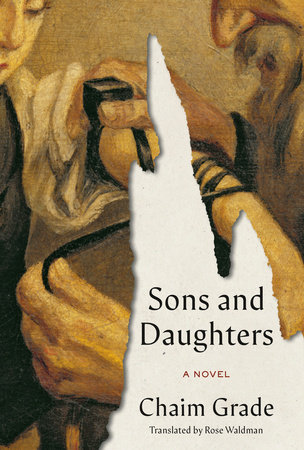
Sons and Daughters

A Novel

Translated by Rose Waldman
Introduction by Adam Kirsch
Look inside
Listen to a clip from the audiobook
audio pause button
0:00
0:00
Hardcover
$35.00 US
| $48.00 CAN
On sale Mar 25, 2025 | 704 Pages | 9780394536460

See Additional Formats
2026 PEN AMERICA AWARD FOR TRANSLATION FINALIST • From “one of the great—if not the greatest—contemporary Yiddish novelists” (Elie Wiesel), the long-awaited English translation of a work, Tolstoyan in scope, that chronicles the last, tumultuous decade of a world succumbing to the march of modernity.

A NEW YORK TIMES BEST HISTORICAL FICTION BOOK • A KIRKUS BEST FICTION BOOK OF THE YEAR • SHORTLISTED FOR THE FREUDENHEIM TRANSLATION PRIZE

“A great beard novel . . . Also a great food novel . . . A melancholy book that also happens to be hopelessly, miraculously, unremittingly funny . . . [Grade’s] fretful characters vibrate as if they were drawn by Roz Chast [and] Rose Waldman's translation seems miraculous to me.” —Dwight Garner, The New York Times


“It is me the prophet laments when he cries out, ‘My enemies are the people in my own home.’” The Rabbi ignored his borscht and instead chewed on a crust of bread dipped in salt. “My greatest enemies are my own family.”

Rabbi Sholem Shachne Katzenellenbogen’s world, the world of his forefathers, is crumbling before his eyes. And in his own home! His eldest, Bentzion, is off in Bialystok, studying to be a businessman; his daughter Bluma Rivtcha is in Vilna, at nursing school. For her older sister, Tilza, he at least managed to find a suitable young rabbi, but he can tell things are off between them. Naftali Hertz? Forget it; he’s been lost to a philosophy degree in Switzerland (and maybe even a goyish wife?). And now the rabbi’s youngest, Refael’ke, wants to run off to the Holy Land with the Zionists.

Originally serialized in the 1960s and 1970s in New York–based Yiddish newspapers, Chaim Grade’s Sons and Daughters is a precious glimpse of a way of life that is no longer—the rich Yiddish culture of Poland and Lithuania that the Holocaust would eradicate. We meet the Katzenellenbogens in the tiny village of Morehdalye, in the 1930s, when gangs of Poles are beginning to boycott Jewish merchants and the modern, secular world is pressing in on the shtetl from all sides. It’s this clash, between the freethinking secular life and a life bound by religious duty—and the comforts offered by each—that stands at the center of Sons and Daughters

With characters that rival the homespun philosophers and lovable rogues of Sholem Aleichem and I. B. Singer—from the brooding Zalia Ziskind, paralyzed by the suffering of others, to the Dostoyevskian demon Shabse Shepsel—Grade’s masterful novel brims with humanity and heartbreaking affection for a world, once full of life in all its glorious complexity, that would in just a few years vanish forever.
1

As they took a stroll—­Bluma Riv­tcha, the rabbi’s daughter, and Zindel Kadish, her prospective fiancé—­the eyes of the townspeople followed them indulgently, lovingly. Everyone knew how much suffering the rabbi’s other children had caused him, and so they wished him joy from his younger daughter, at least. Zindel’s grandfather, the elderly dayan, was also entitled to some joy from his grandson. Some years ago, Zindel’s parents had moved overseas to Canada, where they’d divorced and seemed to have forgotten about bringing Zindel across to join them. He remained at his grandfather’s home, the one consolation of the man’s old age.

Zindel was a young man of twenty-­three, with dark brown eyes and a head of black hair. He boasted a wide forehead and the straight nose of a sensible person, a dimpled chin like that of a pampered only son, cherry-­colored lips, and a sweet smile. Even in the heat of summer he wore a proper suit, complete with vest, shirt, and tie, and a wide-­brimmed hat tilted at an angle. He walked ramrod straight with raised shoulders, always looking straight ahead, as if he never—­not for a moment—­forgot that he was of marriageable age, the dayan’s grandson, and a student of Warsaw’s Tachkemoni, a yeshiva and university combined. As they strolled, he kept throwing sidelong glances at the fair, rose-­colored profile of his bride-­to-­be, her coal-­black hair swinging over her left temple.

Bluma Riv­tcha was not very pleased about having to wear long-­sleeved blouses, long skirts, and stockings every time she went out. Not that her father said anything, but when she put on something immodest, his face clouded with pain. And, of course, she didn’t want to cause him distress. The one thing she was still allowed to keep free was her hair, no scarf containing it until she got married. She squinted up at the sun and waited for a breeze to blow through her uncovered tresses.

The Moreh­dalye residents knew that every afternoon the rabbi studied Talmud and Jewish law with the dayan’s grandson. But over the last few days their schedule had been disrupted: the rabbi’s son-­in-­law had come to visit. This change gave the prospective son-­in-­law more time to take strolls with his bride.

The couple walked to the edge of town, down the path that led to the Narev River, until the curious onlookers could no longer see them. With the couple out of sight, the inhabitants pulled their heads back from the windows. The rabbi’s house sank once again into gloominess despite the dazzling summer’s day outside, with everything glinting like brass.

The rabbi’s home was the first house you saw when you entered Moreh­dalye, and the last one you saw when you left. A long wooden structure, it stood at the corner of the synagogue street with windows on all sides, looking out on the row of houses with balconies, the beis medrash on the hill, and the dirt road winding through Moreh­dalye toward Zembin and Lomzhe. Some of the bedroom windows provided a view of the yard and garden opposite the dilapidated stable, chicken coops, and dried-­out, broken-­down well. The low shingled roof of the rabbi’s house was overgrown with greenish-­yellow moss, and it sunk lower each year. Bushes and tall grass went untrimmed. Alongside the path, willow trees drooped, their thick leafy tops sagging, barely stirring in the breeze, mumbling, as if in a trance, that they’d gotten lost somehow. How they yearned to be growing along the shore of a wide, happy river where cold, fresh water flowed.

On the windowsill of the rabbi’s beis din chambers stood a copper menorah ornamented with two small lions. It remained in this very same spot all through winter, all through summer. Some of the shutters were perpetually closed; the rabbi and his wife rarely looked out those windows. When you walked up the steps of the long, narrow veranda, the floor planks creaked and sighed “Time for some home improvement.” And when the front door was opened, its hinges squeaked, as if in reply to the planks, “It’s falling apart outside because it’s falling apart inside.”

In the drowsy silence a dry August heat glowed. The brief shadows lay motionless. Dazzled by its own brightness, the sun peered out fiery-­peeled, hovering mid-­sky, as if it couldn’t figure out where to go from there. On the other side of the bridge, a dust cloud floated from a peasant’s wagon plowing through deep white sand. A student’s weary voice wafted out of the open windows of the beis medrash on the hill and zigzagged through the empty daytime synagogue street.

The plaster was peeling on the bluish-­white outer walls of the rabbi’s house; inside, in the cold hall, it was dim. Pale green and yellow-­spotted plants sported bizarre shapes, as if they were beings from another world with prickly heads and round hands—­half plant, half creature. The tall gray mirror, the round table on heavy curved legs, the armchairs with sunken seats, and the shadow of the sukkah room’s winged roof—­all were mired in outdated rigidity. Speckles of light trembled through the trees at the window, becoming lost in the folds of faded materials like rays of sun in stagnant water.

With his elbow pressed against the wall, the Moreh­dalye rabbi, Sholem Shachne Katzenellenbogen, stood at one side of one of the windows, his son-­in-­law, Yaakov Asher Kahane, at the other. Yaakov Asher was the rabbi of Le­cheve and also the head of its yeshiva. The father-­in-­law was tall, thin, with narrow shoulders. His gray beard rose past his cheekbones but barely grew below his chin. Through his large round glasses peered sharp eyes, veiled by an aged sadness that had set in years ago, like gray spiderwebs hanging from the branches of an evergreen.

The rabbi was almost sixty-­five, and his son-­in-­law nearly forty. Shorter than his father-­in-­law, Yaakov Asher was broad-­shouldered, corpulent, with a strong, brick-­like forehead, fat lips, and a red beard. Yellow sun spots dotted his face and his stubby fingers. His lapels were dirty; the jacket itself was tight beneath his arms and across his stomach. He kept twisting his face as he spoke—­his collar and tie were tight—­and stubble from his beard pricked his sweaty neck. Anyone with a bit of perceptiveness could instantly discern that this rosh yeshiva was a zealous man, one who toiled in the study of Torah. Like his father-­in-­law, the son-­in-­law gave off a sense of sadness. In his eyes, sorrow smoldered.

Yaakov Asher stuck a finger of his right hand into his beard and sighed. “Well, she certainly tries to conform. She tries to be friendly with the townswomen and my students. But you can’t fool the world, and Tilza can fool herself even less; she’s not that sort of person. So it’s no good. The yeshiva’s growing, may no evil eye harm it. Our family has a respectable livelihood, thank God. But your daughter doesn’t want to be a rebbetzin. Or, more precisely, it’s not so much that she doesn’t want it, but she can’t. She’s not cut out for it.”

Sholem Shachne was annoyed. He felt that his daughter’s husband was reproaching him. Still, Yaakov Asher was considered one of the Torah greats, so despite his annoyance, his father-­in-­law addressed him with respect.

“I warned you before the wedding that Tilza doesn’t want to lead a rebbetzin’s life. But you answered me, ‘My soul desires her,’ and that you hope it’ll be different after the wedding. Well, who’s at fault, then?”

Yaakov Asher’s face flamed as red as his beard. His father-­in-­law seemed to be hinting that he was at fault, that a man was supposed to be able to change his wife, as it is written, “And he shall rule over her.” He replied, “I thought it would be different once she became a mother and felt the town’s respect.” He spread his arms wide.

“I hope my daughter isn’t doing anything to shame God,” the rabbi said, and his son-­in-­law, wincing, replied, “Heaven forbid! But she’s unhappy, and everyone in Le­cheve knows it, sees it. And that’s not good. Not good.”

So that his son-­in-­law wouldn’t notice his agitation, and in order to calm himself somewhat, Sholem Shachne strolled around the hall. He stopped in front of two large photographs framing both sides of the window that looked out onto the synagogue street. Gazing out at him from one photograph was his wife’s father, Eli-­Leizer HaLevi Epstein, the elderly rabbi of Zembin. The Zembiner, who ruled his rabbinical court with a firm hand, who didn’t wear an overcoat with a slit in the back but an old-­fashioned black coat, wide and long, the sort favored by pious Jewish men. Never, not once in his entire life, had he worn a soft-­collared shirt or a tie. His tallis katan was buttoned up to his neck. For as long as the town of Zembin could remember, he’d worn a stiff black hat during the week and a mid-­height top hat on Shabbos and holidays. A soft fedora with a crease in the center was too modern for him, a sign of indulgence. His chest was covered with a wide, thick white beard, like that of a grandfather, and his eyes, too, had a grandfather’s soft expression. Only his raised eyebrows, clipped whiskers, and short, wide, stubborn nose revealed his obstinacy; they announced that he was a man who would not make concessions.

As if to escape his father-­in-­law’s perpetual rebuke that he was too lenient with his congregants, Sholem Shachne moved over to the other portrait, the one of his late parents. In the picture, his father, the former Moreh­dalye rabbi, Refael Katzenellenbogen, sat in a deep chair with an ornamental backrest. He held a holy book in his hands, pressed against his knees. A smile flickered in his heavy-­lidded eyes. His wife stood behind him, one hand on the tall backrest; with the other, she pressed a Korben Mincha prayer book to her heart. Sholem Shachne and his older brother, Avraham Alter, both in short pants and little caps, stood in the front, near their parents.

Sholem Shachne now stood between his son-­in-­law and the portrait of his parents, as if he were the present speaking to both the past and the future.

“When my oldest son was chafing against who knows what, he used to tell me, ‘You see, Father, how Grandfather looks in this picture? His half-­closed eyes? That’s exactly how Grandfather went through life, that’s the way you go through life, the way you want me to go through life—­half-­blind.’ But what did he achieve, my eldest with his open eyes?” Sholem Shachne turned to face his son-­in-­law directly. “He toiled for so long in Switzerland, roamed around there until he sweated himself out a title, doctor of philosophy. But in the end, what does he do? Sits in a library and produces texts for students.”

The son-­in-­law didn’t reply. He knew all too well that his brother-­in-­law, the doctor of philosophy, was a cad. He’d fooled his father, his rosh yeshiva, and his friends. He’d told them all he was traveling to a yeshiva and then fled to study secular subjects. Abroad, he’d gotten married and now had a grown son. For years and years he hadn’t visited his father. The cad!

It was so quiet in the cold hall that it seemed you could hear the plants growing in their pots. The main road outside the window, the one leading to Zembin and Lomzhe, gleamed in the sunlight, vacant for miles. Only the shadow of the sukkah room’s winged roof stirred, growing longer and longer until it reached Sholem Shachne’s feet. Again he spoke, his tone filled with the melancholy and resentment festering in his bones. Each word he uttered hovered in the void of the cold hall, frozen as an echo in a vaulted stone cellar.

“All right,” he finally said. “I can understand that my oldest, Naftali Hertz, abandoned the Torah because of a dream. He wanted to study secular subjects and change the world. But which great goal in life did my Bentzion have? During the day he’s a salesman in a Bia­lystok shop, and in the evening he takes business courses. And because he started late—­he did spend time studying Torah in the beis medrash—­he’s now a twenty-­six-­year-­old who’s still just a student learning to become a businessman. And once he finishes, he’ll probably become a manager of a little factory—­if he’s lucky and finds a position. A lovely accomplishment for a Katzenellenbogen! But try telling that to Bluma Riv­tcha, and right away she snaps that Bentzion doesn’t want to conquer a world. Bentzion wants—­she says—­to be an independent person who earns his own money. You understand?” Sholem Shachne asked his son-­in-­law, but then realized he was actually talking to himself.

The rabbi walked back to the window. He and his son-­in-­law faced each other silently, tugging at their beards. Sholem Shachne was also worried about his youngest son, nearly twenty years old, whom he’d sent to the Le­cheve Yeshiva, where he’d hoped his son-­in-­law would keep an eye on him. But if day after day Refael saw that his sister Tilza was unhappy with her life there, Yaakov Asher’s presence was more likely to make things worse than better. “When I daven, I beg God that at least from Refael’ke I should be spared the grief I’ve suffered from his older brothers. What do you think—­is he following a righteous path? I mean, can you tell if he’s trying to emulate his older brothers?” Sholem Shachne asked, his eyes wide and sharp behind his glasses.

The son-­in-­law spread his arms wide again and shrugged. “What do I know?” he said. Refael’ke, he explained, lived with him and ate at his house. He was careful to provide Refael’ke with the best yeshiva boys as friends, and he was also studying privately with him. What more could he do?

Sholem Shachne knew his children well. He knew they weren’t talkative by nature unless they really trusted the other person. Refael’ke’s not trusting his brother-­in-­law was a bad sign. Further, it vexed him that his son-­in-­law responded to everything with “What do I know?” Did this mean Yaakov Asher really did know but didn’t want to tell?

“His mother wanted his sister to keep an eye on him,” Sholem Shachne said, “to make sure he slept on a clean bed. She wanted you to make sure he was studying. That’s why we sent him. Refael himself didn’t want to travel to a yeshiva. He doesn’t enjoy eating at strangers’ homes. But who knows if it’s his sister who’s corrupting him?”

And once again, his son-­in-­law said, “What do I know? You know your son and daughter better than I do.”

This was the third day of Yaakov Asher’s stay in Moreh­dalye. Supposedly, he had come for a little vacation. After all, the weary students also went on vacation in the summer, and even those who stayed did more strolling around town than studying. So the rosh yeshiva was entitled to a bit of travel, too. His in-­laws wondered aloud why he hadn’t brought along his wife and child, their daughter and grandson. Averting his face, he’d replied that Tilza hadn’t wanted to come, and then added his standard “What do I know?”

At mealtimes, he sat at the table despondently, like a stranger. You could tell he felt pained at having married into a family where the children were abandoning Judaism.

Earlier, before their discussion in the cold hall, his father-­in-­law had asked Yaakov Asher to spend a little time studying with Zindel Kadish, so he could probe his character, feel out the kind of young man he was. As a rosh yeshiva, Yaakov Asher knew how to converse with young men to discern their level of devoutness. Yaakov Asher had acquiesced and had spoken with Zindel Kadish. Now, his father-­in-­law asked, “So what can you tell me about the dayan’s grandson? Do you think he’s a match for my daughter? Is he worthy of being my successor?”

“Well, as for his scholarliness, there’s no point discussing it,” the son-­in-­law replied. “He’s a poor scholar, this Tachkemoni student, and you know it. You study with him. But as for everyday matters, the lad didn’t want to talk to me. I saw that he’d formed some opinions, but he refused to share them with me. And that’s no good. That’s no good at all.”

“You trust no one! I don’t understand how you can lead a yeshiva for young men when you don’t trust a soul!” Sholem Shachne cried, exasperated, and swiveled away from the window.
  • FINALIST | 2026
    PEN Translation Prize
“A great beard novel . . . Also a great food novel . . . A melancholy book that also happens to be hopelessly, miraculously, unremittingly funny . . . [Grade’s] fretful characters vibrate as if they were drawn by Roz Chast. Nearly everyone is about to smack someone . . . Grade has so many gifts as a writer. Like a rabbi, he is a distributor of beneficence . . . he has folk wit as well as intellect . . . he can write about a hairy little soul with as much sensitivity as a great one. He is a custodian of traditions, yet in close, chafing contact with this flippant world . . . Rose Waldman’s translation of Sons and Daughters seems miraculous to me. The language is crisp and clean; it is also bright, like a painting that has been restored.” —Dwight Garner, The New York Times

“A towering achievement. . . . [Grade] can write in many registers, from the comic to the elegiac, and his facility with dialogue . . . surpasses that of Saul Bellow or Philip Roth. . . . Perhaps Grade’s greatest gift is his capacity to relay in dialogue or expository prose complex, abstract ideas about Jewishness, the paradoxical behavior of God, depression, and Nietzsche.” —Daphne Merkin, New York Review of Books

“[Grade’s] ambition is biblical. I don’t think the word overreaches. . . . The risk writers run when they set out to memorialize is that they’ll produce memorials, not literature. Grade didn’t do that. His novels jam almost too much life into their pages. That’s not a criticism, because the streets of prewar Jewish Eastern Europe also jostled and overflowed; Grade’s prose mimetically reproduces the way Jews thronged in their tight quarters. His major accomplishment, though, is at the level of the individual characters. They’re vortices of ambivalence, anxious and raw and at odds with themselves, hypercritical yet hypersensitive, repressed but not undersexed, subject to delusions of grandeur or abasement or both in turns. On the whole, they’re good people. They scheme and bicker and get on one another’s nerves, and yet they have deep family feeling, and few of his protagonists wholly free themselves from a yearning for contact with the divine. The dominant emotion in a Grade novel is tortured loyalty.” —Judith Shulevitz, The Atlantic

“An epic, an elegy, as unfinished as the Jews, and one of the world’s great books.” —Joshua Cohen, author of The Netanyahus

“When millions of Yiddish-speaking Eastern European Jews perished in the Holocaust, their stories, culture and way of life were wiped out with them. One survivor, the novelist Chaim Grade, made it his life’s mission to keep their memory alive. . . . Now that [Sons and Daughters] is available in this superb translation by Rose Waldman, it can appeal to a new and universal audience. For those who would like a vivid picture of pre-war Jewish life in Europe; who appreciate a brilliant recreation of generational conflict in Jewish families, or who may be struggling with their own questions of faith, Grade’s novel may truly resonate. Though the Holocaust itself is never mentioned in the book, it is felt on every page. In some sense, Sons and Daughters can be considered a Holocaust memorial, as the events it describes foreshadow the upcoming annihilation of Polish Jewry. It is this tragic awareness that animates Grade’s questioning and demand for answers from the rabbinic establishment, from the Torah, and from God himself.” —Yossi Newfield, Forward

“Every char­ac­ter mat­ters in Sons and Daugh­ters; each is giv­en their own moment to grap­ple with a soci­ety rife with pover­ty, war, iso­la­tion, and loss of faith. [Their] inter­con­nect­ed sto­ries weave a com­pli­cat­ed tapes­try of argu­ments and friend­ships and unspo­ken confessions.” —Isadora Kianovsky, Jewish Book Council

“[A] richly textured family saga. . . . The novel never loses its focus on powerful, complex psychological forces within the Jewish family. . . . A joint effort between a resourceful, innovative translator and a masterful Yiddish novelist who ran out of time. . . . Waldman captures the charm of Grade’s descriptions as well as the pith of his wit. At the same time, her translation reflects the spirit of cultural revival. . . . The portal this novel opens into the past gives us a world of such vividness, it may help us find our way.” —Julian Levinson, Jewish Review of Books

“A towering work, a loving lament for the shtetl life of 1920s and ’30s Eastern Europe and a heartrending chronicle of generational schism, [in] an inviting and vigorous translation.” —Sam Sacks, Wall Street Journal

“The depiction of Shabse-Shepsel’s marriage must be one of the greatest bad marriages in world literature.” —Eugene Stein, Forward

“Transports one brilliantly and completely into the bygone world of the Jewish shtetl. . . . It is an overwhelmingly colourful world, and every page offers the reader an unforgettable immersive experience. . . . Hopefully, this translation will introduce Chaim Grade to a new generation of admirers. . . . This is a monumental work of translation—all 651 pages—that Waldman has executed with loving and close attention to detail, capturing the myriad descriptive elements that characterise Grade’s writing. Without her dedication and flair, we would be deprived of a marvellous story that compels one’s attention from the first page to the last and also constitutes a magnificent homage to a vanished people and their Middle European culture, erased so tragically in the Holocaust. This rich civilisation, for that is what it was, lives again in Grade’s mesmerising story that pulsates with life.” —Dr. Anne Sarzin, J-Wire

“A great Yiddish novelist’s grimly foreboding and fiercely alive final work. . . . In sustaining his densely detailed, closed-in, slowly advancing narrative over 700 pages, Grade embraces modernism on an epic scale . . . This long-awaited novel is a monumental achievement.” Kirkus (starred review)

“An enormous achievement. . . . Grade, who died in 1982, never alludes to the Holocaust, but its weight informs his elegiac portrait of a bygone life, in which each chapter feels like a fully realized story and the many characters are depicted in compassionate detail.” Publisher’s Weekly (starred review)
© YIVO Institute for Jewish Research
CHAIM GRADE (1910–1982) is “one of the 20th century’s pre-eminent writers of Yiddish fiction” (The New York Times). Born in Vilna (now Vilnius), Lithuania, Grade fled to New York in 1948, after losing his first wife and his mother to the Holocaust. With his second wife, Inna, he lived in the Bronx for the remainder of his life. Grade is the author of numerous works of poetry and prose, including the novels The Yeshiva, The Agunah, Rabbis and Wives, and My Mother’s Sabbath Days, and his beloved philosophical dialogue, My Quarrel with Hersh Rasseyner. View titles by Chaim Grade

About

2026 PEN AMERICA AWARD FOR TRANSLATION FINALIST • From “one of the great—if not the greatest—contemporary Yiddish novelists” (Elie Wiesel), the long-awaited English translation of a work, Tolstoyan in scope, that chronicles the last, tumultuous decade of a world succumbing to the march of modernity.

A NEW YORK TIMES BEST HISTORICAL FICTION BOOK • A KIRKUS BEST FICTION BOOK OF THE YEAR • SHORTLISTED FOR THE FREUDENHEIM TRANSLATION PRIZE

“A great beard novel . . . Also a great food novel . . . A melancholy book that also happens to be hopelessly, miraculously, unremittingly funny . . . [Grade’s] fretful characters vibrate as if they were drawn by Roz Chast [and] Rose Waldman's translation seems miraculous to me.” —Dwight Garner, The New York Times


“It is me the prophet laments when he cries out, ‘My enemies are the people in my own home.’” The Rabbi ignored his borscht and instead chewed on a crust of bread dipped in salt. “My greatest enemies are my own family.”

Rabbi Sholem Shachne Katzenellenbogen’s world, the world of his forefathers, is crumbling before his eyes. And in his own home! His eldest, Bentzion, is off in Bialystok, studying to be a businessman; his daughter Bluma Rivtcha is in Vilna, at nursing school. For her older sister, Tilza, he at least managed to find a suitable young rabbi, but he can tell things are off between them. Naftali Hertz? Forget it; he’s been lost to a philosophy degree in Switzerland (and maybe even a goyish wife?). And now the rabbi’s youngest, Refael’ke, wants to run off to the Holy Land with the Zionists.

Originally serialized in the 1960s and 1970s in New York–based Yiddish newspapers, Chaim Grade’s Sons and Daughters is a precious glimpse of a way of life that is no longer—the rich Yiddish culture of Poland and Lithuania that the Holocaust would eradicate. We meet the Katzenellenbogens in the tiny village of Morehdalye, in the 1930s, when gangs of Poles are beginning to boycott Jewish merchants and the modern, secular world is pressing in on the shtetl from all sides. It’s this clash, between the freethinking secular life and a life bound by religious duty—and the comforts offered by each—that stands at the center of Sons and Daughters

With characters that rival the homespun philosophers and lovable rogues of Sholem Aleichem and I. B. Singer—from the brooding Zalia Ziskind, paralyzed by the suffering of others, to the Dostoyevskian demon Shabse Shepsel—Grade’s masterful novel brims with humanity and heartbreaking affection for a world, once full of life in all its glorious complexity, that would in just a few years vanish forever.

Excerpt

1

As they took a stroll—­Bluma Riv­tcha, the rabbi’s daughter, and Zindel Kadish, her prospective fiancé—­the eyes of the townspeople followed them indulgently, lovingly. Everyone knew how much suffering the rabbi’s other children had caused him, and so they wished him joy from his younger daughter, at least. Zindel’s grandfather, the elderly dayan, was also entitled to some joy from his grandson. Some years ago, Zindel’s parents had moved overseas to Canada, where they’d divorced and seemed to have forgotten about bringing Zindel across to join them. He remained at his grandfather’s home, the one consolation of the man’s old age.

Zindel was a young man of twenty-­three, with dark brown eyes and a head of black hair. He boasted a wide forehead and the straight nose of a sensible person, a dimpled chin like that of a pampered only son, cherry-­colored lips, and a sweet smile. Even in the heat of summer he wore a proper suit, complete with vest, shirt, and tie, and a wide-­brimmed hat tilted at an angle. He walked ramrod straight with raised shoulders, always looking straight ahead, as if he never—­not for a moment—­forgot that he was of marriageable age, the dayan’s grandson, and a student of Warsaw’s Tachkemoni, a yeshiva and university combined. As they strolled, he kept throwing sidelong glances at the fair, rose-­colored profile of his bride-­to-­be, her coal-­black hair swinging over her left temple.

Bluma Riv­tcha was not very pleased about having to wear long-­sleeved blouses, long skirts, and stockings every time she went out. Not that her father said anything, but when she put on something immodest, his face clouded with pain. And, of course, she didn’t want to cause him distress. The one thing she was still allowed to keep free was her hair, no scarf containing it until she got married. She squinted up at the sun and waited for a breeze to blow through her uncovered tresses.

The Moreh­dalye residents knew that every afternoon the rabbi studied Talmud and Jewish law with the dayan’s grandson. But over the last few days their schedule had been disrupted: the rabbi’s son-­in-­law had come to visit. This change gave the prospective son-­in-­law more time to take strolls with his bride.

The couple walked to the edge of town, down the path that led to the Narev River, until the curious onlookers could no longer see them. With the couple out of sight, the inhabitants pulled their heads back from the windows. The rabbi’s house sank once again into gloominess despite the dazzling summer’s day outside, with everything glinting like brass.

The rabbi’s home was the first house you saw when you entered Moreh­dalye, and the last one you saw when you left. A long wooden structure, it stood at the corner of the synagogue street with windows on all sides, looking out on the row of houses with balconies, the beis medrash on the hill, and the dirt road winding through Moreh­dalye toward Zembin and Lomzhe. Some of the bedroom windows provided a view of the yard and garden opposite the dilapidated stable, chicken coops, and dried-­out, broken-­down well. The low shingled roof of the rabbi’s house was overgrown with greenish-­yellow moss, and it sunk lower each year. Bushes and tall grass went untrimmed. Alongside the path, willow trees drooped, their thick leafy tops sagging, barely stirring in the breeze, mumbling, as if in a trance, that they’d gotten lost somehow. How they yearned to be growing along the shore of a wide, happy river where cold, fresh water flowed.

On the windowsill of the rabbi’s beis din chambers stood a copper menorah ornamented with two small lions. It remained in this very same spot all through winter, all through summer. Some of the shutters were perpetually closed; the rabbi and his wife rarely looked out those windows. When you walked up the steps of the long, narrow veranda, the floor planks creaked and sighed “Time for some home improvement.” And when the front door was opened, its hinges squeaked, as if in reply to the planks, “It’s falling apart outside because it’s falling apart inside.”

In the drowsy silence a dry August heat glowed. The brief shadows lay motionless. Dazzled by its own brightness, the sun peered out fiery-­peeled, hovering mid-­sky, as if it couldn’t figure out where to go from there. On the other side of the bridge, a dust cloud floated from a peasant’s wagon plowing through deep white sand. A student’s weary voice wafted out of the open windows of the beis medrash on the hill and zigzagged through the empty daytime synagogue street.

The plaster was peeling on the bluish-­white outer walls of the rabbi’s house; inside, in the cold hall, it was dim. Pale green and yellow-­spotted plants sported bizarre shapes, as if they were beings from another world with prickly heads and round hands—­half plant, half creature. The tall gray mirror, the round table on heavy curved legs, the armchairs with sunken seats, and the shadow of the sukkah room’s winged roof—­all were mired in outdated rigidity. Speckles of light trembled through the trees at the window, becoming lost in the folds of faded materials like rays of sun in stagnant water.

With his elbow pressed against the wall, the Moreh­dalye rabbi, Sholem Shachne Katzenellenbogen, stood at one side of one of the windows, his son-­in-­law, Yaakov Asher Kahane, at the other. Yaakov Asher was the rabbi of Le­cheve and also the head of its yeshiva. The father-­in-­law was tall, thin, with narrow shoulders. His gray beard rose past his cheekbones but barely grew below his chin. Through his large round glasses peered sharp eyes, veiled by an aged sadness that had set in years ago, like gray spiderwebs hanging from the branches of an evergreen.

The rabbi was almost sixty-­five, and his son-­in-­law nearly forty. Shorter than his father-­in-­law, Yaakov Asher was broad-­shouldered, corpulent, with a strong, brick-­like forehead, fat lips, and a red beard. Yellow sun spots dotted his face and his stubby fingers. His lapels were dirty; the jacket itself was tight beneath his arms and across his stomach. He kept twisting his face as he spoke—­his collar and tie were tight—­and stubble from his beard pricked his sweaty neck. Anyone with a bit of perceptiveness could instantly discern that this rosh yeshiva was a zealous man, one who toiled in the study of Torah. Like his father-­in-­law, the son-­in-­law gave off a sense of sadness. In his eyes, sorrow smoldered.

Yaakov Asher stuck a finger of his right hand into his beard and sighed. “Well, she certainly tries to conform. She tries to be friendly with the townswomen and my students. But you can’t fool the world, and Tilza can fool herself even less; she’s not that sort of person. So it’s no good. The yeshiva’s growing, may no evil eye harm it. Our family has a respectable livelihood, thank God. But your daughter doesn’t want to be a rebbetzin. Or, more precisely, it’s not so much that she doesn’t want it, but she can’t. She’s not cut out for it.”

Sholem Shachne was annoyed. He felt that his daughter’s husband was reproaching him. Still, Yaakov Asher was considered one of the Torah greats, so despite his annoyance, his father-­in-­law addressed him with respect.

“I warned you before the wedding that Tilza doesn’t want to lead a rebbetzin’s life. But you answered me, ‘My soul desires her,’ and that you hope it’ll be different after the wedding. Well, who’s at fault, then?”

Yaakov Asher’s face flamed as red as his beard. His father-­in-­law seemed to be hinting that he was at fault, that a man was supposed to be able to change his wife, as it is written, “And he shall rule over her.” He replied, “I thought it would be different once she became a mother and felt the town’s respect.” He spread his arms wide.

“I hope my daughter isn’t doing anything to shame God,” the rabbi said, and his son-­in-­law, wincing, replied, “Heaven forbid! But she’s unhappy, and everyone in Le­cheve knows it, sees it. And that’s not good. Not good.”

So that his son-­in-­law wouldn’t notice his agitation, and in order to calm himself somewhat, Sholem Shachne strolled around the hall. He stopped in front of two large photographs framing both sides of the window that looked out onto the synagogue street. Gazing out at him from one photograph was his wife’s father, Eli-­Leizer HaLevi Epstein, the elderly rabbi of Zembin. The Zembiner, who ruled his rabbinical court with a firm hand, who didn’t wear an overcoat with a slit in the back but an old-­fashioned black coat, wide and long, the sort favored by pious Jewish men. Never, not once in his entire life, had he worn a soft-­collared shirt or a tie. His tallis katan was buttoned up to his neck. For as long as the town of Zembin could remember, he’d worn a stiff black hat during the week and a mid-­height top hat on Shabbos and holidays. A soft fedora with a crease in the center was too modern for him, a sign of indulgence. His chest was covered with a wide, thick white beard, like that of a grandfather, and his eyes, too, had a grandfather’s soft expression. Only his raised eyebrows, clipped whiskers, and short, wide, stubborn nose revealed his obstinacy; they announced that he was a man who would not make concessions.

As if to escape his father-­in-­law’s perpetual rebuke that he was too lenient with his congregants, Sholem Shachne moved over to the other portrait, the one of his late parents. In the picture, his father, the former Moreh­dalye rabbi, Refael Katzenellenbogen, sat in a deep chair with an ornamental backrest. He held a holy book in his hands, pressed against his knees. A smile flickered in his heavy-­lidded eyes. His wife stood behind him, one hand on the tall backrest; with the other, she pressed a Korben Mincha prayer book to her heart. Sholem Shachne and his older brother, Avraham Alter, both in short pants and little caps, stood in the front, near their parents.

Sholem Shachne now stood between his son-­in-­law and the portrait of his parents, as if he were the present speaking to both the past and the future.

“When my oldest son was chafing against who knows what, he used to tell me, ‘You see, Father, how Grandfather looks in this picture? His half-­closed eyes? That’s exactly how Grandfather went through life, that’s the way you go through life, the way you want me to go through life—­half-­blind.’ But what did he achieve, my eldest with his open eyes?” Sholem Shachne turned to face his son-­in-­law directly. “He toiled for so long in Switzerland, roamed around there until he sweated himself out a title, doctor of philosophy. But in the end, what does he do? Sits in a library and produces texts for students.”

The son-­in-­law didn’t reply. He knew all too well that his brother-­in-­law, the doctor of philosophy, was a cad. He’d fooled his father, his rosh yeshiva, and his friends. He’d told them all he was traveling to a yeshiva and then fled to study secular subjects. Abroad, he’d gotten married and now had a grown son. For years and years he hadn’t visited his father. The cad!

It was so quiet in the cold hall that it seemed you could hear the plants growing in their pots. The main road outside the window, the one leading to Zembin and Lomzhe, gleamed in the sunlight, vacant for miles. Only the shadow of the sukkah room’s winged roof stirred, growing longer and longer until it reached Sholem Shachne’s feet. Again he spoke, his tone filled with the melancholy and resentment festering in his bones. Each word he uttered hovered in the void of the cold hall, frozen as an echo in a vaulted stone cellar.

“All right,” he finally said. “I can understand that my oldest, Naftali Hertz, abandoned the Torah because of a dream. He wanted to study secular subjects and change the world. But which great goal in life did my Bentzion have? During the day he’s a salesman in a Bia­lystok shop, and in the evening he takes business courses. And because he started late—­he did spend time studying Torah in the beis medrash—­he’s now a twenty-­six-­year-­old who’s still just a student learning to become a businessman. And once he finishes, he’ll probably become a manager of a little factory—­if he’s lucky and finds a position. A lovely accomplishment for a Katzenellenbogen! But try telling that to Bluma Riv­tcha, and right away she snaps that Bentzion doesn’t want to conquer a world. Bentzion wants—­she says—­to be an independent person who earns his own money. You understand?” Sholem Shachne asked his son-­in-­law, but then realized he was actually talking to himself.

The rabbi walked back to the window. He and his son-­in-­law faced each other silently, tugging at their beards. Sholem Shachne was also worried about his youngest son, nearly twenty years old, whom he’d sent to the Le­cheve Yeshiva, where he’d hoped his son-­in-­law would keep an eye on him. But if day after day Refael saw that his sister Tilza was unhappy with her life there, Yaakov Asher’s presence was more likely to make things worse than better. “When I daven, I beg God that at least from Refael’ke I should be spared the grief I’ve suffered from his older brothers. What do you think—­is he following a righteous path? I mean, can you tell if he’s trying to emulate his older brothers?” Sholem Shachne asked, his eyes wide and sharp behind his glasses.

The son-­in-­law spread his arms wide again and shrugged. “What do I know?” he said. Refael’ke, he explained, lived with him and ate at his house. He was careful to provide Refael’ke with the best yeshiva boys as friends, and he was also studying privately with him. What more could he do?

Sholem Shachne knew his children well. He knew they weren’t talkative by nature unless they really trusted the other person. Refael’ke’s not trusting his brother-­in-­law was a bad sign. Further, it vexed him that his son-­in-­law responded to everything with “What do I know?” Did this mean Yaakov Asher really did know but didn’t want to tell?

“His mother wanted his sister to keep an eye on him,” Sholem Shachne said, “to make sure he slept on a clean bed. She wanted you to make sure he was studying. That’s why we sent him. Refael himself didn’t want to travel to a yeshiva. He doesn’t enjoy eating at strangers’ homes. But who knows if it’s his sister who’s corrupting him?”

And once again, his son-­in-­law said, “What do I know? You know your son and daughter better than I do.”

This was the third day of Yaakov Asher’s stay in Moreh­dalye. Supposedly, he had come for a little vacation. After all, the weary students also went on vacation in the summer, and even those who stayed did more strolling around town than studying. So the rosh yeshiva was entitled to a bit of travel, too. His in-­laws wondered aloud why he hadn’t brought along his wife and child, their daughter and grandson. Averting his face, he’d replied that Tilza hadn’t wanted to come, and then added his standard “What do I know?”

At mealtimes, he sat at the table despondently, like a stranger. You could tell he felt pained at having married into a family where the children were abandoning Judaism.

Earlier, before their discussion in the cold hall, his father-­in-­law had asked Yaakov Asher to spend a little time studying with Zindel Kadish, so he could probe his character, feel out the kind of young man he was. As a rosh yeshiva, Yaakov Asher knew how to converse with young men to discern their level of devoutness. Yaakov Asher had acquiesced and had spoken with Zindel Kadish. Now, his father-­in-­law asked, “So what can you tell me about the dayan’s grandson? Do you think he’s a match for my daughter? Is he worthy of being my successor?”

“Well, as for his scholarliness, there’s no point discussing it,” the son-­in-­law replied. “He’s a poor scholar, this Tachkemoni student, and you know it. You study with him. But as for everyday matters, the lad didn’t want to talk to me. I saw that he’d formed some opinions, but he refused to share them with me. And that’s no good. That’s no good at all.”

“You trust no one! I don’t understand how you can lead a yeshiva for young men when you don’t trust a soul!” Sholem Shachne cried, exasperated, and swiveled away from the window.

Awards

  • FINALIST | 2026
    PEN Translation Prize

Reviews

“A great beard novel . . . Also a great food novel . . . A melancholy book that also happens to be hopelessly, miraculously, unremittingly funny . . . [Grade’s] fretful characters vibrate as if they were drawn by Roz Chast. Nearly everyone is about to smack someone . . . Grade has so many gifts as a writer. Like a rabbi, he is a distributor of beneficence . . . he has folk wit as well as intellect . . . he can write about a hairy little soul with as much sensitivity as a great one. He is a custodian of traditions, yet in close, chafing contact with this flippant world . . . Rose Waldman’s translation of Sons and Daughters seems miraculous to me. The language is crisp and clean; it is also bright, like a painting that has been restored.” —Dwight Garner, The New York Times

“A towering achievement. . . . [Grade] can write in many registers, from the comic to the elegiac, and his facility with dialogue . . . surpasses that of Saul Bellow or Philip Roth. . . . Perhaps Grade’s greatest gift is his capacity to relay in dialogue or expository prose complex, abstract ideas about Jewishness, the paradoxical behavior of God, depression, and Nietzsche.” —Daphne Merkin, New York Review of Books

“[Grade’s] ambition is biblical. I don’t think the word overreaches. . . . The risk writers run when they set out to memorialize is that they’ll produce memorials, not literature. Grade didn’t do that. His novels jam almost too much life into their pages. That’s not a criticism, because the streets of prewar Jewish Eastern Europe also jostled and overflowed; Grade’s prose mimetically reproduces the way Jews thronged in their tight quarters. His major accomplishment, though, is at the level of the individual characters. They’re vortices of ambivalence, anxious and raw and at odds with themselves, hypercritical yet hypersensitive, repressed but not undersexed, subject to delusions of grandeur or abasement or both in turns. On the whole, they’re good people. They scheme and bicker and get on one another’s nerves, and yet they have deep family feeling, and few of his protagonists wholly free themselves from a yearning for contact with the divine. The dominant emotion in a Grade novel is tortured loyalty.” —Judith Shulevitz, The Atlantic

“An epic, an elegy, as unfinished as the Jews, and one of the world’s great books.” —Joshua Cohen, author of The Netanyahus

“When millions of Yiddish-speaking Eastern European Jews perished in the Holocaust, their stories, culture and way of life were wiped out with them. One survivor, the novelist Chaim Grade, made it his life’s mission to keep their memory alive. . . . Now that [Sons and Daughters] is available in this superb translation by Rose Waldman, it can appeal to a new and universal audience. For those who would like a vivid picture of pre-war Jewish life in Europe; who appreciate a brilliant recreation of generational conflict in Jewish families, or who may be struggling with their own questions of faith, Grade’s novel may truly resonate. Though the Holocaust itself is never mentioned in the book, it is felt on every page. In some sense, Sons and Daughters can be considered a Holocaust memorial, as the events it describes foreshadow the upcoming annihilation of Polish Jewry. It is this tragic awareness that animates Grade’s questioning and demand for answers from the rabbinic establishment, from the Torah, and from God himself.” —Yossi Newfield, Forward

“Every char­ac­ter mat­ters in Sons and Daugh­ters; each is giv­en their own moment to grap­ple with a soci­ety rife with pover­ty, war, iso­la­tion, and loss of faith. [Their] inter­con­nect­ed sto­ries weave a com­pli­cat­ed tapes­try of argu­ments and friend­ships and unspo­ken confessions.” —Isadora Kianovsky, Jewish Book Council

“[A] richly textured family saga. . . . The novel never loses its focus on powerful, complex psychological forces within the Jewish family. . . . A joint effort between a resourceful, innovative translator and a masterful Yiddish novelist who ran out of time. . . . Waldman captures the charm of Grade’s descriptions as well as the pith of his wit. At the same time, her translation reflects the spirit of cultural revival. . . . The portal this novel opens into the past gives us a world of such vividness, it may help us find our way.” —Julian Levinson, Jewish Review of Books

“A towering work, a loving lament for the shtetl life of 1920s and ’30s Eastern Europe and a heartrending chronicle of generational schism, [in] an inviting and vigorous translation.” —Sam Sacks, Wall Street Journal

“The depiction of Shabse-Shepsel’s marriage must be one of the greatest bad marriages in world literature.” —Eugene Stein, Forward

“Transports one brilliantly and completely into the bygone world of the Jewish shtetl. . . . It is an overwhelmingly colourful world, and every page offers the reader an unforgettable immersive experience. . . . Hopefully, this translation will introduce Chaim Grade to a new generation of admirers. . . . This is a monumental work of translation—all 651 pages—that Waldman has executed with loving and close attention to detail, capturing the myriad descriptive elements that characterise Grade’s writing. Without her dedication and flair, we would be deprived of a marvellous story that compels one’s attention from the first page to the last and also constitutes a magnificent homage to a vanished people and their Middle European culture, erased so tragically in the Holocaust. This rich civilisation, for that is what it was, lives again in Grade’s mesmerising story that pulsates with life.” —Dr. Anne Sarzin, J-Wire

“A great Yiddish novelist’s grimly foreboding and fiercely alive final work. . . . In sustaining his densely detailed, closed-in, slowly advancing narrative over 700 pages, Grade embraces modernism on an epic scale . . . This long-awaited novel is a monumental achievement.” Kirkus (starred review)

“An enormous achievement. . . . Grade, who died in 1982, never alludes to the Holocaust, but its weight informs his elegiac portrait of a bygone life, in which each chapter feels like a fully realized story and the many characters are depicted in compassionate detail.” Publisher’s Weekly (starred review)

Author

© YIVO Institute for Jewish Research
CHAIM GRADE (1910–1982) is “one of the 20th century’s pre-eminent writers of Yiddish fiction” (The New York Times). Born in Vilna (now Vilnius), Lithuania, Grade fled to New York in 1948, after losing his first wife and his mother to the Holocaust. With his second wife, Inna, he lived in the Bronx for the remainder of his life. Grade is the author of numerous works of poetry and prose, including the novels The Yeshiva, The Agunah, Rabbis and Wives, and My Mother’s Sabbath Days, and his beloved philosophical dialogue, My Quarrel with Hersh Rasseyner. View titles by Chaim Grade
  • More Websites from
    Penguin Random House
  • Common Reads
  • Library Marketing