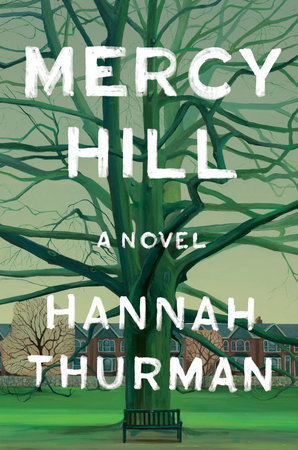
Download high-resolution image Look inside
Listen to a clip from the audiobook
audio pause button
0:00
0:00

Mercy Hill

A Novel

Author Hannah Thurman On Tour
Look inside
Listen to a clip from the audiobook
audio pause button
0:00
0:00
A debut family novel about four sisters growing up on the campus of the underfunded state mental hospital where their strong-willed mother serves as head of psychiatry. A richly moving story of sisterhood, loyalty, and mental health in America.

"Mercy Hill—both the place and the people who live there—will stay with you long after you put the book down.” —Richard Russo, author of Empire Falls


The Cross sisters have lived their entire lives on the sprawling grounds of Mercy Hill, the embattled Raleigh mental hospital run by their formidable mother. Since childhood, JJ, Caro, Mimi, and Denise have been inculcated with their mother's mission: they'll work alongside her to protect Mercy Hill from the fate of other state hospitals across the country, which are being gutted and closed, one by one.

After an incident involving the highest-security ward, Mercy Hill faces greater scrutiny than ever, and Lisa Cross pushes each of her daughters even harder in the name of her mission. As the sisters cross into adulthood, the pressures of their isolated environment and mercurial mother set them on different—and perilous—paths. And as the battle wages on, youngest sister and narrator Denise grapples with the added responsibility that comes from being the last hope for their mother’s dreams.

Set in the late 1990s and early 2000s, with Mercy Hill’s fate hanging in the balance, Denise recounts the transformations that shape and destroy her family, along with the landscape of mental healthcare in the United States. With sharp insight and real humor, debut novelist Hannah Thurman captures the turmoil of growing up, the true meaning of a calling, and the indelible bonds of family.
ONE

Mimi’s branch snapped like a gunshot, and all four of us began to scream.

The magnolia had been an easy climb, and so we’d gone both high and far—­up into the canopy and also out, scooting along the smooth limbs that reached over the barbed wire fence. Eighteen feet below us was the recreation yard of highest-­security Ward C, and up until this moment, we’d had the perfect perch to spy safely on the men below. But Mimi, like always, had gone too far, out to where her bough tapered into leaves. My own arms began to shake as I watched the bough bend and then split.

I felt a great ruffling wind as she plummeted past me, arms still locked around the limb like it would save her from what came next. Then two booms: first, as the wood made contact with the razor-­wire fence, sending a wave of clanging along the chain links. Next, the thud as my sister and her tree limb landed inside the yard.

The summer air was still and wet, and the cloying scent of magnolia flower rose from the ground where Mimi’s fall had knocked down a shower of moon-­white blossoms. Paralyzed, I clung tight to the bark, staring down. Mimi’s right leg was twisted underneath her, bent back at an angle that I’d never seen before. Her face wrenched into a grimace, and even eighteen feet up, I could hear her whisper: Is he coming?

For the first time since hearing the crack, I raised my head and looked around. My other two sisters, J.J. and Caro, were already beginning to make their way down the ladderlike limbs to safety. I tried to follow them, but my hands stayed locked. I had never felt fear like this before, and my heart beat wildly, like some animal was trapped inside me.

“Denise!” Mimi called up at me, louder than before: “Is he coming?”

I looked across the yard. Unlike Ward B, whose residents were allowed passes to the commissary and the post office and the tennis courts, Ward C was surrounded by a razor-­wire fence, a fence ten-­year-­old Mimi was now trapped inside. The men inside this fence arrived on the Hill in police cars and left in prison transport vans. And yes, drawn from the shade of the building where they’d been clustered, they were now making their way toward Mimi, led by the man we all called the Scarecrow.

The Scarecrow was taller than the others, with patchy hair that stuck out in tufts around his somber face. That was why we’d given him the nickname, because you could imagine him staring off in some field for hours, flat eyes fixed on a point well beyond what you were seeing. He’d arrived at the beginning of the summer, and we’d spent the last few weeks observing him. He made even the biggest longtimers, Carl and Joe James, shy away, and we wanted to know why.

J.J. threw herself at the fence from the outside, rattling the metal. “Techs!” she yelled. “Can we get a technician?”

Usually one of the techs, big dough-­faced men with army crewcuts, would be standing in the yard with the residents. But on hot days in the summer, many called in sick to go fishing. The wards were egregiously understaffed at the best of times, and in July and August it often seemed as if no one worked there at all.

J.J. then began to call the names of the nurses: Reginald, Jamie, Noah. At thirteen, she was the oldest and tallest, but standing there against the shining fence, she didn’t even reach the midpoint.

Numbly and dumbly, I thought: I should yell too. But my mouth was so dry I could hardly speak. I stared down at Mimi, watching as red cuts like scales appeared along her hands and arms and cheek, courtesy of the razor wire. With effort, she wrenched her arms behind her back, trying to push herself up to a sitting position. By the time she was upright, the Scarecrow was close enough to touch.

J.J. and now Caro, too, pounded the fence, their voices ringing in a twisted wail. “Mom!” Mimi sobbed, staring in vain at the ward’s open, empty door. “Mom!”

This is what, more than twenty years later, chills me most to remember. Mimi was the wildest, the bravest, the one who taunted the rest of us at any sign of fear. To see her helpless sliced at my skin as if I had been the one who had toppled into the yard.

The Scarecrow crouched down. Extended a broad hand against Mimi’s face, stroking his fingers through the blood on her cheek. She stopped screaming.

He held his hand up to the light, as if it weren’t high noon in August. Blood dripped down his wrist and he sniffed at it like he was trying to place the scent.

“Hey, you!” J.J. shouted, addressing him for the first time. “She’s Dr. Cross’s daughter. You know Dr. Cross?”

The Scarecrow lowered his hand. Mimi’s blood dripped from his finger onto the sun-­fried grass. After a very long moment, he spoke, the first time I’d ever heard his voice. “You look like her,” he said.

That wasn’t surprising. We all looked like our mother: dark hair, dark eyes, narrow hips and shoulders. I felt another wave of fear shake through me. I wanted to be back on the ground, but I didn’t trust myself to let go of my chokehold on the branch. My arms began to ache.

“Please,” J.J. said, pressing her whole body against the fence. “Can you please go get her? Please go get Dr. Cross.”

The air was so thick and still I felt as if I couldn’t take in another breath. My stomach seized at the possibility of violence.

Then he turned. He walked in a broken cadence, like he could come back around at any second. But he walked nonetheless. It drove the other residents back, like a shark through a school of fish, leaving him a direct path to the dark open door of the ward. No one spoke, everything was silent.

When he stepped into the narrow shadow of the building, everything happened at once. A blue flash of men’s scrubs, the snap of plastic restraints, the Scarecrow let out a high, piercing cry and thudded to the ground. His feet thrashed as one of the techs fought to bundle his kicking legs.

Lisa Cross, MD, stepped around the warring men, white coat blinding in the midday sun. She held the plastic cap of a prefilled syringe; with each step, her stethoscope flashed bright silver. She knelt down next to Mimi. “He did this?” She held her hand right where the Scarecrow had, and the gesture looked so similar that I wondered if he had simply been trying to stop the bleeding.

Mimi couldn’t speak. On the other side of the fence, J.J. said, “No, it was the fence. Her leg—­I think it’s broken.”

“Mom, he was trying to find you,” Caro said, staring off across the yard. I followed her gaze. Ernie the tech was standing again, brushing off his hands in a continued stream of motherfuckers. The Scarecrow lay, bound and silent, his face turned toward us. His eyes blinked slowly under heavy lashes, and his mouth, like Mimi’s, was pressed tightly in pain.

“Don’t worry about him,” our mother said. “Mimi, you need to stand if you can.”

Mimi tried once and flopped back down again, so our mother bent over and scooped her up. At ten, Mimi was only a head shorter than our mother, but she curled into her neck like she was much littler. Our mother struggled under the weight, shifting once, then turned to Caro and J.J. through the fence.

“Where’s Denise?”

They answered by looking up, and she followed their gaze. Her look cut through all the waving leaves and branches until it met my own, then went further, burrowing deep into my skull. It felt like I was witnessing my own dissection.

When she spoke, her voice was tighter than usual but no less commanding. “Go home now,” she said. “All of you.”

I felt movement return to my arms. Clumsy and shaking, I scrambled down the tree to where J.J. and Caro were waiting. The yard was empty, my mother and Mimi and all the men gone. How had the Scarecrow been taken back inside, bound as he was by the restraints? I don’t like to think about the answer.

J.J. cleared her throat and stepped between me and the fence, picking up her knit cap from where it had fallen. In the panic, all of us had stripped down to the most animal versions of ourselves and now that it was over, we were quickly reacclimatizing to our personalities. She pulled the hat on, then folded it back so you could see the sides of her cropped hair. In a few years J.J. would come out as a lesbian, and at thirteen, you could tell she was trying both to telegraph and hide the fact that she felt different, which mostly resulted in her wearing Daddy’s winter clothes year-­round.

Caro wiped her face with the back of her hand, elegant as a black-­and-­white-­movie star. At twelve, just a year younger than J.J., she was the most sensitive, able to pick up on our mother’s shifting moods before the rest of us. So when she took my hand and said, “We’d better go tell Daddy before she calls him,” J.J. and I listened, picking up our leaden feet and starting along down the path toward home.

The graying sidewalk was pitted and cracked, and empty holes trailed alongside where railings had once stood. The whole campus was like that, filled with ghostly reminders of its former grandeur. Those days weren’t the ones to idolize, our mother often told us: in the time of secrecy around mental illness, before pharmaceutical intervention, patients languished in these wards for their entire lives. But what wards they had been! We crossed into the shadow of the great limestone admin building, then wound around past the giant stone dormitories of Wards A and B.

The smoking yard for Ward B, which had only a short chain-­link fence, was empty.

“Did they lock down?” I asked, hearing the squeak of fear in my voice.

“I didn’t hear the sirens,” J.J. said, and we continued along in silence.

On the other side of Ward B’s empty yard was the identical Ward A, doors and first-­floor windows blocked with peeling plywood. I was too young to remember what it was like before Ward A closed, but J.J. and our mother told us stories: the patients housed there had been ancient and sedate, born in a time when children with disabilities were sent away to institutions and left there to be forgotten. On sunny days, the staff would push their wheelchairs out in a line into the rec yard, and then after a long and silent hour, they’d be pushed back inside. The last of those patients died in 1992, three years after I was born, and the entire building was shuttered. The four of us sometimes broke in when we were bored, climbing on the old metal bed frames and writing our names on the dust-­covered windows. There wasn’t much to do beyond that, and the shadowy hallways felt heavy with an old sadness and a present fear: that this very thing could happen to Wards B and C, as well.

This fear lurked everywhere across the grounds, a mist so fine it crept into every brick and balance sheet. Across the country, mental health advocates and belt-­tightening legislators alike were calling for deinstitutionalization, for “less restrictive accommodations.” Each year the staff list grew smaller, and we watched as patients were ferried out to halfway houses and group homes. The Hill was crumbling, fast.

You could see it everywhere we walked. Past the rusting swing set and the weedy gardens and down along the dry creek bed, through the patchy woods filled with the remnants of our forts, abandoned in the heat of the summer like tiny wards themselves. Then the path sloped, taking us down through the staff cottages: twenty-­five of them total, maybe ten of them occupied, all but ours by single adults, nurses and techs who didn’t earn enough money to rent a place off campus.

As the director of psychiatry for the entire hospital, our mother made $170,000 a year, which to my nine-­year-­old self seemed almost unfathomable. She was saving nearly all of it for our tuition—­undergraduate, then medical school, which we were all expected to attend. But thriftiness was not the only reason we lived where we did. In our war, as in any other, proximity was power. It’s harder to steal land to which someone has chained herself.
A People Best New Book
An Apple Best Book of the Month Pick

"An immersive, intelligent debut." --People

“Hannah Thurman’s debut novel knocked me for a loop, and trust me, it will do the same to you. A slow burn, Mercy Hill—both the place and the people who live there—will stay with you long after you put the book down.” —Richard Russo, author of Empire Falls and the North Bath trilogy of Fool novels

"Mercy Hill is an absorbing, perceptive, empathetic family novel, cut through with real humor and heart. I look forward to whatever comes next from Hannah Thurman.” --Mary Beth Keane, author of Ask Again, Yes

"Mercy Hill blew me away. I haven’t enjoyed a book this much in a long time—its expansiveness and its intimacy, its deep humanity. Hannah Thurman is a sensational storyteller; every character on these pages lives and breathes." --Claire Lombardo, author of The Most Fun We Ever Had

"Thurman brings a sharp, attentive sensibility to this story of complex family dynamics, control, and the aftermath of a highly pressurized childhood . . . a compelling and assured first book, one that signals a writer with both promise and the skill to fulfill it." --Chapter 16

"Incisive . . . revealing and nuanced . . . a perceptive take on an unusual childhood." Publishers Weekly

"Unique and utterly engrossing . . . a deeply moving and unusual tale about how the bonds of sisterhood are formed and tested.' --Apple Books Reviews

“An intense and poignant debut about four sisters burdened by their mother with an impossible mission—both politically and emotionally—and the different ways they are shaped by the same pressure. With finesse, Thurman renders a layered, extraordinary portrait of the complexity and competing “truths” of childhood—both as it is experienced, and as it is reassessed in adulthood. Readers will leave Mercy Hill pondering where history ends and our own feelings begin.” —Olivia Wolfgang-Smith, author of Mutual Interest

Mercy Hill is a tremendous debut, a beautifully written, engrossing story of family, individuality, and social purpose. Embedded in the landscape of America’s crumbling mental health care system, the Cross family is a crucible powered by a shared mission, its four brilliant daughters coming of age amid the moral complexities and dangers of freedom—both for the residents of Mercy Hill and for themselves. Hannah Thurman builds a nesting doll of a novel that operates on both a societal and personal level, illuminating the thorny nature of sacrifice and altruism, what it means to genuinely care for others, and what is finally and truly worth defending.” —Lauren Acampora, author of The Paper Wasp

“You might start this book for its insider’s take on a complicated era of mental health in America, but you’ll stay for the rough-hewn family of strong, unbending women. Thurman has given us a heart-breaking story of duty, love, rivalry and dedication, told through the voice of a singular narrator.” —Kawai Strong Washburn, PEN/Hemingway Award-winning author of Sharks in the Time of Saviors

"Thurman's careful attention to detail and authentic characterizations contribute to her satisfying domestic-saga debut." --Booklist

“How often does a book come along with the power and magic needed to keep you reading in the Age of Distraction? Mercy Hill—the story of Denise Cross and her sisters, coming of age on the grounds of an imperiled asylum—meets and exceeds that challenge; rarely spotted in Fiction Forest, this is a creature known as the literary page-turner. Do yourself a favor and don't start reading before you've cleared your calendar. Hannah Thurman's debut is a knock-out.” —Shelly Oria, author of New York 1, Tel Aviv 0

“Move over, Tolstoy. If it's true that each unhappy family is unhappy in its own way, then this has got to be the fiercest, funniest depiction of family unhappiness that I've encountered in a long time. A blisteringly beautiful debut that addresses the state of American medicine like a masterwork. Hannah Thurman is the realest of real deals.” —David James Poissant, author of The Heaven of Animals and Lake Life

"The strength of the story is the personality of the sisters as each one grows and fails. The irony of the story is the dysfunction of the family living at a mental health hospital as the girls explore intimacy, religion, and, unfortunately, wrongdoing." --Library Journal

"A powerful glimpse into political and economic realities of providing mental health care in the recent past alongside a compassionate and complex portrait of a contemporary family confronting psychological and social realities of their own while fighting to preserve a common dream." --North Carolina Literary Review
HANNAH THURMAN is a Brooklyn-based writer originally from Raleigh, North Carolina. She was recently named a 2024 NYSCA/NYFA Artist Fellow in Fiction. The winner of the Florida Review’s 2023 Editor’s Prize for Fiction, her stories have been published in The Iowa Review, Michigan Quarterly Review, The Brooklyn Rail, and Southern Indiana Review, among others. She has been chosen for residencies at Yaddo, Ragdale, Vermont Studio Center, and Virginia Center for the Creative Arts. This is her first novel. View titles by Hannah Thurman

About

A debut family novel about four sisters growing up on the campus of the underfunded state mental hospital where their strong-willed mother serves as head of psychiatry. A richly moving story of sisterhood, loyalty, and mental health in America.

"Mercy Hill—both the place and the people who live there—will stay with you long after you put the book down.” —Richard Russo, author of Empire Falls


The Cross sisters have lived their entire lives on the sprawling grounds of Mercy Hill, the embattled Raleigh mental hospital run by their formidable mother. Since childhood, JJ, Caro, Mimi, and Denise have been inculcated with their mother's mission: they'll work alongside her to protect Mercy Hill from the fate of other state hospitals across the country, which are being gutted and closed, one by one.

After an incident involving the highest-security ward, Mercy Hill faces greater scrutiny than ever, and Lisa Cross pushes each of her daughters even harder in the name of her mission. As the sisters cross into adulthood, the pressures of their isolated environment and mercurial mother set them on different—and perilous—paths. And as the battle wages on, youngest sister and narrator Denise grapples with the added responsibility that comes from being the last hope for their mother’s dreams.

Set in the late 1990s and early 2000s, with Mercy Hill’s fate hanging in the balance, Denise recounts the transformations that shape and destroy her family, along with the landscape of mental healthcare in the United States. With sharp insight and real humor, debut novelist Hannah Thurman captures the turmoil of growing up, the true meaning of a calling, and the indelible bonds of family.

Excerpt

ONE

Mimi’s branch snapped like a gunshot, and all four of us began to scream.

The magnolia had been an easy climb, and so we’d gone both high and far—­up into the canopy and also out, scooting along the smooth limbs that reached over the barbed wire fence. Eighteen feet below us was the recreation yard of highest-­security Ward C, and up until this moment, we’d had the perfect perch to spy safely on the men below. But Mimi, like always, had gone too far, out to where her bough tapered into leaves. My own arms began to shake as I watched the bough bend and then split.

I felt a great ruffling wind as she plummeted past me, arms still locked around the limb like it would save her from what came next. Then two booms: first, as the wood made contact with the razor-­wire fence, sending a wave of clanging along the chain links. Next, the thud as my sister and her tree limb landed inside the yard.

The summer air was still and wet, and the cloying scent of magnolia flower rose from the ground where Mimi’s fall had knocked down a shower of moon-­white blossoms. Paralyzed, I clung tight to the bark, staring down. Mimi’s right leg was twisted underneath her, bent back at an angle that I’d never seen before. Her face wrenched into a grimace, and even eighteen feet up, I could hear her whisper: Is he coming?

For the first time since hearing the crack, I raised my head and looked around. My other two sisters, J.J. and Caro, were already beginning to make their way down the ladderlike limbs to safety. I tried to follow them, but my hands stayed locked. I had never felt fear like this before, and my heart beat wildly, like some animal was trapped inside me.

“Denise!” Mimi called up at me, louder than before: “Is he coming?”

I looked across the yard. Unlike Ward B, whose residents were allowed passes to the commissary and the post office and the tennis courts, Ward C was surrounded by a razor-­wire fence, a fence ten-­year-­old Mimi was now trapped inside. The men inside this fence arrived on the Hill in police cars and left in prison transport vans. And yes, drawn from the shade of the building where they’d been clustered, they were now making their way toward Mimi, led by the man we all called the Scarecrow.

The Scarecrow was taller than the others, with patchy hair that stuck out in tufts around his somber face. That was why we’d given him the nickname, because you could imagine him staring off in some field for hours, flat eyes fixed on a point well beyond what you were seeing. He’d arrived at the beginning of the summer, and we’d spent the last few weeks observing him. He made even the biggest longtimers, Carl and Joe James, shy away, and we wanted to know why.

J.J. threw herself at the fence from the outside, rattling the metal. “Techs!” she yelled. “Can we get a technician?”

Usually one of the techs, big dough-­faced men with army crewcuts, would be standing in the yard with the residents. But on hot days in the summer, many called in sick to go fishing. The wards were egregiously understaffed at the best of times, and in July and August it often seemed as if no one worked there at all.

J.J. then began to call the names of the nurses: Reginald, Jamie, Noah. At thirteen, she was the oldest and tallest, but standing there against the shining fence, she didn’t even reach the midpoint.

Numbly and dumbly, I thought: I should yell too. But my mouth was so dry I could hardly speak. I stared down at Mimi, watching as red cuts like scales appeared along her hands and arms and cheek, courtesy of the razor wire. With effort, she wrenched her arms behind her back, trying to push herself up to a sitting position. By the time she was upright, the Scarecrow was close enough to touch.

J.J. and now Caro, too, pounded the fence, their voices ringing in a twisted wail. “Mom!” Mimi sobbed, staring in vain at the ward’s open, empty door. “Mom!”

This is what, more than twenty years later, chills me most to remember. Mimi was the wildest, the bravest, the one who taunted the rest of us at any sign of fear. To see her helpless sliced at my skin as if I had been the one who had toppled into the yard.

The Scarecrow crouched down. Extended a broad hand against Mimi’s face, stroking his fingers through the blood on her cheek. She stopped screaming.

He held his hand up to the light, as if it weren’t high noon in August. Blood dripped down his wrist and he sniffed at it like he was trying to place the scent.

“Hey, you!” J.J. shouted, addressing him for the first time. “She’s Dr. Cross’s daughter. You know Dr. Cross?”

The Scarecrow lowered his hand. Mimi’s blood dripped from his finger onto the sun-­fried grass. After a very long moment, he spoke, the first time I’d ever heard his voice. “You look like her,” he said.

That wasn’t surprising. We all looked like our mother: dark hair, dark eyes, narrow hips and shoulders. I felt another wave of fear shake through me. I wanted to be back on the ground, but I didn’t trust myself to let go of my chokehold on the branch. My arms began to ache.

“Please,” J.J. said, pressing her whole body against the fence. “Can you please go get her? Please go get Dr. Cross.”

The air was so thick and still I felt as if I couldn’t take in another breath. My stomach seized at the possibility of violence.

Then he turned. He walked in a broken cadence, like he could come back around at any second. But he walked nonetheless. It drove the other residents back, like a shark through a school of fish, leaving him a direct path to the dark open door of the ward. No one spoke, everything was silent.

When he stepped into the narrow shadow of the building, everything happened at once. A blue flash of men’s scrubs, the snap of plastic restraints, the Scarecrow let out a high, piercing cry and thudded to the ground. His feet thrashed as one of the techs fought to bundle his kicking legs.

Lisa Cross, MD, stepped around the warring men, white coat blinding in the midday sun. She held the plastic cap of a prefilled syringe; with each step, her stethoscope flashed bright silver. She knelt down next to Mimi. “He did this?” She held her hand right where the Scarecrow had, and the gesture looked so similar that I wondered if he had simply been trying to stop the bleeding.

Mimi couldn’t speak. On the other side of the fence, J.J. said, “No, it was the fence. Her leg—­I think it’s broken.”

“Mom, he was trying to find you,” Caro said, staring off across the yard. I followed her gaze. Ernie the tech was standing again, brushing off his hands in a continued stream of motherfuckers. The Scarecrow lay, bound and silent, his face turned toward us. His eyes blinked slowly under heavy lashes, and his mouth, like Mimi’s, was pressed tightly in pain.

“Don’t worry about him,” our mother said. “Mimi, you need to stand if you can.”

Mimi tried once and flopped back down again, so our mother bent over and scooped her up. At ten, Mimi was only a head shorter than our mother, but she curled into her neck like she was much littler. Our mother struggled under the weight, shifting once, then turned to Caro and J.J. through the fence.

“Where’s Denise?”

They answered by looking up, and she followed their gaze. Her look cut through all the waving leaves and branches until it met my own, then went further, burrowing deep into my skull. It felt like I was witnessing my own dissection.

When she spoke, her voice was tighter than usual but no less commanding. “Go home now,” she said. “All of you.”

I felt movement return to my arms. Clumsy and shaking, I scrambled down the tree to where J.J. and Caro were waiting. The yard was empty, my mother and Mimi and all the men gone. How had the Scarecrow been taken back inside, bound as he was by the restraints? I don’t like to think about the answer.

J.J. cleared her throat and stepped between me and the fence, picking up her knit cap from where it had fallen. In the panic, all of us had stripped down to the most animal versions of ourselves and now that it was over, we were quickly reacclimatizing to our personalities. She pulled the hat on, then folded it back so you could see the sides of her cropped hair. In a few years J.J. would come out as a lesbian, and at thirteen, you could tell she was trying both to telegraph and hide the fact that she felt different, which mostly resulted in her wearing Daddy’s winter clothes year-­round.

Caro wiped her face with the back of her hand, elegant as a black-­and-­white-­movie star. At twelve, just a year younger than J.J., she was the most sensitive, able to pick up on our mother’s shifting moods before the rest of us. So when she took my hand and said, “We’d better go tell Daddy before she calls him,” J.J. and I listened, picking up our leaden feet and starting along down the path toward home.

The graying sidewalk was pitted and cracked, and empty holes trailed alongside where railings had once stood. The whole campus was like that, filled with ghostly reminders of its former grandeur. Those days weren’t the ones to idolize, our mother often told us: in the time of secrecy around mental illness, before pharmaceutical intervention, patients languished in these wards for their entire lives. But what wards they had been! We crossed into the shadow of the great limestone admin building, then wound around past the giant stone dormitories of Wards A and B.

The smoking yard for Ward B, which had only a short chain-­link fence, was empty.

“Did they lock down?” I asked, hearing the squeak of fear in my voice.

“I didn’t hear the sirens,” J.J. said, and we continued along in silence.

On the other side of Ward B’s empty yard was the identical Ward A, doors and first-­floor windows blocked with peeling plywood. I was too young to remember what it was like before Ward A closed, but J.J. and our mother told us stories: the patients housed there had been ancient and sedate, born in a time when children with disabilities were sent away to institutions and left there to be forgotten. On sunny days, the staff would push their wheelchairs out in a line into the rec yard, and then after a long and silent hour, they’d be pushed back inside. The last of those patients died in 1992, three years after I was born, and the entire building was shuttered. The four of us sometimes broke in when we were bored, climbing on the old metal bed frames and writing our names on the dust-­covered windows. There wasn’t much to do beyond that, and the shadowy hallways felt heavy with an old sadness and a present fear: that this very thing could happen to Wards B and C, as well.

This fear lurked everywhere across the grounds, a mist so fine it crept into every brick and balance sheet. Across the country, mental health advocates and belt-­tightening legislators alike were calling for deinstitutionalization, for “less restrictive accommodations.” Each year the staff list grew smaller, and we watched as patients were ferried out to halfway houses and group homes. The Hill was crumbling, fast.

You could see it everywhere we walked. Past the rusting swing set and the weedy gardens and down along the dry creek bed, through the patchy woods filled with the remnants of our forts, abandoned in the heat of the summer like tiny wards themselves. Then the path sloped, taking us down through the staff cottages: twenty-­five of them total, maybe ten of them occupied, all but ours by single adults, nurses and techs who didn’t earn enough money to rent a place off campus.

As the director of psychiatry for the entire hospital, our mother made $170,000 a year, which to my nine-­year-­old self seemed almost unfathomable. She was saving nearly all of it for our tuition—­undergraduate, then medical school, which we were all expected to attend. But thriftiness was not the only reason we lived where we did. In our war, as in any other, proximity was power. It’s harder to steal land to which someone has chained herself.

Reviews

A People Best New Book
An Apple Best Book of the Month Pick

"An immersive, intelligent debut." --People

“Hannah Thurman’s debut novel knocked me for a loop, and trust me, it will do the same to you. A slow burn, Mercy Hill—both the place and the people who live there—will stay with you long after you put the book down.” —Richard Russo, author of Empire Falls and the North Bath trilogy of Fool novels

"Mercy Hill is an absorbing, perceptive, empathetic family novel, cut through with real humor and heart. I look forward to whatever comes next from Hannah Thurman.” --Mary Beth Keane, author of Ask Again, Yes

"Mercy Hill blew me away. I haven’t enjoyed a book this much in a long time—its expansiveness and its intimacy, its deep humanity. Hannah Thurman is a sensational storyteller; every character on these pages lives and breathes." --Claire Lombardo, author of The Most Fun We Ever Had

"Thurman brings a sharp, attentive sensibility to this story of complex family dynamics, control, and the aftermath of a highly pressurized childhood . . . a compelling and assured first book, one that signals a writer with both promise and the skill to fulfill it." --Chapter 16

"Incisive . . . revealing and nuanced . . . a perceptive take on an unusual childhood." Publishers Weekly

"Unique and utterly engrossing . . . a deeply moving and unusual tale about how the bonds of sisterhood are formed and tested.' --Apple Books Reviews

“An intense and poignant debut about four sisters burdened by their mother with an impossible mission—both politically and emotionally—and the different ways they are shaped by the same pressure. With finesse, Thurman renders a layered, extraordinary portrait of the complexity and competing “truths” of childhood—both as it is experienced, and as it is reassessed in adulthood. Readers will leave Mercy Hill pondering where history ends and our own feelings begin.” —Olivia Wolfgang-Smith, author of Mutual Interest

Mercy Hill is a tremendous debut, a beautifully written, engrossing story of family, individuality, and social purpose. Embedded in the landscape of America’s crumbling mental health care system, the Cross family is a crucible powered by a shared mission, its four brilliant daughters coming of age amid the moral complexities and dangers of freedom—both for the residents of Mercy Hill and for themselves. Hannah Thurman builds a nesting doll of a novel that operates on both a societal and personal level, illuminating the thorny nature of sacrifice and altruism, what it means to genuinely care for others, and what is finally and truly worth defending.” —Lauren Acampora, author of The Paper Wasp

“You might start this book for its insider’s take on a complicated era of mental health in America, but you’ll stay for the rough-hewn family of strong, unbending women. Thurman has given us a heart-breaking story of duty, love, rivalry and dedication, told through the voice of a singular narrator.” —Kawai Strong Washburn, PEN/Hemingway Award-winning author of Sharks in the Time of Saviors

"Thurman's careful attention to detail and authentic characterizations contribute to her satisfying domestic-saga debut." --Booklist

“How often does a book come along with the power and magic needed to keep you reading in the Age of Distraction? Mercy Hill—the story of Denise Cross and her sisters, coming of age on the grounds of an imperiled asylum—meets and exceeds that challenge; rarely spotted in Fiction Forest, this is a creature known as the literary page-turner. Do yourself a favor and don't start reading before you've cleared your calendar. Hannah Thurman's debut is a knock-out.” —Shelly Oria, author of New York 1, Tel Aviv 0

“Move over, Tolstoy. If it's true that each unhappy family is unhappy in its own way, then this has got to be the fiercest, funniest depiction of family unhappiness that I've encountered in a long time. A blisteringly beautiful debut that addresses the state of American medicine like a masterwork. Hannah Thurman is the realest of real deals.” —David James Poissant, author of The Heaven of Animals and Lake Life

"The strength of the story is the personality of the sisters as each one grows and fails. The irony of the story is the dysfunction of the family living at a mental health hospital as the girls explore intimacy, religion, and, unfortunately, wrongdoing." --Library Journal

"A powerful glimpse into political and economic realities of providing mental health care in the recent past alongside a compassionate and complex portrait of a contemporary family confronting psychological and social realities of their own while fighting to preserve a common dream." --North Carolina Literary Review

Author

HANNAH THURMAN is a Brooklyn-based writer originally from Raleigh, North Carolina. She was recently named a 2024 NYSCA/NYFA Artist Fellow in Fiction. The winner of the Florida Review’s 2023 Editor’s Prize for Fiction, her stories have been published in The Iowa Review, Michigan Quarterly Review, The Brooklyn Rail, and Southern Indiana Review, among others. She has been chosen for residencies at Yaddo, Ragdale, Vermont Studio Center, and Virginia Center for the Creative Arts. This is her first novel. View titles by Hannah Thurman
  • More Websites from
    Penguin Random House
  • Common Reads
  • Library Marketing