Download high-resolution image
Listen to a clip from the audiobook
audio pause button
0:00
0:00

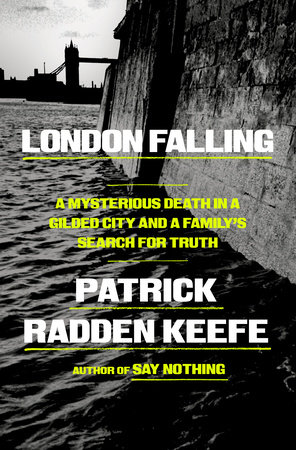
London Falling

A Mysterious Death in a Gilded City and a Family's Search for Truth

Author Patrick Radden Keefe On Tour
Listen to a clip from the audiobook
audio pause button
0:00
0:00
#1 NEW YORK TIMES BESTSELLER • From the bestselling, prizewinning author of Say Nothing and Empire of Pain, a spellbinding account of a family devastated by the sudden death of their nineteen-year-old son, only to discover that he had created a secret life which drew him into the dangerous criminal underworld that lies beneath London’s glittering surface

“Another blockbuster feat of reportage. . . . I sprinted through this addictive book in three days and gasped more than once at the true story’s twists and turns.”
Esquire

A NEW YORK TIMES BEST BOOK OF THE YEAR SO FAR


In the early morning of November 29th, 2019, surveillance cameras at the headquarters of MI6, Britain’s spy agency, captured video of a young man pacing back and forth on a high balcony of Riverwalk, a luxury tower on the bank of the river Thames. At 2:24 a.m., he jumped into the river.

In a quiet London neighborhood several miles away, Rachelle Brettler was worried about her son. Zac had told her that he had gone to stay with a friend for the weekend, but then he did not come home. Days later, a police car pulled up and two officers relayed the dreadful news: Her son was dead.

In their unbearable grief, Rachelle and her husband, Matthew, struggled to understand what had happened to Zac. He had had his troubles, but in no way seemed suicidal. As they would soon discover, however, there was a lot they did not know about their son. Only after his death did they learn that he had adopted a fictitious alter ego: Zac Ismailov, son of a Russian oligarch and heir to a great fortune. Under this guise, Zac had become entangled with a slippery London businessman named Akbar Shamji and a murderous gangster known as Indian Dave. As the Brettlers set about investigating their son’s death, they were pulled into a different and more dangerous London than the one they’d always known, and came to believe that something much more nefarious than a suicide had claimed Zac’s life. But to their immense frustration, Scotland Yard seemed unable—or unwilling—to bring the perpetrators to justice. 

In a bravura feat of reporting and writing, Patrick Radden Keefe chronicles the Brettlers’ quest, peeling back layers of mystery and exposing the seedy truths behind the glamorous London of posh mansions and private nightclubs, a city in which everything is for sale, and aspirational fantasies are underwritten by dirty money and corruption. London Falling is a mesmerizing investigation of an inexplicable death and a powerful narrative driven by suspense and staggering revelations. But it is also an intimate and deeply poignant inquiry into the nature of parental love and the challenges of being a parent today, a portrait of a family trying to solve the riddle not just of how their son died, but of who he really was in life.
PROLOGUE


The headquarters of Britain’s Secret Intelligence Service, MI6, occupies an imposing edifice of concrete and green glass on the south bank of the River Thames, in London. It was erected in the early 1990s, alongside Vauxhall Bridge, under circumstances of such secrecy that when the architect was commissioned to design the building, he did not know who he was designing it for.

The Thames is a tidal river, its powerful currents ebbing and surging twice each day with salt water from the North Sea. Occasionally a bottlenose whale will veer off course, separated from its pod, and wander downriver, dangerously far from the ocean. When the tide recedes, the Thames shrinks, its level plummeting by as much as twenty feet, exposing a muddy shoreline. Urban beachcombers—“mudlarks,” as they’re known—have unearthed artifacts of previous civilizations from the silt along the riverbanks: Bronze Age daggers and Iron Age coins.

It was the Thames that first drew the Romans, two thousand years ago, to establish a walled entrepôt, which they gave the name Londinium. By the heyday of the British Empire, London had colonized a quarter of the globe. In 1860, half of all exports from Asia, Africa, and Latin America were sent there; the Thames was the busiest port in the world. Hundreds of ships arrived each week, and towering cranes unloaded tobacco, ivory, spices, wool, rice, tea, and other treasures. The river was teeming, thrumming with commerce, jostling with all manner of vessels and tradesmen and stevedores and mariners from strange lands, hinting at the existence of other civilizations over the horizon.

But the riverbank could be a frightening place as well. In the Victorian era, the waterfront was rife with crime. People had an alarming tendency to die in the Thames, whether voluntarily, in a moment of despair, or because somebody pushed them. If you misstepped on a slick cobble after a night out drinking, the black water could suck you under in an instant. In the work of Charles Dickens, the river was often depicted as a malignant force, grimy and malodorous, “lapping at piles and posts and iron rings, hiding strange things in its mud, running away with suicides and accidentally drowned bodies.” This was the paradox of the Thames: it was the pulsing artery of London’s industrial boom, with vast factories and warehouses swarming with laborers and belching smoke along its banks. But at the same time, Dickens saw in the river “an image of death,” a ribbon of danger coiling through “the midst of the great city’s life.”

The design of the MI6 building was meant to evoke Britain’s industrial era, echoing the monolithic power stations, like Battersea and Bankside, which stood nearby. But by 1994, when Queen Elizabeth II presided over the opening of the new spy headquarters, the power stations had long since been decommissioned and now seemed like artifacts themselves, relics of London’s vanished past as a factory town. The city had shuttered most of its factories; between 1960 and 1990, jobs in the manufacturing sector declined by 80 percent.

Shipping, too, had disappeared. In 1955, an American trucking executive from North Carolina invented the modern stackable shipping container. The standardization of these twenty- and forty-foot steel boxes during the 1960s sparked a revolution in global commerce, enabling a more integrated transportation infrastructure in which containers could be transferred fluidly from truck to ship to train. Suddenly big waterfront warehouses for the storage of goods were obsolete, and a new class of gigantic container ships could accommodate ever-larger loads. These vessels were so big that they could no longer navigate the narrow docks lining the Thames. So between 1960 and 1980, nearly all of London’s docks shut down and a whole commercial sector that had sustained the region virtually disappeared. For hundreds of years, London had been a port city. Then, quite abruptly, it wasn’t.

At least the air was clear. The word “smog” had been invented in London, to describe the smoke from coal fires and factories, mingled with English fog, that often enshrouded the city. But new regulations on such fires, combined with the closure of so many factories, meant that suddenly London had clean air. By the time MI6 headquarters opened, the old Dickensian industrial city had been supplanted by a glistening new metropolis. London might not be a center of shipping or manufacturing anymore, but it was reinventing itself as a financial capital. The waterfront was experiencing an astonishing revitalization: in 1988, a group of young British art students had converted a derelict warehouse in the Surrey Docks into a temporary gallery for an exhibition called Freeze. Cool restaurants soon followed, and eventually new housing and high-tech trading floors. Having shed any trace of its old grit or menace, London’s waterfront had become a sanitized playground for tourists and young professionals. In 2000, Bankside Power Station reopened as the Tate Modern museum. Battersea Power Station would eventually find new life as a shopping mall.

To many, this new London was hugely exciting: the city had been reimagined as a preferred destination for money and people who had it. Suddenly there were good restaurants for what felt like the first time in history, and world-class shopping and deluxe hotels with chauffeured Bentleys idling out front. Once again, cranes dominated London’s skyline, but now they were not unloading cotton or nutmeg but throwing up glass-and-steel skyscrapers and glossy residential complexes with staggering prices. In fact, a lot of Londoners found themselves priced out of this new version of their city, forced to relocate and commute from distant suburbs. Much of the real estate speculation was driven by foreign buyers, who regarded property in London as an investment rather than a place to live. So the buildings were full of amenities—but curiously devoid of residents, because the international owners were mostly out of town. Clocks in lobbies displayed the times in Moscow, Hong Kong, and Abu Dhabi. “You have people with five, ten apartments all around the world,” a staffer at one new luxury tower remarked. “They come and go.”

London was an attractive second home for “potentates, monarchs, chiefs, sultans, and diplomats,” Trevor Abrahmsohn, a veteran real estate agent with a billionaire clientele, observed. But many of these foreign-owned properties remained unoccupied for much of the year. A former deputy mayor of London, Nicky Gavron, complained that overseas investors “want to buy a luxury flat in a skyscraper to treat as a safety deposit box.” In fact, there is a statistical correlation between the value of a property and the likelihood that it will be occupied: the higher the price, the greater the chance it is empty. As a consequence, parts of London that had once thronged with local people now often seemed eerily depopulated. The effect was unsettling; in fashionable neighborhoods after sundown, the windows of the multimillion-dollar dwellings were all dark. The press gave a nickname to these vacant palaces: ghost mansions.

In 2016, one of these luxury buildings was constructed on the north bank of the Thames, directly across from MI6, on a site that had once housed a nineteenth-century prison. It was a residential complex called Riverwalk and consisted of a pair of sleek towers, one tall and one short, connected by a low-slung lobby and fronted by a cascade of curved balconies. Riverwalk had been conceived by a buccaneering property impresario, Sir Gerald Ronson, who was convicted in 1990 on charges of conspiracy, false accounting, and theft in connection with a stock fraud case; did a stint in prison; and then, in 2012, was made a Commander of the British Empire for his philanthropic work. “Imagine the parties you could throw here,” Ronson told an interviewer when construction was complete. From the £25 million penthouse, you could see as far away as Wembley Stadium. The building’s wealthy residents were rumored to include Tom Jones, the Welsh crooner who was famous for songs like “It’s Not Unusual” and “Help Yourself.” But it was hard to say for sure, because people who purchased units at Riverwalk tended to register them through offshore trusts and shell companies, to preserve their anonymity. And anyway, much of the time the place seemed empty.

In the early hours of November 29, 2019, a surveillance camera on MI6 headquarters registered movement on the fifth floor of the taller tower at Riverwalk, just across the water. The night was cold. The Thames was running high, and the reflected illumination of the lamps lining Vauxhall Bridge danced on the surface of the water. Riverwalk was almost entirely dark, but one apartment blazed with light: unit 504.

At 2:23 a.m., the MI6 camera captured a dark figure walking out of the apartment and onto the narrow balcony overlooking the Thames. It was a slender silhouette against the brightly lit windows: a young man. He made his way to one corner of the balcony and seemed to peer over the ledge, before crossing to the other corner and briefly pausing there. Then, returning to the center of the balcony, he jumped.
A NEW YORK TIMES BEST BOOK OF THE YEAR SO FAR

NAMED A MOST ANTICIPATED BOOK BY The New York Times, The New Yorker, The Washington Post, TIME, Oprah Daily, Vulture, Minneapolis Star Tribune, Cultured, LitHub, Service95, Bookriot


“Consider this a real-life Harlan Coben novel. After 19-year-old Zac Brettler plunges to his death in the river Thames, his grieving family discovers his secret life posing as the heir of a phony Russian oligarch. From there, Keefe reconstructs the seedy underbelly of London that the Brettlers delve into as they attempt to pinpoint what—or who—killed their son.”
The New York Times

London Falling, is [Keefe’s] most gripping book yet, using its initially narrow premise . . . as an entry point into the more expansive story of London’s underworld and the downstream effects of what happens when greed corrupts a city at its highest levels. As always with Keefe the pages turn themselves, and he sidesteps the exploitative pitfalls of the true-crime genre by finding thrills in the margins. . . . When Keefe returns to Brettler’s story, it becomes one about modern parenting and the search for peace amid unresolvable grief.”
New York Magazine

“A remarkable true-crime story. A 19-year-old fell to his death in London. Behind the tragedy lay so much more, as Keefe’s latest book uncovers. . . . The best true-crime stories use a particular event as a key to unlock a world, and Patrick Radden Keefe’s latest work of investigative nonfiction, London Falling, does just that. . . . Keefe finds, in the death of one teenager, both a private loss and a parable of the decay of a once great city.”
—Laura Miller, Slate

“A strange story of wealth, delusion, and violence. . . . [Keefe] shows how London’s vicious currents turn with the tides of finance and immigration. . . . London Falling has a Dickensian texture, but nothing is fictional. Dickens’s readers balk at his use of caricature and coincidence, but as Mr. Keefe shows, both are appropriate for a money-mad city full of affluence and anonymity, weird proximities and sudden death. . . . Keefe casts light on dark waters, and serves a measure of justice to Zac Brettler and his family.”
The Wall Street Journal

“Another blockbuster feat of reportage. . . . I sprinted through this addictive book in three days and gasped more than once at the true story’s twists and turns.”
—Adam Morgan, Esquire

“The most propulsive, quick-reading book that [Keefe] has written; you might find yourself willing to forego scrolling, eating, or sleeping to race to its end. With zero distractions, a devoted reader could finish in a day or two. But London Falling is a book that rewards steady attention and sustained consideration. . . . The alternately seedy and posh vistas of the United Kingdom’s capital, the slow building of suspense, and the weaving together of coming-of-age, post-Soviet, and true-crime storylines give the book a novelistic sense. In the Brettlers, who grow steeled and skeptical as a result of their dogged inquiry, Keefe offers us two protagonists whose brush with the criminal underworld feels like a parable for our age of corruption.”
The Atlantic

“A propulsive true-crime story and surgical critique of the city’s glamorous façade and dark underbelly. . . . His reporting is broad and agile, his prose sharp-edged. . . . Keefe has written a morality tale for an amoral age while entertaining us with shootouts, robberies, heroin deals, and an enigmatic puzzle. His journalism is rooted in our obligations to each other, old-fashioned Eagle Scout citizenship, at a moment when might makes right and obscene wealth overwhelms our institutions.”
—Boston Globe

“[Keefe] brings his capacious literary toolbox to a true-life tale that opens with the apparent suicide. . . . [His] stylish, suspenseful prose shines a light onto the seedy underworld beneath an international capital.”
TIME

“Gripping. . . . Keefe is a master at using true crime as a vehicle for exploring social and political pathologies.”
—NPR

London Falling is superbly gripping. This investigation into the real-life death of a teenage boy follows the trail where money, power and secrecy mingle in the capital. I predict it will become a defining book of our time.”
—Johanna Thomas-Corr, Sunday Times (UK)

“A profound exploration of parental grief and the search for accountability in a city that often protects its most shadowy residents. . . . Compelling.”
—Air Mail

London Falling, grimly absorbing from start to finish, opens a window on to a world of financial dirty work and Walter Mitty-like fantasies of aspirational wealth.”
The Guardian

“Remarkable. . . . Keefe has made a career of finding the human story at the center of large institutional failures, from the Sackler family and the opioid crisis, to the IRA and a woman who vanished in Belfast. With London Falling, he’s found something incredibly intriguing and personal, a family trying to understand their son after it’s too late. . . . Keefe resists easy moralizing. He is more interested in understanding and that may be what makes the book so hard to put down. Readers seem to find themselves rooting for a family to find justice while wondering, alongside them, whether justice is even possible.”
—Parade

“A master storyteller. . . . Fans of rigorous reporting, multilayered true-crime stories, and portraits of families in crisis will find something to love in this tour de force.”
Washington Independent Review of Books

“The world knows Patrick Radden Keefe as one of the great living nonfiction writers. . . . Patrick’s reporting? Deep. His prose? Elegant. His tales? Enveloping. He is our foremost chronicler of illicit systems that would prefer to do their dirty work in the darkness, and which he drags into the light. . . . The book is a caper. A romp. Haunting. Profound. It’s about greed, delusion, predation, willful police incompetence, and the way money can poison the soul not just of a person but of a city.”
Blackbird Spyplane

“A masterclass of evidence-chasing, narrative clarity and authorial empathy. . . . [An] impeccable (indeed unputdownable) investigative exercise. . . . A desperately sad family story, overlaid on a disturbing glimpse of London's sinister, money-driven, exploitative underbelly.”
Literary Review (UK)

“Makes for propulsive reading. . . . Keefe’s mastery of timing reveals makes [London Falling] a page-turner.”
Irish Times

“Magnificent. . . . Keefe has a dramatist’s gift for structure and a novelist’s fascination with character and motive. . . . Riveting and powerful. . . . The book has its origins in a New Yorker article, but it goes so much deeper in its profound revelations. . . . This [is an] enthralling masterpiece, by one of the world’s great nonfiction writers.”
—The Observer

“One of the finest, and most famous, magazine writers in the English-speaking world. . . . Thrilling. . . . Astonishing. . . . Forms a topography not just of the physical London but its psychological terrain, its labyrinth of paranoia.”
—New Statesman

“Keefe has written his most intimate true story. . . . Suspenseful. . . . Compelling. . . . [Keefe] is that rarest of reporter birds, a deeply thorough investigative journalist who can actually write and tell a gripping human story. Anyone who starts London Falling will finish it quickly.. . . Under Patrick Radden Keefe’s relentless drive to get to the bottom of the story lies a deeper and darker distaste for the excesses of capitalism. . . . A tale of what happens when money becomes more important than human beings.”
—The Globe and Mail


London Falling is, it goes without saying, a masterpiece. A novelistic study of parenthood, a portrait of the Anglo-Jewry, a fine-drawn sketch of teenage braggadocio, it also has perhaps the finest work of non-fiction about the London criminal classes, a milieu best known for their cinematic representations in Sexy Beast, The Long Good Friday and the various guilty pleasures that Guy Ritchie proffers.”
The Fence (UK)

“Keefe, the author of some of this century’s finest nonfiction, has crafted another masterwork. This is a penetrating portrait of a young man destroyed by malignant influences given free rein in a global hub of capitalist excess. . . . Keefe might be our sharpest chronicler of the intersection of criminal opportunism and institutional fecklessness. . . . This is powerful reporting, a potential classic about the dangerous allure of a city remade as ‘a twenty-four-hour laundromat for dirty money.’ An exemplary account of naïveté, wealth, and menace, impeccably told by a top-notch journalist.”
Kirkus Reviews (starred review)

“[A] gripping investigation into a young man’s mysterious death. . . . In between piecing together the facts, Keefe zooms out, vividly portraying the morass of the modern London underworld. . . . Keefe’s approach is profoundly humane, particularly in his intimate interviews with Zac’s parents, Matthew and Rachelle, who convey a deep desire to understand their late son. Despite the murky material, Keefe arrives at an artful and clarifying explanation. It’s a remarkable new turn for the celebrated author.”
Publishers Weekly (starred review)

“It feels like taking a weight off and settling into a warm bath, reading the first few paragraphs of a new work by an author so capable that the book’s quality is immediately evident. . . . That’s the joy of London Falling. . . . It’s John le Carré meets Skins in the newest thrilling effort from one of the best nonfiction writers working.”
Bookpage (starred review)

“A meticulously researched propulsive thriller. . . . A feat of remarkable reportage. . . . Irresistible. . . . Keefe’s unerringly razor-sharp attention links these disparate elements of heedless ambition, uninhibited risks, and otherworldly privilege that created a powerful vacuum of want in a tenacious teen desperate for access. With empathetic insight, Keefe deftly sifts through facts and fictions to distill Zac’s young life, enthrallingly seeking the unknowable truth of his tragic death.”
Shelf Awareness

“Nobody writes like Patrick Radden Keefe; nobody makes achieving something so powerfully complex and difficult look so easy. It’s a form of intellectual generosity and, I think, a form of genius. London Falling is a book everyone should read; it grips like a steel trap. To finish it is to be furious at the corruption, criminality and brutality hidden behind the facades of London’s wealthbut the warmth of the authorial voice, and the grace of the Brettler family, keep you from despairing.”
—Katherine Rundell, author of The Transformations of John Dunne and Vanishing Treasures

© Philip Montgomery
PATRICK RADDEN KEEFE is a staff writer at The New Yorker and the author of The New York Times bestsellers Rogues, Empire of Pain (winner of the 2021 Baillie Gifford Prize) and Say Nothing, which received the National Book Critics Circle Award and was named one of the Twenty Best Books of the 21st Century by The New York Times Book Review. His work has been recognized by a Guggenheim Fellowship, the National Magazine Award for Feature Writing and the Orwell Prize for Political Writing. He served as an Executive Producer on the award-winning FX series "Say Nothing," based on his book. He is also the creator and host of the eight-part podcast “Wind of Change,” about the strange convergence of Cold War espionage and heavy metal music, which The Guardian and Entertainment Weekly named the #1 podcast of 2020. View titles by Patrick Radden Keefe

Patrick Radden Keefe discusses his new book LONDON FALLING

About

#1 NEW YORK TIMES BESTSELLER • From the bestselling, prizewinning author of Say Nothing and Empire of Pain, a spellbinding account of a family devastated by the sudden death of their nineteen-year-old son, only to discover that he had created a secret life which drew him into the dangerous criminal underworld that lies beneath London’s glittering surface

“Another blockbuster feat of reportage. . . . I sprinted through this addictive book in three days and gasped more than once at the true story’s twists and turns.”
Esquire

A NEW YORK TIMES BEST BOOK OF THE YEAR SO FAR


In the early morning of November 29th, 2019, surveillance cameras at the headquarters of MI6, Britain’s spy agency, captured video of a young man pacing back and forth on a high balcony of Riverwalk, a luxury tower on the bank of the river Thames. At 2:24 a.m., he jumped into the river.

In a quiet London neighborhood several miles away, Rachelle Brettler was worried about her son. Zac had told her that he had gone to stay with a friend for the weekend, but then he did not come home. Days later, a police car pulled up and two officers relayed the dreadful news: Her son was dead.

In their unbearable grief, Rachelle and her husband, Matthew, struggled to understand what had happened to Zac. He had had his troubles, but in no way seemed suicidal. As they would soon discover, however, there was a lot they did not know about their son. Only after his death did they learn that he had adopted a fictitious alter ego: Zac Ismailov, son of a Russian oligarch and heir to a great fortune. Under this guise, Zac had become entangled with a slippery London businessman named Akbar Shamji and a murderous gangster known as Indian Dave. As the Brettlers set about investigating their son’s death, they were pulled into a different and more dangerous London than the one they’d always known, and came to believe that something much more nefarious than a suicide had claimed Zac’s life. But to their immense frustration, Scotland Yard seemed unable—or unwilling—to bring the perpetrators to justice. 

In a bravura feat of reporting and writing, Patrick Radden Keefe chronicles the Brettlers’ quest, peeling back layers of mystery and exposing the seedy truths behind the glamorous London of posh mansions and private nightclubs, a city in which everything is for sale, and aspirational fantasies are underwritten by dirty money and corruption. London Falling is a mesmerizing investigation of an inexplicable death and a powerful narrative driven by suspense and staggering revelations. But it is also an intimate and deeply poignant inquiry into the nature of parental love and the challenges of being a parent today, a portrait of a family trying to solve the riddle not just of how their son died, but of who he really was in life.

Excerpt

PROLOGUE


The headquarters of Britain’s Secret Intelligence Service, MI6, occupies an imposing edifice of concrete and green glass on the south bank of the River Thames, in London. It was erected in the early 1990s, alongside Vauxhall Bridge, under circumstances of such secrecy that when the architect was commissioned to design the building, he did not know who he was designing it for.

The Thames is a tidal river, its powerful currents ebbing and surging twice each day with salt water from the North Sea. Occasionally a bottlenose whale will veer off course, separated from its pod, and wander downriver, dangerously far from the ocean. When the tide recedes, the Thames shrinks, its level plummeting by as much as twenty feet, exposing a muddy shoreline. Urban beachcombers—“mudlarks,” as they’re known—have unearthed artifacts of previous civilizations from the silt along the riverbanks: Bronze Age daggers and Iron Age coins.

It was the Thames that first drew the Romans, two thousand years ago, to establish a walled entrepôt, which they gave the name Londinium. By the heyday of the British Empire, London had colonized a quarter of the globe. In 1860, half of all exports from Asia, Africa, and Latin America were sent there; the Thames was the busiest port in the world. Hundreds of ships arrived each week, and towering cranes unloaded tobacco, ivory, spices, wool, rice, tea, and other treasures. The river was teeming, thrumming with commerce, jostling with all manner of vessels and tradesmen and stevedores and mariners from strange lands, hinting at the existence of other civilizations over the horizon.

But the riverbank could be a frightening place as well. In the Victorian era, the waterfront was rife with crime. People had an alarming tendency to die in the Thames, whether voluntarily, in a moment of despair, or because somebody pushed them. If you misstepped on a slick cobble after a night out drinking, the black water could suck you under in an instant. In the work of Charles Dickens, the river was often depicted as a malignant force, grimy and malodorous, “lapping at piles and posts and iron rings, hiding strange things in its mud, running away with suicides and accidentally drowned bodies.” This was the paradox of the Thames: it was the pulsing artery of London’s industrial boom, with vast factories and warehouses swarming with laborers and belching smoke along its banks. But at the same time, Dickens saw in the river “an image of death,” a ribbon of danger coiling through “the midst of the great city’s life.”

The design of the MI6 building was meant to evoke Britain’s industrial era, echoing the monolithic power stations, like Battersea and Bankside, which stood nearby. But by 1994, when Queen Elizabeth II presided over the opening of the new spy headquarters, the power stations had long since been decommissioned and now seemed like artifacts themselves, relics of London’s vanished past as a factory town. The city had shuttered most of its factories; between 1960 and 1990, jobs in the manufacturing sector declined by 80 percent.

Shipping, too, had disappeared. In 1955, an American trucking executive from North Carolina invented the modern stackable shipping container. The standardization of these twenty- and forty-foot steel boxes during the 1960s sparked a revolution in global commerce, enabling a more integrated transportation infrastructure in which containers could be transferred fluidly from truck to ship to train. Suddenly big waterfront warehouses for the storage of goods were obsolete, and a new class of gigantic container ships could accommodate ever-larger loads. These vessels were so big that they could no longer navigate the narrow docks lining the Thames. So between 1960 and 1980, nearly all of London’s docks shut down and a whole commercial sector that had sustained the region virtually disappeared. For hundreds of years, London had been a port city. Then, quite abruptly, it wasn’t.

At least the air was clear. The word “smog” had been invented in London, to describe the smoke from coal fires and factories, mingled with English fog, that often enshrouded the city. But new regulations on such fires, combined with the closure of so many factories, meant that suddenly London had clean air. By the time MI6 headquarters opened, the old Dickensian industrial city had been supplanted by a glistening new metropolis. London might not be a center of shipping or manufacturing anymore, but it was reinventing itself as a financial capital. The waterfront was experiencing an astonishing revitalization: in 1988, a group of young British art students had converted a derelict warehouse in the Surrey Docks into a temporary gallery for an exhibition called Freeze. Cool restaurants soon followed, and eventually new housing and high-tech trading floors. Having shed any trace of its old grit or menace, London’s waterfront had become a sanitized playground for tourists and young professionals. In 2000, Bankside Power Station reopened as the Tate Modern museum. Battersea Power Station would eventually find new life as a shopping mall.

To many, this new London was hugely exciting: the city had been reimagined as a preferred destination for money and people who had it. Suddenly there were good restaurants for what felt like the first time in history, and world-class shopping and deluxe hotels with chauffeured Bentleys idling out front. Once again, cranes dominated London’s skyline, but now they were not unloading cotton or nutmeg but throwing up glass-and-steel skyscrapers and glossy residential complexes with staggering prices. In fact, a lot of Londoners found themselves priced out of this new version of their city, forced to relocate and commute from distant suburbs. Much of the real estate speculation was driven by foreign buyers, who regarded property in London as an investment rather than a place to live. So the buildings were full of amenities—but curiously devoid of residents, because the international owners were mostly out of town. Clocks in lobbies displayed the times in Moscow, Hong Kong, and Abu Dhabi. “You have people with five, ten apartments all around the world,” a staffer at one new luxury tower remarked. “They come and go.”

London was an attractive second home for “potentates, monarchs, chiefs, sultans, and diplomats,” Trevor Abrahmsohn, a veteran real estate agent with a billionaire clientele, observed. But many of these foreign-owned properties remained unoccupied for much of the year. A former deputy mayor of London, Nicky Gavron, complained that overseas investors “want to buy a luxury flat in a skyscraper to treat as a safety deposit box.” In fact, there is a statistical correlation between the value of a property and the likelihood that it will be occupied: the higher the price, the greater the chance it is empty. As a consequence, parts of London that had once thronged with local people now often seemed eerily depopulated. The effect was unsettling; in fashionable neighborhoods after sundown, the windows of the multimillion-dollar dwellings were all dark. The press gave a nickname to these vacant palaces: ghost mansions.

In 2016, one of these luxury buildings was constructed on the north bank of the Thames, directly across from MI6, on a site that had once housed a nineteenth-century prison. It was a residential complex called Riverwalk and consisted of a pair of sleek towers, one tall and one short, connected by a low-slung lobby and fronted by a cascade of curved balconies. Riverwalk had been conceived by a buccaneering property impresario, Sir Gerald Ronson, who was convicted in 1990 on charges of conspiracy, false accounting, and theft in connection with a stock fraud case; did a stint in prison; and then, in 2012, was made a Commander of the British Empire for his philanthropic work. “Imagine the parties you could throw here,” Ronson told an interviewer when construction was complete. From the £25 million penthouse, you could see as far away as Wembley Stadium. The building’s wealthy residents were rumored to include Tom Jones, the Welsh crooner who was famous for songs like “It’s Not Unusual” and “Help Yourself.” But it was hard to say for sure, because people who purchased units at Riverwalk tended to register them through offshore trusts and shell companies, to preserve their anonymity. And anyway, much of the time the place seemed empty.

In the early hours of November 29, 2019, a surveillance camera on MI6 headquarters registered movement on the fifth floor of the taller tower at Riverwalk, just across the water. The night was cold. The Thames was running high, and the reflected illumination of the lamps lining Vauxhall Bridge danced on the surface of the water. Riverwalk was almost entirely dark, but one apartment blazed with light: unit 504.

At 2:23 a.m., the MI6 camera captured a dark figure walking out of the apartment and onto the narrow balcony overlooking the Thames. It was a slender silhouette against the brightly lit windows: a young man. He made his way to one corner of the balcony and seemed to peer over the ledge, before crossing to the other corner and briefly pausing there. Then, returning to the center of the balcony, he jumped.

Reviews

A NEW YORK TIMES BEST BOOK OF THE YEAR SO FAR

NAMED A MOST ANTICIPATED BOOK BY The New York Times, The New Yorker, The Washington Post, TIME, Oprah Daily, Vulture, Minneapolis Star Tribune, Cultured, LitHub, Service95, Bookriot


“Consider this a real-life Harlan Coben novel. After 19-year-old Zac Brettler plunges to his death in the river Thames, his grieving family discovers his secret life posing as the heir of a phony Russian oligarch. From there, Keefe reconstructs the seedy underbelly of London that the Brettlers delve into as they attempt to pinpoint what—or who—killed their son.”
The New York Times

London Falling, is [Keefe’s] most gripping book yet, using its initially narrow premise . . . as an entry point into the more expansive story of London’s underworld and the downstream effects of what happens when greed corrupts a city at its highest levels. As always with Keefe the pages turn themselves, and he sidesteps the exploitative pitfalls of the true-crime genre by finding thrills in the margins. . . . When Keefe returns to Brettler’s story, it becomes one about modern parenting and the search for peace amid unresolvable grief.”
New York Magazine

“A remarkable true-crime story. A 19-year-old fell to his death in London. Behind the tragedy lay so much more, as Keefe’s latest book uncovers. . . . The best true-crime stories use a particular event as a key to unlock a world, and Patrick Radden Keefe’s latest work of investigative nonfiction, London Falling, does just that. . . . Keefe finds, in the death of one teenager, both a private loss and a parable of the decay of a once great city.”
—Laura Miller, Slate

“A strange story of wealth, delusion, and violence. . . . [Keefe] shows how London’s vicious currents turn with the tides of finance and immigration. . . . London Falling has a Dickensian texture, but nothing is fictional. Dickens’s readers balk at his use of caricature and coincidence, but as Mr. Keefe shows, both are appropriate for a money-mad city full of affluence and anonymity, weird proximities and sudden death. . . . Keefe casts light on dark waters, and serves a measure of justice to Zac Brettler and his family.”
The Wall Street Journal

“Another blockbuster feat of reportage. . . . I sprinted through this addictive book in three days and gasped more than once at the true story’s twists and turns.”
—Adam Morgan, Esquire

“The most propulsive, quick-reading book that [Keefe] has written; you might find yourself willing to forego scrolling, eating, or sleeping to race to its end. With zero distractions, a devoted reader could finish in a day or two. But London Falling is a book that rewards steady attention and sustained consideration. . . . The alternately seedy and posh vistas of the United Kingdom’s capital, the slow building of suspense, and the weaving together of coming-of-age, post-Soviet, and true-crime storylines give the book a novelistic sense. In the Brettlers, who grow steeled and skeptical as a result of their dogged inquiry, Keefe offers us two protagonists whose brush with the criminal underworld feels like a parable for our age of corruption.”
The Atlantic

“A propulsive true-crime story and surgical critique of the city’s glamorous façade and dark underbelly. . . . His reporting is broad and agile, his prose sharp-edged. . . . Keefe has written a morality tale for an amoral age while entertaining us with shootouts, robberies, heroin deals, and an enigmatic puzzle. His journalism is rooted in our obligations to each other, old-fashioned Eagle Scout citizenship, at a moment when might makes right and obscene wealth overwhelms our institutions.”
—Boston Globe

“[Keefe] brings his capacious literary toolbox to a true-life tale that opens with the apparent suicide. . . . [His] stylish, suspenseful prose shines a light onto the seedy underworld beneath an international capital.”
TIME

“Gripping. . . . Keefe is a master at using true crime as a vehicle for exploring social and political pathologies.”
—NPR

London Falling is superbly gripping. This investigation into the real-life death of a teenage boy follows the trail where money, power and secrecy mingle in the capital. I predict it will become a defining book of our time.”
—Johanna Thomas-Corr, Sunday Times (UK)

“A profound exploration of parental grief and the search for accountability in a city that often protects its most shadowy residents. . . . Compelling.”
—Air Mail

London Falling, grimly absorbing from start to finish, opens a window on to a world of financial dirty work and Walter Mitty-like fantasies of aspirational wealth.”
The Guardian

“Remarkable. . . . Keefe has made a career of finding the human story at the center of large institutional failures, from the Sackler family and the opioid crisis, to the IRA and a woman who vanished in Belfast. With London Falling, he’s found something incredibly intriguing and personal, a family trying to understand their son after it’s too late. . . . Keefe resists easy moralizing. He is more interested in understanding and that may be what makes the book so hard to put down. Readers seem to find themselves rooting for a family to find justice while wondering, alongside them, whether justice is even possible.”
—Parade

“A master storyteller. . . . Fans of rigorous reporting, multilayered true-crime stories, and portraits of families in crisis will find something to love in this tour de force.”
Washington Independent Review of Books

“The world knows Patrick Radden Keefe as one of the great living nonfiction writers. . . . Patrick’s reporting? Deep. His prose? Elegant. His tales? Enveloping. He is our foremost chronicler of illicit systems that would prefer to do their dirty work in the darkness, and which he drags into the light. . . . The book is a caper. A romp. Haunting. Profound. It’s about greed, delusion, predation, willful police incompetence, and the way money can poison the soul not just of a person but of a city.”
Blackbird Spyplane

“A masterclass of evidence-chasing, narrative clarity and authorial empathy. . . . [An] impeccable (indeed unputdownable) investigative exercise. . . . A desperately sad family story, overlaid on a disturbing glimpse of London's sinister, money-driven, exploitative underbelly.”
Literary Review (UK)

“Makes for propulsive reading. . . . Keefe’s mastery of timing reveals makes [London Falling] a page-turner.”
Irish Times

“Magnificent. . . . Keefe has a dramatist’s gift for structure and a novelist’s fascination with character and motive. . . . Riveting and powerful. . . . The book has its origins in a New Yorker article, but it goes so much deeper in its profound revelations. . . . This [is an] enthralling masterpiece, by one of the world’s great nonfiction writers.”
—The Observer

“One of the finest, and most famous, magazine writers in the English-speaking world. . . . Thrilling. . . . Astonishing. . . . Forms a topography not just of the physical London but its psychological terrain, its labyrinth of paranoia.”
—New Statesman

“Keefe has written his most intimate true story. . . . Suspenseful. . . . Compelling. . . . [Keefe] is that rarest of reporter birds, a deeply thorough investigative journalist who can actually write and tell a gripping human story. Anyone who starts London Falling will finish it quickly.. . . Under Patrick Radden Keefe’s relentless drive to get to the bottom of the story lies a deeper and darker distaste for the excesses of capitalism. . . . A tale of what happens when money becomes more important than human beings.”
—The Globe and Mail


London Falling is, it goes without saying, a masterpiece. A novelistic study of parenthood, a portrait of the Anglo-Jewry, a fine-drawn sketch of teenage braggadocio, it also has perhaps the finest work of non-fiction about the London criminal classes, a milieu best known for their cinematic representations in Sexy Beast, The Long Good Friday and the various guilty pleasures that Guy Ritchie proffers.”
The Fence (UK)

“Keefe, the author of some of this century’s finest nonfiction, has crafted another masterwork. This is a penetrating portrait of a young man destroyed by malignant influences given free rein in a global hub of capitalist excess. . . . Keefe might be our sharpest chronicler of the intersection of criminal opportunism and institutional fecklessness. . . . This is powerful reporting, a potential classic about the dangerous allure of a city remade as ‘a twenty-four-hour laundromat for dirty money.’ An exemplary account of naïveté, wealth, and menace, impeccably told by a top-notch journalist.”
Kirkus Reviews (starred review)

“[A] gripping investigation into a young man’s mysterious death. . . . In between piecing together the facts, Keefe zooms out, vividly portraying the morass of the modern London underworld. . . . Keefe’s approach is profoundly humane, particularly in his intimate interviews with Zac’s parents, Matthew and Rachelle, who convey a deep desire to understand their late son. Despite the murky material, Keefe arrives at an artful and clarifying explanation. It’s a remarkable new turn for the celebrated author.”
Publishers Weekly (starred review)

“It feels like taking a weight off and settling into a warm bath, reading the first few paragraphs of a new work by an author so capable that the book’s quality is immediately evident. . . . That’s the joy of London Falling. . . . It’s John le Carré meets Skins in the newest thrilling effort from one of the best nonfiction writers working.”
Bookpage (starred review)

“A meticulously researched propulsive thriller. . . . A feat of remarkable reportage. . . . Irresistible. . . . Keefe’s unerringly razor-sharp attention links these disparate elements of heedless ambition, uninhibited risks, and otherworldly privilege that created a powerful vacuum of want in a tenacious teen desperate for access. With empathetic insight, Keefe deftly sifts through facts and fictions to distill Zac’s young life, enthrallingly seeking the unknowable truth of his tragic death.”
Shelf Awareness

“Nobody writes like Patrick Radden Keefe; nobody makes achieving something so powerfully complex and difficult look so easy. It’s a form of intellectual generosity and, I think, a form of genius. London Falling is a book everyone should read; it grips like a steel trap. To finish it is to be furious at the corruption, criminality and brutality hidden behind the facades of London’s wealthbut the warmth of the authorial voice, and the grace of the Brettler family, keep you from despairing.”
—Katherine Rundell, author of The Transformations of John Dunne and Vanishing Treasures

Author

© Philip Montgomery
PATRICK RADDEN KEEFE is a staff writer at The New Yorker and the author of The New York Times bestsellers Rogues, Empire of Pain (winner of the 2021 Baillie Gifford Prize) and Say Nothing, which received the National Book Critics Circle Award and was named one of the Twenty Best Books of the 21st Century by The New York Times Book Review. His work has been recognized by a Guggenheim Fellowship, the National Magazine Award for Feature Writing and the Orwell Prize for Political Writing. He served as an Executive Producer on the award-winning FX series "Say Nothing," based on his book. He is also the creator and host of the eight-part podcast “Wind of Change,” about the strange convergence of Cold War espionage and heavy metal music, which The Guardian and Entertainment Weekly named the #1 podcast of 2020. View titles by Patrick Radden Keefe

Media

Patrick Radden Keefe discusses his new book LONDON FALLING

  • More Websites from
    Penguin Random House
  • Common Reads
  • Library Marketing