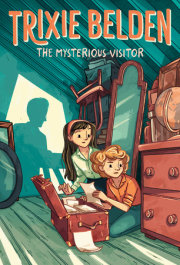
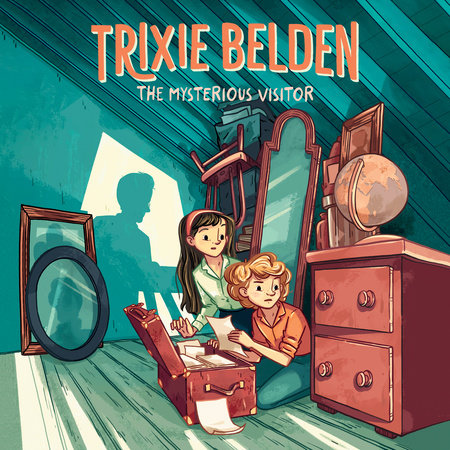
The Mysterious Visitor: Trixie Belden

Trixie Belden #4

There’s a new face in Sleepyside, and Trixie Belden is sure this stranger is up to no good. Too bad no one else believes her. But if anyone can get to the truth of this visitor’s real motives, it’s detective Trixie!

Trixie Belden hasn’t talked to Diana Lynch in a long time—not since her family got incredibly rich…and snobby. But the week before Halloween, Trixie and her best friend, Honey, spot Diana looking a little down, and Trixie knows it is time to put old grievances in the past.

Except the past is exactly the problem for Diana. Her long-lost uncle Monty recently arrived from Arizona, and Diana is less than thrilled about the reunion. Monty won’t stop pulling pranks, he is eager to buy lavish presents, and he constantly embarrasses Diana in front of all of her friends. Worst of all, he’s insisting that Diana host a Halloween party.

Monty may have fooled the adults, but Trixie is convinced he’s wearing a costume of his own. Can Trixie unmask Uncle Monty’s tricks and prove he is an imposter—or will Di be the one who is sent packing?
“Brown eyes,” Trixie said suddenly.
They all stared at her in amazement.
“Well, he has got brown eyes,” Trixie said defensively. “Mr. Wilson has. And Mrs. Lynch’s eyes are as blue as blue delphiniums.”
“So what?” Brian demanded. “You and Mart and Bobby have Moms’s blue eyes, and mine are black like Dad’s. Does that prove that I am an adopted child?”
“No one in his right mind would have adopted you,” Trixie said with a sniff. “I wasn’t trying to prove anything. I was just thinking out loud as usual.” Suddenly she remembered what Regan had said: “Don’t think.” And what Honey had said:
“Even if Mr. Wilson isn’t quite honest, I don’t think we ought to talk about it in front of Di.”
She opened her mouth to change the subject, but Jim was saying cheerfully, “Speaking of adopted children, I’m one and my eyes are neither black nor blue. They’re green. What does that make me, Trix?”
At that moment Di and her uncle joined them at the entrance to the gallery. Mr. Wilson was dressed as a cowboy complete with chaps and toy pistols, and looked to Trixie rather like a wizened little boy. Rubbing his hands together gleefully he said, “On with your wigs and masks, podners. The other guests will be arriving soon. I’ve got it all arranged. No unmasking until the bell rings for chow. Soon as everyone gets here, we’ll have a grand march around the ballroom, with me as judge. First prize goes to the best costume. Booby prize goes to the worst. Then we’ll do some square dancing, podners, until we work up an appetite for grub. I’ll do the calling. There’s not much old Uncle Monty doesn’t know about square dancing. Why, if I had my fiddle here, I’d play ‘Turkey in the Straw’ as you never heard it before. If I had my accordion and mouth organ here, I’d show all of the guests what a real one-man orchestra was like. Music right out of the West!”
“I’m sure you would, Uncle Monty,” Di said, forcing a smile to her taut lips. “But since almost none of the boys and girls I’ve invited knows how to dance, I thought we might let the orchestra leave when the caterers go. Is that all right?”
“Oh, no, no, no, NO!” her diminutive uncle cried, hopping up and down with each “No” as though he were the dwarf, Rumpelstiltskin. “If your guests can’t dance there are plenty of games we can play to music. Musical chairs, London Bridge Is Falling Down, and all that sort of thing.”
“But, Uncle Monty,” Di cried, “we’re too old for that kind of game.”
“Then you're old enough to waltz and do the two-step and the polka,” he said firmly. The orchestra struck up the “Blue Danube” and he bowed gallantly in front of Honey. “This little lady can waltz, I’ll betcha. May I have this dance, miss?”
Trixie held her breath. Now was the time for Honey to be her most tactful self! And Honey was. She dropped a curtsy and said sweetly: “I’d rather not, Mr. Wilson, but I do think your idea of keeping the orchestra on is just great. With you as master of ceremonies, we could have a real quiz show. The orchestra can play a few bars of a song, and the one who names the song first gets a prize.” She laid a slim hand on the decorated cuff of his sleeve. “Why don’t you and I go into Mr. Lynch’s study and make a list of the songs we think the orchestra ought to play for that contest?”
He followed her out of the gallery and into the room across the hall as meekly as a lamb. Trixie let out her breath in a long sigh. “That’s the answer, of course,” she said. “From now on we’ve all got to take turns keeping Uncle Monty from being an emcee.”
The boys nodded solemnly, and Di said gratefully, “Oh, will you? I can’t help because I’m the hostess.” The front door bell rang then and she hurried off, completely forgetting to don her false face and wig in her eagerness to greet the guests before her uncle did.
Without saying a word, the Beldens and Jim took their wigs and masks from the pockets of their jackets and put them on. They all looked very funny, but nobody laughed. For a moment Trixie felt dizzy. In their shapeless jackets, black curly wigs, and realistic, rubber devil’s faces, it was impossible to tell the boys apart. Mart wasn’t, of course, quite as tall as Brian and Jim, but somehow they all seemed now to be exactly the same height. They stood there, as motionless as the luminescent ghosts, witches, skeletons, and dragons on the black draperies. It was hard to breathe behind the close-fitting mask, and for the first time in her life Trixie felt weak and wobbly-kneed, as though she might faint at any moment.
The folding doors at this end of the gallery had been pushed back as far as they would go. Trixie grabbed one of the brass handles to steady herself, and something big and black and horrible with skinny, wiggly legs sprang at her. It dropped on her outstretched hand, then slithered to the floor at her feet.
Julie Campbell (1908-1999) was from Flushing, New York, and shares the same birthday as her character, Mart Belden.  As the daughter of an Army Officer, she travelled widely during her childhood. When she was eight years old, she won her first short story contest while living in Hawaii. In 1933, Campbell married Charles Tatham Jr., and they worked together on many magazine stories and articles.  Campbell lived in a remodeled farmhouse in the Hudson River Valley with her husband and two sons when she began writing the Trixie Belden series. The series was set in fictional “Sleepyside,” but was based on the town Campbell was living in at the time in the Hudson River Valley near Ossining. Her home, “Wolf Hollow,” was the model for Crabapple Farm, and Campbell actually lived on Glendale Road. Julie Campbell passed away in 1999 at the age of 91.  Even at 91 she was still spirited and determined, just like Trixie. View titles by Julie Campbell

About

There’s a new face in Sleepyside, and Trixie Belden is sure this stranger is up to no good. Too bad no one else believes her. But if anyone can get to the truth of this visitor’s real motives, it’s detective Trixie!

Trixie Belden hasn’t talked to Diana Lynch in a long time—not since her family got incredibly rich…and snobby. But the week before Halloween, Trixie and her best friend, Honey, spot Diana looking a little down, and Trixie knows it is time to put old grievances in the past.

Except the past is exactly the problem for Diana. Her long-lost uncle Monty recently arrived from Arizona, and Diana is less than thrilled about the reunion. Monty won’t stop pulling pranks, he is eager to buy lavish presents, and he constantly embarrasses Diana in front of all of her friends. Worst of all, he’s insisting that Diana host a Halloween party.

Monty may have fooled the adults, but Trixie is convinced he’s wearing a costume of his own. Can Trixie unmask Uncle Monty’s tricks and prove he is an imposter—or will Di be the one who is sent packing?

Excerpt

“Brown eyes,” Trixie said suddenly.
They all stared at her in amazement.
“Well, he has got brown eyes,” Trixie said defensively. “Mr. Wilson has. And Mrs. Lynch’s eyes are as blue as blue delphiniums.”
“So what?” Brian demanded. “You and Mart and Bobby have Moms’s blue eyes, and mine are black like Dad’s. Does that prove that I am an adopted child?”
“No one in his right mind would have adopted you,” Trixie said with a sniff. “I wasn’t trying to prove anything. I was just thinking out loud as usual.” Suddenly she remembered what Regan had said: “Don’t think.” And what Honey had said:
“Even if Mr. Wilson isn’t quite honest, I don’t think we ought to talk about it in front of Di.”
She opened her mouth to change the subject, but Jim was saying cheerfully, “Speaking of adopted children, I’m one and my eyes are neither black nor blue. They’re green. What does that make me, Trix?”
At that moment Di and her uncle joined them at the entrance to the gallery. Mr. Wilson was dressed as a cowboy complete with chaps and toy pistols, and looked to Trixie rather like a wizened little boy. Rubbing his hands together gleefully he said, “On with your wigs and masks, podners. The other guests will be arriving soon. I’ve got it all arranged. No unmasking until the bell rings for chow. Soon as everyone gets here, we’ll have a grand march around the ballroom, with me as judge. First prize goes to the best costume. Booby prize goes to the worst. Then we’ll do some square dancing, podners, until we work up an appetite for grub. I’ll do the calling. There’s not much old Uncle Monty doesn’t know about square dancing. Why, if I had my fiddle here, I’d play ‘Turkey in the Straw’ as you never heard it before. If I had my accordion and mouth organ here, I’d show all of the guests what a real one-man orchestra was like. Music right out of the West!”
“I’m sure you would, Uncle Monty,” Di said, forcing a smile to her taut lips. “But since almost none of the boys and girls I’ve invited knows how to dance, I thought we might let the orchestra leave when the caterers go. Is that all right?”
“Oh, no, no, no, NO!” her diminutive uncle cried, hopping up and down with each “No” as though he were the dwarf, Rumpelstiltskin. “If your guests can’t dance there are plenty of games we can play to music. Musical chairs, London Bridge Is Falling Down, and all that sort of thing.”
“But, Uncle Monty,” Di cried, “we’re too old for that kind of game.”
“Then you're old enough to waltz and do the two-step and the polka,” he said firmly. The orchestra struck up the “Blue Danube” and he bowed gallantly in front of Honey. “This little lady can waltz, I’ll betcha. May I have this dance, miss?”
Trixie held her breath. Now was the time for Honey to be her most tactful self! And Honey was. She dropped a curtsy and said sweetly: “I’d rather not, Mr. Wilson, but I do think your idea of keeping the orchestra on is just great. With you as master of ceremonies, we could have a real quiz show. The orchestra can play a few bars of a song, and the one who names the song first gets a prize.” She laid a slim hand on the decorated cuff of his sleeve. “Why don’t you and I go into Mr. Lynch’s study and make a list of the songs we think the orchestra ought to play for that contest?”
He followed her out of the gallery and into the room across the hall as meekly as a lamb. Trixie let out her breath in a long sigh. “That’s the answer, of course,” she said. “From now on we’ve all got to take turns keeping Uncle Monty from being an emcee.”
The boys nodded solemnly, and Di said gratefully, “Oh, will you? I can’t help because I’m the hostess.” The front door bell rang then and she hurried off, completely forgetting to don her false face and wig in her eagerness to greet the guests before her uncle did.
Without saying a word, the Beldens and Jim took their wigs and masks from the pockets of their jackets and put them on. They all looked very funny, but nobody laughed. For a moment Trixie felt dizzy. In their shapeless jackets, black curly wigs, and realistic, rubber devil’s faces, it was impossible to tell the boys apart. Mart wasn’t, of course, quite as tall as Brian and Jim, but somehow they all seemed now to be exactly the same height. They stood there, as motionless as the luminescent ghosts, witches, skeletons, and dragons on the black draperies. It was hard to breathe behind the close-fitting mask, and for the first time in her life Trixie felt weak and wobbly-kneed, as though she might faint at any moment.
The folding doors at this end of the gallery had been pushed back as far as they would go. Trixie grabbed one of the brass handles to steady herself, and something big and black and horrible with skinny, wiggly legs sprang at her. It dropped on her outstretched hand, then slithered to the floor at her feet.

Author

Julie Campbell (1908-1999) was from Flushing, New York, and shares the same birthday as her character, Mart Belden.  As the daughter of an Army Officer, she travelled widely during her childhood. When she was eight years old, she won her first short story contest while living in Hawaii. In 1933, Campbell married Charles Tatham Jr., and they worked together on many magazine stories and articles.  Campbell lived in a remodeled farmhouse in the Hudson River Valley with her husband and two sons when she began writing the Trixie Belden series. The series was set in fictional “Sleepyside,” but was based on the town Campbell was living in at the time in the Hudson River Valley near Ossining. Her home, “Wolf Hollow,” was the model for Crabapple Farm, and Campbell actually lived on Glendale Road. Julie Campbell passed away in 1999 at the age of 91.  Even at 91 she was still spirited and determined, just like Trixie. View titles by Julie Campbell
  • More Websites from
    Penguin Random House
  • Common Reads
  • Library Marketing