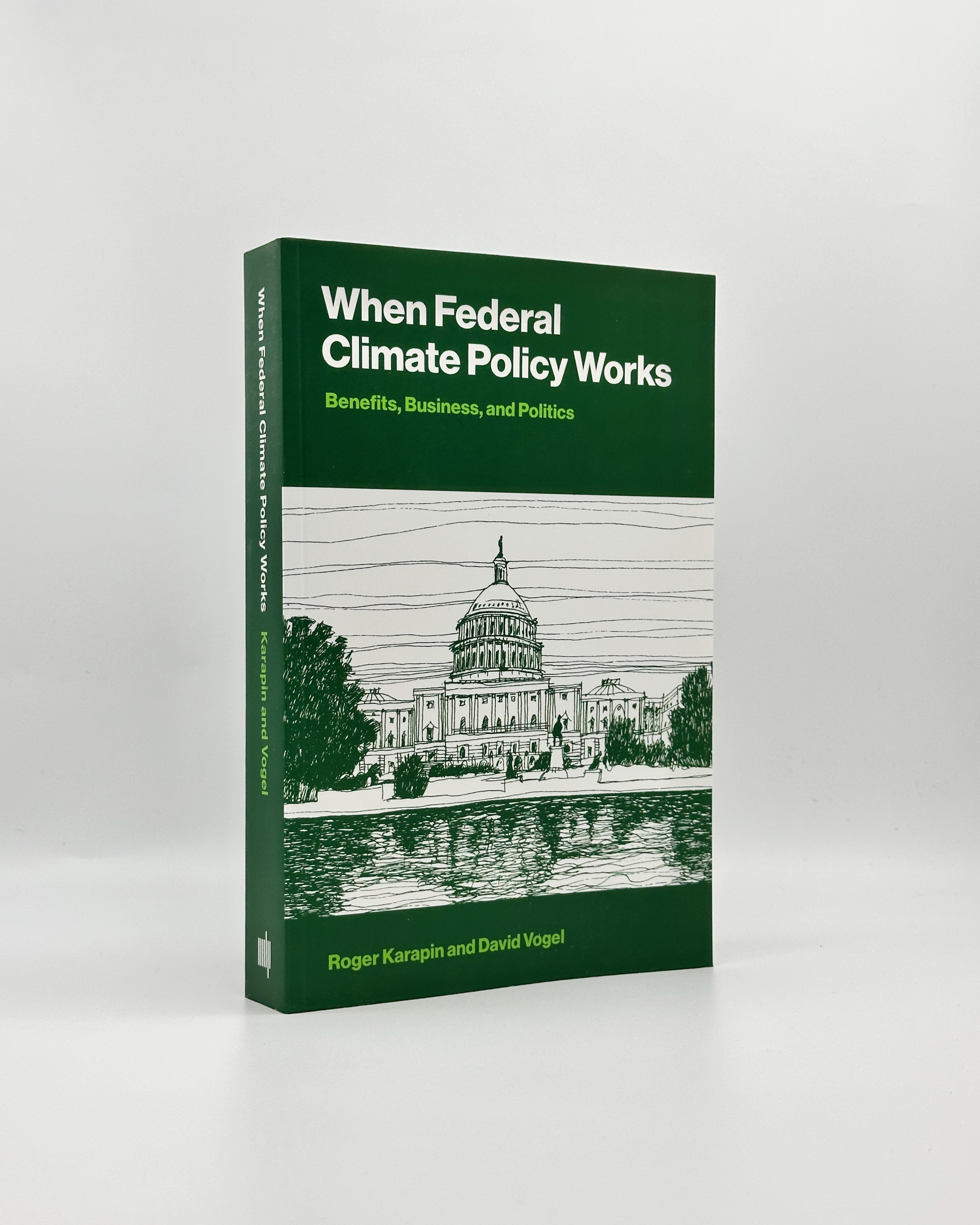
When Federal Climate Policy Works

Benefits, Business, and Politics

Look inside
Paperback
$45.00 US
| $60.00 CAN
On sale May 12, 2026 | 418 Pages | 9780262053556

See Additional Formats
An original analysis of the federal government’s sectoral climate policy accomplishments over the last five decades, with recommendations for policy makers.

When Federal Climate Policy Works challenges the widely accepted belief that the federal government has been unable to adopt effective policies to reduce greenhouse gas (GHG) emissions. Roger Karapin and David Vogel argue that the federal government has made measurable progress by adopting more narrowly focused sectoral policies. These have reduced GHG emissions in many sectors: through fuel economy and GHG standards for motor vehicles, the promotion of electric vehicles, mandatory standards and voluntary Energy Star labels for the energy efficiency of appliances and equipment, tax credits for renewable energy investments and production, restrictions on HFCs, and regulations on methane emissions from landfills and oil and gas production.

Almost all of these measures began as unintentional climate policies during the 1970s, when they received substantial bipartisan support. Their initial policy frameworks have exhibited substantial continuity even after the policies become repositioned as more politically contentious, explicit climate change policies during the 1990s and later decades. Throughout the last 50 years, policy adoption has depended on including non-climate benefits, gaining business acceptance, and navigating partisan politics.
ENDORSEMENTS

"In an era of spiraling pessimism about the role of government, Karapin and Vogel offer a laser-guided view of where an active, focused US federal government can yield profound green change. —David G. Victor, author of Fixing the Climate and Making Climate Policy Work

Roger Karapin and David Vogel offer a comprehensive review of American climate policy that cuts across multiple sectors and various greenhouse gases. They consider variation in policy adoption, implementation, and durability, emerging with a valuable analysis of past decades that offers numerous insights to guide future policy development.
—Barry Rabe, author of Can We Price Carbon?


A compelling, evidence-rich account that fundamentally reframes U.S. climate policy history, revealing overlooked federal successes and valuable lessons for navigating an era of political polarization. Essential reading for policy makers and scholars alike.
—Jonas Meckling, author of Carbon Coalitions
Roger Karapin is Professor of Political Science at Hunter College and the Graduate Center, City University of New York.

David Vogel is Professor Emeritus of Haas School of Business, Department of Political Science, University of California, Berkeley.

About

An original analysis of the federal government’s sectoral climate policy accomplishments over the last five decades, with recommendations for policy makers.

When Federal Climate Policy Works challenges the widely accepted belief that the federal government has been unable to adopt effective policies to reduce greenhouse gas (GHG) emissions. Roger Karapin and David Vogel argue that the federal government has made measurable progress by adopting more narrowly focused sectoral policies. These have reduced GHG emissions in many sectors: through fuel economy and GHG standards for motor vehicles, the promotion of electric vehicles, mandatory standards and voluntary Energy Star labels for the energy efficiency of appliances and equipment, tax credits for renewable energy investments and production, restrictions on HFCs, and regulations on methane emissions from landfills and oil and gas production.

Almost all of these measures began as unintentional climate policies during the 1970s, when they received substantial bipartisan support. Their initial policy frameworks have exhibited substantial continuity even after the policies become repositioned as more politically contentious, explicit climate change policies during the 1990s and later decades. Throughout the last 50 years, policy adoption has depended on including non-climate benefits, gaining business acceptance, and navigating partisan politics.

Reviews

ENDORSEMENTS

"In an era of spiraling pessimism about the role of government, Karapin and Vogel offer a laser-guided view of where an active, focused US federal government can yield profound green change. —David G. Victor, author of Fixing the Climate and Making Climate Policy Work

Roger Karapin and David Vogel offer a comprehensive review of American climate policy that cuts across multiple sectors and various greenhouse gases. They consider variation in policy adoption, implementation, and durability, emerging with a valuable analysis of past decades that offers numerous insights to guide future policy development.
—Barry Rabe, author of Can We Price Carbon?


A compelling, evidence-rich account that fundamentally reframes U.S. climate policy history, revealing overlooked federal successes and valuable lessons for navigating an era of political polarization. Essential reading for policy makers and scholars alike.
—Jonas Meckling, author of Carbon Coalitions

Author

Roger Karapin is Professor of Political Science at Hunter College and the Graduate Center, City University of New York.

David Vogel is Professor Emeritus of Haas School of Business, Department of Political Science, University of California, Berkeley.
  • More Websites from
    Penguin Random House
  • Common Reads
  • Library Marketing