Close Modal
Download high-resolution image Look inside
Listen to a clip from the audiobook
audio pause button
0:00
0:00

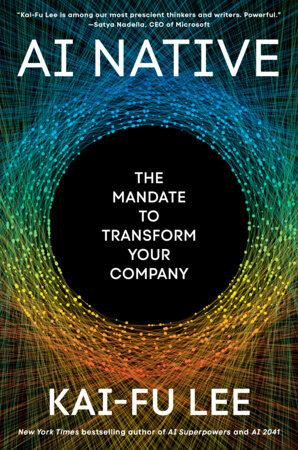
AI Native

The Mandate to Transform Your Company

Author Kai-Fu Lee
Look inside
Listen to a clip from the audiobook
audio pause button
0:00
0:00
Hardcover
$34.00 US
| $46.00 CAN
12 per carton
On sale Nov 03, 2026 | 208 Pages | 9798217400423
Grades 9-12

See Additional Formats
A sweeping roadmap for business leaders in the AI age, when every organization must rethink how it operates, competes, and creates value—from AI legend and New York Times bestselling author of AI Superpowers and AI 2041 Kai-Fu Lee

“Kai-Fu Lee is among our most prescient thinkers and writers…. Powerful.”—Satya Nadella, Microsoft CEO


Two years ago, the best AI agents could autonomously complete tasks that took a human expert roughly six minutes to complete. Today, top AI agents across nearly all white-collar industries can complete the workday of the smartest humans in less time than a coffee break—at a fraction of the cost. 

What happens when the most expensive thing that companies buy—human thinking—becomes practically free?

This is the single most consequential question facing business leaders for a generation, and many are struggling with how to answer it. AI is not simply another technology cycle but a fundamental transformation in the economics of business. The answer is not to dabble. It is to become AI Native.

Kai-Fu Lee has spent the past four decades pioneering AI in business from nearly every vantage point: as a researcher, senior executive at Apple, Microsoft, and Google, and now a CEO himself. Few thinkers can match his combination of technical expertise and business acumen. 

In AI Native, he draws from this deep well of experience to offer a radical new roadmap for company leaders to become AI Native. With punchy, insightful guidance, Lee dispels the lies CEOs are being told about AI, offers a clear roadmap for how to re-structure teams with powerful agentic AI at the center of the enterprise, and reveals the power and potential of using AI to tap into the hidden trove of knowledge inside companies. Those that get it right will flourish in the AI age.

AI Native is the only book leaders need to navigate the defining challenge of our time.
Chapter 1: This time is different

To understand the present moment and what it means for organizing your business enterprise, we must first zoom out far enough to think in millennia.

The economic historian Angus Maddison devoted his life to estimating humanity’s economic output over the past two thousand years. The picture that emerged resembles a hockey stick: a long flat line, virtually unchanging for centuries, before suddenly bending upward at the end of the eighteenth century like a vertical blade.

For most of human history, average economic output per person barely moved. In Maddison’s estimates, world GDP per capita around AD 1 was around $1,100 expressed in 2021 prices. By 1820 it had risen to a mere $1,500. In other words, after eighteen centuries, average global income per person had increased by only about 40 percent.

For more than a millennium, a person could live an entire lifetime without experiencing any meaningful improvement in material life or productive capacity. A baby born in 1900 entered a world where high infant mortality meant the average life expectancy of a newborn was only about 32 years. That was the natural state of humanity in the absence of systematic productivity growth.

In 1798, the economist Thomas Robert Malthus distilled this thousand-year pattern into his famously pessimistic conclusion: population growth would always catch up with food production, and humanity would be condemned to struggle forever at the edge of subsistence.

Then, everything changed.

The prosperity we now take for granted–clean water, abundant food, life spans far beyond 40, literacy, education, science, and technology–is almost entirely the product of the past two hundred years. I like one analogy in particular: if we compressed the 300,000-year history of Homo sapiens into a single day, the explosion that changed everything would have occurred in the final minute.

Look at the growth of global GDP over the past few centuries, and the pattern of economic acceleration is unmistakable. Each technological revolution has pushed this enormous curve upward at an exponential rate.

The catalysts have been a special class of technologies that economists such as Timothy F. Bresnahan call general-purpose technologies, or GPTs. Coincidentally, this is also the acronym for the transformative technology OpenAI released publicly in 2022—the Generative Pre-trained Transformer—which sparked today’s large language model (LLM) revolution.

General-purpose technologies share three traits: they can penetrate almost every industry; they keep improving over time while their costs fall; and they make it easier for others to invent new things. The steam engine, electricity, computers, and the internet all fit this pattern. Rather than tools for a single industry, they were engines for, and redrew the contours of, the entire economy.

But this did not happen quickly. As evidenced in the work of contemporary thinkers like Erik Brynjolfsson, the value of a new technology takes time to be realized. When electricity first arrived in factories, people treated it as a more convenient steam engine. They kept the old factory layouts, assembly lines, and management methods. Only when companies redesigned factories, workflows, and organizational structures around electricity did the productivity dividend materialize. The same was true of computers and the internet. Buying computers did not automatically make a company more efficient. They had to redesign their processes, training, and data, and computing itself created new economies and business models. The same will again be true for your company and AI.

AI is the latest general-purpose technology and has much in common with its predecessors. Truly realizing its revolutionary benefits requires businesses to invest in new skills, data infrastructure, processes, and organizational models. Because these investments only deliver productivity improvements later, a company’s short-term costs may rise without significant immediate efficiency or productivity gains, and may even decline as firms adjust to changing working patterns and devote resources to experimentation. But later, the gains can arrive, suddenly and dramatically.

While AI mirrors this uneven path towards GPT-driven productivity growth, it is also unique. Previous revolutions commoditized three major input factors: energy, computation and information. This time, intelligence itself is being commoditized. That is not a difference in degree, but in kind.
“This book is the operating manual for the largest economic transformation since the Industrial Revolution.”—Erik Brynjolfsson, Stanford professor, coauthor of bestselling The Second Machine Age, and cofounder of Workhelix

“This is the guide every leader needs. Kai-Fu’s advice is timely, strategic, and actionable.”—Adam Grant, #1 New York Times bestselling author

“Kai-Fu Lee is among our most prescient thinkers and writers on the subject of artificial intelligence. AI Native shows why organizations must rethink how they learn, organize, build IP, and thrive in this new era. It is a powerful call for an AI future where human expertise is amplified and value flows broadly across every company, every industry, and every country.”—Satya Nadella, chairman and CEO, Microsoft

“Economists have long understood that organizations run on asymmetric information: Those who act know what those who decide cannot see. Kai-Fu Lee understands that AI’s most profound effect at the enterprise level is to attack that asymmetry at its root. AI Native turns that insight into a concrete, compelling operating model.”—Michael Spence, Nobel laureate in economics and dean emeritus, Stanford Graduate School of Business

“Kai-Fu Lee is a world-class researcher who realized very early that neural networks were the future of AI. He is also a leading investor and an accomplished business leader, so he speaks with great authority when he describes how companies should incorporate AI and how people can remain relevant.”—Geoffrey Hinton, Nobel laureate in physics

“Even in the C-suite at some of the world’s biggest companies, the AI revolution is underhyped. Finally, here’s a book for leaders who sense AI’s vast potential but need a road map.”—Eric Schmidt, former CEO of Google and bestselling author of The Age of AI

“Enterprises that integrate artificial intelligence thoughtfully will flourish; those that do not will fail. As an AI pioneer, executive, investor, and visionary, Kai-Fu Lee is exceptionally well positioned to explain what this moment demands. AI Native is a clear, urgent, and practical guide to redesigning organizations around abundant intelligence, while preserving meaning, dignity, and human purpose.”—Peter Brown, CEO, Renaissance Technologies

“Kai-Fu Lee has long been one of the clearest and most thoughtful voices on how AI is transforming business and society. In AI Native, he offers leaders a practical guide to reimagining how organizations work—and how people and AI can come together to solve meaningful problems and create lasting value.”—Dr. Lisa Su, chair and CEO, AMD

“As a scientist, entrepreneur, and investor, Kai-Fu Lee has helped shape the AI revolution from its earliest days. With AI Native, he has written an essential guide for leaders building the next generation of great companies.”—Marc Benioff, chairman and CEO, Salesforce
© Courtesy of the author
Kai-Fu Lee is the CEO of Sinovation Ventures and New York Times bestselling author of AI Superpowers. Lee was formerly the president of Google China and a senior executive at Microsoft, SGI, and Apple. Co-chair of the Artificial Intelligence Council at the World Economic Forum, he has a bachelor’s degree from Columbia and a PhD from Carnegie Mellon. Lee’s numerous honors include being named to the Time 100 and Wired 25 Icons lists. He is based in Beijing. View titles by Kai-Fu Lee

About

A sweeping roadmap for business leaders in the AI age, when every organization must rethink how it operates, competes, and creates value—from AI legend and New York Times bestselling author of AI Superpowers and AI 2041 Kai-Fu Lee

“Kai-Fu Lee is among our most prescient thinkers and writers…. Powerful.”—Satya Nadella, Microsoft CEO


Two years ago, the best AI agents could autonomously complete tasks that took a human expert roughly six minutes to complete. Today, top AI agents across nearly all white-collar industries can complete the workday of the smartest humans in less time than a coffee break—at a fraction of the cost. 

What happens when the most expensive thing that companies buy—human thinking—becomes practically free?

This is the single most consequential question facing business leaders for a generation, and many are struggling with how to answer it. AI is not simply another technology cycle but a fundamental transformation in the economics of business. The answer is not to dabble. It is to become AI Native.

Kai-Fu Lee has spent the past four decades pioneering AI in business from nearly every vantage point: as a researcher, senior executive at Apple, Microsoft, and Google, and now a CEO himself. Few thinkers can match his combination of technical expertise and business acumen. 

In AI Native, he draws from this deep well of experience to offer a radical new roadmap for company leaders to become AI Native. With punchy, insightful guidance, Lee dispels the lies CEOs are being told about AI, offers a clear roadmap for how to re-structure teams with powerful agentic AI at the center of the enterprise, and reveals the power and potential of using AI to tap into the hidden trove of knowledge inside companies. Those that get it right will flourish in the AI age.

AI Native is the only book leaders need to navigate the defining challenge of our time.

Excerpt

Chapter 1: This time is different

To understand the present moment and what it means for organizing your business enterprise, we must first zoom out far enough to think in millennia.

The economic historian Angus Maddison devoted his life to estimating humanity’s economic output over the past two thousand years. The picture that emerged resembles a hockey stick: a long flat line, virtually unchanging for centuries, before suddenly bending upward at the end of the eighteenth century like a vertical blade.

For most of human history, average economic output per person barely moved. In Maddison’s estimates, world GDP per capita around AD 1 was around $1,100 expressed in 2021 prices. By 1820 it had risen to a mere $1,500. In other words, after eighteen centuries, average global income per person had increased by only about 40 percent.

For more than a millennium, a person could live an entire lifetime without experiencing any meaningful improvement in material life or productive capacity. A baby born in 1900 entered a world where high infant mortality meant the average life expectancy of a newborn was only about 32 years. That was the natural state of humanity in the absence of systematic productivity growth.

In 1798, the economist Thomas Robert Malthus distilled this thousand-year pattern into his famously pessimistic conclusion: population growth would always catch up with food production, and humanity would be condemned to struggle forever at the edge of subsistence.

Then, everything changed.

The prosperity we now take for granted–clean water, abundant food, life spans far beyond 40, literacy, education, science, and technology–is almost entirely the product of the past two hundred years. I like one analogy in particular: if we compressed the 300,000-year history of Homo sapiens into a single day, the explosion that changed everything would have occurred in the final minute.

Look at the growth of global GDP over the past few centuries, and the pattern of economic acceleration is unmistakable. Each technological revolution has pushed this enormous curve upward at an exponential rate.

The catalysts have been a special class of technologies that economists such as Timothy F. Bresnahan call general-purpose technologies, or GPTs. Coincidentally, this is also the acronym for the transformative technology OpenAI released publicly in 2022—the Generative Pre-trained Transformer—which sparked today’s large language model (LLM) revolution.

General-purpose technologies share three traits: they can penetrate almost every industry; they keep improving over time while their costs fall; and they make it easier for others to invent new things. The steam engine, electricity, computers, and the internet all fit this pattern. Rather than tools for a single industry, they were engines for, and redrew the contours of, the entire economy.

But this did not happen quickly. As evidenced in the work of contemporary thinkers like Erik Brynjolfsson, the value of a new technology takes time to be realized. When electricity first arrived in factories, people treated it as a more convenient steam engine. They kept the old factory layouts, assembly lines, and management methods. Only when companies redesigned factories, workflows, and organizational structures around electricity did the productivity dividend materialize. The same was true of computers and the internet. Buying computers did not automatically make a company more efficient. They had to redesign their processes, training, and data, and computing itself created new economies and business models. The same will again be true for your company and AI.

AI is the latest general-purpose technology and has much in common with its predecessors. Truly realizing its revolutionary benefits requires businesses to invest in new skills, data infrastructure, processes, and organizational models. Because these investments only deliver productivity improvements later, a company’s short-term costs may rise without significant immediate efficiency or productivity gains, and may even decline as firms adjust to changing working patterns and devote resources to experimentation. But later, the gains can arrive, suddenly and dramatically.

While AI mirrors this uneven path towards GPT-driven productivity growth, it is also unique. Previous revolutions commoditized three major input factors: energy, computation and information. This time, intelligence itself is being commoditized. That is not a difference in degree, but in kind.

Reviews

“This book is the operating manual for the largest economic transformation since the Industrial Revolution.”—Erik Brynjolfsson, Stanford professor, coauthor of bestselling The Second Machine Age, and cofounder of Workhelix

“This is the guide every leader needs. Kai-Fu’s advice is timely, strategic, and actionable.”—Adam Grant, #1 New York Times bestselling author

“Kai-Fu Lee is among our most prescient thinkers and writers on the subject of artificial intelligence. AI Native shows why organizations must rethink how they learn, organize, build IP, and thrive in this new era. It is a powerful call for an AI future where human expertise is amplified and value flows broadly across every company, every industry, and every country.”—Satya Nadella, chairman and CEO, Microsoft

“Economists have long understood that organizations run on asymmetric information: Those who act know what those who decide cannot see. Kai-Fu Lee understands that AI’s most profound effect at the enterprise level is to attack that asymmetry at its root. AI Native turns that insight into a concrete, compelling operating model.”—Michael Spence, Nobel laureate in economics and dean emeritus, Stanford Graduate School of Business

“Kai-Fu Lee is a world-class researcher who realized very early that neural networks were the future of AI. He is also a leading investor and an accomplished business leader, so he speaks with great authority when he describes how companies should incorporate AI and how people can remain relevant.”—Geoffrey Hinton, Nobel laureate in physics

“Even in the C-suite at some of the world’s biggest companies, the AI revolution is underhyped. Finally, here’s a book for leaders who sense AI’s vast potential but need a road map.”—Eric Schmidt, former CEO of Google and bestselling author of The Age of AI

“Enterprises that integrate artificial intelligence thoughtfully will flourish; those that do not will fail. As an AI pioneer, executive, investor, and visionary, Kai-Fu Lee is exceptionally well positioned to explain what this moment demands. AI Native is a clear, urgent, and practical guide to redesigning organizations around abundant intelligence, while preserving meaning, dignity, and human purpose.”—Peter Brown, CEO, Renaissance Technologies

“Kai-Fu Lee has long been one of the clearest and most thoughtful voices on how AI is transforming business and society. In AI Native, he offers leaders a practical guide to reimagining how organizations work—and how people and AI can come together to solve meaningful problems and create lasting value.”—Dr. Lisa Su, chair and CEO, AMD

“As a scientist, entrepreneur, and investor, Kai-Fu Lee has helped shape the AI revolution from its earliest days. With AI Native, he has written an essential guide for leaders building the next generation of great companies.”—Marc Benioff, chairman and CEO, Salesforce

Author

© Courtesy of the author
Kai-Fu Lee is the CEO of Sinovation Ventures and New York Times bestselling author of AI Superpowers. Lee was formerly the president of Google China and a senior executive at Microsoft, SGI, and Apple. Co-chair of the Artificial Intelligence Council at the World Economic Forum, he has a bachelor’s degree from Columbia and a PhD from Carnegie Mellon. Lee’s numerous honors include being named to the Time 100 and Wired 25 Icons lists. He is based in Beijing. View titles by Kai-Fu Lee
  • More Websites from
    Penguin Random House
  • Common Reads
  • Library Marketing