Close Modal
Download high-resolution image Look inside
Listen to a clip from the audiobook
audio pause button
0:00
0:00

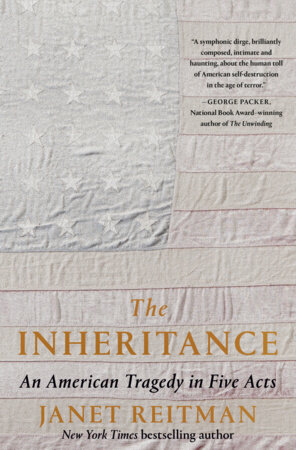
The Inheritance

An American Tragedy in Five Acts

Look inside
Listen to a clip from the audiobook
audio pause button
0:00
0:00
Hardcover
$32.00 US
| $44.00 CAN
12 per carton
On sale Oct 06, 2026 | 448 Pages | 9781984854728
Grades 9-12 + AP/IB

See Additional Formats
A stunning work of narrative nonfiction that traces the lives of nine Americans over three decades, offering a vivid account of a nation in crisis—from award-winning New York Times Magazine writer Janet Reitman

“Richly empathetic, morally complex . . . a particle collider for the forces of the age . . . [Reitman] pushes back against one of the worst ideas that surged after Sept. 11: Trying to understand others is endorsement or complicity. Thus emerges an origin story for the present.”—The New York Times

A thrill-seeking former Navy pilot chases adventure in Afghanistan, while in suburbia, his teenage son spirals into extremism. The grandson of African freedom fighters joins the FBI to save America from terrorism and ends up terrorizing the African immigrants he’d sworn to protect. A young Marine who sees himself as a true-blue American goes to war in Iraq, comes home broken, and is reborn as white nationalist. An idealistic young attorney defends a Palestinian engineer she believes is wrongly accused of funding Hamas. These four people, and five others, struggle to find their way in a country reimagining itself in the wake of 9/11.

In The Inheritance, Janet Reitman, the bestselling author of Inside Scientology, delivers an intimate and urgent account of American disillusionment—and a paean to hope. From the bucolic suburbs of Boston to the immigrant enclaves of Dallas, from the deserts of Iraq to the encrypted chatrooms that fuel hatred and extremism, The Inheritance unfolds in repeating narratives of people moving through the decades, from the end of the Reagan era to the present day, painting a sweeping and deeply affective portrait of how a country revered for its democratic ideals became a nation defined by its fears.

Rigorously reported and brimming with novelistic detail, The Inheritance reveals the hidden cost of the war on terror, exposing the psychic wounds that haunt us to this day.
Walter Oneschuk

Wally Oneschuk was sixteen years old when Ronald Reagan was first elected president. It was 1980, and he was living with his family outside of Boston, in the small city of Lynn. No one called Massachusetts a blue state back then—­it was just liberal Massachusetts. But there were plenty of people who felt let down by Jimmy Carter and the Democrats, and in Lynn, Reagan-­Bush lawn signs were everywhere. People wanted change, which was understandable: they’d lived through the seventies, through gas lines and unemployment lines and water rationing and sky-­high inflation and the return of Vietnam vets who nobody thanked for their service and a stock market that lost 40 percent of its value in less than two years and an Iranian hostage crisis that went on for what felt like forever. In his 1980 campaign slogan, Reagan promised to make America great again. He won by a landslide. And just like that, America—­strong, proud, hopeful—­was back. The hostages came home. The yellow ribbons came off the trees. It was Morning in America.

Wally believed that.

In those days, Wally was having a good time, or trying to, which is about as much as you could say for any suburban white kid in 1980. The economy was still in a slump, particularly in fading industrial cities like Lynn, though Wally’s family lived in a nice part of town and sent their sons to private school, so he didn’t really think much about those things, as they never seemed to touch him. He was tall and athletic, with dark brown eyes and dark wavy hair. At St. John’s Prep, the all-­boys Catholic school he attended, Wally played football, ran track, and mainly tried to stay out of the way of the Jesuits. He was a good skier and a decent swimmer, important skills to have in his social circle. In the eleventh grade, he grew a thick mustache because he could. Wally told people he thought it made him look older and tougher, like Magnum, P.I., or the Marlboro Man. And at least it was different. Everyone looked the same at St. John’s: jacket and tie for school; khakis and Top Siders or duck boots at all other times, with thick L.L. Bean sweaters and old oxford shirts. This was the uniform of the East Coast WASP establishment, and it was a look that Wally, lacking that pedigree, appropriated. And even with the moustache, he pulled off the look as well as any other New En­gland prep school kid whose middle-­class parents aspired to more. If you have to fake it, the logic went, at least fake it well.

Wally’s father, Walter Oneschuk, Sr., was also a faker, though it would take years for Wally to learn the extent of his father’s disguise. Walter was a salesman, and the only thing his son ever knew about him for sure was that he’d been born poor and grew up during the Depression in Chelsea, a working-­class town just across the Mystic River from Boston. After that, the facts were mutable. He claimed to have been a navy officer during World War II, though as Wally later learned, he was actually a baker’s mate. He said he’d attended Columbia University, though he never produced a diploma. He also said that his Russian-­born father had married an Italian opera singer, though in truth, Walter’s mother wasn’t an opera singer, and wasn’t Italian but was, like her husband, Russian or Ukrainian or Belarusian—­it was all very confused, Wally thought—­and for all anyone knew, they might have been Jewish, since one out of every three people in Chelsea at that time was part of the Jewish diaspora. But nobody knew. Like most immigrants, they’d come to America to escape their pasts and start again, and they’d succeeded.

They were Americans.

Lynn, ten miles north of Boston, was settled in 1629 by the Puritans, stern English Protestants who saw all of eastern Massachusetts as a promised land. Their pastor, Rev. John Winthrop, urged his flock to build a new society that would be “a shining city upon a hill,” as Winthrop put it, quoting Jesus. For more than two hundred years, Lynn’s residents, aspirants all, lived and farmed, and then tanned leather, and later built a thriving industry in shoe manufacturing, though by 1892, it was the new General Electric plant that served as the city’s main economic driver. Wally’s maternal grandmother, Dora Consoles, worked in Lynn’s shoe factories, and at GE, as did her parents and her husband and all his brothers and sisters, who had come from Italy around 1900 and lived within five blocks of each other. When Wally’s mother, Josephine, was a little girl, in the 1930s, her father did some masonry and landscaping work, on top of his job at the factory. When things got really bad, her parents left Lynn for jobs at a Rhode Island rubber factory, and Josephine stayed behind with her aunts and uncles. This helped forge Josephine into a remarkably self-­sufficient woman for her time, whose reverence for hard work was matched only by her desire to rise above her station. Her mother shared her drive. “Who is better than us?” Dora would say. Who is better than us?

Josephine internalized that mantra. Profoundly optimistic—­Wally would later describe his mother as someone who didn’t so much see the world through rose-­colored glasses as reject that there was any other color—­she was a shrewd businesswoman who loved nice things and set out to acquire them. In high school, she worked at the salon inside of Lynn’s most elegant hotel, the Edison, doing pin curls for wealthy clients. Within a few years, she’d moved to a new salon in nearby Swampscott, and then she bought the salon, and then the entire building. By the time she was thirty, Josephine had made enough to leave the immigrant enclaves of gritty south Lynn for the leafy east side of town and was on her way to opening her second salon.

It was around that time that Josephine, recently widowed, met Walter Oneschuk, who then worked in the beauty supply business. He was suave and handsome and a snazzy dresser, and Josephine was charmed. In 1962 they were married, and two years later, Walter, Jr.—­Wally—­was born, joining two older half brothers from Josephine’s first marriage. The family lived in the house that Josephine built on Lynnfield Street—­which was still in Lynn, but “on the Lynn­field line,” as people liked to say as a way to distinguish their proximity to a wealthier town. Wally grew up in that house, which his mother decorated in the most au courant fashion, with damask wallpaper and modish wall sconces and a powder-­blue entrance hall and a pink kitchen. There were two living rooms, one upstairs and the other leading out to the pool, where, on summer weekends, the One­schuks entertained their friends and clients. By the late 1960s, Josephine had three salons and a sizable real estate portfolio. This was what paid for her sons’ schooling and the ski trips and tennis lessons and eleven summers at Camp Tohkomeupog in New Hampshire, and membership at the Salem Country Club, where Josephine served on the decorating committee. In keeping with the mores of that time, it was her husband who held the membership.

Later, Wally would reflect on the supreme irony of this. His dad never made much money, though in the 1970s, when Lynn’s manufacturing industry was at its nadir, Walter, Sr., bought a few properties, expecting they’d be gentrified. Instead, they became Section 8 housing and Walter became a slumlord who fixed things on the cheap. A few years later, one of his properties burned down, and Walter, who’d never taken out fire insurance, had to borrow money from his wife’s portfolio to rebuild it. Ten years later, he was still paying down the loan.

Walter, Sr., would ultimately borrow so much money from his wife she’d have to refinance her house three times. Still, when Wally applied to Phillips Andover—­a stretch, given that he was only a B student—­father and son drove up in Walter’s Mercedes to tour the campus. They had barely met the admissions officer before Walter adopted an upper-­class Bostonian accent that made his son want to crawl under the table. Afterwards, he confronted his dad. “I mean, are you shitting me?” he said, mortified.

Walter gave his son a look. “What, you think they’re gonna let Phil the trash man in here?”

That was Wally’s father in a nutshell. He was still the poor boy from Chelsea who had spent years trying to sell a more glamorous version of himself. Then again, that was the promise of American reinvention: that with the right clothes, and cars, and club memberships, you might just pass as genuine, even when your lies were as transparent as your fake Brahmin accent.
“[The Inheritance] becomes a particle collider for the forces of the age. . . . [Reitman’s] subjects are the vessel; emotions are the thing. Her approach shouldn’t seem countercultural today, but it does. . . . She subliminally pushes back against one of the worst ideas that surged after Sept. 11: Trying to understand others is endorsement or complicity. . . . Thus emerges an origin story for the present. . . . Richly empathetic, morally complex, many-windowed.”—The New York Times

“An extraordinarily incisive—and bracing—study of the American dream gone awry . . . Rendered in a gripping, novelistic style, Reitman’s finely wrought subjects carry the reader steadily deeper into the nation’s ‘burnt over’ landscapes, forlorn places of extremism and paranoia, of alienation and despair.”—Scott Anderson, author of King of Kings

“The Inheritance is a symphonic dirge, brilliantly composed, intimate and haunting, about the human toll of American self-destruction in the age of terror.”—George Packer, NBA-winning author of The Unwinding and The Emergency

“This vast, intimate, heartbreaking book should change the way we read and think and tell stories about what it means to be an American, or to live in the United States, decades or centuries into our vexed condition. The Inheritance is beautifully made, profoundly reported—a mighty book from which I could not look away.”—Jeff Sharlet, bestselling author of The Family

“A riveting and superbly reported account of America’s descent into violent political division told through the eyes of fascinating characters . . . In the mode of John Dos Passos, it captures our fractured country with incredible power. It reads like a novel but is all too real.”—Jane Mayer, author of Dark Money

“Told through the lives of half a dozen indelible characters, Reitman's portrait of a traumatized nation illuminates how the attacks accelerated the forces that brought us to where we are today: extremism, xenophobic violence, and a justice system increasingly geared toward retribution.”—Joshua Hammer, author of The Bad-Ass Librarians of Timbuktu

“What’s happening in America? How did we get here? Where are we going? The Inheritance is a book of revelation. It’s an epic history, a journalistic masterpiece, a story of people caught in the swirling currents of our time. It reads like a great novel and lingers in your mind like a ghost map to America’s future.”—Jeff Goodell, author of The Heat Will Kill You First

“A powerful portrait of homegrown terrorism and a host of misguided efforts to contain it . . . [a] swift-moving, expertly told narrative.”—Kirkus Reviews, starred review

“Extremism and grievance are baked into our society, leaving many to wonder why and how America got this way. It’s a complex and perplexing question, and Reitman’s sharp observations of individual trauma demonstrate why definitive answers remain elusive.”—Booklist, starred review

“Through immersive, intimate storytelling, [Reitman] surfaces the suffering of many Americans that began during the war on terror. . . . [A] brilliant novelistic examination of American extremism after 9/11 . . . This is a landmark view of the recent lineage of violence and wrecked personal lives that has culminated in America’s troubled present.”—Publishers Weekly, starred review
© Kathy Ryan 
Janet Reitman is an award-winning journalist and contributing writer for The New York Times Magazine. Formerly a contributing editor at Rolling Stone, she has twice been a finalist for the National Magazine Award and was a fellow at the New America Foundation. Reitman’s previous book, Inside Scientology: The Story of America’s Most Secretive Religion, was a national bestseller and New York Times Notable Book. View titles by Janet Reitman

About

A stunning work of narrative nonfiction that traces the lives of nine Americans over three decades, offering a vivid account of a nation in crisis—from award-winning New York Times Magazine writer Janet Reitman

“Richly empathetic, morally complex . . . a particle collider for the forces of the age . . . [Reitman] pushes back against one of the worst ideas that surged after Sept. 11: Trying to understand others is endorsement or complicity. Thus emerges an origin story for the present.”—The New York Times

A thrill-seeking former Navy pilot chases adventure in Afghanistan, while in suburbia, his teenage son spirals into extremism. The grandson of African freedom fighters joins the FBI to save America from terrorism and ends up terrorizing the African immigrants he’d sworn to protect. A young Marine who sees himself as a true-blue American goes to war in Iraq, comes home broken, and is reborn as white nationalist. An idealistic young attorney defends a Palestinian engineer she believes is wrongly accused of funding Hamas. These four people, and five others, struggle to find their way in a country reimagining itself in the wake of 9/11.

In The Inheritance, Janet Reitman, the bestselling author of Inside Scientology, delivers an intimate and urgent account of American disillusionment—and a paean to hope. From the bucolic suburbs of Boston to the immigrant enclaves of Dallas, from the deserts of Iraq to the encrypted chatrooms that fuel hatred and extremism, The Inheritance unfolds in repeating narratives of people moving through the decades, from the end of the Reagan era to the present day, painting a sweeping and deeply affective portrait of how a country revered for its democratic ideals became a nation defined by its fears.

Rigorously reported and brimming with novelistic detail, The Inheritance reveals the hidden cost of the war on terror, exposing the psychic wounds that haunt us to this day.

Excerpt

Walter Oneschuk

Wally Oneschuk was sixteen years old when Ronald Reagan was first elected president. It was 1980, and he was living with his family outside of Boston, in the small city of Lynn. No one called Massachusetts a blue state back then—­it was just liberal Massachusetts. But there were plenty of people who felt let down by Jimmy Carter and the Democrats, and in Lynn, Reagan-­Bush lawn signs were everywhere. People wanted change, which was understandable: they’d lived through the seventies, through gas lines and unemployment lines and water rationing and sky-­high inflation and the return of Vietnam vets who nobody thanked for their service and a stock market that lost 40 percent of its value in less than two years and an Iranian hostage crisis that went on for what felt like forever. In his 1980 campaign slogan, Reagan promised to make America great again. He won by a landslide. And just like that, America—­strong, proud, hopeful—­was back. The hostages came home. The yellow ribbons came off the trees. It was Morning in America.

Wally believed that.

In those days, Wally was having a good time, or trying to, which is about as much as you could say for any suburban white kid in 1980. The economy was still in a slump, particularly in fading industrial cities like Lynn, though Wally’s family lived in a nice part of town and sent their sons to private school, so he didn’t really think much about those things, as they never seemed to touch him. He was tall and athletic, with dark brown eyes and dark wavy hair. At St. John’s Prep, the all-­boys Catholic school he attended, Wally played football, ran track, and mainly tried to stay out of the way of the Jesuits. He was a good skier and a decent swimmer, important skills to have in his social circle. In the eleventh grade, he grew a thick mustache because he could. Wally told people he thought it made him look older and tougher, like Magnum, P.I., or the Marlboro Man. And at least it was different. Everyone looked the same at St. John’s: jacket and tie for school; khakis and Top Siders or duck boots at all other times, with thick L.L. Bean sweaters and old oxford shirts. This was the uniform of the East Coast WASP establishment, and it was a look that Wally, lacking that pedigree, appropriated. And even with the moustache, he pulled off the look as well as any other New En­gland prep school kid whose middle-­class parents aspired to more. If you have to fake it, the logic went, at least fake it well.

Wally’s father, Walter Oneschuk, Sr., was also a faker, though it would take years for Wally to learn the extent of his father’s disguise. Walter was a salesman, and the only thing his son ever knew about him for sure was that he’d been born poor and grew up during the Depression in Chelsea, a working-­class town just across the Mystic River from Boston. After that, the facts were mutable. He claimed to have been a navy officer during World War II, though as Wally later learned, he was actually a baker’s mate. He said he’d attended Columbia University, though he never produced a diploma. He also said that his Russian-­born father had married an Italian opera singer, though in truth, Walter’s mother wasn’t an opera singer, and wasn’t Italian but was, like her husband, Russian or Ukrainian or Belarusian—­it was all very confused, Wally thought—­and for all anyone knew, they might have been Jewish, since one out of every three people in Chelsea at that time was part of the Jewish diaspora. But nobody knew. Like most immigrants, they’d come to America to escape their pasts and start again, and they’d succeeded.

They were Americans.

Lynn, ten miles north of Boston, was settled in 1629 by the Puritans, stern English Protestants who saw all of eastern Massachusetts as a promised land. Their pastor, Rev. John Winthrop, urged his flock to build a new society that would be “a shining city upon a hill,” as Winthrop put it, quoting Jesus. For more than two hundred years, Lynn’s residents, aspirants all, lived and farmed, and then tanned leather, and later built a thriving industry in shoe manufacturing, though by 1892, it was the new General Electric plant that served as the city’s main economic driver. Wally’s maternal grandmother, Dora Consoles, worked in Lynn’s shoe factories, and at GE, as did her parents and her husband and all his brothers and sisters, who had come from Italy around 1900 and lived within five blocks of each other. When Wally’s mother, Josephine, was a little girl, in the 1930s, her father did some masonry and landscaping work, on top of his job at the factory. When things got really bad, her parents left Lynn for jobs at a Rhode Island rubber factory, and Josephine stayed behind with her aunts and uncles. This helped forge Josephine into a remarkably self-­sufficient woman for her time, whose reverence for hard work was matched only by her desire to rise above her station. Her mother shared her drive. “Who is better than us?” Dora would say. Who is better than us?

Josephine internalized that mantra. Profoundly optimistic—­Wally would later describe his mother as someone who didn’t so much see the world through rose-­colored glasses as reject that there was any other color—­she was a shrewd businesswoman who loved nice things and set out to acquire them. In high school, she worked at the salon inside of Lynn’s most elegant hotel, the Edison, doing pin curls for wealthy clients. Within a few years, she’d moved to a new salon in nearby Swampscott, and then she bought the salon, and then the entire building. By the time she was thirty, Josephine had made enough to leave the immigrant enclaves of gritty south Lynn for the leafy east side of town and was on her way to opening her second salon.

It was around that time that Josephine, recently widowed, met Walter Oneschuk, who then worked in the beauty supply business. He was suave and handsome and a snazzy dresser, and Josephine was charmed. In 1962 they were married, and two years later, Walter, Jr.—­Wally—­was born, joining two older half brothers from Josephine’s first marriage. The family lived in the house that Josephine built on Lynnfield Street—­which was still in Lynn, but “on the Lynn­field line,” as people liked to say as a way to distinguish their proximity to a wealthier town. Wally grew up in that house, which his mother decorated in the most au courant fashion, with damask wallpaper and modish wall sconces and a powder-­blue entrance hall and a pink kitchen. There were two living rooms, one upstairs and the other leading out to the pool, where, on summer weekends, the One­schuks entertained their friends and clients. By the late 1960s, Josephine had three salons and a sizable real estate portfolio. This was what paid for her sons’ schooling and the ski trips and tennis lessons and eleven summers at Camp Tohkomeupog in New Hampshire, and membership at the Salem Country Club, where Josephine served on the decorating committee. In keeping with the mores of that time, it was her husband who held the membership.

Later, Wally would reflect on the supreme irony of this. His dad never made much money, though in the 1970s, when Lynn’s manufacturing industry was at its nadir, Walter, Sr., bought a few properties, expecting they’d be gentrified. Instead, they became Section 8 housing and Walter became a slumlord who fixed things on the cheap. A few years later, one of his properties burned down, and Walter, who’d never taken out fire insurance, had to borrow money from his wife’s portfolio to rebuild it. Ten years later, he was still paying down the loan.

Walter, Sr., would ultimately borrow so much money from his wife she’d have to refinance her house three times. Still, when Wally applied to Phillips Andover—­a stretch, given that he was only a B student—­father and son drove up in Walter’s Mercedes to tour the campus. They had barely met the admissions officer before Walter adopted an upper-­class Bostonian accent that made his son want to crawl under the table. Afterwards, he confronted his dad. “I mean, are you shitting me?” he said, mortified.

Walter gave his son a look. “What, you think they’re gonna let Phil the trash man in here?”

That was Wally’s father in a nutshell. He was still the poor boy from Chelsea who had spent years trying to sell a more glamorous version of himself. Then again, that was the promise of American reinvention: that with the right clothes, and cars, and club memberships, you might just pass as genuine, even when your lies were as transparent as your fake Brahmin accent.

Reviews

“[The Inheritance] becomes a particle collider for the forces of the age. . . . [Reitman’s] subjects are the vessel; emotions are the thing. Her approach shouldn’t seem countercultural today, but it does. . . . She subliminally pushes back against one of the worst ideas that surged after Sept. 11: Trying to understand others is endorsement or complicity. . . . Thus emerges an origin story for the present. . . . Richly empathetic, morally complex, many-windowed.”—The New York Times

“An extraordinarily incisive—and bracing—study of the American dream gone awry . . . Rendered in a gripping, novelistic style, Reitman’s finely wrought subjects carry the reader steadily deeper into the nation’s ‘burnt over’ landscapes, forlorn places of extremism and paranoia, of alienation and despair.”—Scott Anderson, author of King of Kings

“The Inheritance is a symphonic dirge, brilliantly composed, intimate and haunting, about the human toll of American self-destruction in the age of terror.”—George Packer, NBA-winning author of The Unwinding and The Emergency

“This vast, intimate, heartbreaking book should change the way we read and think and tell stories about what it means to be an American, or to live in the United States, decades or centuries into our vexed condition. The Inheritance is beautifully made, profoundly reported—a mighty book from which I could not look away.”—Jeff Sharlet, bestselling author of The Family

“A riveting and superbly reported account of America’s descent into violent political division told through the eyes of fascinating characters . . . In the mode of John Dos Passos, it captures our fractured country with incredible power. It reads like a novel but is all too real.”—Jane Mayer, author of Dark Money

“Told through the lives of half a dozen indelible characters, Reitman's portrait of a traumatized nation illuminates how the attacks accelerated the forces that brought us to where we are today: extremism, xenophobic violence, and a justice system increasingly geared toward retribution.”—Joshua Hammer, author of The Bad-Ass Librarians of Timbuktu

“What’s happening in America? How did we get here? Where are we going? The Inheritance is a book of revelation. It’s an epic history, a journalistic masterpiece, a story of people caught in the swirling currents of our time. It reads like a great novel and lingers in your mind like a ghost map to America’s future.”—Jeff Goodell, author of The Heat Will Kill You First

“A powerful portrait of homegrown terrorism and a host of misguided efforts to contain it . . . [a] swift-moving, expertly told narrative.”—Kirkus Reviews, starred review

“Extremism and grievance are baked into our society, leaving many to wonder why and how America got this way. It’s a complex and perplexing question, and Reitman’s sharp observations of individual trauma demonstrate why definitive answers remain elusive.”—Booklist, starred review

“Through immersive, intimate storytelling, [Reitman] surfaces the suffering of many Americans that began during the war on terror. . . . [A] brilliant novelistic examination of American extremism after 9/11 . . . This is a landmark view of the recent lineage of violence and wrecked personal lives that has culminated in America’s troubled present.”—Publishers Weekly, starred review

Author

© Kathy Ryan 
Janet Reitman is an award-winning journalist and contributing writer for The New York Times Magazine. Formerly a contributing editor at Rolling Stone, she has twice been a finalist for the National Magazine Award and was a fellow at the New America Foundation. Reitman’s previous book, Inside Scientology: The Story of America’s Most Secretive Religion, was a national bestseller and New York Times Notable Book. View titles by Janet Reitman
  • More Websites from
    Penguin Random House
  • Common Reads
  • Library Marketing