Close Modal

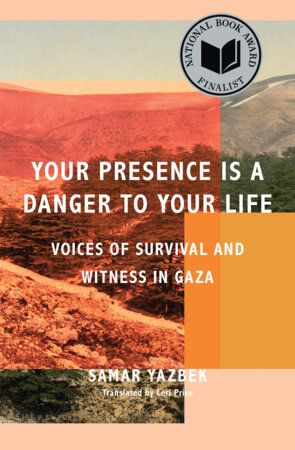
Your Presence Is a Danger to Your Life

Voices of Survival and Witness in Gaza

Translated by Leri Price
Finalist for the National Book Award for Translated Literature

An acclaimed Syrian journalist crafts a vital portrait of October 7, 2023, and its aftermath through the harrowing yet life-affirming accounts of 26 Palestinians.


Throughout 2024, Samar Yazbek met with hundreds of survivors from Gaza, asking each of them about their experience of October 7, 2023, and what their life has been like since that pivotal date. In Your Presence Is a Danger to Your Life—a title adapted from one of the flyers dropped on the residents of Gaza minutes before a bombing—Yazbek captures the raw, chilling accounts of ordinary civilians aged 13 to 65, who have witnessed what history may remember as one of the most savage military offensives of our time.

Their stories reveal a nightmarish dystopia, where each survivor has endured unimaginable loss—homes shattered, loved ones vanished, limbs obliterated—and many have been treated in hospitals ravaged by Israeli attacks. But these survivors remain determined to share their experiences, and cling to the hope that their voices will resonate.

More than a record of horrors for posterity, this breathtaking collection testifies to the power of education and writing, which remind us of our common humanity.
PREFACE

More than a year has passed since I finished this book, and although the world is discussing the ceasefire, it is far from being a reality while Israel is still bombing hospitals and their surroundings, even now. This has not been discussed much in the media. In point of fact the ceasefire has been violated several times by Israel, and Gazan victims number in the hundreds. The truth is there is no ceasefire to speak of.
Perhaps I can say that, in the time since compiling this book of testimonies, famine has been wielded as a weapon, claiming a large number of victims. The massacre did not stop with the events testified to in these pages; rather, they were followed by a new art form of murder. Along with murder by artificial intelligence Israel has instigated the weapon of starvation against the people of Gaza.
According to a statement issued by the Ministry of Health in Gaza on October 1, 2025, the confirmed number of deaths in the Strip through starvation and malnutrition has risen to 455, including 151 children. I did not record this new method of genocide against the Gazans in the testimonies; when the process of starving Gazans and using famine as a weapon of war began, I said to myself that perhaps it was a reverberation from other wars around the globe. But after following what is happening on the ground in Gaza daily and attentively, I have found that Israel used starvation and death from starvation as another form of systematic genocide. The pictures arriving in succession through the media and news agencies were appalling, and I would wonder to myself to what depths the moral shame of the human race will descend, when we stand thus, arms crossed, in front of children who are dying from hunger. Their figures were like moving skeletons, slowly dying every day in front of our eyes and the eyes of the entire world.
On October 23, 2025, the World Health Organization announced that “the situation in Gaza still remains catastrophic because what’s entering [Gaza] is not enough.” The organization has not recorded any improvement in hunger levels among Gazans, confirming that the nutritional and health situation has not changed despite the ceasefire, which of course has subsequently been violated by Israel.
The painful truth that persists in the details and grief of the people of Gaza is that forms of brutality have been diversifying and increasing, and the horrifying testimonies I gathered were only the beginning of a systematic process of murder. I was struck by something like numb shock when I realized that even the mechanism of destroying the hospitals was systematic. The wounded were murdered slowly, in the sense that the hospitals continued to be targeted with the aim of killing the greatest possible number of survivors, and after the ceasefire, hospitals such as al-Shifa were retargeted. We are confronted with the word “survivor” taking on new and paradoxical dimensions: whoever survived a bomb or missile cannot really be called a “survivor” because they remain in imminent danger. Wounded patients in the hospitals become perpetual targets of the Israeli killing machine.In truth, after all this time, I was hopeful that there would be a reduction in the killing and suffering of Gazans, a building of bridges of peace in the region, but another year has passed and still we are falling into the abyss. Perhaps there is a more important question for me as I continue my project of constructing humanity’s collective memory, and which relies on the theory that “the personal is political”: Was I right to record these testimonies?
Perhaps, to my crushing disappointment, for all these lives I collected, believing I would defend victims who resisted death and lost pieces of their bodies and lives—perhaps I have done nothing but add a black stain to human history. A stain of words . . . the words of the people of Gaza.
“[Yazbek] is widely regarded as one of the most important voices documenting conflict in the Middle East today. Her latest work…is a vital, harrowing document…a human portrait of one of the most devastating military offensives in recent history.” —The Mirror, 6 Unmissable Books Coming Out This Month

“Yazbek documents humanity at both its most broken and most resilient…This is not an easy book to read, but it is an essential one.” —Buzz Magazine

“These testimonies from Palestinians living in Gaza are important reading; the cumulative effect of encountering them in one place is also utterly devastating.” —Words Without Borders

“Since the start of Israel’s genocide against Palestinians, I have been grasping for words. Yazbek has done something extraordinary. She has captured the vocabulary we have all been searching for by turning to the people who witnessed this violence firsthand in Gaza. The book does not make heroes of genocide survivors, nor does it romanticize their struggle. Instead, we are invited to mourn with them, to marvel at their endurance, and to be sobered by humanity’s capacity for barbarism. Yazbek shows us what it means to bear witness, to make space for grief, pain, and suffering too vast to be contained, and how to do so with dignity, respect, and humility. She has once again modeled what it means to be a keeper of humanity’s memory.” —Tareq Baconi, author of Fire in Every Direction

“A work of profound ethical significance, a direct offering of words from voices that should never be silenced. Your Presence Is a Danger to Your Life is almost too painful to read, but so deeply humane and important that it compels us not to look away.” —Preti Taneja, author of Aftermath

“This is a remarkable, shattering book that holds its voices with dignity and care. It speaks to us from a red world of absolute loss, yet is suffused with an extraordinary persistence of love. Beyond geopolitics, rhetoric, territory, and leaders, there remains the bare fact of broken lives and the unbearable weight of human love.” —A. L. Kennedy, author of Alive in the Merciful Country

“These testimonies of the unconscionably injured are among hundreds of thousands such testimonies emerging from Gaza since October 7, 2023. Despite Israel’s genocidal drive to silence Palestinian voices, despite Western complicity in this silencing, these twenty-six testimonies—shared with Yazbek and translated by Price—now exist as pages. If, like me, you have the means and the capacity to read them in all their blistering detail, and if you too have no personal knowledge of the unspeakable zannanat that plague these pages, then you—we—have a particular duty: not only to read these precious words, but to act on them.” —Natasha Soobramanien, coauthor (with Luke Williams) of Diego Garcia
© Astrid di Crollalanza
Samar Yazbek is a Syrian writer and journalist who has been a prominent advocate for human rights, and more specifically women’s rights, in Syria. In 2010, Yazbek was selected as one of the “39 most promising authors under the age of 40” by Beirut39, organized by the Hay Festival. In 2011, she took part in the popular uprising against the Assad regime and was forced into exile soon after. In 2012 she was awarded the PEN/Pinter Prize “International writer of courage” for her book In the Crossfire, and received the Swedish Tucholsky Prize and the Dutch Oxfam/PEN Prize the following year. In 2022 Yazbek was appointed by the Royal Society of Literature as one of twelve International Writers. Yazbek has published two short-story collections, seven novels, and four nonfiction literary narratives. Her work has been translated into more than twenty languages. View titles by Samar Yazbek

About

Finalist for the National Book Award for Translated Literature

An acclaimed Syrian journalist crafts a vital portrait of October 7, 2023, and its aftermath through the harrowing yet life-affirming accounts of 26 Palestinians.


Throughout 2024, Samar Yazbek met with hundreds of survivors from Gaza, asking each of them about their experience of October 7, 2023, and what their life has been like since that pivotal date. In Your Presence Is a Danger to Your Life—a title adapted from one of the flyers dropped on the residents of Gaza minutes before a bombing—Yazbek captures the raw, chilling accounts of ordinary civilians aged 13 to 65, who have witnessed what history may remember as one of the most savage military offensives of our time.

Their stories reveal a nightmarish dystopia, where each survivor has endured unimaginable loss—homes shattered, loved ones vanished, limbs obliterated—and many have been treated in hospitals ravaged by Israeli attacks. But these survivors remain determined to share their experiences, and cling to the hope that their voices will resonate.

More than a record of horrors for posterity, this breathtaking collection testifies to the power of education and writing, which remind us of our common humanity.

Excerpt

PREFACE

More than a year has passed since I finished this book, and although the world is discussing the ceasefire, it is far from being a reality while Israel is still bombing hospitals and their surroundings, even now. This has not been discussed much in the media. In point of fact the ceasefire has been violated several times by Israel, and Gazan victims number in the hundreds. The truth is there is no ceasefire to speak of.
Perhaps I can say that, in the time since compiling this book of testimonies, famine has been wielded as a weapon, claiming a large number of victims. The massacre did not stop with the events testified to in these pages; rather, they were followed by a new art form of murder. Along with murder by artificial intelligence Israel has instigated the weapon of starvation against the people of Gaza.
According to a statement issued by the Ministry of Health in Gaza on October 1, 2025, the confirmed number of deaths in the Strip through starvation and malnutrition has risen to 455, including 151 children. I did not record this new method of genocide against the Gazans in the testimonies; when the process of starving Gazans and using famine as a weapon of war began, I said to myself that perhaps it was a reverberation from other wars around the globe. But after following what is happening on the ground in Gaza daily and attentively, I have found that Israel used starvation and death from starvation as another form of systematic genocide. The pictures arriving in succession through the media and news agencies were appalling, and I would wonder to myself to what depths the moral shame of the human race will descend, when we stand thus, arms crossed, in front of children who are dying from hunger. Their figures were like moving skeletons, slowly dying every day in front of our eyes and the eyes of the entire world.
On October 23, 2025, the World Health Organization announced that “the situation in Gaza still remains catastrophic because what’s entering [Gaza] is not enough.” The organization has not recorded any improvement in hunger levels among Gazans, confirming that the nutritional and health situation has not changed despite the ceasefire, which of course has subsequently been violated by Israel.
The painful truth that persists in the details and grief of the people of Gaza is that forms of brutality have been diversifying and increasing, and the horrifying testimonies I gathered were only the beginning of a systematic process of murder. I was struck by something like numb shock when I realized that even the mechanism of destroying the hospitals was systematic. The wounded were murdered slowly, in the sense that the hospitals continued to be targeted with the aim of killing the greatest possible number of survivors, and after the ceasefire, hospitals such as al-Shifa were retargeted. We are confronted with the word “survivor” taking on new and paradoxical dimensions: whoever survived a bomb or missile cannot really be called a “survivor” because they remain in imminent danger. Wounded patients in the hospitals become perpetual targets of the Israeli killing machine.In truth, after all this time, I was hopeful that there would be a reduction in the killing and suffering of Gazans, a building of bridges of peace in the region, but another year has passed and still we are falling into the abyss. Perhaps there is a more important question for me as I continue my project of constructing humanity’s collective memory, and which relies on the theory that “the personal is political”: Was I right to record these testimonies?
Perhaps, to my crushing disappointment, for all these lives I collected, believing I would defend victims who resisted death and lost pieces of their bodies and lives—perhaps I have done nothing but add a black stain to human history. A stain of words . . . the words of the people of Gaza.

Reviews

“[Yazbek] is widely regarded as one of the most important voices documenting conflict in the Middle East today. Her latest work…is a vital, harrowing document…a human portrait of one of the most devastating military offensives in recent history.” —The Mirror, 6 Unmissable Books Coming Out This Month

“Yazbek documents humanity at both its most broken and most resilient…This is not an easy book to read, but it is an essential one.” —Buzz Magazine

“These testimonies from Palestinians living in Gaza are important reading; the cumulative effect of encountering them in one place is also utterly devastating.” —Words Without Borders

“Since the start of Israel’s genocide against Palestinians, I have been grasping for words. Yazbek has done something extraordinary. She has captured the vocabulary we have all been searching for by turning to the people who witnessed this violence firsthand in Gaza. The book does not make heroes of genocide survivors, nor does it romanticize their struggle. Instead, we are invited to mourn with them, to marvel at their endurance, and to be sobered by humanity’s capacity for barbarism. Yazbek shows us what it means to bear witness, to make space for grief, pain, and suffering too vast to be contained, and how to do so with dignity, respect, and humility. She has once again modeled what it means to be a keeper of humanity’s memory.” —Tareq Baconi, author of Fire in Every Direction

“A work of profound ethical significance, a direct offering of words from voices that should never be silenced. Your Presence Is a Danger to Your Life is almost too painful to read, but so deeply humane and important that it compels us not to look away.” —Preti Taneja, author of Aftermath

“This is a remarkable, shattering book that holds its voices with dignity and care. It speaks to us from a red world of absolute loss, yet is suffused with an extraordinary persistence of love. Beyond geopolitics, rhetoric, territory, and leaders, there remains the bare fact of broken lives and the unbearable weight of human love.” —A. L. Kennedy, author of Alive in the Merciful Country

“These testimonies of the unconscionably injured are among hundreds of thousands such testimonies emerging from Gaza since October 7, 2023. Despite Israel’s genocidal drive to silence Palestinian voices, despite Western complicity in this silencing, these twenty-six testimonies—shared with Yazbek and translated by Price—now exist as pages. If, like me, you have the means and the capacity to read them in all their blistering detail, and if you too have no personal knowledge of the unspeakable zannanat that plague these pages, then you—we—have a particular duty: not only to read these precious words, but to act on them.” —Natasha Soobramanien, coauthor (with Luke Williams) of Diego Garcia

Author

© Astrid di Crollalanza
Samar Yazbek is a Syrian writer and journalist who has been a prominent advocate for human rights, and more specifically women’s rights, in Syria. In 2010, Yazbek was selected as one of the “39 most promising authors under the age of 40” by Beirut39, organized by the Hay Festival. In 2011, she took part in the popular uprising against the Assad regime and was forced into exile soon after. In 2012 she was awarded the PEN/Pinter Prize “International writer of courage” for her book In the Crossfire, and received the Swedish Tucholsky Prize and the Dutch Oxfam/PEN Prize the following year. In 2022 Yazbek was appointed by the Royal Society of Literature as one of twelve International Writers. Yazbek has published two short-story collections, seven novels, and four nonfiction literary narratives. Her work has been translated into more than twenty languages. View titles by Samar Yazbek
  • More Websites from
    Penguin Random House
  • Common Reads
  • Library Marketing