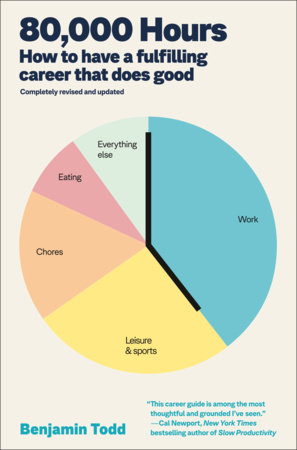
IntroductionYou have about 80,000 hours in your career: 40 hours a week, 50 weeks a year, for 40 years. This means your choice of career is the most important decision you’ll ever make.
It accounts for roughly one-third of your waking life as an adult—more time than you’ll spend eating, socializing and watching Netflix put together. It’s long enough to walk around the Earth ten times. Choose well, and you can have a more rewarding, interesting life, and also help solve some of the world’s most pressing problems. Choose poorly, and you could waste decades.
So what should you do?
At twenty-one, I didn’t know what to do with my life. I knew I wanted to find something that I’d enjoy, that would pay the bills and make a worthwhile contribution to society—but what?
Like millions of others, I’d heard the advice to ‘follow your passion.’ But it felt shallow. I was passionate about philosophy and martial arts. So maybe I should have become a warrior monk? But I’m glad I didn’t.
I’d been a nerdy kid, obsessed with investing to the point that my parents had let me manage their pension. At university I entered a stock-picking competition and landed a job in investment management. This would certainly have paid the bills, but I was worried it would feel meaningless and so in the end be unfulfilling.
I studied physics and philosophy at Oxford, and after a summer research project in climate physics, I considered following my father into academia. But I wasn’t sure about facing years of lowly paid postdocs, fierce competition and no guarantee of making useful discoveries.
I wasn’t even sure how to go about making the decision. I searched around and spoke to careers advisors, but nowhere had the information I needed. Most career advice didn’t seem to be based on any research. And the advice I
could find was about how to land different jobs rather than which were worth pursuing in the first place.
Many friends, not knowing what else to do, ended up in law or consulting. These were supposed to be the safe, prestigious paths. But many ended up putting in seventy-hour weeks doing work that felt pointless.
When it came to making a difference the default options were things like medicine, social work, teaching, or (most thrillingly) working in corporate social responsibility, none of which seemed like a great fit for me anyway.
Then I started to realize the decision mattered even more than I’d thought. In my second year at university, sitting, sandwich in hand, on the floor at a lunchtime seminar, the Oxford ethicist Toby Ord walked us through the results of hundreds of studies comparing the cost of saving lives in different countries.
The numbers were staggering. It turned out that even the most expensive treatments in low-income countries were cheaper than many everyday interventions in places like the UK. But even more importantly, the cheapest and most effective interventions, like childhood vaccinations, could save lives hundreds of times more cheaply again.
No one had ever told me about these differences, and later it became obvious why. When you poll people about how much more effective they think the best charities are at saving lives compared to the average, they guess they’re about 50% better. A noticeable difference, but not huge. Poll experts in global health, however, and they’ll say the best are around 100 times more cost-effective, a difference of 10,000%. In other words, there are huge differences in the impact of different ways of helping people, but no one knows about them.
This had enormous implications for my career. It suggested that ten years spent working at one of the most effective organizations in an area could achieve what would have taken 1,000 years working at a typical one. I could spend the remaining thirty years of my career meditating on the beach and still have done far more good for the world.
But this data raised even more questions. What if, instead of working at one of these organizations, I went into finance and donated to them instead? If I could give twice what my salary would have been, they could hire two people, maybe doubling my impact.
Then I remembered a job fair I’d attended as a teenager where I’d spoken to a couple of civil servants about working in government. If the UK’s aid budget is over £10bn a year, perhaps helping to get it spent a little more efficiently could do even more good again?
Through Toby I met Will MacAskill, then a PhD student in philosophy. He was asking the same questions, so we started researching them together. In 2011, we presented some of our ideas in a lecture. To our surprise, five of the thirty or so people in the audience decided to totally change what they were planning to do with their lives. Several of them asked us to start an organization exploring these issues. So we founded 80,000 Hours.
The name was chosen to represent the length of a typical career. If you could use those hours just 1% better, it would be worth spending up to 800 hours figuring out how to do that—twenty weeks of full-time work. (Fortunately this book will be a lot shorter.)
Our aim was to create the advice we wish we’d had: in-depth, clearly explained, and based on the best research available; rather than our own (highly limited) life experience. Since you can find a study to ‘prove’ almost anything, we tried to focus on meta-analyses and expert consensus in the most relevant fields.
We raised donations so we could provide everything for free, initially working in a basement at the back of an estate agent’s. After graduating I started working at the organisation full-time. Instead of choosing a career, my career would become researching which careers to choose.
We wanted to tackle not only the question of which careers were most impactful, but also what research had to say about classic career questions like how to find your fit, how to compare your options and which skills are most valuable. The hope was to create a complete, research-backed guide to finding a fulfilling career that does good.
Within months, we were invited to speak on the BBC and the website started to grow. In 2015, we were one of the first non-profits to go through Y Combinator, the world’s leading startup accelerator. As more people changed their careers, we were able to raise more donations and grow further. Today we have over fifty staff providing online research, a podcast with expert interviews, a job board and free one-on-one consultations.
To date over 10 million people have read our advice and over 3,000 of them have told us they’ve changed their career path as a result. In the coming chapters we’ll meet some of them, including Elena, who ended up at the White House aged twenty-one getting tens of millions invested in masks for the next pandemic; Neel, who helped start a new field of research dedicated to understanding how AI systems work on the inside; and Tom, founder of the world’s first charity focused on fish welfare in India and China. (I’ll explain.)
While it was research in global health that convinced us careers differ in impact more than people think, we eventually wondered if there might be even bigger and more urgent issues out there. Over the years we’ve looked at dozens of pressing problems, from climate change to mental health to even risks from nanotechnology. We found some problems had stakes hundreds of times larger than others, but received hundreds of times less attention. This suggested that your choice of which problem to focus on could matter even more than how exactly you try to tackle it—but no one had ever encouraged us to think hard about this question.
By 2015, we’d started to wonder if the most crucial issues of our time might involve AI. In 2016, an AI model created by DeepMind beat one of the world’s top players at Go, a Chinese board game known for needing strategic intuition. Driven by a new approach to AI called ‘deep learning’, the victory came sooner than many expected, and progress showed no signs of slowing. Today when I speak to people about their careers, one of the most common questions is ‘will I lose my job to AI?’ And while it may be hard to get a great answer from your school’s guidance counsellor, there’s plenty of evidence from economic history to provide clues about how auto-mation might affect your employment prospects.
But more crucially, if the current rate of progress in AI continues, we’re on course to eventually create systems that are smarter and more generally capable than humans at most economically relevant tasks. This could usher in a new age of abundance, or pose risks much worse than mass unemployment. Despite the hype around AI, however, many of these risks remain extremely neglected. Some have even joked that we should rename the organization ‘20,000 hours’ because the next ten years could be so consequential.
Copyright © 2026 by Benjamin Todd. All rights reserved. No part of this excerpt may be reproduced or reprinted without permission in writing from the publisher.